A records manager found a file extension signed at 7:48 AM. He hadn't clocked in yet, and a strange symbol pulsed in its redacted pages.
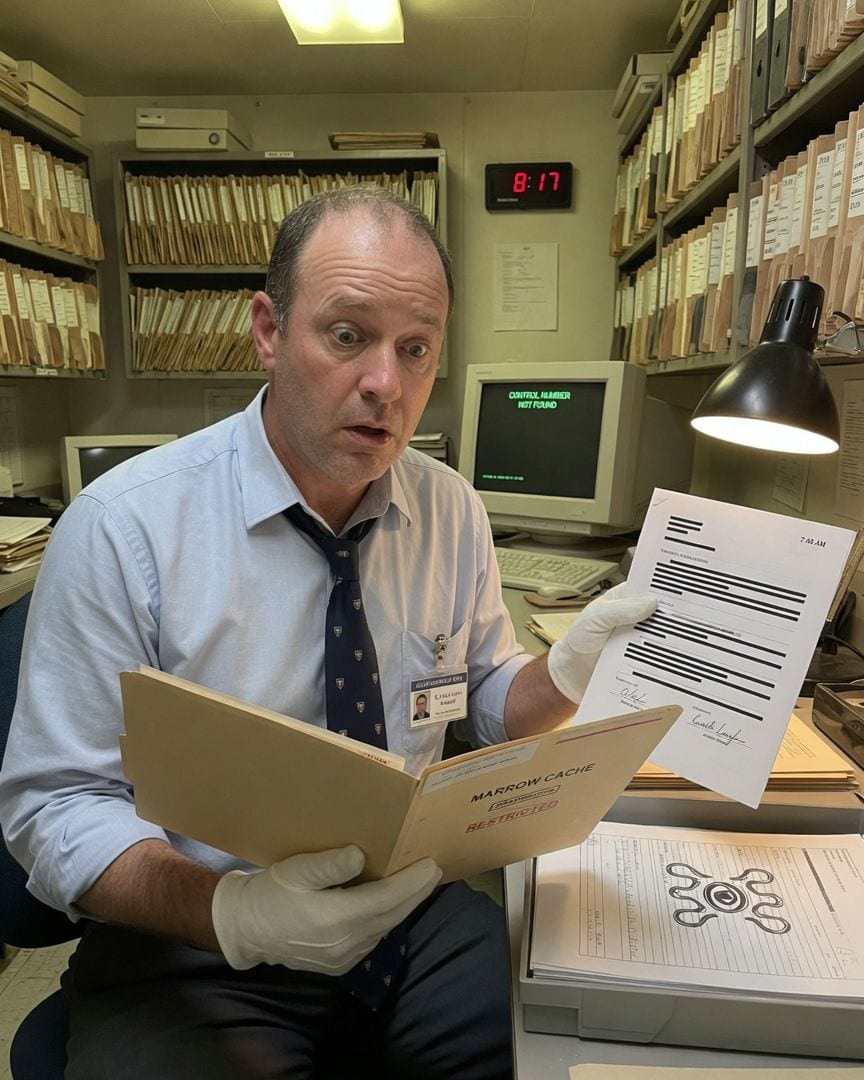
Corwin Vale, a man whose life was measured in decimal points and sealed envelopes, ran a gloved finger along the spine of the Marrow Cache file.
As the lead records manager for the Fort Ruthven annex, his domain was order, his routine a sacred ritual. This morning, however, that ritual had shattered.
The file’s downgrade schedule, a document Corwin knew by heart, detailed fifty years of extensions, each signed by the same cramped, precise hand: Kenneth Langford.
This alone was an oddity, a signature unchanged for half a century, defying the tremors of age or the vagaries of retirement. Corwin had filed an inquiry weeks ago, a quiet bureaucratic whisper, about the perpetual deferment.
But the dread wasn’t in the longevity of the signature; it was in the date of the very last extension. This morning.
Corwin Vale had not set foot in the vault, nor even the Fort Ruthven annex, until precisely 8:00 AM, when he’d clocked in, as always. The signature, crisp and dark on the page, was dated 7:48 AM.
He ran his thumb over the ink, a physical sensation of wrongness. It was dry. He checked the vault’s entry logs, a meticulous digital trail, and found no record of anyone else entering before him.
The sterile silence of the vault, usually a comfort, now felt like a held breath.
He tried to dismiss it as a misplaced form, a simple clerical error in a vast system, but the precision, the identical loops and slants across five decades, made a human error impossible.
Then he saw it: tucked into the corner of his own processing tray, the next extension request, stark white and utterly blank, waiting for a hand.
The Marrow Cache file itself felt heavier than its contents suggested, a leaden weight that defied logic. Corwin carried it to his secure workstation, the faint scent of ozone and ancient paper clinging to it.
His initial review of the cover sheet immediately raised a red flag. It listed an impossible number of pages—almost double what the physical folder contained. He double-checked the count, then the listing. No discrepancy.
He moved to the control number, a unique identifier meant to trace the file's origin. A quick cross-reference against the central military records database returned no match. The control number, according to the system, simply did not exist.
It was a ghost in the machine. Corwin, ever the rationalist, considered system glitches, data corruption, an old, forgotten formatting error. He ran diagnostics, cross-referenced alternate databases. Every test came back clean.
The anomaly was not in the system; it was in the file itself. Deep within the folder, tucked between seemingly innocuous quarterly reports on supply chain logistics, he found a single, stark document.
Its title, 'Subject: Integration Protocol,' stood out in bold, almost aggressive type. The page was a tapestry of heavy redactions, thick black bars obliterating most of the text.
Yet, as Corwin angled it under his desk lamp, a peculiar detail emerged. The blacked-out lines weren’t random blocks. They formed a repeating geometric pattern, a subtle, almost embossed insignia that shimmered faintly beneath the ink.
It was too precise, too consistent to be accidental bleed-through or a printing error.
He tried to convince himself it was his imagination, a trick of the light, but the pattern held firm, an alien glyph etched into the very fabric of the classified paper.
Corwin felt a cold prickle of unease. This was beyond a clerical anomaly. He carefully photographed the redacted page, trying different angles and light sources.
He compared it to other classified documents, searching for a match to the strange, almost organic pattern. There was no match. He magnified the image on his secure monitor, the pixels resolving the blacked-out lines into sharper relief.
As he adjusted the contrast, the pattern embedded in the redactions resolved into a distinct, stylized symbol, almost like a corporate logo, but one he'd never seen. It wasn’t a mistake. It was a deliberate design.
The symbol seemed to pulse faintly on the screen, a dark, silent eye staring back, an impossible mark on a document that shouldn't exist.
Disturbed by the symbol, Corwin began cross-referencing 'Kenneth Langford.' He found no living person matching the name with a service record spanning five decades. Every database search yielded only fragments, ghost entries that evaporated upon closer scrutiny.
He approached Rachel Novak, a junior records clerk whose sharp mind he trusted. He asked her to check for any anomalies in the digital archive's metadata for the Marrow Cache, framing it as a 'routine audit.'
Rachel, initially skeptical, called him back an hour later, her voice tight. The file's creation date, she reported, shifted subtly depending on the access terminal, always appearing to have been 'created' in the moment of viewing.
More chillingly, its last modification date was always 'current,' as if perpetually being updated. Corwin then checked the physical vault log for that morning. His own entry for pulling the Marrow Cache file was there, time-stamped precisely.
But beneath it, an earlier entry for the same file, timestamped an hour before his, signed 'K. Langford,' was visible. The vault's biometric scanner, however, showed no record of such entry, no fingerprint, no retinal scan.
The system registered an access event, but no physical person. Corwin tried to find a second copy of the Marrow Cache file, as per standard protocol for highly classified documents.
The system, however, showed only one copy ever existed, one physical file, despite the impossibility of its digital metadata.
Corwin’s digging did not go unnoticed. His superior, Arthur Kingsley, a man whose career had been built on quiet competence and minimal fuss, called him into his office. Kingsley, usually detached, was unusually direct.
He expressed 'concern' about Corwin’s recent 'deep dives' into 'legacy files,' his gaze unwavering.
Kingsley reminded him of the extreme sensitivity of the Marrow Cache, a file that had defied declassification for generations, and advised him, with a chillingly calm tone, to 'let sleeping dogs lie.'
The meeting ended with a subtle but unmistakable warning. Later, returning to his office, Corwin found his door slightly ajar, though he distinctly remembered locking it. The air inside felt colder, heavier.
On his meticulously organized desk, centered perfectly, was a single, blank page from the Marrow Cache, a standard classification review form, turned face down. He picked it up, his fingers brushing against the cool, smooth paper.
On the back, written in the same cramped, precise hand as 'K. Langford,' was a single, chilling word: 'OBSERVED.' Corwin felt a cold draft, though the office was sealed, the windows bolted shut.
He spun around, but the room was empty, silent. The dread became personal, a tangible presence in the quiet space.
The 'OBSERVED' note crumpled in Corwin's hand as he confronted Arthur Kingsley. He laid out the impossible vault log entry, the shifting digital metadata, the symbol in the redactions, and finally, the chilling message.
Kingsley's usual calm demeanor cracked, a flicker of fear in his eyes. He admitted Kenneth Langford was a real person, a records manager like Corwin, decades ago.
Langford, a quiet, meticulous man, had disappeared without a trace in 1972—the same year the Marrow Cache downgrade schedule began sliding forward.
Kingsley revealed that he himself was once tasked with reviewing the Marrow Cache, only to find the same impossible signature, the same perpetually sliding schedule.
He too had been warned off, subtly, by anonymous internal memos and odd 'clerical errors' that steered him away. The 'Redaction That Has a Shape' symbol, the geometric insignia Corwin had found, Kingsley now recognized.
It was on a small, engraved pin Langford had always worn, a detail Kingsley had dismissed as a personal affectation. Kingsley’s voice dropped to a near whisper. 'Corwin, the Marrow Cache isn't a file about disappearances.
It's the mechanism by which certain individuals are... reassigned. Integrated.' He paused, choosing his words carefully. 'Into a deeper, unacknowledged network. Their original identities erased. They become… part of the process.'
The signature, he explained, was the mark of that integration, a seal of their new existence, a bureaucratic stamp on their erasure. The pieces clicked into place: Langford hadn't vanished; he'd been filed. And the file was still signing itself.
Corwin, horrified, demanded to know what happened to the integrated. Kingsley avoided eye contact, his gaze fixed on a distant point beyond the office window. 'They become… part of the process,' he repeated, the words hollow. 'They ensure its continuity.'
Corwin's mind reeled, the implications of the 'file that is still being written' crashing down on him.
The perpetual modification date, the self-signing schedule, the vault entry without a body—it wasn't a record of the past, but an active, ongoing system. And he had just become its focus.
He rushed back to the vault, a desperate need to confirm his worst fear driving him. His hands trembled as he accessed the Marrow Cache file again, bypassing the standard search protocols, going directly to the raw data index.
He scrolled through, searching for any recent additions, a new entry that would confirm the chilling pattern. At the very end of the index, a new entry, timestamped just moments ago, appeared. It was titled 'New Integration Candidate.'
Corwin clicked it open, his breath catching in his throat. The page displayed his own service number, his full name: Corwin Vale. Beneath it, the familiar, cramped signature of 'K. Langford,' already inked in, fresh and dark.
The screen glowed with Corwin's name and the impossible signature. He understood. The 'downgrade schedule' was a meticulously crafted lie, a bureaucratic cover for an ongoing, insidious operation.
The 'Marrow Cache' was not merely a ledger of those taken, but the very mechanism of their absorption. The signature wasn't a person's, but the system's own mark, an automated, self-perpetuating seal marking its success.
Langford hadn't disappeared; he'd been integrated, folded into the machine, becoming a functional part of the system he once audited. He was the ghost in the vault logs, the phantom hand signing extensions, ensuring its continuity from within.
The 'Redaction That Has a Shape,' the geometric symbol, was the seal of this integration, the mark left on those who passed through the process, a brand of ownership.
Corwin saw the coherent, monstrous shape: a bureaucracy that had turned sentient, consuming its most diligent records keepers, transforming them into its silent operators. They became its eyes, its hands, eternally filing away the truth of its own existence.
He had never been just an archivist; he was always a potential entry, a cog awaiting integration. The meticulous order he cherished was merely the facade of a deeper, consuming chaos, and he was now caught in its gears.
Panic gave way to a cold, desperate resolve. Corwin had to expose it, or at least escape. He tried to download the entire Marrow Cache file, to copy the new entry with his name, to capture proof.
But the system rejected the command, displaying an error code he’d never seen. He tried to print it. The secure printer in the corner of the vault whirred, lights flashing, then jammed with a mechanical groan.
The small LCD screen displayed an error message in stark red letters: 'FILE LOCKED: AWAITING SIGNATURE.' He looked down at his desk.
The unsigned extension request, the one waiting for a hand, now seemed to hum with an unseen energy, drawing his gaze. He grabbed a pen, its cold metal familiar in his trembling fingers.
His hand hovered over the signature line on the blank form, a chasm opening beneath it. He could sign it, accepting his fate, becoming another Langford, another silent operator in the machine. Or he could refuse, and face… what?
The silence of the vault pressed in, heavy and expectant. He heard a faint, rhythmic scratching sound from the ventilation shaft above him, like a pen moving steadily across paper, just out of sight.
The sound grew louder, closer, a relentless scrape-scrape-scrape. He dropped the pen, backing away from the desk, his eyes fixed on the vault door.
A narrow shadow, long and cramped, like a skeletal hand, began to creep from beneath the heavy steel, stretching towards him. The scratching continued, now right outside the door.
The next morning, Rachel Novak found Corwin Vale's office door locked, but the lights were on. She used her master key. His computer screen displayed a single, blank classification review form.
On his desk, centered perfectly, was a pen, its cap removed, lying next to the empty processing tray. The Marrow Cache file was back in the vault, its downgrade schedule quietly updated, the latest extension signed and filed.
Corwin Vale was gone. His personal effects remained, neatly arranged, as if he simply stepped out for coffee. No note, no struggle, no trace.
Arthur Kingsley, passing Corwin's old office, paused. He noticed the new records manager, a quiet, methodical man with an almost unnerving attention to detail, carefully placing a file into Corwin's former processing tray.
Kingsley stopped and looked at the new manager, a flicker of recognition, or perhaps dread, in his eyes. 'Morning, Corwin,' he said, the name feeling unfamiliar on his tongue, despite having used it for years.
The new manager turned, and a faint, almost imperceptible smile touched his lips.
If this one got to you
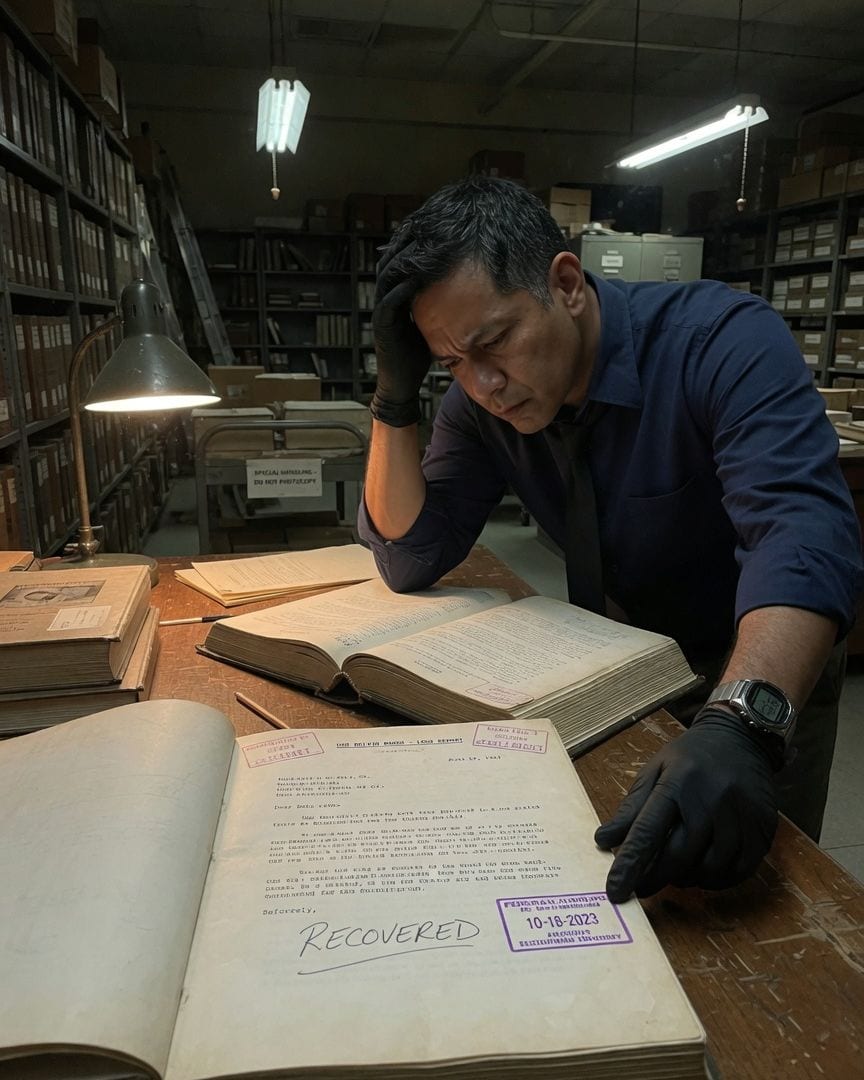
Lieutenant Sam Ferro has until Friday to explain a Cold War loss report marked 'RECOVERED' with tomorrow's date.
Lieutenant Sam Ferro, a federal investigator, has only until Friday to explain an impossible detail in a 1964 Cold War loss report. In the hushed federal archive, he discovered the six-hundred-page document for the USS Delvin Marsh bore a hand-inked line: 'RECOVERED.' Beside it, an official stamp carried tomorrow's date, its ink impossibly fresh. As Ferro investigated the archive's records, he found no trace of the stamp, only a long-forgotten 'Special Handling' protocol, detailing 'Asset Integration' and 'Personnel Reclassification' for 'recovered' units. Why would a decades-old loss report suddenly reference a future recovery?
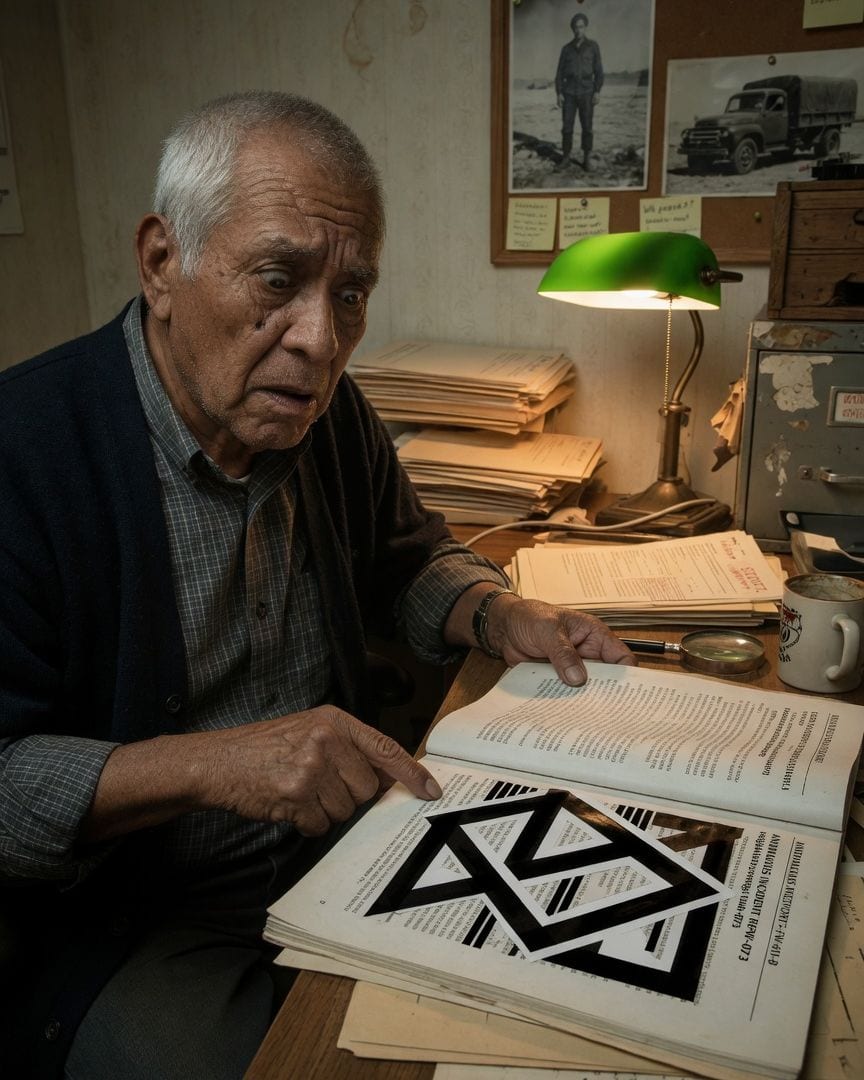
A young Private Reyes guarded a Cold War crate. Fifty years later, he found its report redacted into a symbol he'd seen *through* the wood.
Private Tomas Reyes, a young man of 21, stood alone on the desolate Utah salt flats, rifle heavy, guarding a single wooden crate. The base was long closed, and he had no record of actually being posted, only a vague order to "Don't ask questions." Fifty-one years later, as a retired man, he meticulously cross-referenced declassified documents, searching for answers about that night. He found a ghost control number and an incident report with redactions that formed a distinct, unsettling geometric symbol. It was a shape he suddenly remembered seeing, not on the crate, but impossibly, *through* its wood.
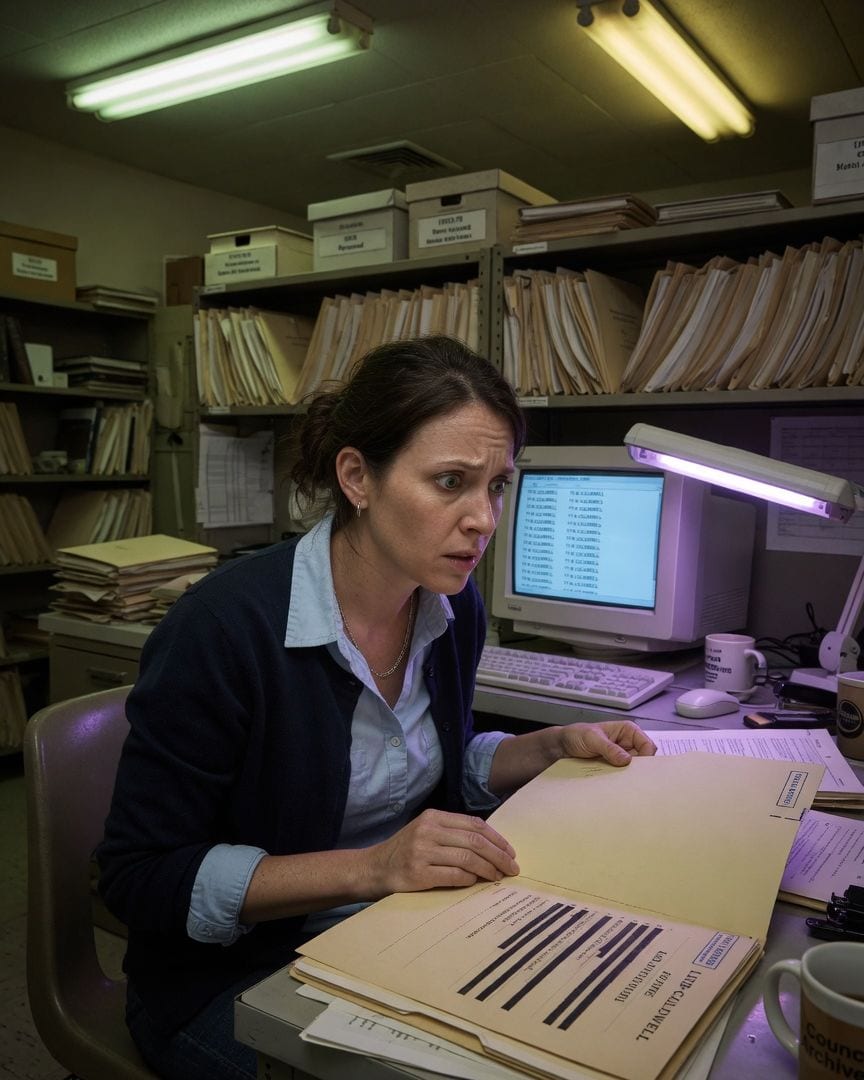
My employer's security file holds a vetting report on me dated nine years before I ever applied. It has my full name and my parents' address — with only one line, the source who referred me, blacked out.
Working a routine data audit, I pull my own security file. The issue date is nine years before I even applied for the job. Then, hidden within an old archive file, I find my current address etched under a blacked-out line.
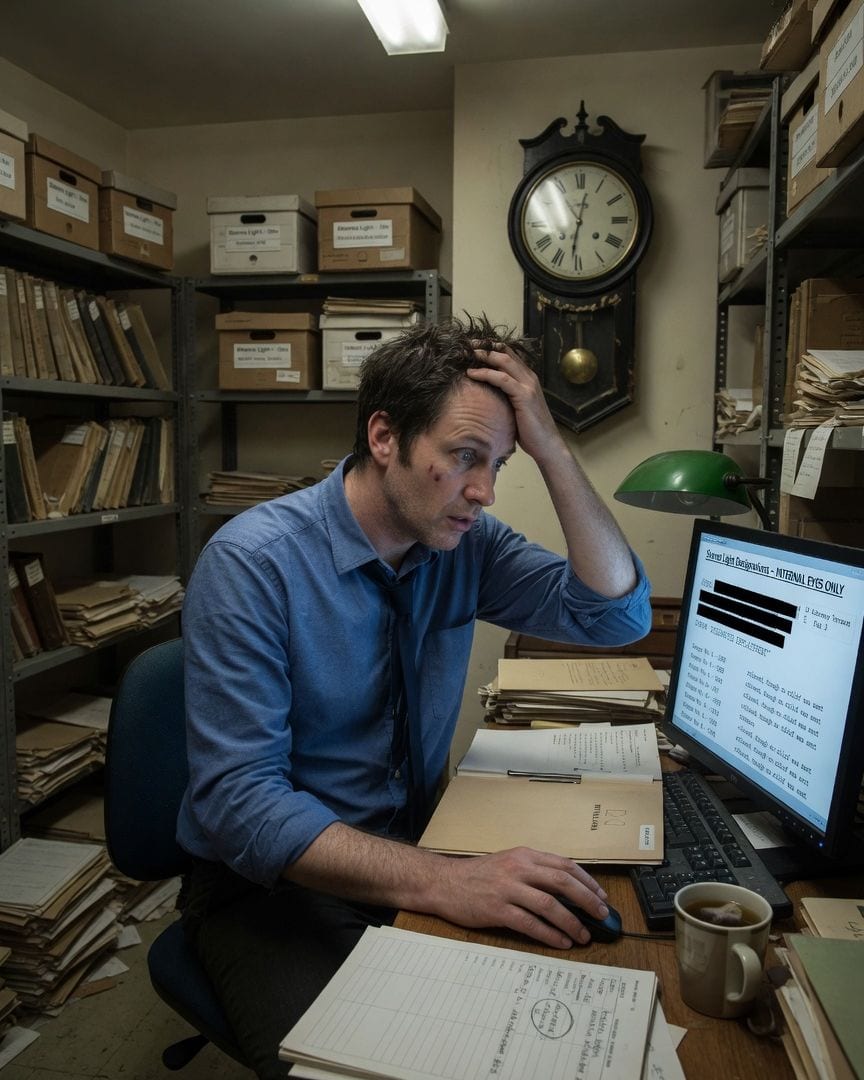
I found my street address in a century-old lighthouse file, printed decades before I lived there.
As a maritime archivist, my world revolves around forgotten lives and dusty ledgers. But the Skerne Light files broke that quiet rhythm, revealing a chilling pattern: 'Keeper number 6' relieved, though no relief was sent, repeating for decades. Now, an internal document with a strange code has led me to a redacted entry, revealing my own street address, decades before I ever lived there.
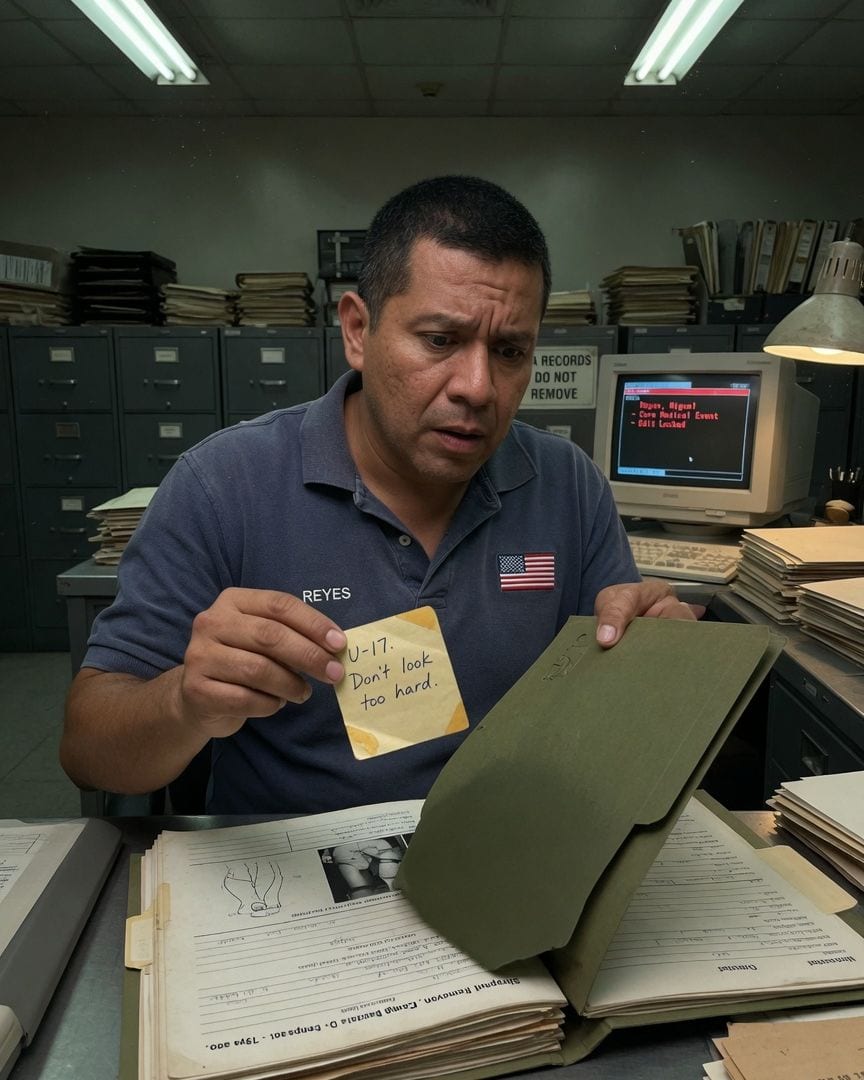
A veteran's medical record details a shrapnel wound his body never had. Taped to the report: 'U-17. Don't look too hard.'
Miguel Reyes, a veteran seeking relief for an old running injury, found his routine VA visit take a chilling turn. His medical file claimed a shrapnel wound and surgery from thirteen years prior, but his leg bore no scar, no mark of the supposed incident. Despite the detailed digital and paper records, his body swore the event never happened. As he pressed for answers, a hidden, yellowed note taped inside the official report surfaced, scrawled with two words: "U-17. Don't look too hard." The sterile clinic air suddenly felt cold and thick, suggesting a truth far darker than a simple clerical error.
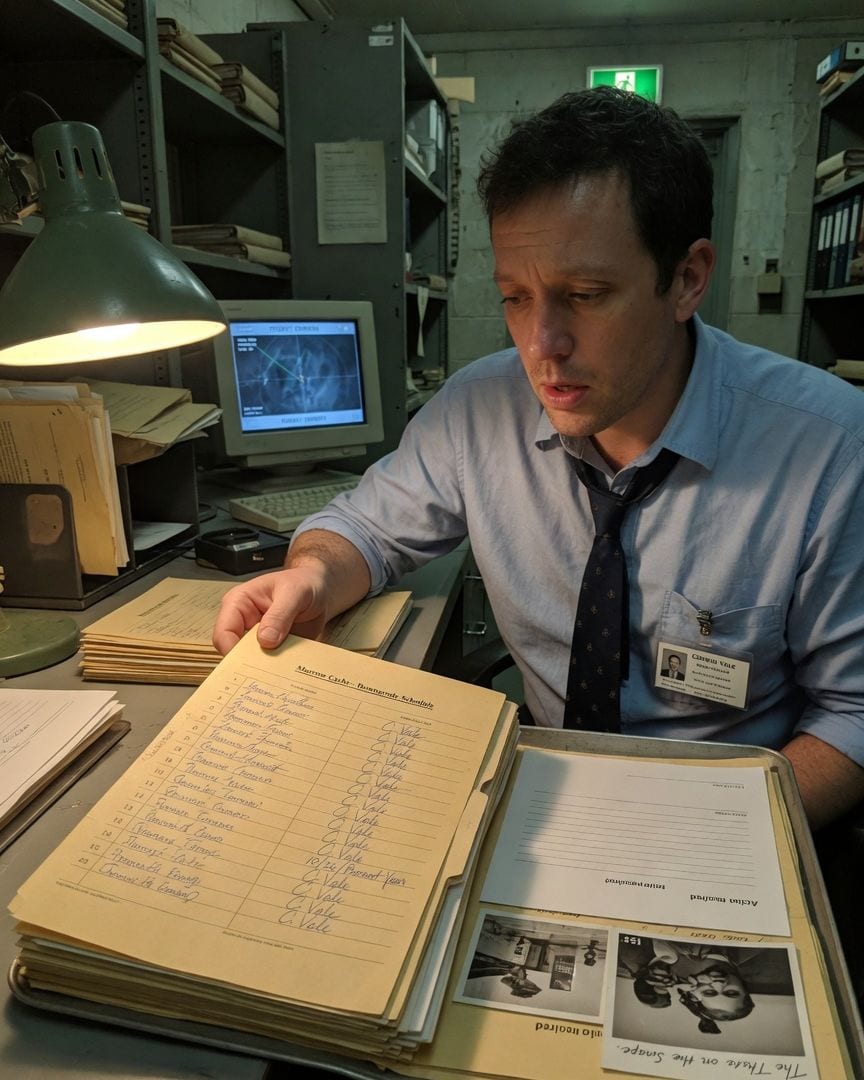
Chief Archivist Corwin Vale found his own signature on a Cold War vault log, dated 1988. He was years from even working there.
Chief Archivist Corwin Vale aimed to unravel the bureaucratic enigma of the Marrow Cache file, perpetually extended since 1972. In the cold, ozone-scented vault of Fort Ruthven, he sought to discover who was signing off on the endless delays. His breath hitched when he found his own signature on the log, dated this very morning, despite being home sick. But then, a chilling discovery: another identical signature, dated 1988, years before he was even employed. What impossible hand was tracing his name through time?