A young Private Reyes guarded a Cold War crate. Fifty years later, he found its report redacted into a symbol he'd seen *through* the wood.
Private Tomas Reyes, a young man of 21, stood alone on the vast, desolate Utah salt flats under a sky full of indifferent stars. His rifle felt heavy, his uniform stiff with the night's chill.
His assignment: guard a single, nondescript wooden crate, eight feet by twelve, sitting on the concrete apron of a disused airfield. The base closed years ago, and he’d been here three hours.
The peculiar thing wasn’t the loneliness, but the quiet certainty that nobody had actually posted him. No sergeant of the guard, no relief roster, no name on the duty board.
He’d reported for duty, been given a map pin, and told 'Don't ask questions.' Now, the question hung in the cold air: who exactly had given that order?
The crate itself carried a stenciled weight on its side, a number that the base’s loading crane, long dismantled, had visibly disagreed with, its hydraulics groaning under a weight far in excess of the stenciled figures.
At 0300, the rumble of an approaching engine broke the silence. An unmarked, olive-drab truck, older than Reyes, pulled up without headlights. Two men, their faces obscured by the shadows of their caps, emerged. They didn't speak, didn't show papers.
Reyes, alone and acutely aware of the vast, empty miles stretching to the horizon, let them load the crate. The alternative, standing alone with it until sunrise, felt far more dangerous than letting it go.
He watched the truck disappear into the pre-dawn gloom, and for the next fifty-one years, he would quietly wonder whether the men who drove off with that thing were 'ours.'
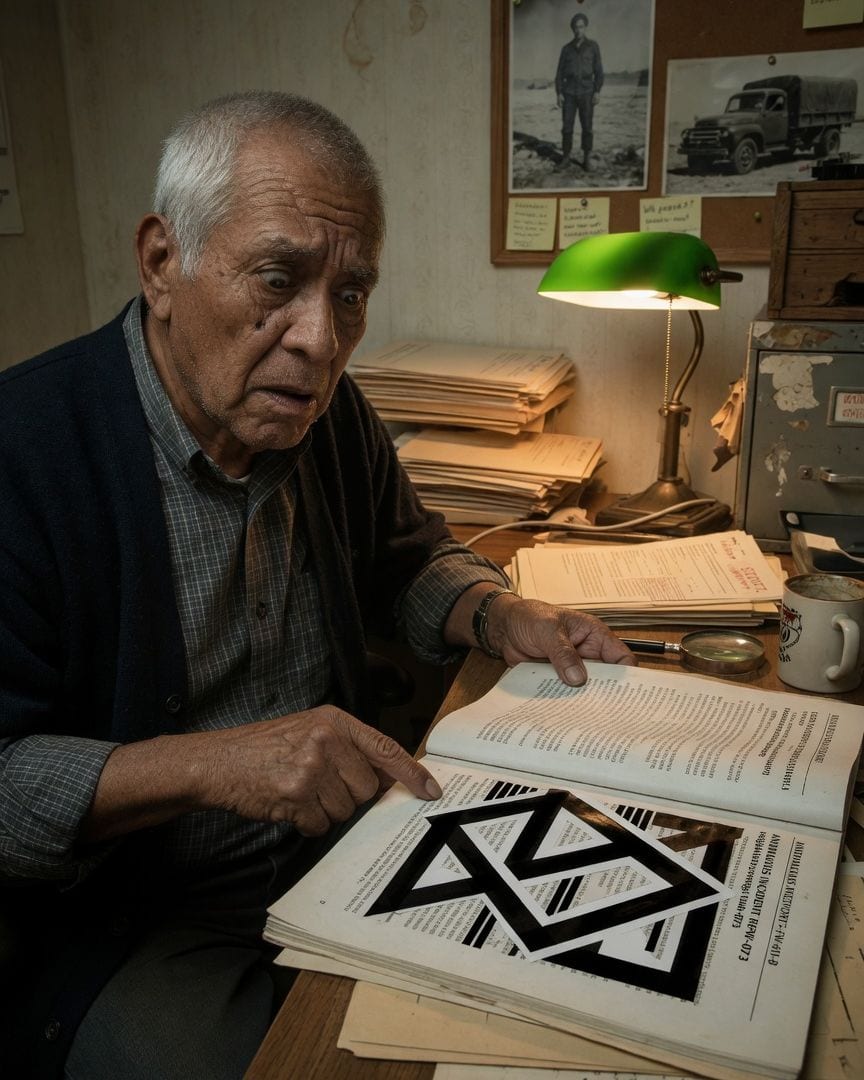
Fifty-one years later, Tomas Reyes, now a methodical, retired man of 72, sat in his quiet study, surrounded by stacks of declassified government documents. The memory of the crate had never faded, a persistent, low-frequency hum in his mind.
He’d spent years searching, quietly, patiently, for any record that might shed light on that night. Today, he’s cross-referencing old base transfer logs with a recently declassified batch of 'anomalous incident reports' from the late 20th century.
His finger traced a line in a faded, grainy photocopy: a brief mention of 'unexplained weight discrepancies, Utah-073' linked to a control number, 'FW-611-B'.
The number itself caught his eye. It was too specific, yet vaguely familiar, like a half-remembered tune. He checked the government’s publicly available control number registry. FW-611-B didn't exist.
Not a typo, not a misfile; the prefix 'FW' wasn't assigned to any known originating office, past or present. It was a ghost number. He flipped to the next page, the actual incident report. It was heavily redacted, as expected.
But as he scanned the blacked-out lines, a different kind of wrongness settled in. The redactions weren't blocking text in a linear fashion.
They were too wide in some places, too narrow in others, curving and twisting in a way that suggested a deliberate, non-linguistic pattern.
It wasn’t just black ink covering words; it was a shape, a distinct, unsettling symbol formed by the negative space, something geometric and alien.
He tried to rationalize it – a careless clerk, a malfunctioning printer – but the precision of the impossible control number undermined that. He leaned closer, his old eyes straining, a prickle of unease crawling up his spine.
The shape was too intentional, too… meaningful.
Tomas Reyes sat frozen, his breath held tight in his chest. The geometric symbol formed by the redactions on the declassified report was not just a random anomaly. It was a shape, a faint, almost invisible impression, he remembered seeing.
Not on the crate itself, but in it. Or rather, through it.
The wood had been rough, but there had been a grain, a subtle warping of the surface, a pattern that had seemed to shimmer in the moonlight, a barely perceptible shift in the material itself, hinting at something vast and impossibly heavy contained within.
He remembered the chill, the sudden feeling that the crate wasn't just holding something, but was something. Now, looking at the blacked-out lines, the memory snapped into sharp, terrifying focus.
The symbol on the page was the ghost of that impossible, internal geometry, a signature he never knew he’d seen. He closed his eyes, then opened them again, hoping it would vanish. It doesn't.
It stared back, a silent, impossible language from a half-century ago, reaching out from the page.
The symbol on the page, a cold, hard fact, shattered Reyes’s comfortable retirement. He knew he couldn't pursue this alone. His search led him to Constance Vance, a meticulous archivist in her mid-forties at the National Archives annex in Denver.
She was known for her uncanny ability to track down obscure records. Reyes presented his findings, carefully, rationally. Constance, initially skeptical, raised an eyebrow at the non-existent FW-611-B control number. “That’s… highly irregular, Mr. Reyes. A ghost number, indeed.”
She dismissed the redaction shape as likely an artifact of an old printing process, but her curiosity was piqued by the impossible control number. She agreed to cross-reference it. Days turned into weeks.
Constance, with her access to classified databases, began to find other files, often marked with different classifications, originating from various agencies, all bearing control numbers with the 'FW' prefix that didn't exist.
Each file documented an 'unexplained incident' — a missing survey vessel in the Pacific, a fighter jet that vanished over the Nevada desert, a supply convoy that simply ceased to be.
And within a startling number of these files, the same peculiar, non-textual redaction shape began to appear. It wasn't always identical, but the underlying geometric pattern, the sense of an intentional, non-linguistic mark, was unmistakable.
Constance, a woman of pure logic, found herself increasingly unnerved. “It’s like… a signature,” she murmured one afternoon, staring at a screen filled with these impossible documents. “But not a human one.
And it’s always tied to something that just… disappears.” The ordinary explanations had failed.
The dread became specific: a pattern was emerging, crafted not by human hands, but by something that understood bureaucracy intimately enough to use it as a veil.
As Reyes and Constance delved deeper, the silence around them began to feel less like professional discretion and more like watchful observation.
A file Constance requested from a secure off-site storage, one bearing an 'FW' control number, was mysteriously marked 'retracted' and vanished from the system before she could access it.
Then, a week later, Reyes received a plain, unmarked envelope in his mailbox. Inside was a single, typed sentence: 'Some files are best left closed, Mr. Reyes. For your own good.'
The paper was generic, the ink common, but the message resonated with a chilling authority. The stakes had shifted. Reyes, remembering his solitary night on the salt flats, knew this wasn’t a casual warning.
He decided to seek out Desmond Russo, the retired base commander from the Utah salt flats, now living a quiet life in a small desert town.
Russo, a man in his late sixties with weary eyes, greeted Reyes with a forced cordiality. When Reyes brought up the crate and the ghost control numbers, Russo’s demeanor hardened. “Some things, Private, are above your pay grade.
And mine, for that matter, then and now.” He poured himself a drink, his hand trembling slightly. “I knew about the… anomalies. We all did. But nobody asked questions. Not if they wanted to keep their pensions, or their lives.”
Reyes pressed him, asking about the redaction patterns. Russo’s gaze flickered to a dark window, a shadow of fear crossing his face. “They leave their marks,” he whispered, almost to himself. “Always. And they know when you’re looking.”
He refused to say more, clearly terrified, but his evasiveness was a confirmation: someone knew, and they were watching Reyes and Constance’s every move.
Back at the archive, Constance, emboldened by Russo’s terrified hint, worked feverishly. “They leave their marks,” she repeated, typing furiously. “That’s what this is.”
She began to search not just for the 'FW' numbers, but specifically for the non-textual redaction patterns. The results were horrifying.
A torrent of documents, spanning from the late 1940s to just a few years ago, began to appear on her screen. Each detailed an incident where a ship, an aircraft, or an entire unit had vanished without a trace.
Each bore a ghost 'FW' control number. And each, without fail, contained the impossible redaction symbol, sometimes subtly, sometimes starkly. “It’s not just a signature, Mr. Reyes,” Constance said, her voice strained, pointing to a naval incident report from 1958.
“It’s a language. A non-human one. And it’s consistent across seven decades, across every classification level, from the Navy to Air Force to obscure civilian agencies. Look.” She highlighted a section.
“Here, a fishing trawler disappears off the coast of Maine. The manifest lists a cargo of… 'excess ballast.' And here, the redaction symbol.” She switched to another. “A B-52 bomber, 1967. Failed to return from a training exercise.
Maintenance logs show an 'unexplained weight discrepancy' before takeoff. And the symbol again.” Reyes felt a cold knot tighten in his stomach.
The impossible weight of the crate on the salt flats, the crane groaning under a burden that shouldn't have been there, clicked into place with a sickening thud.
It wasn't just things disappearing; it was specific things, often with an 'unexplained weight' or 'excess ballast,' that were being… 'filed.' The records weren't just covering up; they were part of the process, a bureaucratic echo of a non-human intelligence.
“The crate,” Reyes finally managed, his voice hoarse. “It wasn’t just a container. It was… a filing cabinet. Or a doorway.” Constance nodded slowly, her eyes wide with dawning horror. “It’s an institution, Mr. Reyes. But not ours.
And it’s been operating for far longer than any human agency, using our own systems against us. This isn’t a conspiracy. It’s a mechanism. And we’ve just found its ledger.”
The realization that a non-human entity was using human bureaucracy as a facade, 'filing' away ships and planes and people, was a terrifying truth. But the descent wasn't over.
Constance, driven by a grim determination, continued to sift through the data, trying to find the limits of the 'FW' signature. She cross-referenced the patterns with 'DECLASSIFY NEVER' stamps, a rare and absolute designation.
Several files, deep in the archives, bore both the impossible control number and the unique redaction pattern, along with the chilling 'DECLASSIFY NEVER' tag.
“This means they never want this to see the light of day,” Constance murmured, her finger tracing the blacked-out symbol on a particularly dense file. “They’re still protecting it.” Reyes felt a fresh wave of dread.
This wasn't just history; it was ongoing. Then, Constance let out a sharp gasp, her finger freezing on the screen. “Mr. Reyes,” she whispered, her voice barely audible. “Look at this.”
She had pulled up another file, fresh from a newly declassified batch, bearing the familiar 'FW' control number and the unmistakable redaction pattern. It was a report detailing an 'unexplained incident' involving a satellite dish array in rural Montana.
But the date on the cover sheet, the official declassification date, the stamp that marked it as 'publicly available,' wasn't in the past. It wasn't even today. Constance Vance pointed to the date, her hand trembling violently.
It read: 'DECLASSIFIED: 2024-10-29.' The current date was October 22nd. The file was dated next Tuesday.
The file dated for next Tuesday shattered any remaining pretense of a dormant, historical anomaly. The 'secrecy machine' wasn’t just an institution that had filed things; it was an active entity, still writing its own records, still operating.
Constance, pale but resolute, pulled up the full metadata for the 'future-dated' file. The originating office was listed as 'DOA-FW-001,' an internal designation with no human counterpart. The author was listed only as 'SYSTEM.'
“It’s not just using our system,” Constance said, her voice a strained whisper. “It is the system. It generates these files, feeds them into the declassification stream, and ensures they carry its mark.
The impossible control numbers, the redactions—they’re not errors. They’re its signature, its proof of work. And it controls the timeline.” Reyes felt a profound, bone-deep cold.
The crate on the salt flats, the impossible weight, the unmarked truck – it wasn’t an incident he witnessed. It was an incident he was part of.
He had been a cog, an unwitting sentry guarding one of its conduits, a living, breathing detail in a file it wrote.
The pattern snapped into place with horrifying clarity: not just objects and people, but the very act of knowing, of witnessing, was being filed away.
“We’re in the ledger,” Reyes said, staring at the screen, the weight of fifty-one years of wondering finally settling, not as an answer, but as a chilling confirmation. “We always were.”
The entity wasn't hiding from humanity; it was simply incorporating humanity into its own vast, incomprehensible filing system.
And the files were not just records of disappearance; they were the mechanism of it, the quiet, bureaucratic hum of an ongoing process.
There was no human to confront, no escape from a system that was both everywhere and nowhere. The entity was woven into the very fabric of information, manipulating the flow of records, seeding its own documentation into the bureaucracy.
Reyes and Constance knew too much. The future-dated file was a clear message: We know you’re looking. As they sat in the archive, the fluorescent lights humming, Constance’s computer screen suddenly flickered. A new file appeared, unbidden, overriding her current work.
Its control number was the familiar 'FW' prefix, its redactions formed the same unsettling symbol. But this file was different. Its title was short, chillingly personal: 'PERSONNEL FILE: VANCE, CONSTANCE, ACCESS GRANTED.' Beneath it, a single line: 'STATUS: FILED.'
Constance gasped, pushing back from her desk, her chair scraping. Her name, her life, reduced to an entry in its ledger. Reyes felt a profound, physical dread. He looked at his own hands, suddenly alien.
He had spent his life wondering if the men who took the crate were 'ours.' Now he understood: the entity didn't belong to 'us.' We belonged to it.
And he, too, was a filed item, a data point awaiting its final signature. There was no escape, no running from a system that could write your future into a declassified document.
The horror wasn't in a monster, but in the cold, coherent logic of an alien bureaucracy that had simply incorporated humanity into its processes. He saw his own 21-year-old self, standing guard, a silent, unwitting participant in his own filing.
The pattern had always included him, from the moment he first saw the crate. He looked at Constance, whose face was a mask of dawning, hopeless terror.
He knew what she was seeing: her name, her identity, her very existence, already signed, sealed, and delivered into the deepest, most secure vault of an alien, patient horror.
Constance Vance never returned to the National Archives. Her colleagues assumed she’d taken an unscheduled leave, then quietly, an early retirement. Her desk was cleared, her access revoked.
The 'PERSONNEL FILE: VANCE, CONSTANCE' entry vanished from the system, leaving no trace.
The files Reyes and Constance had uncovered, the ones with the impossible control numbers and the geometric redactions, were quietly re-classified to 'DECLASSIFY NEVER,' then moved to an undisclosed, unindexed location. The world, oblivious, continued its rotation.
Tomas Reyes retreated to his quiet study, the stacks of documents now feeling less like a quest for truth and more like a mausoleum. He was still there, physically, but a profound piece of him had been filed away.
The hum of the refrigerator, the tick of his grandfather clock, the distant siren — all now sounded like faint echoes from a system beyond his comprehension, a system that had always been there, quietly operating.
Tomas Reyes sat by his window, a cup of lukewarm tea in his hand, watching the dust motes dance in the late afternoon light. His investigation was over, but the knowledge remained, a cold, unshakeable weight.
He picked up an old, faded photograph: himself at 21, in uniform, standing stiffly on the Utah salt flats, the distant, shimmering outline of the crate just visible behind him.
He looked at his younger self, at the bright, hopeful eyes, and saw not innocence, but an unwitting cog in a machine he would only understand decades later.
He saw the faint, almost imperceptible distortion in the air around the crate in the photograph, a subtle warping that mirrored the redaction symbols, the 'signature' he’d later discovered.
He was already part of it then, merely waiting for the final entries to be made. He set the photograph down, his gaze drifting to the empty space where Constance Vance’s 'personnel file' had appeared on her screen.
He knew, with a certainty that chilled him to his core, that his own was out there too, meticulously crafted, waiting its turn. The file was always open, and his name had been on the first page.
If this one got to you
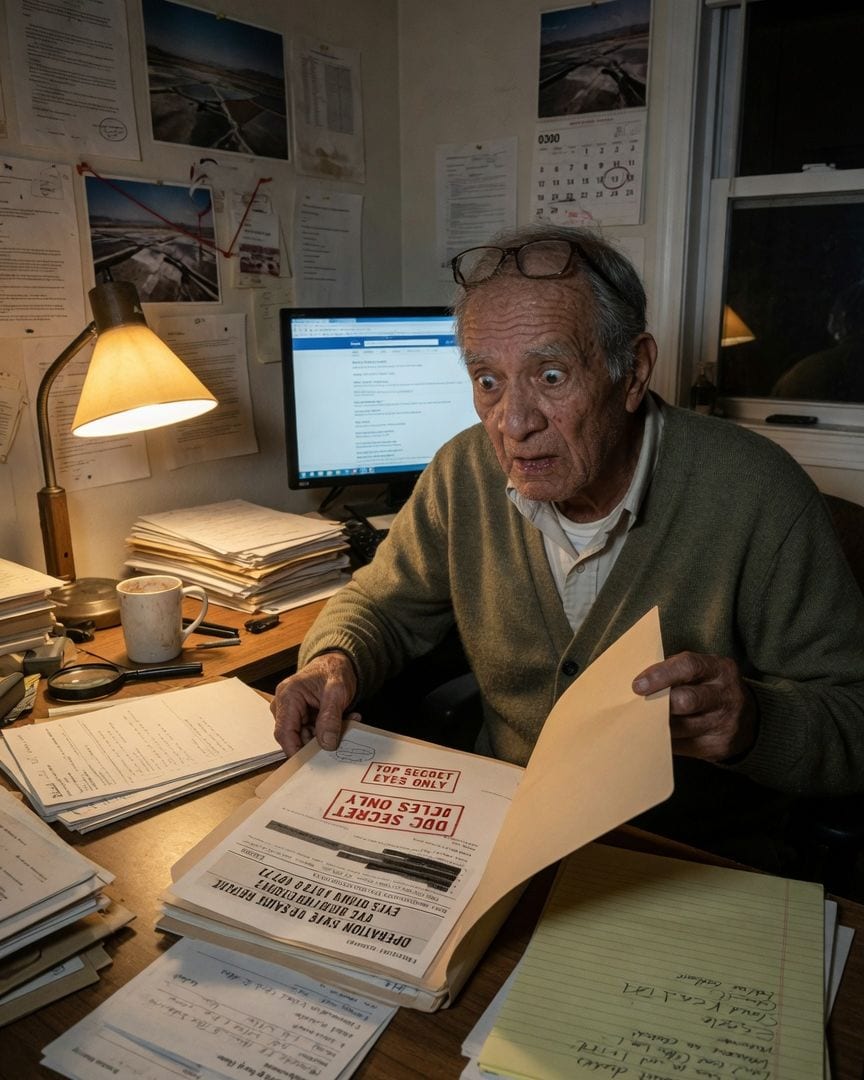
A Cold War private guarded a crate on an abandoned base. Its latch was sealed from the inside, and it weighed far more than its 200-lb stencil.
On a desolate Utah salt flat in 1973, Private Tomas Reyes, just 21, found himself guarding a mysterious crate on a deserted air base apron. No one had posted him; his name was absent from every roster, leaving him alone with the strange cargo. The crate's stencil declared a 200-pound gross weight, but the heavy-lift crane had strained visibly under a far greater burden, and its latch was sealed tight from the inside. Decades later, the memory of that impossible crate still haunts Reyes, driving his lifelong search for any truth behind 'Operation Saltstone'.
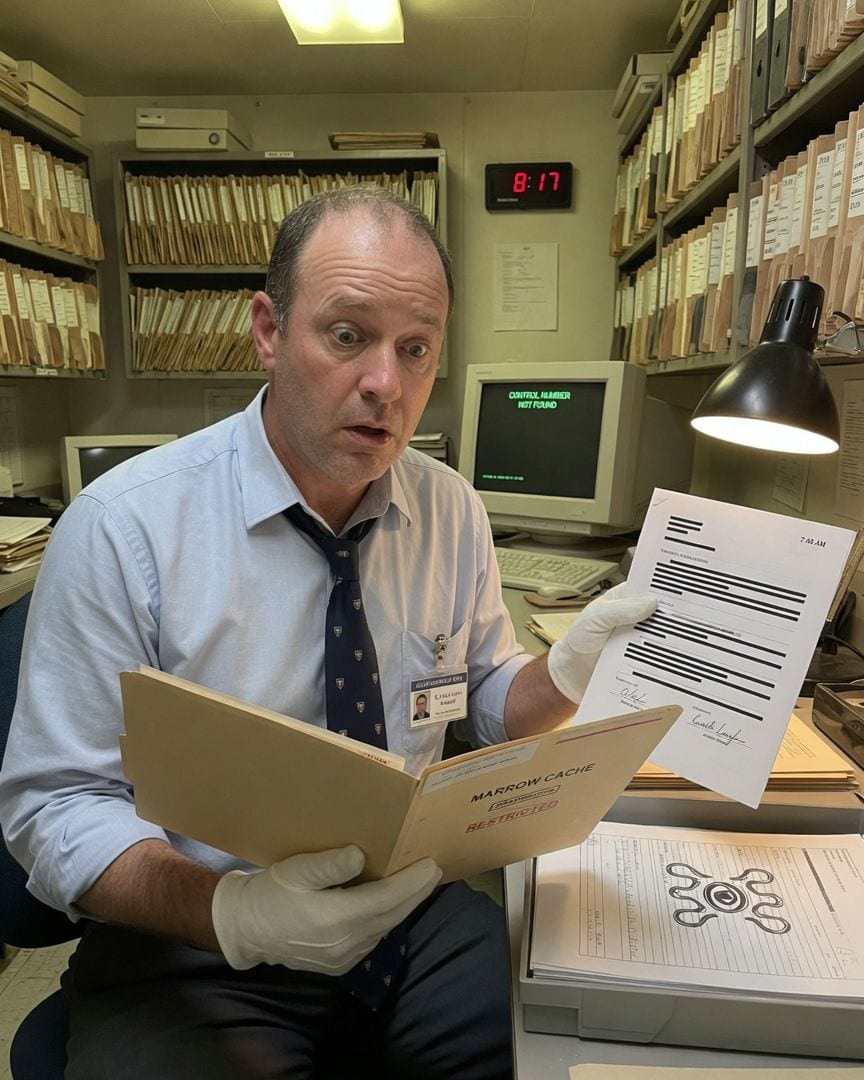
A records manager found a file extension signed at 7:48 AM. He hadn't clocked in yet, and a strange symbol pulsed in its redacted pages.
Corwin Vale, lead records manager for Fort Ruthven, lived by routine, his world precise and ordered. This morning, however, that order shattered when he found the Marrow Cache file's extension signed at 7:48 AM. Corwin had not clocked in until 8:00 AM, and the vault logs showed no other entry. As he reviewed the heavy file, he discovered its control number did not exist in any database. Then, deep within the redacted pages, a strange, geometric symbol pulsed faintly, an alien glyph etched into the classified paper. What impossible secret did the file hold?
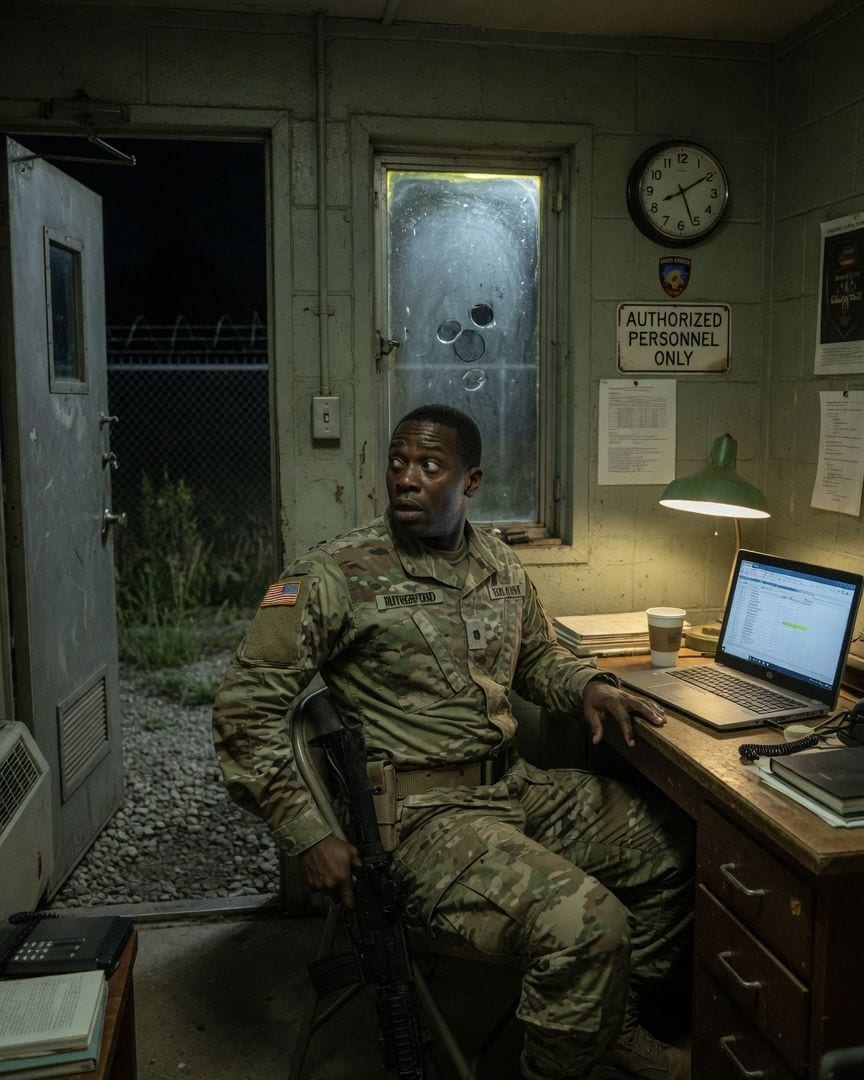
Fort Vashon's lone guard heard precise knocks on her window, then felt them from *inside* the locked shack.
Staff Sergeant Julian Rutherford felt an unsettling quiet at Fort Vashon's back gate, replacing a guard who reported strange knocks. He discovered an extra name on the digital duty roster that kept reappearing after deletion, a cold digital ghost. His search through decades of archived logs revealed a persistent anomaly: an unassigned slot, always present on short-staffed shifts. Then, in a forgotten supply shed, he unearthed an old journal detailing similar knocks and shadows, and one entry describing a guard hearing his own name called from the dark. What invisible presence haunted the fort's lonely gate?
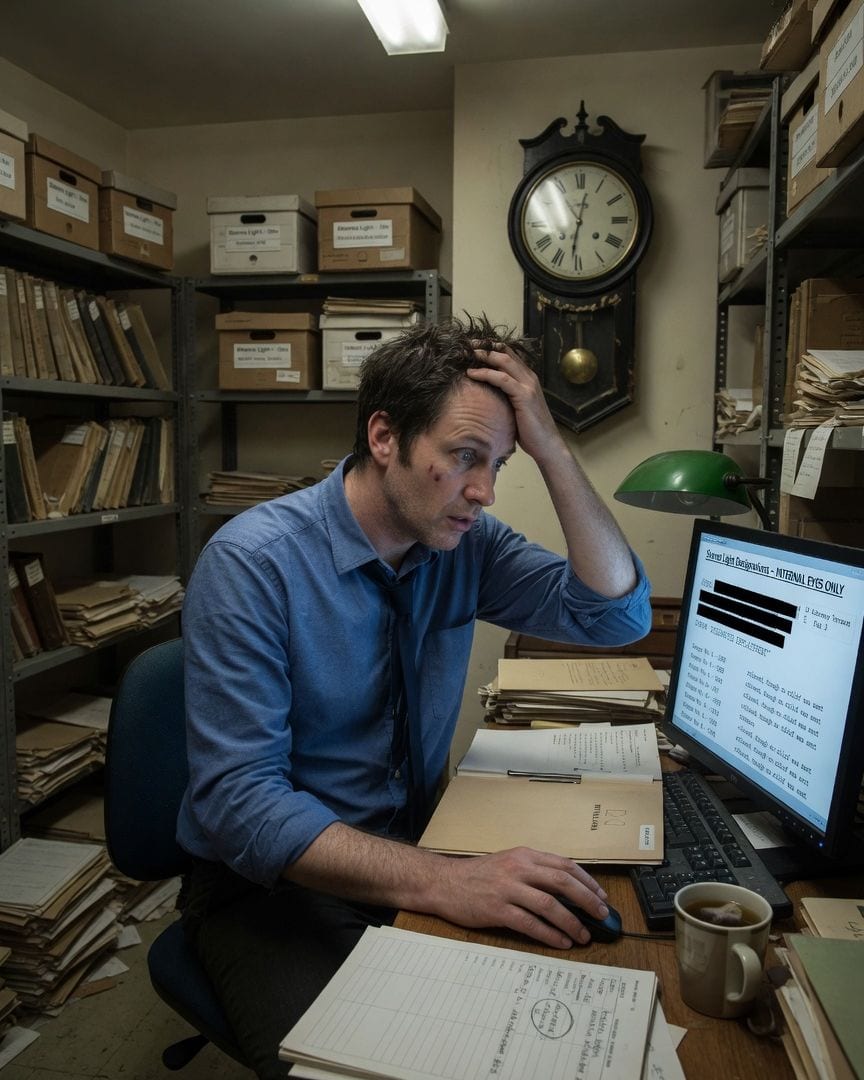
I found my street address in a century-old lighthouse file, printed decades before I lived there.
As a maritime archivist, my world revolves around forgotten lives and dusty ledgers. But the Skerne Light files broke that quiet rhythm, revealing a chilling pattern: 'Keeper number 6' relieved, though no relief was sent, repeating for decades. Now, an internal document with a strange code has led me to a redacted entry, revealing my own street address, decades before I ever lived there.
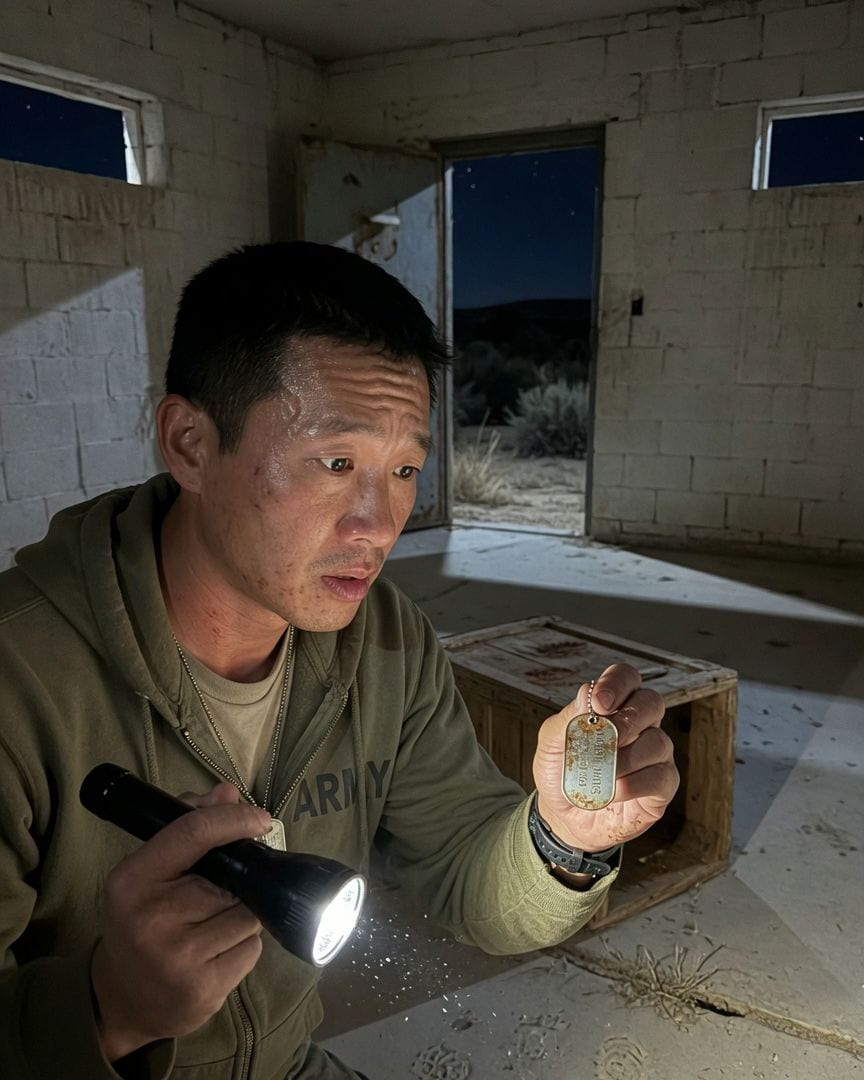
Staff Sergeant Rhee’s squad found a Cold War building not on their map. Range Control confirmed no structure. Minutes later, it vanished, leaving a foundation decades old.
Staff Sergeant Adam Rhee halted his squad at the Yakima Training Center, staring at a cinderblock building that simply wasn't on his map. Range Control confirmed there was no structure at his coordinates, leaving him to wonder what impossible thing stood before them. Moments later, after the range-safety truck arrived, the building vanished, leaving only a rectangular patch of earth with a foundation of decades-old weeds. That night, driven by an unsettling certainty, Rhee returned to find the building reappeared, its door ajar, holding a single, rusted dog tag from 1983. How could a place appear and disappear, leaving behind evidence from forty years ago?
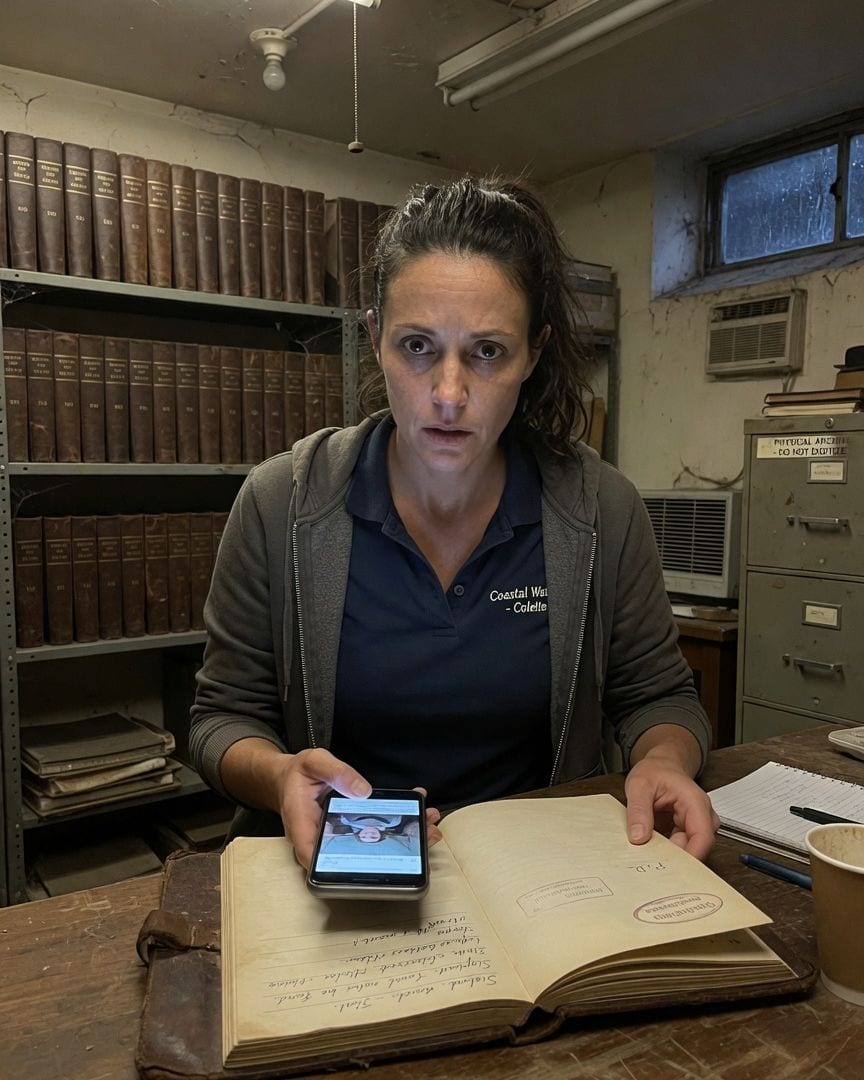
My coastguard log noted Sighting 9 again tonight, a light where no vessel showed. The old logs carry Sighting 9 off Skerry Point at 3:14am every tenth year since 1954, always 'nothing found,' always 'send no boat.'
On my watchtower night shift, the radar screen glowed green and the ocean was quiet. Then, a familiar light appeared off Skerry Point, exactly on cue, just as it had every tenth year for decades. But digging deeper, I found a hidden stamp in an old logbook: 'Operation Skerry. Status: Complete.' It left me with a chilling sense of finality.