My empty birdcage sings every dawn, door ajar. Inside, a sampler reads 'Edith Langford, 1954' — the previous owner died here in 1984.
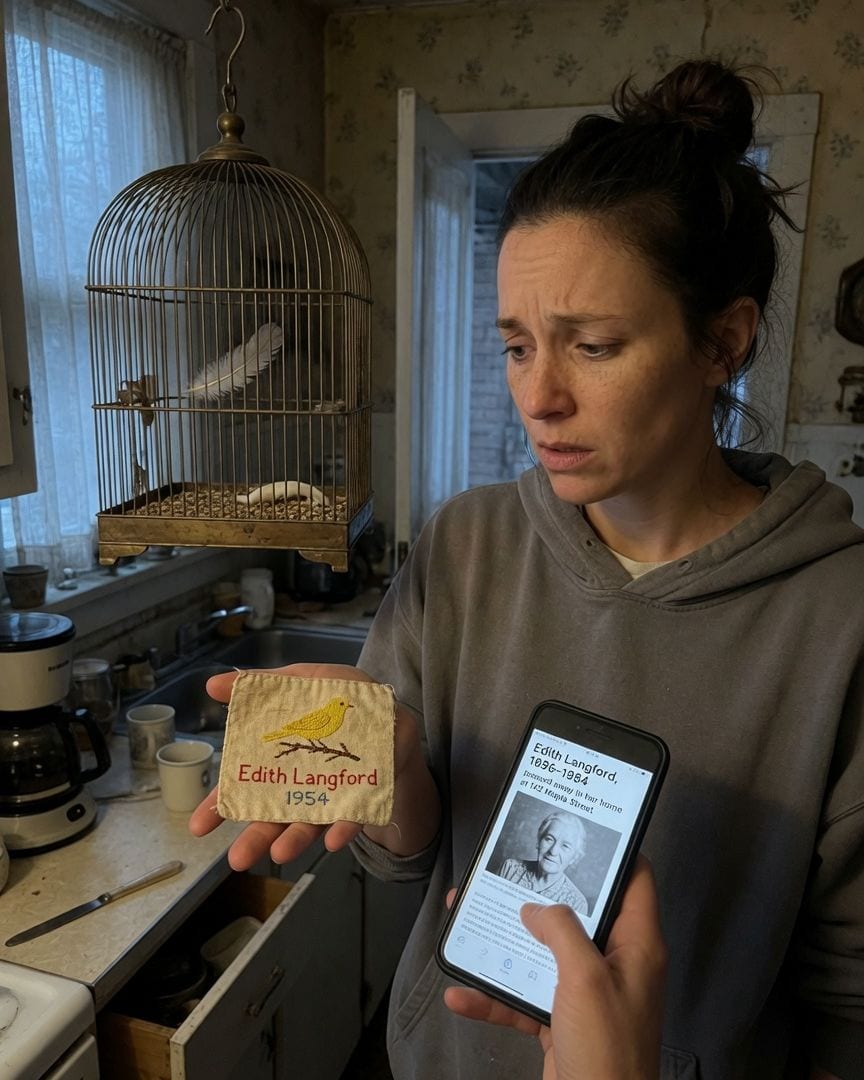
The first time I heard the canary sing, I was still half-asleep, the morning light just barely reaching the kitchen window. The sound was bright, clear, right there.
I opened my eyes, disoriented, and saw the brass birdcage, hanging exactly where I’d left it: empty. I’d inherited it with the house, a charming, antique thing, and kept it for decoration.
But the song was unmistakable, a trilling, cheerful melody that lasted for a good minute before fading. I told myself it was the neighbor’s, a trick of the acoustics, or maybe just a dream.
The next morning, it happened again. This time, I was already up, making coffee. The cage door, which I always kept latched, was slightly ajar.
On the tiny seed tray, a scattering of fresh, golden seed lay next to a small, white cuttlefish bone I hadn’t noticed before. A grey feather, impossibly delicate, was caught in the wire.
Then the song began, a vibrant, living sound that seemed to emanate directly from the cage’s interior, though it remained visibly vacant. It wasn't a dream. It wasn't a neighbor's bird. I checked outside, the windows, the vents. Nothing.
The schedule never varied. Every dawn, the song, the open door, the fresh seed.
This morning, it was even clearer, brighter, the trills so sharp I could almost feel the bird’s tiny chest vibrating against the brass bars, just out of sight. It was impossible, and it was happening.
The persistent, impossible song gnawed at me. I stood in front of the cage, coffee forgotten, my fingers tracing the cold, aged brass.
It felt absurd, but I was looking for a speaker, some hidden mechanism, anything to explain the fresh seed and that relentless, vibrant song.
I ran my hands over every inch of the wire, checked the hinged bottom tray, even shook it gently, a foolish hope that something would clatter. Nothing. Just dust, and the metallic tang of old brass.
Then, my fingertip snagged on something. A tiny ridge, almost imperceptible, along the underside of the main tray, where it met the base. There was a faint seam, tight and almost invisible.
I grabbed a butter knife from the drawer and carefully worked its thin blade into the gap. It resisted, then clicked open with a soft, dry pop.
Inside, nestled in the shallow cavity, was a tiny, faded scrap of cloth. I pulled it out. It was a hand-stitched sampler, about three inches square, the linen yellowed with age, the embroidery floss muted.
On it, a crude but recognizable canary sat perched on a branch. Beneath it, in painstaking cross-stitch, were two lines: ‘Edith Langford’ and ‘1954’.
A prickle, cold and sharp, crawled up my spine. Edith Langford. I knew the name from the property deed, the previous owner. The Langford family had owned this house for generations. But 1954? That was seventy years ago.
My phone was still in my pocket. I pulled it out, my fingers fumbling as I typed. A quick search brought up an obituary from the local archives.
Edith Langford, born 1896, died in her home, this very address, in 1984, at the age of 88.
The sampler, a testament to someone’s patient needlework, felt too personal, too vivid, to be a mere relic.
It was a tangible connection to a life lived here, decades before I was even born, yet the bird’s song had been as fresh as dawn itself, just this morning.
Vanessa stares at the faded, hand-stitched sampler in her palm: a canary, 'Edith Langford,' and a date from 70 years ago.
Her phone screen, still open to Edith's obituary, confirms the woman had died in this very house, decades before Vanessa was even born.
Yet, the bird's song had been clear and vibrant that morning, fresh seed in the tray, the cage door swung open.
The routines weren't just lingering; they were happening, now, as if Edith were still here, setting out breakfast for her pet.
The sampler, Edith’s name, the impossibly fresh song—it all amplified my awareness of the other oddities. I started noticing things I’d previously dismissed as old house quirks. The distinct, sweet smell of Earl Grey tea and digestives.
It wasn’t a faint odor, not like something baked yesterday. It was a fresh, warm scent that wafted from the empty living room at precisely 3 PM each day, strong enough to make my stomach rumble.
I’d checked the kettle, the cupboard, the sink. Nothing.
Then there was the staircase. Seven steps, then a landing, then another five. The third stair on the main flight always let out a low, mournful creak when I stepped on it. I’d assumed it was loose, settling.
But I noticed a faded, almost invisible path worn into the carpet, a slight dip, that clearly showed someone, over many years, had consistently placed their foot on either the second or fourth step, meticulously avoiding the third.
My own feet, without conscious thought, started skipping it too. A strange, almost compulsive urge to conform.
The armchair by the fireplace in the living room also caught my eye. It was an old, floral thing, comfortable enough, but I hadn’t used it much.
Yet, the indentation in its cushion was deep, profound, far more pronounced than my occasional use could explain. It was as if someone had sat there, day in, day out, for decades.
I went to the attic. It was mostly empty, but in a dusty corner, I found a small wooden box labeled 'Langford Family Keepsakes.' Inside, among yellowed letters and dried flowers, were photographs.
Dozens of them, black and white, capturing a lifetime. And there she was: Edith Langford. A stern-faced woman with tightly pinned hair and sensible spectacles.
In one photo, she sat in that very armchair, a cup and saucer on a side table beside her, a small brass birdcage visible in the background, near the window. My cage.
In another, she was about to descend the staircase, her foot poised in mid-air, unmistakably skipping the third step.
The photos didn't just show her routines; they showed my routines, the house’s routines. I felt a growing sense of complicity, a chilling realization that I wasn't just observing these phantom habits, but slowly, unconsciously, becoming part of them.
I’d reach for the kettle just before 3 PM, a strange, almost magnetic pull. My foot would lift, unbidden, over the third stair.
The unease became a persistent thrum under my skin. I was disturbed not just by the impossible routines, but by my own unsettling ease in adopting them.
I needed answers, or at least someone to confirm I wasn't losing my mind.
I sought out Trevor Bennett, a local historian known for his encyclopedic knowledge of the town's older homes. His office, a cramped room above the old library, smelled of dust and ancient paper.
Trevor, a man in his late seventies, with sharp, perpetually calm eyes, listened intently as I described the birdcage, the sampler, the routines—the tea, the stair, the armchair. He didn't interrupt, his gaze unblinking over the rim of his spectacles.
He finally leaned back, a faint, almost imperceptible smile playing on his lips. He took a slow sip of his tea, a steaming mug cradled in his gnarled hands.
"Ah, the Langford house," he murmured, his voice soft, almost a whisper. "Always had its ways. Some things just... stick, you know? Like a good stain." He waved a hand dismissively, a gesture that brushed away my genuine alarm.
"Old houses, they remember things, that's all. Especially when a person lives alone, makes their own little world within the walls. Routines become almost physical, like worn paths on a carpet."
He paused, his eyes, dark and knowing, meeting mine. There was a strange depth there, a weight that belied his casual tone. "Best not to dig too deep, lass," he said, his voice dropping, "Some memories are best left undisturbed.
Especially when they're not yours to begin with."
The conversation left me more unsettled than reassured. His calm felt less like ignorance and more like a profound, unsettling acceptance, as if he knew something I didn't, something he wasn't quite ready to share.
He spoke of 'memory' but his eyes suggested something far more active, far more demanding than simple echoes.
He watched me as I left, that faint, unreadable smile still playing on his lips, and I felt a chill that had nothing to do with the cool autumn air.
The canary’s song was louder than ever in my mind, the cloying scent of biscuits almost tangible. I couldn't shake Trevor's knowing gaze, his evasive calm. I went back to his office.
He was hunched over a stack of old plat maps, his breath fogging his spectacles.
“Mr. Bennett,” I began, my voice tighter than I intended, “Edith Langford has been dead for forty years. Forty. How can her routines be happening now? How can that cage have fresh seed?
How can I be hearing a bird that died before I was born?” I placed the tiny sampler, with its faded canary and 1954 date, on his cluttered desk.
He sighed, a slow, deep exhalation that seemed to carry the weight of decades. He picked up the sampler, his thumb tracing the stitched name. "Edith was a creature of habit, Vanessa.
Lived alone for most of her life after her husband passed in '48. Her routine was her world. That canary, Pip, was her only companion. Every morning, the fresh seed, the cuttlefish, the song.
Every afternoon, the tea and biscuits in that armchair. She never missed a beat, not for fifty years."
He looked up, his gaze softening, but the depth in his eyes remained. "After Edith died, the routines... they didn't just stop. They seemed to linger. Fading, yes, slowly over time, but never truly vanishing.
The house itself," he said, leaning forward, his voice dropping to a near whisper, "it held onto her. It absorbed her patterns, her very presence. It's not a ghost, Vanessa. It's... an echo. A very strong one."
He confirmed the sampler's date was accurate, a small gift Edith had made for herself, a testament to her devotion to her bird.
The dread solidifed then, an icy, heavy lump in my stomach. It wasn't a random haunting, not some wandering spirit. It was a precise, coherent replay of a life.
The worn stair, the armchair with its deep impression, the inexplicable scent of tea and biscuits – all of it clicked into place as a living, breathing history, a loop running endlessly through the fabric of the house itself.
The house wasn't just where Edith had lived; it was Edith now, playing out her days. And I, the new occupant, was walking into her story, step by deliberate step.
Seeing the true terror dawn in my eyes, Trevor's calm broke slightly. A tremor ran through his hand as he put down the sampler.
"It's not just Edith," he murmured, his gaze distant, unfocused, as if looking through me, through the walls, through time itself.
He shuffled through a stack of ancient town records on a nearby shelf, pulling out a brittle, yellowed photograph. It was a picture of the Langford house, unmistakable, but clearly from a much earlier era, perhaps the late 19th century.
The porch looked different, more ornate, and the trees were saplings. In the foreground, a different woman, severe and alone, stood on the porch, her dress long and dark.
The caption beneath, in faded, elegant script that was barely legible, spoke of 'the peculiar habits of Mrs. Eleanor Yates, whose house continued to hum with her life even after her passing, particularly the phantom braying of her donkey, long gone.'
Trevor’s gnarled finger tapped the photo, right on the severe woman’s face. "The house has done this before, Vanessa. It collects. It repeats. And it seems to prefer its occupants solitary, just so.
One life at a time, etched into the stone." He looked up, his eyes meeting mine, the silence in the room suddenly thick with the weight of generations, a chilling, unspoken question hanging between us.
Trevor, now fully unburdening himself, explained the house's true nature. His voice was steady, matter-of-fact, as if discussing the weather, and that made it even worse. "It's not a haunting, not in the way people think. It's the stone.
The very foundation."
He produced an ancient, hand-drawn blueprint of the Langford house, unfurling it carefully on his desk. His finger, still gnarled, traced a peculiar, dark red stone embedded deep in the cellar.
"Local legend says it's a 'memory stone,' from a place where the earth itself holds onto time, where the past is... denser. The house was built around it, quite by accident, becoming a kind of resonance chamber."
He explained how strong, repetitive, solitary lives, especially those lived within its walls for decades, didn't just leave an impression; they imprinted themselves onto the house's fabric.
"Like grooves in a record," he said, his voice flat. "And when the conditions are right—a new, solitary occupant, after a period of quiet—the record starts to play again."
He revealed that the house had been empty for a generation before I bought it, a period of 'dormancy' that now made chilling sense. It wasn't just a quiet house waiting for a new family.
It was a mechanism, a recurring trap for lives lived within its walls, waiting for the next one to step into its rhythm, to start its own loops. Eleanor Yates, Edith Langford, and now, me.
The pattern stretched back further than any record, a slow, inevitable accumulation.
Horrified, I tried to break the cycle. I ripped the brass birdcage from its hook, carrying it outside to the furthest corner of the yard.
I packed away Edith's dusty photos, sealing them in a box and putting them in the attic. I deliberately, forcefully, walked on the third stair, stomping down on it with a defiant crunch.
I forced myself to sit in different chairs, to break my own emerging routines, to refuse the pull of the house's schedule.
But the house resisted, subtly at first, then with escalating force. The phantom canary's song became deafening, a relentless, piercing melody that seemed to drill into my skull even when the cage was out of sight.
The smell of tea and biscuits was overwhelming, cloying, filling every room, clinging to my clothes, making me gag. I tried to leave. I packed a bag, my heart pounding, convinced I could escape.
But as I reached the door, my feet felt impossibly heavy, a strange, undeniable compulsion pulling me back, back to the living room, back to the worn armchair. My hand, unbidden, reached for the kettle.
In a desperate, final act of defiance, a frantic search for the source, I went to the cellar, seeking the 'memory stone' Trevor described. The air down there was thick, cold, and still.
I found the peculiar, dark red stone, half-hidden behind a stack of old firewood. It was smooth, cool, almost warm to the touch, humming with an unearthly resonance.
And tucked into a small hollow within it, a second, perfectly preserved, tiny hand-stitched sampler. This one depicted a braying donkey and the name 'Eleanor Yates,' dated 1894.
It was pristine, untouched by time, the colors still vibrant, the fabric unmarred. An impossible artifact of a routine that should have long since crumbled into dust. The ordinary explanation died completely.
The house wasn't just remembering; it was creating, manifesting, perpetuating. It was a living archive, and I was its latest entry.
Vanessa did not escape. Her resistance crumbled, her will slowly subsumed by the house's relentless rhythm. The packing remained unfinished, the birdcage returned to its window. She no longer questioned the routines; she performed them.
A delivery driver, dropping off a package, noted the new occupant seemed a quiet sort, always in the same armchair at 3 PM, a faint, sweet smell of biscuits accompanying the distant, reedy sound of a bird from the kitchen.
She looked distant, her movements precise, unhurried, as if guided by an unseen hand.
The last entry in Vanessa's phone journal, found months later, simply read: 'The song is so clear now. I think Pip likes the new seed.'
The kettle clicks on at 6 AM, and the same worn spot on the armchair deepens just a little more each day.
If this one got to you
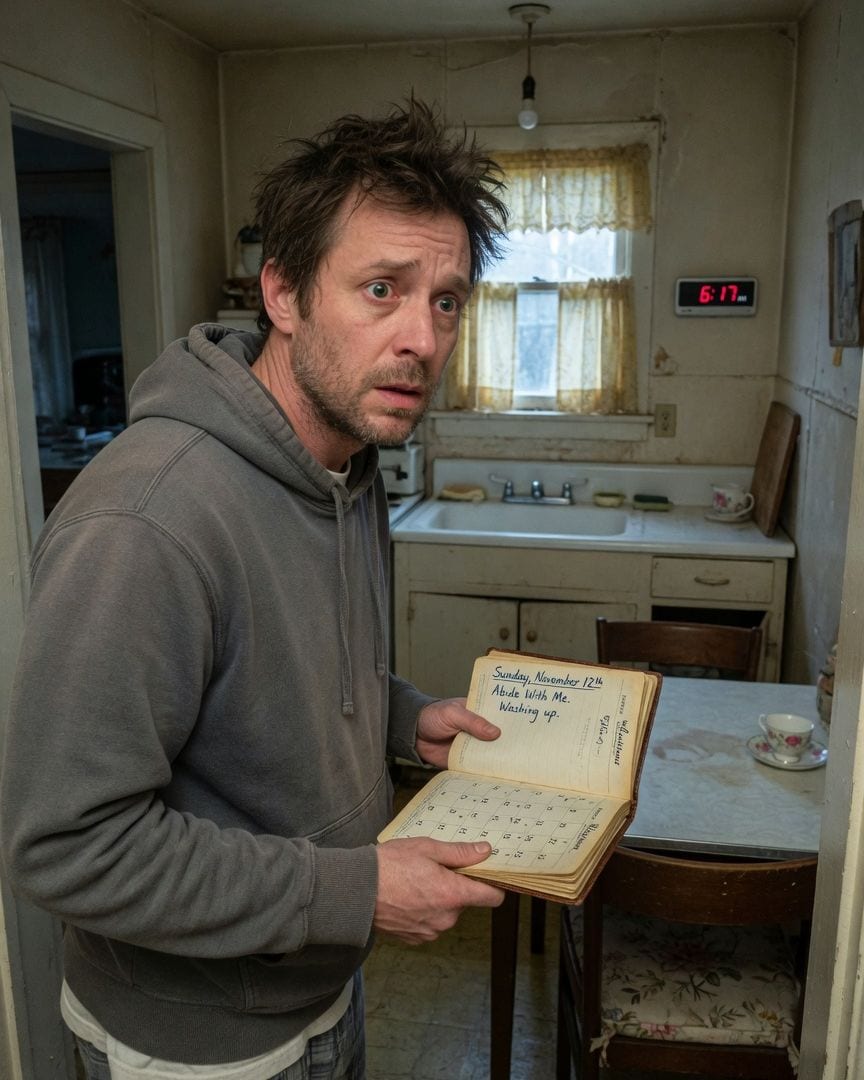
My kitchen hums an old hymn every Sunday morning. The taps run themselves, and I live alone.
Every Sunday morning, my inherited kitchen comes alive with a woman's soft humming of 'Abide With Me' and the distinct gush of taps. I live alone, yet this domestic ritual unfolds precisely at 6:15 AM, leaving the sink perfectly dry. But then, I found an old calendar from 1973, with one chilling entry for every Sunday: 'Abide With Me. Washing up.'
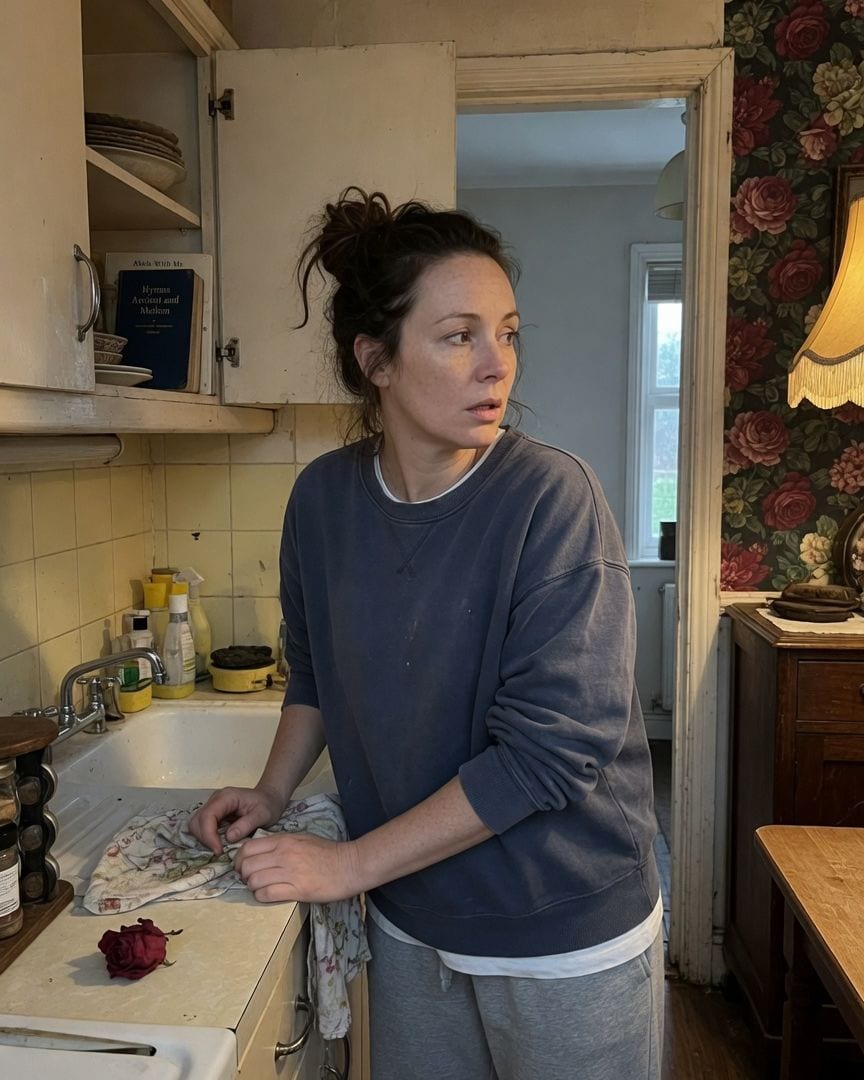
My kitchen taps run themselves on Sundays while a woman hums 'Abide With Me.' I live alone.
I moved into this quiet 1928 house for a fresh start, living alone. But for three months now, every Sunday morning, a low, tuneless hum and the distinct sound of running water drift from my kitchen sink. A plumber found no explanation.
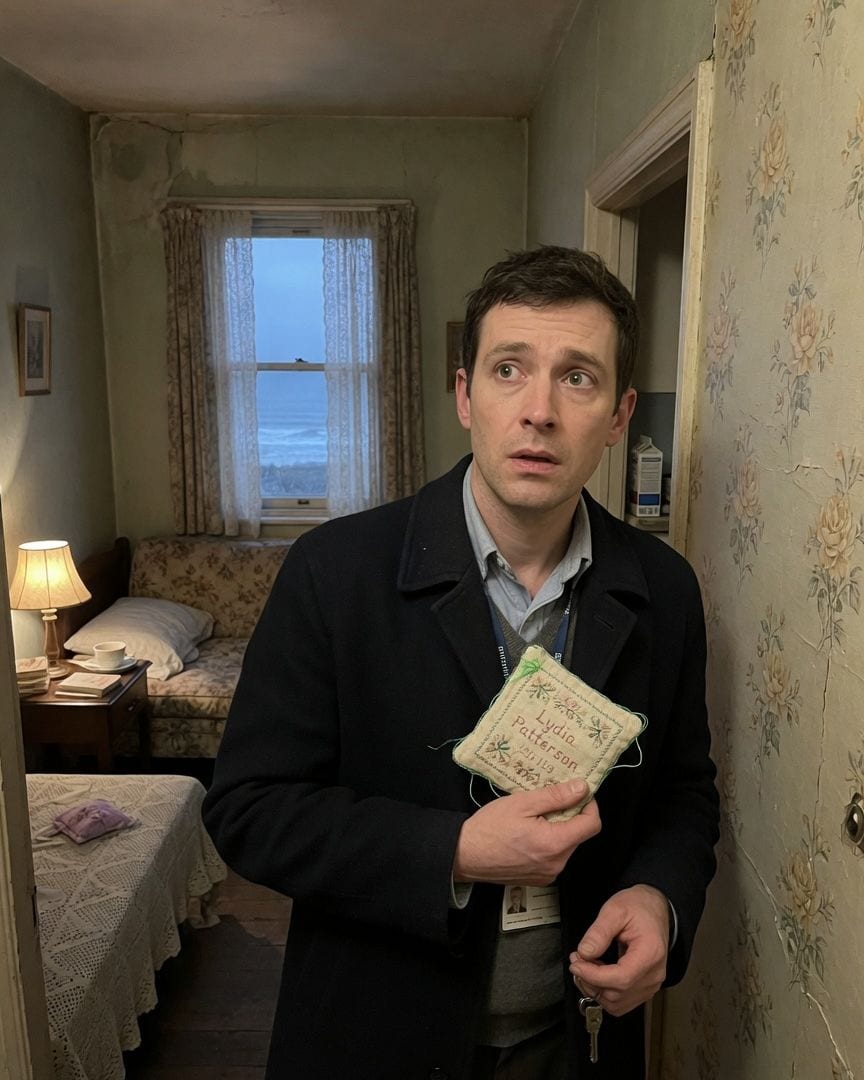
The 'empty' almshouse I was auditing wasn't empty. I heard a bare foot *thump-thump* from next door.
My new charity role involves auditing the supposedly 'empty' almshouse units. But from the unexplained activity outside to a fresh carton of milk inside, something is deeply wrong. Then, in one unit, I found a dead woman's sampler with a jarringly new thread, and heard bare feet thumping next door.
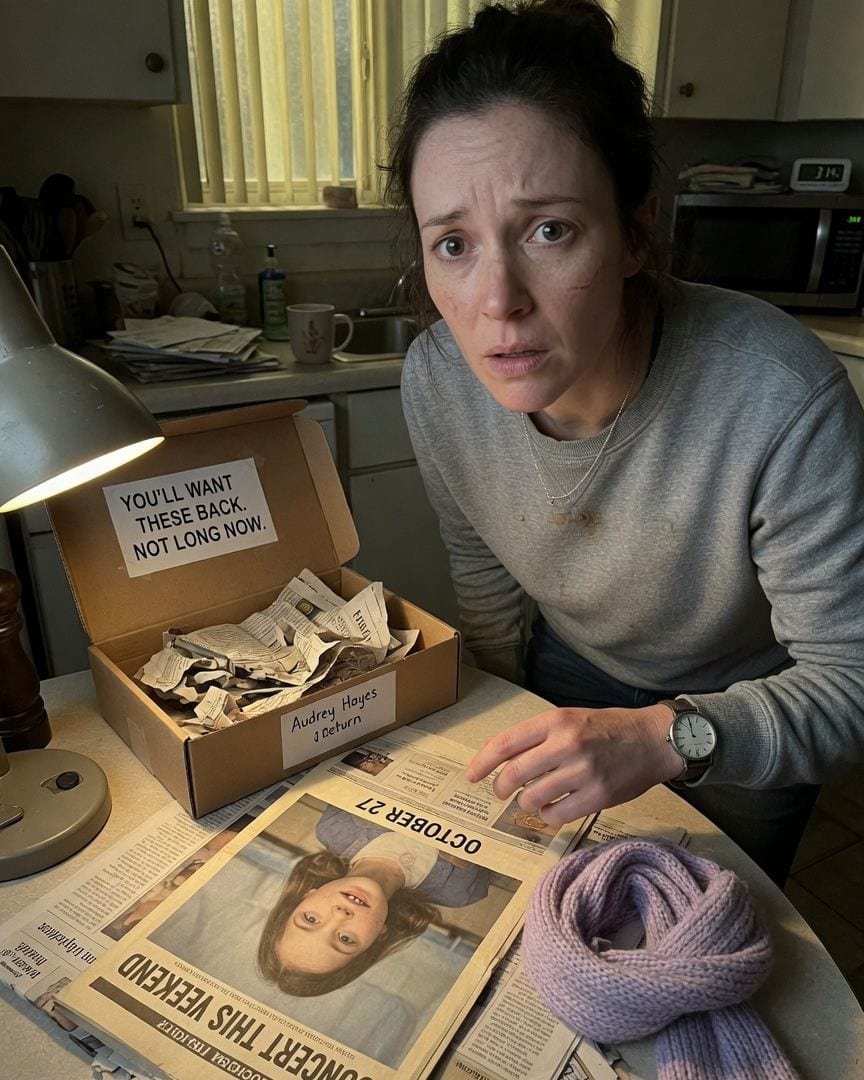
A box turned up with my name and no sender. Inside was a watch I lost years ago, still ticking and set right — wrapped in newspaper dated two weeks from now.
A plain brown box appeared on my step, containing my long-lost personal items. Among them, my grandmother's ticking watch and a newspaper dated two weeks in the future. But a historical ledger then revealed my name and these exact items, listed in 1965.
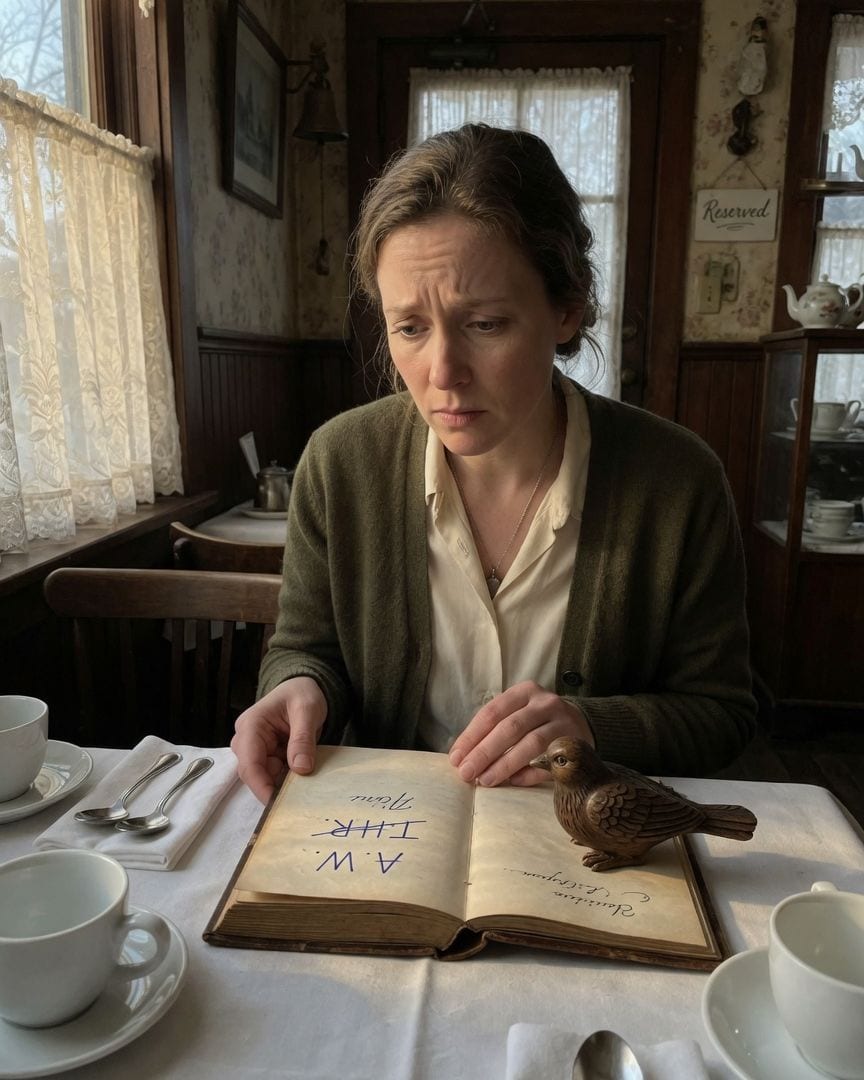
My tearoom table reservation replaced three initials booked daily since 1926. Today, I sat in their seat.
As an art restorer, I loved the quiet history of Oakhaven’s tearoom, especially a sunlit corner table. But the owner, Gloria, always insisted it was reserved, despite it being meticulously set and empty every single day since 1926.
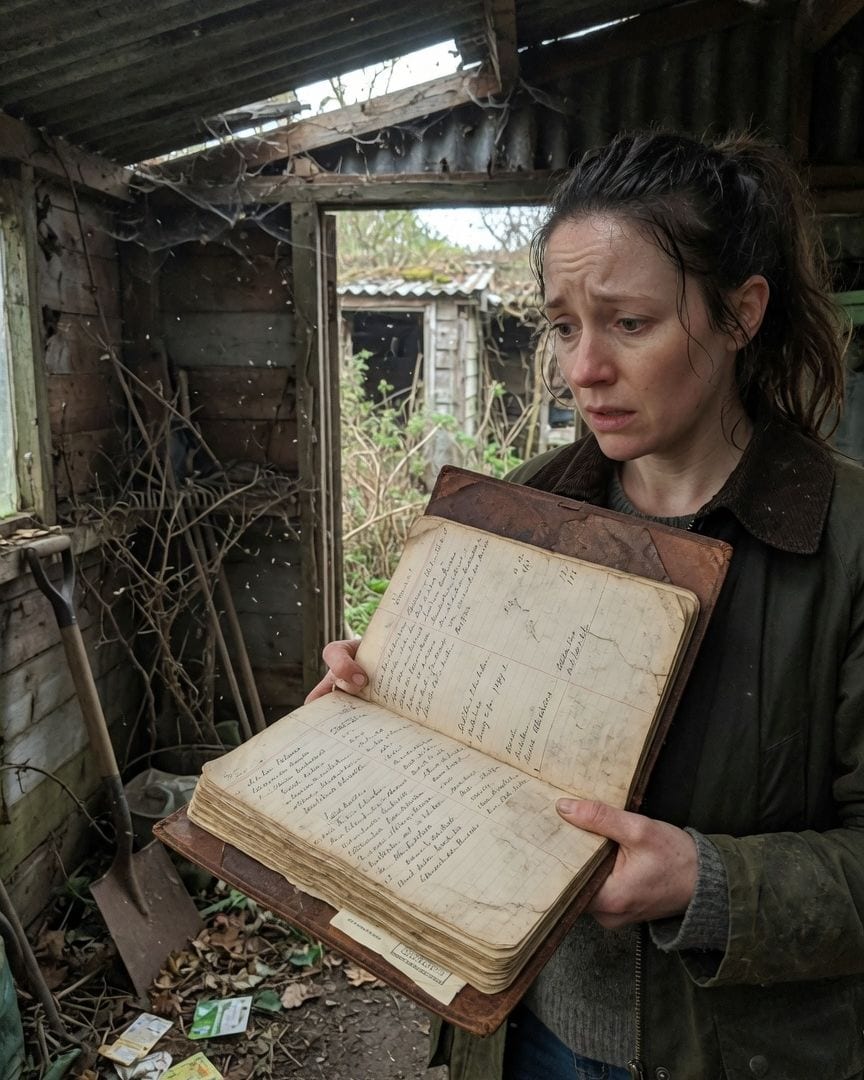
My mailbox holds my own obituary, updated weekly. The postmark reads Cold Ashby allotments, where there's only a standpipe and sheds.
Every Wednesday, a crisp white envelope arrives, containing my own obituary. It's mailed from the desolate Cold Ashby Allotments, a place with no post office, and each week a new, accurate detail of my life is added, leaving only the death date chillingly blank.