My kitchen taps run themselves on Sundays while a woman hums 'Abide With Me.' I live alone.
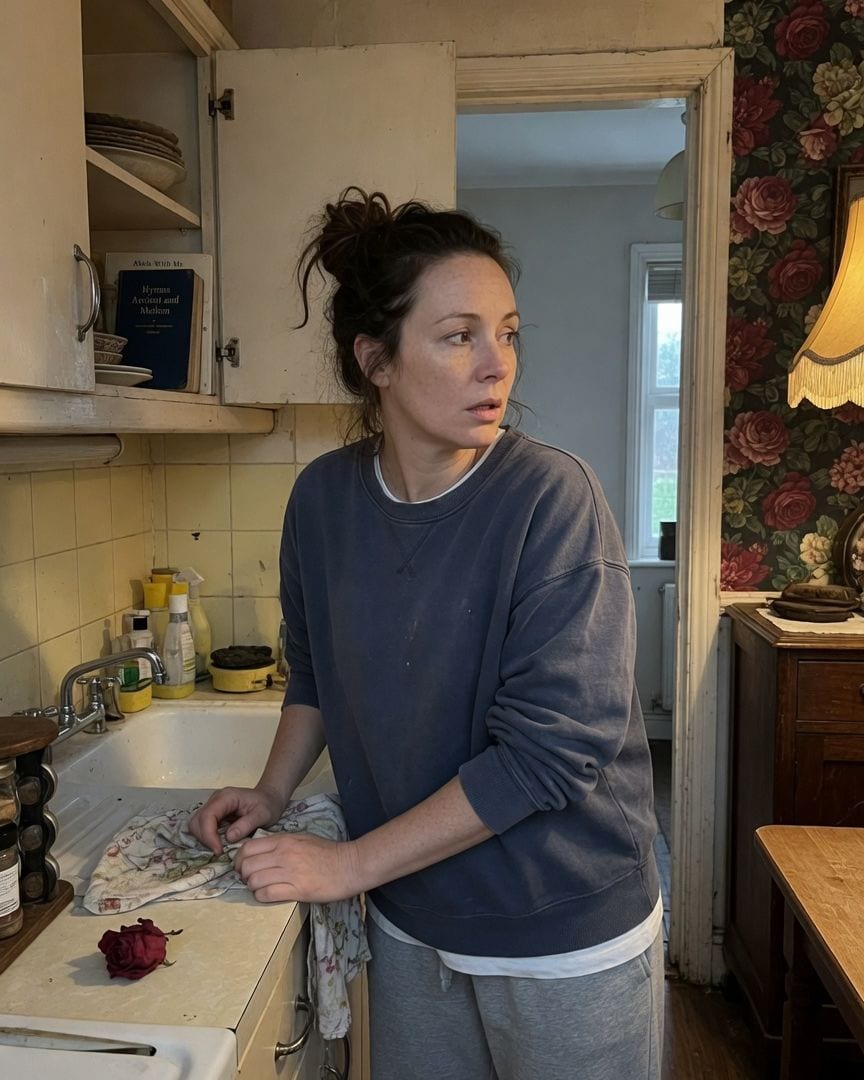
It started three months ago, almost as soon as I unpacked the last box. Every Sunday morning, without fail. I’d be in bed, maybe reading, or still half-asleep, and then I’d hear it.
A low, tuneless hum, soft at first, then growing clearer, drifting from the kitchen. And with it, the unmistakable rush of water from the tap over the sink.
It sounded like someone was filling a kettle, or perhaps just letting the water run, idly, while they hummed.
I live alone. Always have. This house, built in 1928, was meant to be my fresh start, a quiet place away from the city. For the first few Sundays, I thought I was dreaming.
Then I thought maybe it was the neighbours, though their houses are a good distance away, and their windows don’t align with my kitchen that well. I even checked the plumbing.
Got a plumber out, actually, a gruff man who looked at me like I was mad when I described the ghost water. He checked every pipe, every valve, the boiler, the main line. Everything was sound, he said.
No leaks, no pressure drops, nothing.
The hum was always the same tune, too. Eventually, out of sheer frustration, I typed the melody into a music recognition app, humming it myself. It pulled up 'Abide With Me.' A hymn. That just added another layer of weirdness.
I’m not religious. Never have been. Why would my house be playing an old hymn? It was always quiet during the week. Just Sunday.
Then I found the hymn book. Tucked away in the back of an old, unused kitchen cupboard, beneath a stack of dusty placemats. It was a worn, dark blue copy of 'Hymns Ancient and Modern,' brittle with age.
And it was open, perfectly, to page 320: 'Abide With Me.' Almost like it had been left there for me to find, a clue I didn’t know I was looking for.
The taps ran that Sunday, just like always, and the hum, fainter now that I was standing right there, seemed to echo the words on the page.
The hymn book changed things. It solidified the fact that this wasn't just my imagination or a faulty pipe. The unease, which had been a low thrum beneath my daily life, now surfaced, sharp and cold.
I started looking at my kitchen differently. It felt… occupied. Not by a person, but by a memory.
I decided to investigate, methodically. I went over every inch of the kitchen, not for leaks this time, but for anything out of place.
Near the sink, right where the water sounds came from, I started noticing a faint, lingering scent. Lavender. And something else, something powdery and delicate, like very old lace.
It wasn’t strong, but it was definite, a ghost of a perfume. I’d clean the counters, scrub the sink, open the windows, and still, hours later, a wisp of it would return, settling in that one corner.
Then came the rose petal. I found it one Tuesday morning, balanced perfectly on the edge of the kitchen counter, next to the spice rack. A single, dried rose petal.
Deep crimson, almost black with age, but still perfectly formed, not crushed or broken. There had been nothing there the night before. I remembered cleaning the counter thoroughly before bed. I picked it up, feeling its papery fragility. A draft?
Did it blow in from an old neighbour’s garden? But my windows had been shut. It felt too deliberate, too placed. Like the hymn book.
I started digging into the house’s history. The real estate agent, a woman named Carol, had been a little cagey about the previous owner, Vera Fairfax. 'A bit of a recluse,' she’d said, looking at the ceiling.
'Died alone in the house back in 2014. It sat empty for a while after that. Sad, really.' She’d quickly changed the subject.
Online, there wasn’t much. A few sparse mentions in local obituaries, a record of property transfers, but nothing personal, nothing that spoke of a woman who hummed hymns or left dried petals. No photos of the interior from her time.
It was a blank slate, which made the hum, the scent, the rose petal, all feel more significant, like fragmented whispers from a past I wasn't meant to hear.
They weren’t fitting into any logical pattern, but they felt like pieces of one, waiting to be assembled.
One Tuesday afternoon, about a week after the rose petal, I was cleaning the kitchen again. Scrubbing the countertop, wiping down the cupboard doors, feeling a bit foolish for letting these strange occurrences get to me.
I reached the old wooden doorframe that separates the kitchen from my dining room, a plain, painted archway. As I ran my cloth along the dust-roughened wood, something flickered.
It wasn't a trick of the light. For a split second, the dining room beyond the open door is not my newly decorated, minimalist space with its pale grey walls and modern oak table.
Instead, it was a room from another time entirely. Heavy, dark floral wallpaper, a pattern of deep reds and greens, covered the walls. A large, ornate mahogany sideboard, scarred with age, stood against the far wall.
A faded, fringed lampshade, casting a dim, sepia light, hung from the ceiling. The air in that glimpse felt thick, laden with dust and the scent of beeswax.
And in the periphery of that older room, a faint, almost imperceptible shadow shifted, as if a person had just moved out of view.
I blinked. My heart hammered against my ribs, a sudden, violent drum. The modern dining room snapped back into place, bright and familiar, my oak table gleaming under the afternoon light.
But the image of that other room, the heavy wallpaper, the mahogany, the sepia glow – it was burned into my mind, as real and terrifying as anything I had ever seen.
The vision in the doorway wasn't just a flicker; it was a fracture. It shattered any remaining doubt I had about my sanity or the mundane explanations I'd desperately clung to. This was real. And it was old.
Shaken, I drove to the local historical society the next morning. It was housed in an old brick building downtown, smelling of paper and dust. I needed to know more about Vera Fairfax, about this house.
I was hoping for architectural records, old photographs, anything that might explain what I’d seen.
Behind a high counter piled with ledgers, I found Dean Galloway. He was a man in his late fifties, with shrewd, kind eyes behind thick spectacles and an air of quiet authority.
I introduced myself, explained I’d recently moved into Vera Fairfax’s old house, and was looking for information.
He was polite, almost overly so, but I noticed a flicker of something in his eyes when I mentioned Vera’s name and the address. A brief, unreadable hesitation.
'Ah, yes, the old Fairfax place,' he said, tidily stacking a pile of periodicals. 'Lovely property. Been in the family a long time, the Fairfaxes.'
He then skillfully steered the conversation away, launching into a detailed monologue about the town’s early textile mills, local luminaries from the turn of the century. He talked about general local history, not my specific house.
I pressed him. 'Mr. Galloway, does the house, specifically, have any… unusual historical anecdotes? Anything at all?'
His gaze sharpened then, a definite glint. He paused, fiddling with a pen. 'Old houses have long memories, Miss Mitchell,' he said, his voice dropping slightly. 'Some say they keep a little bit of everyone who lived in them.'
It was vague, unsettling. He wouldn’t be drawn further.
Stubborn, I insisted on looking through old newspaper archives for my address. He sighed, a faint sound, but pointed me towards the microfiche readers. It took hours of squinting at blurry headlines, scrolling through decades. And then I found it.
A brief article from 1983, tucked away in a dusty folder labelled 'Local Curiosities.' The headline was innocuous enough: 'Garden Club Notes Peculiar Resident.' No mention of Vera by name, but the address was mine.
The article described a woman known for her 'unconventional routines' and 'talking to herself,' observed by neighbours. It also vaguely referenced 'seasonal disappearances' of small, personal items – spoons, thimbles, an antique brooch – from local homes, never solved.
The journalist had almost written it off as local gossip, a charming eccentricity. But it was there, a yellowed truth. It felt like someone hadn't wanted it found, buried as it was.
The article about the 'peculiar resident' churned in my mind all night. It was more than just local gossip; it was corroboration. The next day, I returned to the archives, determined to find more.
Dean Galloway was noticeably absent from his usual post. Instead, a younger assistant, barely out of college, was manning the desk. I caught her watching me, her eyes darting away quickly whenever I met her gaze.
It felt less like curiosity and more like monitoring.
I went straight back to the microfiches, searching for anything else related to Vera Fairfax or the house. I pulled up more records, and then, nestled among a collection of donated local history materials, I found them.
A series of handwritten notes from Vera Fairfax herself. Donated years ago, presumably by an executor, categorised vaguely as 'local oddities and folklore.'
Her handwriting was neat, elegant, but the content was anything but. She detailed strange weather patterns, inexplicable animal behaviour, and then, a heavily underlined section about 'the turning of the house.'
She wrote about 'temporal shifts' and a specific 'doorway where the past bleeds through.' My blood ran cold. The doorway. She knew. She had seen it too. My dining room, with its floral wallpaper and mahogany, was not a hallucination.
Later that week, I found a note tucked under my front door. It wasn't in an envelope, just a single sheet of cream-coloured paper, folded precisely in half.
The handwriting was neat, almost academic, with a careful flourish on the capital letters. It read: 'Some doors are best left shut. Some songs are best unheard.'
My hands shook as I unfolded it. It was a warning. A clear, unmistakable warning. From whom? My mind immediately went to Dean Galloway. He had been so evasive, so quick to deflect.
And now his assistant seemed to be watching me. Or perhaps it was someone else, someone connected to Dean, someone who knew.
The thought that my digging had been noticed, that my investigation was being monitored, made the house feel less like a strange mystery and more like a carefully laid trap. The hum, the scent, the door—they weren’t just random anomalies.
They were part of a pattern, and someone else was aware of it. I found myself double-checking my locks that night, the cold layer of dread settling deeper in my bones.
The anonymous note, coupled with Vera's chilling handwritten research, solidified my resolve. I marched back to the archives the following morning, the note clutched in my hand.
Dean Galloway was back at his desk, his spectacles perched on his nose, looking through some old maps.
I laid Vera's research notes and the anonymous warning directly in front of him. 'Mr. Galloway,' I said, keeping my voice steady despite the tremor in my hands. 'You know something about this house. And about Vera Fairfax.
And I think you know who sent this.'
He stared at the note, his calm demeanor finally cracking. His jaw tightened, and he ran a hand over his thinning hair. He pushed his spectacles up his nose, avoiding my gaze.
'My family has lived here for generations, Miss Mitchell,' he said, his voice lower than usual. 'We remember a lot. Especially about that house.' He paused, collecting himself. 'My great-aunt lived next door to Vera. She talked about her often.
Said Vera was… changing. Becoming more and more secluded. Obsessed, really.'
He finally looked at me, his eyes clouded with a weary kind of knowledge. 'Vera Fairfax wasn't just an eccentric, Miss Mitchell. She was a woman consumed by that house. She believed it had a 'memory.' A cycle.
She thought it replayed parts of its past, like an old film reel.'
He confessed that Vera had approached him, years ago, at this very archive, with her detailed observations and theories. She’d asked for his help, to find historical precedents, to prove her wild claims.
'I dismissed her,' he admitted, a note of regret in his voice. 'I thought she was deluded, that old age was getting to her. But she wasn't. She was charting it.'
He reached beneath his counter and pulled out a dusty, leather-bound ledger, thicker and older than anything else I'd seen him handle. He opened it to a page filled with neat, spidery handwriting.
'She called it 'the turning of the house',' he stated, his voice a strained whisper. 'She said it would start small. A hum. A smell. Then the visions. The doorway…' He looked at me, his eyes confirming my worst fears.
'She believed the house would 'reset' to a previous occupant’s time. And that the current occupant would slowly, irrevocably, be absorbed into that past.'
He tapped the ledger. 'Vera died in that house, Miss Mitchell. A fall down the stairs. Official ruling was accidental. But her final notes to me… she said she was trying to 'break the cycle' at its peak.
She was desperate. She thought she’d found a way to stop it.'
The hymn. The taps. The lavender and the rose petal. The doorway. It all snapped into chilling, terrible focus. It wasn't just a haunting. It wasn't random. It was a re-enactment. A performance, staged by the house itself.
And I, Elena Mitchell, was now playing a part. Not just a witness, but a reluctant actress on a stage set by a ghost.
Dean, visibly disturbed by his own confession, slumped against the counter. 'Vera had a record,' he said, his voice barely a whisper. 'She believed it was the only way. Hidden in the house. For the 'next one'.' My heart lurched.
The 'next one' – he meant me.
I drove home in a daze, the dread a cold, heavy stone in my stomach. The house loomed, no longer just a home, but a predatory entity. Dean’s words echoed: 'the heart of the hum.'
Vera's notes, the ones I'd found in the archives, spoke of it too. That specific, precise corner of the kitchen where the hum always seemed strongest, where the lavender scent lingered.
Back in my kitchen, I dropped to my hands and knees, tapping along the old pine floorboards, listening for any hollow spots. Right beneath the sink, where the 'Abide With Me' seemed to originate, my knuckles hit a loose board.
With a grunt, I managed to pry it up.
Beneath, nestled in the dark, was an old, locked wooden chest. It was heavy, dark oak, bound with iron straps, covered in a fine layer of dust.
My hands trembled as I worked the rusty latch – surprisingly, it wasn't locked, just stiff with age.
Inside, carefully packed, I found it all: a vintage reel-to-reel tape recorder, several unmarked tapes, and a stack of leather-bound journals, filled with Vera Fairfax’s cramped, precise handwriting.
I pulled out the recorder, plugged it in, my hands shaking so violently I almost dropped the first tape. I threaded it onto the spindles, pressed play. Vera's voice, aged but clear, filled the quiet kitchen.
She detailed the early signs of the recurrence, the hum, the specific scent, the small objects appearing. Every detail matched my own experiences exactly.
I fast-forwarded, skipping through weeks, then months, of Vera’s meticulous records. Her voice grew increasingly desperate with each entry, documenting the 'doorway' and the increasing vividness of the past. My breath caught in my throat.
She was describing my dining room. My glimpses.
I loaded the last tape. The recording began with a low, mournful hum, the exact tune of 'Abide With Me.' Vera's voice cut in, strained, almost frantic, overriding the hum. 'It's almost here. The peak.
It’s pulling me in… There’s a way, I think, to stop it… but I'm losing time…' Then, a sudden, sharp intake of breath, a rattling sound, like something falling, or struggling, and a final, chilling whisper, directed not at the empty room, but at me, across decades: 'And to whoever finds this… know that the hum will grow louder.
The door will stay open longer. And you, like me, are already too far in. There is no escape from the turning of the house, not truly.'
Vera's final, desperate whisper echoed in the silent kitchen long after the tape spooled to its end.
The 'record that cannot be' – her journals, her tapes – lay open before me, an invitation to a horror I was already living.
I spent the next day poring over every word, every recorded thought, the full, terrifying truth of the house unfolding.
Vera Fairfax had been a scientist of the paranormal, driven to catalog the house's temporal cycles with a meticulousness that bordered on madness.
She had noted their periodicity: intensifying every 30-40 years, always drawing the current occupant deeper into a re-enactment of a specific past life.
She detailed previous 'manifestations,' including the 1983 incident Dean vaguely referenced, which resulted in a woman named Sophia Novak disappearing from the house. Sophia, Vera believed, had been the one before her, absorbed into the house’s turning.
Vera's research pointed to the kitchen doorway as the primary 'bleed point,' the membrane between past and present becoming thinnest there. The cycle's peak, she’d discovered, coincided with the vernal equinox – just days away.
My heart hammered against my ribs as I read this. The house, she theorized, was trying to 'complete' a past routine, a life lived within its walls.
If it succeeded, the current occupant – me – would be permanently trapped in the temporal loop, effectively replacing the past figure, becoming just another ghost humming 'Abide With Me' forever.
But Vera hadn't given up. She had devised a 'containment ritual.' It was a desperate, untested method, a series of specific actions and spoken words, focused on the hymn and, crucially, the doorway.
Her aim was to disrupt the temporal anchor, to 'reset' the house, to sever the link that bound the present to the past.
The final entries in her last journal, and the last snippets on the tapes, revealed her growing despair, her hurried preparations, her attempts to perform the ritual. Her last words were not of resignation, but of a struggle.
Her fall down the stairs, Dean had said. It suddenly seemed less like an accident and more like the house’s final, violent act of absorption.
The day of the equinox arrived, heralded by a sky the colour of bruised plums. The house was alive. Faint sounds, like distant footsteps on an upstairs floor, shifted through the air.
Shadows seemed to lengthen and deepen of their own accord. And from the kitchen, a constant, low hum, 'Abide With Me,' vibrated through the floorboards, through my bones.
The doorway to the dining room was no longer flickering; it was an open window onto another time. Glimpses of the past held steady for seconds, then minutes, revealing more of that floral wallpaper, the mahogany sideboard.
I armed myself with Vera's notes, her worn hymn book clutched in one hand. This was it. The climax. The ritual.
At the precise time Vera had indicated in her notes – 3:14 PM, a seemingly arbitrary number that now held terrifying significance – I stood in the kitchen doorway. The dining room beyond was fully transformed.
It was its 1950s iteration, vibrant and eerily real. The air in there felt different, cooler, smelling faintly of old wood polish and something metallic, like ancient electricity. A woman, indistinct but clearly Vera Fairfax, moved within it.
She was humming 'Abide With Me,' her back to me, placing a vase of dried roses on the mahogany sideboard.
My voice was a raw whisper at first, then I forced it louder, reciting the words from Vera’s journal. A strange mix of old prayers, incantations, and declarations of severance.
'By the memory I refuse, by the present I reclaim…' The hum intensified, becoming a cacophony of overlapping voices, a chorus of 'Abide With Me,' sung by unseen entities. The kitchen around me blurred at the edges.
The air grew frigid, then stiflingly hot, a dizzying oscillation.
Vera’s spectral figure in the dining room turned. Her eyes, wide and dark, met mine across the temporal divide.
Her face was etched with a pleading sorrow, and she reached out a hand, a gesture of desperate warning, or perhaps an attempt to pull me in.
I pushed through the surge of primal fear, forcing the final, desperate lines from my throat.
I tore a page from the worn hymn book – the one open to 'Abide With Me' – and, as Vera’s notes instructed, I lit it with a match, dropping the burning scrap into the cold, empty kitchen sink.
The house roared. A deep, resonant groan that shook the foundations, rattling the windows in their frames. The temporal bleed at the doorway became a violent vortex of shimmering light and shadow, sucking at the air.
I felt an immense pull, as if the house itself was trying to draw me into the past, into that 1950s dining room, to become Sophia, or Vera, or just another nameless echo.
I held my ground, finished the ritual, slammed my hand onto the doorframe. 'I am not yours!'
With a deafening crack, like timber splitting, the vision in the doorway shattered. The vortex collapsed. In its place, my modern dining room snapped back into existence, sharp and clear. The humming died.
The house fell silent, a profound, aching silence that resonated in the aftermath of the storm.
The silence that followed was absolute, almost oppressive in its intensity. My kitchen, my entire house, felt utterly drained. I leaned against the doorframe, my legs trembling, my chest heaving. Exhaustion washed over me, a physical weight.
But the oppressive dread, the constant sense of being watched, of something waiting, was gone. The air no longer carried that phantom scent of lavender and old lace.
I walked to the sink, ran my hand over the cold metal. The taps were dry and still. I turned them on, then off again, just to be sure. Nothing.
The doorway to the dining room is just a doorway, leading to my bright, contemporary space. No flickering, no sepia tones, no spectral figures.
I gathered Vera's journals and tapes, the 'record that cannot be.' I placed them in a new, secure metal box, locked it, and tucked it away in the back of my wardrobe.
Not to be forgotten, but to be understood, to serve as a warning, a testament. The house felt empty now, truly empty, not echoing with a past that wasn't hers or Sophia's. I had survived the turning.
But the experience had etched itself deep into me, a permanent shift in my perception of reality and home. I knew now what lay beneath the mundane, what could lurk in the silence between heartbeats.
Months have passed since the equinox. The house is quiet now. I still live here, but I’ve changed. The hum is gone from my kitchen now, and the doorway remains firmly in the present.
I’ve learned to live with the knowledge of what my home once was, and what it could have made me. The quiet feels different now, not peaceful, but watchful.
I still check the taps every Sunday morning, a small, ingrained habit I can’t shake. A quiet ritual, a silent acknowledgment of the battle I fought and, by some miracle, won.
It's a way of proving to myself, every week, that the silence holds.
But sometimes, on a particularly still Sunday, when the air is thick with the scent of rain and the leaves outside are barely rustling, I think I hear something.
A faint, unfamiliar tune, hummed low and tunelessly, drifting through the open window from the house next door.
The hum is gone from my kitchen now, but sometimes, on a quiet Sunday, I hear a new tune drift in from the house next door.
If this one got to you
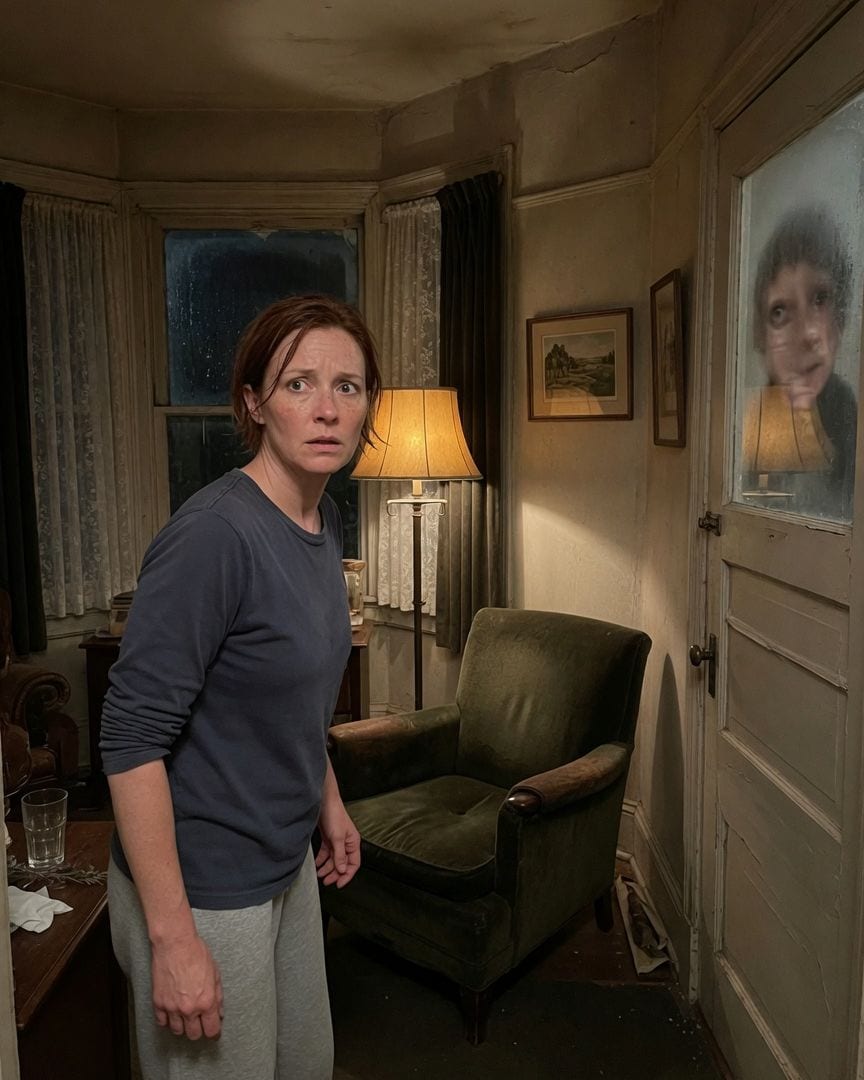
The armchair by the bay window was warm last Tuesday at 9pm. I’ve never sat in it, and the cushion was still settling from a weight that wasn't mine.
I bought this old house for quiet, and most days it's exactly what I needed. But there’s an antique armchair in the living room, deep green velvet, with a permanent hollow from years of use. I’ve never sat in it, yet last Tuesday, I found it radiating a distinct warmth, the cushion slowly settling as if someone had just left.
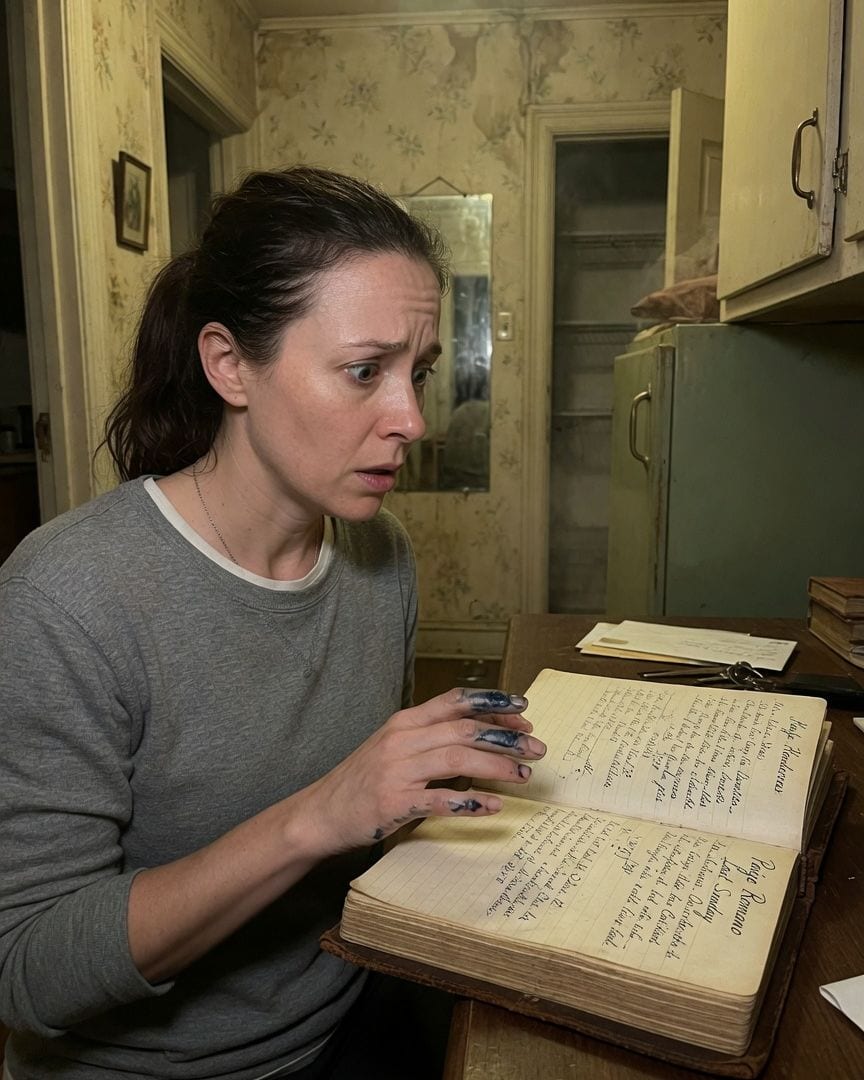
My visitors' book records guests who arrive in the future. Last Sunday, my own name appeared at the bottom, the ink still wet.
I bought an old house last March, complete with a dusty, leather-bound visitors' book. It seemed a charming relic, until I found new entries appearing, dated months into the future, the ink still wet. Then, my own name, Paige Romano, appeared, dated 'Last Sunday,' with a bead of ink shimmering at the 'R'.
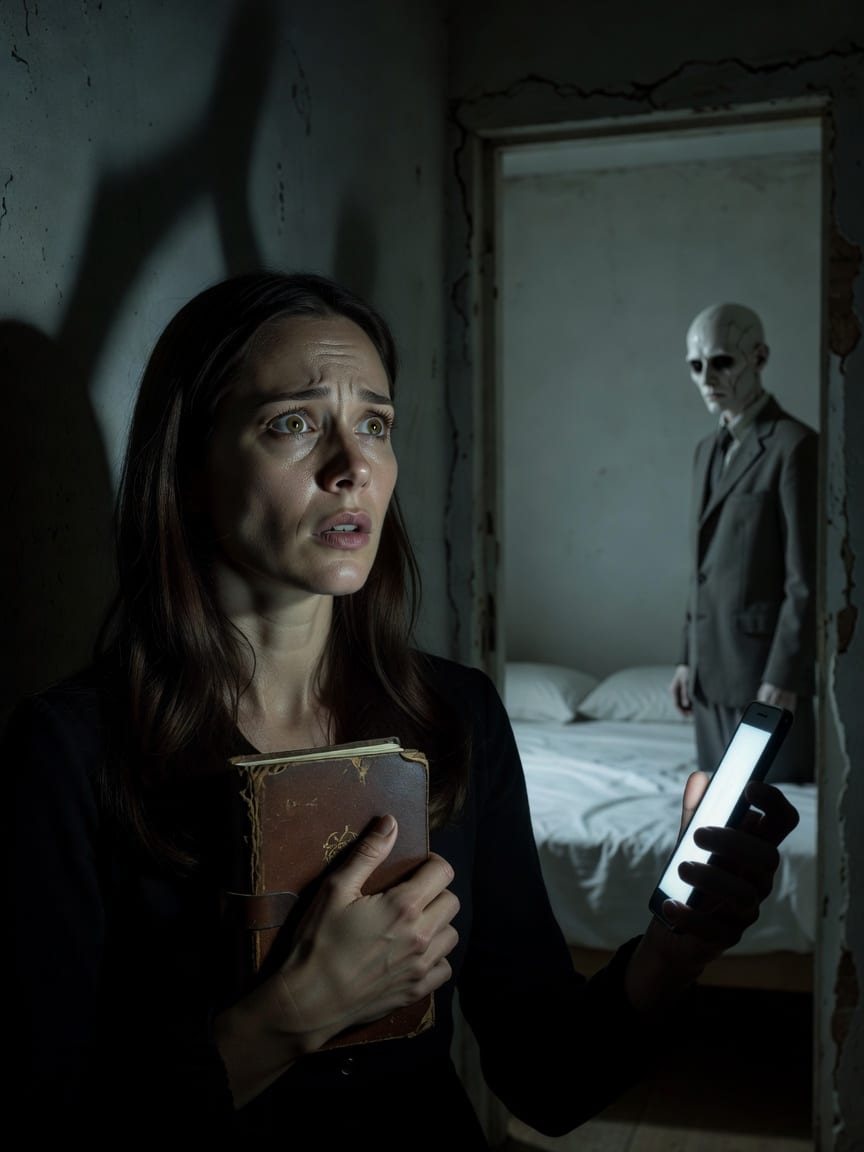
Behind a plastered-over doorway, I found a room. Papered, carpeted, and furnished with a made bed, sealed for decades. The air was dead still, but the bed wasn't dusty. My council tax bill only lists five rooms.
I'm Claire, an architect, meticulously planning my new Victorian terrace renovation. But when I uncovered a hidden room behind a wall, everything I knew about time and decay shattered. The bed was perfectly made, the air still, yet there was no dust, only an unnerving cold.
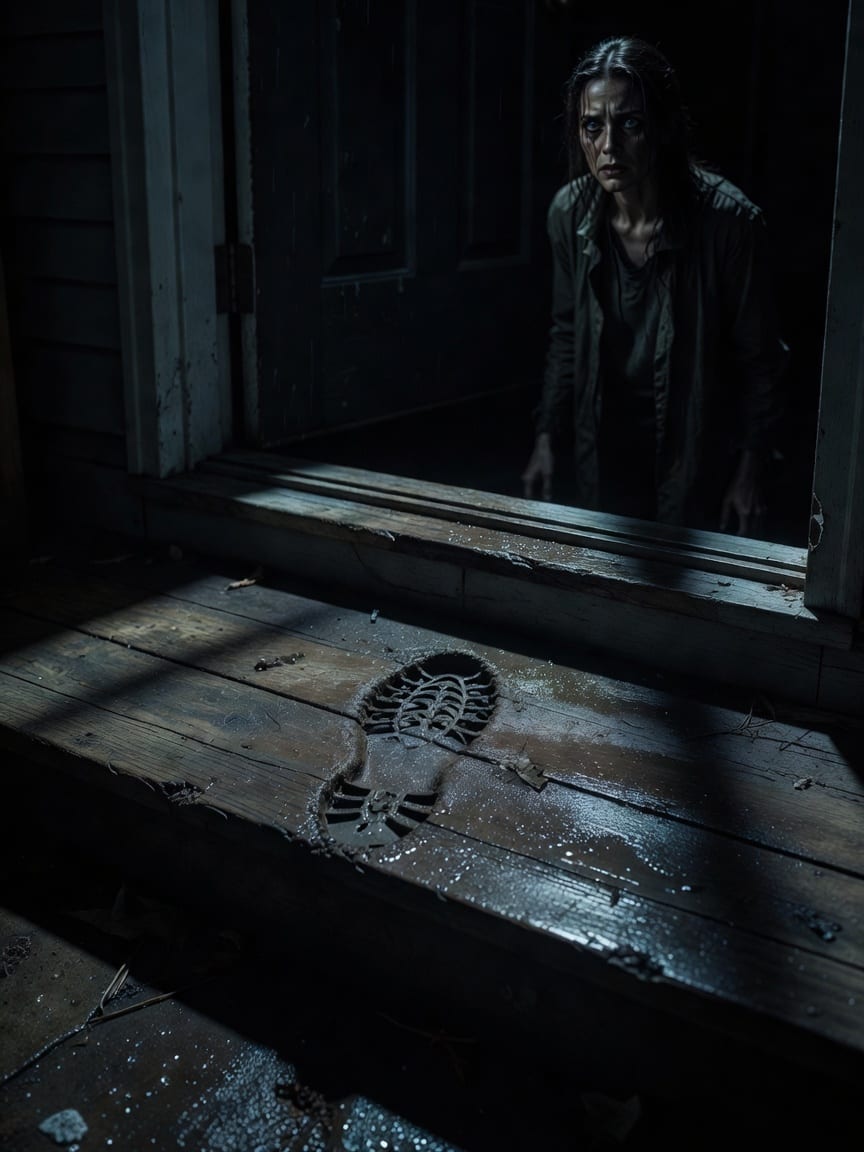
My landlord's only rule: never let the outside tap run after sundown. Last week it dripped. This morning, wet bootprints ringed the back step from the tap to my door, all the same size. The tap was off.
We'd just settled into Waterside House, with its strange landlord rule about the outside tap. After the washer broke, I found perfect, wet bootprints leading from the tap to our back door, but the tap was cranked completely off, tighter than I could manage.
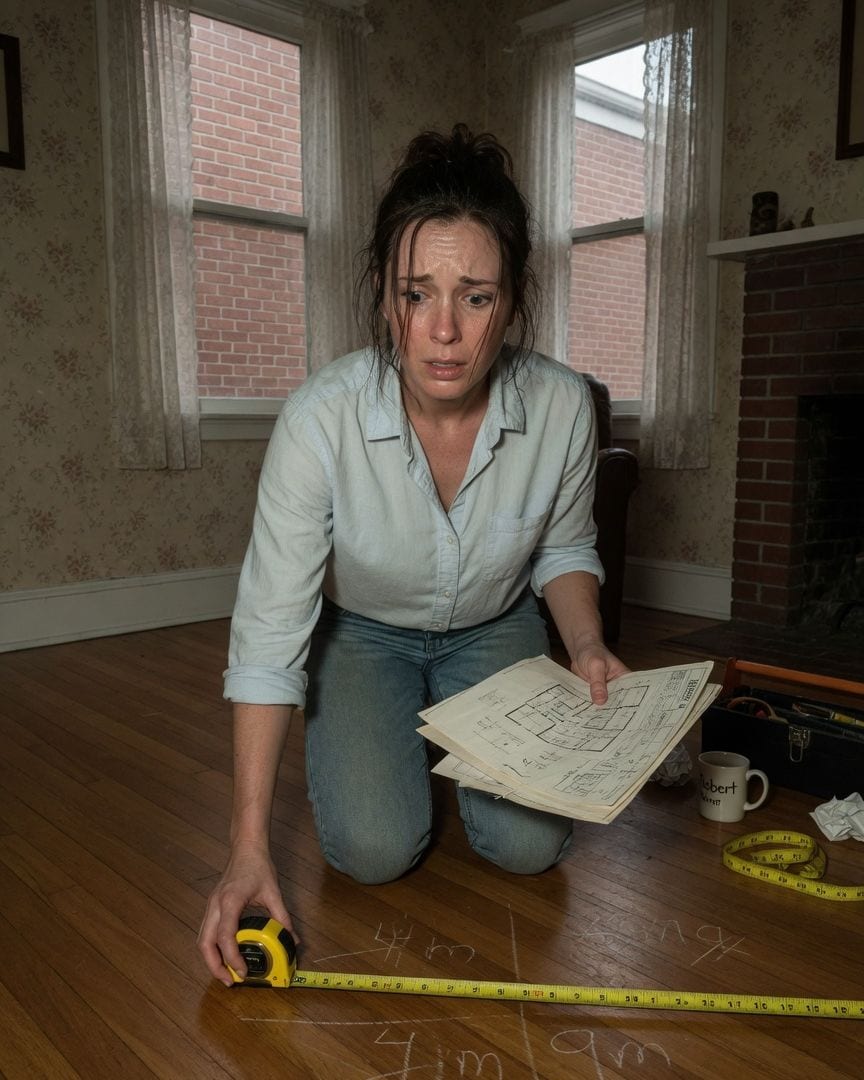
Our living room measures four by five metres. But the outside wall is nine metres long. A metre of house, gone, and I can't find it.
After moving into our charming 1920s house, I was meticulously measuring the living room when the dimensions refused to add up. My calculations of the interior space led me to discover a narrow, unpainted fifth door in the hallway, tucked almost out of sight. It wasn't on any original plans, and it opened to absolute, impenetrable darkness.
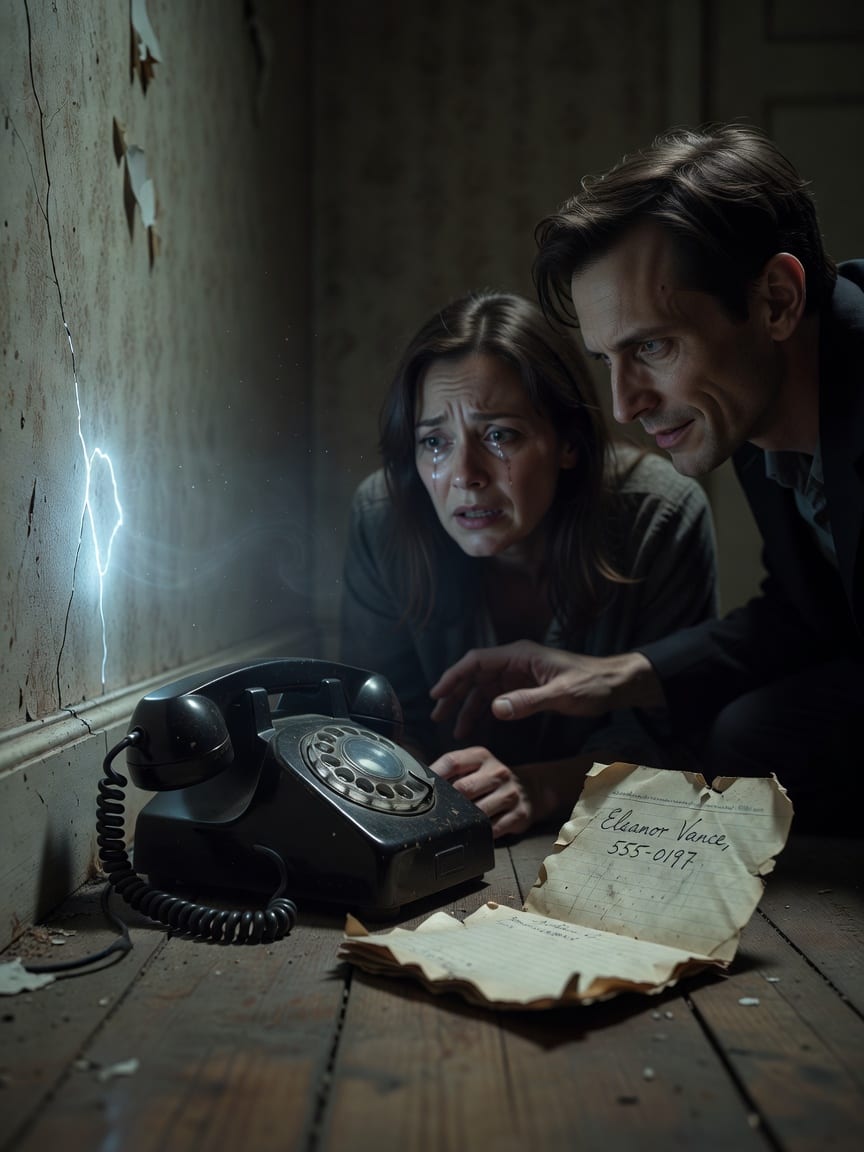
My house's walls ring when I dial a phone number from a 1974 directory. My neighbors said that directory was trash.
I was sifting boxes in my new house when I found an old 1974 telephone directory for my street. It listed my address, 12 Elm Street, under the name "Mr. & Mrs. Sheppard." On a whim, I called the faded seven-digit number. My cell phone rang, but a low, muffled sound also vibrated from the wall beside me.