A Fire Controlman's radar shows a man standing on the open ocean. Then, its head turns to stare directly at her ship.
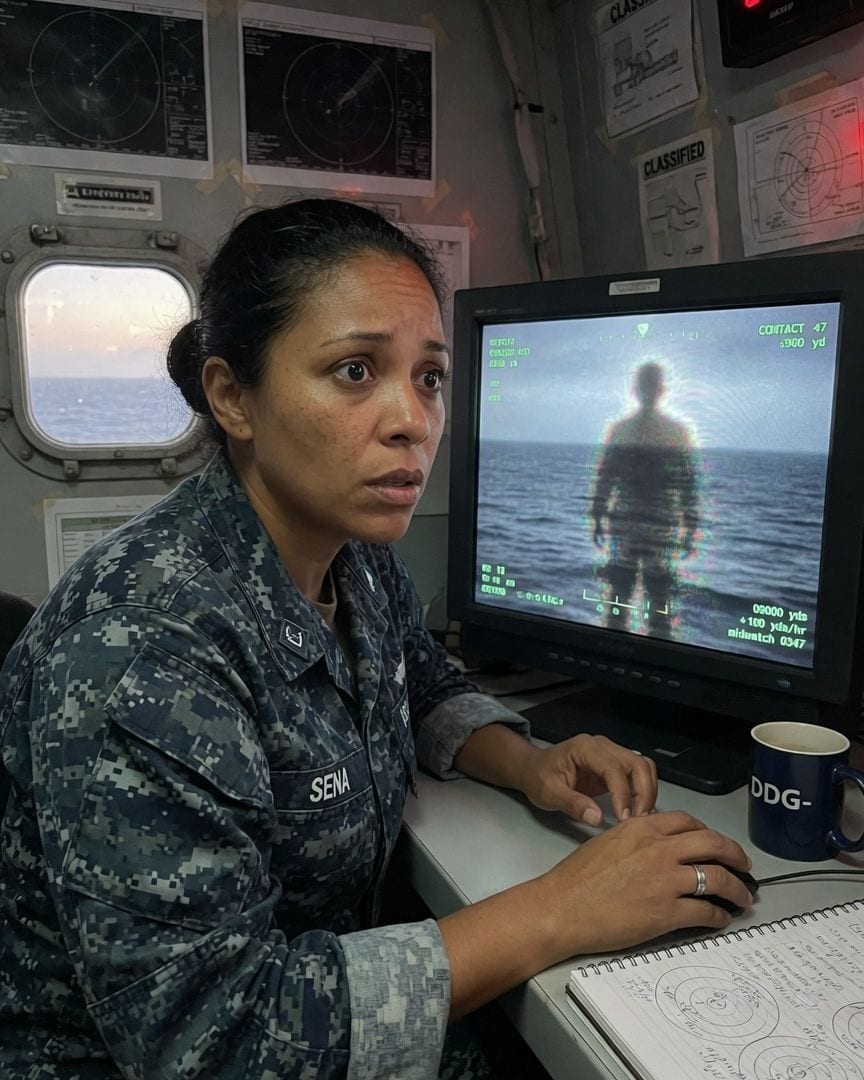
Fire Controlman First Class Iris Sena, two weeks from a career-making shore command transfer, stared at her SPY radar console in the DDG's Combat Information Center.
For the third midwatch in a row, a surface contact held perfect station nine thousand yards off the starboard bow. It was invisible to the bridge’s glasses, the FLIR, and every other optical sensor.
Yet, the radar kept painting it, a faint, persistent blip, inching a hundred yards closer each hour, a phantom presence on the open ocean off Norfolk. She’d run diagnostics, recalibrated, even swapped out a sensor array, but the contact remained.
Every time first light touched the horizon, it vanished without a trace, only to reappear on the next midwatch, picking up its slow, methodical creep.
Iris, a squared-away Fire Controlman with a spotless record, trusted her instruments, but what they showed her defied every protocol, every lesson in her twenty-eight years.
The system, designed for absolute accountability, was failing, or worse, reporting something that couldn't exist.
The next morning, after her watch, Iris pulled the recorded video feed from the radar. She sat alone in a small analysis room, the glow of the screen reflecting in her tired eyes.
She fast-forwarded through hours of empty ocean, past routine patrols and distant merchant ships, until she reached the midwatch. There it was, the faint blip, holding station.
She zoomed in, pixel by pixel, expecting to find a glitch, a reflected wave, a digital anomaly. What she saw made her stomach clench.
For a brief, flickering moment, not a ship, not a wave, but a shimmering distortion of light appeared on the water's surface. It pulsed, a faint heat signature that no instrument had registered, then resolved into a static, human-shaped silhouette.
It was indistinct, like heat haze off asphalt, yet undeniably a figure, standing on the vast, empty sea. Her mind raced for a rational explanation—atmospheric refraction, an optical illusion caused by the radar's frequency—but her training screamed otherwise.
Nothing in her experience, nothing in the Navy's doctrine, accounted for a man-shaped light distortion holding station on the sea, invisible to the naked eye.
The air in the small room seemed to grow heavier, pressing in on her, making the silence louder.
Iris Sena zoomed in further, her fingers trembling slightly on the controls. The figure on the screen, a shimmering outline of a man, stood utterly still, facing the ship.
Then, as she watched, a slight shift in the light, a barely perceptible flicker, made it seem as if the figure’s head tilted. The formless 'face' of the light distortion turned, slowly, deliberately.
Iris froze, a cold dread seeping into her bones. It wasn't just a static image. The figure was now looking directly at the DDG’s bow, at the very bridge where she had been standing, as if watching her watch it.
The next day, Iris tried the official channels. She presented her findings to Commander Hale, the ship’s XO, a stern but fair officer.
He listened patiently, reviewed the video, and dismissed it as a sensor anomaly, advising her to get some rest. “Sena, you’re up for shore command. Don’t let a phantom blip derail your career now.”
He tapped the table, a final, dismissive sound. Unconvinced, Iris started digging.
She spent her off-watch hours in the ship’s library, then discreetly accessed naval archives through a secure terminal, searching for any historical precedent of such an anomaly, any unexplained contact.
Her search kept circling back to one name: the USS Vance, a destroyer that had vanished 65 years ago in these very waters, officially lost with all hands. No wreckage, no distress call, just gone.
The reports were sparse, almost intentionally so. She found old news clippings, vague and contradictory, about a 'severe storm' that no other vessel in the area had reported. The official narrative felt thin, too neat.
Iris began cross-referencing names, dates, and locations, a growing unease coiling in her gut. The Vance wasn’t just lost; it felt like it had been erased.
The ship’s hum, usually a comforting drone, now felt like a low, incessant vibration under her feet, a subtle tremor that hinted at something hidden.
Iris’s persistent inquiries did not go unnoticed. Commander Hale called her into his office, his face grim. “Sena, I’ve had some inquiries about your recent… research. You’re attracting attention. Drop it.”
He didn’t elaborate, but the implication was clear, heavy in the air between them. Later, while Iris was in the library, a file she’d been reviewing on naval disappearances from the 1950s was abruptly removed from the server, inaccessible.
She tried to retrieve it, but the system logged a 'corrupted file' error. It was too specific, too convenient. That night, during her midwatch, FC3 Hughes, a junior sailor, reported a strange incident.
He fidgeted, his gaze darting around the CIC, avoiding her eyes. “FC1 Sena, I swear I heard something on the external comms, just static, but it sounded… like a voice, whispering my name.”
Hughes was visibly shaken, but the comms log showed nothing. Iris felt a prickle on the back of her neck.
Someone knew she was digging, and they were sending a message, not to her directly, but through the system, through her crew.
The CIC itself seemed to hold its breath, the rhythmic beeps of the consoles suddenly stark against the silence. The anomaly wasn’t just an observation anymore; it was observing her back.
The pressure mounted. Iris knew she had to force the issue. She confronted Commander Hale again, this time with a printout of the sparse, contradictory Vance reports she’d managed to piece together. “Sir, this doesn’t add up.
The storm reports are inconsistent. No wreckage, no bodies, just a blank slate.” Hale sighed, rubbing his temples. The lines around his eyes seemed to deepen with a weariness Iris hadn't noticed before.
“Sena, there are things… classified incidents that remain classified for a reason.” He hesitated, glancing at the closed door, then leaned forward, his voice low, almost a whisper. “My grandfather was in the Navy.
He served on a sister ship to the Vance. He told me stories, things that weren’t in the official reports. He said the Vance wasn’t lost in a storm. He said they just… stopped responding.
And then, for weeks, other ships in the area reported phantom contacts, ships that weren’t there, maintaining station. It was covered up, declared a total loss, and everyone was told to forget it.”
Hale looked at her, his eyes weary, haunted. “They said it was mass hysteria, the stress of the Cold War. But my grandfather… he swore they heard voices on the open net, calling out names. Names of the Vance crew.”
The revelation hit Iris hard, a cold wave washing over her. The radar blip, the shimmering figure, the whispered name to Hughes – it all clicked into place, the disjointed pieces of her puzzle suddenly forming a coherent, terrifying image.
The contact wasn’t a glitch; it was a desperate, methodical attempt at communication, a call for accountability that had been ignored for decades.
The very air in Hale's office seemed to vibrate with the weight of unspoken history, the room suddenly vast and echoing with ghosts.
Driven by Hale’s reluctant admission, Iris redoubled her efforts. She knew there had to be more. Late that night, circumventing official channels entirely, she accessed a truly archaic database, one that predated digital manifests, filled with scanned, handwritten logs.
The old terminal whirred, its fan struggling against the dust of decades. She searched for 'USS Vance' and 'crew'. Pages of faded, yellowed text scrolled by, each entry a ghost from a bygone era.
And then, buried deep within a supplementary engineering log, a document clearly marked 'UNOFFICIAL - DO NOT FILE', she found it. A list of names, scribbled in a different hand, appended to the official crew roster.
It was a partial list, perhaps a last-minute addition, or a record of those who had gone missing before the official 'loss'.
Her eyes scanned down the list, past unfamiliar names, until they landed on one that made her blood run cold.
'Sena, I.' it read, followed by a series of numbers that, while not her own service number, held an unnerving, almost identical sequence. Her breath hitched, a sharp, involuntary gasp.
The cold realization settled, a leaden weight in her chest, that this isn't just about a lost ship; it's about her.
The unofficial manifest, with 'Sena, I.' on it, detonated in Iris’s mind. It wasn't just a coincidence. Her grandfather, Franklin Sena, had been a seaman on the USS Vance.
He was listed on the official manifest, confirmed in the archives she’d already seen. The 'Sena, I.' on the unofficial one could only be a mistake, a clerical error, or… a premonition.
The lost crew of the Vance weren't just haunting the seas; they were seeking a very specific form of accountability. The slow, methodical approach of the radar contact, the way it maintained station, was not random.
It was a formation, a silent patrol, searching. And they had found her. The contact wasn't just following the DDG; it was following her, Iris Sena.
They weren't just trying to communicate; they were trying to complete their manifest, to bring a living soul into their ranks, to finally balance the books of the lost.
The 'I' on the unofficial list, so close to her own, was a placeholder, a generational claim. She was the next Sena in line, a debt to be collected, an empty space on their eternal roster, waiting to be filled.
That night, during Iris’s midwatch, the radar contact didn't drop off at first light. Instead, it accelerated, closing the distance rapidly. The CIC buzzed with alarm, the console lights flashing like frantic warnings.
Commander Hale ordered the ship to full alert, but it was useless. The contact was still invisible to every optical sensor. Then, a junior FC called out, his voice cracking, “Sir, surface contact! Dead ahead, closing fast!”
But the screen was empty, a blank void where a blip should have been. Simultaneously, a chilling clatter echoed from the main deck, sharp and metallic above the thrum of the engines.
Iris, already on edge, felt an irresistible pull, a silent summons that bypassed all logic. She ran to the nearest ladder and ascended to the deck, the cold sea air hitting her face with a sudden, shocking intensity.
The ship’s deck was slick with spray, reflecting the pre-dawn gray. And there, lying near the starboard railing, glinting faintly in the gloom, was a waterlogged, rusted dog tag. It bore the faded, unmistakable insignia of the USS Vance.
And etched into its metal, the name: 'Sena, F.' Franklin Sena. Her grandfather.
As she knelt, picking up the impossibly real artifact, her fingers closing around the cold, corroded metal, the air grew heavy, thick with the scent of salt and old, forgotten rust.
The temperature plummeted, a sharp, unnatural drop that made her breath plume. A shimmering distortion began to coalesce just beyond the railing, growing larger, more distinct, resolving into a silent, waiting crowd of figures.
They were no longer just a single silhouette. They were many, their forms made of shifting light, their eyes, if they had them, fixed on her. They had come for their accountability.
Iris clutched the dog tag, her fingers growing numb. A cold, unseen hand settled on her shoulder, drawing her gaze to the impossible faces now just feet away, their forms reaching out.
The DDG returned to Norfolk a week later, its mission cut short, its crew shaken but unable to articulate why.
Fire Controlman First Class Iris Sena completed her transfer to shore command as scheduled, but the long-awaited advancement felt hollow, a meaningless step in a life that had irrevocably shifted.
She was quiet, withdrawn, her eyes holding a far-off, distant gaze that never quite focused on the present.
Her spotless record remained, but the sharp, analytical mind that had once defined her seemed to have dimmed, replaced by a quiet, vacant certainty.
The dog tag, inexplicably found on the deck, was logged as an unidentifiable artifact, its provenance a mystery the Navy would quickly bury under layers of paperwork.
Commander Hale, when questioned about the peculiar end to their deployment, simply stated 'equipment malfunction' and 'personnel fatigue.' The official story held, as it always did.
Iris Sena now worked in a quiet, windowless office, processing manifests and equipment logs. The hum of the shore base was a dull drone compared to the constant thrum of a destroyer.
She was efficient, meticulous, but there was a stillness about her, a profound absence in her presence. She never spoke of her last deployment, never looked at the ocean.
One afternoon, FC3 Hughes, now transferred to the same shore command, stopped by her desk. His voice was hesitant, his gaze uncertain. “FC1 Sena? Are you alright? You seem… different.”
Iris looked up, a faint, almost imperceptible smile touching her lips. It was a smile that didn’t quite reach her eyes, which remained fixed on some distant, unseen horizon.
She just nodded slowly, her gaze drifting back to the endless rows of names on her screen, as if searching for one in particular.
The FC3 eventually backed away, disturbed. Iris Sena remained at her desk, working late into the evening, long after everyone else had gone home.
The names on the manifests blurred, but she kept scanning, her fingers a blur on the keyboard.
And when the new FC3 asked if she was alright, Fire Controlman Sena just smiled, a faint, wrong little smile that didn’t reach her eyes.
If this one got to you
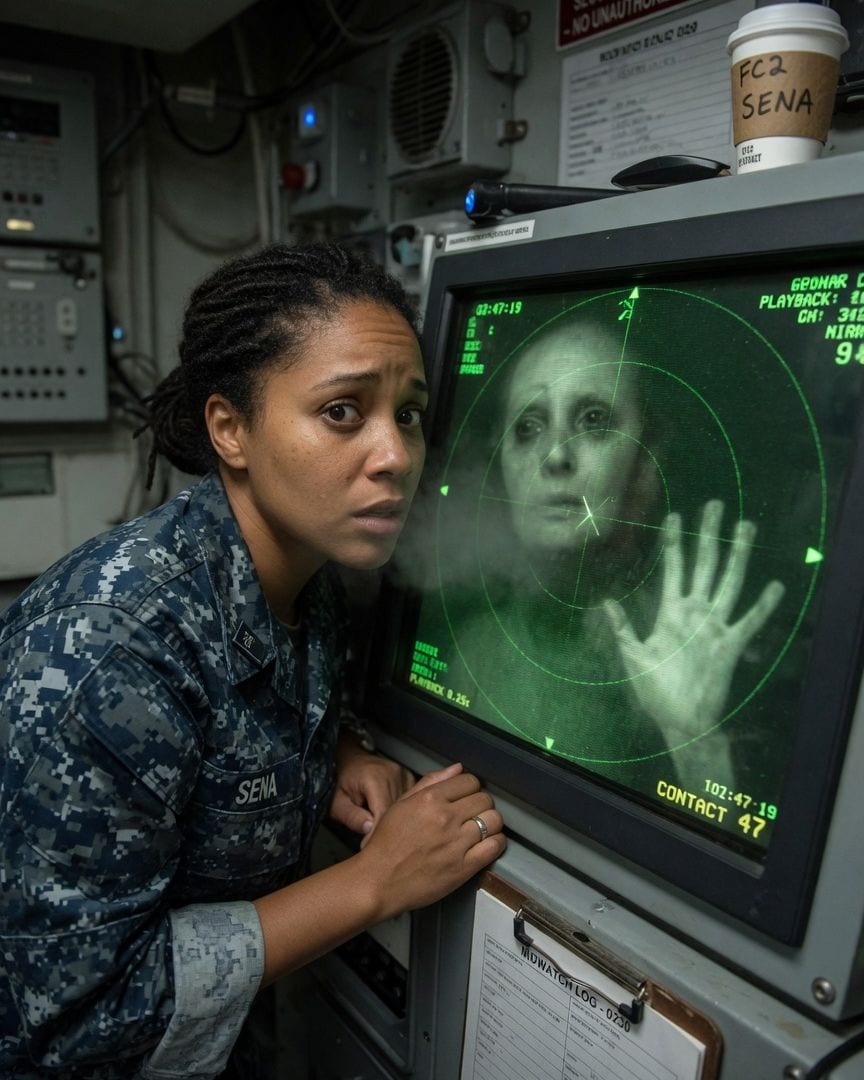
A Fire Controlman saw a gaunt face pressed against her radar screen, from the inside, while a phantom contact crept closer.
Fire Controlman Vera Sena spent her midwatch on the USS Mahan tracking an impossible radar contact that only she could see, silently creeping closer for three nights running. Despite endless checks and reboots, the blip remained, defying logic and baffling her shipmates, an invisible presence in the vast Atlantic darkness. But reviewing her recorded data, she noticed a flicker on the monitor’s glass itself: a blurry outline, like a gaunt face, pressed against the screen from the inside. It stared out with wide, dark eyes, a chilling image superimposed over the digital data, reaching out for a fleeting second before vanishing. What was pressing against her screen, and what did it want from the Mahan?
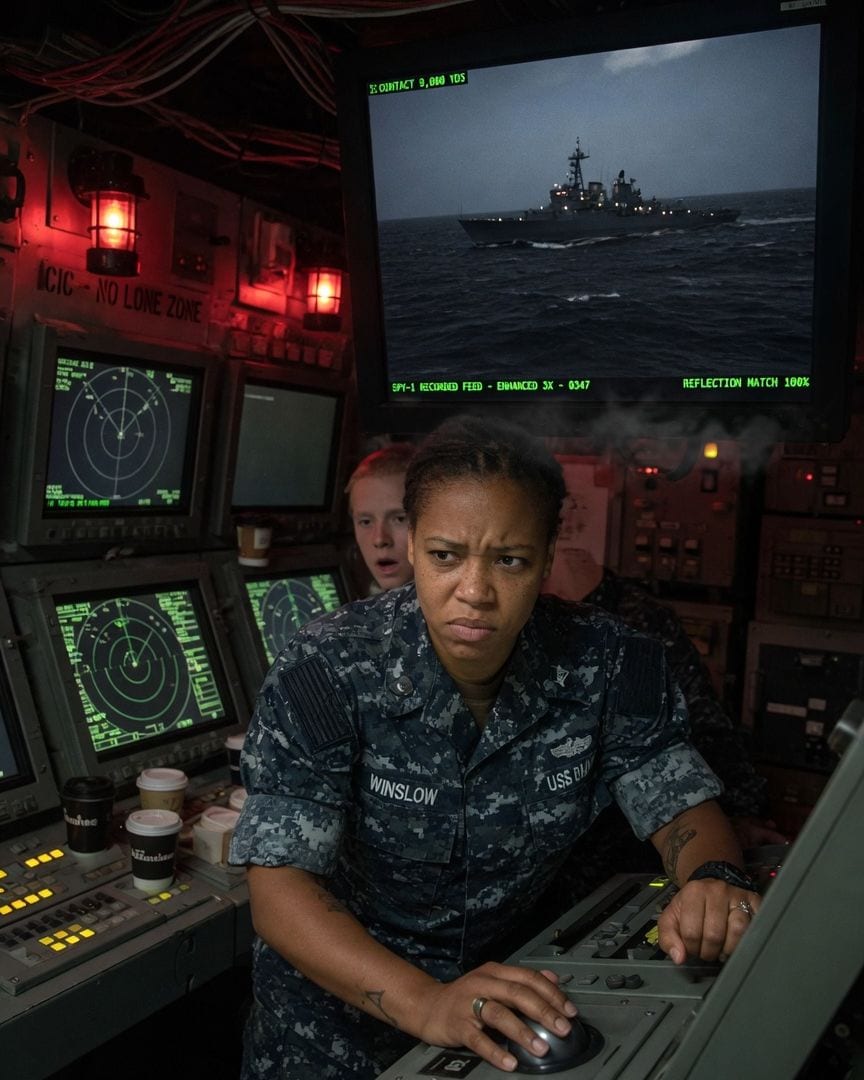
A Fire Controlman tracks an impossible radar contact: a perfect, empty reflection of their own warship, moving in lockstep from a void.
Fire Controlman Sena Winslow spent her third midwatch tracking an impossible radar contact in the USS Banshee's dim CIC. A blip held perfect station off Norfolk, mirroring their destroyer's every turn, creeping a hundred yards closer each hour. Bridge glasses saw only empty ocean and FLIR detected no heat, yet the SPY system screamed 'contact,' a solid digital presence. Sena checked every system, finding no glitch for the profound contradiction. Enhancing the video feed, she finally saw it: a perfect, clear, yet utterly empty reflection of the USS Banshee itself. It was their ship's silhouette, moving in lockstep through the black water, reflected by nothing visible. Cold dread seeped into her bones as the screen showed their spectral twin, mirroring them from an impossible void.
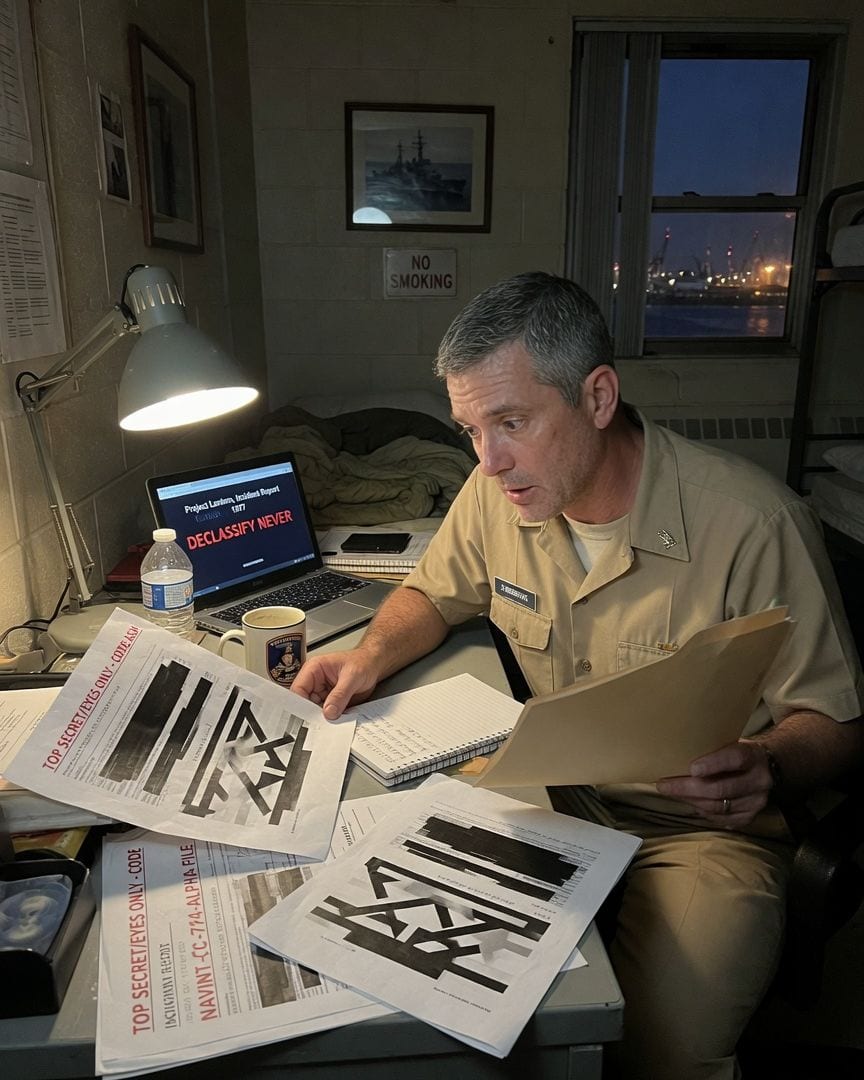
On the USS Farragut, Lieutenant Commander Roy Ashgrove logged a zero-altitude contact. His report was stamped 'TOP SECRET,' and a directive for it read: 'DECLASSIFY NEVER.' He found an old Cold War file with an identical, geometric redaction.
Four days from ending his Gulf deployment, Lieutenant Commander Roy Ashgrove longed for home leave. On the bridge of the USS Farragut, his surface search radar painted a contact a mile off the port beam, but its altitude readout was impossibly zero. He ordered the searchlight on it, watching as the dark mass moved toward the beam, then stopped dead still on the moving water. Roy's incident report was swiftly stamped 'TOP SECRET,' and a follow-up directive carried a chilling downgrade schedule: 'DECLASSIFY NEVER.' His investigation soon unearthed an old Cold War file containing an identical, geometric redaction, hinting at a secret far deeper than a sensor glitch.
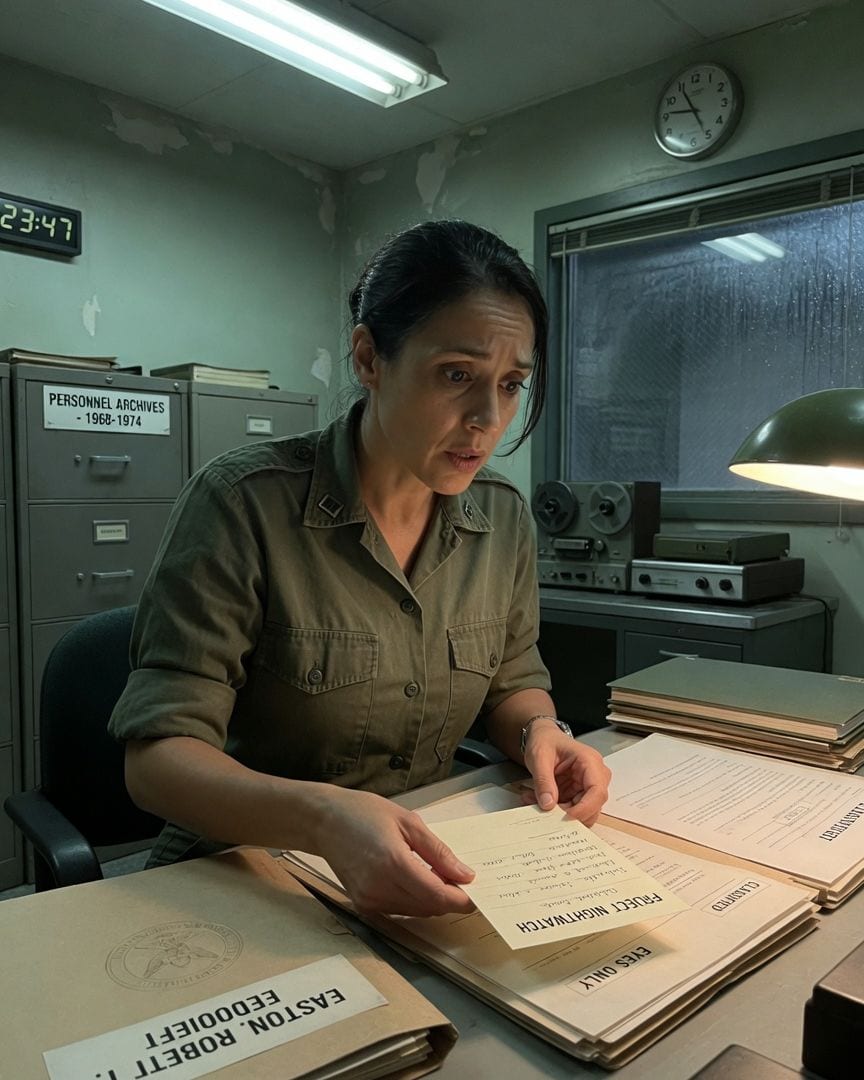
A Cold War tower controller logs an object vanish from radar, then hears the pilot scream it’s filling his windscreen. Her own name, 'Bardolph, Ines', now marked 'Observed' in a secret file.
Captain Ines Bardolph, a tower controller, was counting down the months until her transfer to Langley and the decommissioning of her base, hoping to leave behind the unsettling incidents of her final posting. But one night, her radar scope showed an impossible blip, solid and unwavering, 40 miles north of the Danube, only to vanish in less than a second, leaving a pilot screaming in terror. Despite the clear evidence, the official report blamed "atmospheric inversions," while the terrified pilot received a glowing review and promotion, his file meticulously scrubbed of any anomaly. As Captain Bardolph reviewed the pilot's pristine record, she found a hidden slip of paper, revealing a chilling truth: 'Subject: Bardolph, Ines. Status: Observed.' Was she merely an observer of the impossible, or was she now part of something far more sinister?
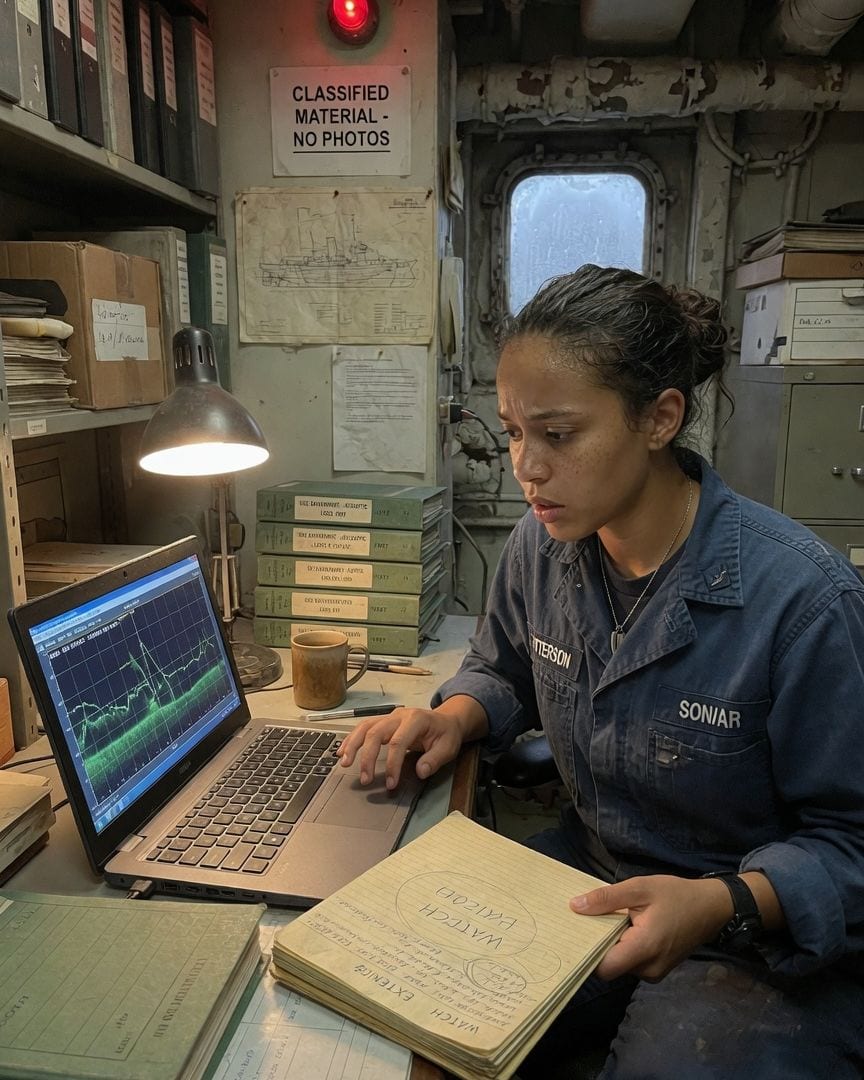
On the USS Calloway's final patrol, a sonar technician found an old log with two chilling words: 'WATCH EXTENDED.'
Sonar Technician Brooke Patterson had only two days left on the USS Calloway's last patrol, a finality that hung heavy in the humid sonar room. Through the impenetrable fog, her radar showed only empty water, but then an impossible biologic contact pinged, mimicking a vessel with eerie precision for three silent hours. It vanished at 0400, just as an identical trace had done weeks before. Searching old archives, Brooke found the precise pattern in a decades-old log from a scrapped destroyer. Scrawled next to it, in faded ink, were two words: "WATCH EXTENDED." What did those words truly mean?
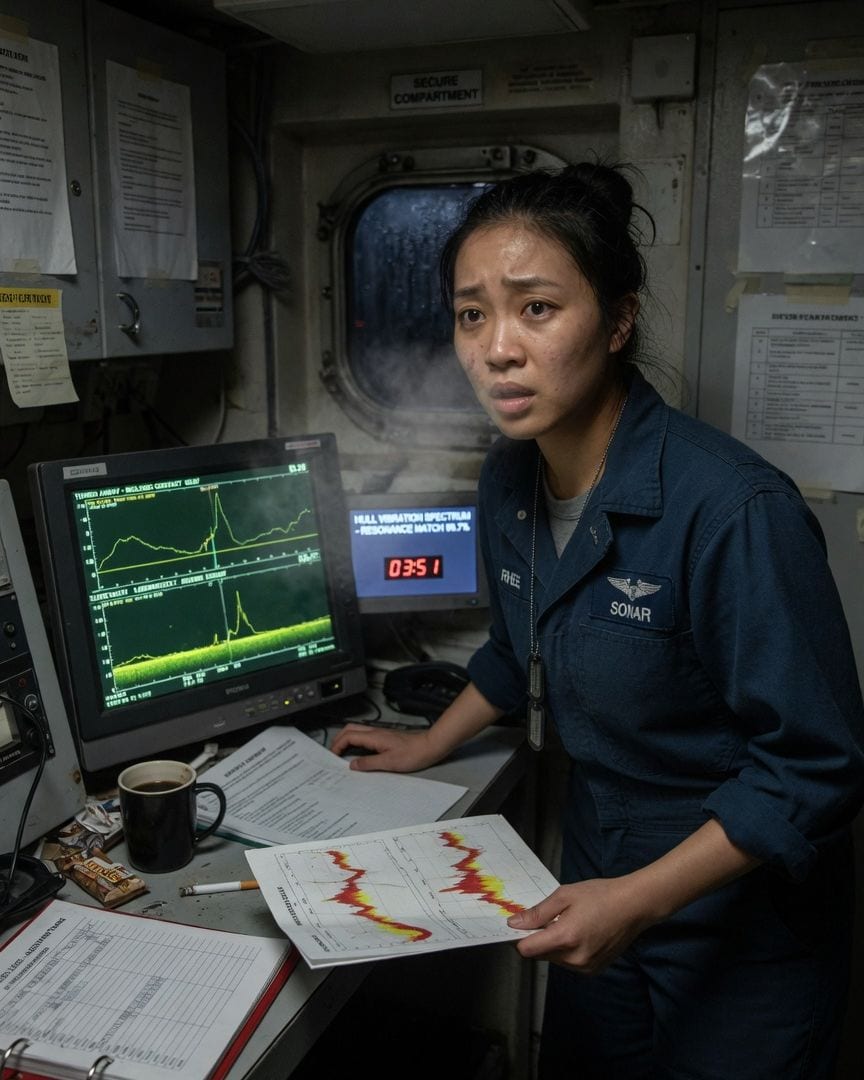
Sonar Technician Isabella Rhee's screen shows a massive hull tracking her ship. Her own hull then vibrates in perfect sync, from outside.
Sonar Technician Isabella Rhee was two days from her final patrol aboard the USS Vance, navigating frigid, fog-choked Aleutian waters. Her sonar screen registered an impossible contact: a solid hull holding forty meters, perfectly matching her ship's tactical turns while radar reported only empty black water. Desperate for answers, Isabella discovered the Vance's internal hull monitors also registered a subtle, high-frequency vibration spike – a resonant thrum mimicking a ship's propulsion, yet coming from outside. A faint, massive dark shape, like a thermal ghost, then briefly appeared on her screen, pressing against the hull where the vibrations originated. What unseen force was tracking the USS Vance?