A Fire Controlman saw a gaunt face pressed against her radar screen, from the inside, while a phantom contact crept closer.
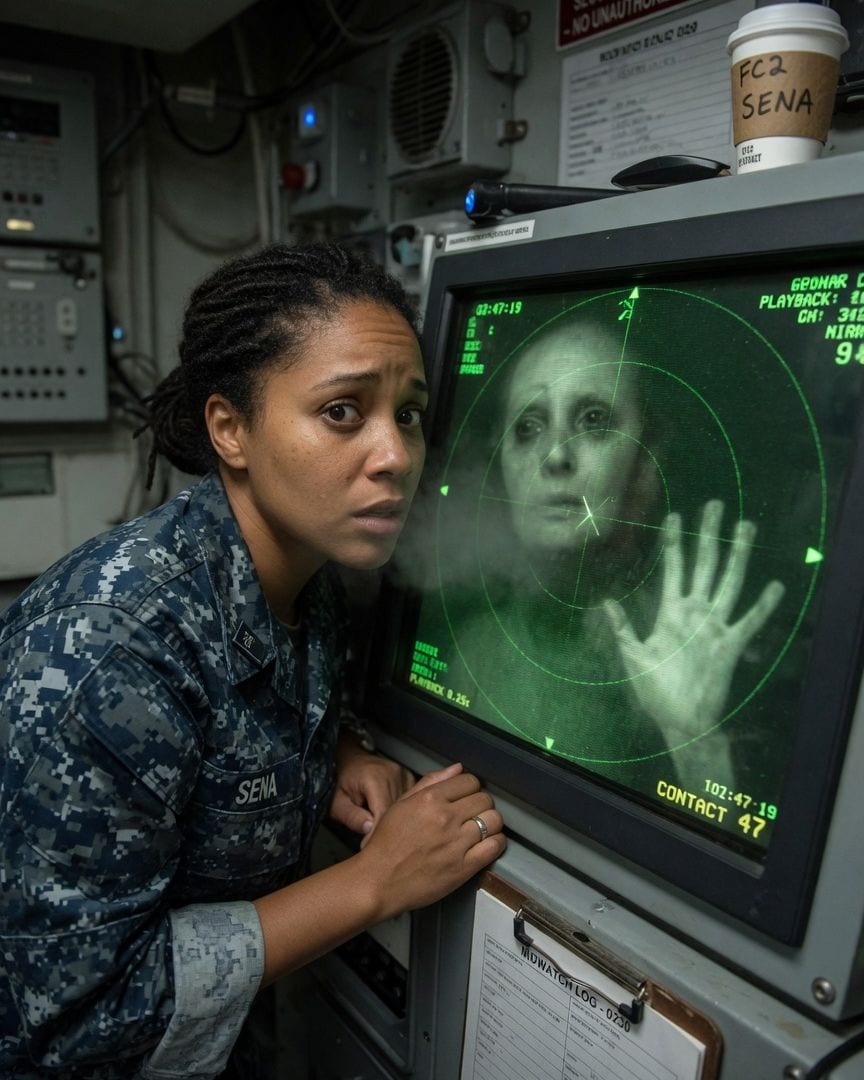
Fire Controlman Vera Sena sat in the dimly lit Combat Information Center (CIC) of the USS Mahan (DDG-72), the green glow of the SPY radar console reflecting in her eyes.
It was 0230, the deepest part of midwatch, and the Atlantic was a black expanse off Norfolk. For the third night running, a surface contact held perfect station at nine thousand yards, its blip unwavering.
She'd watched it creep a hundred yards closer each hour, a phantom precision that defied logic.
Sena had checked every diagnostic, every setting. She’d run through the entire operational checklist, rebooted the system, and even swapped out a suspected faulty card. The contact remained. She’d called the bridge; nothing on their glasses.
Their lookout reported clear skies, calm seas. FLIR, passive sonar—nothing. The other Fire Controlman, Hans Muller, had shrugged and said his console was clean.
It was there, a perfect target on her scope, yet utterly invisible to the rest of the ship. Her fingers hovered over the log entry, the standard form mocking her with its demand for 'verified contact.'
She knew what she was seeing, and it wasn’t a glitch. It was just… there. And it kept coming.
The next morning, off-watch, Sena locked herself in a small, secure compartment with the recorded video from her midwatch. The room was cold, the hum of the ship’s internal systems a low thrum against her ears.
She replayed the segments, frame by frame, zooming in on the contact’s blip, searching for a rational explanation: a software bug, an environmental anomaly, a stray signal from a fishing trawler that had somehow spoofed her system.
The data was clean, too clean. The contact’s bearing rate, speed, and range were consistent to an impossible degree, holding its position relative to the Mahan with an eerie stillness that no actual vessel could maintain for so long.
As the playback reached the point of the contact's closest approach, Sena noticed something. Not in the data stream itself, but on the glass of the monitor. A flicker, a momentary distortion, almost imperceptible against the green static.
It was like a brief shimmer, gone as quickly as it appeared. She frowned, rewound, and played it again, slowing it to an agonizing crawl, her eyes glued to the screen. There it was.
For a split second, a faint, blurry outline. It looked like a face, or perhaps a hand, pressed against the screen from the inside, a fleeting, almost subliminal image that had nothing to do with the radar signal itself.
It was a reflection of something that wasn’t there, yet undeniably present on the display’s surface. Her heart hammered against her ribs, a frantic rhythm against the ship’s steady pulse. This wasn’t a radar ghost. This was something else entirely.
The cold in the room seemed to deepen, wrapping around her.
Vera Sena leaned close to the SPY radar console, her breath fogging the screen. On the frozen frame of the recorded video, the impossible human-like outline on the glass of the monitor was now undeniably clear.
It was gaunt, with wide, dark eyes, staring out from the static, distinct for a split second. Not a reflection of her own face, but something else entirely, superimposed over the digital data.
The image seemed to be trying to reach out, a silent plea or a desperate warning. Her hand trembled as she tried to capture the frame, but the playback flickered, and the image vanished, replaced by the mundane blip.
She knew it wasn’t just a radar anomaly anymore. This was a presence.
Sena began her discreet investigation. She spent her off-watch hours poring over old ship’s logs in the small, dusty records room, a cramped space smelling of stale paper and electronics.
She cross-referenced radar reports from previous deployments of the Mahan and even sister ships, hoping to find a pattern or similar unexplained entries. Official electronic records yielded nothing.
Any anomalous contacts were marked 'sensor malfunction' or 'environmental artifact'—neatly categorized, easily dismissed.
She spoke to Hans Muller, a junior Fire Controlman, who'd mentioned a 'weird blip' once, a few months back, during his own midwatch. He'd quickly dismissed it. "Probably just tired, FC2," Muller had said, shrugging. "You know how midwatches are.
Shadows play tricks." Sena then approached Chief Petty Officer Trevor Hughes, her division chief, a man with three decades at sea and a reputation for knowing everything that happened on any ship.
Hughes listened to her describe the contact, his eyes unreadable as he picked at a loose thread on his uniform. He dismissed it as 'sea stories,' the kind of thing new sailors imagined on long midwatches.
"Every ship's got its ghosts, Sena," he grunted, his voice gruff but not unkind. "Don't go chasing phantoms. You're transferring soon; don't make waves."
But there was a flicker in his eyes, a hesitation that lasted only a fraction of a second, that told Sena he knew more than he let on. The chief’s composure was too perfect.
She returned to the logs, focusing on old, physical logbooks in the back of the room, their pages brittle with age. She searched for midwatch shifts, for anything out of the ordinary that hadn't made it into official reports.
And she found a pattern. Not in official reports, but in the margin notes of these old, physical logbooks, hastily scrawled entries by different FCs over the years: 'Ghost Contact,' 'Unverified,' 'Possible malfunction, persistent.'
The entries were infrequent, easily overlooked, often written in faded ink or pencil, but undeniably there, stretching back decades, always during midwatch. Each note was brief, almost reluctant, but the consistency was chilling.
The ship itself seemed to be whispering its secrets through these forgotten notations.
Lieutenant Commander Charlotte Vance, the Operations Officer, observed Sena’s unusual diligence in the records room. Vance was sharp, by-the-book, and had a reputation for not tolerating distractions from standard operational procedures.
One afternoon, she called Sena into her office, the air crisp and professional, the desktop meticulously organized. "FC2 Sena, I've noticed your recent interest in historical radar logs," Vance said, her voice even, her eyes assessing.
"Is there something you need to report, or are you just getting a head start on your shore duty research?"
Sena felt a prickle of unease. Vance’s questions were precise, cutting through any pretense. She explained her curiosity, framing it as an academic interest in sensor anomalies, a pre-transfer project. Vance's gaze was piercing. "I understand.
However, I must caution you against chasing phantoms, Sena. The stress of an underway, combined with an impending transfer, can play tricks on the mind. Focus on your current duties. The fleet doesn't tolerate… distractions."
The warning was clear, delivered with a polite smile that did not reach her eyes. The coldness emanating from Vance's desk seemed to match the chill in the records room.
Later that day, Sena returned to her secure compartment to review her own radar logs from the previous midwatches. She pulled up the recorded video, the familiar green interface glowing. She noticed a subtle change.
The specific timestamp for the fleeting 'face' she’d seen on the screen was now slightly corrupted. The video segment just before and after it showed a brief, unexplained static burst, a digital noise that hadn’t been there before.
The data wasn't gone, but it was muddied, harder to prove. It looked like an accident, a random glitch, but the timing was too perfect. Someone had been in her files.
Someone knew exactly what she was looking for, and they were trying to make it disappear.
Sena cornered Chief Hughes during a quiet moment in the mess hall, away from prying ears. The clatter of trays and low conversations provided a thin cover.
She laid out the pattern she’d found: the cryptic margin notes stretching back years, the consistent midwatch appearances across different ships and dates, the subtle corruption of her own logs. Her voice was low, urgent.
"Chief," she pressed, "this isn't just sea stories. This isn't just exhaustion. Someone knows. And it keeps happening. Someone tried to erase what I saw."
Hughes’s jovial facade finally cracked. He stopped pretending to be interested in his coffee, his gaze shifting to a point beyond her shoulder, as if looking into the past.
He looked around, then leaned in close, his voice dropping to a near whisper, forced by years of keeping secrets. "Alright, Sena. You're not the first. But you're the first to dig this deep, the first to connect the dots."
He took a deep, shuddering breath, the smell of stale coffee and something else—fear?—hanging in the air around him. "There's a legend, passed down from one old FC to the next. About a Fire Controlman, name of Simon Harlow.
Lost at sea, decades ago. Not a battle, not an accident on deck. A collision. Midwatch."
He paused, his gaze distant, unfocused, lost in memory. "They said his body was never recovered. Just… gone. His service record, they say, got 'lost' in a fire at the archives a few years later. Cleaned up, neat and tidy.
Uncounted." Sena felt a cold dread settle in her stomach, a chill that had nothing to do with the air conditioning. "Uncounted?" she echoed, the word tasting like ash in her mouth. "Yeah. Like he never existed. Erased.
But the sea… the sea remembers. And the ship… it remembers its own. They say he’s still out there, trying to report the contact that hit him. Trying to be accounted for. To finish his watch."
Hughes finished, his voice barely a whisper, the last words almost lost in the din of the mess hall. "He always drops off at first light.
Like he can’t stand the light of day, or maybe… maybe that’s when his watch officially ended. When the new day’s orders came in, and he was still waiting for his." The pieces clicked into place, horrible and precise.
The midwatch, the slow, inexorable creep, the disappearance at dawn. It all fit the story of a sailor trying to complete a final, impossible duty. The dread solidified, growing heavy and cold in her chest.
Driven by Chief Hughes’s revelation, Sena scoured the ship’s small, outdated library, a forgotten corner filled with ancient textbooks and yellowed publications. She searched for anything related to ship collisions or lost personnel from the era Hughes had vaguely referenced.
She eventually found an old, unofficial ship’s yearbook from a sister destroyer, the USS Sterling (DDG-68), tucked away in a forgotten locker behind a stack of navigation manuals. The pages were stuck together, the binding cracked.
Inside, a faded, grainy photograph showed a young, smiling sailor in a group shot of the Fire Control division. His face was blurry, but the uniform was unmistakable, the earnest youth in his eyes palpable.
Underneath, a handwritten caption in neat block letters read: 'FCA Simon Harlow, 19XX.' Sena felt a jolt, a sudden recognition that punched the air from her lungs. This was him.
She then found an old, barely legible casualty report, brittle with age, from the naval archives. The paper was thin, almost translucent, its text faint. It detailed a catastrophic mid-ocean collision between two destroyers, approximately thirty years prior.
The report listed all hands recovered from both vessels, with one chilling exception: 'Harlow, Simon, FCA. Unrecovered.' The destroyer he’d served on, the USS Sterling (DDG-68), had been heavily damaged.
The date of the collision was starkly visible, a black mark on the aged paper: October 14th, 0037. Sena's breath hitched, caught in her throat. October 14th.
That was the exact date of the oldest 'Ghost Contact' margin note Chief Hughes had pointed out in the logbooks, a faint, almost illegible entry in pencil.
It wasn't just a legend; it was a recurring event, a persistent echo tied to a specific loss, a name that refused to be forgotten by the deep.
The chill in the ship's library suddenly felt deeper, colder than the air conditioning, as if the uncounted presence had just brushed past her.
The full, horrible truth detonated in Sena's mind, shattering any lingering hope for a rational explanation. Simon Harlow had been on midwatch, likely at the radar console, when the collision occurred.
His 'final contact' wasn't a phantom, but the other ship, closing fast, a threat he tried desperately to report, a warning that went unheeded.
The slow, inexorable creep of the radar blip was his unfinished warning, his ghost forever trying to complete his last, most critical duty. He was stuck in that moment, forever reliving the seconds before impact.
The 'face' she’d seen on the monitor was his desperate attempt to communicate, to be seen, to be counted, to scream his warning one last time across the decades.
The 'accountability that cannot be' wasn't just a lost record; it was a soul still on station, trapped in a loop of its final, terrifying moments, forever unseen, unheard, but ever present.
He sought to rejoin his ship, to deliver his report, to make his presence known to a system that had erased him.
The recurring nature across different ships, different rotations, different FCs, and through all the intervening years wasn't random; it was tied to the specific conditions of his loss: midwatch, in a similar operating area off the coast of Norfolk, on a ship of the same class.
He was trying to report for duty, to warn them, to be recognized. Every clue now clicked into place, forming a coherent, terrifying pattern of a duty-bound ghost, a final, uncompleted transmission across the veil.
The USS Mahan was ordered to a specific waypoint for a routine training exercise.
As Sena reviewed the charts in CIC, a cold knot formed in her stomach: the waypoint was eerily close to the coordinates of the USS Sterling's collision, decades ago, just a few nautical miles from the site of Harlow’s final duty.
It was her final midwatch before transfer, a few short hours until she was off the ship for good.
At 0215, the contact appeared again, closer than ever, its blip almost filling the screen, no longer a phantom dot but a significant presence. This time, a tremor ran through the entire CIC.
Equipment buzzed with an unusual hum, the lights flickered momentarily. The bridge reported an inexplicable 'sensor ghost' on their own systems, not just Sena's radar, but their surface search and even their limited visual aids.
The air grew heavy, thick with an unseen presence, pressing down on everyone.
Sena, knowing the truth, knew what she had to do. She bypassed Lieutenant Commander Vance, bypassed Chief Hughes, bypassing procedure and rank.
Without authorization, she opened an urgent channel and broadcast a warning over the ship’s internal comms system to the bridge.
Her voice, though strained, was clear and precise, detailing the contact's true nature, its history, and its connection to Simon Harlow. She urged them to change course, to break the pattern, to acknowledge the uncounted.
As she spoke, she simultaneously created a detailed log entry on her console, documenting everything she knew, every piece of evidence, every chilling detail, ensuring it would be recorded in at least one official system.
The moment her transmission ended, the CIC doors burst open, slamming against the bulkheads. Lieutenant Commander Vance, face etched with fury, stormed in, her eyes blazing. "Fire Controlman Sena! You are relieved of duty! Confined to your bunk, immediately!"
Sena stood, her gaze fixed on the radar screen, where the impossible blip continued its slow, inexorable creep, now closer than ever, just beyond the bridge’s visual range, its final warning almost delivered. Her duty was done.
The USS Mahan, after a brief, unexplained course correction ordered by the bridge (officially attributed to 'avoiding unexpected maritime traffic'), completed its mission without further incident.
Vera Sena was formally reprimanded for insubordination and making 'unsubstantiated claims,' her final log entry flagged 'unverified' by Lieutenant Commander Vance. Despite the disciplinary action, her transfer to shore duty proceeded as planned, a quiet, expedited departure.
The incident was scrubbed from official reports, a minor blip in the ship's operational history, a footnote for those who cared to look.
Sena carried her proof with her: a small, encrypted data chip containing her original radar recordings and the historical documents she'd uncovered. Nobody believed her, but she knew. She carried the truth, a heavy, unseen burden.
Years later, Vera Sena lived a quiet civilian life, working a desk job far from the sea, the hum of office fluorescents a pale echo of the ship’s pulse.
She still kept a small, faded printout of the radar screen from that last midwatch, the one with the faint distortion, tucked away in an old photo album.
She occasionally checked naval forums, lurking in obscure threads about ship legends and unexplained phenomena, a habit she couldn't break. One day, scrolling through an old, forgotten thread titled 'Midwatch Ghosts,' she saw a new post.
It was from a Fire Controlman on a different DDG, asking about 'the phantom midwatch contact' that kept perfect station, creeping closer each hour, always dropping off the scope at first light. Sena's blood ran cold.
The contact was still out there, still trying to report.
The post had no replies, but the date it was made was exactly twenty-five years to the day after the USS Mahan, hull number DDG-72, was decommissioned and scrapped.
If this one got to you
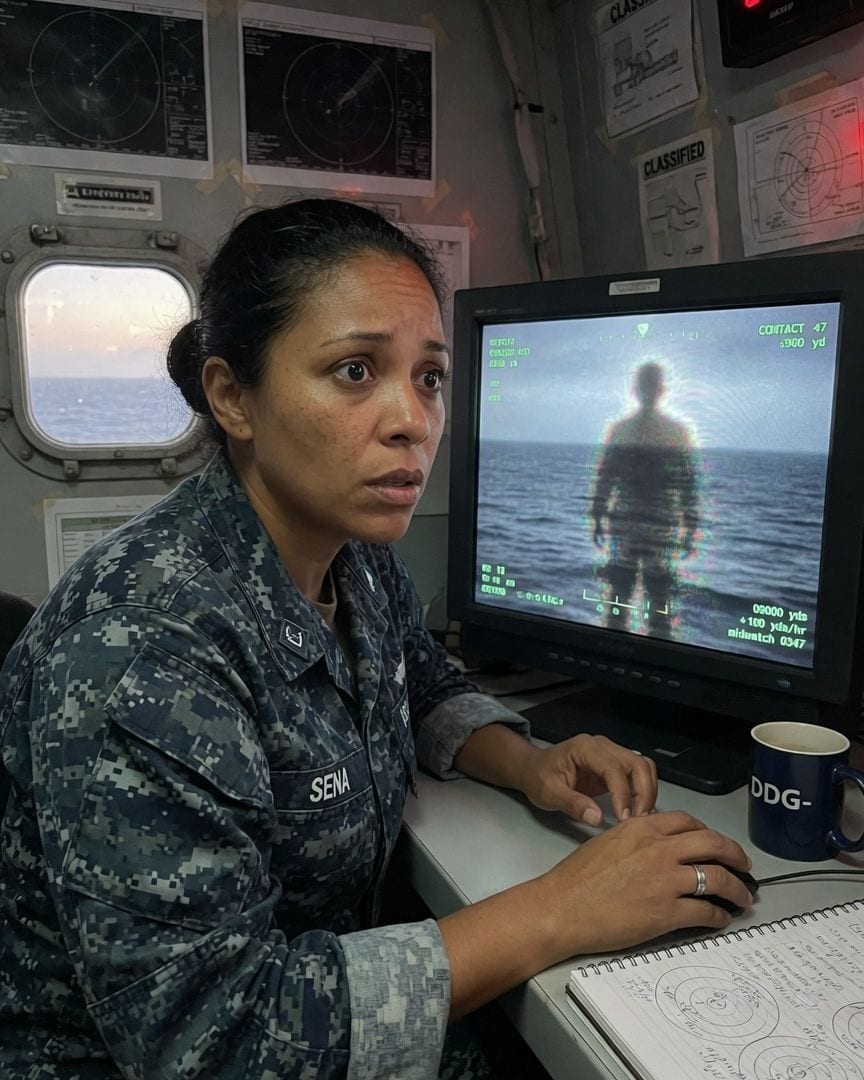
A Fire Controlman's radar shows a man standing on the open ocean. Then, its head turns to stare directly at her ship.
Fire Controlman First Class Iris Sena, just two weeks from a pivotal career transfer, kept watch over her radar console aboard a destroyer off Norfolk. For three midwatches, a phantom contact held perfect station, a faint blip invisible to every optical sensor, yet inching closer each hour. Reviewing the radar’s video, she zoomed in to find not a glitch, but a shimmering, human-shaped distortion of light, undeniably a figure standing on the vast, empty sea. A cold dread seized her as the figure’s formless head slowly tilted, its gaze now fixed directly on her ship, as if watching her watch it.
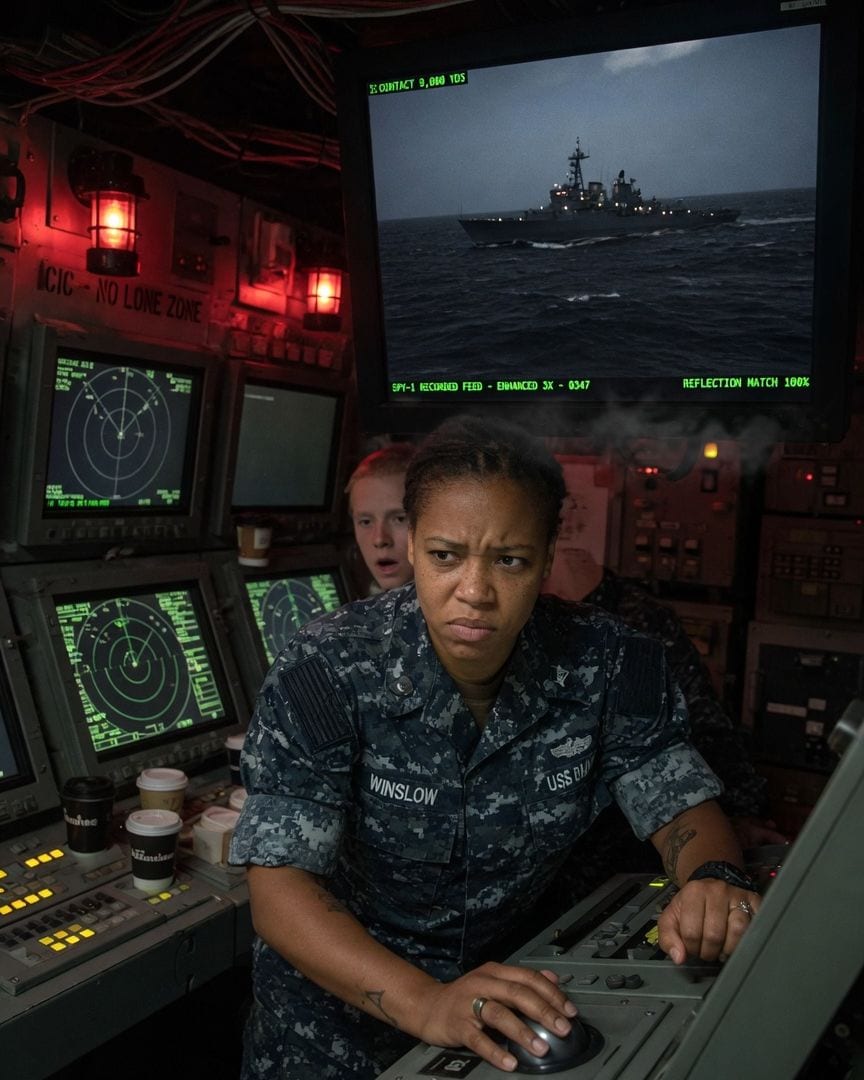
A Fire Controlman tracks an impossible radar contact: a perfect, empty reflection of their own warship, moving in lockstep from a void.
Fire Controlman Sena Winslow spent her third midwatch tracking an impossible radar contact in the USS Banshee's dim CIC. A blip held perfect station off Norfolk, mirroring their destroyer's every turn, creeping a hundred yards closer each hour. Bridge glasses saw only empty ocean and FLIR detected no heat, yet the SPY system screamed 'contact,' a solid digital presence. Sena checked every system, finding no glitch for the profound contradiction. Enhancing the video feed, she finally saw it: a perfect, clear, yet utterly empty reflection of the USS Banshee itself. It was their ship's silhouette, moving in lockstep through the black water, reflected by nothing visible. Cold dread seeped into her bones as the screen showed their spectral twin, mirroring them from an impossible void.
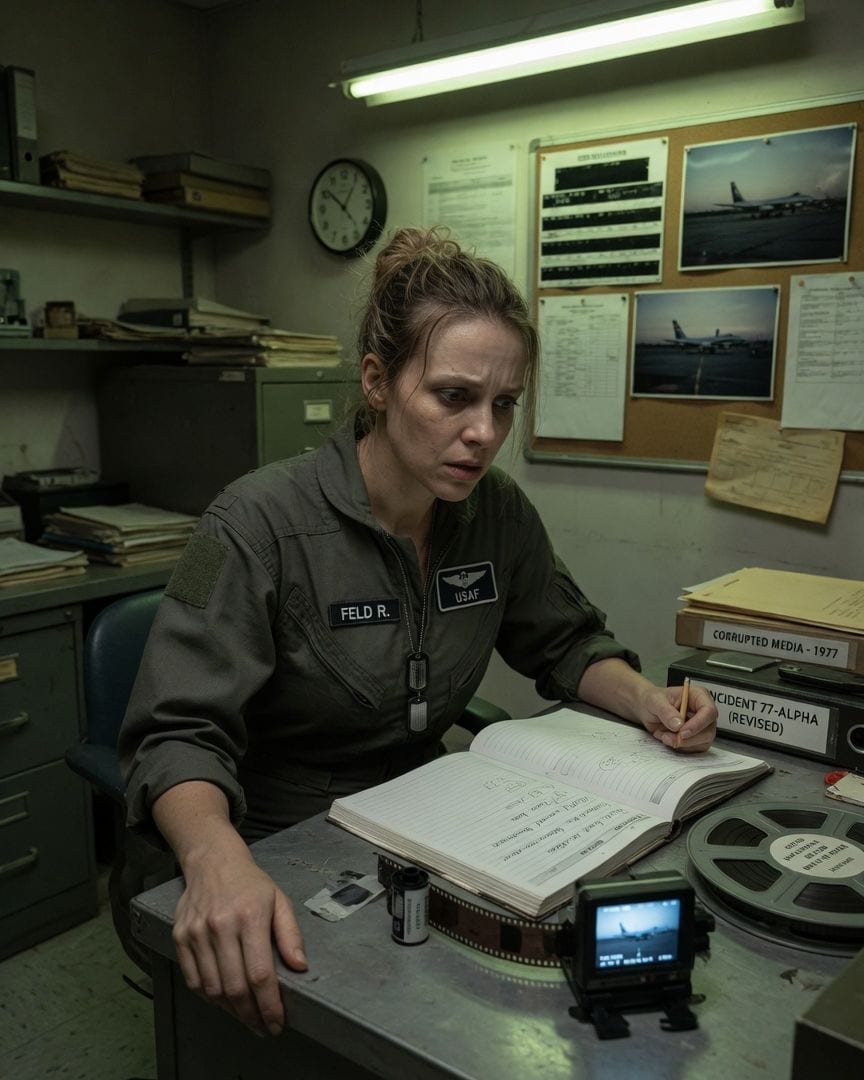
A pilot's gun camera caught an impossible craft. It pulsed a geometric symbol directly at her lens.
Captain Rosamund Feld sat in a sterile debriefing room, her flight log open, battling the fatigue in her eyes. She insisted her jet had returned to base ahead of her, silent, orbiting an empty tower. But Major Ingram claimed sensor malfunction and presented a 'revised' radar tape, erasing the incident. Determined to prove what she saw, Feld unearthed her gun camera footage from old records. The grainy film revealed a dark, non-metallic craft, rotating impossibly, then pulsing a strange geometric symbol directly at her lens.
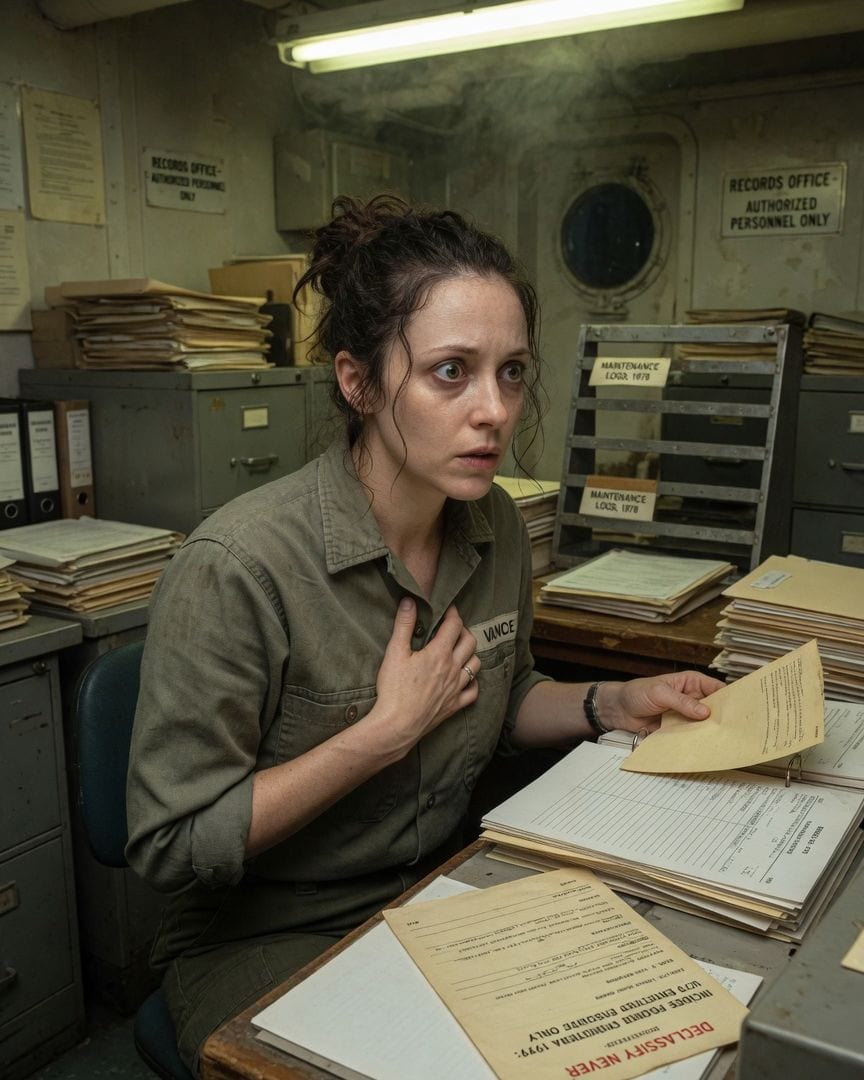
A Cold War carrier radar operator's first solo watch tracked a craft dropping 60,000 feet in four seconds. The next morning, her tape reel was gone.
A young radar operator, Peggy Vance, faced her first night alone in the USS Enterprise's Combat Information Center, the massive carrier steaming silently off San Diego. Her green-lit scope revealed an impossible contact: a craft dropping sixty thousand feet in under four seconds, then holding station just two hundred yards off the bow. Despite her detailed log, the tape reel vanished and official records showed no incident. The ship's history had been tampered with.
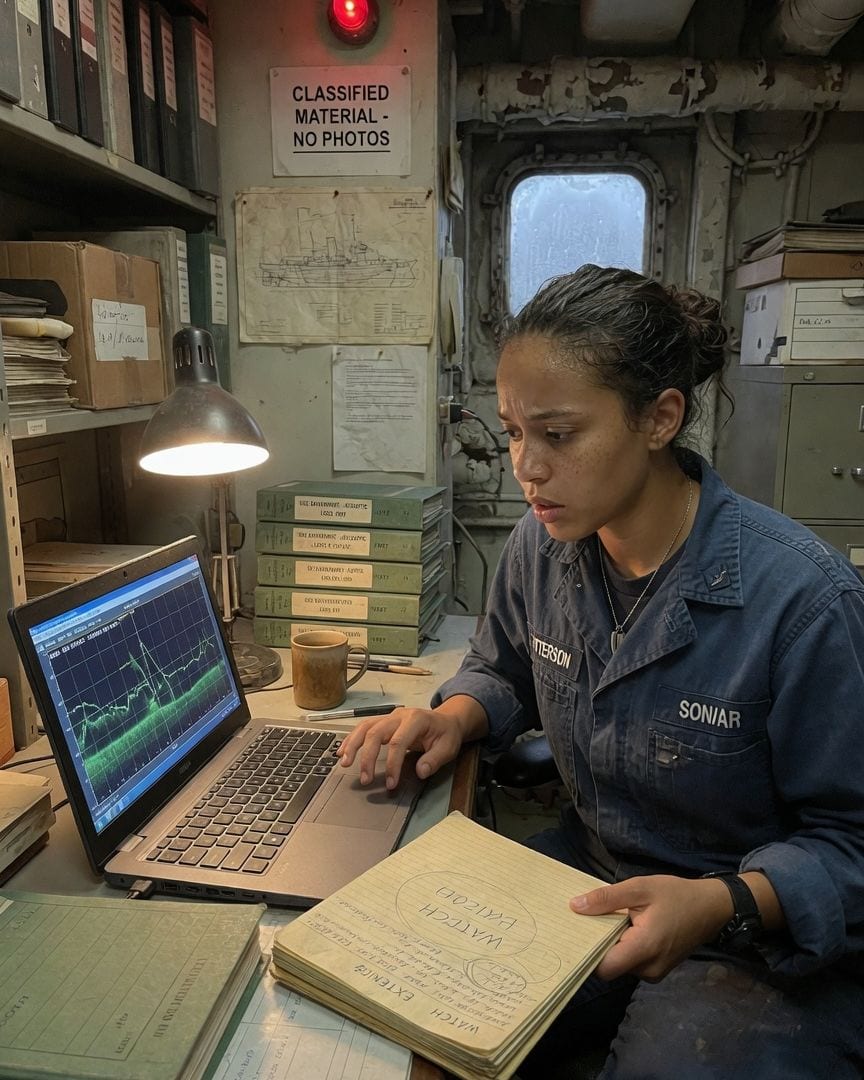
On the USS Calloway's final patrol, a sonar technician found an old log with two chilling words: 'WATCH EXTENDED.'
Sonar Technician Brooke Patterson had only two days left on the USS Calloway's last patrol, a finality that hung heavy in the humid sonar room. Through the impenetrable fog, her radar showed only empty water, but then an impossible biologic contact pinged, mimicking a vessel with eerie precision for three silent hours. It vanished at 0400, just as an identical trace had done weeks before. Searching old archives, Brooke found the precise pattern in a decades-old log from a scrapped destroyer. Scrawled next to it, in faded ink, were two words: "WATCH EXTENDED." What did those words truly mean?
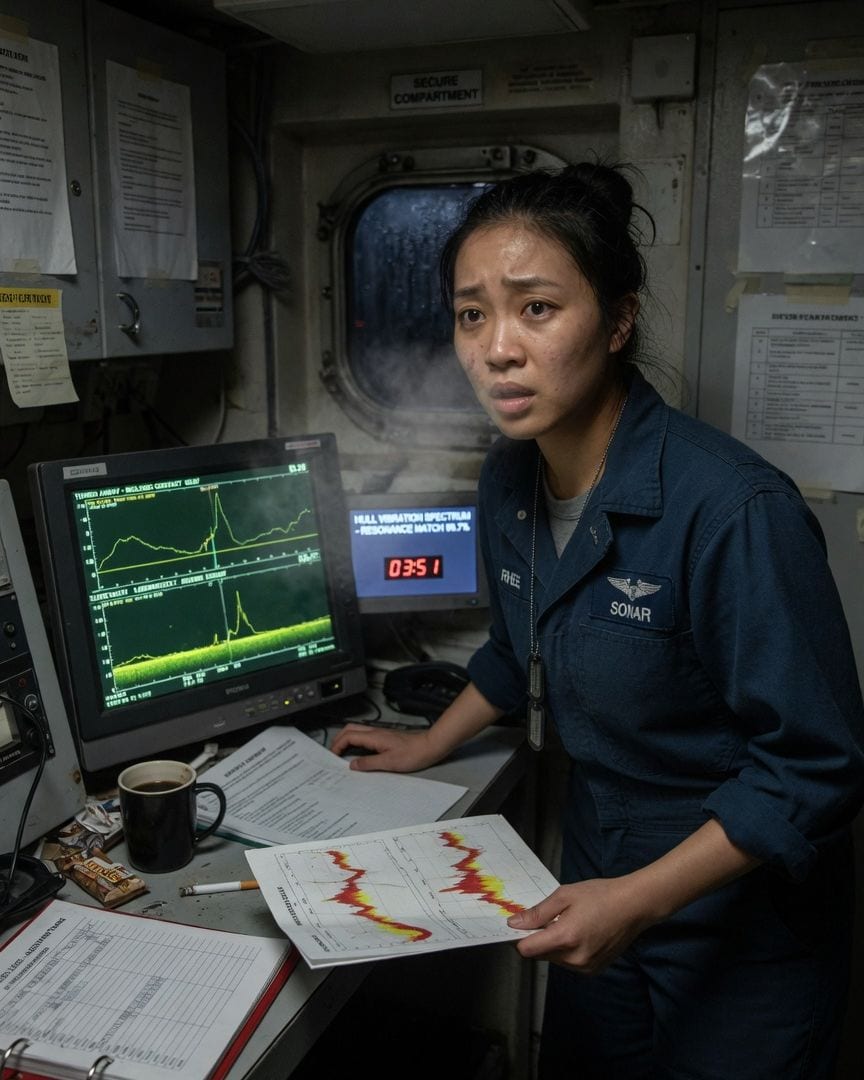
Sonar Technician Isabella Rhee's screen shows a massive hull tracking her ship. Her own hull then vibrates in perfect sync, from outside.
Sonar Technician Isabella Rhee was two days from her final patrol aboard the USS Vance, navigating frigid, fog-choked Aleutian waters. Her sonar screen registered an impossible contact: a solid hull holding forty meters, perfectly matching her ship's tactical turns while radar reported only empty black water. Desperate for answers, Isabella discovered the Vance's internal hull monitors also registered a subtle, high-frequency vibration spike – a resonant thrum mimicking a ship's propulsion, yet coming from outside. A faint, massive dark shape, like a thermal ghost, then briefly appeared on her screen, pressing against the hull where the vibrations originated. What unseen force was tracking the USS Vance?