A pilot's gun camera caught an impossible craft. It pulsed a geometric symbol directly at her lens.
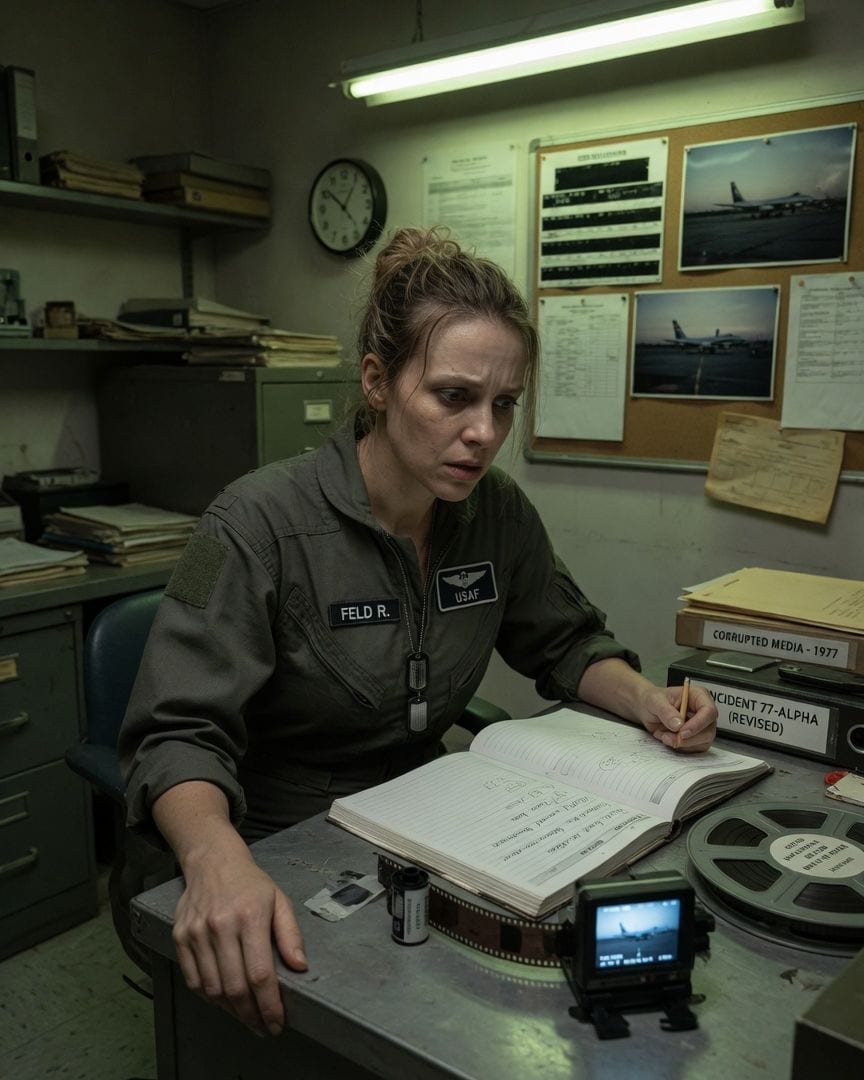
Captain Rosamund Feld, still in her flight suit, sat at a metal table in a sterile debriefing room. Her flight log lay open, its crisp pages a contrast to the fatigue in her eyes.
She tapped a pencil against the entry for her last flight: 'Target: Unidentified. Maneuvers: Extreme.' Her mind replayed the impossible numbers she'd scribbled on a napkin: 200+ Gs. No known aircraft, not even hers, could withstand that.
The two officers across from her, Major Ingram and Captain Romano, glanced at each other. The fluorescent lights hummed, making the silence feel heavy, like a weight.
Ingram cleared his throat, 'Captain Feld, the preliminary report indicates a sensor malfunction, possibly an atmospheric inversion.' Feld looked up, her expression calm but resolute. The air in the room felt thin. 'Major, my aircraft's systems were green.
Every gauge, every display. And the tower was silent when it orbited the field. It didn't malfunction. It came home ahead of me.' The silence that followed was heavy, thicker than the Dakota night itself.
Days later, Feld was presented with the final incident report, a thick binder of officialese. It detailed 'atmospheric anomalies' and 'pilot disorientation.'
The radar tape attached, labeled 'Feld, R. Incident 77-Alpha,' showed her jet's pursuit, then the blip simply faded into general clutter. Feld frowned. The radar screen had always held a crystal-clear image of the unidentified craft. 'This isn't the tape.
There's a section missing.' Major Ingram, seated across from her, raised an eyebrow. 'Captain, this is the official recording. Any other footage would be considered extraneous.' Feld persisted. Her palms felt clammy. 'I had a gun camera running.
It records everything on the target acquisition.' Ingram's smile was thin, a practiced gesture. 'Ah, the gun camera. Unfortunately, that footage was corrupted during retrieval. Standard procedure during high-stress maneuvers.' Feld felt a cold knot in her stomach. Corrupted.
She remembered the clear, sharp image on her HUD, the way the blip had resolved into something more, something… deliberate, something following her commands, not just moving randomly. She pushed the report back across the table. 'I can't sign this.
It's inaccurate.' Ingram sighed, then gestured to a junior officer. 'Captain Feld requires further review. Please provide her with the standard archive access for related incidents, and a fresh copy of the radar tape.'
The junior officer returned with a new, identical reel, still sealed in its casing, but the label was subtly different: 'Feld, R. Incident 77-Alpha (REVISED).' Feld knew, without opening it, that the critical seconds would still be gone.
Ignoring the 'revised' tape, Feld spent hours in the base's old records office, a place that smelled of dust and forgotten paper.
She patiently requested every piece of 'corrupted' media from her flight, sifting through boxes no one else seemed to care about. She finally retrieved a small, unmarked canister, almost certainly overlooked, tucked behind a stack of dated flight manuals.
Inside, a single reel of 16mm film. Back in her quarters, the hum of the air conditioning seemed to mock her. She threaded the film into a portable viewer she'd borrowed from a technician.
The grainy footage flickered to life: her cockpit, the HUD display, the target growing larger. Then, the craft. Not a blip, but a smooth, dark form against the night sky. It wasn't metallic. It was utterly black, absorbing light.
As she closed, it didn't flee. It began a slow, deliberate turn, rotating on an impossible axis, its surface somehow shifting, becoming more defined, less amorphous. Feld zoomed in on the single flickering frame of her gun-camera footage.
The craft’s surface reflected no light, but absorbed it, and for a split second, a complex, luminescent geometric symbol, not etched but appearing to shift beneath the surface, seemed to pulse directly at the lens.
Then it’s gone, replaced by the smooth, impossible dark.
The symbol burned into Feld’s memory. It wasn't just a flicker; it was a gaze, a recognition. She knew then that this wasn't an equipment malfunction, or even a foreign incursion. This was something else entirely, something that had looked back.
Her official duties became a cover for her real investigation. She started digging into the base archives, a maze of dusty shelves and forgotten files in the oldest part of the administration building.
The air grew colder the deeper she went, as if the building itself held its breath. She requested 'unexplained aerial phenomena' reports, 'atmospheric disturbance' incidents, anything that might align with her experience.
The records were a masterclass in obfuscation: a radar ghost here, a weather balloon there, an 'inversion layer' for every impossible acceleration. But patterns emerged.
Across decades, she found reports of impossible G-loads, objects appearing and disappearing without trace, always filed under different, mundane cover stories. The sameness of the lies was chilling.
She noticed a recurring detail: many of these incidents, like hers, involved objects returning to the vicinity of military installations.
One afternoon, while sifting through a shelf labeled 'Meteoric Impact Surveys, 1950-1960,' she found a small, unmarked wooden box tucked behind a stack of binders. It wasn't listed in any finding aid, had no accession number.
Inside, wrapped in faded canvas, was a reel of film, its label handwritten in a precise, looping script: 'Observation Log, Site Beta. Unclassified-X. 1958.'
Feld took the unlabeled reel back to her quarters, a tremor of unease accompanying her. The footage was grainy, silent, showing a distant, dark form hovering over a desolate landscape, mirroring the impossible object from her own encounter.
It was the same craft, decades earlier. The dread deepened. Her search hadn't gone unnoticed.
A few days later, she found her office door ajar, a faint scent of ozone in the air, like a storm had just passed through the room.
Nothing was missing, but her 'Revised' radar tape, which she'd left in a locked drawer, was now conspicuously placed on her desk, the seal broken. A quiet warning, as clear as a shouted command.
Later that day, Major Ingram called her in. His tone was cordial, almost paternal, a smooth surface over something hard. 'Captain Feld, your recent enthusiasm for archival research is commendable.
However, I must remind you of the sensitive nature of some of these records. Unsanctioned access to classified materials carries severe penalties. We wouldn't want to see a promising career cut short by… curiosity.'
He paused, his gaze fixed on hers, the silence in his office thick enough to taste. 'There are some things, Captain, that are best left filed.' The message was clear. She was being watched, managed.
But the knowledge of the ancient craft, the impossible symbol, and now this older footage, pushed her past the point of turning back. She knew Ingram wouldn't give her answers.
But there was one man, now retired, who had signed off on dozens of these 'unexplained' incident reports from the 50s and 60s: Marcus Kowalski, the former chief records clerk.
Feld found Marcus Kowalski living a quiet life in a small town outside the base, his house filled with the scent of pipe tobacco and old paper. The walls seemed to breathe with the weight of forgotten stories.
She approached him cautiously, showing him the 'Observation Log' film. Kowalski’s eyes widened, a flicker of recognition in their depths. 'Where did you find this, Captain?' he asked, his voice raspy with age. 'It was… unlisted.'
He chuckled, a dry, humorless sound that crackled like old parchment. 'They’re all unlisted, in one way or another. Or listed under half a dozen different categories, just to keep things… neat.' Feld pressed him.
Her heart hammered against her ribs. 'What is it? What did you see?' Kowalski leaned back, a faraway look in his eyes, as if gazing into another century. 'What we saw, Captain, was a pattern.
Not a threat, not an invasion. A pattern. They’ve always been here. Coming and going. Always returning to certain… points. Like this base. Or that old observation site in the film.'
He pointed to the screen, where the dark form hovered silently. 'They don’t communicate in words, not like us. They communicate in events. In physics-defying displays. In impossible returns.'
Feld thought of the G-forces, the craft orbiting the field, the way it had simply come home. 'And the records? The cover-ups?' Kowalski sighed. 'The records are how we cope. How we contain the panic. How we file the un-fileable.
We call it 'Project Sentinel'. The craft… they seem to understand the filing. They return to their 'file' after an interaction, like they’re closing out a report.' Feld stared at him, the implications chilling her to the bone.
'So, it wasn't a malfunction. It was… a demonstration. And it returned to the base as if… signing off?' Kowalski nodded slowly. His eyes, though aged, held an unnerving clarity. 'That’s how we came to understand it.
They demonstrate, we record. They return, we file. A quiet agreement, you might say. And some pilots, like yourself… they get a closer look. They're 'activated'.' The word hung in the air, chilling her, settling in her bones.
Feld felt a wave of cold realization wash over her. 'Activated? What does that mean?' Kowalski shifted uncomfortably in his armchair, a creak of old springs echoing in the quiet room. 'It means… you were chosen, Captain.
Or perhaps, you chose yourself by being in the right place at the wrong time, with the right skills. They seem to… select. Or recognize. It’s never clear.'
He pushed himself up and walked to an old metal filing cabinet in the corner of his study, its paint chipped and faded.
The metal groaned as he pulled out a drawer, rummaged for a moment, and then produced an aged, leather-bound ledger. Its title, embossed in faded gold, read 'Project Sentinel.'
He placed it on the table between them, its weight heavy and ancient, radiating a forgotten history. 'This is the master log. The true archive. Not the sanitized versions you found.'
He opened it, revealing page after page of meticulous, cryptic entries. The handwritten script was elegant, precise, almost ritualistic. He pointed to a column of cryptic entries, each with a date spanning decades.
Feld’s eyes fell to a line, not dated from her incident, but years earlier, where her own callsign, 'Vigilant-3', is recorded next to a set of coordinates, already filed.
Feld traced her callsign with a trembling finger, the date years before she had even qualified for her jet. The room seemed to tilt slightly. 'This… this isn't possible.' Kowalski's gaze was solemn, unblinking. 'It is.
You weren't a random encounter, Captain. You were always a part of the record. The craft, they have a way of identifying who they'll interact with, sometimes long before the event.
Project Sentinel isn't just about recording; it's about predicting, containing, and managing the human response to an ongoing, non-human presence. Your 'impossible G-load' was a signature, a demonstration. Your 'letting you hold the lock' was an invitation.
Your craft returning to base was their way of 'closing the file' on that particular interaction.'
He explained that the secrecy machine, far from being evil, was a desperate attempt to maintain global stability, to prevent mass hysteria or misinterpretations that could lead to catastrophe.
They didn't understand the craft's motives, only its consistent behavior and its seemingly benign, albeit unsettling, pattern of interaction. 'We're not fighting them, Captain,' Kowalski whispered, his voice barely audible above the quiet hum of the house.
'We're just… documenting them. And trying to keep the peace.'
The realization that her entire career, her very presence in that cockpit, might have been pre-ordained by an incomprehensible entity, and then silently managed by her own government, was a horror that transcended any fear of physical danger.
Feld returned to the base, the Project Sentinel ledger a phantom weight in her mind, the silence of the hallways now humming with a new, terrible knowledge.
She requested a meeting with Colonel Everett Winslow, the senior intelligence officer Marcus Kowalski had obliquely mentioned. Winslow's office was sparse, clinical, a contrast to Kowalski's cluttered study. The air in the room felt crisp, almost cold.
He listened to her calmly, his expression unreadable, as she laid out her findings, the gun-camera footage, the patterns, her callsign in the ancient ledger. When she finished, he simply nodded.
'Captain Feld, you've proven yourself a remarkably perceptive and tenacious officer. You've uncovered what few ever do.' He leaned forward, his voice low and even, devoid of any surprise or judgment. 'Project Sentinel is real.
What Marcus told you is true. We don't understand 'them' fully, but we've learned their patterns. They interact. They demonstrate. They file. And we, in turn, file their interactions, and the chosen witnesses. Your experience, Captain, was not an anomaly.
It was an event within a larger, ongoing system. The impossible G-forces, the return to base, the 'corruption' of your footage – all part of the established protocol, for both sides.' He offered her a choice, not a threat.
His composure was unsettling. 'You can choose to integrate this knowledge. To understand that your role, your unique perspective, is valuable to Project Sentinel.
You will continue your career, with full access to our findings, but with the understanding that this knowledge remains within these walls. Or,' he paused, his eyes unwavering, 'you can choose to be 'filed away' yourself.
A quiet discharge, a transfer to a desk job in a remote location, your records sealed and your story dismissed as a psychological incident. The choice, Captain, is yours. But the truth you now carry, it never leaves you.'
The calm certainty in his voice, the complete lack of malice, was terrifying. It wasn't a villain she faced, but a functionary of a cosmic bureaucracy.
Feld looked at the man, a cog in a machine that spanned decades, and knew she could never unsee what she had seen.
She would choose to file her experience, to live with the knowledge, to become another quiet guardian of the impossible truth.
Captain Rosamund Feld continued her career, rising steadily through the ranks. She became a model officer, efficient, precise, and utterly dependable. The incident, officially classified, faded from open discussion. She never spoke of it, not to friends, not to family.
But the world had changed for her. She saw the quiet omissions in official reports, the subtle ways reality was shaped to fit a digestible narrative.
Every unexplained radar blip, every distant flash in the night sky, carried a new, chilling implication. She became an expert in reading between the lines, in understanding the language of silence.
The dread never left her; it simply became a permanent, quiet companion, a hum beneath the surface of her ordinary life, like a low, constant frequency only she could perceive.
Years later, now a Brigadier General, Rosamund Feld sat in a high-backed leather chair, reviewing a new batch of 'unexplained incident' reports.
The files detailed a pilot's encounter over the Pacific: impossible velocity, sudden disappearances, and a final, chilling detail – the craft had reappeared, orbiting the carrier group, before vanishing for good.
Feld recognized the precise, methodical language of the debriefing, the careful sanitization of the radar logs, the mention of 'corrupted' gun-camera footage. The new pilot’s name was Florence Lawson, callsign 'Vanguard-9.' Feld paused, her finger resting on the file.
She closed her eyes for a moment, the ghost of a geometric symbol pulsing behind her eyelids, a silent, internal echo of a moment decades past. The cycle continued, unbroken.
She opened her eyes, picked up her pen, and in a steady hand, stamped the report 'CLASSIFIED, PROJECT SENTINEL.' She returned to her work, the familiar hum of the base outside her window. The file was still being signed.
General Feld's aide entered, finding her staring out the window. 'General, your next appointment is in five minutes.' Feld turned, a faint, almost imperceptible smile touching her lips. 'Is that so?'
If this one got to you
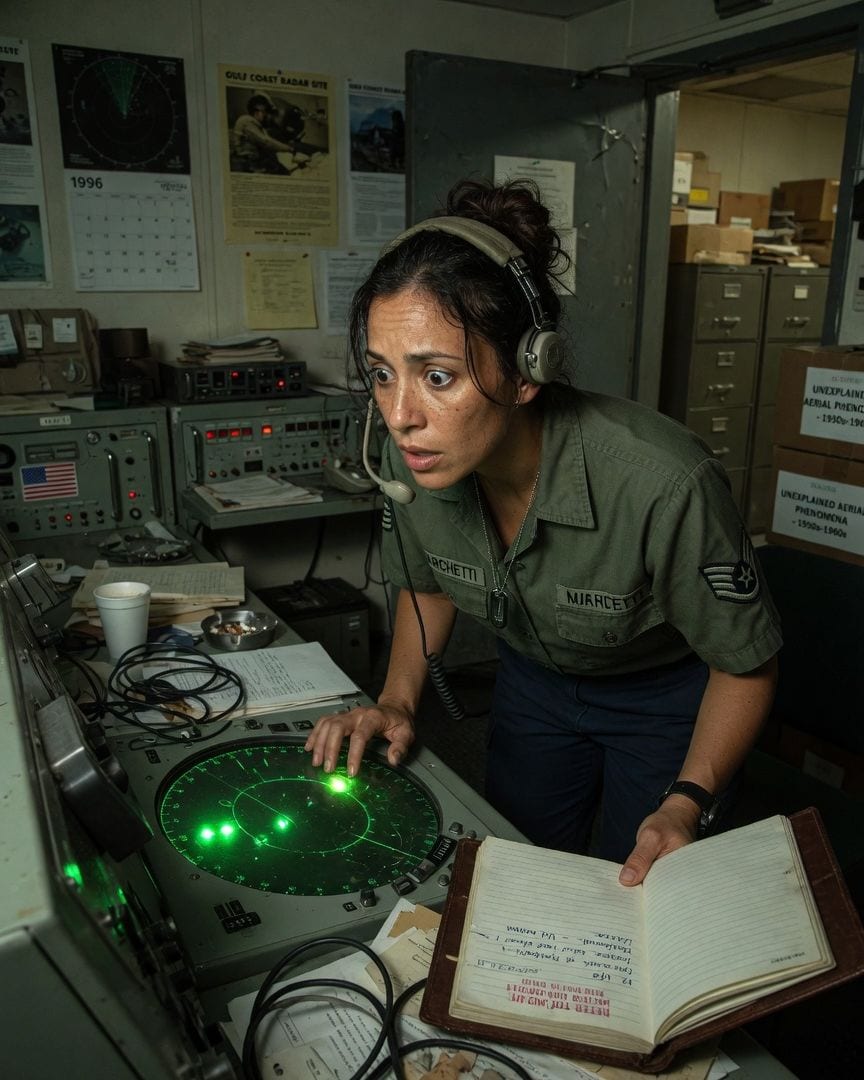
During her last weeks at the Cold War radar site, a technical sergeant logged a UFO. Her entry box was already stamped with a code from a missing 1958 jet.
Technical Sergeant Odile Marchetti was winding down her last few weeks as a radar operator at a remote Gulf Coast site in 1996. Alone in the cavernous room, she watched the green glow of her scope, the only light cutting through the pre-dawn gloom. At 2:30 AM, an airliner reported something flying in formation—a craft Odile couldn't see, until a massive, impossible blip bloomed beside it on her screen. After the pilot reported flying straight through empty air, Odile logged the UFO, only to find a faded, decades-old code already stamped on her logbook entry, identical to one on a missing jet report from 1958. Had this happened before, and was her own entry just a pre-written footnote in a much older, terrifying file?
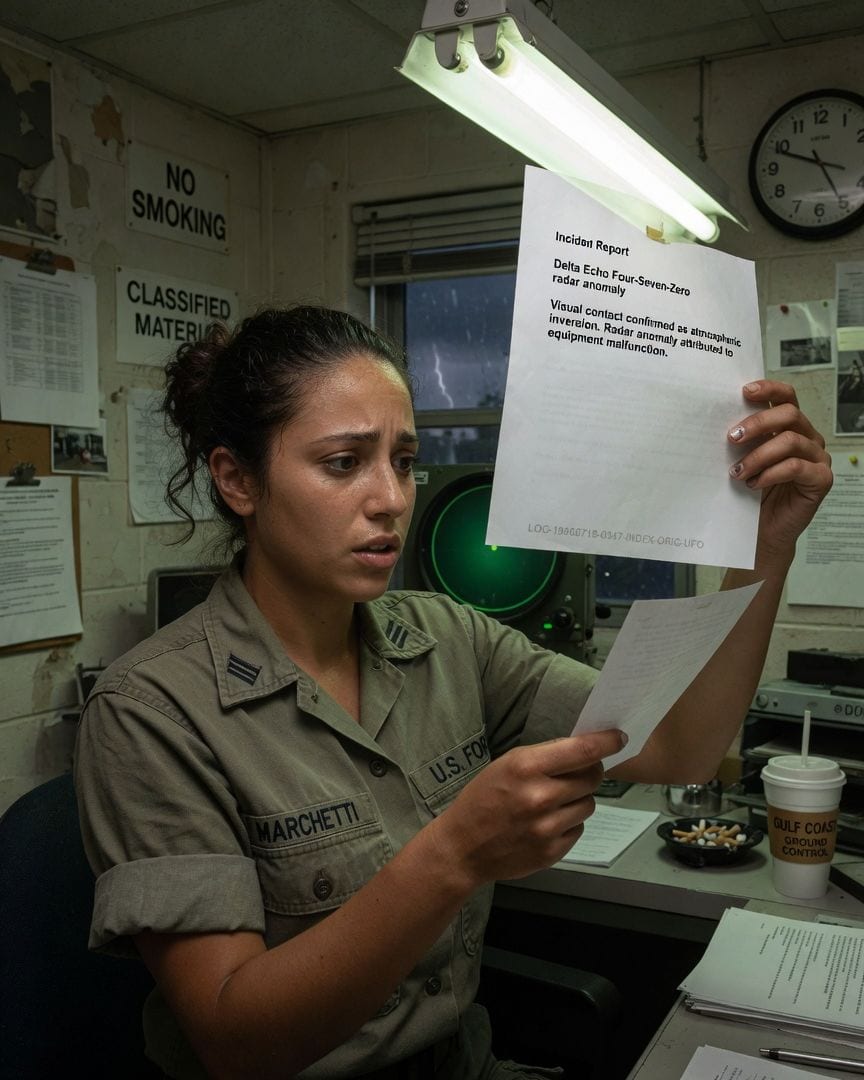
A radar operator's official report changed her UFO sighting to a malfunction, signed by her own system.
Technical Sergeant Odile Marchetti, a 22-year-old radar operator, was deep into a routine midnight shift at a dimly lit Gulf Coast ground control site in 1996, the air thick with an approaching summer storm. Her quiet night shattered when a pilot reported an impossible second return on her scope, a blip twice the size of an airliner that then vanished into the original. But the true dread settled in the morning when the official incident report, meant to log her 'UFO' sighting, returned with a mundane explanation she hadn't written. Scrutinizing the paper, she found a faint digital watermark: a sequence of numbers from her own system, silently falsifying her record. Who had overridden her log, and why?
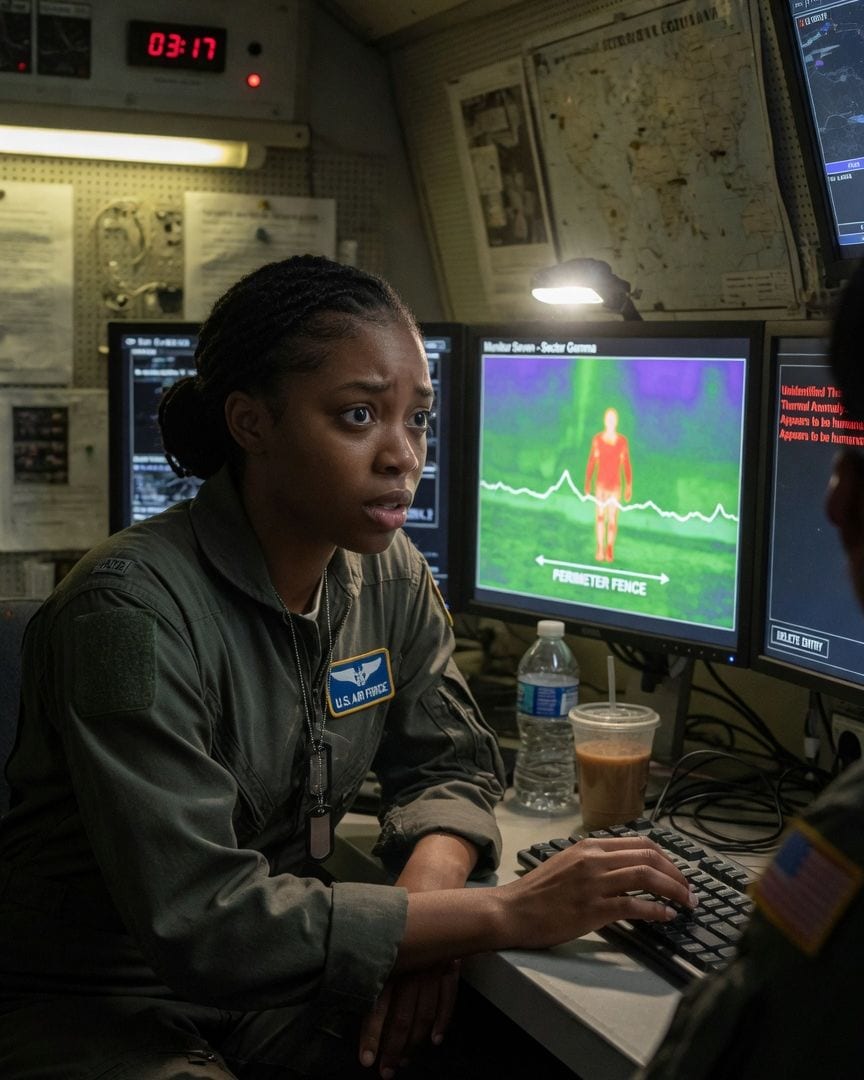
An airman’s thermal feed shows a figure moving in the restricted desert. Her captain orders it scrubbed, but the heat signature appears to tilt its head and look right at her.
Airman First Class Olivia Kade was new to her remote high-altitude outpost, fresh from advanced training, and the isolation pressed in, amplifying every hum. Her duty was to monitor the desert perimeter, but one shift, a faint thermal signature appeared on Monitor Seven: a solitary, upright figure moving with impossible precision beyond the barbed wire. No personnel were authorized in that sector. Her mission commander quickly ordered the anomaly scrubbed, but as it dissolved, the featureless outline seemed to tilt its head, looking directly into the camera. Now, the signature returns night after night, forcing the airman to wonder what impossible thing patrols the dark beyond the wire.
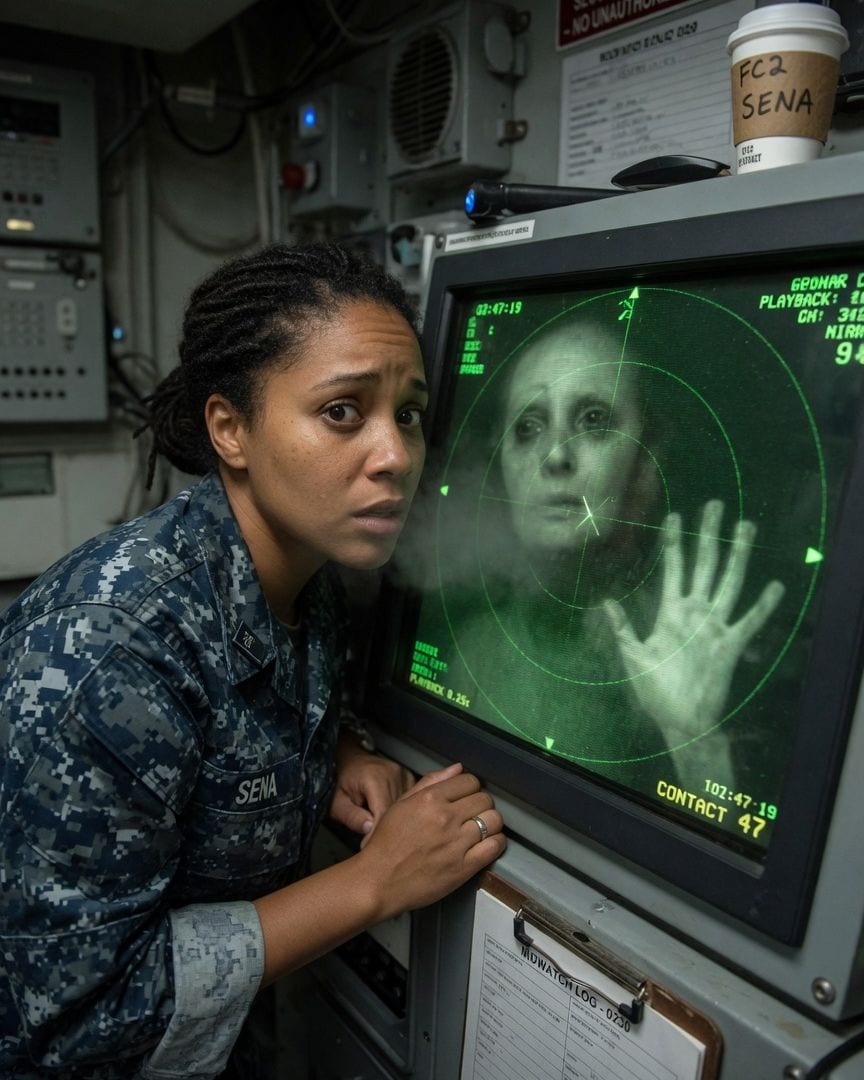
A Fire Controlman saw a gaunt face pressed against her radar screen, from the inside, while a phantom contact crept closer.
Fire Controlman Vera Sena spent her midwatch on the USS Mahan tracking an impossible radar contact that only she could see, silently creeping closer for three nights running. Despite endless checks and reboots, the blip remained, defying logic and baffling her shipmates, an invisible presence in the vast Atlantic darkness. But reviewing her recorded data, she noticed a flicker on the monitor’s glass itself: a blurry outline, like a gaunt face, pressed against the screen from the inside. It stared out with wide, dark eyes, a chilling image superimposed over the digital data, reaching out for a fleeting second before vanishing. What was pressing against her screen, and what did it want from the Mahan?
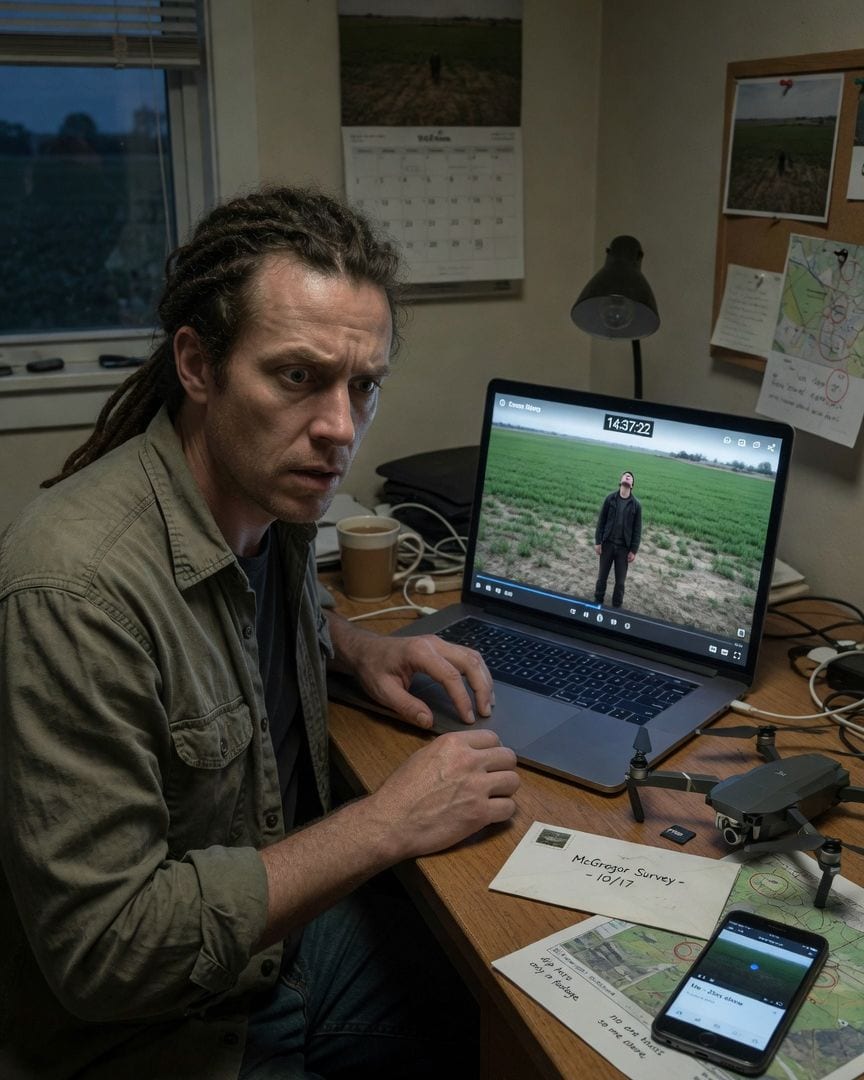
My drone's return footage shows a man standing alone in the field, looking up. The field was empty when I flew out, and I was alone.
I sent my drone for a routine agricultural survey, mapping crop health across a farmer's property. But reviewing the footage, a man materialized, standing perfectly still in the middle of a field I knew was completely empty. He was looking straight up at my drone, a solid figure where no one should have been.
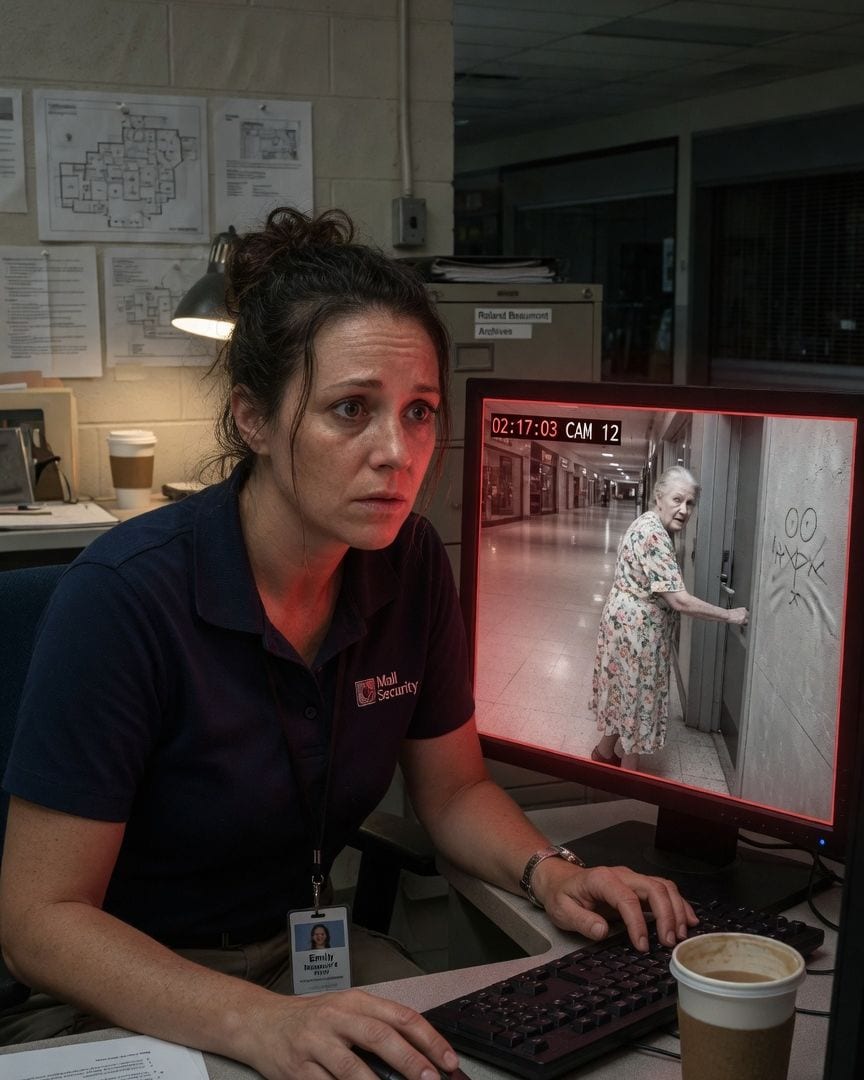
Mall security footage caught an old woman walking the concourse after closing. Every camera filmed her, but no single frame shows how she got in.
Working the overnight shift, I monitor my locked mall's security footage. It was 2:17 AM, five hours after closing, when an old woman in a floral dress simply appeared on Camera 7. She was never seen entering the frame, only *present*, walking slowly across the deserted concourse.