A firebase patrolman counted four men on his night patrol. Only three were visible. An old logbook echoed his impossible tally years ago.
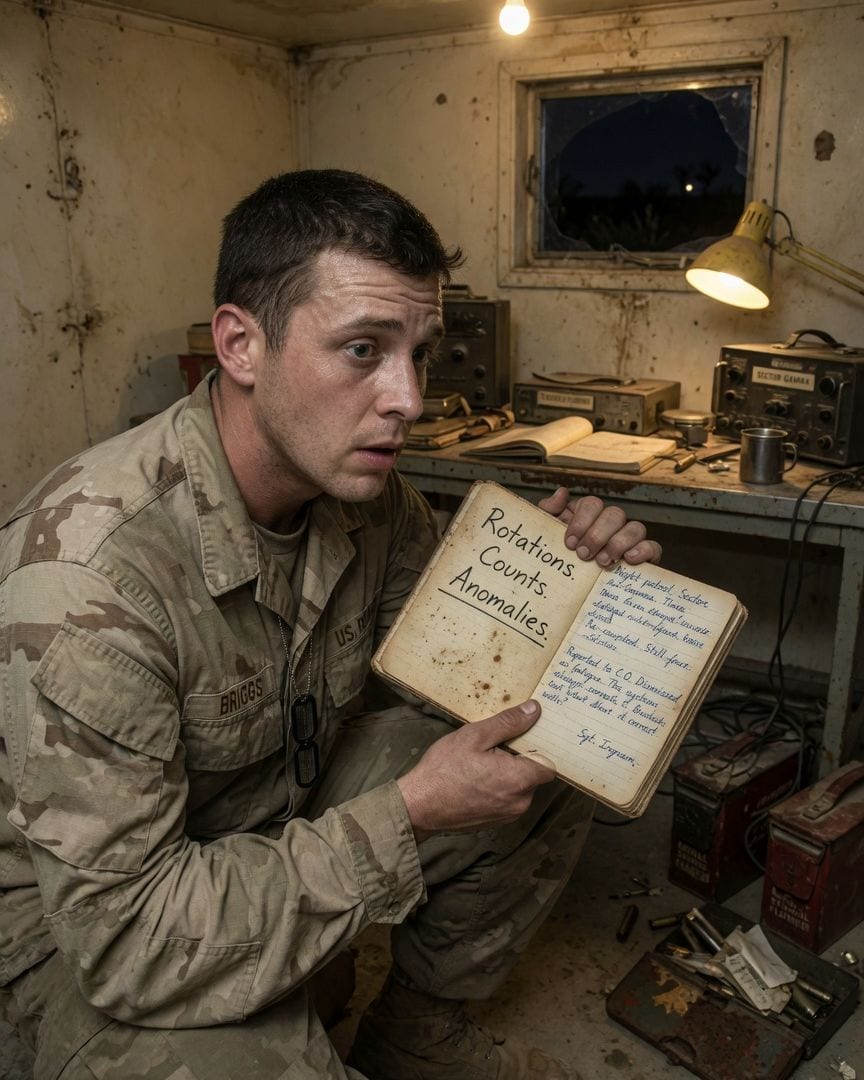
Lance Corporal Everett Briggs, new to the remote firebase and still skeptical of old-timer talk, moved through the black scrub on night patrol. The air, thin and cold, tasted of dust and distant mesquite.
His boots crunched against the brittle ground, a sound swallowed quickly by the vast, arid night. Ahead, the silhouettes of Lance Corporals Pamela Brooks and Franklin Ford were barely visible against the faint starlight.
The unofficial rule, whispered among the longer-serving troops, was clear: you never counted out loud past the wire, especially not on the bad stretches, because the count always came out four.
Briggs, dismissing it as nonsense born of isolation and boredom, counted anyway. It was a habit, a reflex from training.
“One, two, three,” he muttered, his voice a low rumble, checking each man ahead. Brooks on the left, Ford centered, leading the way. A beat of silence settled over the patrol, thick and heavy. “Four.”
The number hung in the air, a physical weight. Briggs blinked, the image of three men stark in his vision. He shook his head, a dry chuckle catching in his throat, and counted them again, slower, more deliberately.
His gaze fixed on Brooks, then Ford, then the empty space to Ford’s right. “One, two, three.” He paused, his breath catching, the arid night suddenly colder. “Four.”
The number echoed in his mind, stark and impossible, as he stared at the three visible figures, their backs to him, completely unaware.
Briggs tried to rationalize his experience, even as the cold knot in his gut tightened. Fatigue, he told himself, or perhaps a trick of the desolate light.
Maybe Brooks and Ford, those notorious pranksters, had found a way to mess with him, the new guy. He confronted them later, back inside the wire. Both denied it, their faces earnest. They had seen only three.
They had counted only three.
He checked the patrol log, his fingers tracing the columns of names and times. Officially, it listed three men. His own entry, scrawled hastily after the patrol, listed three. The discrepancy gnawed at him, a persistent itch he couldn't scratch.
The numbers didn’t add up, not in his head, not in the records.
Later that day, in the mess hall, the clatter of trays and low drone of conversation did little to ease his unease. He overheard Sgt. Ronald Abbott, an old-timer radio operator known for his gruff demeanor, grumbling to himself.
Abbott, hunched over a mug of lukewarm coffee, spoke of 'ghost pings' on the perimeter sensors in Sector Gamma – the very sector where Briggs had counted four.
Always an extra blip, Abbott complained, a fleeting shadow on the screen that vanished before anyone could verify it. Then, the count would clear to normal. Briggs felt a cold dread tighten in his gut.
The 'ghost pings' and his 'four-man patrol' seemed unsettlingly connected, two disparate pieces of a puzzle he didn’t want to solve.
He decided to investigate. The old comms shack, a dusty, forgotten building rumored to hold decommissioned equipment, beckoned. The smell of ozone and damp concrete hung heavy in the air as he stepped inside.
Pushing aside a stack of rusty ammo cans, their paint flaking to rust-red dust, he found a corroded footlocker tucked into a dark corner, half-hidden by a tangle of frayed cables.
It looked as though it hadn't been opened in decades.
Briggs knelt, the concrete floor cold beneath his knees, prying open the footlocker's rusted latch. It groaned, a metallic protest against its long slumber.
Inside, beneath a pile of ancient signal flares, their paper casings brittle with age, lay a crudely bound, unofficial logbook.
Its cover, once some kind of military green canvas, was worn smooth by countless hands, titled in faded black ink: 'Rotations. Counts. Anomalies.' He pulled it out, the pages brittle, exhaling a cloud of dust.
He flipped it open to a random entry, dated years ago, the paper thin and yellowed. The handwriting was tight, precise, etched in faded blue ink.
'Night patrol, Sector Gamma. Three men deployed. Count returned four. Re-counted. Still four.'
Briggs's breath hitched, a sharp gasp in the silent shack. He read the words again, unable to tear his eyes away. The entry continued, chilling him to the bone: 'Reported to C.O. Dismissed as fatigue. The system always corrects itself.
But what does it correct with?' It was signed, 'Sgt. Ingram.' Briggs stared at the faded, precise handwriting, the entry detailing a patrol count of four, and Sgt. Ingram's chilling question echoing in his mind.
The hair on his neck prickled, and the arid night outside suddenly felt colder, vast and watchful.
Briggs, now utterly unnerved, took Ingram's logbook, concealing it carefully beneath his uniform shirt. He showed it to Pamela Brooks later that night, the dim light of their shared bunk illuminating the brittle pages.
He hoped for a rational dismissal, a logical explanation, but the sheer consistency of the entries, spanning years and meticulously detailing identical anomalies, silenced her skepticism. Her brow furrowed, a grim line.
Together, they began cross-referencing names and dates from Ingram's log with official manifests stored in the firebase’s records office.
It was a dim, dusty room, smelling of old paper and stale coffee, filled with decades of paperwork stacked precariously on metal shelves that bowed under the weight of history.
Their presence, however, didn't go unnoticed. Captain Nathan Sinclair, the firebase commander, appeared in the doorway, his uniform crisp against the dusty backdrop, his shadow stretching long across the floor.
He asked what they were 'researching,' his tone laced with suspicion. Briggs, caught off guard, gave a vague answer about 'optimizing patrol routes,' a lie that felt thin and transparent even to his own ears.
Sinclair's eyes narrowed, sharp and probing. He warned them against 'idle speculation' and 'superstition,' emphasizing the importance of 'official channels' and 'protocol.' The air in the room seemed to thicken, pressing in on them.
Ignoring the warning, Briggs and Brooks continued their meticulous work.
They uncovered a disturbing pattern: multiple entries for 'count discrepancies' in Ingram's log were consistently followed by official records listing a specific soldier from that rotation as 'transferred' or 'reassigned' shortly after.
Yet, a deeper search, tedious and frustrating, revealed those names never appeared on any subsequent roster or unit transfer paperwork. They simply vanished from the system, a blank space where a soldier should have been.
It was as if they had never existed beyond their initial deployment. The deeper they dug, the colder the records room felt, its shadows seeming to stretch and contract with each new, terrifying discovery.
The digging was noticed. Captain Sinclair’s 'check-ins' became more frequent, always appearing just as Briggs and Brooks were poring over old manifests, his presence like a cold draft in the stale air of the records office.
He would lean in the doorway, his expression unreadable, before moving on, leaving behind a lingering sense of unease. One evening, Pamela found a note slipped into her bunk.
It was folded precisely, the paper slightly yellowed, and written in the same precise, tight hand as Ingram’s logbook. The message was stark, chilling: 'Don’t count what isn’t there. Don’t look for what is gone.'
They realized the only other person who might know about Ingram’s log, or at least its implications, was Sgt. Abbott. They confronted him in the radio shack, the air thick with the hum of electronics and the smell of ozone.
Briggs held out the note. Abbott’s face, already etched with the lines of age and weariness, paled further. He admitted he knew Ingram, that Ingram had been a 'good man, but obsessed.'
Abbott explained that Ingram had been driven out for 'unprofessional conduct' trying to expose the 'pattern.' His eyes, rheumy and distant, seemed to see something beyond the walls of the shack.
Abbott warned them that the anomaly 'feeds on attention,' that it 'corrects the system' once it’s acknowledged. He urged them, his voice a low, desperate plea, to drop it.
“Some ledgers are better left unbalanced,” he whispered, glancing nervously at the humming radio equipment, as if the machines themselves were listening. “Better to leave it alone.” The air crackled, not just with static, but with something colder, heavier.
Briggs pressed Abbott, laying out Ingram’s logbook on the console, its brittle pages open to show the evidence of the vanishing names, the unexplained transfers. “They didn’t just transfer, Sergeant,” Briggs insisted, his voice tight with growing dread. “They disappeared.
Completely.” Abbott, seeing the meticulous detail of their findings, the decades of evidence staring him in the face, finally broke. He slumped onto a communications console, his shoulders heavy, the weight of years of silence pressing down on him.
“The count isn’t just a number, son,” he began, his voice raspy, barely a whisper over the steady hum of the equipment. “It’s an acknowledgment. This firebase… it’s built on old ground. Unaccounted dead, they say. Ancient burial grounds.
And our system, with its manifests, its headcounts, its perfect records… it gives it something to latch onto.”
He explained that the anomaly sought to be counted, to be made 'real' within the military’s rigid accounting. It wanted to be registered.
When it was, when that extra presence was acknowledged, the system, in its relentless drive for balance, would 'reconcile' itself. It would make a living soldier 'one short,' effectively removing them from the roster and, by implication, from existence itself.
“Ingram tried to stop it,” Abbott continued, his gaze distant, haunted. “That rule, ‘never count out loud’ – it was his way to deny it, to starve it of its acknowledgment. To keep it from becoming real in the system.”
The old radio operator’s eyes, red-rimmed and filled with a profound weariness, met Briggs’s. “Ingram… his own name vanished from the roster eventually. They said he went AWOL. But I saw his last entry in that log.
He knew what was coming.”
The earlier clues clicked into place with horrifying clarity: the 'ghost pings' were the anomaly trying to register, the 'four' on patrol was its presence demanding acknowledgment, and the 'transfers' that disappeared without a trace were its victims.
The truth, chilling and undeniable, seeped into Briggs’s very bones.
Armed with Abbott's terrifying explanation, Briggs and Pamela returned to Ingram’s logbook, now seeing its faded entries with chilling clarity. Each cryptic note, each warning, resonated with a new, horrifying significance.
They meticulously cross-referenced the dates of every ‘count anomaly’ with the subsequent ‘transfers’ that followed. A grim pattern emerged, stark and undeniable: the disappearances weren’t random.
They occurred in cyclical rotations, often tied to specific phases of the moon or particular dates that Ingram had meticulously noted, dates that correlated with an old, forgotten calendar he must have consulted.
Each ‘extra’ count was a precursor to a ‘missing’ soldier.
As they traced the pattern, a cold dread seeped into Briggs’s bones, heavier and more profound than any fear he had known on patrol.
His finger moved across the page, past entries for men he’d never known, until he saw a blank space, a future date marked for the firebase’s imminent decommissioning.
And next to it, in Ingram’s familiar, precise hand, penciled in starkly against the faded paper, was a single, terrifying name: ‘Everett Briggs.’
He stared at his own name, the date just a few days away, a future entry in a ledger of the disappeared. Everett Briggs's blood ran cold as he traced the cyclical pattern in Sgt.
Ingram's logbook, his finger landing on a blank space for the firebase's decommissioning date, then on the name penciled next to it: his own.
The realization detonated in Briggs and Pamela’s minds, a sickening, cold clarity: the anomaly wasn't just about an extra count; it was about insidious replacement, a fundamental corruption of existence itself.
It needed to be acknowledged, to be counted as real, to manifest, and then the system, in its rigid drive for balance, would 'correct' its ledger by taking a living soldier, making them 'one short.'
The 'ghost pings' on the perimeter weren’t just random glitches; they were the anomaly’s constant attempts to register its presence, to be seen by the system’s watchful eyes.
Each blip, each fleeting shadow, was a plea for acknowledgment, a step towards its ultimate goal.
They confronted Captain Sinclair one last time, in his stark, functional office, the fluorescent lights humming overhead.
Briggs laid out Ingram’s logbook, open to the page with his own name, followed by the meticulously documented vanishing names, the cyclical dates, the terrifying pattern.
Sinclair, initially dismissive, grew pale as the irrefutable evidence mounted, his composure crumbling under the weight of the impossible truth.
He finally admitted, his voice barely a whisper, that he’d seen similar ‘unexplainable transfers’ in his own early career at other remote outposts. Always dismissed as clerical errors or classified reassignments, things never to be questioned.
He’d been trained, like all of them, to ignore what didn’t fit the official narrative, to trust the system above all else.
The true horror became sickeningly clear: the military’s own unbending system, designed for ultimate accountability, was the very mechanism the anomaly exploited.
By systematically ignoring or re-explaining the impossible numbers, the system became the anomaly’s unwitting accomplice, feeding the very ledger it corrupted to make people disappear without a trace.
With the firebase decommissioning only hours away, Briggs and Pamela devised a desperate plan. The anomaly needed to be counted, then ignored. They couldn’t fight it directly; it was a presence, not a physical foe.
But they could starve it of the acknowledgment it craved. They disabled the automated perimeter sensors in Sector Gamma, the area where the 'ghost pings' were most frequent, effectively blinding the system to the anomaly’s attempts to register its presence.
The small, red indicator lights on the console winked out, plunging the sensor grid into a digital darkness.
During their final night patrol in that sector, the ‘fourth man’ appeared again.
It was a shadowy, indistinct figure, always just at the edge of their vision, never fully solid, a wavering outline in the moonlight, a deeper patch of darkness against the black scrub.
Briggs, instead of counting, deliberately miscounted, his voice loud and clear in the quiet night. “Two of us tonight, right, Brooks? Ford?”
he called out, forcing Pamela and Franklin to confirm the wrong number, to deny the anomaly its crucial acknowledgment.
“Two, sir,” Pamela responded instantly, her voice firm.
“Just two,” Franklin added, his gaze fixed straight ahead, avoiding the periphery.
The shadowy figure seemed to waver, to strain against its indistinct form, like a mirage trying to solidify. They continued this, night after night, for their remaining patrols in Sector Gamma.
Each time, Briggs would deliberately miscount, and Pamela and Franklin would confirm, denying the ‘fourth man’ its place in their mental ledger, its entry into their reality.
On their absolute final patrol before decommissioning, the figure was there, but weaker, less distinct, a fading echo. As they reached the wire for the last time, Briggs shouted, his voice hoarse, “Two!”
The figure seemed to dissolve into the black scrub, leaving nothing but the sound of the wind whipping through the desolate outpost. They had denied it its ‘count,’ its ‘reality’ in the system, forcing it to retreat, for now.
The firebase was decommissioned without further incident. The last personnel left, leaving behind an empty, silent testament to military presence.
Briggs, Pamela Brooks, and Franklin Ford were reassigned to different units, each far from any remote outposts, a silent acknowledgment of their proximity to something unexplainable.
Captain Nathan Sinclair, visibly shaken by what he’d been forced to acknowledge, requested a transfer to a desk job, citing ‘stress-related issues.’ He left the desert behind, seeking the ordered predictability of bureaucracy, away from things that defied explanation.
Ingram’s logbook, now meticulously copied and distributed among a small, unofficial network of service members who had ‘seen things,’ became a grim manual, a whispered warning passed from hand to hand, a counter-guide to the official military record.
The official records for the firebase remained flawless, all personnel accounted for, the ‘transferred’ names from Ingram’s log officially gone and forgotten, absorbed into the perfect, unblemished data.
Years later, Everett Briggs, now a civilian, worked a quiet, unremarkable job in a city far from the dust and shadows of the desert. The military was behind him, but the weight of what he knew never truly lifted.
He still found himself scanning social media feeds, not for old friends, but for news of remote outposts, for any mention of ‘ghost pings’ or ‘impossible counts.’ He looked for the pattern, the recurring nightmare hidden in plain sight.
One quiet evening, a post caught his eye: a newly established outpost, deep in a forgotten desert, pictures of fresh-faced recruits smiling under a harsh sun.
A comment beneath, posted by an anonymous account, read, ‘Heard the new guys are already talking about ghost pings on the wire. Old Sergeant Johnson told them, ‘Don’t count it out loud.’’
The screen glowed with the familiar words, a pattern across rotations and dates, a quiet echo in the documented world.
The system always finds a way to balance its books.
If this one got to you
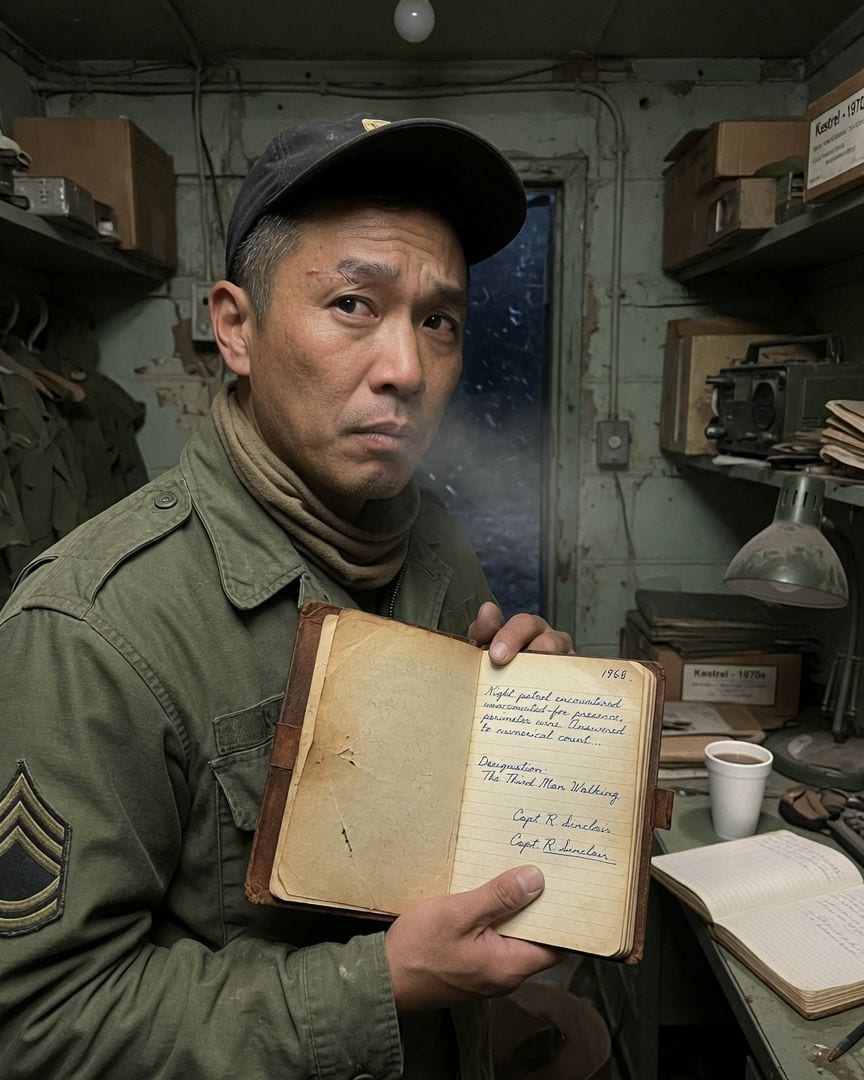
A patrol leader's final count at Cold War Firebase Kestrel found four men. A raspy fifth voice answered, 'Five.'
Sergeant Julian Aoki, a career NCO, prepared for his final perimeter sweep of Firebase Kestrel, a remote outpost days from decommissioning. He aimed to leave the desolate, windswept plateau with a clean manifest before the relief column arrived at dawn. As he called out his four-man patrol’s numbers, a raspy, barely audible fifth voice answered 'Five,' though only four men stood before him. Later, a fifth set of heavy boot prints appeared in the dust, matching his stride back to the wire, a silent, invisible companion. Dismissing it as fatigue, Aoki later found a disused, leather-bound logbook describing identical perimeter encounters, including a 'Third Man Walking' in 1968. Could this unsettling record be more than just old superstition?
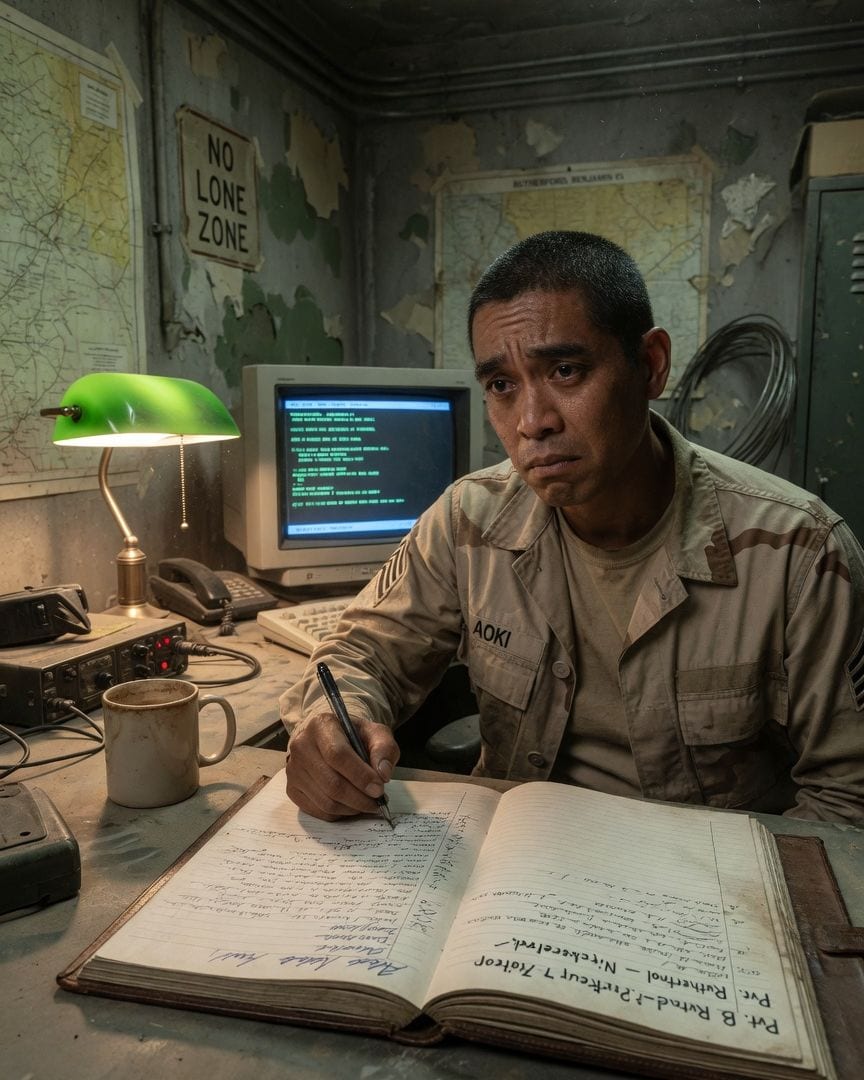
Sergeant Aoki's four-man patrol hears a fifth voice answer their count. A fresh name then appears in the duty log beneath his own signature.
Sergeant Isaac Aoki's final rotation at Outpost 7 was nearing its end, with relief due at dawn. On his four-man night patrol, he broke an old superstition, counting his team aloud in the dust-choked desert. A fifth voice answered, clear and unsettling, from the moonless dark. Back inside the bunker, the chill deepened when a fresh name appeared in the duty log, 'Pvt. B. Rutherford,' beneath Aoki's own signature, a soldier no one knew. Even more disturbing, Aoki later found his own signature on a valor citation for Rutherford, an event he never witnessed.
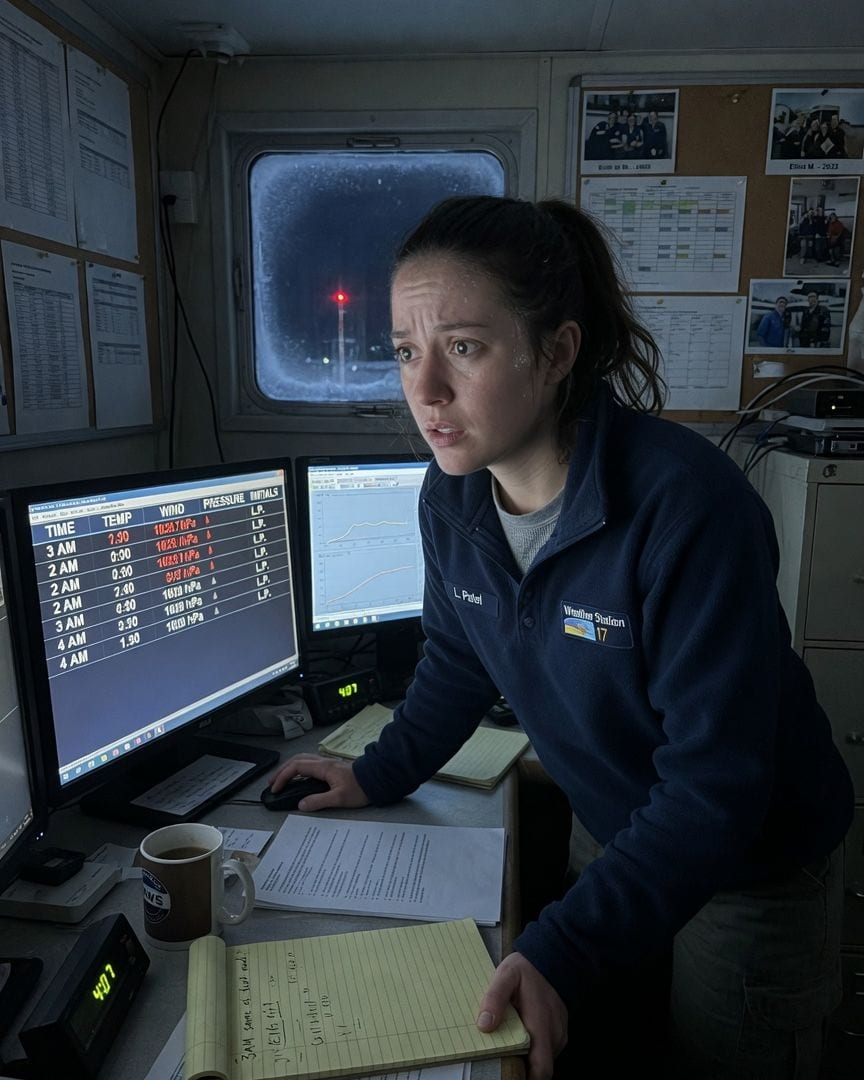
My weather station's 3 AM log shows a pressure reading I never made. My initials are on it, but the dials were dead still.
Working the overnight shift at the remote weather station, I routinely checked the digital logs. The 3 AM entry showed an impossible barometric pressure spike, a hurricane that simply hadn't happened. I distinctly remembered being outside at that time, calibrating a sensor, not making that entry. Yet, my initials, L.P., were clearly logged next to data I never made.
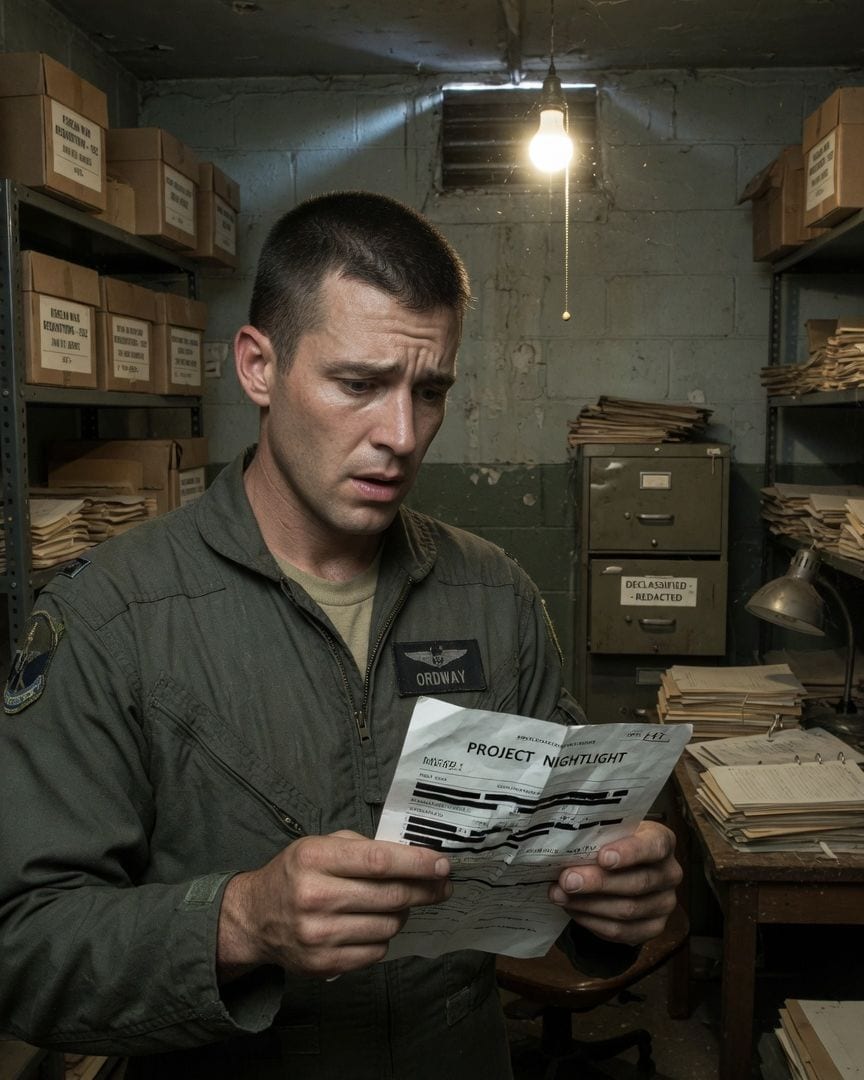
A Cold War pilot's F-104 Starfighter was shadowed by an impossible object. Weeks later, a secret memo referenced his own service number for 'pilot reassignment protocols.'
First Lieutenant Cal Ordway soared over the Mojave in his F-104 Starfighter in 1962, the night sky a familiar canvas. But that night, one 'star' broke formation, pulling alongside his wing and mirroring his every impossible maneuver. His instruments confirmed the silent, unblinking object, defying all known physics. After filing his precise report, Cal found his flight log altered to 'no incidents,' radar tapes corrupted, and a superior advising him to 'let it go.' Driven by his training, he uncovered a heavily redacted memo referencing 'Project NIGHTLIGHT' and, chillingly, his own service number for 'pilot reassignment protocols initiated.' Was he merely a witness, or already a subject in a much deeper secret?
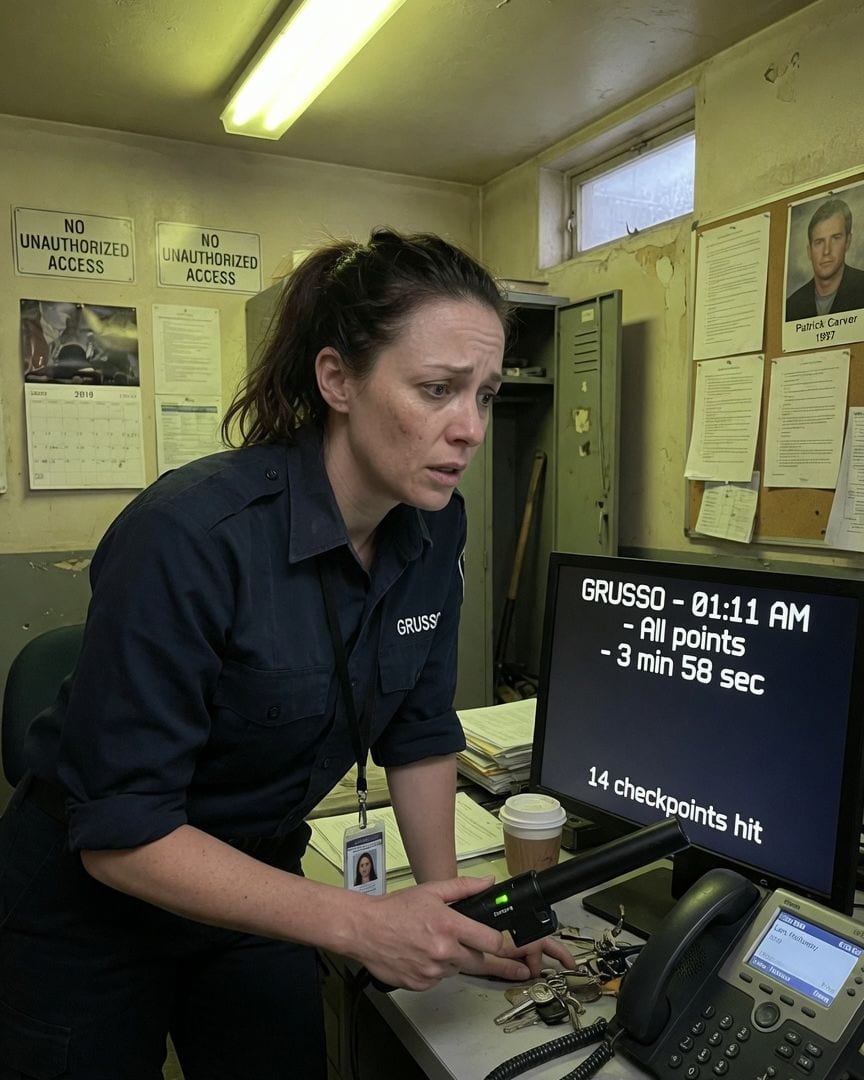
My security wand logged a full round at 1:11 AM in under four minutes. It was in the charger. Every tap is logged as mine.
Finishing my night shift, all I wanted was to get home. But the dock readout screen showed my security wand logged a full patrol at 1:11 AM, completed in just under four minutes. I knew my wand had been charging right beside the monitor the entire time, yet the log, under my ID, confirmed the impossible.
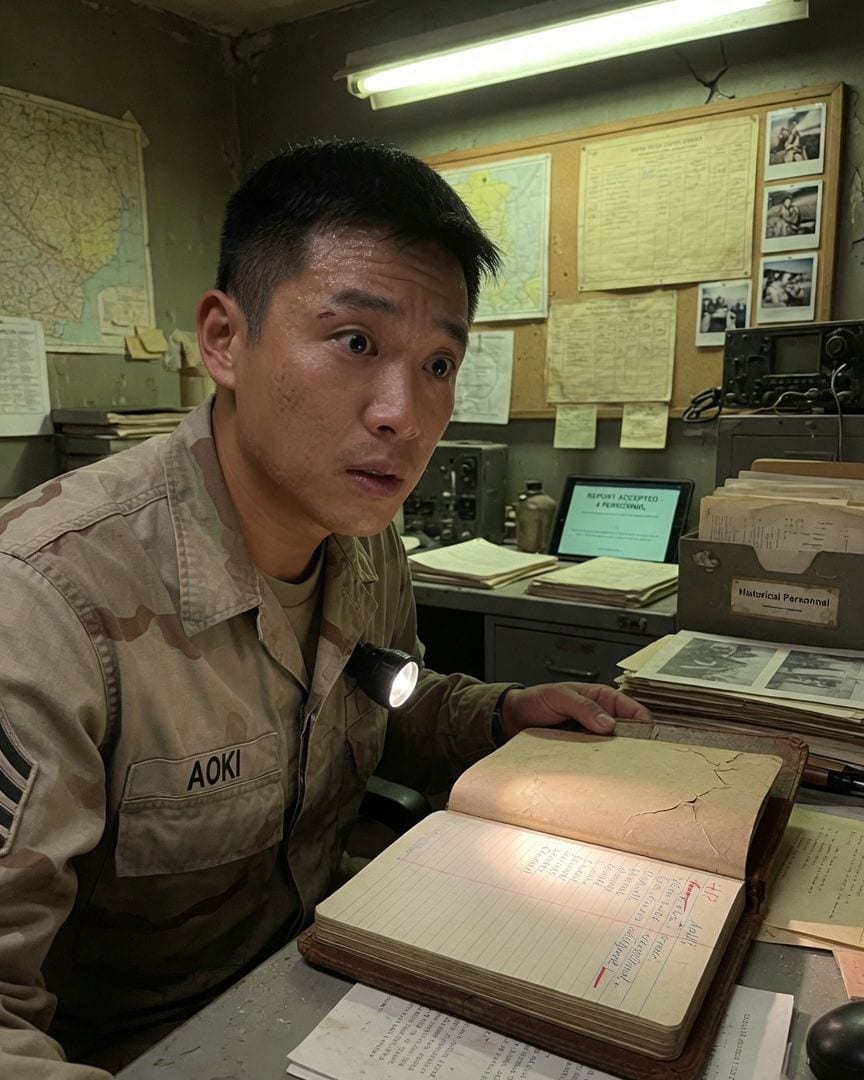
Sergeant Daniel Aoki counted his four-man night patrol, but a fifth presence murmured back from the desert dark. An old logbook from fifty years ago also noted a mysterious '+1?'
Sergeant Daniel Aoki, 32, led his four-man night patrol along Firebase Kestrel's wire, the desert wind a constant, gritty whisper. With relief due at dawn, Aoki conducted a quick headcount. After calling out his four men, a soft, almost imperceptible murmur acknowledged the call from just off his right shoulder, a fifth presence in the dark. His flashlight swept empty ground, but the cold dread that settled in his gut told him otherwise. Later, an old logbook from fifty years ago revealed a similar mystery, with a scribbled '+1?' next to a patrol led by an 'Aoki, R.'