Four people have used my National Insurance number since 1948. All worked at the same Foundry Street plant. Not one ever drew a pension.
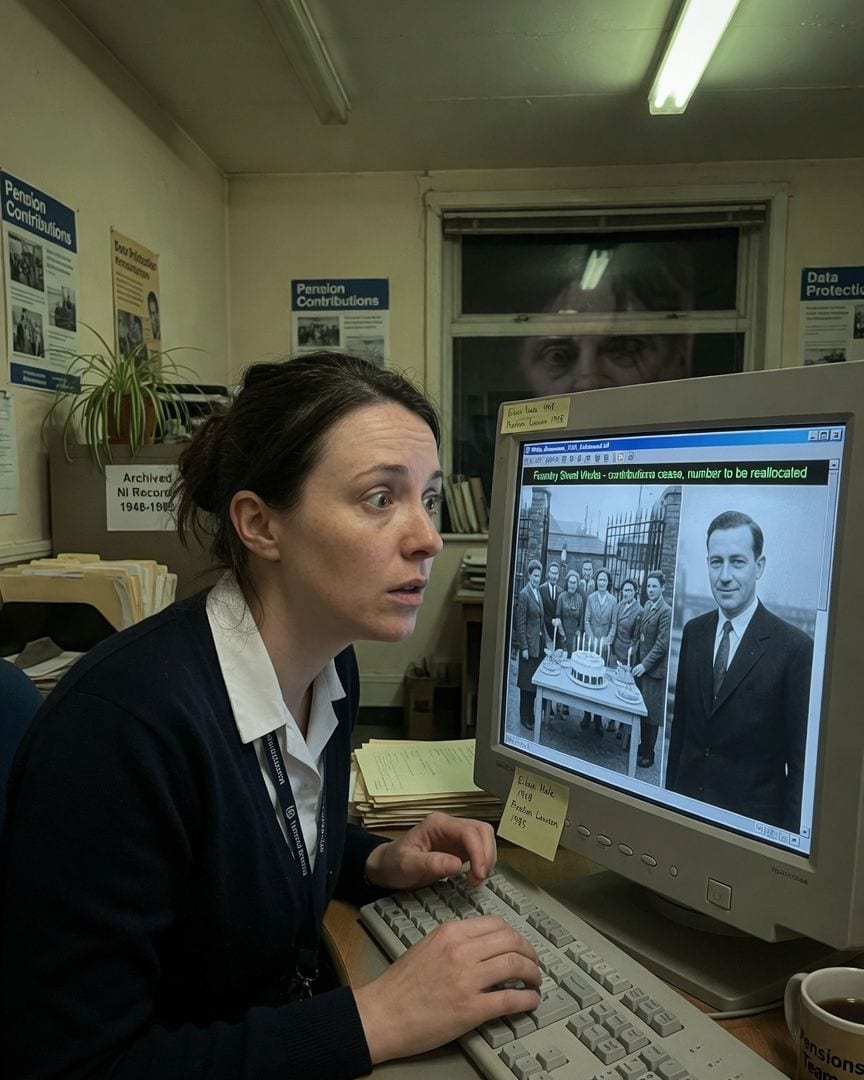
The fluorescent lights of the council office hummed, casting a sterile glow on Nancy Foster's tired face. She was a pensions clerk, a woman in her mid-fifties with kind eyes that usually held a faint, reassuring warmth.
Today, though, as she typed my National Insurance number into her system, that warmth slowly bled away.
“Vivian Hartley, is that right?” she murmured, more to herself than to me, her fingers hovering over the keyboard. I confirmed it, eager to finalize this last piece of administrative tedium. Pension sorted, life moved on. Simple.
But Nancy didn’t move on. She paused, her gaze fixed on the screen, a faint frown creasing her brow like lines etched by years of paperwork.
The hum of the computer seemed to grow louder, the air in the small cubicle thickening.
“That’s… unusual,” she finally said, her voice barely a whisper.
I leaned forward, a prickle of irritation starting to form. “Unusual how, Nancy? Is there a problem?” I’d heard enough government jargon for one day.
She shook her head slowly, still staring at the glowing text. “No, not a problem, exactly. Just… your number. It’s flagged. Not as a mistake, you understand. But as… previously allocated.”
My irritation shifted to a dull unease. “Previously allocated? What does that mean? I’ve had this number since I was sixteen.”
Nancy sighed, running a hand through her short, grey hair. “According to our system, your National Insurance number has been active since 1948. And it’s been assigned to four different individuals before you.
Each instance is marked with the same notation: ‘contributions cease, number to be reallocated’.” She looked up then, her eyes meeting mine, and I saw a new, unsettling quality in them: a quiet bewilderment.
“And the oddest thing, Vivian, is that every single one of them was last employed at the old Foundry Street Works. You know, the plant that closed down in the eighties.
And not one of them, not a single one, ever drew a penny of pension.”
The words hung in the air, cold and hard. Four people. My number. The same defunct factory. And no pension. It wasn't a glitch. It was too specific, too neat a pattern for a mere bureaucratic error.
A cold knot tightened in my stomach. It didn't add up. Not at all.
I tried to dismiss it, to tell myself it was just an antiquated system glitch, a digital ghost from a bygone era. But the details nagged at me.
The shared NI number, the defunct factory, the missing pensions – it felt like a puzzle with too many pieces missing, or, worse, too many pieces fitting in the wrong way.
The next morning, the unease still clinging to me, I found myself heading to the local archives. It was a low, squat building near the old canal, smelling faintly of dust and forgotten paper.
Paul Carter, the manager, was a man as old and worn as the documents he oversaw, his spectacles perched low on his nose. He regarded me with mild surprise when I asked for records related to 'Foundry Street Works'.
"Foundry Street, eh?" he rasped, his voice dry like parchment. "Been a while since anyone asked about that place. Most folks just remember the smell of iron." He shuffled off, returning a few minutes later with a large cardboard box.
"Here you are. Employee rosters, blueprints, some old internal memos. Not much interest, really. Mostly union disputes and production targets."
He placed the box on a heavy oak table, the wood scarred by generations of researchers. The smell of old paper, a distinct scent of lignin and time, filled my nostrils as I began to sift through the contents.
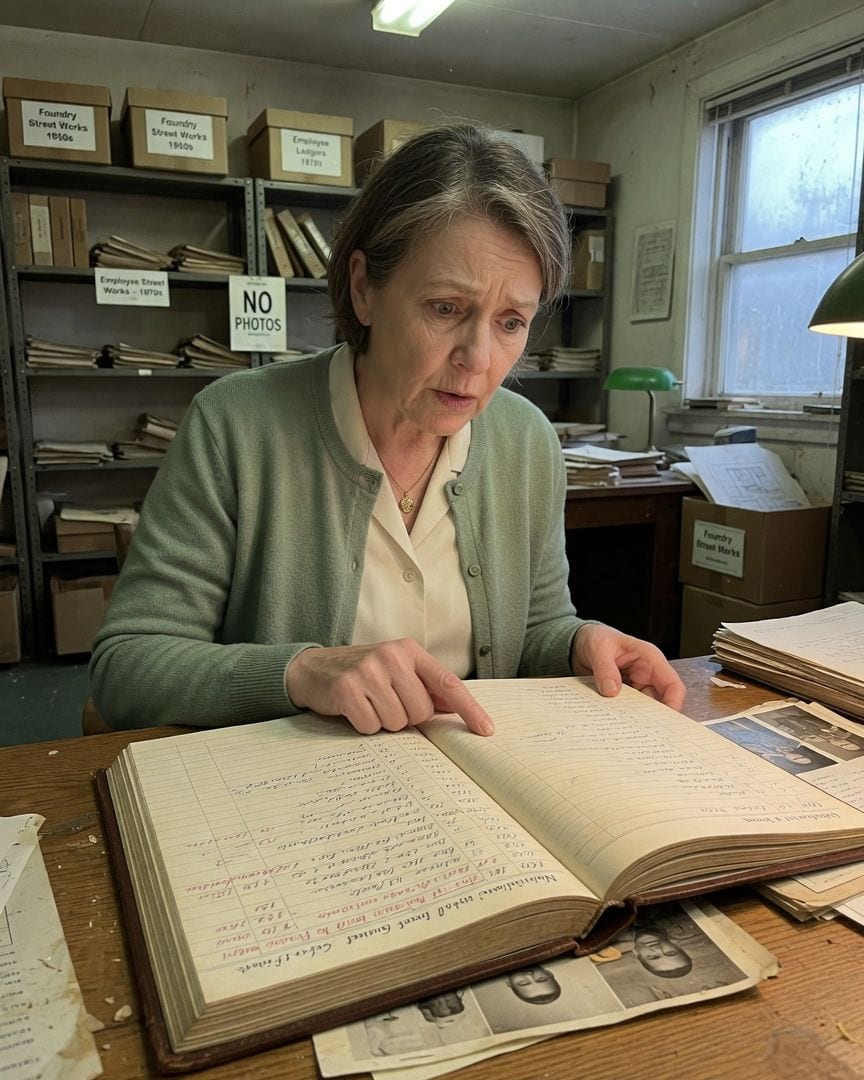
Faded blueprints curled at the edges, yellowed photographs showed stern-faced men in overalls, and then, nestled beneath a stack of annual reports, I found it.
It was a personnel ledger, thick and bound in crumbling leather, its spine cracked. The pages were a creamy yellow, filled with meticulous, looping copperplate handwriting. Dates of employment, departments, addresses. And, crucially, National Insurance numbers.
My heart began to thump a heavy, erratic rhythm against my ribs. I flipped through the early pages, my fingers tracing the columns, until I saw a sequence of digits that made the blood run cold. It was my number.
Undeniable.
But the name next to it was 'Gideon Granger', and the dates of employment listed – 1954 to 1957 – preceded my birth by decades.
Below Gideon’s entry, in a different hand, a stark, precise cursive, was a small, neat note. It read: ‘contributions cease, number to be reallocated.’
My breath hitched. I found other instances. Another entry, same phrase, different name, different number. Then another. It wasn’t just my number. It was a standard procedure. A pattern.
My hands trembled slightly as I pored over the ledger, flipping back and forth, tracing the recurring phrase and the unnerving consistency of the numbers.
My own National Insurance number stared back at me, tied to Gideon Granger, then to another, Rose Carver, from the 1970s. Each time, the same chilling annotation: 'contributions cease, number to be reallocated.'
Then I noticed it, almost hidden in the margin of Gideon Granger's entry, a faint, almost illegible penciled note. It looked like an address, or part of one.
I squinted, holding the brittle page closer to the weak light from the archive window. "...adjacent to Hartley Street."
Hartley Street. My street. The street I live on now. The dread solidified, cold and sharp, radiating outward from my chest.
I looked up, my eyes wide, the archives suddenly feeling too quiet, too still, as if the very air was holding its breath.
The mention of Hartley Street lodged itself deep in my mind, a cold splinter. It wasn't just some random administrative glitch; it was personal.
I returned to the archives the next day, not for a general search, but with a specific, desperate purpose: to find any connection between Foundry Street Works and my own neighborhood.
Paul Carter, surprised by my renewed interest in the defunct factory, merely grunted and pointed me towards a section of old council planning documents.
"Demolition permits, acquisition records, that sort of thing," he rasped, gesturing with a hand that trembled slightly.
I spent hours poring over dusty blueprints and faded proposals. I discovered that the original Foundry Street Works, a sprawling industrial complex, had been acquired in the late 1980s. The buyer was a shadowy entity called 'Sterling Holdings Group.'
They hadn't demolished it. They’d repurposed it. The building, once a bustling factory churning out metal goods, was now listed as a 'secure data storage facility.'
The shift from the tangible grit of industrial production to the ethereal, invisible world of 'data' felt eerily significant. A knot of unease tightened in my stomach.
I dug deeper. Using the names from the old ledger—Gideon Granger, Rose Carver—I cross-referenced them with local death records, then national ones. Nothing. No matching obituaries, no burial sites, no trace of them after their 'contributions ceased.'
It was as if they simply vanished into thin air.
Sterling Holdings Group. The name itself felt cold, corporate, utterly faceless. I accessed a public-facing corporate registry online, a maze of shell companies and subsidiaries, with a surprisingly minimal online presence for an organization of its apparent size.
No "About Us" page with smiling faces, no mission statement. Just names of directors, a registered address, and a list of assets.
Using a public records database – the kind you pay for a month’s subscription to on a whim – I managed to find a digitized version of an old, obscure 'Foundry Street Works Employee Handbook' from the 1970s.
It was a dull, grey document, but I scrolled through it methodically. Tucked within its 'Personnel Policies' section, under a heading titled 'Specialized Employee Transfers,' I found a paragraph that made my blood run cold:
"Unique circumstances regarding National Insurance number re-allocation for employees transferring to specialized internal departments will be managed in accordance with established company policy. Such transfers are considered internal re-assignments and are not subject to standard external notification protocols."
The language was deliberately vague, bureaucratic boilerplate designed to obscure. But the phrase 're-allocation' jumped out, a chilling echo of the ledger. 'Specialized internal departments.' 'Not subject to standard external notification protocols.'
It read like a quietly formalized process, not a mistake. Not a glitch. A procedure.
My research became clandestine. Every night, after putting my laptop away, I started noticing things. My desktop computer, usually pristine, had a faint smudge on the screen that I didn't remember.
A specific old newspaper clipping I'd left on my desk, detailing the sale of Foundry Street Works, was subtly out of place, slightly askew, as if someone had moved it and put it back carelessly.
I tried to rationalize it – I was tired, my cleaning habits weren't perfect, I was overthinking. But the feeling of being watched, a cold prickle on my skin, grew stronger.
One evening, after a particularly late night spent poring over digital archives, cross-referencing names and dates until my eyes blurred, I received an anonymous email. The subject line was blank. I almost deleted it, thinking it was spam.
But something made me open it. The body contained only two words, chillingly simple, centered on the white screen:
‘Drop it.’
No sender. No other text. Just those two words, cold and direct. My breath hitched. I felt a sudden, visceral jolt of fear. I tried to rationalize it again – a random spam, a misdirected message, a hacker’s prank.
But the timing, after my intense, obsessive focus on Foundry Street and Sterling Holdings, felt too precise. My apartment, usually a refuge, suddenly felt exposed, the quiet hum of the refrigerator too loud, too empty.
My heart hammered against my ribs. Someone knew I was digging. Someone was watching. And they wanted me to stop.
The anonymous email confirmed my deepest suspicions: this wasn't just an old record-keeping error. This was an active secret. Someone was protecting it, and they were watching me. I couldn't drop it. Not now.
I had to confront someone who might have been there, at the source, someone who knew.
I remembered a name from the periphery of the old employee rosters: Gordon Sterling, a foreman.
With a bit of digital sleuthing, I tracked him down to a quiet suburban bungalow, a small house with neat rose bushes and a freshly painted gate.
Gordon, a frail but sharp-minded man of 70, greeted me with a weary smile, offering tea and digestive biscuits. He settled into an armchair, his hands clasped over a tartan blanket.
Initially, he dismissed my questions about 'reallocated numbers' as old factory gossip, shaking his head. "Foundry Street had its share of characters, sure. But nothing like that."
I pressed him gently, carefully, about the specific phrase in the ledger and the handbook. I mentioned Gideon Granger, Rose Carver, the missing pensions. Gordon’s eyes, initially placid, clouded over, losing their sparkle.
He took a long sip of his tea, the silence stretching between us, heavy and thick. The ticking of a grandfather clock in the hallway sounded unnaturally loud.
"Some things," he finally said, his voice raspy, barely above a whisper, "were… handled internally. Beyond HR, you understand." He avoided my gaze, looking instead at a faded photograph on the mantelpiece. "There was a… a special department.
Tucked away in the deepest part of the factory. Down by the old smelting furnaces, but completely separate. Nobody asked about it."
He described 'transfers' that weren't really transfers, of people who 'moved on' without notice, their lockers cleared by morning.
He used the word 'reallocated' himself, not as a direct admission of wrongdoing, but as a euphemism, a quiet, almost apologetic justification for a procedure he clearly understood but never questioned. "They just… went.
And their numbers… well, they were cleared from the books. Made ready for the next cycle."
A profound weariness settled on his face, deepening the lines around his mouth. "It was just how things were done," he said, a shudder running through him, a tremor that seemed to shake the very teacup in his hand.
"You learned not to ask. You just… filed it away." The calm acceptance in his voice, the weary resignation, was more terrifying than any monster, any overt threat. It wasn't an accident. It wasn't a mistake. It was a process.
And he knew. He'd lived with it.
Gordon Sterling’s quiet admission confirmed the horrifying institutional knowledge. This wasn't just history; it was a deeply ingrained, unquestioned procedure. Now desperate, now terrified, I decided on a bold move.
I used a pretext – a 'historical research inquiry' for a local history project, hoping Paul Carter's vague academic interest might override his usual caution – to gain limited access to the current 'data storage facility' on Foundry Street, now owned by Sterling Holdings.
To my surprise, Paul facilitated my entry, guiding me through the gate with a special key card, the air heavy with the unspoken gravity of his compliance.
Inside, the building was cold, sterile, a labyrinth of server racks humming with an almost imperceptible vibration. Fluorescent lights flickered over rows of grey filing cabinets, a contrast to the old factory photographs I’d seen.
Paul, distracted by a call on his walkie-talkie, pointed me vaguely towards a "records section" in the back, then disappeared down an aisle.
I slipped away, my heart hammering, finding a neglected corner with older, physical files, some still in original Foundry Street Works folders.
Hidden amongst them, tucked behind a shelf that looked like it hadn't been touched in years, I found a thick, unmarked binder. Its cover was plain grey, unblemished by any title or label.
My hands shook as I opened it. Inside were internal memos from Sterling Holdings, marked 'Confidential – Reallocation Protocols.' The words swam before my eyes: 'Phase 3: Resource Optimization. Target acquisition via NI Number identification.'
There were diagrams, flowcharts, a chillingly neutral tone explaining a process that sounded utterly dehumanizing.
I flipped to a page titled 'Pending Allocations.' It was a list. Columns of National Insurance numbers, dates, and names. My eyes scanned down the list, and then froze.
My own National Insurance number was there, underlined. Followed by my full name, Vivian Hartley. And next to it, a date. '14.03.XX' – tomorrow.
The binder slipped from my numb fingers, hitting the floor with a soft thud, echoing in the cold, silent cavern of servers.
The binder lay open on the cold concrete floor, revealing the full, monstrous shape of the truth. My mind raced, trying to grasp it, to make sense of the horrifying coherence.
The 'data center' wasn't just storing information; it was processing it. The 'reallocation' wasn't a transfer or a retirement; it was a systematic removal, a harvesting of individuals.
The specific NI numbers were the key, the unique identifiers for their targets. The 'Resource Optimization' was a euphemism for clearing people from the system before they could draw pensions, before they could become 'liabilities.'
The patterns across the dates in the old ledger, the recurring phrase, the quiet disappearances Gordon Sterling spoke of – it all snapped into place with horrifying clarity.
Foundry Street Works, and now Sterling Holdings, had been running this operation for decades, a calm, bureaucratic horror humming beneath the surface of everyday life.
This 'data center' was where the 'reallocation' happened, a place designed to make people disappear without a trace, their identities and lives consumed.
My own name, underlined with tomorrow’s date, confirmed I was always inside this pattern, merely waiting for my turn. The building, once a symbol of industry, was now a silent, efficient abattoir of identity.
The cold hum of the servers around me felt like a predatory purr, a vast, indifferent machine preparing for its next meal.
I scrambled, my heart hammering against my ribs, and shoved the binder back into its hidden alcove, trying to make it look untouched. I had to get out.
As I turned to flee, a calm voice spoke from behind me, echoing slightly in the vast space.
"Looking for something, Ms. Hartley?"
Paul Carter, the archives manager, stood in the doorway of the secluded section, his expression neutral, almost serene. He held a small, encrypted tablet in his hand, its screen glowing faintly.
He didn't move to block my path, but his presence seemed to fill the narrow aisle, the air growing heavy and cold.
"We've been expecting you to connect the dots," he continued, his voice devoid of malice, as if discussing a weather report. "You're quite thorough. Our algorithms flagged your repeated inquiries."
My mouth felt dry. I backed away slowly, my eyes darting, searching desperately for an exit. The dim emergency exit sign I’d spotted earlier suddenly seemed impossibly far away.
"The protocols are quite clear," Paul went on, taking a step closer, his gaze unblinking. "Resource optimization requires… efficiency. We ensure no liabilities accrue. Your number, you see, was due for its final cycle.
A pension, Ms. Hartley, is a cost."
"What… what do you do to them?" I whispered, my voice barely audible, thick with terror.
Paul smiled faintly, a chilling, almost paternal expression that didn't reach his eyes. "We reallocate. Their contributions cease, and their numbers are prepared for reuse. It’s quite elegant, really. A sustainable system."
He gestured vaguely around the cold, server-filled room, his hand sweeping across the silent rows of machines. "The data must flow, Ms. Hartley. And sometimes, the source must be… integrated."
As he spoke, I saw a faint flicker of movement in the deeper shadows of the facility, a figure in a dark uniform, half-hidden between the server racks. My decision was made.
I spun, desperate, and sprinted towards the dimly lit emergency exit sign. I didn’t wait for a reply, didn’t look back. The alarm didn't blare immediately, only a soft click as I shoved the bar.
Paul Carter simply watched me go, his calm smile unchanging, as if observing a predictable, if slightly inconvenient, part of the 'protocol.'
I burst out into the cool night air, the heavy steel door clanging shut behind me, the sudden silence of the empty street a contrast to the quiet horror I'd left behind.
I ran until my lungs burned, until my legs ached, not stopping until I was miles away, my phone dead, my breath ragged and cold in the night air.
I tried to report it to the police, my frantic story of 'reallocation protocols' and 'resource optimization' met with polite skepticism, then barely disguised pity. There was no physical evidence, no binder, no proof.
I was just a woman rambling about a conspiracy involving an old factory and a pension number.
The Foundry Street 'data center' remained exactly as it was, a dark, windowless block, always lit by a faint, internal glow. Paul Carter was still the archives manager, calmly going about his duties.
Nancy Foster remained at her desk in pensions, her kind, tired eyes betraying nothing.
I was safe, physically, but the experience had carved a permanent fissure in my perception of the world.
I still had my National Insurance number, but every time I saw it, every time I had to write it down, I felt a cold dread, a phantom touch of the chilling process.
I had escaped, but the knowledge I carried was a heavy, invisible chain. I was marked, forever aware of the quiet, bureaucratic horror humming beneath the surface of everyday life.
I still check my National Insurance number online, every month. Just to be sure. The Foundry Street data center still stands, a dark, windowless block, always lit by a faint, internal glow.
I drive past it sometimes, just to see it, to remind myself it's real. The world moved on, oblivious. The quiet hum of the servers, the calm voices of the people who knew, still echo in my mind.
The dread isn't in what they did, but in how calmly they did it, how perfectly it all fit into the fabric of everyday systems.
And sometimes, late at night, I wonder whose number I'm really holding, and who might be holding mine.
If this one got to you
My National Insurance number has been used by four people since 1948. Each one worked at the same Foundry Street works, and none ever drew a pension.
I was just sorting out my new National Insurance number, a routine task I expected to take minutes. But the clerk found it had been used four times since 1948. Even stranger, all four previous holders worked at the defunct Foundry Street Works and never drew a penny of pension.
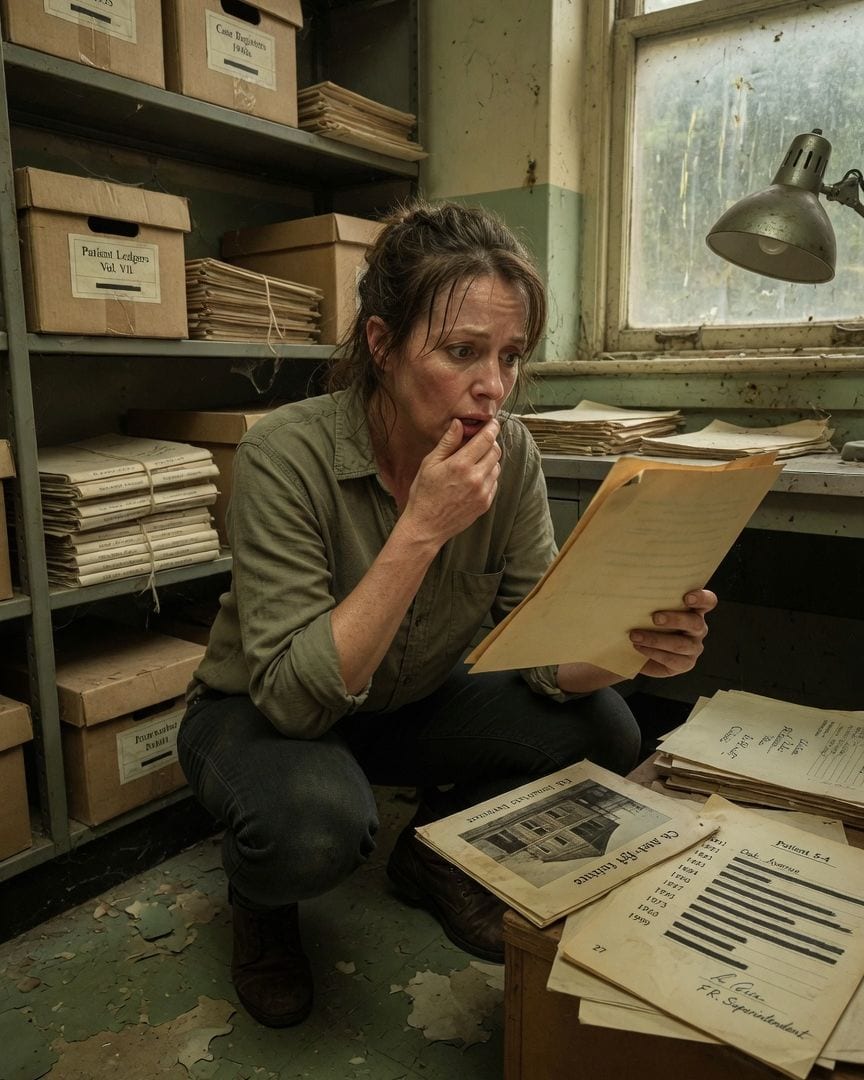
Patient 5-4 keeps checking into my aunt's old sanatorium chalet. The same initials sign them out, 'not traced,' every thirteen years since 1921.
Sifting through my aunt Margaret's estate, I found her old sanatorium file from 1999. Her patient record listed her as 'Patient 5-4,' discharged 'not traced.' But when I accessed the archives, I found 'Patient 5-4' was admitted every thirteen years since 1921, always with identical discharge notes.
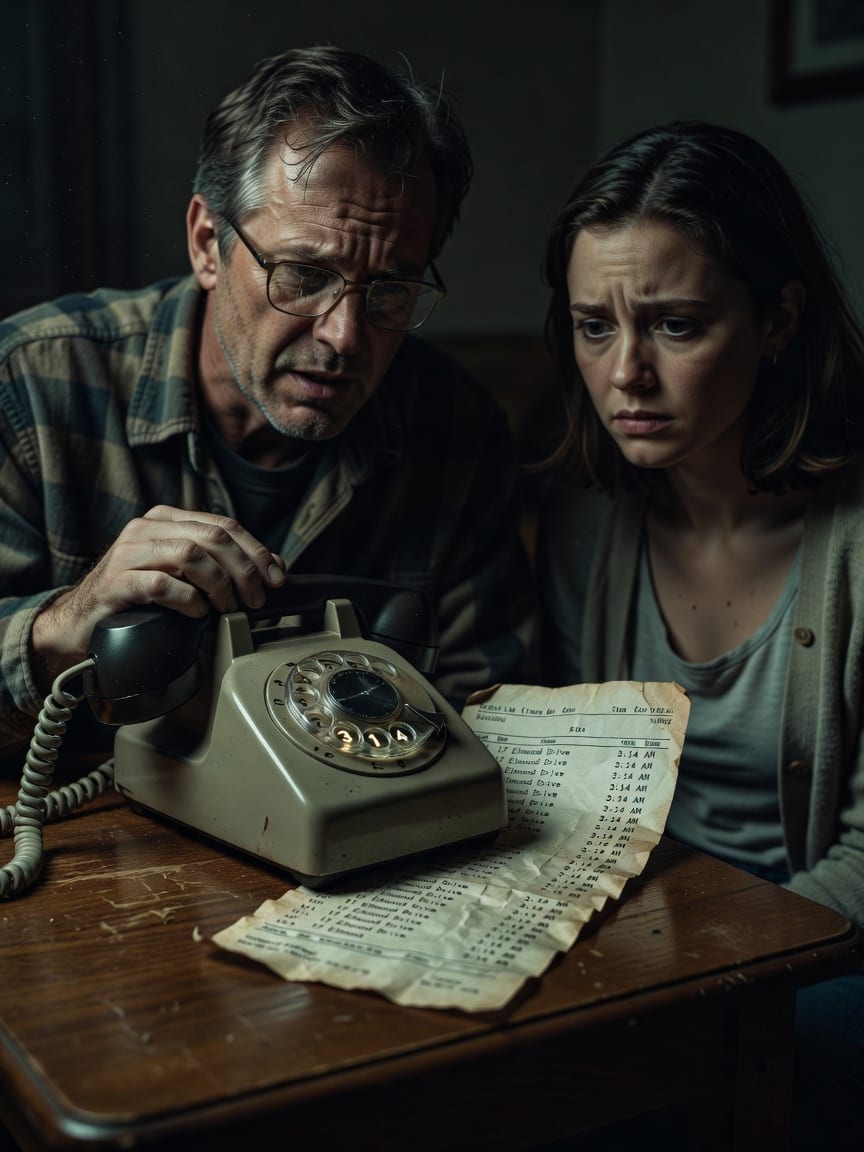
My phone bill itemised forty calls from my number to a house demolished in 1990. Each call at 3:14 AM, lasting eleven minutes. The bill arrived postmarked from a flattened building.
I expected the usual mobile bill, but my landline statement listed forty calls from my number to '17 Elmwood Drive.' That address was for a house torn down in 1990, a vacant lot I remembered from childhood. The phone company insisted the calls were legitimate, leaving me profoundly unsettled by the impossible charges.

My taxi driver knew my name before I spoke, then apologized for the flight I was going to miss. I was arriving. The cab's plate was scrapped four years ago.
After a strange taxi ride, I received an unsettling birthday card addressed to me. Its return address listed 'Old Mill Road Field,' an empty lot where a mill once stood, and it was postmarked locally. The card arrived four months before my actual birthday, sparking a cold dread I couldn't ignore.
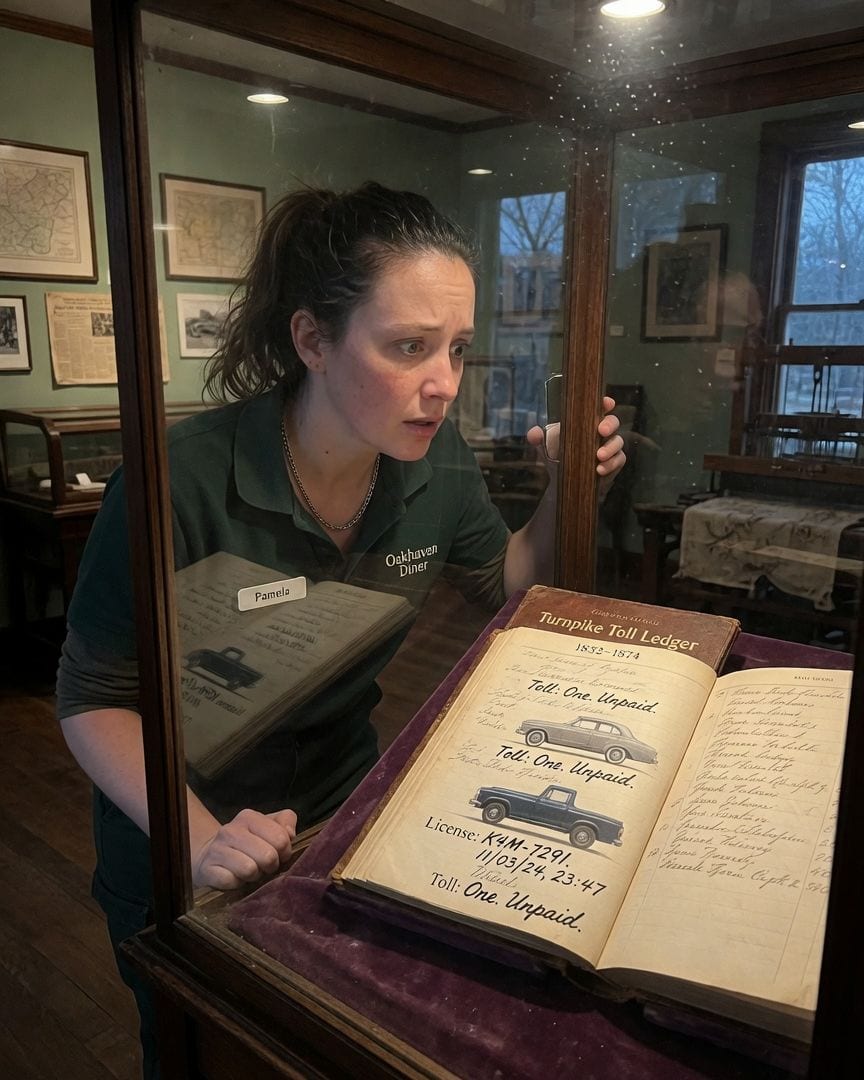
My car stalled at the old turnpike milestone, after dark. The toll ledger, closed in 1874, then listed my car, my stall time, and a toll of one, unpaid.
I had just moved to Oakhaven when my old sedan died on a dark, winding road by an infamous turnpike milestone. The next day, I found my car's exact registration and stall time written in fresh ink in a 150-year-old, locked museum ledger, marked 'Toll: One. Unpaid.' The curator dismissed it as a prank, but her white knuckles and strained voice hinted at something far more unsettling.
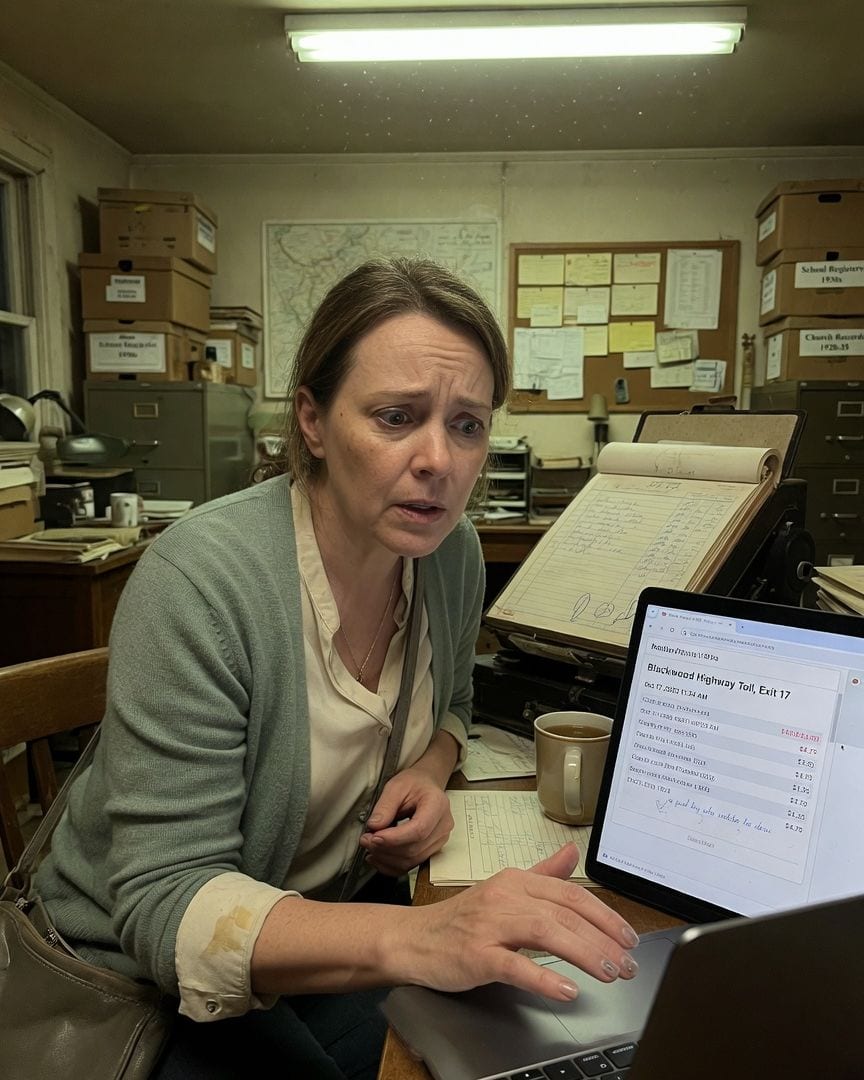
A 1931 school register marks me present every single day of that spring term — but I was born in 1969. And the teacher's note beside my name calls me 'a quiet boy who watches the door.'
As the village archivist, Lydia Kowalski uncovered her own name in a 1931 school register, decades before she was born. Then she found her unmistakable signature in the book, followed by the teacher's chilling note describing 'a quiet boy who watches the door'. Later, her bank statement showed a highway toll charge from a place she'd never been, on a day she was home with the flu.