My hand found a hidden seam in the concrete wall. Inside, a desperate note warned: 'Don't count past sixty'.
The fluorescent lights of the underground parking lot usually hummed a familiar, almost comforting drone. It was Tuesday, 7:45 AM, and I was running a few minutes late.
My digital pass, a sleek black rectangle, flashed green at the boom gate, a crisp, efficient sound. My assigned space was 44, halfway down the third row.
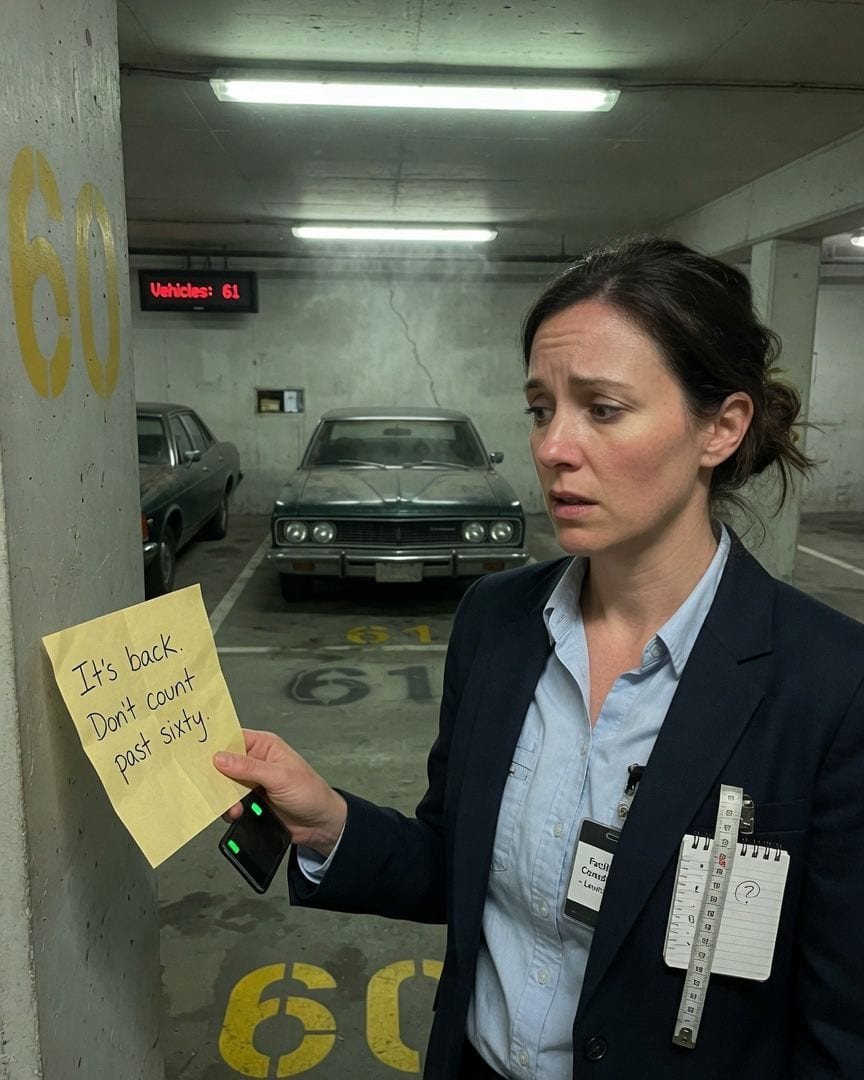
But today, the small LED indicator on the reader, usually so reliable, blinked '61'.
I paused, frowning. Sixty-one? Our lot was numbered to sixty, that was it. Always had been.
I drove slowly, my old sedan rattling a little, past the familiar concrete pillars, past the lines of cars already settled in for the day. Space 58, 59, then 60, right at the end of the painted lines.
Beyond that, the wall. Solid concrete. Except today, it wasn't.
Tucked into what should have been an unbroken expanse of gray, past the final painted line and the '60' stenciled on the ground, was another space. A bay. Numbered '61'.
It was narrower than the others, almost squeezed into the concrete, but undeniably there. And in it, parked with an unnerving precision, sat a vintage sedan. Dark green, slightly dusty, the kind of car you only saw in old movies.
As I pulled my own car alongside it, the air shimmered faintly above its bonnet. I could see the heat rising, a soft, almost imperceptible wisp in the cool underground air. It had to have been driven recently.
I parked in 61, bewildered, and killed my engine. The quiet was immediate, thick. My pass still in my hand, I stared at the impossible car. No one at our company drove anything like that. No one.
A quick glance at my phone showed 7:51 AM. I still had time. Shaking my head, I walked towards the entrance, my eyes scanning the digital display screen that showed the current vehicle count for the lot.
It cycled through temperatures, air quality, and then, the vehicle count. It blinked, unwavering: 'Vehicles: 61'.
I checked my pass reader again, then the screen. It cycled back to '61'.
My brain tried to find a mundane explanation – a glitch, a prank by one of the overnight crew, a new temporary space I hadn't been informed about. But I was Facilities Coordinator.
I’d be the first to know about a new parking space. The numbers just refused to add up.
I spent the better part of my morning trying to reconcile the discrepancy. My coffee went cold on my desk as I pulled up the parking system's digital logs. Sixty spaces, it insisted. Each one accounted for.
I cross-referenced it with the building's official blueprints, both the crisp digital files and the yellowed, rolled-up paper copies in the archive room.
Every single one, from the original construction plans in '73 to the latest renovations, showed a 60-space layout for the underground lot. There was no '61'. It didn't exist.
Frustration simmered. I told myself I was tired, that I'd miscounted, that the screen was malfunctioning. So, during my lunch break, I returned to the parking lot, armed with a measuring tape and a notepad.
The vintage sedan was still there, squat and dark in its impossible bay. I started at space 1, meticulously counting each bay, ticking them off on my notepad. One by one, I walked the length of the lot.
Fifty-eight, fifty-nine, sixty. Then, just as before, the unnatural 61st space, still occupied by the same car, the faint wisp of heat still rising from its bonnet.
I paced the perimeter, trying to make sense of the geometry. My measurements showed the building's outer wall should have been precisely where the 61st space now stood. There simply wasn't room.
It was like a page had been added to a book that was already perfectly bound. As I ran my hand along the concrete where the phantom space met the 'real' wall, I noticed something.
A subtle, almost invisible seam, a faint line in the otherwise smooth gray surface. It wasn't quite a crack, more like a scar.
And if I looked at it for too long, in my peripheral vision, it seemed to ripple, a brief, unsettling distortion in the solid concrete. My hand felt cold then, despite the ambient temperature of the lot.
The physical reality of the lot, this impossible space and its occupant, directly contradicted every official record, every blueprint, every logical explanation. Yet, it was undeniably present.
I ran my hand along the faint seam in the wall again, a strange, persistent chill emanating from it, not unlike the air coming off the old car's body. I pressed gently, my fingers exploring the unusual texture.
And then, a faint, metallic click sounded from within the concrete. I froze, my heart thudding. A small, recessed panel, almost perfectly camouflaged in the gray, slid inward an inch.
Tucked inside, resting on a thin ledge, I saw a single, yellowed sheet of paper. My fingers trembled as I carefully extracted it. It was brittle to the touch, handwritten in a spidery, desperate scrawl, and dated decades ago.
The words on it seemed to leap out, stark and terrible: "It's back. Don't count past sixty."
The note chilled me to the bone, its brittle paper feeling like ancient skin in my hand. I clutched it, not wanting to let go, but also desperate to be rid of it.
First thing the next morning, I took it to Harold Thornton, the long-time security guard.
Harold, a man who'd seen everything from basement floods to the time a flock of pigeons got stuck in the ventilation system, glanced at the yellowed paper, then back at his monitors, tracking movement on the third floor. He shrugged.
"Ah, that old thing," he rumbled, his voice thick with disinterest. "Probably some old prank. We used to have a bunch of ghost stories we'd tell the new hires. Kept 'em on their toes." He waved a dismissive hand.
"Don't count past sixty. Ha. Good one." He chuckled, a dry, rattling sound, but his eyes, when they briefly met mine, held something I couldn't quite place – a flicker of something ancient and weary.
Undeterred, and now with a cold dread tightening in my gut, I delved deeper into the building's digital archives. If the note was an "old prank," it was one with a very specific, unnerving detail.
I searched for any mention of "sixty-one," "structural anomalies," "impossible spaces," or anything out of the ordinary around the parking lot. The database coughed up scattered, almost redacted references.
I found a brief report from 1993 on "misplaced inventory" in a storage area, with a casual mention of a delivery scheduled for "Storage Bay 61," a bay that didn't, and had never, existed on any blueprint.
Then, an elevator log from 1987, showing an impossible 'floor 61' entry, followed by a quick override.
Each mention of the phantom '61' unit in these disparate systems was quickly followed by a note of "system error," "data corruption," or "human oversight."
The pattern was horrifyingly consistent: an extra, non-existent '61' appearing, only to be systematically scrubbed or dismissed. It was like the building itself was trying to tell me something, and then immediately erasing the evidence.
My persistent digging didn't go unnoticed. Harold's dismissive attitude, which I had initially attributed to his general grumpiness, began to shift.
He didn't say anything directly, but I'd catch him watching me from his booth, his gaze lingering a little too long as I walked past. A quiet, unsettling watchfulness.
Then, Warren Mercer, my boss and the Facilities Director, called me into his office. Warren, a man whose default setting was 'blandly pleasant', leaned back in his chair, his smile tight.
He didn't directly address my investigation, not in so many words. Instead, he made a point of discussing department efficiency, the upcoming budget, and the importance of "focusing on our core duties."
He spoke softly, almost casually, about avoiding "stirring up old rumors that could affect morale" and how "some people can get a little over-imaginative with old building stories." His eyes, however, were not casual. They were pointed, a subtle warning.
The room, usually sterile and impersonal, suddenly felt like a closed box.
Later that week, I returned to my office after a late meeting, well after everyone else had gone home. The building was silent, the silence amplifying every distant creak and groan of the old structure.
I distinctly remembered locking my door. But now, it was slightly ajar, a sliver of darkness visible at the crack.
My heart gave a little jump, but I chalked it up to being tired, maybe I’d forgotten to turn the handle all the way. Inside, everything looked normal. Except for one thing.
A specific archived blueprint I'd been examining, detailing the parking lot's original construction, was lying on my desk, subtly out of place. I had left it carefully folded and stacked under a paperweight.
Now, it was unfolded, slightly askew, as if someone had been looking at it. My blueprint.
I felt a prickle on the back of my neck, an undeniable sense of being observed. The feeling clung to me as I walked through the quiet, echoing corridors, especially as I neared the parking lot entrance.
The air grew heavy, thick and still, no longer just the normal recycled air. And the distant hum of the building, usually a comforting backdrop, now felt less like machinery, more like a low, watchful breath.
The building, it seemed, was not happy with my inquiries.
The next morning, I cornered Harold in his security booth, determined to get something real from him.
I spread out my printouts: the anomalous logs, the old warning note, my own meticulous measurements scribbled on a diagram of the parking lot.
"This isn't a prank, Harold," I insisted, my voice low but firm, cutting through his usual morning newspaper rustle. "Someone is either messing with the building systems, or... something else is happening.
And that note," I tapped it, "it’s old, it’s specific. ‘Don’t count past sixty.’ What does it mean?"
Harold's facade, usually impenetrable, finally cracked. His eyes darted around nervously, checking the cameras, though there was no one else in the immediate area.
"Greta, you gotta let some things lie," he mumbled, his voice barely a whisper, a contrast to his usual booming tone. He fidgeted with the small stack of keys on his belt. "Things like this... they happen."
"Things like what?" I pressed, leaning closer. "Impossible spaces? Missing inventory in phantom storage bays? Phantom floors?"
He sighed, a long, weary sound, the kind of sound a very old man makes when he’s about to tell you something he’s been keeping to himself for too long.
He slowly reached behind his desk, his hand fumbling with something pinned to the corkboard. He pulled down a faded, slightly curled photograph.
It was a group shot, clearly from decades ago – an outdoor picnic, people in old-fashioned clothes, smiling stiffly. Our company picnic, maybe, from the 1970s.
"Take a look," he said, his voice flat. He pointed a gnarled finger at the photo. Everyone was there, all the faces from the old HR files I’d seen.
Except, one man, a previous security guard, was conspicuously absent from the frame, though a ghostly, almost transparent hand rested on another man's shoulder. A hand that clearly belonged to someone who should have been there.
"Joseph Kowalski," Harold said, his voice now devoid of all emotion. "He was the last one who went looking for space sixty-one. Happened about thirty years ago. Just like you. Asking too many questions. Said he saw something.
Kept going down there." Harold’s eyes finally met mine, and they were full of a terrible, quiet grief. "They found his car, that same old vintage sedan, in that same spot. But they never found him. Not a trace."
He paused. "This photo," he added, "it was from a 'non-existent' company picnic. Never officially recorded in the books. Just like everything else around that time."
The old warning note, the phantom '61's appearing and disappearing in records, the impossible space, the now-explained vintage car, the missing man – it all clicked into place with a horrifying, sickening inevitability. This wasn't a prank.
This was a pattern. This was something real, and it had claimed someone before.
The truth hit me like a physical blow: Joseph Kowalski didn't just vanish; he was swallowed by the impossible space. And the car... the car was his. It was a chilling, undeniable link to something monstrous. My stomach churned.
I knew, with a certainty that settled cold and heavy in my bones, that I had to see it again. I had to go back down there.
I descended to the parking lot, the fluorescent lights seeming dimmer, the air colder than before. The 61st space was there, just as it had been, just as Harold said it would be.
The vintage sedan still occupied it, its dark green paint gleaming dully under the harsh lights. Its bonnet still emitted that faint, unnatural heat, a persistent whisper of warmth in the cool underground.
I approached cautiously, my footsteps echoing louder than they should in the empty lot. The air around the car felt charged, a palpable tension. My eyes, drawn by an almost magnetic force, fell upon the dashboard.
There, resting face up on the dusty surface, was an old, faded ID badge. Its plastic was yellowed with age, brittle and cracked.
The photo was almost completely gone, just a ghost of a face, but the name 'Joseph Kowalski' was clearly visible, printed in faded block letters beneath the phantom image.
My breath caught in my throat. It was him. The missing man. This was his badge. I looked from the badge to the car's rearview mirror, my gaze drifting almost involuntarily.
In the reflection, just for a split second, I saw it. A slumped figure in the driver's seat, wearing what looked like Joseph Kowalski's old security guard uniform. It was hunched forward, as if asleep, or... worse.
Slowly, impossibly, the figure's head lifted. Its eyes, hollow and ancient, met mine in the glass.
The spectral figure in the rearview mirror held me in its ancient gaze, unblinking, utterly silent. It was a chilling testament, undeniable, to the building's true nature.
I scrambled back from the car, my heart hammering against my ribs, the image of those hollow eyes burned into my mind. I burst into Harold’s booth again, gasping, trying to articulate what I’d seen.
He listened, his face pale, his usual weariness now tinged with visible fear.
"This place... it's always been a thin place," Harold explained, his voice heavy with resignation, a quiet understanding that went beyond mere fact. "Where things bleed through."
He recounted old stories, not the pranks or the ghost stories for new hires, but the hushed legends that circulated among the long-timers. Tales of strange disappearances, objects found in impossible locations, sounds from places that shouldn't exist.
The 61st space, he elaborated, wasn't just an extra bay. "It's a temporary pocket of a different geometry. A... a catchment. It manifests when the cycle peaks." He spoke as if relaying an undeniable, though terrifying, scientific principle.
"The cars, the people—they aren't truly gone. They're stuck. Perpetually recurring within that shifted space, like a record skipping the same groove over and over. Their echoes, sometimes, become visible. Their presence leaves residual traces."
He gestured vaguely, "Like that warm bonnet you noticed, or that faint symbol you mentioned seeing on the wall. That ripple."
The old note, the 'non-existent' records, Joseph Kowalski's fate, his car, his badge, his ghostly presence – it all clicked into place. Not as a series of unrelated anomalies, but as a consistent, horrifying pattern.
A recurring dimensional bleed, a glitch in reality that our building, our mundane building, hosted every few decades.
I knew I had to get out, but I also knew I needed proof. Something tangible this time. My hands shaking so violently I could barely hold it steady, I pulled out my phone.
I aimed it through the window of the old sedan, snapping rapid photos of Joseph Kowalski's faded ID badge on the dashboard.
Then, with a surge of terror, I angled it towards the rearview mirror, trying to capture the slumped figure. As I did, the spectral figure stirred more violently, its movements becoming less echo-like, less a mere reflection, and more insistent.
It was there.
The air in the 61st space grew stiflingly hot, oppressive, making it hard to breathe. Then, just as suddenly, it turned bone-chillingly cold, a raw, piercing cold that cut through my clothes.
The walls of the bay began to shimmer, the solid concrete blurring as if melting, the painted lines on the ground seeming to ripple and stretch like water.
Driven by an urgent, primal terror, I reached into the slightly ajar glove compartment of the vintage car. My fingers closed around an old, brittle parking ticket, its edges ragged with age. It was dated, clearly, thirty years ago.
As I snatched it, a guttural moan echoed from the figure in the driver's seat, a sound that seemed to scrape against the very concrete walls.
Then, the unmistakable sound of a car door creaking open behind me sent a jolt of pure fear through my spine.
I scrambled backward, the old ticket clutched tight in my hand, as the impossible space visibly rippled, the concrete walls seeming to fold inward, threatening to swallow everything, including me.
I burst from the parking lot, gasping for air, stumbling a little on the concrete ramp. I didn't look back. But I knew, with a certainty that eclipsed all doubt, that the impossible space was gone.
The wall behind me was now solid, unmarked. Back to sixty spaces.
I reported everything. Every detail, every log, every experience. My account, frantic and wild-eyed, was met with polite concern and thinly veiled skepticism. Warren Mercer listened with that tight, knowing smile, then suggested I take a "stress leave."
The photos on my phone, which I swore I took, were corrupted, showing only static.
The old parking ticket, clutched tight in my hand, was dismissed as a prop, its faded date illegible under the harsh office lights, my story chalked up to a delusion.
Harold, though he believed me, denied everything when questioned by management. "Greta's been a little overwhelmed lately," he'd said, his eyes flicking to mine, a silent apology. The entrance screen now consistently showed 60 vehicles.
The 61st space, and all the terror it held, was gone, leaving no trace.
I tried to live a normal life, to forget. I found a new job, at a smaller, newer building, free of old legends and impossible spaces.
But the knowledge gnawed at me, a constant, dull ache beneath the surface of my ordinary days. I kept the parking ticket, now framed on my desk at home, its faded date mocking me every morning.
I knew what I saw. I knew it happened. And I knew, with absolute certainty, it would happen again.
A year later, Greta received a routine email from her old department: an update on the parking lot numbering system. A new digital display had been installed, capable of tracking up to 70 vehicles.
The first daily report showed 61 vehicles parked in the lot, with a small, appended note about an 'unaccounted for' vehicle in a newly designated overflow section. Her old parking pass, still in her wallet, felt strangely warm.
It has, after all this time, finally counted past sixty.
If this one got to you
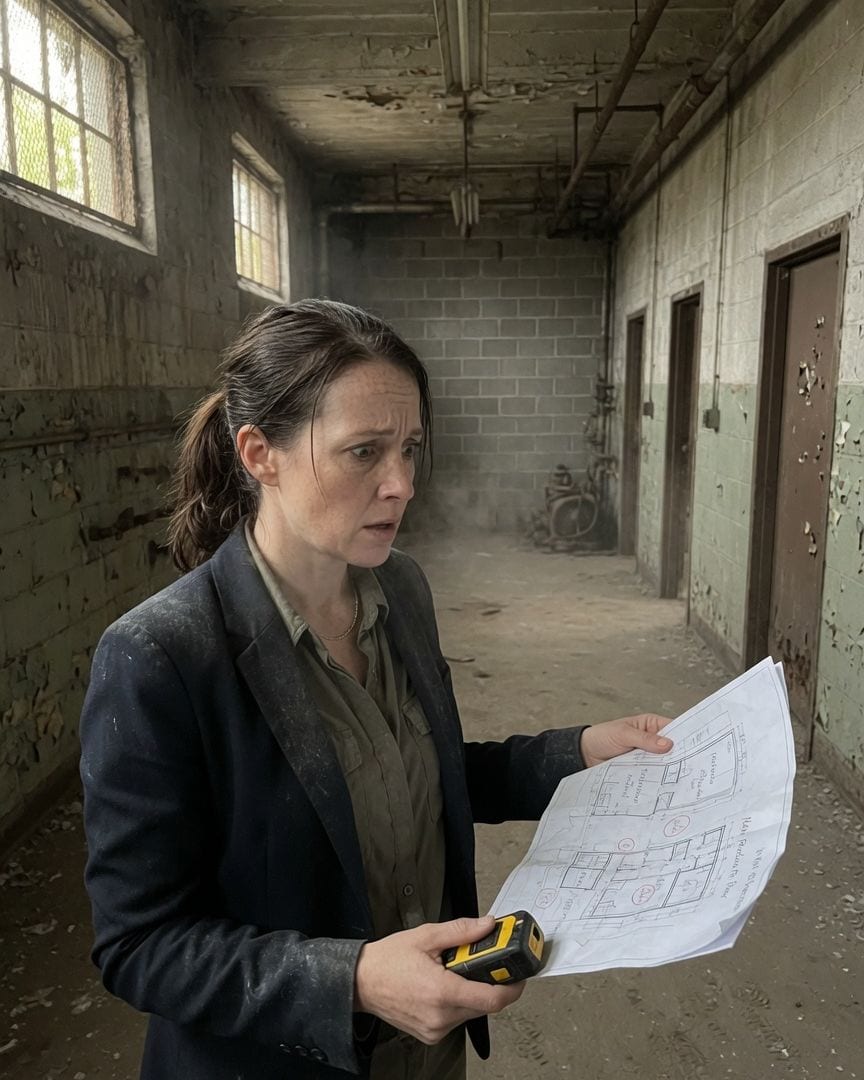
One room is missing from this factory floor. My blueprints show four, but I only found three doors.
Intrigued by an abandoned industrial complex, I secured its old blueprints and entered the cold, silent building. Pacing a long corridor, I meticulously counted doors, comparing them to the detailed plan. The blueprint clearly showed four distinct rooms, but the corridor's length, and my own count, revealed only three doors.
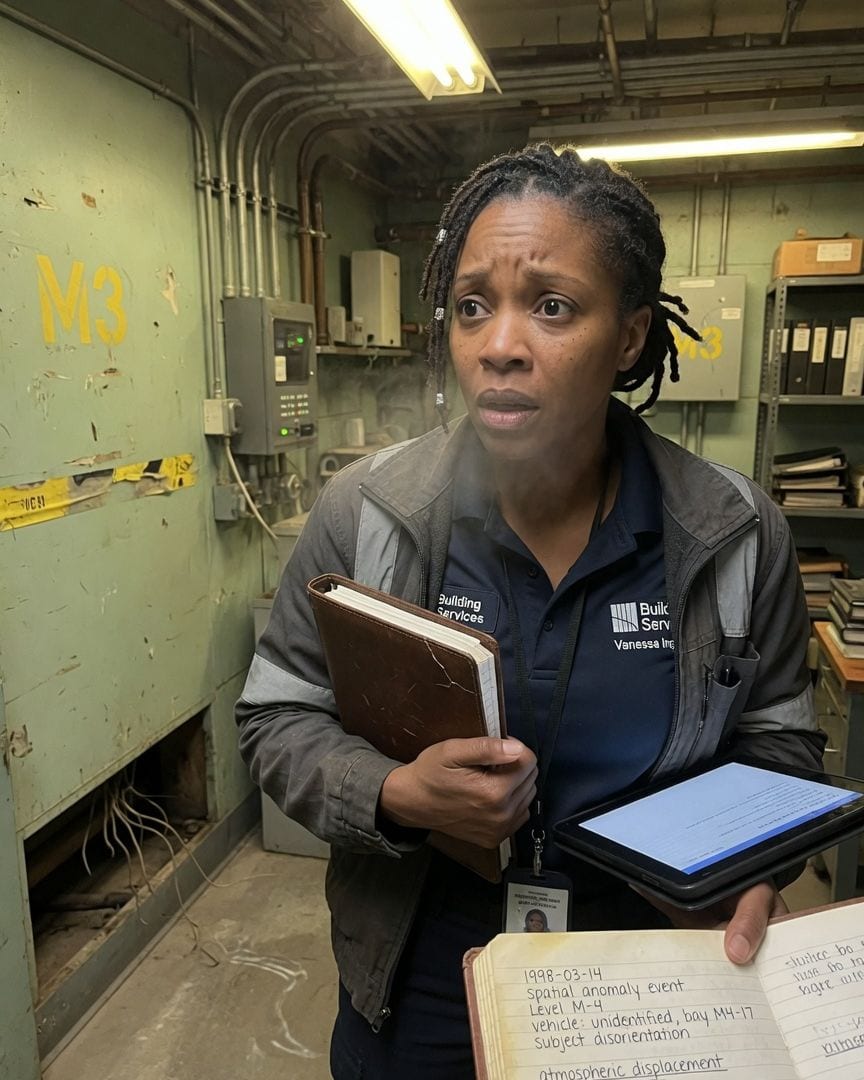
The lift offered a level below the lowest one, so I took the stairs down a flight that has never existed — into cold, empty bays where a single car sat, its engine still ticking like it had just been driven.
My routine as a Building Services Technician is usually solid, but today, the building offered a fourth basement level, M-4, that shouldn't exist. Descending into its frigid gloom, I found an old car tucked away in a bay, its engine ticking softly as if it had just arrived.
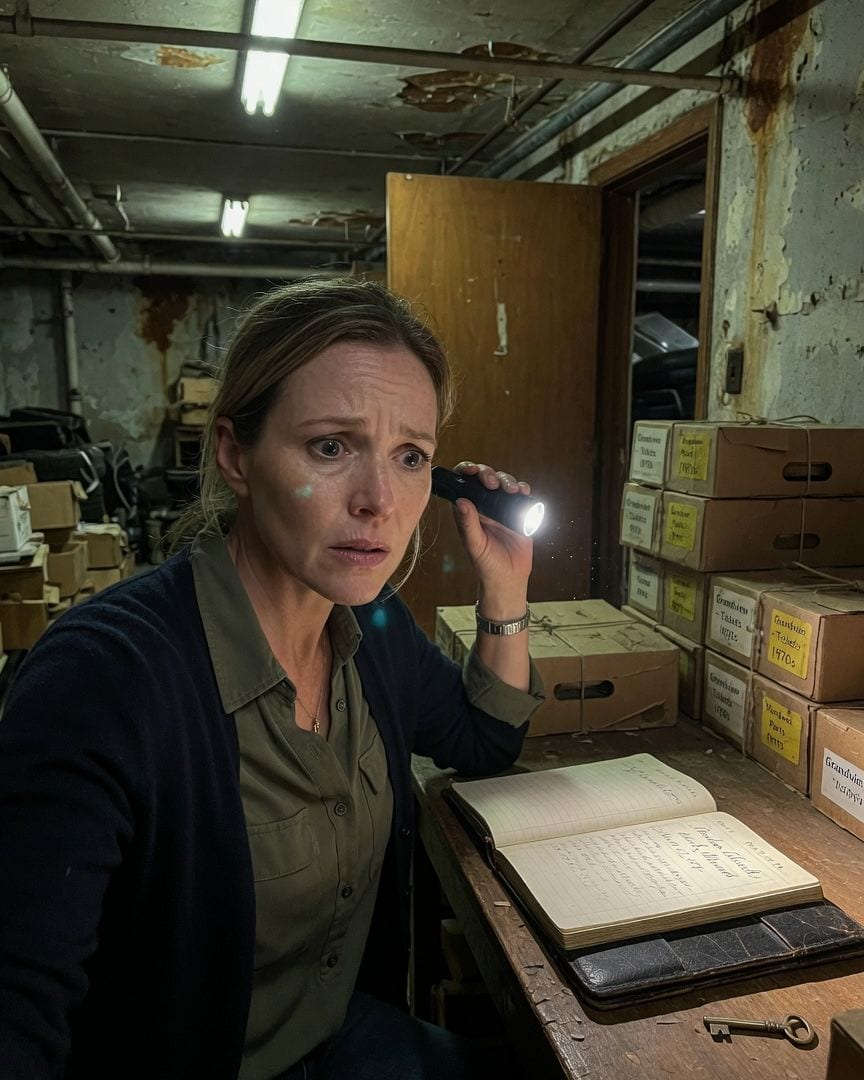
My old cinema's letter said "We kept your seat," and it closed in '94. The seat number was mine, a secret I never wrote down.
Penelope Ellsworth receives a mysterious letter from the Grandview Cinema, which closed in 1994. The letter claims it 'kept her seat,' a specific row and number she never shared with anyone. Driven by an unsettling curiosity, Penelope uncovers an old ledger in the defunct cinema's basement with her name and seat number, dated 1977—seventeen years before she was born.
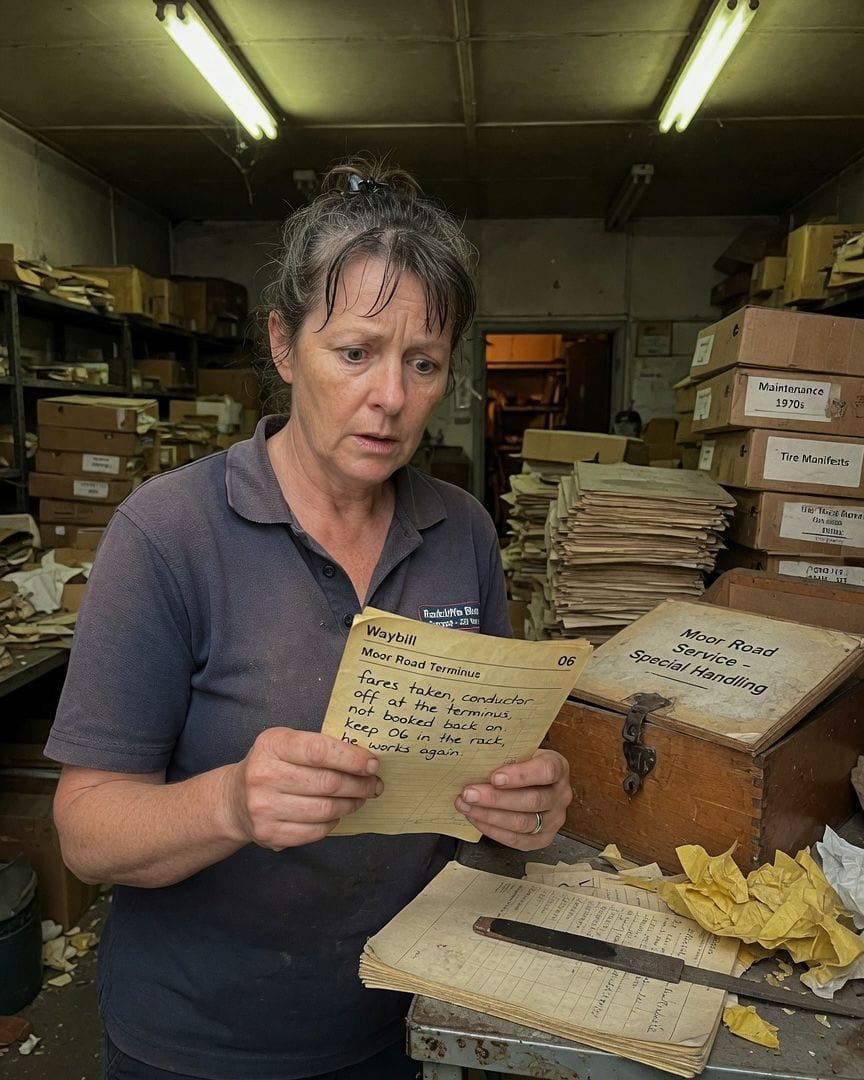
Our depot's Waybill 06 filed a moor road service we stopped running years ago. Every eight years since 1956, it closes: 'keep 06 in the rack, he works again.'
Sorting waybills in the depot, I stumbled across a form for the Moor Road Terminus. That route was decommissioned decades ago, but this waybill had a chilling handwritten instruction: 'keep 06 in the rack, he works again.'
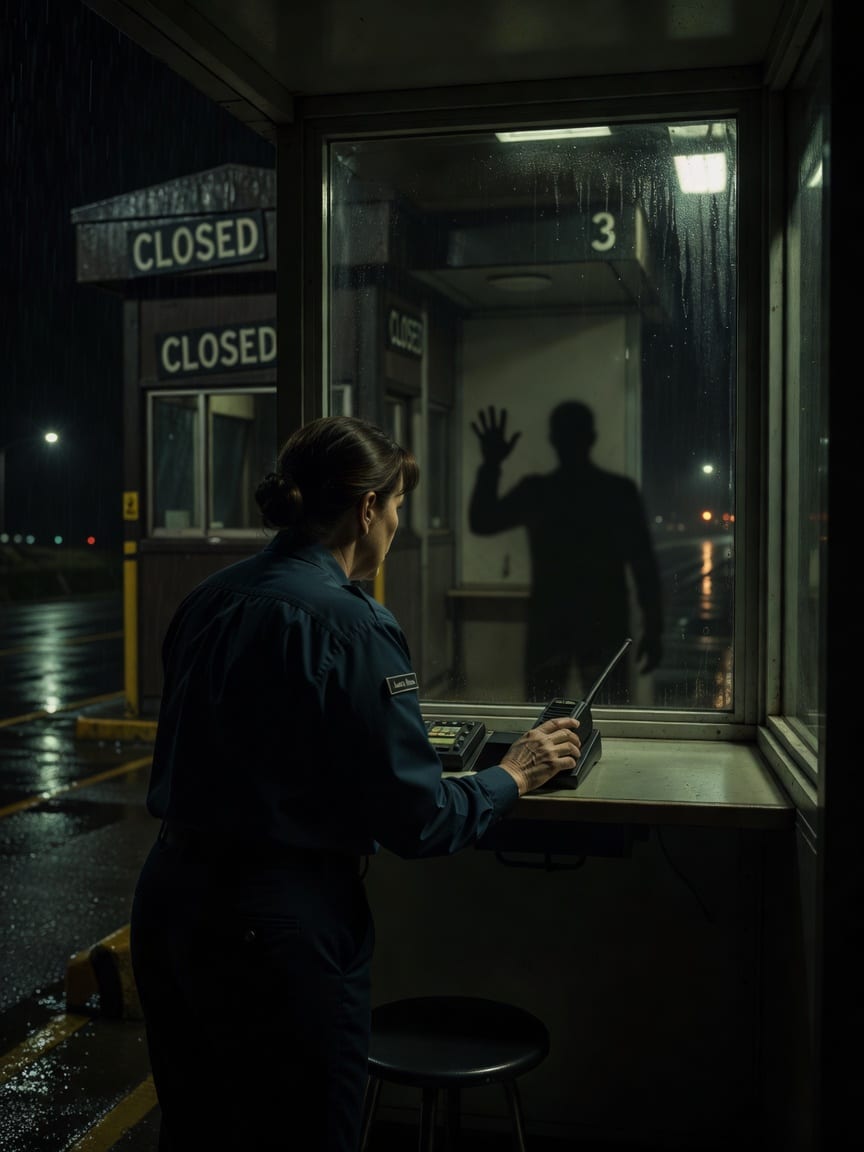
My Booth 2 radio crackles every night with Booth 3's traffic count. Central office just called about a discrepancy and told me Booth 3 has been closed since 2016. No radio, no operator.
Working the night shift, I logged vehicle counts from Booth 3 just like every other night. But my manager called, her voice tight, to tell me Booth 3 has been closed and unmanned since 2016. So who just reported the vehicle count?
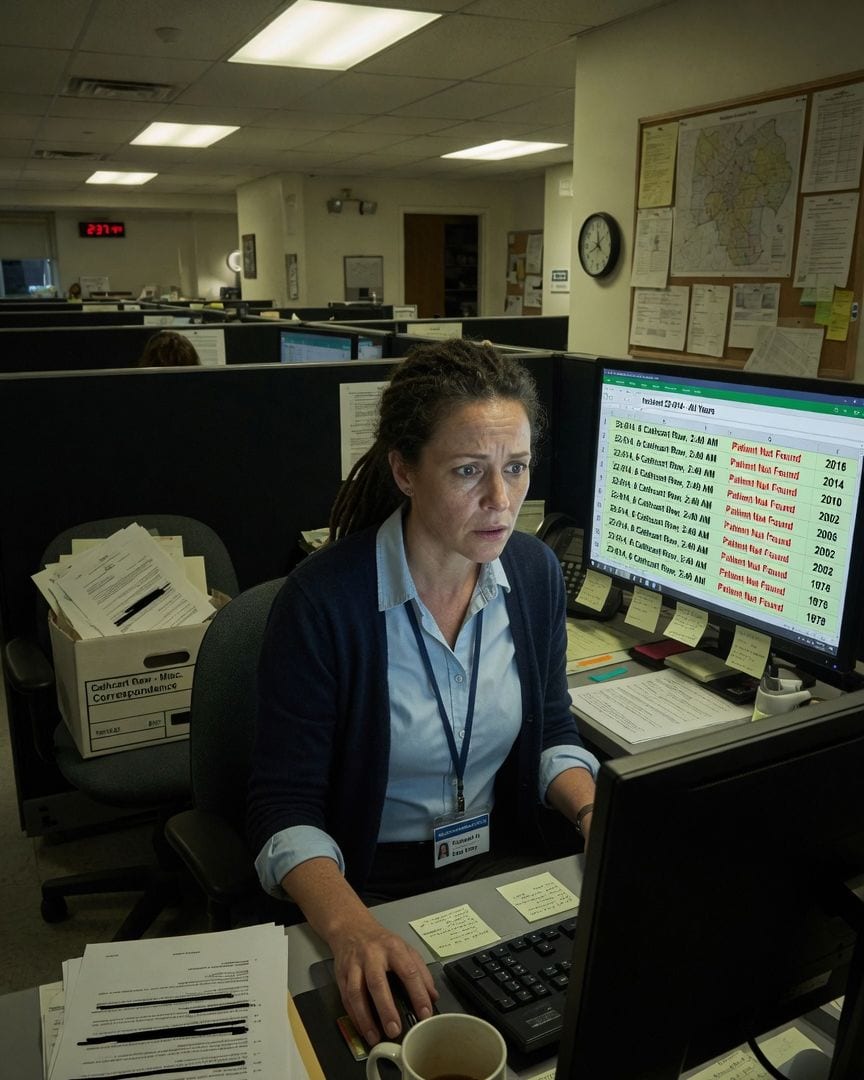
My computer log shows the same 2:40 AM call to Cathcart Row, every four years since 1978, always closed 'patient not found'.
Working data entry for the County Ambulance Trust, I found a routine incident logged as 'Patient Not Found.' But digging deeper, I discovered the exact same phantom call had repeated every four years for over forty years, always at the same address, always at 2:40 AM. Then I found a heavily redacted memo linking it to my own street.