One room is missing from this factory floor. My blueprints show four, but I only found three doors.
The first time it happened, I actually laughed. I was on my way to a new client site, a consulting gig out in the sticks, a good hour’s drive from my apartment.
Picked up the rental car, a grey sedan I barely looked at, plugged the address into the sat-nav. The voice, calm and digital, guided me out onto the highway.
I passed through a couple of small towns, nothing remarkable, until the landscape started to get a bit more rural.
Then, just as I was mentally preparing for a final turn, the sat-nav announced, without a hint of irony, “You have reached your destination.”
I stared at the screen. The blue dot hovered over a cluster of buildings, labelled ‘Vance Car Rentals.’ The actual Vance Car Rentals. The place I’d literally just driven out of an hour ago.
The familiar blue and white sign, slightly peeling, was directly ahead. My brain tried to process it. Had I taken a wrong turn? A massive, inexplicable loop?
But the map on the screen showed I was on the right road, a road I’d never been on before, leading to a town named Oakhaven. Oakhaven, which I had no memory of entering or driving through.
“Okay, that’s… quite the glitch,” I muttered to myself. I pulled into the familiar forecourt, the same patchy asphalt, the same fluorescent lights glinting off the hood of this very hire car. I turned off the engine, restarted the sat-nav, re-entered the address.
It recalculated, gave me new directions. I followed them, meticulously, double-checking every sign. Forty-five minutes later, the voice, still calm, still digital, repeated: “You have reached your destination.” And there I was again. Vance Car Rentals.
The same beige brick office, the same sign, the same parking space, as if I’d never left. The hire car felt suddenly much colder.
I just stared at the sign for a long moment, the hum of the engine the only sound. This wasn't a glitch. Two hours of driving, and I'd gotten nowhere. Or rather, I'd gotten right back here.
I went inside, handed the keys to the bored clerk. "The GPS seems to be malfunctioning," I said, trying to keep my voice even. "It kept directing me back here. Said I'd reached my destination, both times."
He barely looked up from his phone. "Happens sometimes with older units," he mumbled, and just handed me the receipt for the rental. No questions, no concern. Just… an acceptance that seemed entirely too easy.
Stepping back out into the late afternoon, the feeling of unease tightened its grip. Oakhaven. I needed to see this place that wasn’t on any visible map, yet my car had apparently driven through.
I found a gas station a few blocks away and bought a physical map of the county. I unfolded it on the passenger seat, tracing lines with my finger. No Oakhaven.
It wasn't just my sat-nav; the town genuinely didn't seem to exist on any official record. My phone, however, found an old forum post mentioning 'Galloway Mills' near the coordinates my GPS had listed for Oakhaven.
An abandoned industrial complex, it said. Intrigued, and a little unnerved by the coincidence of the name—Galloway, my own surname—I drove out in my own car.
The complex was exactly as described: sprawling, grey brick, oddly featureless. Like a placeholder for a building rather than a true structure. There was a faded 'For Sale' sign near the crumbling main gate, with a contact number.
I called it. The agent on the other end was surprisingly unhelpful, almost dismissive, but eventually emailed me a link to the property's original blueprints. Back in my car, parked across the street, I opened the PDF on my laptop.
It was for the 'Main Production Floor.' I counted the rooms on the plan, compared them to the exterior windows I could see from the street. Something felt off. The numbers didn't quite align.
It was a subtle difference, but one that pricked at the corner of my mind. The plans seemed to suggest more internal spaces than the exterior suggested. I knew I wouldn't rest until I'd checked it myself.
A growing, cold unease settled deep in my gut.
I managed to secure a temporary access code through the same unhelpful agent. The code worked, letting me through a rusted side door. I stepped into the cold, silent interior of the Galloway Mills.
Dust motes danced like tiny, confused spirits in the weak light filtering through grimy windows. The air was still and heavy, smelling faintly of old concrete and something metallic.
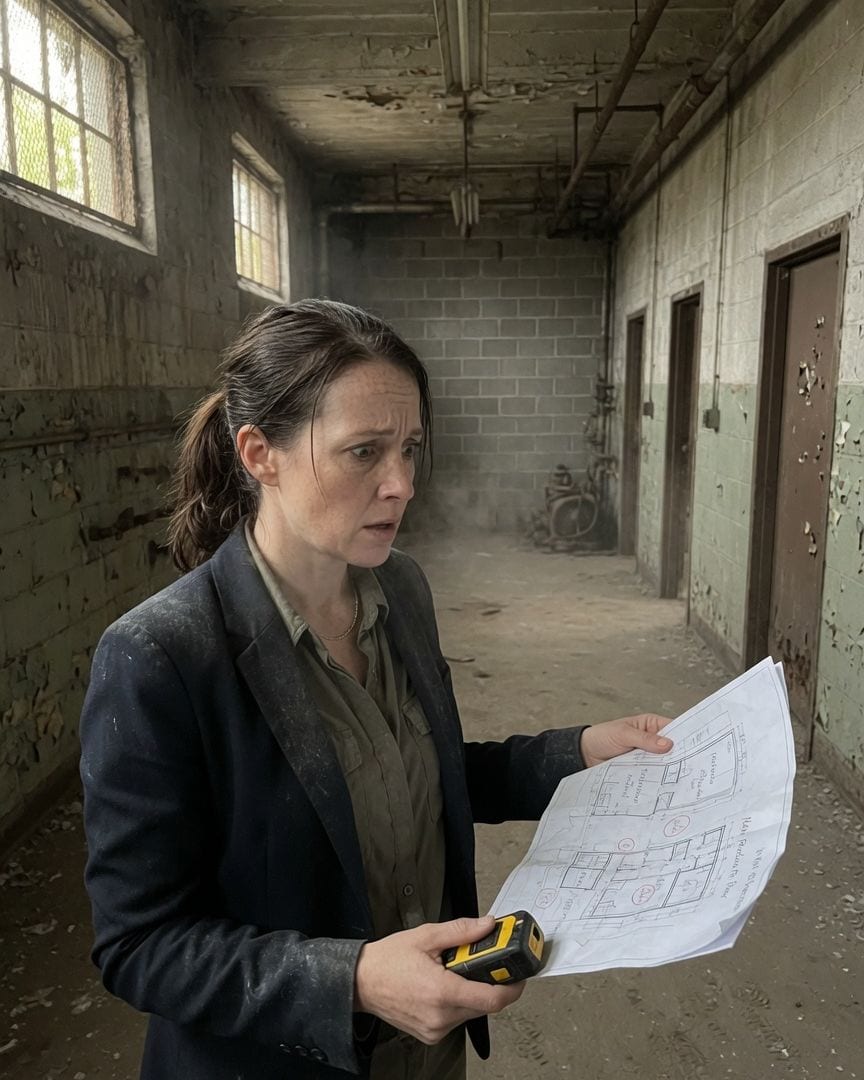
I pulled out the blueprint on my phone and, using a laser measurer I always carried for work, began to pace, counting doors. The plan showed a clear layout of four distinct, equally sized rooms opening off a central corridor.
I started at one end, tapping my foot to mark each length. One door. Two. Three. I reached the end of the corridor. There was a solid brick wall, unmarred. No fourth door.
I retraced my steps, counting again, meticulously checking every corner, every shadowed recess, peering behind old, rusted machinery that lay like forgotten carcasses. Three doors.
The space for the fourth simply wasn't there, yet the corridor's length, according to my laser measurer, clearly accounted for it. It was like a paragraph with a word missing, but the sentence still made sense, just stretched too thin.
Linda stands in the empty, dust-filled corridor, clutching a crumpled blueprint.
She has just paced the length of the hall for the third time, confirming the impossible: the space measures out to accommodate four specific rooms on this floor, matching the blueprint, but there are clearly only three doors opening off it.
Her breath catches, the cold air suddenly heavy.
The next few days were a blur of obsession. The Mills consumed me. I went back, again and again, armed with my laser measurer, a compass, even an old plumb bob. I tried different floors, different sections.
Each time, the geometry misbehaved in maddening, subtle ways. A staircase would lead to a small, dusty landing that felt unconnected to the floor directly above it, like a pause in mid-air.
A window, clearly visible from the outside, would look out onto a solid brick wall from the inside, or just a stretch of grey nothingness that couldn’t possibly exist.
It was a physical contradiction, over and over, no matter how many times I measured, no matter how many angles I checked.
The building was a lie, constructed out of stone and mortar, yet defying every law of physics I understood.
I started asking around, seeking anyone who might know something about the Mills. Local historians, old-timers at the town library. Eventually, I found Nathaniel Vance, a retired archivist who’d managed the town's property records for decades.
His office was a cramped, overflowing space in the old town hall annex, smelling of aged paper and dry dust. He was a quiet, calm man, perhaps 68, with thin grey hair and spectacles perched on his nose.
He listened to my increasingly frantic questions about the Mills, about the impossible measurements, without a flicker of surprise or concern. He just nodded slowly, a faint, knowing smile playing on his lips.
"The Mills," he said, his voice soft, "always been a bit of a puzzle, that one. Changes its mind, you might say." He offered no further explanation, just that unsettlingly unbothered smile.
I found an old land deed in the local archives, confirming Vance's long association with the property, dating back over 40 years. The deed showed the Mills property boundary as a perfect square, meticulously drawn.
Yet, a survey map from the exact same year depicted a section mysteriously 'excluded' from that square. A tiny, infuriating gap. It didn't reconcile with the deed's measurements, not by a long shot.
It was a discrepancy so small you could almost miss it, but once you saw it, it became maddeningly precise, like a missing piece of a puzzle that would otherwise fit perfectly, mocking you with its absence.
As my investigation deepened, I started noticing things that had nothing to do with blueprints or ledgers.
My car, parked outside the Mills while I was inside, had a faint, blurred dust print on the driver's side window when I returned, as if someone had leaned against it, pressing their forehead to the glass, looking in.
The next morning, I found a note tucked under my windshield wiper back at my apartment, a single line scrawled in an elegant, old-fashioned hand: 'Some things are better left uncounted.'
It wasn't a threat, not overtly, but it felt like a warning.
The day after that, I saw Nathaniel Vance's distinctive, vintage sedan parked several blocks from the Mills, well away from any logical reason for him to be there. No houses, no shops, just a stretch of overgrown roadside.
He was just sitting there, not looking at me, but I felt his presence. As I rounded the corner, he slowly pulled away. The unease in my gut shifted. It wasn't just a puzzle anymore. It felt personal.
Someone knew I was digging, and they were watching.
I couldn't take it anymore. I drove straight to Nathaniel's office. He was sitting at his cluttered desk, sipping tea from a delicate porcelain cup. I didn't bother with pleasantries.
I laid out the crumpled blueprints, the land deed, my notes on the impossible measurements. "What is this place, Mr. Vance?" I demanded, my voice tight, barely recognizing the edge of hysteria in it.
He took another slow sip of his tea, his expression utterly unreadable. "It's a structure, Ms. Galloway," he said, setting the cup down with a soft click. "Designed to… contain certain irregularities."
He spoke of the Mills not as a building, but as a mechanism, a device. He explained, without emotion, that the impossible geometry, the shifting rooms, the looping roads, were not flaws or glitches, but inherent features.
"It folds space," he said, his eyes distant, as if seeing something I couldn't. "To ensure what is within, stays within."
He described it as a kind of architectural 'seal,' built long ago by a forgotten order. Their purpose, he said, was to manage 'fluxes in the local fabric,' whatever that meant. "The 'Room That Isn't Counted'?"
I prompted, my throat dry. He nodded. "That's its primary function. A space that exists and doesn't exist, a gateway that only appears when the structure is 'active.' Like a lung breathing in, and holding."
His calm, matter-of-fact tone made the horrifying implications all the more real. The sat-nav looping me back to the car depot, the missing town of Oakhaven – it wasn't a glitch. It was the structure 'activating' around me.
Drawing me in. Holding me.
The blood drained from my face as Nathaniel's words sank in. I wasn't just investigating a local oddity. I'd been caught in a trap. A trap that had closed around me the moment my sat-nav had first said 'destination reached.'
Nathaniel, sensing my terror, sighed, a quiet, almost sympathetic sound. "There’s one more thing you should see, Ms. Galloway," he said, pushing his teacup aside.
He reached beneath his desk, pulling out a heavy, leather-bound ledger, its pages brittle with age. It looked like something from centuries past.
He opened it carefully, the spine creaking. It was a meticulous record of the Mills, not just of its construction materials or maintenance, but of its 'occupants.'
He turned to a page, yellowed and fragile, and pointed to an entry with a steady finger.
His finger lands on a faded, looping script. 'This is where we keep track of… everything,' he says, his eyes calm. Linda looks down, her heart seizing.
Stamped beneath a date from 1957, alongside a list of 'structural components,' is her own full name, Linda Galloway, followed by a single, chilling word: 'Occupant.'
Nathaniel watched my face, impassive. "You are not the first, Ms. Galloway, nor will you be the last."
He explained that the Galloway Mills was a recursive trap, designed to draw in specific individuals – 'occupants' – who possessed a certain resonance with the spatial anomaly.
My name, he explained, appeared in the ledger not as a historical record of a distant relative, but as a recurring entry, an 'imprint' of my repeated cycles within the structure.
Each time an 'Occupant' was drawn in, their memories of previous cycles were reset, but their resonance remained, ensuring their return.
The sat-nav loop, the missing town, the room that wasn't counted – these were all markers of my re-entry into the cycle.
He described the building as a living pattern, feeding on the disorientation and experience of its occupants to maintain its impossible geometry.
The 'Room That Isn't Counted,' he explained, was not just a missing space, but the chamber where the cycle reset, where an occupant's consciousness was 'realigned' before their next iteration.
He said all this with a quiet, almost mournful resignation, like a man who had witnessed countless such cycles, countless returns. He wasn't gloating; he was merely stating an undeniable, ancient truth.
"There has to be a way out!" I cried, rejecting his calm acceptance, the desperation rising in my throat. I couldn't just accept this. I couldn't be a part of some ancient, repeating nightmare.
I raced back to the Mills, the grey sedan a blur on the road, determined to break the pattern. I re-drove the exact route the sat-nav had taken, hoping to find a flaw, a moment of divergence, a missed exit.
Nothing. The roads remained stubbornly normal, leading me straight to the Mills, no looping this time, but no escape either.
Inside, the building felt different, colder, more watchful. I tried to count the doors again, to force the 'missing room' to appear, to refuse its presence with sheer will.
I paced the corridors, pushing against invisible walls, testing every surface, every shadow. The geometry, which had been subtly wrong, now felt actively hostile.
The corridor shifted, subtly elongating as I walked its length, then contracting behind me, its far end seeming to recede as I approached, the dust motes in the weak light swirling around me like a silent accusation.
I pounded on a solid brick wall where a window should have been, the dull thud echoing back, mocking me. The air grew heavy, thick with unseen pressure, pressing in on my chest.
As I rounded a familiar corner on the 'Main Production Floor,' a door I had never seen before materialized, silent and sudden.
It was a plain, unpainted wooden door, identical in every way to the three others, now making the count of four. This was it. The 'Room That Isn't Counted,' now fully manifest. It wasn't an exit. It was an entrance.
A profound, crushing understanding washed over me, a wave of cold certainty. I was never meant to escape. I was meant to return.
The door stood ajar, revealing only an inviting, featureless darkness, a silence that seemed to hum with ancient, inescapable purpose. I took a single, involuntary step forward, drawn by an irresistible pull.
The door to the 'Room That Isn't Counted' closed softly behind her, the latch clicking with a sound that resonated not through the building, but deep within her. She felt a profound, peaceful emptiness, a quiet settling of things.
The geometry folded around her, a familiar embrace. Her memories, once so sharp and distinct, began to blur, to re-form. The drive, the sat-nav, the blueprints, Nathaniel's face – they became patterns, echoes of a recurring dream.
She knew only the hum of the structure, the perfect, unyielding coherence of the loop.
Days later, Nathaniel Vance received a new entry in the old ledger. He opened to a fresh page, dipped his pen in ink, and carefully wrote a single line.
The date was current, the name was Linda Galloway, and the status was 'Occupant.' He closed the book, a faint, wrong little smile playing on his lips, and returned it to its shelf. The pattern was complete, once more.
If this one got to you
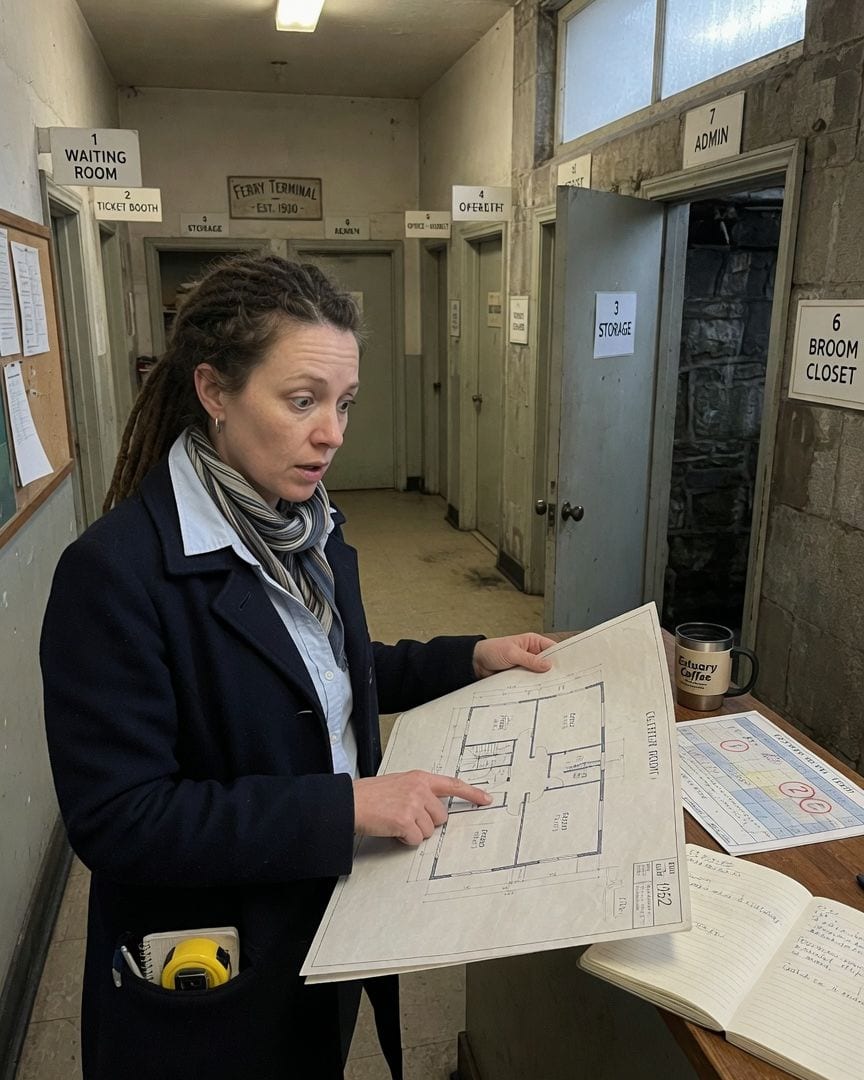
Our ferry returned to the same slipway three times yesterday, the town quay dissolving to our village shore. The crossing was never made.
After our ferry inexplicably kept returning to shore, I investigated the old office building. Its architectural plans clearly showed six rooms, but when I walked the hallway, I found a seventh door. That extra room was undeniably there, an impossible presence.
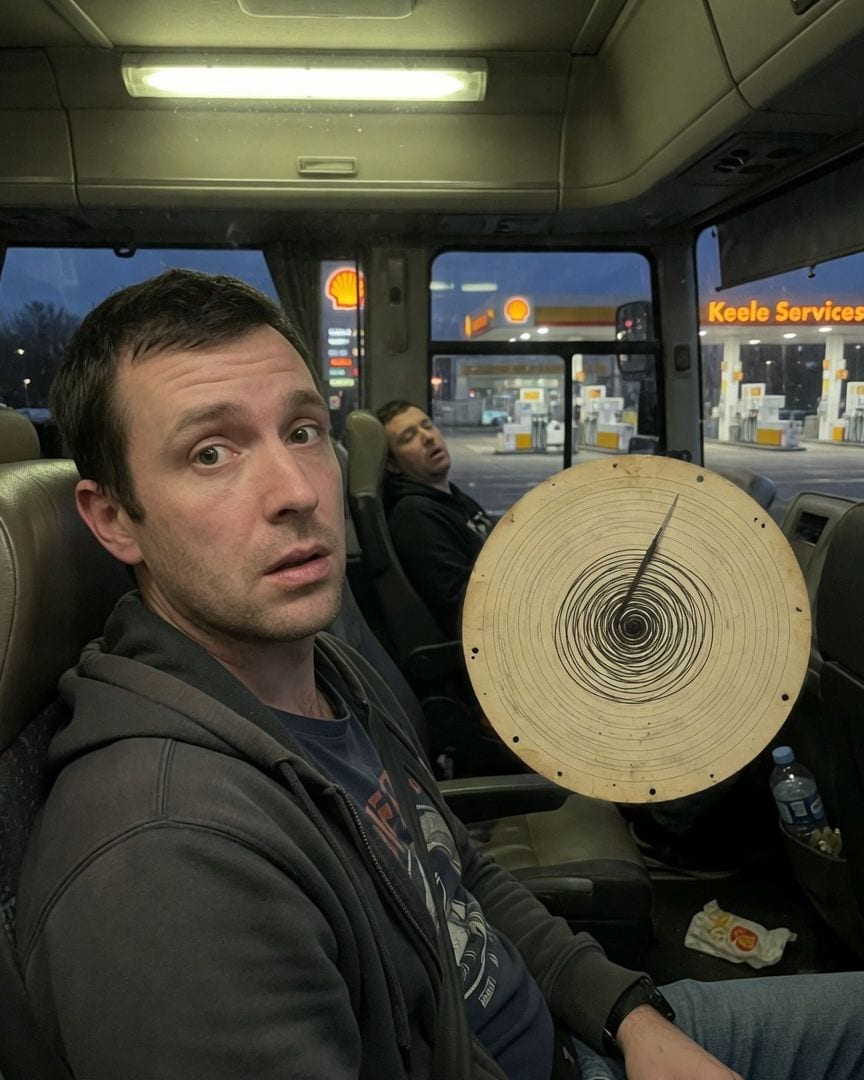
My coach stopped twice at Keele services this morning. Same pumps, same lit sign, the driver's log disc spinning a tight circle, never leaving the one place.
I was on an overnight coach, tired and stiff, when I first woke at Keele Services at 3:20 AM. An hour and a half later, I woke again to find us still there, the driver's log disc spinning a perfect, impossible circle of stasis.
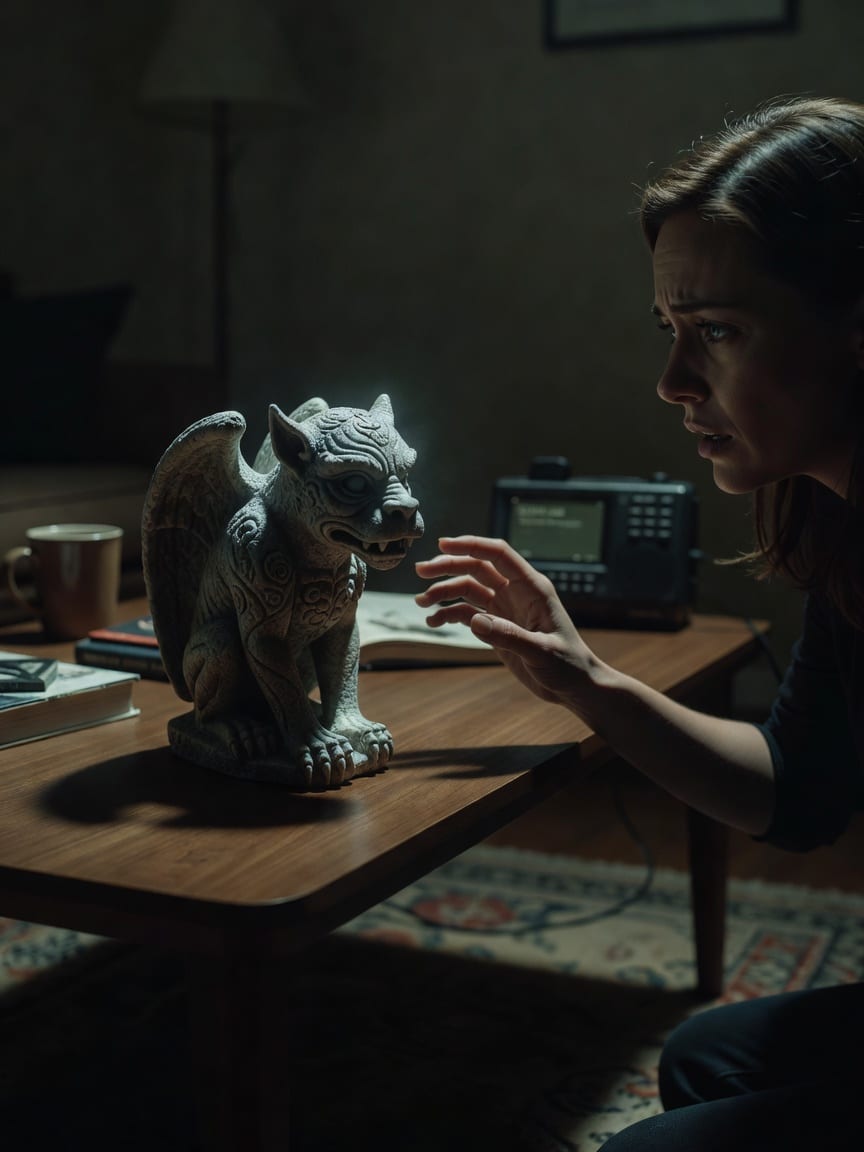
My radio scanner spoke my address at 2 AM. A flat voice read local homes, all with past dates. Mine was the only one in the future.
It was two in the morning, and my quiet house was filled with the usual hum of my weather scanner. But the static broke, replaced by a flat, synthesized voice reading a list of local addresses and dates. My hand froze when it spoke my own address, 181 Foster Drive, followed by a date: October 27th. That date was three weeks from now.
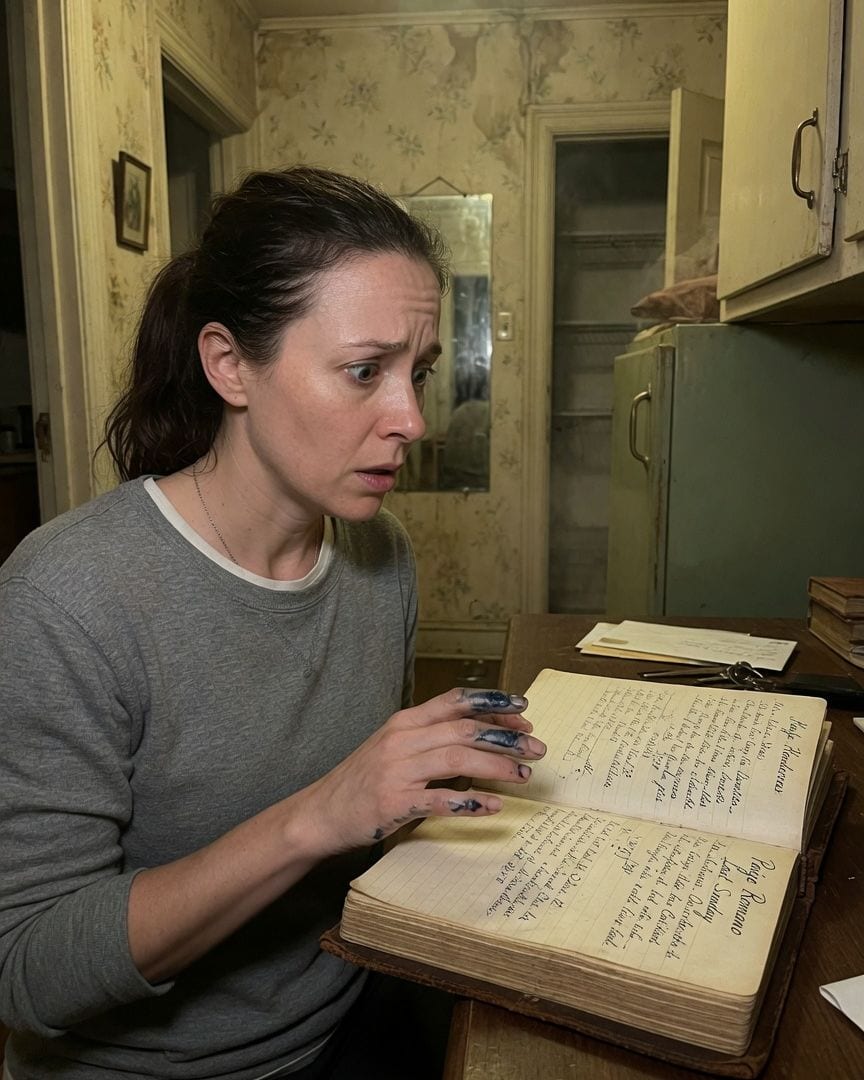
My visitors' book records guests who arrive in the future. Last Sunday, my own name appeared at the bottom, the ink still wet.
I bought an old house last March, complete with a dusty, leather-bound visitors' book. It seemed a charming relic, until I found new entries appearing, dated months into the future, the ink still wet. Then, my own name, Paige Romano, appeared, dated 'Last Sunday,' with a bead of ink shimmering at the 'R'.
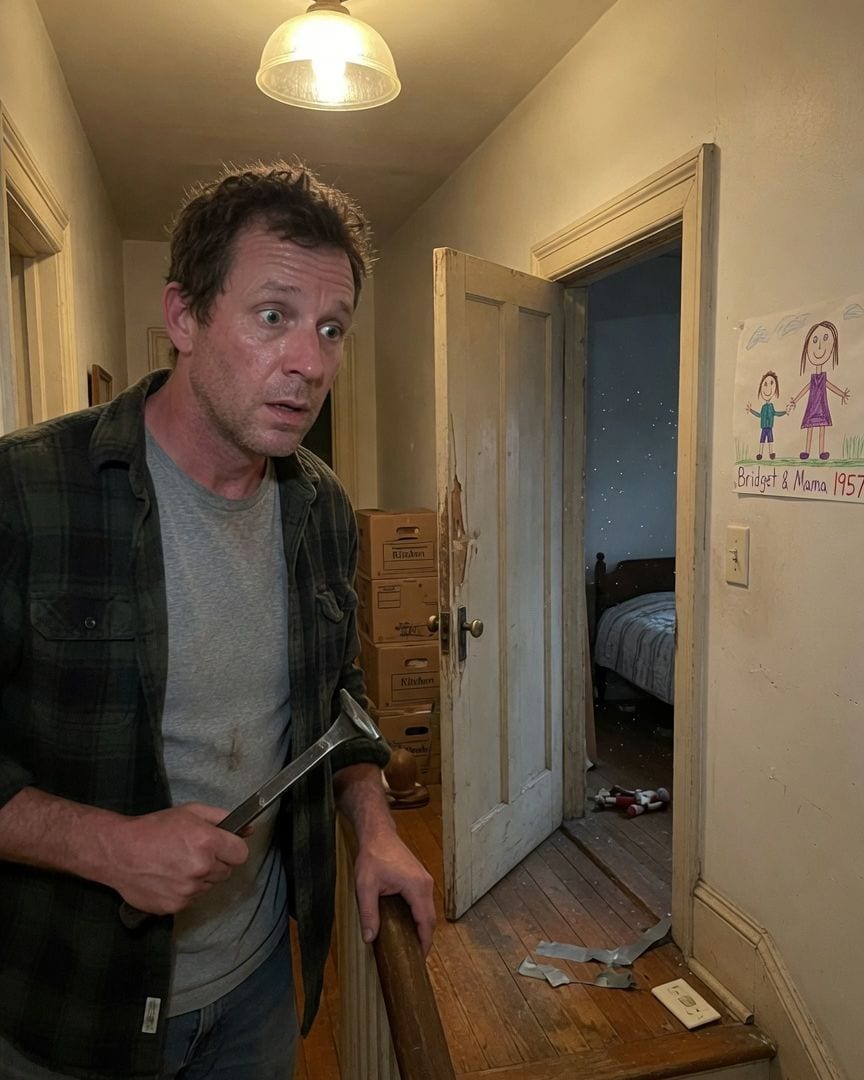
My landing light switches itself off at 9:40 every night. I've watched the switch flick down under nothing, the tape peeled back. The house holds its breath.
My great-uncle's old house was a quiet gift, a place to finally settle. But as I unpacked, a strange worn path on the floorboards led me to a small, barely visible door, perfectly blended into the wall. It was undeniably locked, and felt like a deliberately obscured secret.
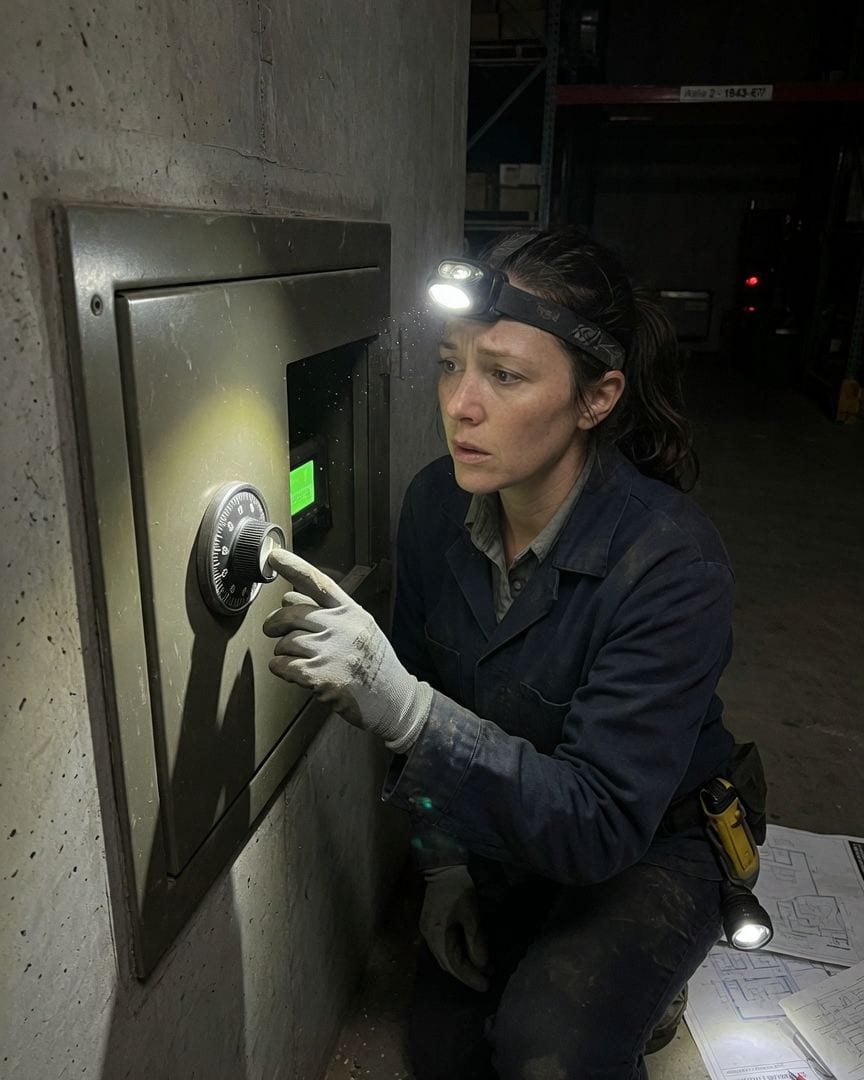
A meticulous records clerk finished her final inventory in a Cold War depot, then found a steel door not on any blueprint, worn smooth by decades of use, opening to an office with a log updated just hours ago.
Merit Lachance moved through the echoing darkness of Building 9, her headlamp cutting a lonely circle through dust motes. The depot’s oldest section was losing power, leaving her to finish her mandated shelf-read for the impending decommissioning. Every blueprint showed Building 9 as a single, vast room, so when her light fell on a waist-high, solid steel door set flush into the wall, her mind reeled. Its combination dial was worn smooth from decades of constant use, an impossible contradiction to the building’s known history. After meticulously working the dial, the heavy door shifted inward, revealing a dust-free, actively maintained office space with a terminal log updated just hours ago.