A historian discovered a Cold War US Army unit's dissolution order from 1954. It was signed by names from 1988 and 1995, decades in its future.
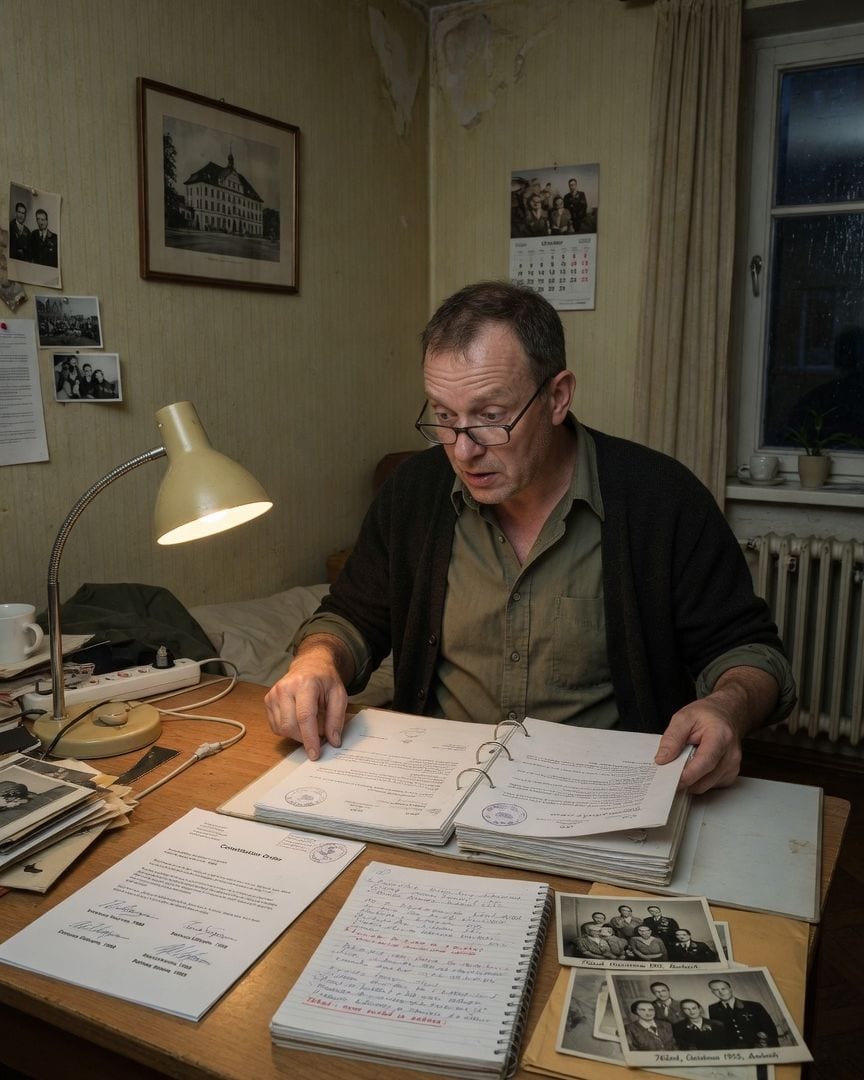
Willem Achterberg arrived in Ansbach in the crisp fall air, notebook in hand, seeking the forgotten history of a kaserne.
The project felt simple enough: document the lives surrounding a US Army base that had, for all intents and purposes, been erased from public memory. He imagined tales of forgotten heroes, mundane military life, perhaps a few local romances.
But the town itself remembered the kaserne vividly.
Shopkeepers, like old Carl Sterling, named the American unit with a casual familiarity that chilled Willem. The 762nd, Carl had called it, as if it had only left last year.
He’d described the specific beer the soldiers drank at the corner pub—a dark, local brew—the exact street where the boys married local girls, even the names of children born to these unions.
Willem, methodical and rational, cross-referenced Carl's recollections and others’ with official Army archives. He spent weeks poring over microfilm, scanning digitized rosters, sifting through unit histories. The 762nd, according to every official record he could find, had never existed.
Not in any deployment roster, unit history, or personnel file. It was a ghost. Yet, the town's collective memory was a perfect, coherent echo of a unit the Army swore was a phantom.
The anomaly was not a gap in the record, but a vibrant, insistent presence outside it.
For three months, Willem worked tirelessly, driven by a growing unease that sharpened his focus. He collected sixty sworn affidavits from Ansbach residents, each recounting precise details about the 762nd.
He meticulously recorded marriage certificates found in the local church registry, linking American servicemen's names to local women. Faded photographs, pulled from dusty family albums, showed soldiers in uniform, clearly labeled as the 762nd, posing with their new German families.
He even found a christening register listing US fathers from the unit, their ranks and serial numbers legible. Each piece of evidence pointed to the 762nd's undeniable presence. The local records were a robust, tangible counter-narrative to the Army's silence.
Willem compiled everything into a binder, a monument to a unit that shouldn't be. He tried every mundane explanation. Perhaps a numerical error, a misremembered designation for a temporary detachment, or a vast, systemic clerical oversight.
He even considered a shared delusion, a collective folk memory based on a misunderstanding. But each attempt crumbled under the weight of the town's detailed, consistent testimony.
The dread wasn't in the mystery itself, but in the sheer, unwavering coherence of the impossibility. The ordinary explanations simply refused to fit. The truth, whatever it was, had to be far stranger.
He finally found a lead, buried deep in a dusty, digitized index of obscure post-war orders. A single entry: a 'Constitution Order, 762nd Provisional Unit, Ansbach, 1954.' A thrill of vindication, cold and sharp, shot through him. He was right.
It had existed. Quickly, he located the digital file. Within the folder, tucked away with the constitution order, was another document: a 'Dissolution Order, 762nd Provisional Unit, Ansbach, 1954.' Both were dated the same day, August 14th, 1954.
Eleven hours apart, the timestamp clearly indicated. Formed and disbanded, all within a single working day. Strange, but at least an official record.
Willem Achterberg stared at the 1954 dissolution order for the 762nd, his finger tracing a signature dated 1988, then another from 1995. Each was in a steady, official hand, utterly impossible, yet undeniably real on the faded parchment.
The constitution order was signed with period-appropriate names—Colonel James Rutherford, Captain Robert Olsen—but the dissolution order, dated merely eleven hours later, bore names that hadn't been born when the ink first dried. Vincent Ingram. Richard Barlow.
His historian's mind reeled, trying to force a rational explanation for a temporal paradox, but there was none. No timestamp error, no mislabeled file.
The control number on the dissolution order was also unique, a seven-digit string that traced to no known originating office or department. The document itself was a contradiction, a physical impossibility that defied every rule of record-keeping.
It was a file signed by ghosts of the future.
The impossible signatures consumed Willem. He cross-referenced the names, Vincent Ingram and Richard Barlow, with official personnel lists at the National Archives.
They existed, all right, but their service records began decades after 1954, one in 1978, the other in 1985. Neither had any listed connection to Ansbach or the 762nd.
He drove to the National Archives in College Park, Maryland, the imposing concrete structure doing little to soothe his rising unease.
He requested all files related to 'Provisional Unit, Ansbach, 762nd,' submitting his digital copies of the constitution and dissolution orders as proof of existence.
The archivist, Janet Norwood, a woman with kind eyes and a nervous habit of smoothing her graying hair, initially found nothing. Her search results matched his own: a void.
When Willem insisted, showing her his physical printouts, the impossibility of the signatures starkly visible, she hesitated. Her gaze lingered on the '1988' and '1995' dates for a beat too long.
She returned ten minutes later with a single, thin folder. The cover sheet listed '762nd Provisional Unit, Ansbach, 1954' but noted 'Pages: 27.' The folder contained only two: the constitution and dissolution orders Willem already had.
The 'DECLASSIFY NEVER' stamp on the cover was stark, a stark red block against the aged cream paper. Willem also noticed the redactions on the dissolution order were unusually heavy, almost obscuring the entire text body beneath the signatures.
He asked Janet if there were other copies. 'Sometimes,' she murmured, her voice barely a whisper, 'different copies, different redactions. Depends on the classification level, who has access.'
He pressed her, sensing a tremor in her composure, and she reluctantly produced a microfiche copy. Willem gasped.
The redactions on the microfiche were in different places, revealing fragments of text previously hidden, and obscuring parts that had been clear on the paper copy. A name here, a date there, shifted, vanished.
The control number on this microfiche copy was identical to the paper, yet its internal sub-codes were subtly altered, tracing to no known department or even a logically sequential numbering system.
It was as if the record itself was fluid, shifting with each presentation, a digital phantom. The unease sharpened into a cold certainty: this wasn't a clerical error. This was deliberate.
Willem's relentless digging started to attract unwanted attention. His university email received cryptic, unsent messages, subject lines reading 'Ansbach File' followed by strings of numbers.
They appeared in his outbox, as if he had attempted to send them himself, only to fail. Then they vanished.
His research requests at the Archives were met with increasing scrutiny, the desk clerks taking longer, their eyes flicking over his shoulder.
He caught glimpses of a man, always in a dark suit, nondescript and utterly forgettable, observing him from a distance in the Archives reading room. The man never approached, never spoke, just watched.
One afternoon, as Willem left the Archives, the chill wind whipping at his coat, Janet Norwood intercepted him. She looked pale, her face etched with a fear he hadn't seen before.
'Dr. Achterberg,' she whispered, her voice tight, 'you need to be careful. Some files… they don't like being reopened. Especially ones with 'DECLASSIFY NEVER' on them.'
She glanced nervously over her shoulder, her eyes darting past him to the Archives entrance. 'There are units, ghost units, that exist only in paper. And the people who manage those papers… they're very patient.'
Her warning was stark, her breath misting in the cold air, but she wouldn't elaborate, shaking her head and hurrying away.
Later that week, back in his apartment, the memory of Janet’s fear still a prickle on his skin, Willem found a small, official-looking envelope slipped under his door. It was thin, unlabeled.
Inside was a single, photocopied page: the cover sheet of his own Ansbach research binder, the one he had just compiled, complete with his handwritten notes and the university seal.
Scrawled across it, in the same crisp blue ink as the impossible signatures from 1954, was a single word: 'STOP.' The threat was no longer abstract; it was personal, precise, and had already entered his private space.
The lock on his door felt suddenly useless. Someone knew exactly what he was doing, and they were very close. The room itself seemed to hold its breath, the silence in the apartment pressing down on him.
The 'STOP' note rattled Willem, but also galvanized him. The fear was real, but so was the challenge. He called Janet Norwood immediately, demanding answers.
The phone rang for a long time before she picked up, her voice a thin thread of sound. She resisted at first, stuttering, making excuses, but the fear in her voice was palpable, a live thing shivering down the line.
'They know, don't they?' she choked out. 'About the note.' Willem confirmed it. 'Janet, what is this? Who are 'they'?'
She took a shaky breath, a sound that seemed to scrape against the receiver. 'It’s not a 'who,' Dr. Achterberg. It’s a 'what.' A system. The secrecy machine.'
She explained in hushed, fragmented sentences, each word a chilling piece of a larger puzzle. 'Ghost units... they're not military units in the traditional sense. They're administrative constructs.
When something… anomalous… happens, something that can't be explained or allowed to exist in the public record, it gets 'filed.' People, events, even entire operations. The 762nd was one of those files.'
The impossible signatures, she explained, were the 'signers.' 'Not the people who were there in 1954, but the people who came after. Generations of them. They manage the files, retroactively ensuring coherence, making sure the official record holds.
They sign off on the erasure. The 'DECLASSIFY NEVER' doesn't mean it’s locked away forever. It means it's an ongoing process. It means it's still active. The maintenance of the official silence.'
Willem's mind raced, piecing together the shifting redactions, the impossible control numbers, the ghost unit that wasn't a ghost to the people of Ansbach. 'So, the 762nd… those men from Ansbach… they were filed?'
Janet nodded, her eyes wide, even over the phone her terror was tangible. 'They were never lost. They were accounted for. And their files were kept coherent, across decades, by a steady official hand. By the signers.
They are the record-keepers of things that never were.' The horror wasn't a monster in the dark, but a bureaucratic process, patient and absolute, stitching history into a tapestry of carefully managed lies.
Willem, armed with Janet's terrifying explanation, felt a cold dread settle deep in his bones. The vast, unseen architecture of this 'secrecy machine' was both monstrous and utterly mundane in its execution.
He knew he had to dig deeper, to find the heart of it, to somehow expose it.
His next target was Patrick Porter, the military records officer he'd encountered earlier at the Archives, whose office managed the more obscure, classified archives. Porter had been coolly professional, almost too calm, during their brief interaction weeks ago.
Willem fabricated a story about needing to cross-reference Cold War-era provisional unit structures. He requested to see any contemporary files related to 'ongoing provisional unit protocols,' a term Janet had nervously mentioned.
Porter's smile didn't quite reach his eyes, a thin, polite line on his face, but he produced a folder from a locked cabinet labeled 'Project Ansbach: Containment Protocols.'
The folder felt unnervingly new, its edges sharp, its contents smelling faintly of fresh ink.
As Porter turned to answer a ringing phone, his back partially to Willem, Willem’s gaze fell on a document lying half-exposed on the edge of the desk.
It was a printed protocol sheet, clearly titled 'Containment Protocol Beta-7,' dated for the current week, just days away. His blood ran cold. His heart hammered against his ribs.
Willem snatched the recently filed 'Containment Protocol Beta-7' from the desk, his eyes scanning the 'Subjects Under Review' section.
There, beneath a fresh control number, identical in structure to the 762nd's unique string, was his own name, Willem Achterberg, followed by a date set for next week, and a single, unredacted signature he recognizes as Patrick Porter's.
Patrick Porter hung up the phone, his smile now chillingly devoid of humor. The polite mask had slipped, revealing something far colder. 'I see you've found your file, Dr. Achterberg.'
Willem gripped the document, his own name staring back at him, the ink on the page a cruel confirmation. 'What is this, Porter? What have you done?'
Porter calmly leaned back in his chair, his movements deliberate, unhurried. 'We haven't done anything yet, Willem. You have. You've become an anomaly. You've dug too deeply into a history that was meant to stay… coherent.
The 762nd was a temporary designation for a very specific kind of event. An erasure. Not a physical one, not always. A historical one. Those men were simply… filed. Their existence, their purpose, their impact, scrubbed from the official narrative.
The town remembers because the town isn't the official record. But the record, Willem, must remain absolute. It must be a perfectly smooth, unblemished surface.'
He gestured to the document in Willem’s trembling hand. 'Your 'Containment Protocol Beta-7' is simply the next iteration of that process. Your research, your book, your very identity as a historian, they threaten the coherence.
You are now a variable that must be fixed. And I, like Vincent Ingram, Richard Barlow, and countless others before me, am one of the fixers. The signatures are not from the future, Willem.
They are from the present, ensuring the past remains as it should be. We are the stewards of the silence. We ensure the timeline holds. And the file, Willem, is still being signed.'
The air in the room grew heavy, a palpable pressure, as if the very walls were listening, complicit.
Willem stared at Porter, the implications crystallizing into a horrifying, absolute certainty. He was to be erased, his existence meticulously unwritten, just like the soldiers of the 762nd.
His mind raced, searching for an escape, a way to expose this monstrous, patient machine. He couldn't let it happen.
Porter rose, his polite smile now completely gone. As he moved, two silent, broad-shouldered men appeared at the office door, their faces blank. They hadn't been there a moment ago. 'It's time, Willem.'
Willem, clutching the 'Containment Protocol Beta-7,' feigned a sudden dizzy spell, stumbling backward into Porter's desk with a crash that sent a stack of folders scattering across the floor.
In the momentary confusion, he fumbled for his phone, which he'd kept recording since the 'STOP' note. His thumb flew across the screen.
He quickly activated a pre-drafted email to a trusted colleague, a fellow historian who would recognize the absurdity of the attached files.
He attached a photo he'd taken of the 'Beta-7' document with his name on it, and a copy of the 1954 dissolution order with its impossible signatures.
He hit 'send' just as one of the men grabbed his arm, his grip like iron.
'You won't get far, Willem,' Porter said, his voice flat, completely devoid of emotion. 'The machine is thorough.' Willem struggled, but the men were efficient, their movements practiced, economical.
They moved with the quiet determination of bureaucrats carrying out a procedure. He could feel his phone being expertly removed from his hand, the recording stopped, the email probably intercepted.
He was being led out, not violently, but with an unnerving, quiet determination. This wasn't a fight; it was an administrative procedure. He caught a final glimpse of Porter, who offered a small, almost regretful smile. 'Don't worry, Dr. Achterberg.
Your story will be filed. Just not under your name.' The office door clicked shut behind him, sealing him in the sterile corridor.
Willem Achterberg vanished. His university office was quietly reassigned, the contents boxed and removed. His research files, including the Ansbach project, disappeared from the department server, overwritten by routine backups.
The partially written manuscript of his book on forgotten kasernes was eventually credited to an obscure, deceased German historian, its focus subtly shifted, the 762nd unit unmentioned. His name was scrubbed from academic journals and conference rosters.
Colleagues noticed his absence, but when they tried to recall his specific contributions, their memories became hazy, as if a layer of static had settled over his entire professional life, blurring his edges.
His lease expired, his apartment emptied, and no one came looking. The town of Ansbach continued to remember the 762nd unit, its collective memory an enduring, inconvenient truth against an official silence.
The kaserne remained a local legend, a ghost in the collective unconscious, but never in print.
Months later, Janet Norwood sat at her desk in the National Archives, meticulously cataloging new acquisitions. The fluorescent lights hummed with their usual indifferent drone. A fresh folder, sealed and marked 'DECLASSIFY NEVER,' landed on her cart.
Its control number was new, yet disturbingly familiar in its structure—the same seven digits, the same altered sub-codes. She opened the cover sheet. The subject: 'Project Ansbach, Protocol Beta-7.'
Beneath it, a list of 'Subjects Under Review,' with one name already crossed out, its entry dated for last week. Willem Achterberg. Below it, a new line was typed, waiting for a name.
She remembered the historian, the meticulous man who had dared to chase a ghost unit. She remembered the fear in his eyes, and the quiet certainty in Patrick Porter's.
Her hand trembled as she picked up her pen, ready to make a note in her personal, unofficial log, a tiny act of rebellion in the face of absolute coherence.
The silence of the archives felt heavier than usual, pressing in on her, a vast, patient weight. She knew. She simply knew. A new name would soon appear on the Ansbach file, waiting for its turn to sign.
If this one got to you
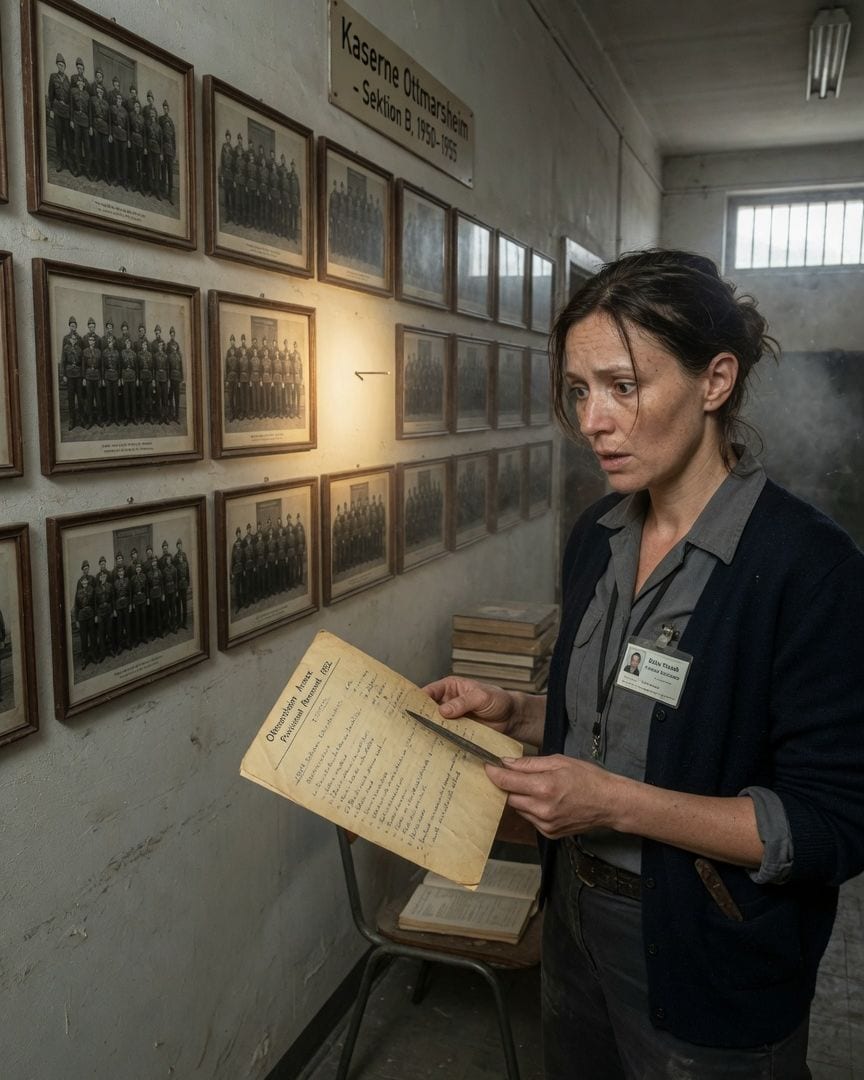
At a Cold War kaserne days from demolition, inventory clerk Delia Straub found a missing photo frame for a unit that never existed. Every soldier on the wall stared directly at its empty space.
Inventory clerk Delia Straub had eleven days to log every item at Kaserne Ottmarsheim before demolition crews arrived, turning history into rubble. Amid the dusty halls, she found a stark anomaly: a missing photo frame for the 604th Ordnance Detachment, a unit never officially stationed at the base. What made the empty space chilling was that every soldier in the surrounding photographs was looking not at the camera, but directly into that void. Delia's search for answers unearthed an unofficial manifest listing the 604th, with names of men officially declared killed in action years before. Who were these phantom soldiers, and why did their impossible record persist?
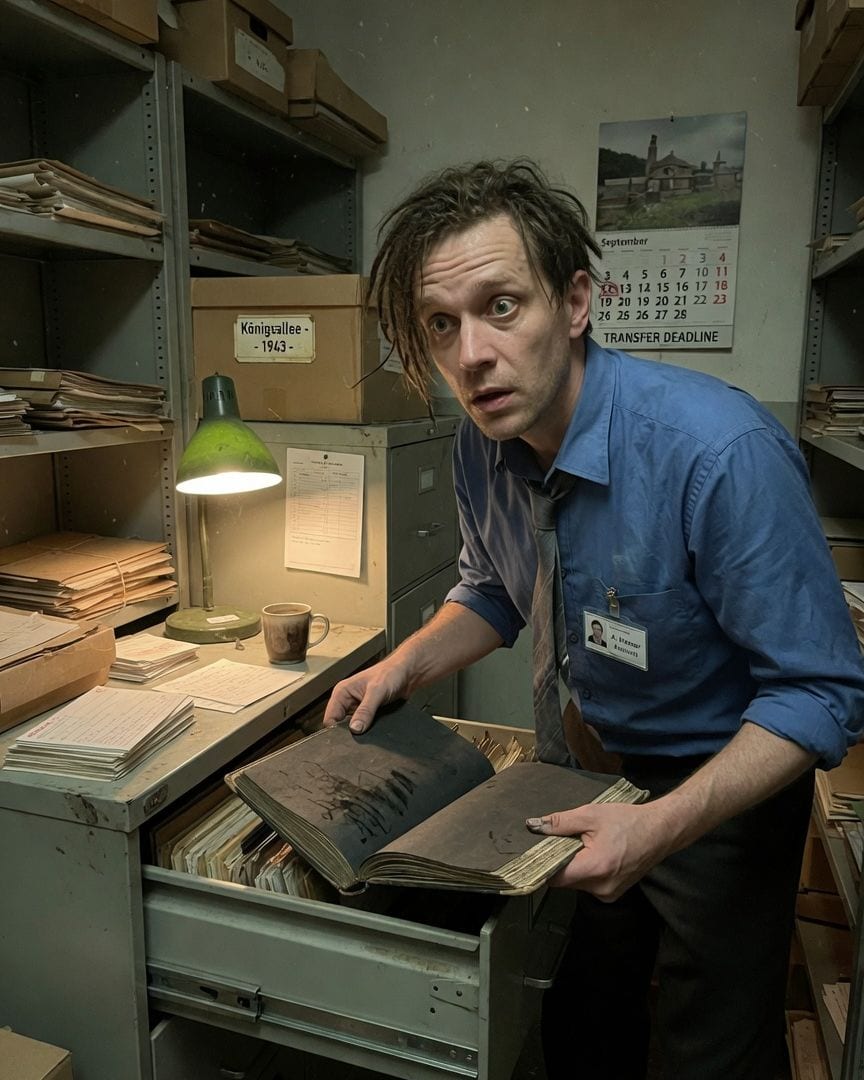
A Berlin archive researcher races a deadline. A hidden log for a Cold War barracks on a vacant lot has ink still wet from last month.
Ansel Vidmar, a methodical researcher, felt the pressure of a looming deadline. The municipal transfer of the old Berlin archive was days away, and he still had countless documents to categorize amidst towering stacks of forgotten history. His focus narrowed to an unindexed metal cabinet, revealing records for a garrison company at Königsallee – an address that had been a vacant lot since the war. A punishment log inside listed an entry from 1983, a date far too recent for a non-existent building. When Ansel visited the site, he found only overgrown grass, save for a single, eerily clean concrete doorstep emerging from the earth. His unease solidified into dread when he later uncovered a hidden Quartermaster's Log, meticulously detailing supplies for the same barracks, with entries extending to "last month," the final page's ink still faintly wet. What unseen operations were still being maintained?
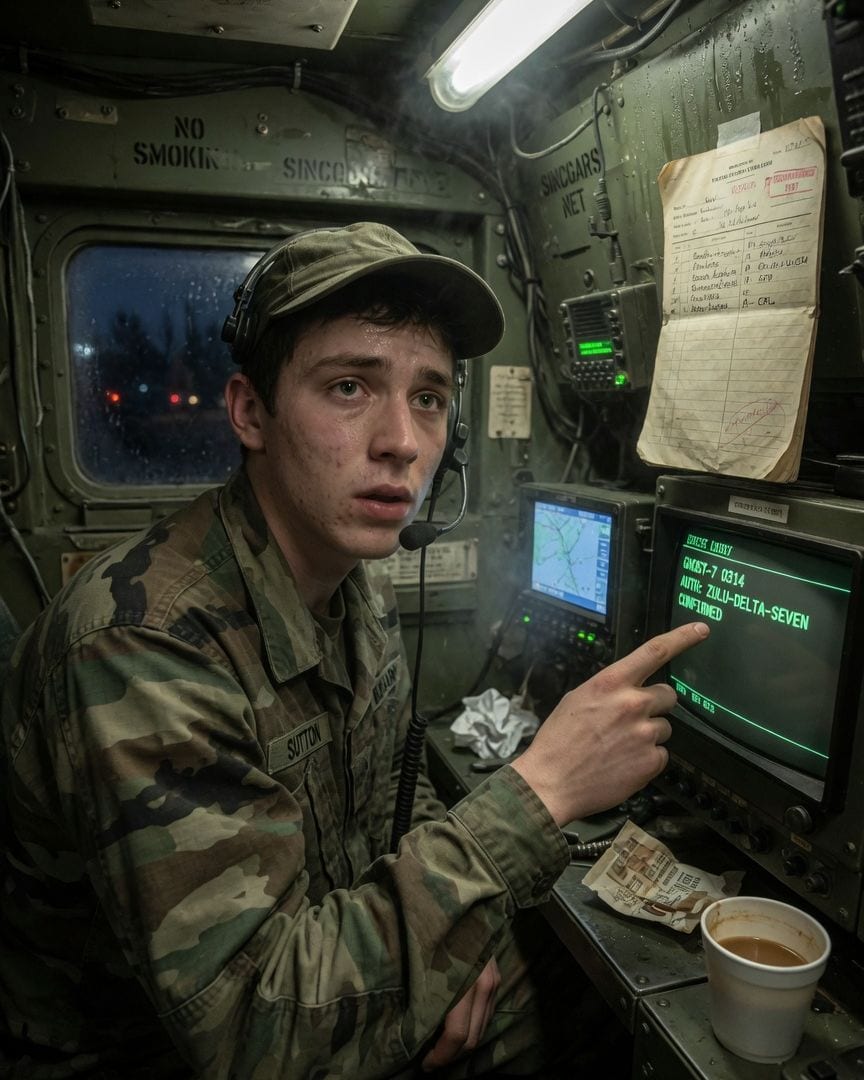
Corporal Aldous Sutton found his own name, rank, and call sign in a 1987 logbook from his exact outpost, decades before he was born.
Corporal Aldous Sutton, 22, was hunched in his cramped comms track, the air thick with stale coffee, monitoring a quiet German night. The division exercise outside was routine, all units accounted for, until an unknown call sign crackled through his headset. 'Ghost-7' requested authentication using a protocol decommissioned years before Aldous was even born. Despite his superior dismissing it as a glitch, Aldous found official logs confirming the impossible exchange, even dating his own hesitant responses. But the real dread landed when he cross-referenced the phantom unit and discovered his own name, rank, and call sign listed in a 1987 logbook, attached to 'Ghost-7' at his exact outpost.
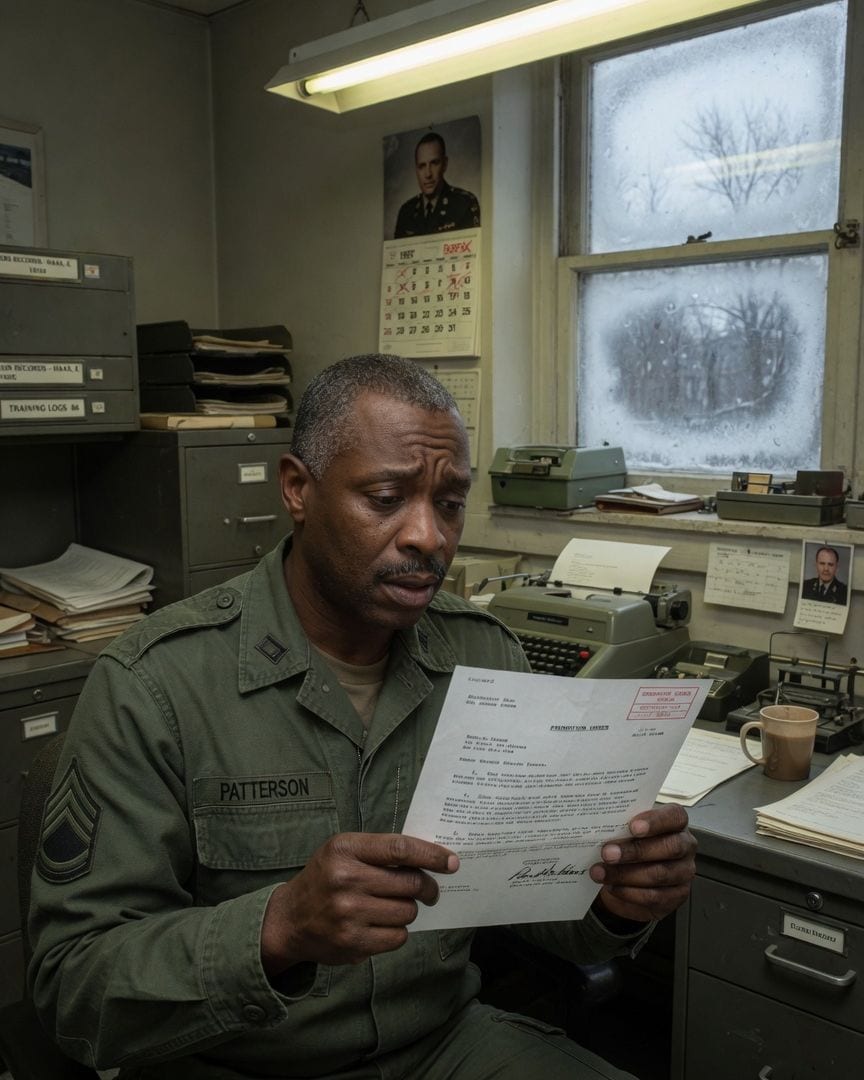
Staff Sergeant Felix Patterson held a promotion order for a young corporal, signed by a Cold War colonel dead for a full year.
Staff Sergeant Felix Patterson felt the German winter chill as he stood in the base admin office, holding Corporal Erich Haas’s promotion order. The young clerk, Private Davenport, wrung her hands, confirming the impossible: Colonel Fairfax’s signature was genuine, despite the colonel having been dead for a full year. A deep, cold dread settled in Felix’s gut, making the office air feel heavy and silent around him. He spent days scrutinizing Haas’s service record, soon uncovering a training certificate also bearing the deceased colonel’s signature, dated months after his death. This was no mere bureaucratic slip; these meticulously clean documents were fundamentally, impossibly wrong.
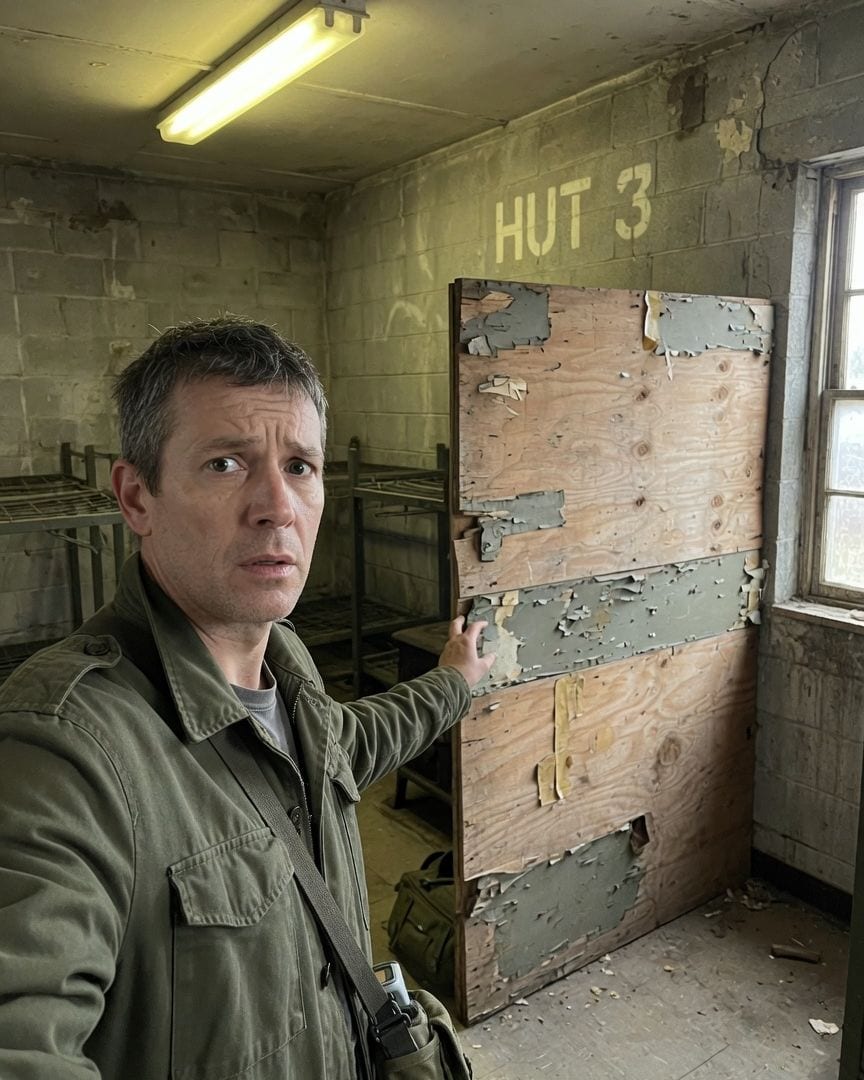
One morning there were twenty-one bunks in a hut built for twenty — the extra one made up tight at the far end past the stove, a kitbag beneath it stencilled with a name no roll could match. By nightfall the sergeant had that end boarded over.
I was a young recruit in a barracks hut built for twenty men, each bunk accounted for. But one morning, a twenty-first bunk appeared, impossibly tucked into a corner, meticulously made up for a man who didn't exist on any roster. Twenty-eight years later, the boarded-up wall concealing its secret remains, defying all logic and every measurement.
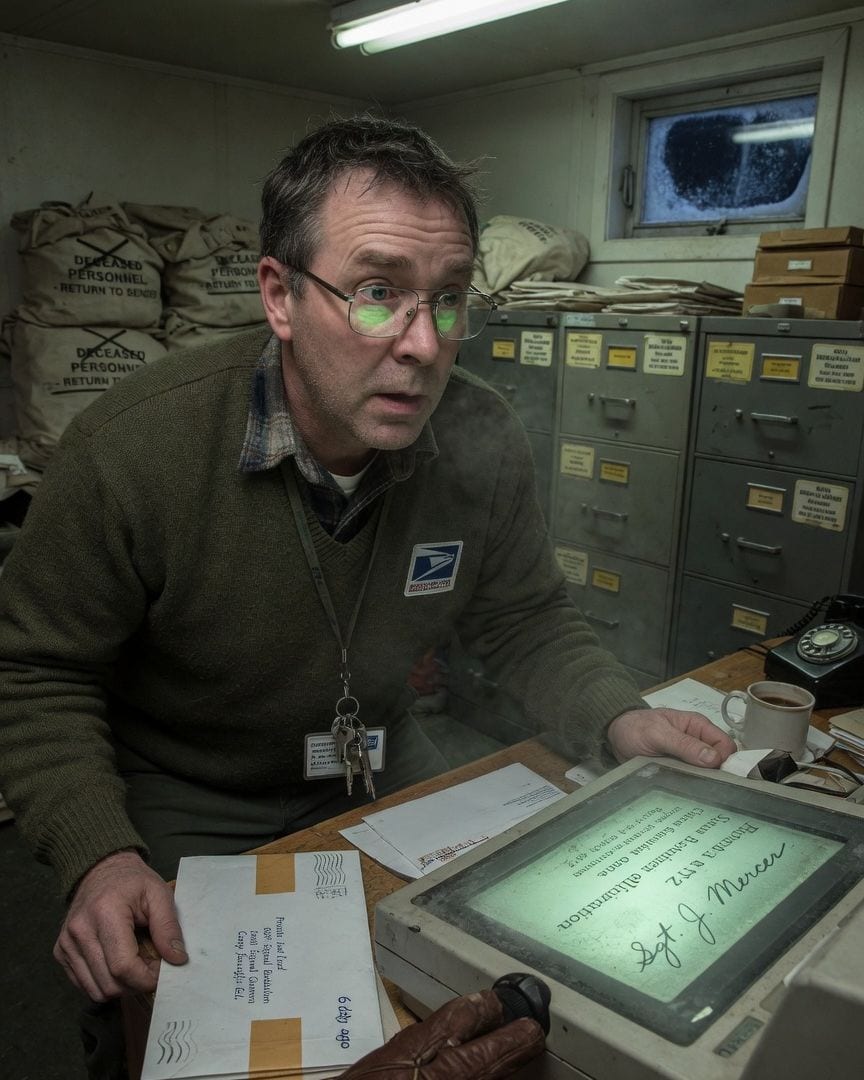
A postmaster at a Cold War Alaskan outpost still received mail for soldiers declared dead in 1969. Then he found their base was active three years later.
Postmaster Rowan Ashcroft had spent two decades watching the weekly mail plane land at Camp Bidwell Annex, a lonely outpost in the bitter Alaskan wind. His methodical mind, accustomed to order, was jolted when the latest mail sack contained forty-three letters for men officially declared dead in 1969. Each envelope, postmarked within days, was addressed to a soldier who wasn't coming back, and Rowan found one already opened and neatly resealed. Driven by duty, he began to sift through declassified Army archives, only to uncover a chilling maintenance log entry for the camp's equipment, dated three years after the base was officially shuttered. What was still happening at Camp Bidwell?