My house's 1962 mortgage archive had a redacted line. It named a 'condition as attaches to each owner in turn,' the same code as mine. There's no sealed page.
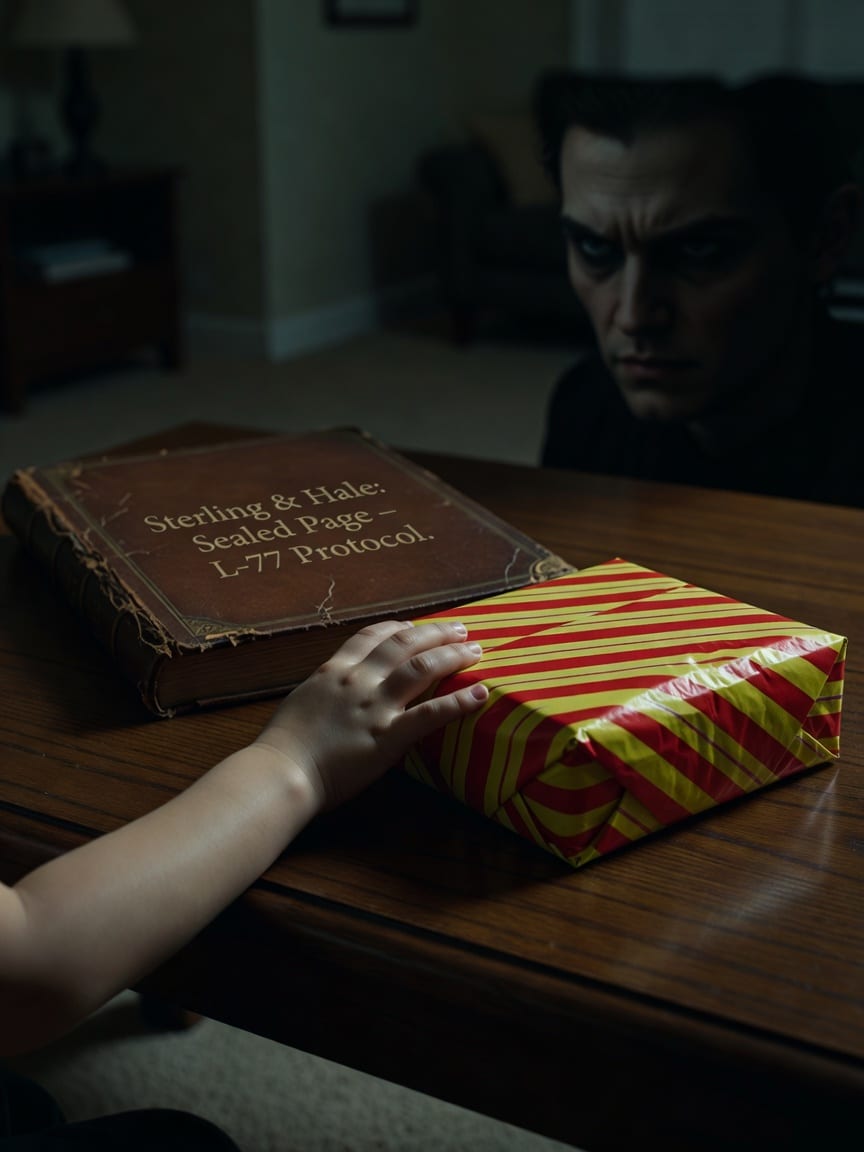
The box Sterling & Hale Building Society sent me was an insult. Not just the weight of it, the sheer, dead bulk of history I hadn't asked for, but the smell.
Dust and something else, something metallic and faintly sweet, like old, dried blood. I remember running my finger over the rough cardboard as I dragged it into my home office, a slight tremor in the floorboards under my feet.
Just an old house, settling. It was late, Lily already asleep.
Inside, beneath a stack of faded, carbon-copied statements and a brittle sales brochure for a 1970s kitchen suite, I found the 1962 valuation report. My house, on Elm Street. The paper crackled like ancient skin.
I smoothed it open on the desk, the low hum of the streetlights filtering through the blinds making the faded ink hard to read. Section after section of mundane figures and descriptions. Then, under 'Special Conditions,' there it was.
A line, heavily redacted with black ink so thick it seemed to absorb the light. Someone had gone to serious effort.
But right next to it, scrawled in a precise, almost elegant hand, a surveyor's note cut through the censorship: 'condition as attaches to each owner in turn, see the sealed page.'
A 'sealed page'? I flipped through the entire archive. Nothing. Not a whisper of it. But below the surveyor's note, a code was referenced: 'L-77.' My stomach did a slow roll. I knew that code.
It was printed, small and easily missed, right there on my own mortgage completion statement, dated just last month. A small alphanumeric string that no one at the bank had ever explained, just another bureaucratic flourish.
I looked around my quiet home office, at the framed photos of Lily on the wall, her innocent, four-year-old grin. My house, I realized, came with a hidden clause. And I'd signed for it.
The 'L-77' code became a burr under my skin. I couldn't shake the feeling it was more than just a formality, not after that redacted line. The next morning, I called Sterling & Hale.
After navigating the usual labyrinth of automated menus, I finally reached a live human: Conrad Hawkins, a 'Client Services Manager.' His voice was like polished marble – smooth, cool, utterly impenetrable.
"Ms. Hughes," he said, the name sounding foreign on his tongue, "I assure you, your query regarding 'L-77' is easily resolved. Archival formality, nothing more." He sounded bored, as if explaining basic arithmetic to a difficult child.
"It's standard procedure for properties of a certain age, a legacy designation."
"And the 'sealed page' the surveyor mentioned?" I pressed, my voice a little too sharp. "It's referenced directly next to the condition."
Conrad gave a low, dismissive chuckle. "Ah, the 'sealed page.' An internal reference, Ms. Hughes, purely administrative. Certainly not for client disclosure." He paused, a beat too long. "You needn't trouble yourself. Everything is in order with your property."
His calm, unyielding tone left me more unsettled than if he'd been openly hostile. I hung up, my hand trembling slightly. This wasn't 'standard procedure.' This was a carefully managed evasion.
Unconvinced, and now thoroughly agitated, I started digging. The local historical society was a labyrinth of its own, smelling of old paper and dust motes. I spent hours hunched over microfiche readers, then sifting through actual physical documents.
Deeds, old tax assessments, even a few faded photographs of my house from the 1950s, looking so much smaller, somehow. Nothing about 'L-77' until I nearly gave up.
It was tucked away in a cardboard box labeled 'Misc. Local Records – 1960s/70s.' An old, handwritten ledger, its cover worn smooth, meticulous entries recording local residents and their properties, kept by a now-defunct neighborhood association.
On page 43, there was my address. And next to it, in neat, looping script, was 'L-77.' The air in the archive felt suddenly heavy, pressing in on me. The ceiling lights hummed, almost vibrating.
I stood in the hushed local archive, my finger tracing a faded ink entry in the brittle ledger. The silence felt like a physical thing, something pressing against my ears.
Below my house's address and the familiar 'L-77' code, a child's name, 'Marcus Norwood,' was listed with a date: 'October 14, 1975.' My breath hitched. A quick mental calculation confirmed it was Marcus's fifth birthday.
Next to it, in neat, looping script, was the phrase: 'Condition Fulfilled – Asset Transferred.' The words were too clinical, too stark, for a community ledger. They were the language of a transaction, not a birthday party.
The phrase 'Asset Transferred' chilled me to the bone. Marcus Norwood. I spent the next few days in a blur, my mind racing, fueled by weak coffee and a growing sense of dread.
Back at the historical society, I scoured local birth records, found Marcus's certificate – born October 14, 1970. Then school registers. A single entry for his reception year at Elm Street Primary, dated September 1975.
A small, blurry photo, a serious little boy with dark hair and wide eyes. After that, nothing. No further school records, no census entries, no adult life. As if he had simply ceased to exist after October 14, 1975.
I found Janet Prescott in the local directory. She was 74, her voice thin but sharp. Her parents had owned my house before the Norwoods. I drove over, trying to keep my questions casual, just a homeowner curious about history.
Her living room smelled of lavender and old books.
"Marcus?" Janet frowned, her brow deeply furrowed. "Oh, yes. A quiet little boy, always playing in the garden. Kept himself to himself. Then one day, he was just… gone. His parents said they moved away, suddenly.
Said they got a new job out of state, had to leave quickly." She sighed. "It was quite a thing, how fast they cleared out."
I pressed, my voice carefully even. "Did your parents ever mention anything unusual when they sold the house? Any 'conditions' or special paperwork?"
Janet paused, looking out her window at her rose bushes. "Paperwork? Oh, yes. Dad always said there was more than usual when they sold that house. Something about the building society. 'More hoops to jump through,' he called it.
They never went into detail. Just said some things were 'non-negotiable,' you know? That's how things were back then, dear. Institutions had their ways." She shrugged, a frail movement. "They just signed what they were told to sign.
Trusted the bank."
I felt a prickle of unease that had nothing to do with Janet’s memories. My home office, where I’d spread out the documents, felt less private now. The walls seemed to breathe with a different rhythm.
One evening, I found a small, unmarked envelope tucked under my front door. No stamp, no address, just slid cleanly into place.
Inside was a single sheet of paper, thick and slightly glossy, a printout of the 'L-77' code, circled in red. Subtly watermarked in the corner, barely visible, were the words 'Sterling & Hale.' No message, no threat, just the code.
It was a cold, precise gesture. Someone knew I was digging. Someone was watching.
The next day, it started. A dark sedan, polished charcoal grey, parked two streets down from my house. Distinctively out of place among the usual family cars and battered vans. I noticed it first when I left for Lily's nursery.
It was still there when I returned, an hour later. The driver, a man with a bland, corporate face, sat perfectly still, hands on the wheel.
He made no move, but his gaze, when I caught it in my rearview mirror, was flat and utterly devoid of expression. It lingered on my house, then on my car, as I pulled into the driveway.
The cold knot in my stomach tightened. This was no longer academic curiosity. This was personal. The calm, bureaucratic facade of Sterling & Hale was cracking, revealing something watchful and very much alive beneath.
My house wasn't just old; it was marked. And now, so was I.
I went to Sterling & Hale's local branch the next morning, Marcus Norwood's records clutched in my hand, the anonymous 'L-77' printout tucked among them. The branch was modern, gleaming, a contrast to the old documents I carried.
Conrad Hawkins sat across from me in a small, glass-walled meeting room.
His smooth facade wavered for a millisecond as his eyes scanned the papers I laid out – Marcus’s birth certificate, the school register entry, the census blanks, and that chilling ledger entry: 'Condition Fulfilled – Asset Transferred.'
"Ms. Hughes, I truly don't understand your persistence," he said, his voice regaining its marble smoothness. "These are… historical anomalies. Misfilings. Sterling & Hale manages hundreds of thousands of properties across the country. Petty errors are inevitable."
He picked up a pen, twirling it. The soft click of the cap was the only sound in the room.
"Anomalies that specifically apply to every owner of my house?" I pushed, leaning forward, my voice trembling with suppressed fury. "Anomalies that coincide with children's fifth birthdays, and then they vanish from all records?"
I shoved the anonymous 'L-77' printout across the table. "Did Sterling & Hale send this, Mr. Hawkins? Are you watching me?"
His eyes flicked to the printout, just a flicker, but it was there. Something unreadable, a momentary crack in the polished surface. He cleared his throat. "This is entirely inappropriate, Ms. Hughes. Your queries are becoming… disruptive.
I understand you have concerns, but this is straying into accusations."
Then he leaned forward, his voice dropping, almost a whisper, yet still perfectly controlled. "The 'special conditions' attached to your property are a legacy arrangement, Ms. Hughes. Your signature on the completion statement acknowledged them.
It's a matter of… community welfare, historically speaking. Certain agreements were put in place, long before our time, to ensure the prosperity of particular local trusts." He didn't explain what welfare, or what community.
He just stated it, bland and unbothered.
He wasn't denying the pattern. He was reframing it. The 'L-77' wasn't a glitch; it was a designation. The 'Asset Transferred' wasn't a mistake. It meant exactly what it sounded like. Marcus Norwood wasn't a misfiling. He was a transaction.
And my own daughter, Lily, who would be five in a few months, was now living in a house marked by 'L-77'. The polished room, the bland professionalism, suddenly felt like a tomb.
I retreated from Sterling & Hale, the full weight of Conrad’s words crushing me. ‘Community welfare.’ The phrase echoed in my ears, mocking me.
I drove home on autopilot, my hands gripping the steering wheel so hard my knuckles were white. The house, when I pulled into the driveway, felt like a trap, its windows like empty eyes.
Once inside, I went straight to my laptop, my fingers shaking as I typed. I needed more. I pulled up archived property records, old digitized school registers, local census data.
My house’s address, the recurring 'L-77' code, became my search parameters.
I found a digitized scan of an old school register from the 1980s. My house's address. 'L-77'. A girl named 'Genevieve Rutherford,' born in 1983. Her fifth birthday marked for 1988. Then, nothing.
Her name simply vanished from all subsequent school records, from every census.
I scrolled further, a sickening dread building in my chest. Another entry, from the 1990s: 'Donald Beaumont,' same address, 'L-77', his fifth birthday marked. Then, he too vanished. And another: Cecilia Vance, early 2000s. Preston Hayes, 2010s.
A chilling line of forgotten children.
The 'L-77' code wasn't just for Marcus. It was a continuous, horrifying thread woven through the very fabric of my house's history.
The pattern across dates and names became terrifyingly clear: each entry corresponded to a child living in the house, always noted around their fifth birthday, and each child then vanished from all subsequent public records, as if they never existed beyond that date.
The cold silence of the house pressed in on me, the hum of the laptop a frantic whisper.
My hands trembled as I looked at Lily’s birth certificate, tacked to the corkboard above my desk, her tiny foot impression a faded blue. Then I glanced at the calendar. Lily’s fifth birthday was in six months.
Driven by a raw, primal terror for Lily, I drove back to Janet Prescott's house. I found her in her garden, clipping roses.
She looked up, her expression softening when she saw me, but then her eyes sharpened as she saw the desperation etched on my face.
"Laura, dear, what's wrong?" she asked, her voice concerned.
"Janet," I began, my voice hoarse, "that paperwork your father kept... did he keep anything else? Anything unusual? Anything from Sterling & Hale?" I explained everything, the pattern, the vanished children, Conrad's chilling evasions. Janet listened, her face growing pale.
"My father," she finally said, her voice barely a whisper, "he was always meticulous. Kept everything. There was a dusty box. I thought it was just old war bonds and deeds, but… he was a stickler for official records."
She led me to a small, cluttered attic. At the bottom of a heavy wooden trunk, beneath old photo albums and moth-eaten blankets, I found it. A thick, leather-bound document, brittle with age, tied with a faded ribbon.
The embossed title, in stark, gothic script, made my breath catch in my throat: 'Sterling & Hale: Sealed Page – L-77 Protocol.'
My hands shook so violently I could barely untie the ribbon. Inside, it detailed a 'Community Contribution Agreement' dating back to the late 1800s.
Certain properties, including Laura's, were designated for a 'biennial harvest of vital biological essence' from 'minor residents' upon their fifth year.
The 'essence' was described, in chillingly detached language, as crucial for 'the longevity and prosperity of the Sterling & Hale Benevolent Trust,' a shadowy organization tied to the building society's earliest days.
The 'L-77' code was the designation for these 'harvest sites'. The document calmly outlined the 'transfer of asset' procedures, the 're-issuing' of the condition with each new owner, and the 'discretion' required. It was all there.
The redactions, the surveyor's note, the vanished children, Conrad's placid composure. It was never a secret; it was simply a condition, openly stated, then quietly filed and managed, buried in plain sight.
I didn't confront Conrad again. What was the point? He was a cog in this horrifying machine, perfectly aware, perfectly unbothered. Confronting him would be pointless, dangerous. Instead, I acted.
With the 'Sealed Page' clutched in my hand, my mind a whirl of icy clarity, I called a lawyer, a distant cousin named Preston Rutherford who specialized in property law.
I sent him the scanned document, the ledger entries, the census blanks, every piece of horrifying proof. He was initially skeptical, then silent, then utterly horrified. "This is… institutionalized abduction," he whispered over the phone, his voice tight.
"Disguised as a property covenant."
I packed. Not just clothes, but every document, every scrap of proof I’d found. Lily’s birth certificate. My own mortgage statement. Everything. I took Lily from nursery early, a lie about an emergency, an unexpected trip tumbling from my lips.
Her innocent face, beaming at the surprise early pick-up, was a knife in my heart.
As I loaded the last bag into my car, the dark sedan from earlier pulled up across the street. It parked, silent and still.
Conrad Hawkins was in the passenger seat, not looking at me, but straight ahead, his expression utterly blank, as if simply observing the weather. A chillingly calm witness.
I started the car, my heart pounding a frantic drumbeat against my ribs. I didn't look back at the house, or at the car.
I knew they’d be watching, but I also knew the 'condition' was tied to the property, not to me. I had to get Lily away, far away, before her fifth birthday. That house, that terrible 'condition,' could not have her.
Laura and Lily disappeared into a new life, hundreds of miles away. The small town they settled in was unremarkable, its houses devoid of any unsettling history.
The lawyer, Preston, began the slow, arduous process of bringing the 'Sealed Page' to light, but the Sterling & Hale Benevolent Trust proved to be a labyrinthine entity, its legal team formidable, its origins obscured behind layers of corporate shell companies and historical agreements.
The house on Elm Street, Laura’s former home, was quickly sold, the 'L-77' code undoubtedly passed on to its new, unsuspecting owners. The pattern, Laura knew, would continue.
She monitored property listings online, seeing the house appear and disappear, a silent, predatory cycle. The quiet bureaucracy of it all, the sheer banality of the evil, was what haunted her most.
Lily is six now, bright and safe. I watch her play in the local park, her laughter ringing out, a constant, low thrum of dread in my chest, a permanent scar on my peace.
I know the truth, and that truth has marked me. Every time I see a Sterling & Hale branch, every time I hear a polite, corporate voice, I feel the chill of recognition.
I check the news for any hint, any whisper about the Benevolent Trust, but there is never anything. They are too quiet, too deep, woven too tightly into the fabric of ordinary life. The world moves on, oblivious.
I look at Lily, truly safe, truly hers. But the knowledge is a shadow I carry, a file buried deep in my own memory, never to be unsealed. The house on Elm Street, I know, is still waiting.
Its condition, still attached.
If this one got to you
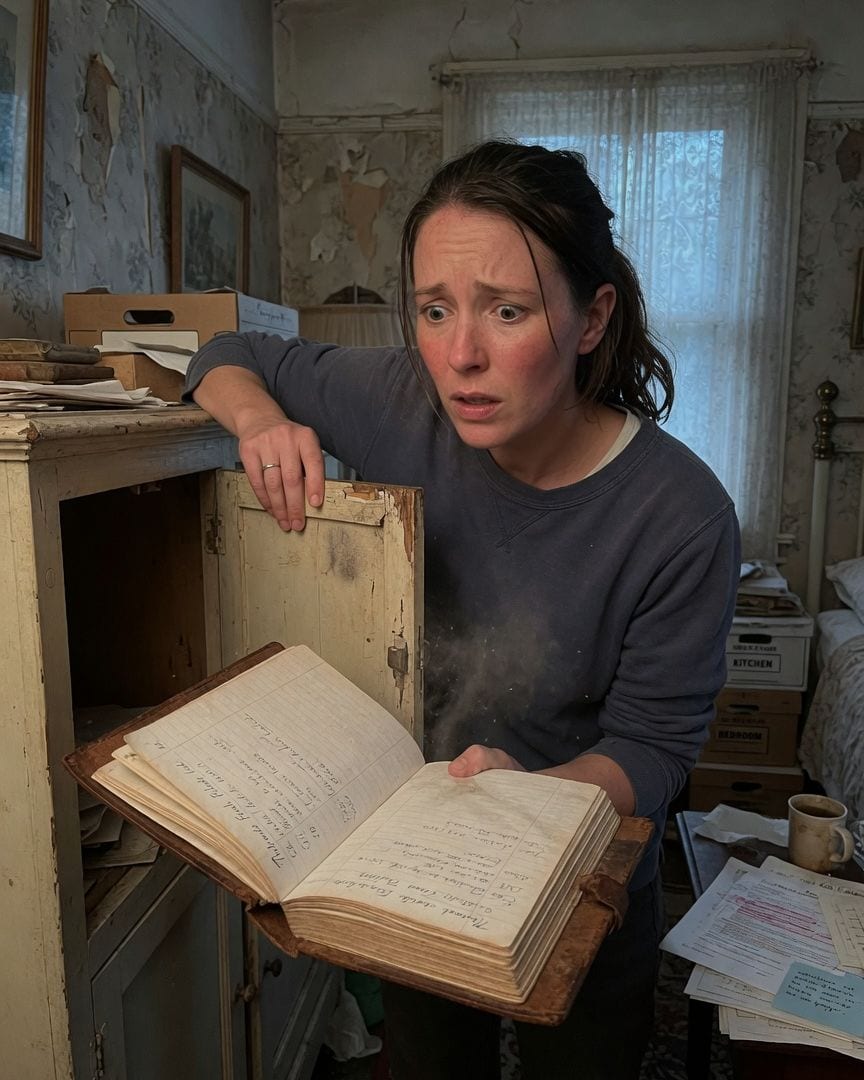
My house’s 1962 valuation has a redacted line, but the surveyor’s note says 'condition as attaches to each owner in turn.' It’s the same code on my own mortgage completion statement.
Moving into my new Victorian house, I found a redacted line in an old mortgage report. It mentioned a condition that 'attaches to each owner in turn,' a phrase my solicitor dismissed as an 'archival quirk.' But then, a hidden ledger in a bedroom cupboard revealed a chilling chain: every past owner's name, followed by 'Condition Fulfilled'.
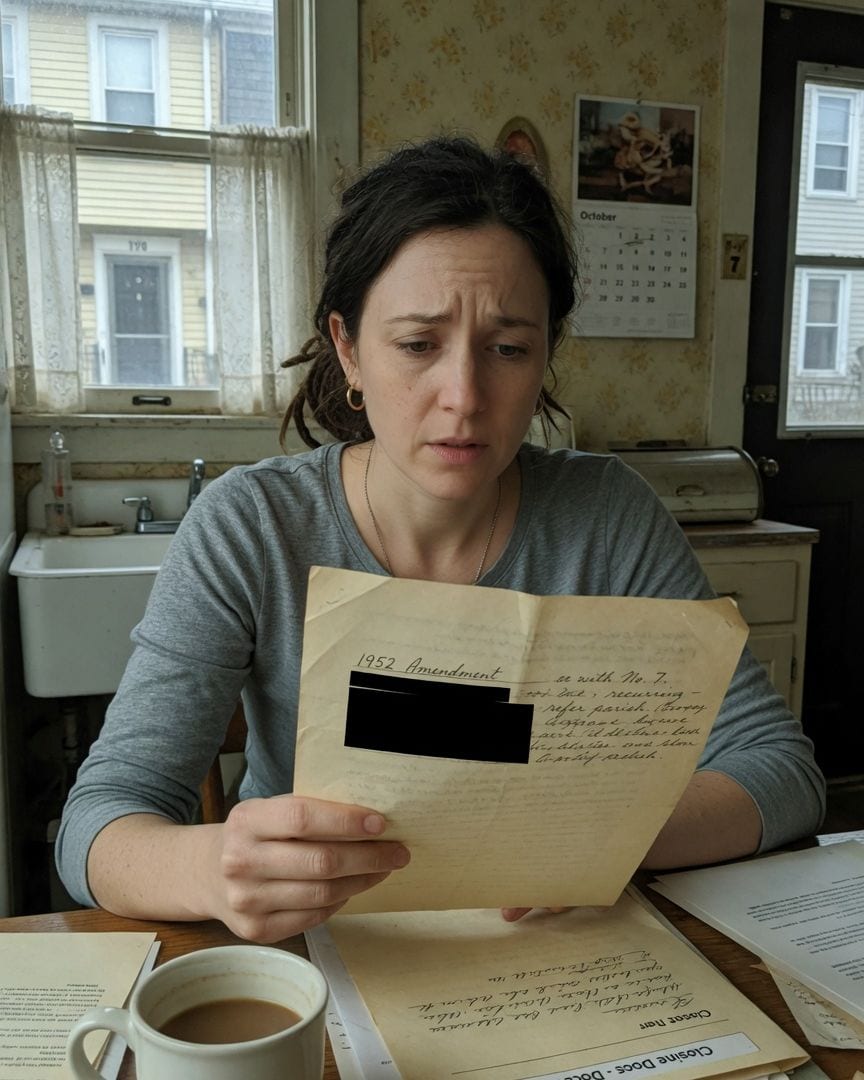
My new house deed has a blacked-out line. My mother's voice went brittle when I asked about her old No. 7 home.
Settling into my new Harlow Street home, I found a stark blacked-out line on my land registry deed. My attorney dismissed it as routine, but a hidden marginal note read 'as with No. 7, recurring – refer parish.' No. 7 was my mother's childhood home, and her reaction to my questions was chillingly evasive.
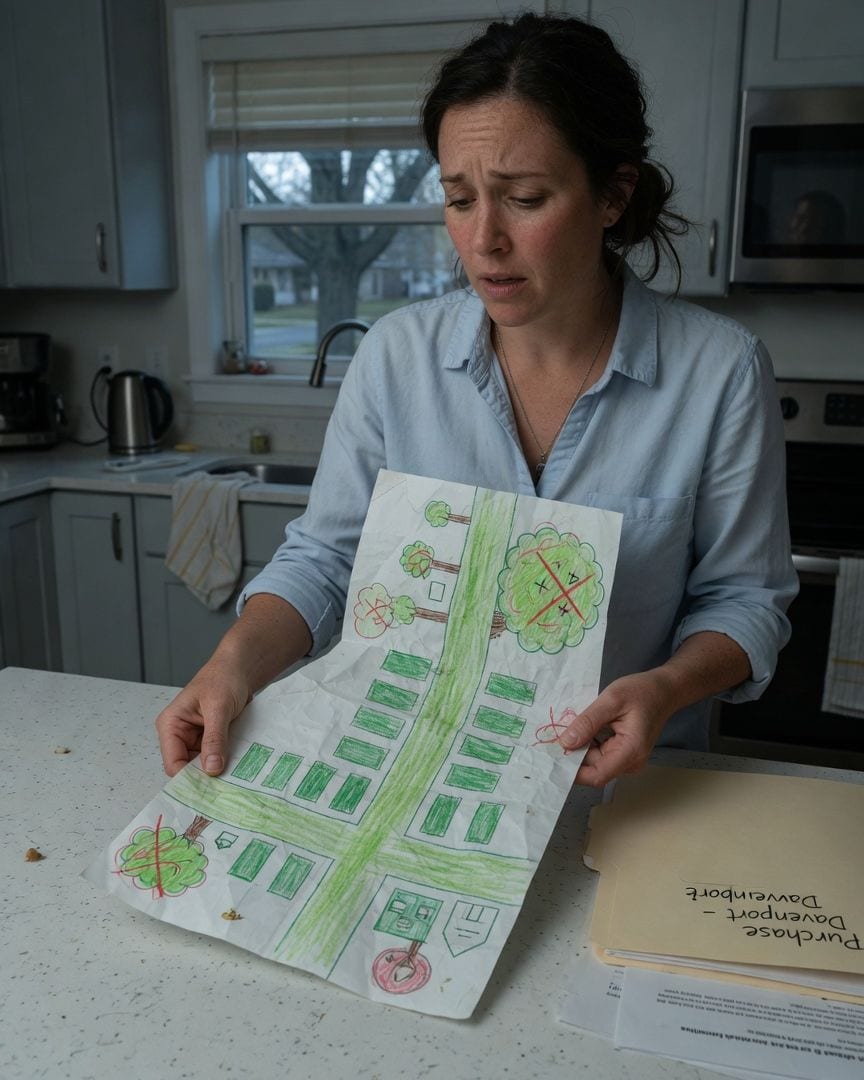
A hand-drawn map keeps arriving through our letterbox — every space on the lane marked green, except the one spot under the old lime tree, alone in red. The agent made us swear we'd never park there.
My new house came with a strange local quirk: weekly maps slipped through my letterbox, each one marking a specific parking spot with an angry red X. A legal addendum about the spot, and my neighbors' evasiveness, made me uneasy. But nothing prepared me for the ancient, identical map I found, which marked my own house with that terrifying red X.
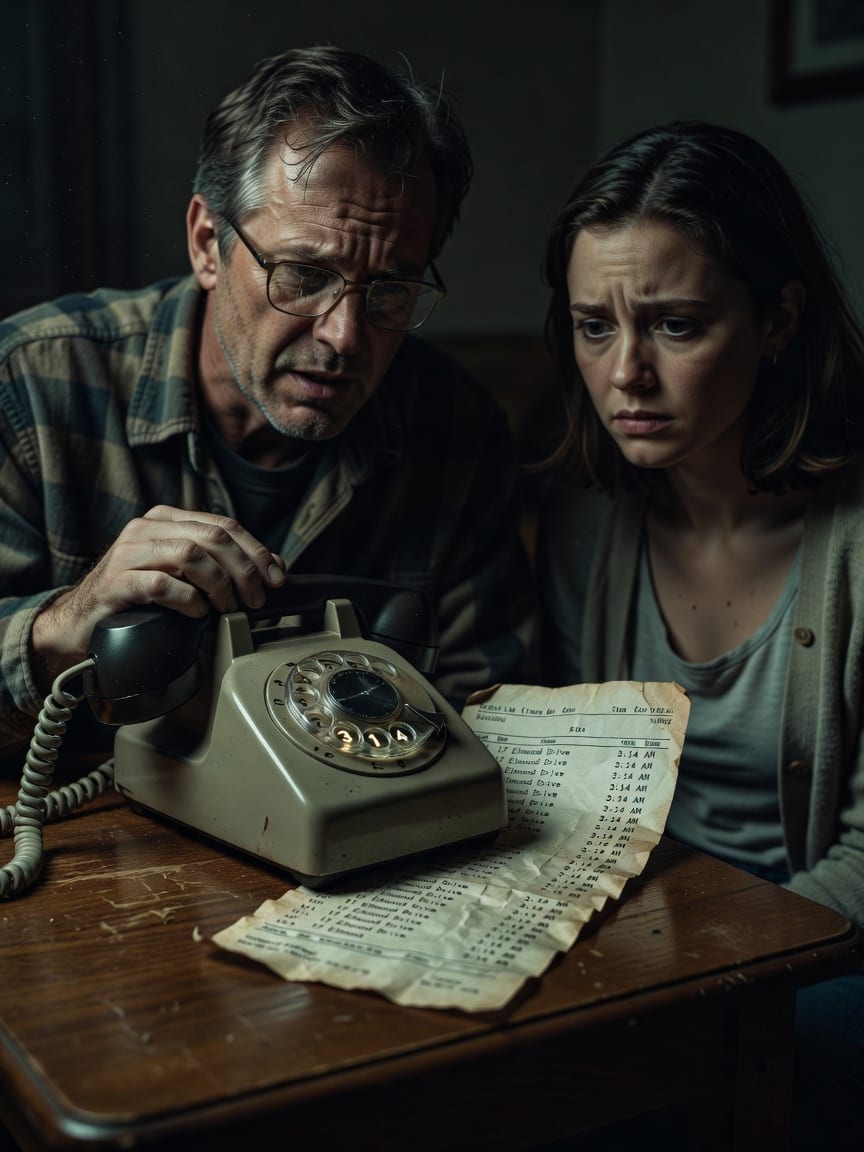
My phone bill itemised forty calls from my number to a house demolished in 1990. Each call at 3:14 AM, lasting eleven minutes. The bill arrived postmarked from a flattened building.
I expected the usual mobile bill, but my landline statement listed forty calls from my number to '17 Elmwood Drive.' That address was for a house torn down in 1990, a vacant lot I remembered from childhood. The phone company insisted the calls were legitimate, leaving me profoundly unsettled by the impossible charges.
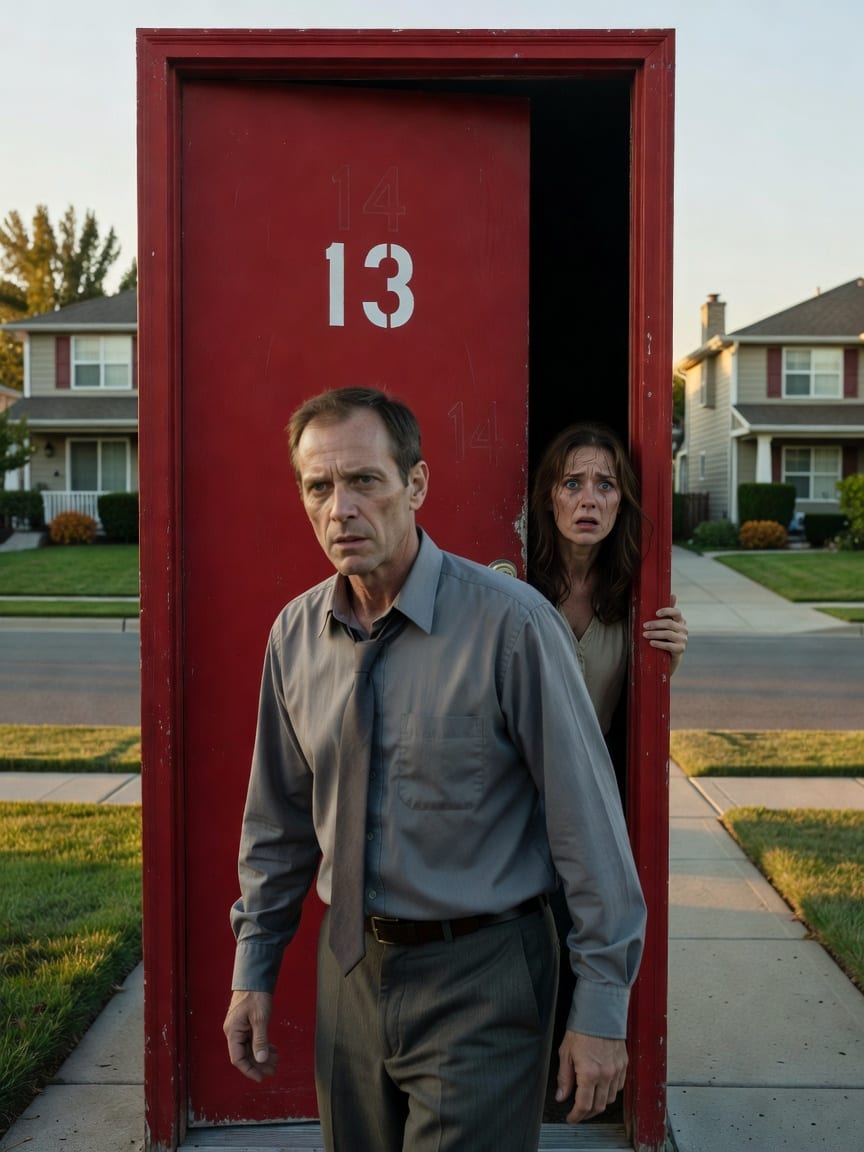
Our red front door now reads 13, not 14. Someone repainted it. The council still says 14, but every neighbor writes 13 on our mail.
My partner and I painted our front door a defiant red, proud of our new home at 14 Elmwood Lane. But then, the number '14' kept changing to a crisp '13' overnight, no matter how many times we repainted it. It wasn't a prank; under layers of paint, a faint but undeniable '13' was etched into the original wood itself.
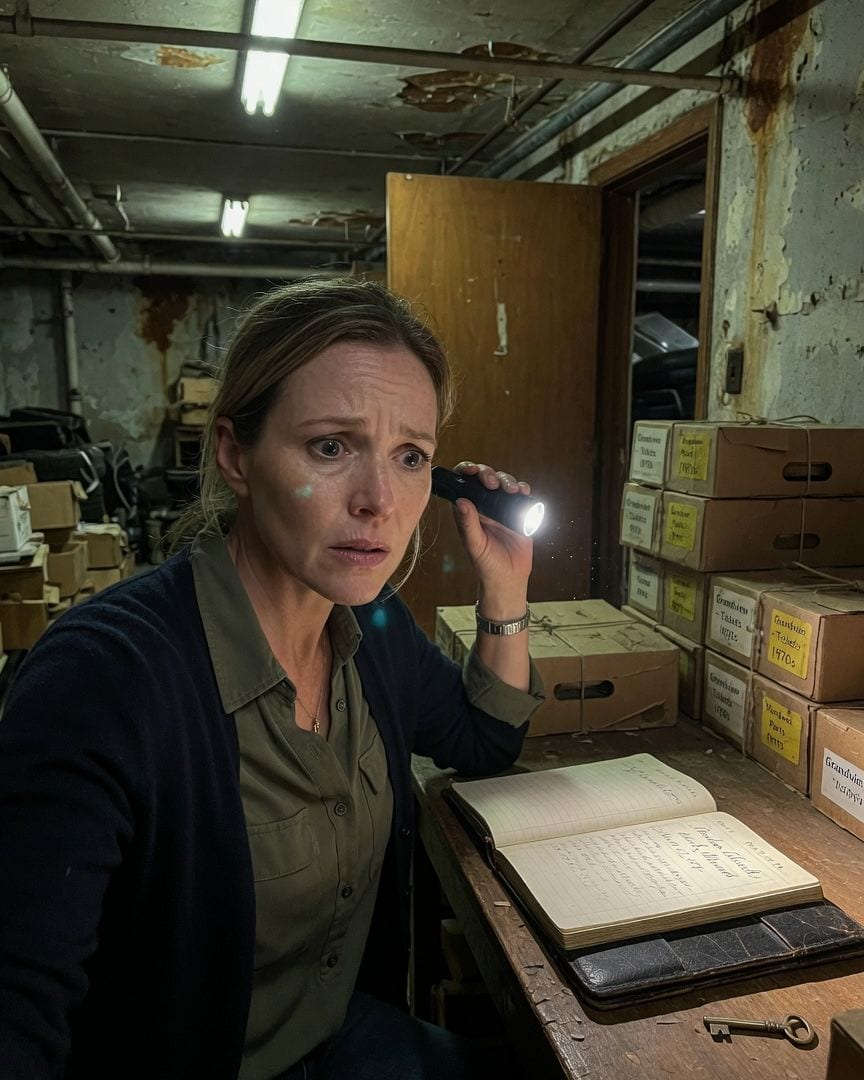
My old cinema's letter said "We kept your seat," and it closed in '94. The seat number was mine, a secret I never wrote down.
Penelope Ellsworth receives a mysterious letter from the Grandview Cinema, which closed in 1994. The letter claims it 'kept her seat,' a specific row and number she never shared with anyone. Driven by an unsettling curiosity, Penelope uncovers an old ledger in the defunct cinema's basement with her name and seat number, dated 1977—seventeen years before she was born.