My new house deed has a blacked-out line. My mother's voice went brittle when I asked about her old No. 7 home.
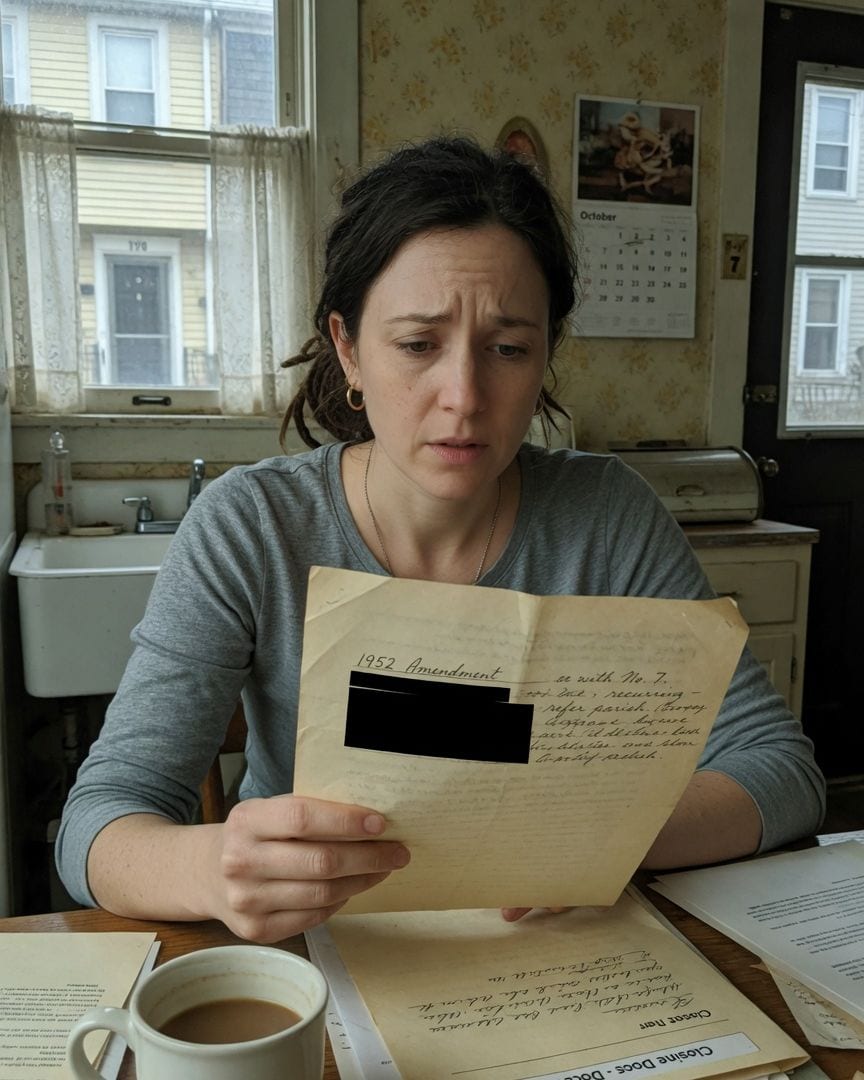
I was just doing paperwork, you know? The boring stuff after you close on a house. My new place on Harlow Street, a pretty row house with good light.
The sale had finally closed last week, and I figured a quiet Saturday morning, a fresh cup of coffee, was the perfect time to get everything filed away.
William Mercer, my attorney, had been clear: everything was in order, a clean transfer. But as I sat at my kitchen table, the coffee cooling beside my elbow, my eyes kept going back to the land registry deed.
There it was, a stark black rectangle of ink. One entire line, under a 1952 amendment, was completely blacked out. The rest of the faded text around it looked normal, but that block of ink was just… wrong.
I remembered Mercer’s dismissive wave when I’d asked about it during closing. “Routine, Ms. Novak,” he’d said, not even looking up from his stack of documents. “Just an old covenant, nothing to worry about.” I’d let it go, trusting him.
But now, in the quiet of my own home, it nagged at me.
Then I saw it. A small, handwritten marginal note, barely visible where some long-dead clerk’s thumb had missed it with the black ink.
The script was elegant, looping, and the ink was a different shade, older, pressed deeper into the parchment paper. It read: “as with No. 7, recurring – refer parish.”
No. 7. The address echoed in my head. That was my mother Linda’s childhood home, three doors down from where I now sat. She’d lived there with my grandparents, though they’d sold it long before I was born.
My mother rarely spoke of it. And that word: recurring. It settled in my mind, cold and quiet, like a chime in an empty room.
I tried to shake the feeling. It was probably nothing. An old administrative quirk, just like Mercer said. Maybe a property dispute from seventy years ago, long resolved.
But the image of that blacked-out line and the marginal note, the word ‘recurring,’ kept sticking. It was like a loose thread in a sweater; I just couldn't leave it alone.
I called my mother. Linda picked up on the second ring, her voice bright. I tried to sound casual. “Mom, I was just looking at my deed. It reminded me of No. 7. Do you remember anything about it?
Any old rules, or weird covenants from when you lived there?”
There was a pause, a slight hesitation on the line. Then, her response was clipped, almost terse. “Oh, that old place? Nothing special, dear. Just where I grew up. Why?”
“Just curious,” I said, pressing gently. “I saw a note on my deed that mentioned it, something about ‘recurring.’ Did you ever hear anything odd about it?”
Linda laughed then, a brittle, thin sound. “Odd? Goodness, no. Just the usual. Don't let your ball hit Mrs. Henderson's prize-winning roses, that sort of thing. Why on earth would you ask that?”
The evasion was palpable. It wasn’t just a simple forgetfulness; it was a deliberate shift. Dissatisfied, a chill starting to spread in my stomach, I decided to take the marginal note literally. ‘Refer parish.’
The local parish office might have old property records.
Kenneth Caldwell, the aging parish clerk, was initially unhelpful, citing privacy laws for historical property records. He was a man made of paper dust and forgotten dates, his spectacles perched on the end of his nose.
“We simply don’t keep records of every covenant modification, ma’am,” he rasped, gesturing vaguely at stacks of boxes.
But I persisted, explaining my concern about the 'recurring' note, mentioning No. 7. I saw a flicker in Caldwell’s eyes, a brief moment where his usual bureaucratic mask slipped. He cleared his throat. “No. 7, you say? Harlow Street?”
He disappeared into a back room, the air in the office suddenly feeling colder, the silence heavier. I heard the scuff of old boxes, the rustle of paper.
He returned after what felt like an hour, carrying a heavy, leather-bound ledger, its spine cracked, its pages yellowed and brittle with age. He laid it carefully on the counter, the leather smelling of dust and dried ink.
He opened it to a page marked 'Harlow Street Properties – 1950s.' His finger, gnarled and stained, traced a line. “Here’s No. 7, 1952. See? Covenant re-established.” He pointed to a section.
It was similar to my own deed, the text faded but legible, but with one crucial difference: a clear, handwritten ‘case’ number.
“PN-610-Galloway-7.” Caldwell read it aloud, his voice flat. “Old administrative code for property re-registrations.
Seems they liked to keep things tidy,” he muttered, but his gaze was fixed on the number, a strange, distant look in his eyes, as if he were seeing something far beyond the ledger’s yellowed pages.
I thanked Caldwell and quickly made my excuses, the number 'PN-610-Galloway-7' burning in my mind. The sun was setting as I drove home, casting long, unsettling shadows across Harlow Street.
Back in my kitchen, I pulled out my own deed again. I compared it to the mental image of the ledger in the parish office. The blacked-out line, the marginal note, the faint impression of a number beneath the ink...
it had to be there.
I held the deed up to my desk lamp, tilting it, trying to catch the light just right, hoping to see some ghost of the numbers Caldwell had shown me. Nothing. Just that stark, rectangular void.
Frustrated, a quiet desperation building in my chest, I tried tracing the blacked-out area with a sharpened pencil, hoping to lift some of the underlying impression, even a hint. It was a long shot, I knew, a desperate, irrational act.
But then, as the graphite smudged, a faint, raised texture emerged. Not just random bumps, not the uneven surface of old paper, but the ghost of an impression, a series of indentations that seemed deliberate.
I leaned closer, squinting, my heart beginning to thump an unsteady rhythm against my ribs. It was too faint to read clearly, but the shape, the rhythm of it, was unmistakable.
A letter, then numbers, then a dash, then more letters. And then, at the very end, a clear, raised '7'. It was the same pattern, the same length, the same final digit as the code in the parish ledger.
It was the exact same code. 'PN-610-Galloway-7.' My own deed, just like my mother’s childhood home, carried the very same reissued number, buried beneath layers of ink and time.
The realization hit me like a physical blow. This wasn't a quirk; it was a pattern. A reissued number, linking my new home to my mother's old one, decades apart.
The casual explanation Caldwell had offered about "keeping things tidy" felt like a lie, thin and fragile. I spent the next few days in a blur of research, fueled by a knot of dread in my stomach.
Online, I typed 'PN-610-Galloway-7' into every search engine I could think of. It yielded nothing. The number itself was a dead end.
But searching for 'recurring covenants Harlow Street' brought up a handful of obscure forum posts from local history buffs. Threads from ten, fifteen years ago. Vague references to 'the old laws' and 'the quiet places.'
Whispers of things managed, not understood. One post, buried deep in an archived discussion about historical property disputes, mentioned a retired parish official, Oscar Harlow.
It claimed he was a local historian with an encyclopedic knowledge of the town's 'lesser-known ordinances.' He was the thread I needed.
I tracked down Oscar Harlow’s address from an old historical society roster.
His house, on the very edge of town, looked as though it hadn't been touched in fifty years, crammed with books and dusty files, the air thick with the smell of aging paper and something else, something vaguely metallic.
Oscar, a frail but sharp-minded man in his eighties, with a thin comb-over and eyes that missed nothing, was initially wary.
I explained my deed, the blacked-out line, the marginal note, and finally, the 'PN-610-Galloway-7' code, watching his face for any reaction.
Oscar’s rheumy eyes, which had been dull with age, suddenly sharpened, focusing on me with an intensity that made the hair on my arms stand up.
He paused, then slowly, deliberately, pulled out a thick, leather-bound volume from a shelf behind him. It wasn't a ledger, like Caldwell's, but a personal journal, its pages filled with neat, looping script.
"Ah, the Galloway Line," he murmured, tracing a finger down a page. His voice was soft, papery, but carried an undeniable authority. "My great-grandfather was the first to document it properly. Said it was a burden, but a necessary one."
He explained that 'PN' stood for 'Parish Nodal,' a designation for properties identified as 'nodal points' for a recurring 'environmental instability.'
He spoke of it with a chilling scientific detachment, as if discussing a geological fault line, not some unknown dread. "The covenants," he explained, "are designed to maintain a specific structural and energetic integrity. To prevent… disturbances."
Oscar’s calm, almost academic explanation of 'environmental instability' sent a shiver down my spine.
He described it not as a monster, not as a malevolent spirit, but as a subtle drain, a quiet 'taking' of peace, of memory, of purpose from those who lived in the 'nodal' homes.
It wasn't a haunting, he insisted, but a slow erosion, a psychic resonance that could leave people feeling perpetually tired, unmotivated, their minds hazy at the edges.
The 'PN' number, he said, was reissued when a property changed hands and the covenant needed to be re-established, 'resetting the balance.' He warned me, his gaze steady, "Some people don’t like it when the quiet places are disturbed.
The management… it’s been in place for a long time."
The next day, after a second, longer visit to Oscar’s dusty house, I found a small, unmarked envelope tucked under my front door. No stamp, no address. Just a thick, cream-colored envelope, its edges slightly frayed.
Inside was a single, typed sheet of paper. The typeface was old, like something from a manual typewriter. It read:
'The balance must be maintained. Do not dig where the roots are deep. PN-610-Galloway-7 is settled. Do not disturb the quiet.'
There was no name, no return address. Just those words, cold and authoritative. My blood ran cold. Someone knew. Someone was watching. I recalled Oscar’s mention of 'the management.'
The calm, bureaucratic horror of it was worse than any ghoul I could have imagined. This wasn't a random threat; it was a directive.
I felt a prickle on my neck, a distinct sense of being observed, even in my own home, even with the curtains drawn tight.
I checked the locks again, pulled the blinds down, but the unease lingered, a cold, dry taste in my mouth. The entity wasn’t a monster; it was a managed problem, and I had just become a problem for the managers.
Later that week, William Mercer, my attorney, called me. His voice, usually smooth and reassuring, was unusually stiff, almost clipped. "Ms. Novak, I understand you’ve been making inquiries about your deed. Certain… historical aspects."
He paused, and I heard a slight intake of breath on his end, as if he were choosing his next words carefully. "I must advise you to cease. For your own good. Some things are best left undisturbed."
He didn't offer to explain, just delivered the warning, then ended the call.
Mercer’s thinly veiled threat confirmed it. The 'management' was real, pervasive, and reached even into the offices of local attorneys. I couldn't ignore it any longer. I drove straight to my mother’s house.
She was watering her prize-winning petunias, humming a cheerful tune. She looked up, her smile fading as she saw my face.
"Mom," I started, my voice tight, "what do you know about PN-610-Galloway-7? About the covenants on No. 7? About 'environmental instability'?"
Linda flinched, a subtle recoil, her face paling. The color seemed to drain from her cheeks, leaving her looking suddenly fragile. "What are you talking about?" she asked, too quickly, her voice thin.
I laid out the evidence, piece by piece. My deed, the blacked-out line, the marginal note, Oscar’s journal entries, the anonymous note under my door, Mercer’s warning. "It’s about our family, isn’t it? The Galloway line?
You grew up in No. 7, Mom. You must know."
She didn't try to deny it this time. She just turned off the hose, slowly, deliberately, and sank into a patio chair, her shoulders slumping as if under an invisible weight.
Her eyes, usually so lively, were shadowed with a deep, ancient sorrow. "It’s… it’s a burden, Vanessa," she whispered, her voice barely audible, raw with an emotion I rarely heard from her. "A responsibility.
The Galloway name, it wasn’t just the street. It was a family. My grandmother’s line. They were… the first caretakers. They knew how to… manage the quiet."
Linda began to explain, her voice picking up a quiet, terrible momentum.
The 'environmental instability' wasn't just a drain on peace; it was a subtle, psychic resonance that, if unchecked, could lead to chronic apathy, memory loss, and a slow, quiet fading of the soul in those living in the 'nodal' homes.
The covenants, the 'PN' numbers, the re-registrations—they were all part of a complex, generations-old ritual to 'reset' the spiritual resonance, to contain the drain, and to protect the residents. "But it always needs a… conduit. A connection.
Someone to acknowledge the ledger, to keep the records straight. My grandmother did it. My mother… she tried. And then I… I just tried to forget." Linda’s eyes filled with tears, her voice cracking.
"When you bought this house, Vanessa… I knew. I knew the number would be there. I just hoped it wouldn’t… activate."
Activate. The word hung in the air, heavy with unspoken dread, settling like a cold mist in the room. I stared at my mother, a cold certainty crystallizing in my mind. "Activate what, Mom?
And what does it mean that I have the number now? That I bought the house?" My voice was barely a whisper.
Linda shook her head slowly, her gaze distant, as if seeing something beyond the living room walls. "The 'PN' isn't just a property number, Vanessa. It's a designation. A binding.
When a house changes hands, the new owner… they become part of the agreement. They become the next in line."
Then, she reached out, her hand closing gently but firmly on my arm.
Her touch was strangely cold, and her eyes, usually so warm and full of life, were suddenly flat, ancient, devoid of personal emotion, like windows to a long-forgotten room.
"It's not just the houses, honey," she whispered, her voice a dry rustle, utterly unlike her own. "It's us. Always has been. The Novak line, the Galloway line… we're the ones who keep the ledger straight."
I felt a chill spread from her arm, seeping into my very bones. The quiet dread in my mother’s voice, the distant, knowing look in her eyes – it wasn’t just a family secret.
It was a family inheritance, a burden passed down. And now, it was mine.
Linda’s grip on my arm tightened, her voice now a monotonous drone, as if reciting a long-memorized text. "The entity… it feeds on the un-remembered, the un-cared-for. It’s not malicious, just hungry. It needs an anchor, a steward.
A conscious mind to acknowledge its presence, to keep its ledger. The covenants bind the land, but the bloodline binds the steward."
She explained that the 'environmental instability' wasn’t just a drain, but a low-level, pervasive psychic entity that resonated with neglect and forgotten history.
The 'PN' number wasn't just a case file; it was a marker for the current 'steward' — the living person whose consciousness was now subtly linked to the entity, tasked with 'managing' its quiet hunger.
The blacked-out line on the deed wasn't just a redaction; it was a symbol of the 'unspoken agreement,' legally binding the property and its owner to this stewardship. Linda’s family, the Galloways, had been the original stewards.
When No. 7 was sold, the stewardship passed to a new line, but the 'recurring' nature of the entity meant it would always seek out a connection, a 'nodal point.'
Vanessa, by buying her house, had unknowingly stepped into the role.
Linda revealed that her own mother, my grandmother, had succumbed to the entity’s 'drain,' becoming listless and forgetful in her later years, a warning of what happens when a steward fails.
"I tried to break the chain, Vanessa," Linda whispered, her voice regaining a flicker of her own personality, "but it always finds a way back. You bought the house, you carry the number. You are the steward now."
I felt a profound, chilling shift within me. Not a hostile takeover, not a sudden possession, but a subtle integration, like a new layer of awareness settling over my own.
I felt a faint pull, a quiet resonance with the old house, with the land, with the very fabric of Harlow Street itself. It wasn’t painful, but it was utterly alien, like having an extra, quiet sense I’d never known.
I understood the 'management' now – not a fight against a monster, but a delicate, constant balancing act to prevent a slow, psychic decay.
Linda, her face etched with sorrow, explained that the only way to 'stop' it, to prevent the entity from overwhelming the community, from spreading its quiet hunger, was for the steward to actively, consciously acknowledge and 'contain' it.
"It’s a living document, Vanessa. The ledger. The deed. You have to keep it straight. Or it will feed."
I looked down at my own hands, seeing them not just as mine, but as part of a larger, older mechanism, tools for a task I had unknowingly inherited.
I realized the true horror: the institution, the parish, the legal system—they weren’t fighting a monster, they were managing a natural, recurring phenomenon, and I had just been drafted into its quiet, bureaucratic work.
I understood the blacked-out line, the reissued number, the 'recurring' note: they were not just records, but instructions.
My attorney, Mercer, the parish clerk, Caldwell, even Oscar Harlow—they were all part of the quiet, calm network of those who 'know,' ensuring the system endures.
I felt the pull, a deep, ancient hum, drawing me towards the old ledger, toward the quiet, neglected places in my house. I knew what I had to do. I had to keep the ledger straight.
I had to manage the quiet. The pattern was exposed, the mechanism understood, and I was now, irrevocably, part of it. The cost was my own free will, my own untroubled mind, slowly subsumed by the ancient, bureaucratic task.
I remained in my house. The sale, ironically, was never fully completed; the paperwork remained in a perpetual state of limbo, just like the line on my deed. I quietly resigned from my job.
My friends noticed I was quieter, more contemplative, often lost in thought, staring out at the row houses on Harlow Street, seeing not just bricks and mortar, but nodal points on an intricate, living map.
I spent hours in the parish archives, poring over old ledgers, meticulously cross-referencing property deeds, updating the 'PN' records. My attorney, William Mercer, stopped calling after a while.
Kenneth Caldwell, the parish clerk, now greeted me with a knowing, deferential nod whenever I visited, offering me keys to back rooms without me even asking.
Linda, my mother, came by occasionally, her visits tinged with a profound sadness, but also a strange, quiet acceptance. I never spoke of the entity, the covenants, or the 'reissued number' again. I simply… managed.
One evening, Linda sat with me in the living room, watching the twilight deepen over Harlow Street, painting the old houses in shades of bruised purple and gray. "Are you alright, honey?"
Linda asked, her voice soft, tentative, as if afraid to disturb something.
I, who had been staring at the blacked-out line on my deed, now framed and hanging on the wall, turned to my mother. A faint, almost imperceptible smile touched my lips, a smile that didn't quite reach my eyes.
"Oh, yes, Mom," I replied, my voice calm, utterly devoid of warmth. "The ledger is clear. And it was never the only one."
If this one got to you
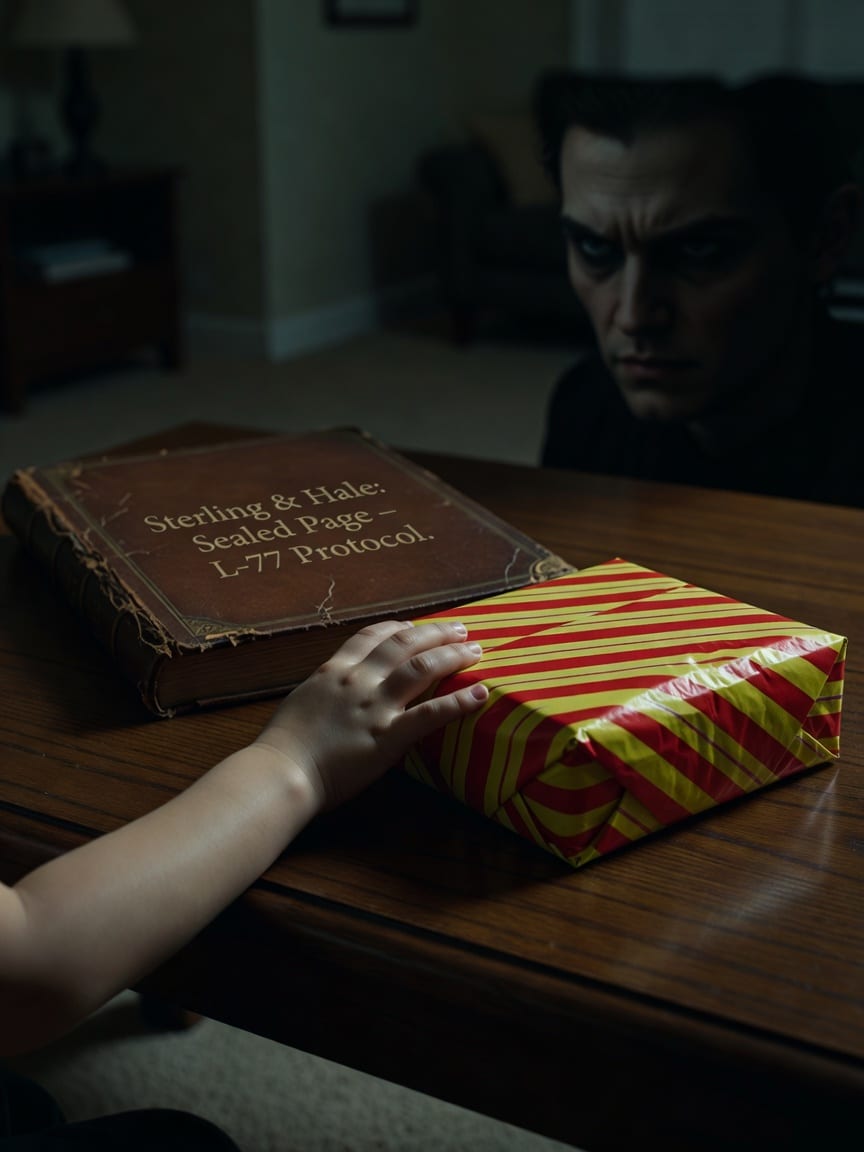
My house's 1962 mortgage archive had a redacted line. It named a 'condition as attaches to each owner in turn,' the same code as mine. There's no sealed page.
When a box of old documents arrived, I found my house's 1962 valuation report contained a heavily redacted line. A surveyor's note cut through the censorship, referencing a 'sealed page' and a code: 'L-77.' That same code was on my own mortgage statement, dated just last month.
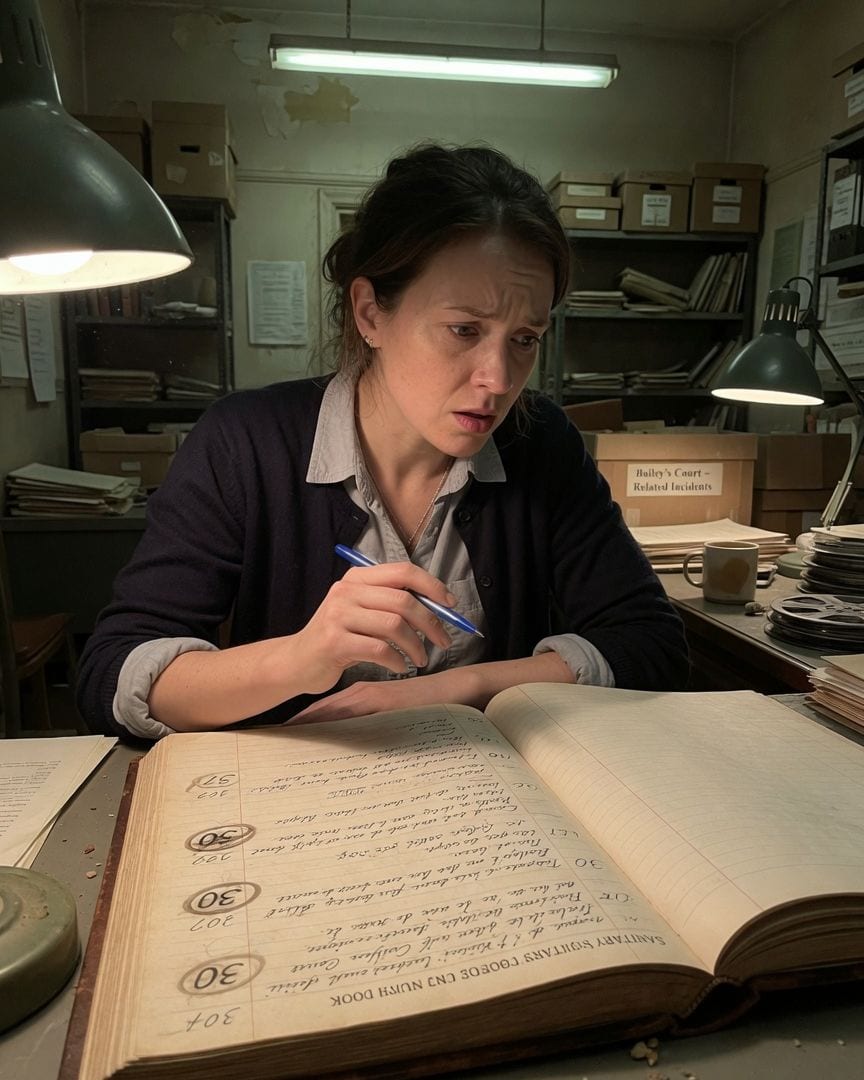
Entry 30 in the old records was re-inked for decades, always the same 'foul drain,' same order: 'do not act.' Then I found it on my street.
My job as a transcriber is usually tedious, but then I found Entry 30. The same complaint, a foul drain, logged for decades, was always re-inked with a chilling instruction: 'nuisance as before, enter it, do not act.' Then I found the same entry again, this time for my own street.
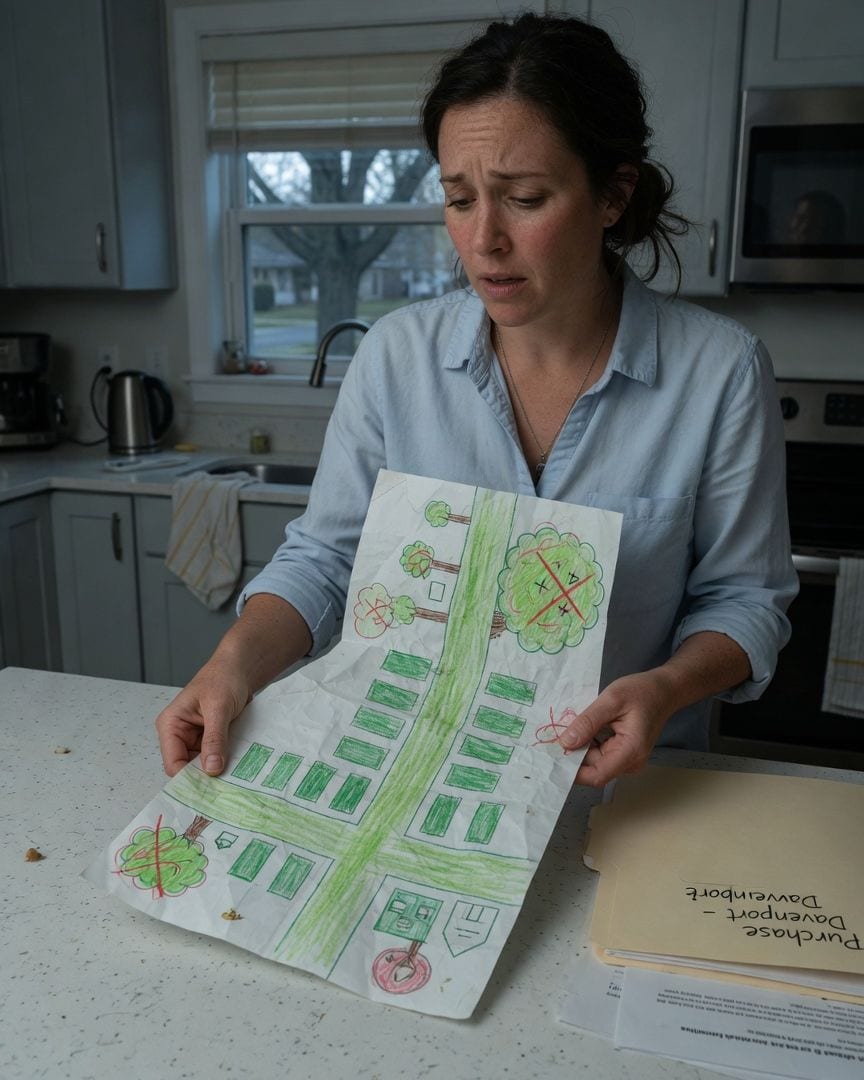
A hand-drawn map keeps arriving through our letterbox — every space on the lane marked green, except the one spot under the old lime tree, alone in red. The agent made us swear we'd never park there.
My new house came with a strange local quirk: weekly maps slipped through my letterbox, each one marking a specific parking spot with an angry red X. A legal addendum about the spot, and my neighbors' evasiveness, made me uneasy. But nothing prepared me for the ancient, identical map I found, which marked my own house with that terrifying red X.
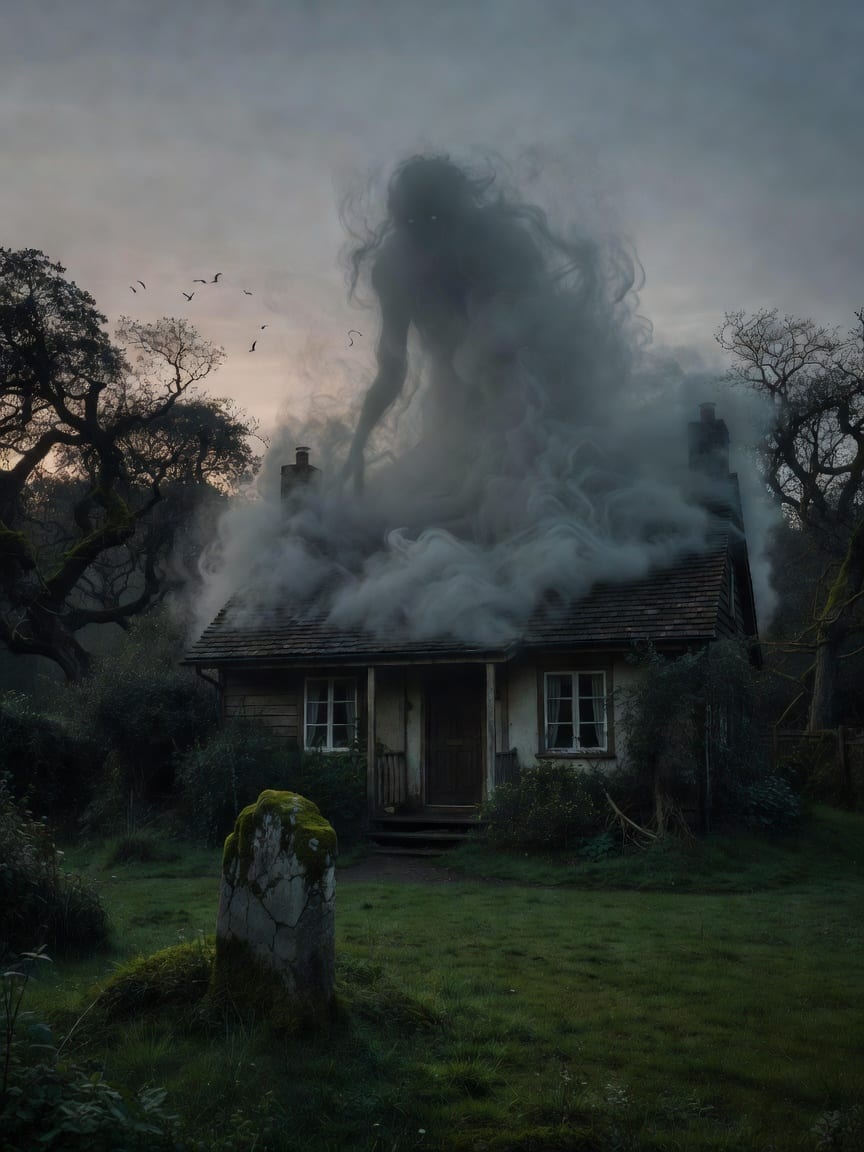
My cottage is now outside the parish, says the vicar. I moved one boundary stone into my ditch, and now I'm outside the line.
I loved my new cottage, with its sprawling garden and ancient oak. But after I moved an old, mossy stone at the edge of my property, Vicar Vance arrived with grave news: my cottage was now outside the parish line, and he could no longer keep me 'on the right side.'
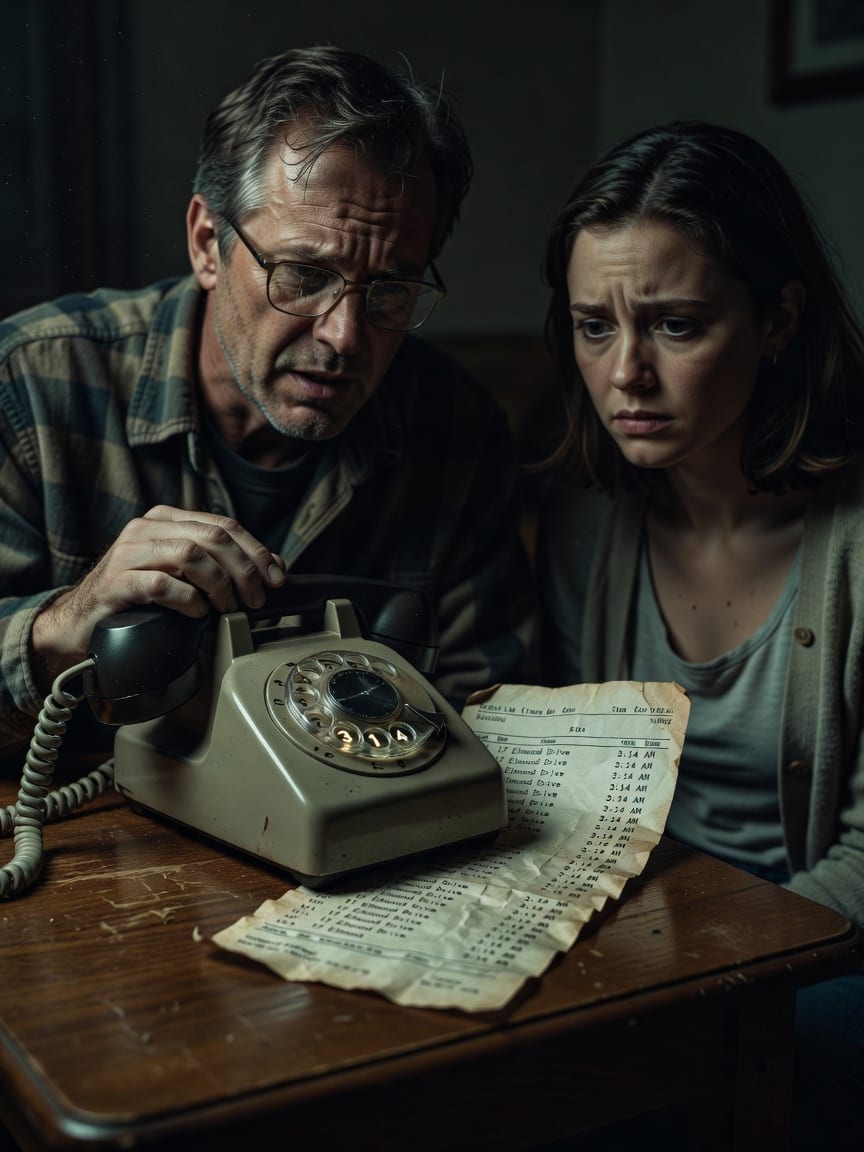
My phone bill itemised forty calls from my number to a house demolished in 1990. Each call at 3:14 AM, lasting eleven minutes. The bill arrived postmarked from a flattened building.
I expected the usual mobile bill, but my landline statement listed forty calls from my number to '17 Elmwood Drive.' That address was for a house torn down in 1990, a vacant lot I remembered from childhood. The phone company insisted the calls were legitimate, leaving me profoundly unsettled by the impossible charges.
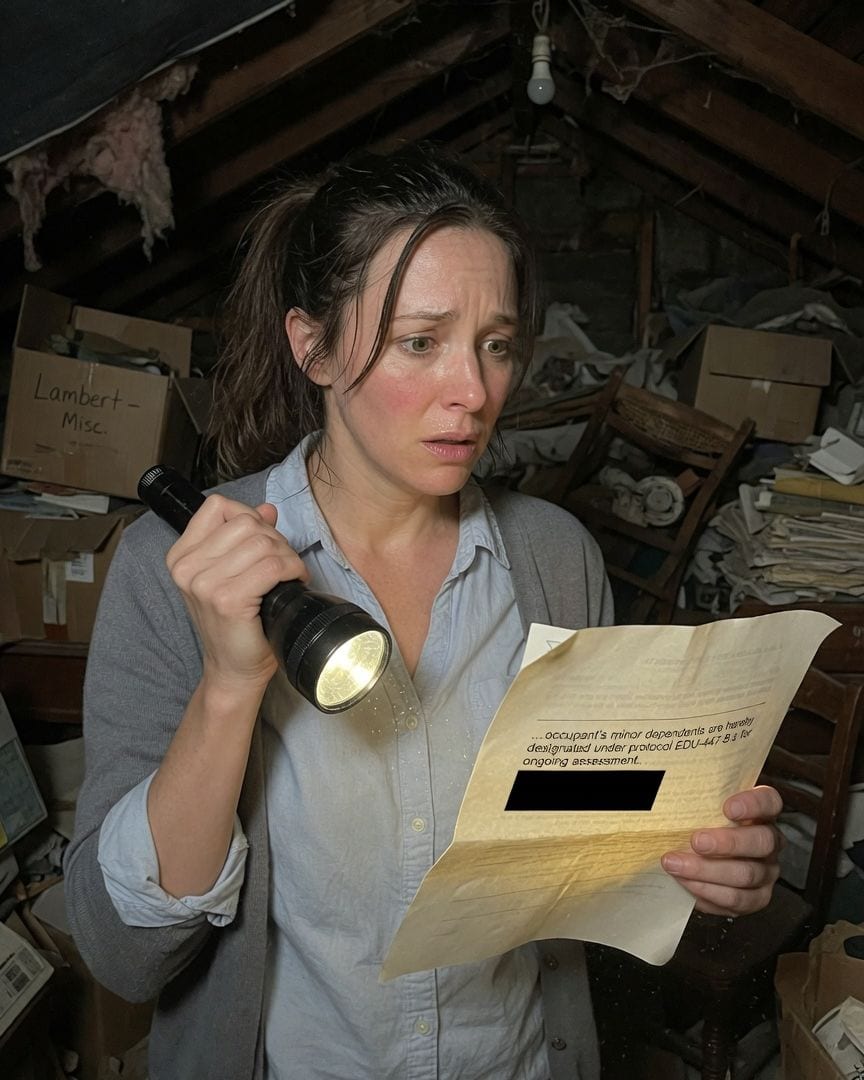
My county archive digital file has a redacted line from 1901, marked 'recurs each generation.' The address? My house. The instruction number? My son's school registration.
Searching mundane county archives, I found a 1901 school log entry for my house, Church Lane, No. 17. A perfectly blacked-out line, marked as 'Withheld – recurs each generation,' pointed to a code Monica at the Education Office used when registering my son. Then, in our attic, I found an identical blacked-out line on an old property notice, designating 'minor dependents' under the same code.