Our red front door now reads 13, not 14. Someone repainted it. The council still says 14, but every neighbor writes 13 on our mail.
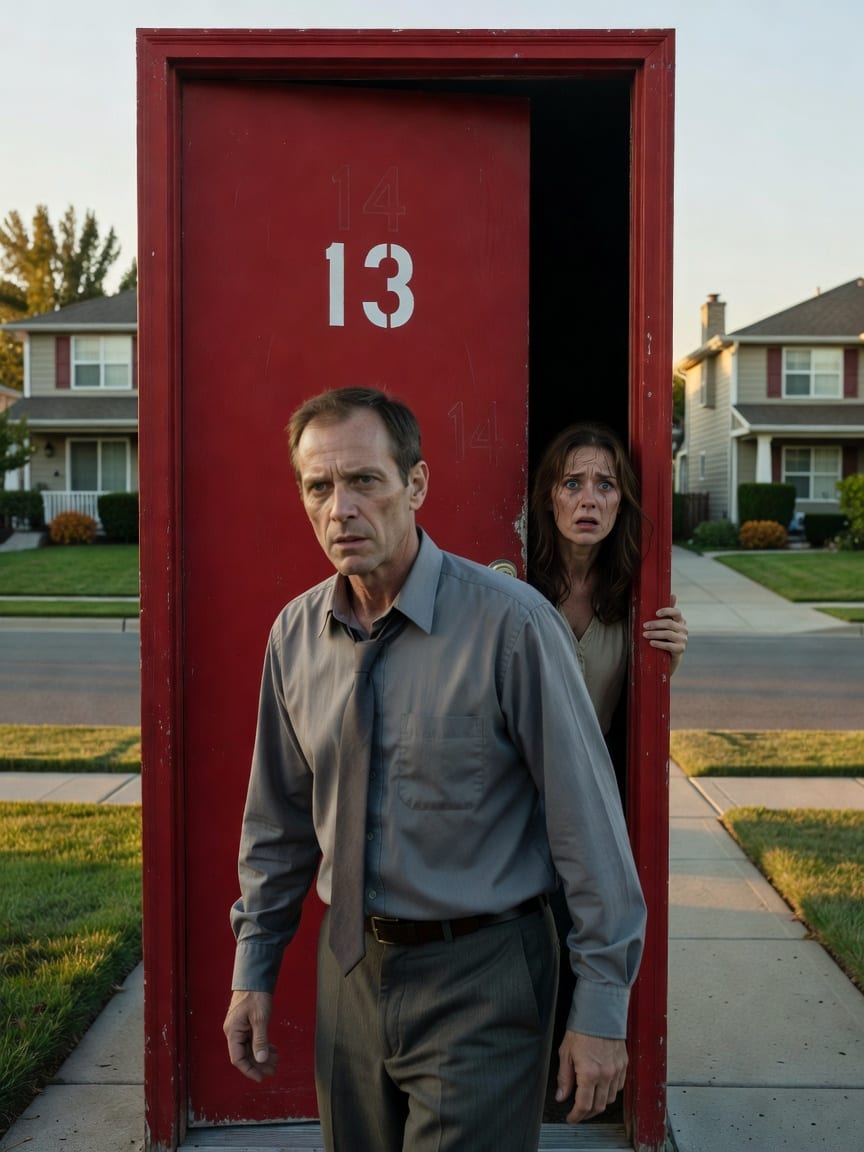
The first time it happened, two weeks after we’d painted our front door that bright, almost defiant red, I thought it was kids. Some stupid prank.
My partner, Mark, laughed it off, said it was probably the previous owners' old address or something. But it wasn't. Our house, 14 Elmwood Lane, was clearly painted '14' when we bought it, and that's what we repainted.
Then, one Tuesday morning, there it was: a perfect, crisp '13' where the '14' should have been. No sloppy lines, no paint drips. Like it had always been there.
Mark just sighed, grabbed the leftover red paint, and fixed it. By Friday, it was '13' again.
We called the council. '14 Elmwood Lane,' the woman confirmed, her voice bored. 'Always has been.' We checked the post office. 'Mail for 14, Sarah? Got it.'
But every holiday card, every local flyer, slipped through our mail slot with '13' scrawled on it, sometimes over the printed '14'. Constance Mercer, our elderly neighbor with the prize-winning petunias, stopped me as I was taking out the trash.
She offered a tight, almost brittle smile. "Beautiful red door, dear," she said, her eyes fixed on the number. "Around here, you don't repaint your front door until the house next door does."
She chuckled, a dry, rustling sound, and went back to watering her flowers. It wasn’t a mistake. It was a mark.
I stood there, staring at the number. The red felt less defiant now, more like a target. What the hell was going on?
I grabbed a wire brush from the garage, determined to scrub the damn '13' off once and for all. This was my house, officially 14, and I wasn't going to let some weird local prank dictate its identity.
I scraped hard at the freshly painted number, red flakes flying. But as the new paint came away, something else emerged. Not wood grain, not primer. A ghost of a number.
Faint, almost invisible, but undeniable: a '13' subtly etched into the original wood beneath layers of old paint. It wasn't a scratch. It was too precise, too deliberate.
The next day, I drove to the local council office again. This time, I spoke to a different clerk, a younger man named Kevin. He pulled up the official register. 'Ellsworth, Sarah. 14 Elmwood Lane. See?'
He pointed at a large, laminated map on the wall. A small red dot, clearly labeled '14', sat exactly where my house was. He even showed me an old, bound property deed, yellowed but legible. '14, Elmwood Lane,' it declared.
He printed a copy for me. 'We don't have a 13 Elmwood Lane, actually. The numbering jumps from 12 to 14 on that side of the street.' I thanked him, trying to keep my voice even.
At the post office, the postmaster, a stout man named Mr. Henderson, looked genuinely perplexed when I showed him a flyer marked '13'. 'I'll have a word with the new delivery folks, ma'am,' he assured me, shaking his head.
'No idea why they'd write that.'
Back home, I stopped trying to fix it. I ran my fingers over the faintly etched '13' on the door. It felt ancient.
I got down on my hands and knees, examining the lower part of the doorframe, where the wood met the threshold. The old house had a thick, hand-hewn frame. My nail snagged on something.
I pressed harder, picking at a tiny bump of paint. It flaked away, revealing a sliver of dark, tarnished brass.
I kept picking, carefully, until I uncovered it: a tiny, almost invisible brass plaque, painted over countless times, with the number 13 embossed on it. It was embedded deep in the wood, a permanent fixture.
This wasn't a prank. This was something else.
I needed to know more, to find out if this number '13' had always been tied to my address, or if it was some recent, twisted joke.
The town had a tiny library, mostly local history, run by Gideon Calloway, an older man with wire-rimmed glasses and a permanent aura of dust.
He pointed me to a collection of brittle, leather-bound town deeds, stacked in a back corner.
Hours later, my neck aching, my fingers grimy, I was about to give up. Then, nestled between two thicker volumes, I found it: a fragile, yellowed document, thin as tissue. It was a property deed, dated 1950, for our plot.
My heart hammered against my ribs as I opened it. In neat, old-fashioned script, the address was clearly listed: '13, Elmwood Lane'. The paper trembled in my hand.
Armed with the 1950 deed, brittle and silent proof, I walked straight to Constance Mercer's house the next morning. She was on her porch, pruning her hydrangeas, wearing pristine white gloves.
"Morning, dear," she chirped, but her eyes were already on the document clutched in my hand. I unfolded it, pushing it towards her. "This is a deed for my house, Constance. From 1950. It says '13 Elmwood Lane'."
Her tight smile didn't waver. Her eyes, though, were unreadable, like polished stones. "Oh, those old records are full of quirks, dear. You can't trust everything you read in those dusty papers."
She made a dismissive gesture with her gloved hand, the shears clicking softly. "Always some little peculiarity in every town's history, wouldn't you say? Now, have you seen the preparations for the flower festival?
Robert Thatcher has outdone himself this year." She seamlessly pivoted, never once looking back at the deed.
Robert Thatcher, when I asked him later that day, pushing the deed under his nose as he fetched his mail, just chuckled, a dry, rasping sound. "Just a local peculiarity, no harm in it. Town's got a long memory, Sarah.
Best not to stir things up." He smiled, too wide, and quickly shuffled back into his house, his official mail clutched tight – addressed to 12 Elmwood Lane.
Not once had he, or Constance, or any other local I’d spoken to, actually said my house number aloud. It was always 'your place', or 'the red door house', or even just 'down the lane'.
The omission was as loud as a shout.
I went back to the library. The quiet hum of the fluorescent lights was starting to feel oppressive. Gideon Calloway was behind the main desk, sorting returned books. I didn't bother him.
I found the old town directories, the local newspapers, and started cross-referencing. I specifically looked for '13 Elmwood Lane' and any residents listed there. It was painstaking work.
Whole periods – decades, sometimes – where records for that address seemed to simply vanish. Blank spots in old census reports.
Newspaper articles referring to ‘the vacant lot next to 12 Elmwood’ when I knew, absolutely knew, my house stood there. It was like the address, and whoever lived in it, had been erased.
As I delved deeper into the archives over the next few days, Gideon Calloway seemed to appear more frequently. He wasn't overtly obstructive, just… present. His movements were quiet, almost imperceptible, a shadow drifting between the towering shelves.
He'd offer "helpful" suggestions, his voice soft, directing me to unrelated historical texts.
"Ah, the old mill deeds, very interesting for understanding property lines back in the day," he’d say, gently nudging a heavy tome onto my table, its topic miles away from Elmwood Lane.
He always seemed to be shelving books near the sections I was researching, his eyes occasionally flicking towards my table, then away. It felt less like helpfulness and more like observation.
One evening, after the library closed and I'd retreated to the unsettling silence of my own house, I found a small, folded piece of paper slipped under my red front door. It wasn't post. It was too thin.
My heart gave a little lurch. The note was handwritten, in a neat, old-fashioned script. Chillingly, it was uncannily similar to the elegant cursive in the margins of the 1950 deed. It simply read: 'Some numbers are best left alone.
You're drawing attention.' I felt a prickle of cold sweat on my neck. The air in my house suddenly felt heavy, thick, watched. The red door seemed to pulse with a low, menacing energy.
I returned to the library the next morning, the anonymous note clutched in my hand, crumpled and damp from my grip. Gideon was meticulously shelving books by the local history section, his back to me.
The low hum of the overhead lights was the only sound. I walked straight to the counter, placing the note flat against the worn wood.
"You sent this, didn't you?" I asked, my voice tight, barely above a whisper.
Gideon turned slowly, his hands still holding an old almanac. He looked at the note, then at me, his expression unreadable, calm as still water. "I simply advise caution, Miss Ellsworth." His voice was soft, even.
I pushed the 1950 deed across the counter, sliding it next to the note. "And what about this, then? My house was 13. And now it is again. Why do all the neighbors call it 13?
Why did Constance tell me not to repaint until the house next door did?" The words tumbled out, raw and frustrated. "What the hell is going on here?"
Gideon sighed, a slow, deep sound that seemed to carry the weight of years. He finally laid the almanac down. "Miss Ellsworth, the number '13' on Elmwood Lane... it's a marker. A designation. Something this town has 'managed' for generations."
He leaned forward slightly, his eyes holding mine. "That rule Constance mentioned, about not repainting your front door until the house next door does? It's not about avoiding work, or some silly custom. It's about avoiding the marker.
It's about not drawing attention." His gaze flicked to my red door, visible through the library window across the street. "By repainting your door, by breaking that silence, you inadvertently drew its attention to your house.
You made it the next '13'."
My stomach clenched. "The neighbors. They know, don't they? That's why they use '13'. Their quiet agreement..."
He nodded, a barely perceptible dip of his head. "It's their quiet acknowledgment. Their desperate way of maintaining the balance, to protect their own homes."
The fluorescent lights above seemed to flicker, and I felt a sudden, chilling draft, though all the windows were closed. My skin crawled.
Seeing the growing horror on my face, Gideon Calloway pushed himself away from the counter. "Come," he said, his voice flat, devoid of emotion, "There is more you need to understand."
He led me to a back room I’d never noticed, a small, dark space filled with forgotten things. In the corner, obscured by dusty boxes, stood a heavy, locked cabinet.
He produced a small, antique key from his waistcoat pocket, the metal gleaming dully in the dim light. The lock clicked, a sound like a bone snapping.
He retrieved a heavy, leather-bound ledger from the cabinet, its cover unadorned, its pages yellowed and brittle with age. "This is the true record," he said, placing it on a small, scarred table.
He opened it to a specific page, worn smooth from countless turnings.
It was a chilling list. A column of names, then dates, then an address. All the addresses were '13, Elmwood Lane'. And next to each name, a terse, handwritten note: 'vanished'. I scanned the list, seeing a horrific pattern.
Dates from the early 1900s, then the 1930s, the 1960s, the 1990s. Roughly every 25 to 30 years, a name, a date, a disappearance from my address. The room suddenly felt very cold, so cold my breath plumed faintly.
My eyes raced down the list, past a name from the 1990s, past another from the 1960s, until they landed on a new, freshly penned entry at the very bottom. It was my address.
And beneath it, in the same neat, old-fashioned script as the anonymous note, was my own name: 'Sarah Ellsworth'. The current date was filled in beside it.
The ledger lay open between us, my name a fresh, stark stain on its ancient page. The date beside it seemed to burn into my retina. My own hands were shaking, badly. Gideon Calloway stood opposite me, his face impassive.
"There is something beneath Elmwood Lane," he explained, his voice devoid of emotion, like he was reciting a well-worn story. "It demands a tribute, a… harvest, every cycle. It always takes from the house marked '13'."
He gestured vaguely towards the window, in the direction of my street. "The town, Miss Ellsworth, has maintained this cycle for centuries. A silent, terrible agreement. To ensure the entity is appeased.
To ensure it doesn't take indiscriminately from other homes."
My head swam. "So the rule... the repainting..."
He nodded. "By repainting your door that bright, conspicuous red, by marking it so clearly, you inadvertently 'activated' your house. You made it the next in line." He didn't gloat, he didn't apologize.
He simply stated it, a grim fact of existence in this town. Every planted clue, every oddity, every too-smooth smile from the neighbors, clicked into place with sickening precision.
Constance Mercer's tight smile, Robert Thatcher's dismissive chuckle, the blank spots in the old records, the brass plaque beneath the paint, the deed from 1950. It all fit.
The horror wasn't in some monstrous reveal, but in the terrible, inescapable coherence of it all. This wasn't chaos; it was order.
"What can I do?" I asked, the words barely a whisper, my throat suddenly dry and raw. "There has to be something. Can I repaint it back? Leave town? Burn the damn house down?"
My voice rose, cracking with a desperate edge.
Gideon's gaze was steady, unblinking, like he'd heard these questions countless times before. "The number is set, Miss Ellsworth. The agreement is old." He paused, his eyes drifting to the ledger. "The Peterson family.
They lived there in the early 60s. They tried to fight it. Repainted their door back to 14 every single day. Tried to leave town in the dead of night." His voice was flat as he continued.
"Their car broke down on the old, unpaved road out of town, just past the county line. Engine died, tires flat, phone dead. They were never seen again. Not a trace."
He looked at me then, truly looked at me, and I saw a deep, ancient sorrow in his eyes, but no pity. "This town's survival, its quiet prosperity, relies on maintaining this cycle.
There is no escape, no undoing the mark once it's made." He offered no comfort, no solution. Simply watched me, as the full, horrifying truth settled in my bones, chilling me to the core. The knowing was the ending.
There was nothing left to do.
I walked back to my house on Elmwood Lane. I didn't try to repaint the number back to 14. I didn't pack my bags.
I simply walked through the red door, into the silence, and watched the street, the quiet houses, my neighbors tending their gardens. The postman, oblivious, continued to deliver mail addressed to '14'.
But the local paper, folded neatly on my porch, arrived addressed to '13'. I stopped answering the door after dark.
From my window, I saw Constance Mercer wave from her porch, a small, knowing smile on her lips, a silent acknowledgment of the new '13'.
Days bled into weeks. I sat in my living room, the red door with its stark '13' visible through the window. I thought about Gideon's calm face, the heavy ledger, the names. I knew what was coming.
I just didn't know when. One evening, a delivery driver, a young man I hadn't seen before, knocked on my door. He was holding a small, flat package. "Delivery for Sarah Ellsworth, number 13?" he asked, his smile normal, friendly.
I opened the door just enough to take it. He glanced at the number. "Have a good night, number 13."
The package was empty. The next morning, Constance Mercer noticed Sarah's front door was slightly ajar. The red paint on the number 13 looked particularly fresh. So it begins again.
If this one got to you
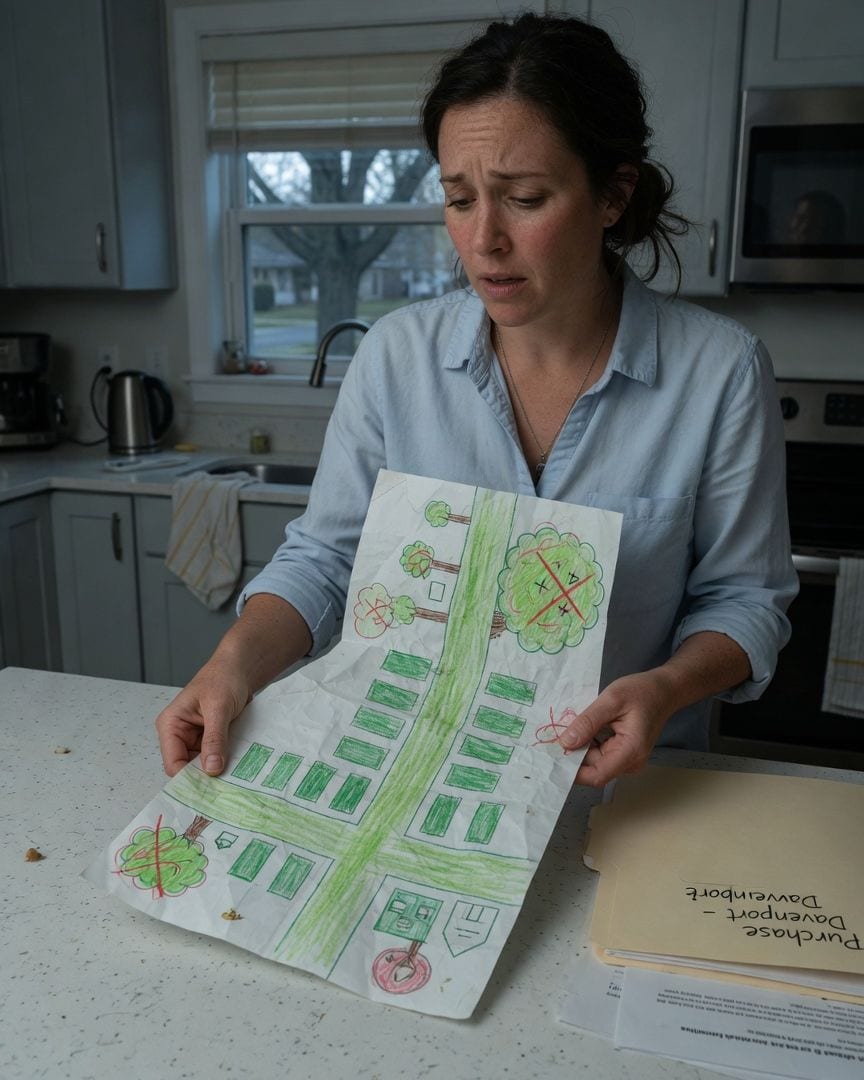
A hand-drawn map keeps arriving through our letterbox — every space on the lane marked green, except the one spot under the old lime tree, alone in red. The agent made us swear we'd never park there.
My new house came with a strange local quirk: weekly maps slipped through my letterbox, each one marking a specific parking spot with an angry red X. A legal addendum about the spot, and my neighbors' evasiveness, made me uneasy. But nothing prepared me for the ancient, identical map I found, which marked my own house with that terrifying red X.
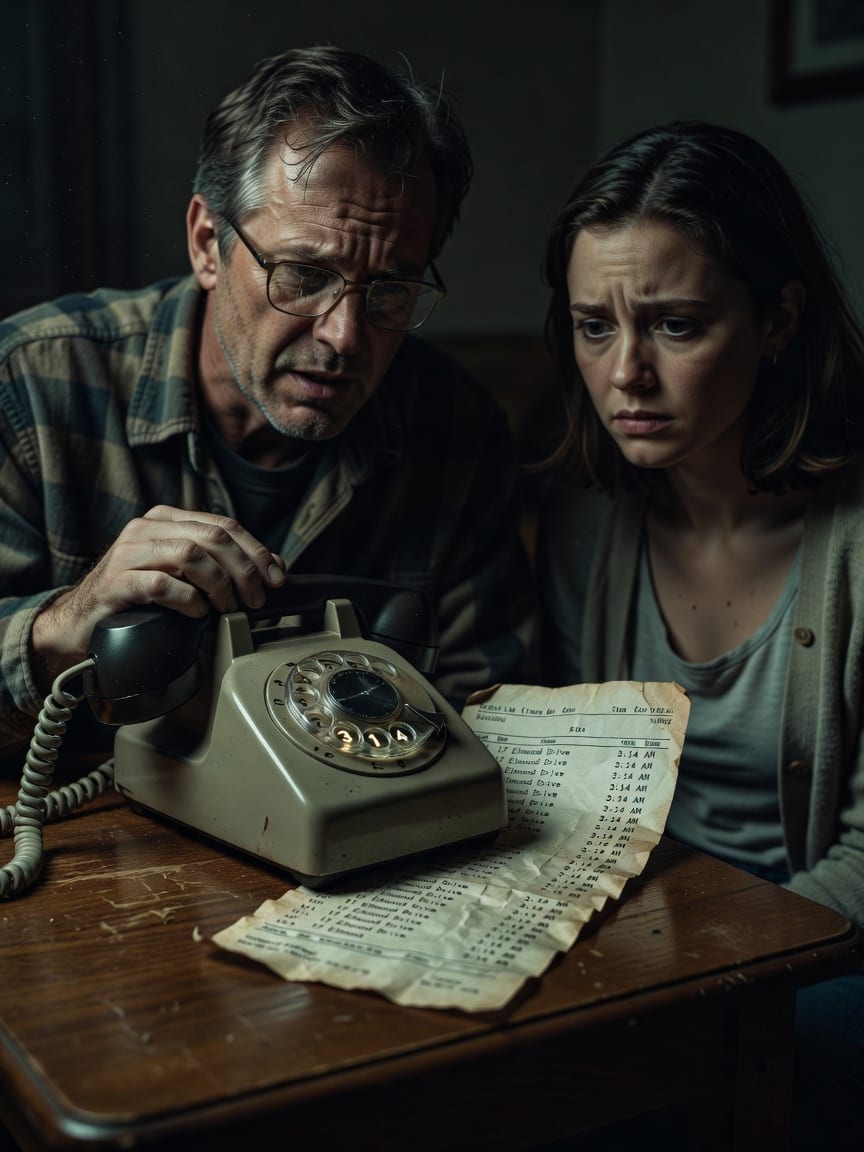
My phone bill itemised forty calls from my number to a house demolished in 1990. Each call at 3:14 AM, lasting eleven minutes. The bill arrived postmarked from a flattened building.
I expected the usual mobile bill, but my landline statement listed forty calls from my number to '17 Elmwood Drive.' That address was for a house torn down in 1990, a vacant lot I remembered from childhood. The phone company insisted the calls were legitimate, leaving me profoundly unsettled by the impossible charges.
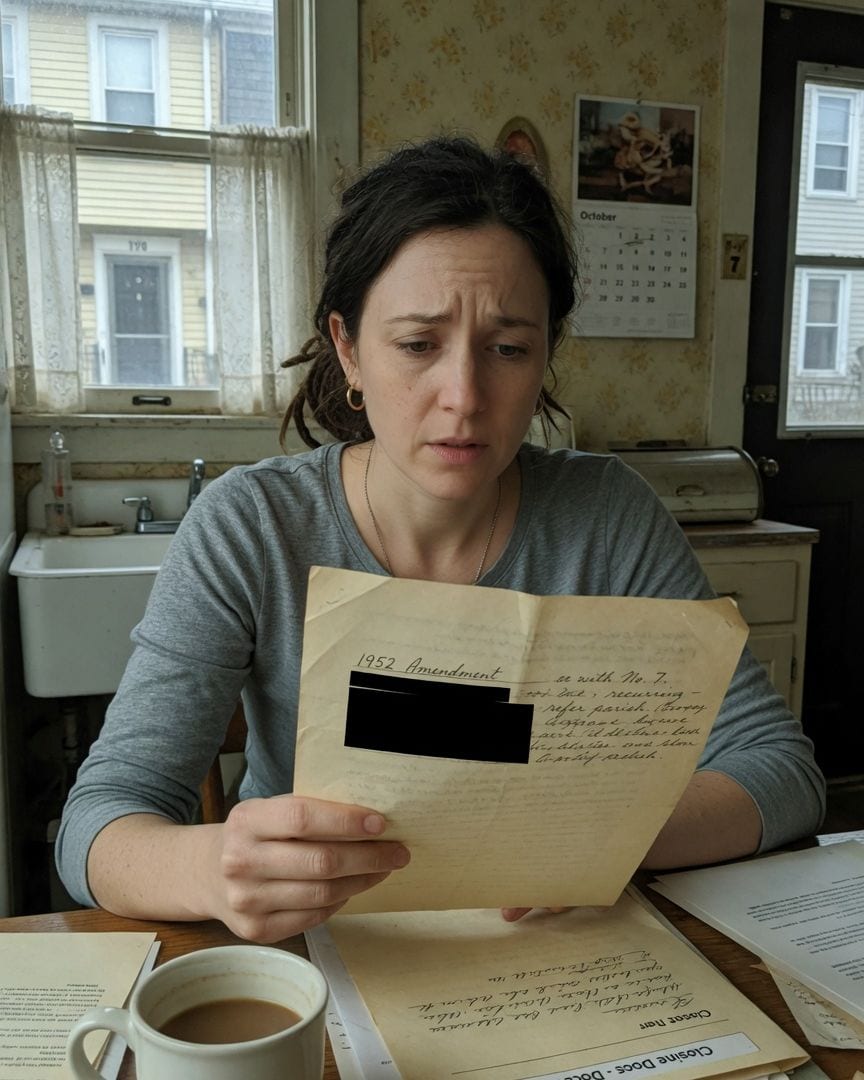
My new house deed has a blacked-out line. My mother's voice went brittle when I asked about her old No. 7 home.
Settling into my new Harlow Street home, I found a stark blacked-out line on my land registry deed. My attorney dismissed it as routine, but a hidden marginal note read 'as with No. 7, recurring – refer parish.' No. 7 was my mother's childhood home, and her reaction to my questions was chillingly evasive.
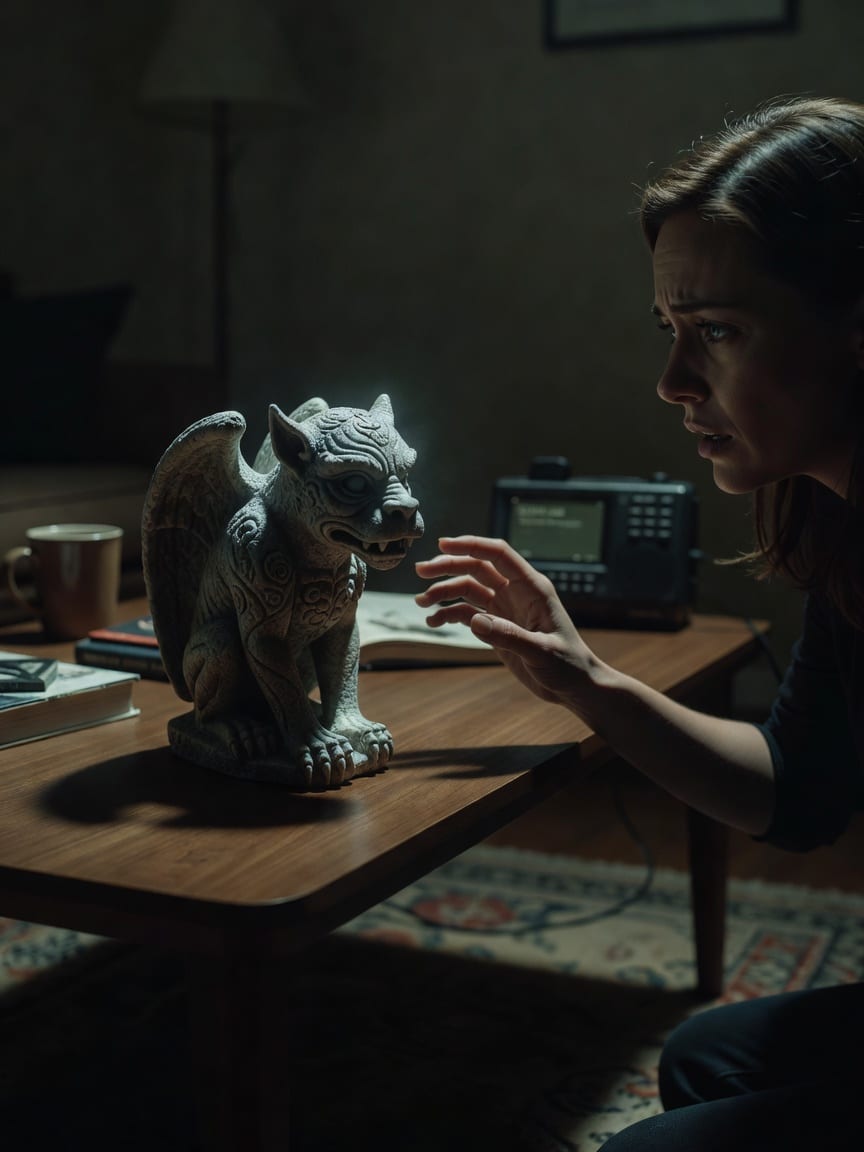
My radio scanner spoke my address at 2 AM. A flat voice read local homes, all with past dates. Mine was the only one in the future.
It was two in the morning, and my quiet house was filled with the usual hum of my weather scanner. But the static broke, replaced by a flat, synthesized voice reading a list of local addresses and dates. My hand froze when it spoke my own address, 181 Foster Drive, followed by a date: October 27th. That date was three weeks from now.
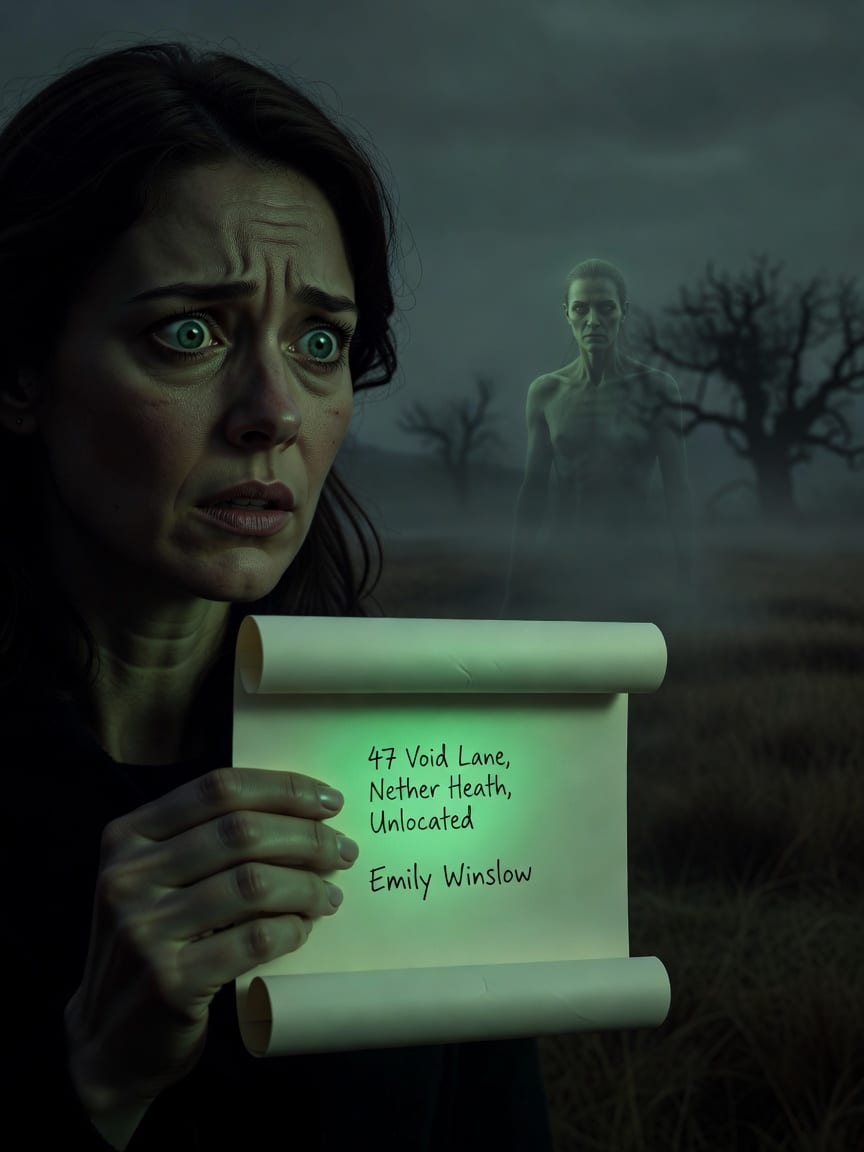
My change-of-address card arrived today. It said I'd moved to a house I'd never seen, on a street that didn't exist. And it was signed with my own hand, a month from now.
A crisp, cream-colored card on my kitchen counter informed me I'd moved to 42 Willow Creek Lane, an address that didn't exist. The signature was my name, Emily Winslow, a chillingly precise ghost of my own handwriting. But then I found an old 1947 ledger, listing 42 Willow Creek Lane and a signature identical to the one on my card.
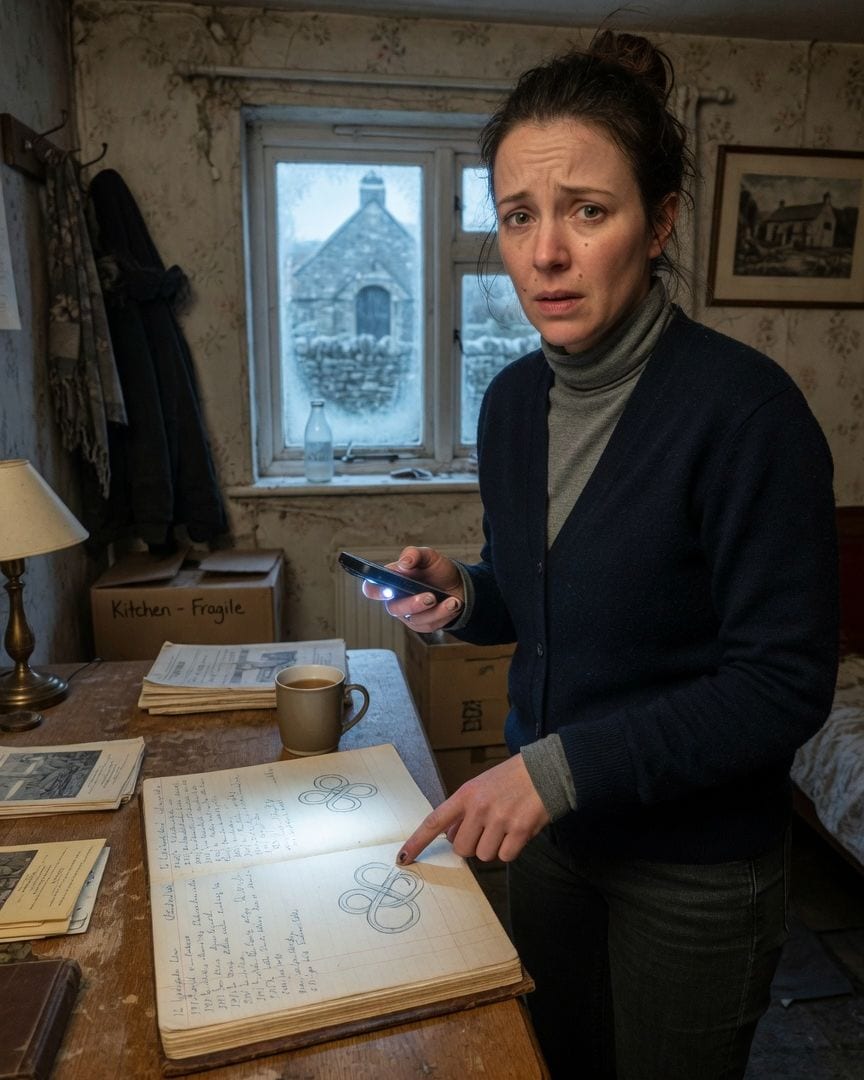
Milk appears daily by my lychgate. The dairy closed in '79. My address is handwritten into their old delivery book, starting the day we moved in.
Moving to Blackwood Creek, I loved the quaint charm, especially the unexpected morning milk delivery to my lychgate. But when I mentioned it to Eleanor at the village shop, her smile froze. She told me Willow Creek Dairy closed decades ago, in '79.