An impossible patrol: A Corporal's signature appears in a bunker's logbook for a duty she never performed.
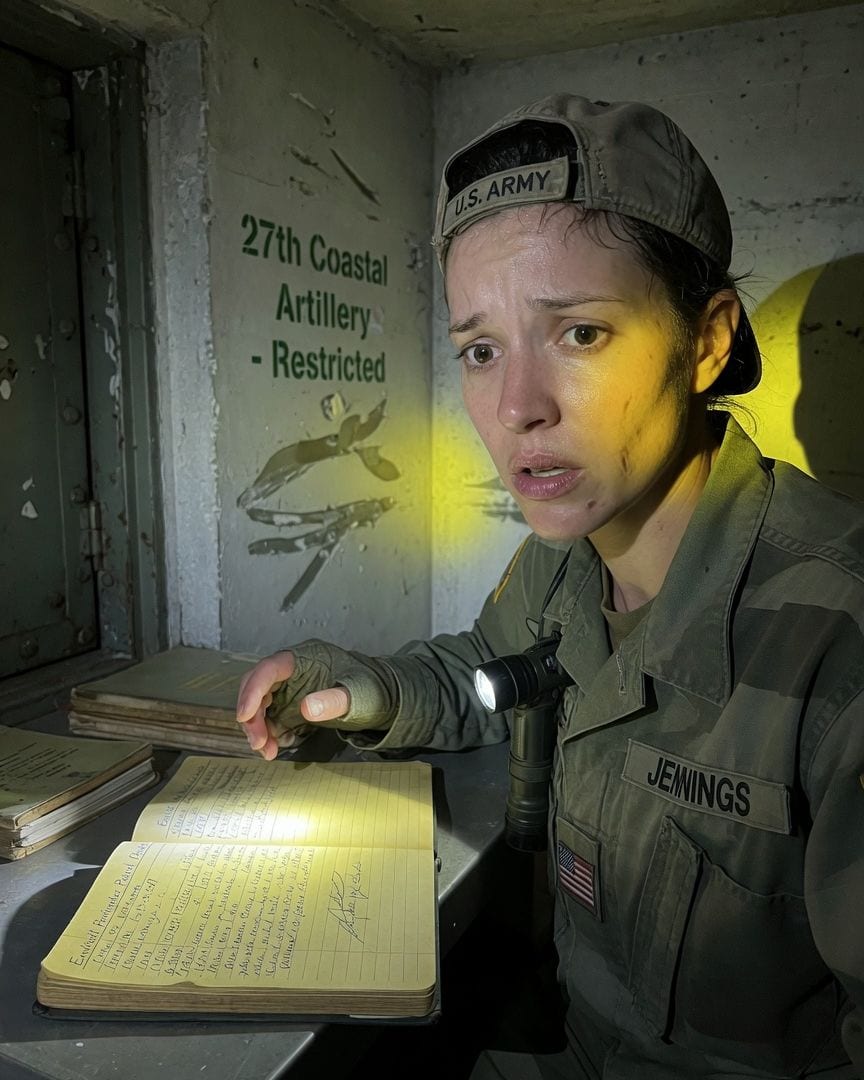
Corporal Annika Jennings, 26, adjusted the straps of her pack, the damp air of the bluff clinging to her fatigues. Her three-man patrol picked their way carefully through the ragged, raw scar left by the recent storm.
The coastal erosion had been severe, carving deep into the hillside, exposing bedrock and ancient, root-tangled earth.
Where the slope had collapsed, it revealed a section of the old Endicott-era gun battery, a relic of early 20th-century harbor defenses, supposedly sealed and forgotten since the 1960s.
Instead of solid rock or bricked-up tunnels, a heavy steel door, surprisingly intact, stood ajar in the fresh scar, its thick paint chipped but clearly designed to seal tight against the elements.
A faint, low hum vibrated the air, a deep, resonant thrumming that Jennings felt more in her chest than heard with her ears. Specialist Nathan Russo, 22, the youngest of the patrol, cautiously shone his tactical flashlight inside.
The passage was dry, the air cool and still, lacking the expected musty stench of decades-old damp earth. Faded green unit stenciling on the concrete walls—‘27th Coastal Artillery’—looked remarkably fresh, a stark, unsettling contrast to the decades of neglect outside.
Two hundred meters in, the tunnel turned a sharp corner, and a soft, steady, unnatural yellow light pulsed from deeper within, past where the fort's official as-built plans, filed away in dusty archives, swore the hill was solid rock.
The light was clean, electric, and utterly out of place.
Sergeant Roy Maddox, 45, radioed in the discovery, his voice tight with a mix of disbelief and professional protocol.
Command was confused; the Endicott battery was unequivocally off-limits, decommissioned, its tunnels bricked up and its existence largely purged from active manifests.
They were ordered to secure the visible entrance, document the anomaly, and await an EOD (Explosive Ordnance Disposal) team, though no explosives had been found. Jennings, however, couldn't shake the image of that pulsing light.
The hum had followed her, a phantom vibration in her teeth. Later that night, unable to sleep, she returned alone, using a master key she’d acquired from a maintenance shed that still held relics from the battery's active days.
The steel door, now secured by her patrol, yielded with a heavy clang. Inside, the light pulsed, unmoving, emanating from an unseen source around the bend. She found a small, bolted-down desk and a stack of weathered, official-looking logbooks.
The top one, a duty roster for 'Endicott Perimeter Patrol,' was open to the current month. Her eyes scanned the neat, official entries, each line a record of a soldier’s name, rank, and assigned duty. Her breath hitched.
There, dated two weeks prior, was 'Jennings, A. Cpl,' followed by her own unmistakable signature, logging a perimeter check inside the extended passage.
She remembered that day clearly, every detail vivid: she'd been on a grueling, multi-day training exercise three hundred miles inland, nowhere near this forgotten coast.
Jennings traced the signature with a gloved finger, her own hand, unmistakable in its familiar loops and crosses. But it wasn't. It couldn't be.
The date, the specific location, the assigned duty—all official, all meticulously recorded in military paperwork, yet all impossible. Her own memory, her own lived experience, screamed that this entry was a lie. She pulled her hand back as if burned.
The soft, steady, unnatural yellow light from deeper within the tunnel seemed to intensify, casting long, wavering shadows that danced with the low hum. It wasn't just a physical vibration now; it was a presence, a watchful silence.
She looked up from the book, the hum a physical pressure against her eardrums, and felt an icy dread seep into her bones. The passage stretched into the unknown, and a record swore she'd already walked it.
Jennings meticulously documented the logbook, photographing every page with her secure-line phone, ensuring timestamps and metadata were captured. She recorded every entry, every signature, every date, then returned the book to the desk, leaving it exactly as she’d found it.
Her next step was to cross-reference the unit stenciling. The '27th Coastal Artillery' had been officially deactivated in 1958, years before the battery was supposedly sealed for good. This discrepancy gnawed at her.
She spent days in the base’s dusty, disused archive, sifting through brittle microfiche and musty paper records.
She found sporadic, almost deliberately obscured records: supply requests for specialized, heavy-duty lighting and ventilation equipment, dated after the battery was supposed to be decommissioned.
The requests were signed by various officers, some long dead, others retired, all with impeccable service records. The paperwork trail was sparse, almost deliberately incomplete, but it existed.
Each document, however, was stamped 'Endicott Battery, Perimeter Maintenance,' even though that duty shouldn't have existed for a sealed, abandoned site.
The equipment described—large-capacity air purifiers, high-output generators, specialized conduits—was industrial-grade, far beyond what a normal coastal battery would require, suggesting not just minimal maintenance, but active, continuous operation.
The dates on these requisitions stretched back decades, forming a thin, almost invisible thread through the military's bureaucratic labyrinth.
She felt a growing, icy chill: this wasn't an oversight or a clerical error; it was a ghost operation, running parallel to the official military structure, yet woven into its fabric through legitimate-looking but ultimately false paperwork.
The unease became specific, concrete: someone, or something, was actively maintaining this deception, and had been for a very long time.
Her relentless inquiries didn't go unnoticed. A quiet word from Sergeant Maddox, who had initially dismissed her concerns as fatigue, escalated into a direct warning. He cornered her by the motor pool, his posture rigid.
'You need to drop this, Jennings,' he'd said, his eyes unusually flat, devoid of their usual warmth. 'Some things are better left buried. For your own good, and for the good of your career.'
Later that week, she found her personal locker slightly ajar, though nothing was missing that she could immediately discern. The next morning, her digital records, including her training deployment from two weeks prior, were suddenly inaccessible from the base network.
Any attempt to access them resulted in a generic 'system error' message, while all other records remained perfectly available. A few hours later, a thick, official-looking memo appeared on her bunk, unsigned, simply stating: 'Endicott Battery is secured.
Further unauthorized access, investigation, or discussion regarding its status is a court-martial offense, punishable by severe penalties.' The threat was clear, and it was personal. She was being watched, her movements and inquiries tracked.
The system, designed to protect, was now subtly, menacingly turning against her.
She felt the weight of unseen eyes, the chill of an organization that could effortlessly erase or alter information, and she knew she was no longer just investigating a mystery; she was now the subject of an unspoken warning.
The familiar, comforting structure of military order was warping around her, becoming a cage.
Undeterred by the warnings, Jennings bypassed the network block by using a public library computer off-base, a place where her digital footprint wouldn't be immediately flagged. She focused on the names signed on the old Endicott supply requests.
One, a retired Quartermaster Sergeant, Simon Hayes, was still alive and listed in a civilian directory. Jennings drove to his quiet suburban home, a two-hour drive north. He was frail, his memory occasionally hazy, but his eyes were sharp.
When she showed him a photo of the '27th Coastal Artillery' stenciling from the tunnel and the later maintenance logs, his eyes narrowed, a flicker of something unreadable passing across them.
'That battery was sealed tight,' he insisted, his voice firm, then hesitated, looking away towards his garden. 'Unless… unless they found it again.'
He recounted a vague rumor from his early days in the Quartermaster Corps, a whispered legend among the older NCOs: an old tunnel, a system before the system, maintained by a shadow detail, operating entirely off-book.
He'd never seen it, only heard hushed talk of 'accountability sheets' for personnel no one ever saw, ghost entries for ghost duties.
He mentioned a specific, unindexed archive section for 'legacy assets,' a place where records too sensitive or too anomalous for regular filing were quietly shunted away. He stressed that nobody asked questions about 'legacy assets,' implying a quiet, enforced complicity.
The details he offered were fragmented, but they painted a chilling picture: an ongoing, concealed operation stretching back decades, a deliberate blind spot in the military's otherwise meticulous record-keeping.
The hum, the light, the impossible signature – they all clicked into a horrifying new coherence. The military wasn't just unaware; it was actively, if silently, perpetuating the deception.
Hayes then pulled out a faded, creased photograph from his own service album, taken in 1988. It showed his unit in front of a newly painted sign for the base, a typical military photo.
In the background, partially obscured by a utility pole, was a maintenance truck with 'Endicott Perimeter' stenciled on its side, and next to it, a figure in fatigues, facing away. The figure was clearly female, with short, practical hair.
Hayes pointed to the figure, a soft smile on his face. 'That was Margaret,' he said, 'Margaret Hayes. My wife. She was in the Quartermaster Corps too, back then. Sharp as a tack.
She signed off on some of those strange supply requisitions for 'Endicott Perimeter' – before she was officially in, of course. Just helping out.' Jennings felt a sickening lurch.
She remembered the name from the archived duty logs: 'Hayes, M. Sgt,' logging perimeter checks at the Endicott battery in 1988.
This was a full three decades after it was supposedly sealed, and a full decade before Margaret Hayes ever officially joined the military. Jennings showed Margaret Hayes, now a polite, elderly woman, the log entry.
Margaret’s initial polite confusion hardened into a chilling calm, her eyes turning utterly blank as she calmly stated, 'That's not a place you were ever assigned, Corporal.
And you never saw me there,' her words perfectly rehearsed, erasing any possibility of a simple mistake or a lie.
Margaret's initial polite confusion hardened into a chilling calm as Jennings pressed her, showing her the log entries and the photo of the truck. Margaret finally broke, but not as Jennings expected.
She explained, in a low, even voice, that the 'Endicott Perimeter' was a codename. Not for a place, but for a 'sustaining operation.'
She had been part of a small, discreet unit tasked with maintaining the illusion of a sealed battery while facilitating access for another entity.
The logs, she admitted, were fabricated, a necessary fiction to account for 'personnel' who were never officially present.
She revealed that the extension was not recent, but an original, unrecorded feature of the battery, maintained continuously for 'observation and supply' since the turn of the century.
The stenciling, the light, the hum—all were part of the ongoing operation, a system-within-a-system. The 'anomaly' was the constant, unacknowledged presence that had been there for over a hundred years, predating the modern military as Jennings knew it.
It wasn't about discovery; it was about stewardship. The entire military apparatus, from the lowest supply clerk to the highest general, played a part in maintaining the secrecy, often unknowingly, through layers of misdirection and convenient 'errors'.
Margaret led Jennings to a hidden compartment in her study, behind a loose panel in a bookshelf. She produced a single, heavy, leather-bound ledger. It was a master log, meticulously kept in elegant, looping script, detailing 'Endicott Perimeter' operations.
The entries stretched back to 1903, long before the modern military, long before the battery was even conceptualized. Each page meticulously recorded 'resource allocation' and 'personnel accountability' for the anomaly—never named, only referred to by a numerical designation: 'Unit 734.'
The ledger documented its 'feeding cycles,' its 'growth phases,' and the 'rotations' of the small, dedicated units, like Margaret's, who ensured its continued existence, always under the guise of maintaining a 'sealed' battery.
The climax was not a fight, but the chilling realization that the military wasn't fighting an anomaly; it was its quiet, unwilling keeper, ensuring its survival, generation after generation.
The horror was in the sheer, bureaucratic scale of the cover-up, the way an entire institution had absorbed and normalized the impossible. It wasn't about stopping it; it was about understanding that it couldn't be stopped, only managed.
The ledger was the system's own record, laid bare, stating plainly in black and white how many decades they had known, and how deeply they were entangled.
Jennings copied the ledger's contents, digitizing every page onto an encrypted drive, then destroyed the original as Margaret watched, her expression unreadable. She returned to base, the weight of the ledger's truth settling heavy on her shoulders.
The official report on the Endicott battery was sealed, citing structural instability and ordering permanent re-sealing with concrete, a final, definitive closure that Jennings knew was another layer of the lie.
Sergeant Maddox gave her a long, appraising look, then nodded slowly, as if a silent message had passed between them, a recognition of shared, unspoken knowledge. The system had closed ranks.
Jennings now recognized the subtle shifts in the official narratives, the quiet disappearances in the records, the gaps that were always filled by a convenient, unchallengeable lie.
She watched the news, saw the reports of remote outposts, of strange, unexplainable events, and understood the true, terrifying coherence behind them. The silence was the loudest part, the sound of the system working perfectly, endlessly.
A few months later, Annika Jennings was honorably discharged due to 'stress-related medical conditions.' She moved to a quiet town, far from any coast, seeking a peace she knew was illusory.
Sometimes, late at night, she'd check her old service record online, just to make sure.
Every entry was correct, every deployment accounted for, every signature hers, except for one, dated two weeks before her Endicott discovery, logging perimeter duty at a facility she'd never seen, signed with a hand she knew was not her own.
If this one got to you
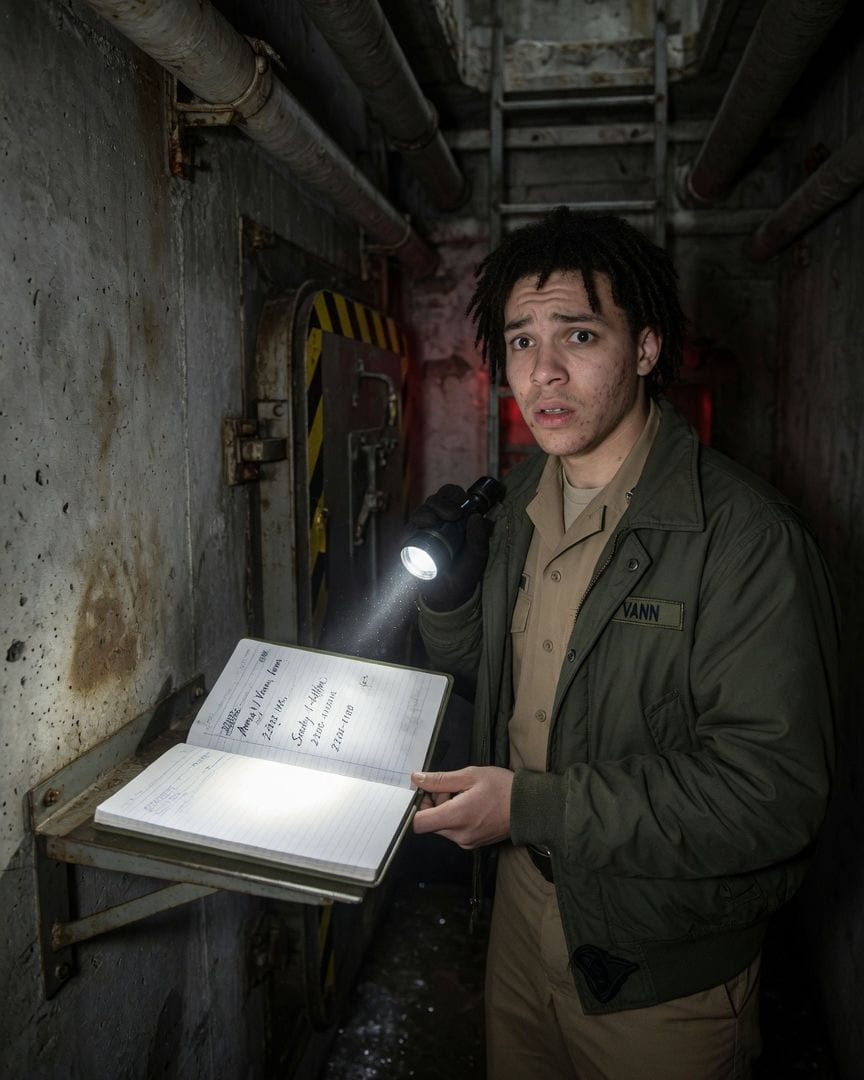
On his last patrol, Airman Vann sees a Cold War silo hatch light up from *inside*—it was welded shut a decade ago.
Airman Vincent Vann was on his last patrol across a vast, desolate Cold War missile field in the Dakotas, the cold, starless sky mirroring the emptiness of the landscape before his transfer. His routine check of eight hardened silo caps was shattered when a red fault light pulsed on Silo 4’s access panel, signaling an impossible breach from *inside* a hatch sealed for a decade. As more silos lit up, ignoring base orders, Vann found the hatch unlocked from within and descended into the dark shaft, where he discovered a pristine logbook bearing his own signature next to a chilling entry from a non-existent sentry, dated for *that very night*. Now, a steady *thump* echoed from deeper within the sealed concrete, leaving the Airman desperate for an explanation that simply wasn't there.
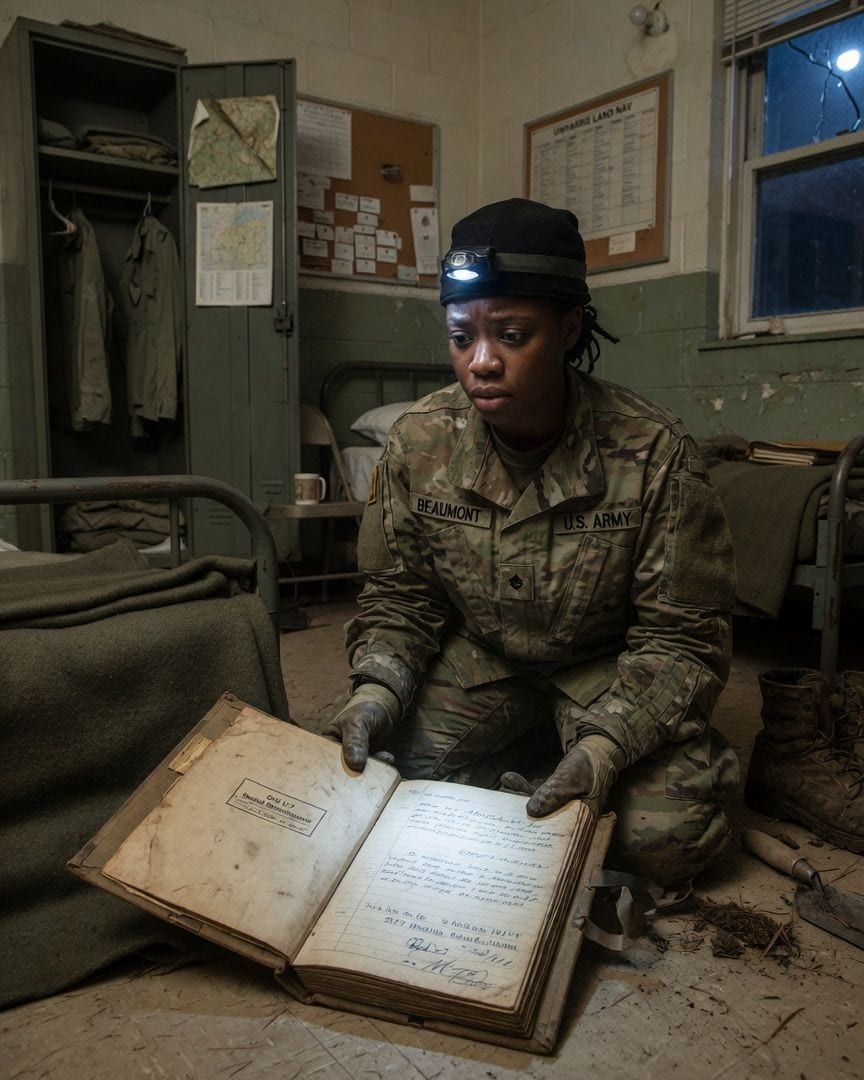
A burn barrel's impossible heat led a lieutenant to a hidden logbook, holding her own signature on a patrol she never took.
Second Lieutenant Monica Beaumont, bone-tired after a land-navigation course, logged an unexpected compound in the Uwharrie backcountry. Her cadre officer, Captain Russo, insisted she'd invented it, marking her record. The next morning, leading her platoon back to the coordinates, the compound was gone, but they found fresh post holes, cold fire pits, and a burn barrel still radiating an impossible heat. Unable to shake the uncanny feeling, Lieutenant Beaumont returned alone that night and unearthed a heavily corroded metal box. Inside, a canvas-bound logbook detailed decades of activity at a site that didn't exist, until she found an entry from eighteen months prior: her own signature on a night watch she was hundreds of miles away from.
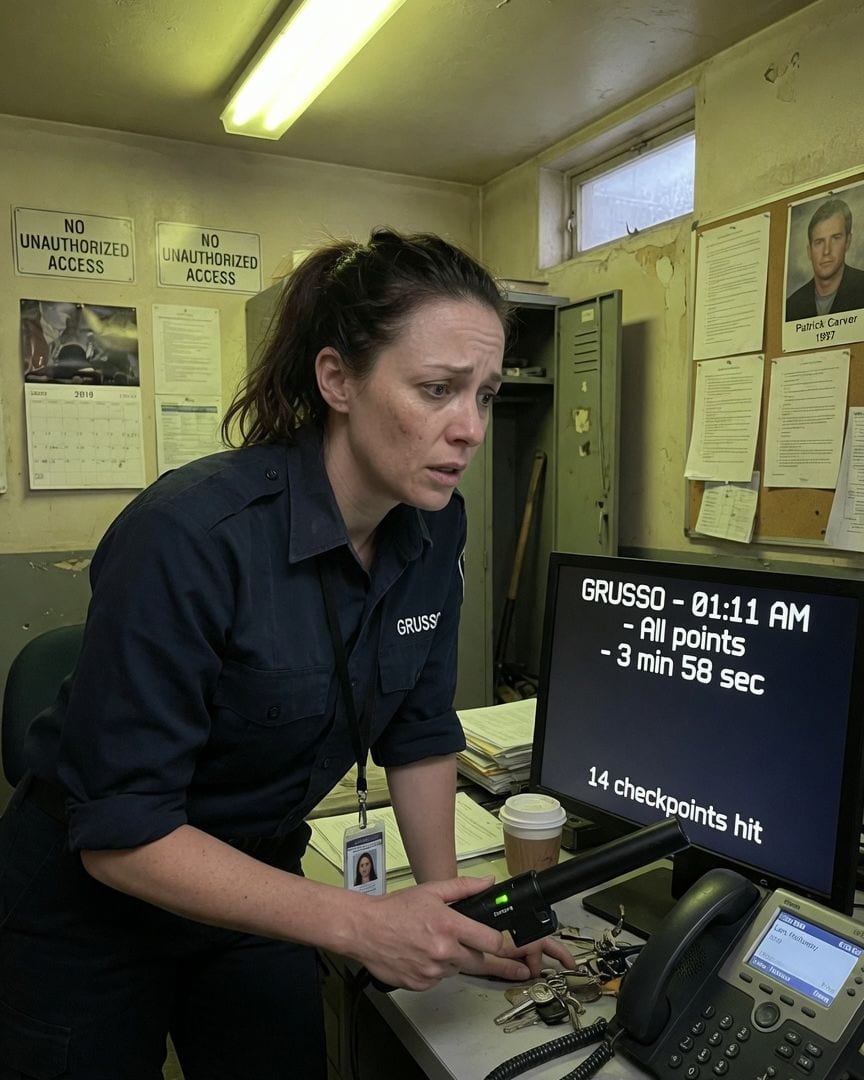
My security wand logged a full round at 1:11 AM in under four minutes. It was in the charger. Every tap is logged as mine.
Finishing my night shift, all I wanted was to get home. But the dock readout screen showed my security wand logged a full patrol at 1:11 AM, completed in just under four minutes. I knew my wand had been charging right beside the monitor the entire time, yet the log, under my ID, confirmed the impossible.
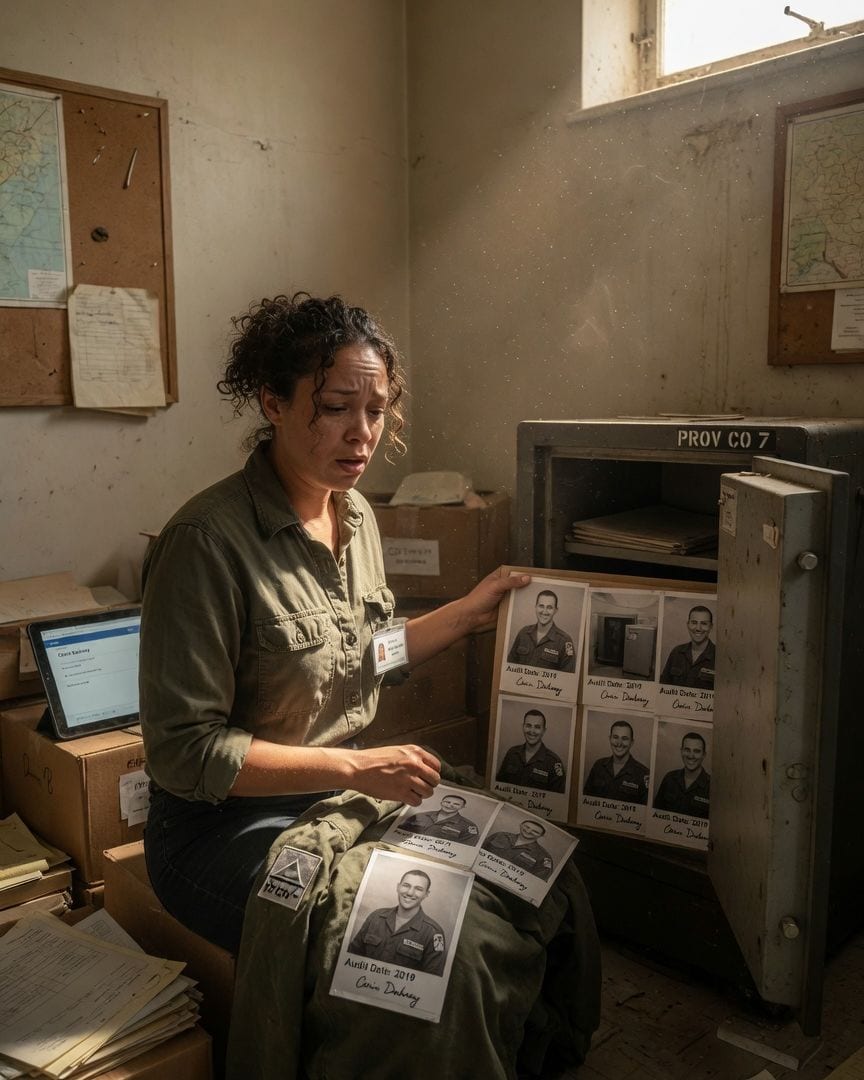
With eight days to clear a Cold War fort, Corin Calloway found files signed 'Corin Dabney' from 2019.
With just eight days left before Fort Halloway was gutted by demolition crews, Corin Calloway worked to clear half a century of forgotten lives from its dusty archives. As she meticulously sorted through records, she discovered an old, unlisted safe, its pitted door stenciled with a phantom designation. Inside, Corin found seven personnel jackets, each dated '2019' and signed with the name 'Corin Dabney.' But Corin Calloway knew she had never set foot in the building before this week, and the name 'Corin Dabney' existed nowhere in the base's official history. What secret was Fort Halloway's forgotten safe trying to reveal?
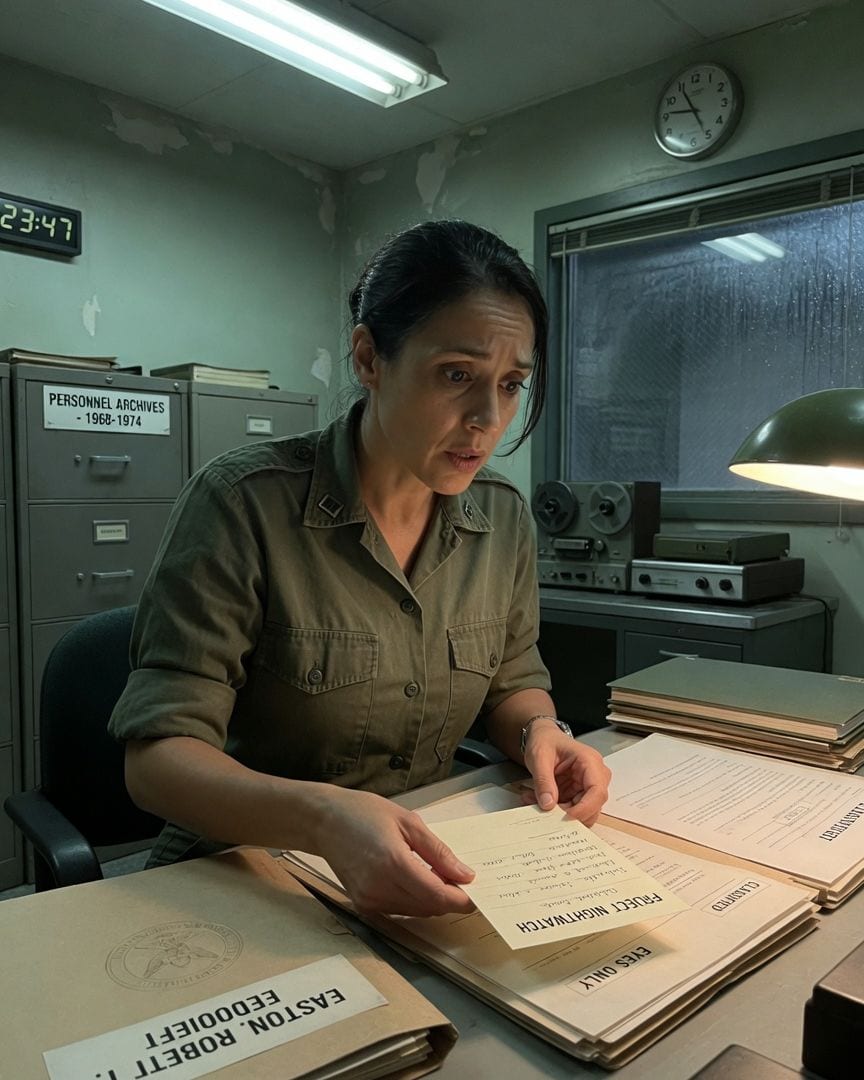
A Cold War tower controller logs an object vanish from radar, then hears the pilot scream it’s filling his windscreen. Her own name, 'Bardolph, Ines', now marked 'Observed' in a secret file.
Captain Ines Bardolph, a tower controller, was counting down the months until her transfer to Langley and the decommissioning of her base, hoping to leave behind the unsettling incidents of her final posting. But one night, her radar scope showed an impossible blip, solid and unwavering, 40 miles north of the Danube, only to vanish in less than a second, leaving a pilot screaming in terror. Despite the clear evidence, the official report blamed "atmospheric inversions," while the terrified pilot received a glowing review and promotion, his file meticulously scrubbed of any anomaly. As Captain Bardolph reviewed the pilot's pristine record, she found a hidden slip of paper, revealing a chilling truth: 'Subject: Bardolph, Ines. Status: Observed.' Was she merely an observer of the impossible, or was she now part of something far more sinister?
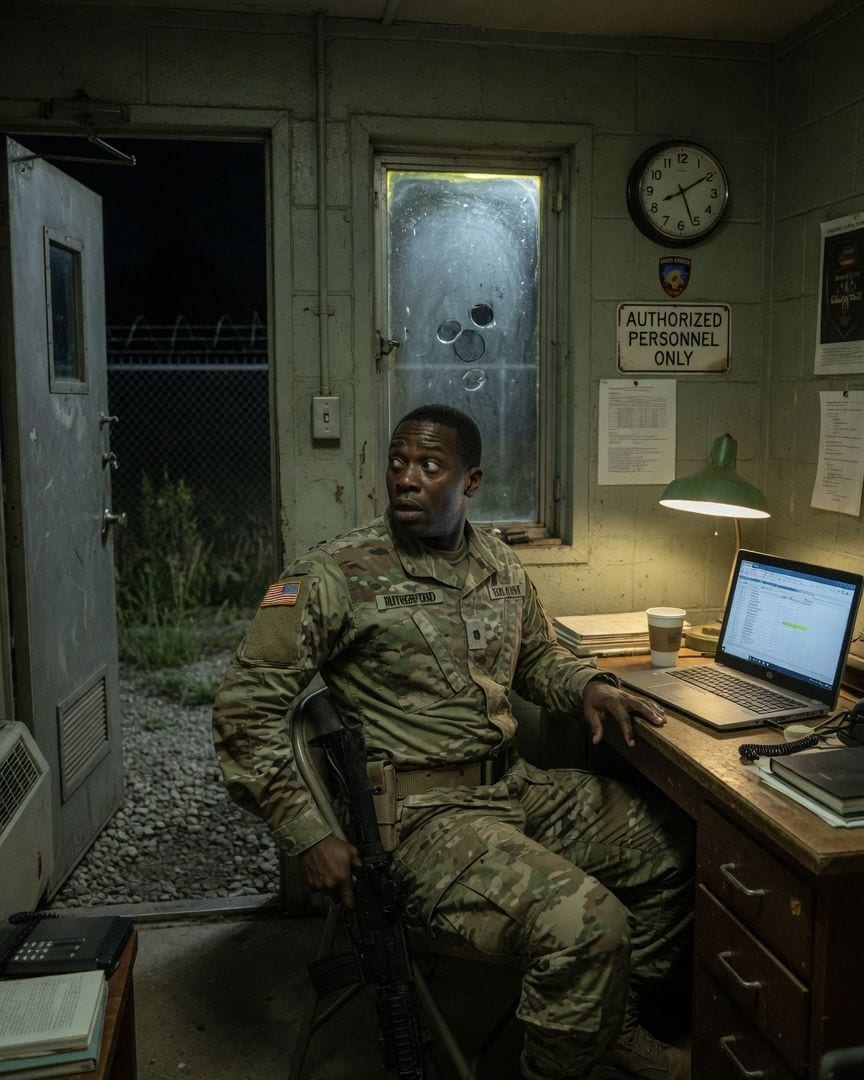
Fort Vashon's lone guard heard precise knocks on her window, then felt them from *inside* the locked shack.
Staff Sergeant Julian Rutherford felt an unsettling quiet at Fort Vashon's back gate, replacing a guard who reported strange knocks. He discovered an extra name on the digital duty roster that kept reappearing after deletion, a cold digital ghost. His search through decades of archived logs revealed a persistent anomaly: an unassigned slot, always present on short-staffed shifts. Then, in a forgotten supply shed, he unearthed an old journal detailing similar knocks and shadows, and one entry describing a guard hearing his own name called from the dark. What invisible presence haunted the fort's lonely gate?