A burn barrel's impossible heat led a lieutenant to a hidden logbook, holding her own signature on a patrol she never took.
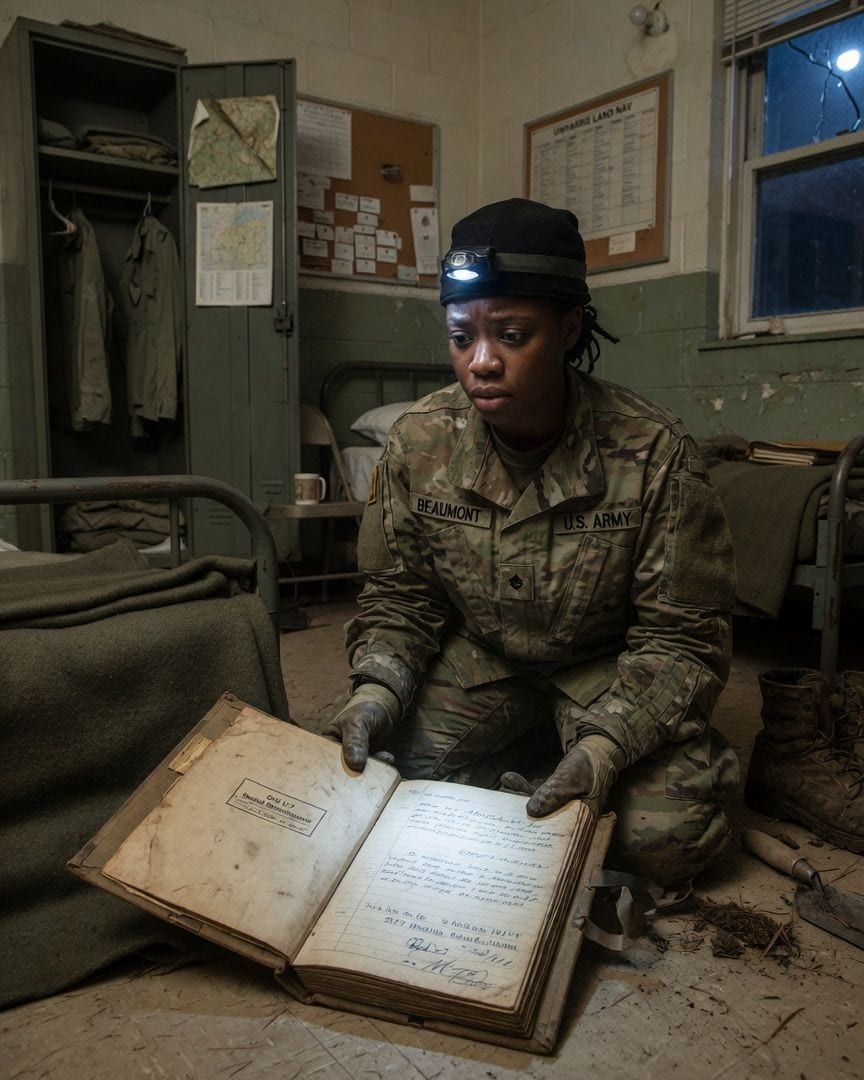
Second Lieutenant Monica Beaumont, bone-tired but meticulous, finished her night land-navigation course in the Uwharrie backcountry.
The dense canopy had swallowed the moonlight, forcing her to rely on her compass and the faint glow of her headlamp, its beam cutting tunnels through the oppressive dark.
She’d navigated through tangled undergrowth and across shallow creeks, her boots squelching in the damp earth. Then, she’d walked straight through it: an unexpected compound. It was fenced, not robustly, but enough to delineate a boundary.
Inside, a few olive-drab tents stood silent, a mess station with folded tables, and a flagpole from which no flag currently flew.
Doctrine dictated logging everything, so despite the odd placement, she carefully marked the grid coordinates in her official land-nav logbook.
During the debrief back at base, Captain Russo, her cadre officer, frowned at her entry. He traced a finger across his own map, then back to Monica’s neat script.
'Beaumont,' he said, a note of exasperation in his voice, 'you’ve invented a site. There’s nothing here but trees.' He marked her down for 'inventing' a post, a strike against her otherwise perfect record.
Monica, determined to prove her adherence to procedure, insisted. She described the fence, the tents, the mess station. Russo scoffed, but seeing her unwavering conviction, agreed to re-run her lane with the entire class in daylight.
The next morning, the air crisp and cool, Monica led her platoon back to the coordinates. The trees, now bathed in sunlight, looked harmless, ordinary. They found no compound. No tents, no mess station, no flagpole. The fence was gone.
Monica felt a prickle of unease, a cold sensation coiling in her gut, but she kept her face impassive as Russo gave her a stern, disappointed look. Then, one of her soldiers called out.
At the exact, unmapped coordinates she’d logged, they found fresh post holes, neatly arranged in a rectangular pattern, as if tents had just been struck. Nearby, two fire pits, choked with cold ash.
And tucked almost out of sight, a burn barrel, its metal still faintly radiating a residual heat that defied the cool morning air. It wasn't warm enough to be recent, but warm enough to be impossible.
Monica felt a deeper prickle of unease, a cold certainty seeping into her bones. The cadre dismissed it as leftovers from a rogue survivalist camp, a plausible but unsatisfying explanation.
The precision of the layout, the deliberate spacing of the post holes, and the impossible warmth of the barrel gnawed at her. Survivalists didn't arrange camps with military exactitude.
That evening, after her shift, unable to shake the image of the subtly steaming barrel, she returned alone. She hiked back to the grid, the twilight quickly giving way to a moonless night.
The air grew colder as she neared the spot, a damp chill that seemed to emanate from the earth itself.
Poking through the disturbed earth where a tent pole might have stood, her gloved fingers brushed against something hard. It wasn’t a rock. She knelt, digging carefully with a small trowel she’d brought.
The soil was loose, as if recently turned. She unearthed a small, heavily weathered metal box, dark with corrosion, but still tightly sealed. She pried it open.
Inside, nestled in dry soil, was a thick, canvas-bound logbook, its cover bearing a faded, official-looking stamp: 'Grid U-7 - Special Reconnaissance'.
The canvas was stiff, brittle with age, the pages yellowed, but the writing inside was crisp, military script filling every line. The entries detailed routine watches, supply drops, and personnel rotations, all for a site that didn't exist.
Monica carefully turned the pages, the dread tightening in her gut with each passing year. The dates spanned decades, some entries so old the ink was barely legible.
She saw names she didn't recognize, and unit designations that seemed archaic, like ghosts from forgotten wars. The logbook was thick, filled with hundreds of these impossible entries.
Then, on a page dated eighteen months prior, a cold shock seized her. There, clear as day, was an entry for a night watch: '2LT Monica Beaumont, Alpha Platoon, Grid U-7'.
Below it, a signature, unmistakably hers, with the same distinctive loop on the 'M' she always used.
But eighteen months ago, Monica Beaumont had been in Officer Candidate School, hundreds of miles away at Fort Benning, confined to base, her every hour accounted for.
Her hand trembled, the paper rustling softly in the oppressive silence of the woods. This was not a mistake. This was a record of a moment stolen from her past.
Back in her bunk, the logbook hidden under her mattress, Monica meticulously cross-referenced its entry with her own service record.
Her OCS dates were unimpeachable, her presence at Fort Benning logged down to the hour, her training schedule a precise timetable of physical exertion and classroom lectures. The logbook was a lie, yet her signature was real.
She spent hours trying to find a mundane explanation, a faulty pen, a prank, but the loop of her 'M' was too distinct, too personal.
She tried looking up other names in the logbook: 'PFC Isaac Russo,' 'SGT Naomi Lockwood.' Some returned no results in the military database, as if they had never existed.
Others belonged to soldiers long deceased, or assigned to units that had never operated in Uwharrie, according to official records.
A chilling pattern emerged: certain dates, often corresponding to specific lunar cycles or seasonal changes, seemed to repeat across the decades, as if the 'rotations' at Grid U-7 were cyclical, not linear, a perpetual shadow deployment.
The logbook itself felt subtly wrong, the paper almost too smooth in places, the ink too vibrant on some of the older entries, defying the laws of fading.
She noticed a faint, almost invisible watermark on several pages, a tiny, intricate symbol resembling a twisted knot, that she couldn’t identify from any military emblem she knew. It looked ancient, alien.
Monica's quiet inquiries, her late-night research into obscure base records, didn't go unnoticed. Master Sergeant Daniel Barlow, a grizzled NCO with a reputation for knowing everything that happened on base, seemed to watch her with an unnerving intensity.
His eyes, though often hidden under a perpetual frown, followed her from the mess hall to the training grounds. One evening, he found her sifting through old training area maps in the supply shed.
He didn't speak, just leaned against the doorframe, cleaning his rifle with slow, deliberate movements. The metallic scent of gun oil filled the small room. 'Some things, Lieutenant,' he drawled, his voice low, a gravelly whisper, 'are best left undisturbed.
Especially things that don't exist.' He gave her a hard, knowing look, then walked away.
A few days later, Monica discovered her access to the base's archived personnel files had been temporarily revoked. The system cited 'system maintenance,' a vague excuse that felt targeted.
Her access to standard training maps for the Uwharrie area was also inexplicably limited. The system seemed to be closing in around her. Then, she found it. She’d hidden the anomalous logbook deep in her locked footlocker.
When she checked it again, on the very last page, a new entry had appeared, written in a stark, unfamiliar hand. It simply read: 'You've been assigned, Beaumont. Don't fight it.' The logbook had been in her locked footlocker.
Someone knew. The air in her bunk seemed to thicken, pressing down on her, the quiet hum of the barracks suddenly loud and ominous.
The message, stark and chilling, propelled Monica to confront Barlow. She cornered him in the supply depot, the scent of canvas and stale oil thick in the air, the rows of stacked crates looming like silent sentinels.
'Sergeant Barlow,' she began, holding up the logbook, her voice tight, 'what is Grid U-7?' Barlow sighed, a long, weary exhalation, his eyes scanning the empty shelves before settling on her.
He looked less like a military man and more like a man who carried the weight of too many years.
'It's a place, Lieutenant,' he said, his voice flat, devoid of emotion, 'that isn't a place. It's been here longer than any map. We don't talk about it.'
He reached out, his calloused finger gently touching the cover of the logbook. 'Because it talks to us. Through records.'
Monica pressed him, showing him her own impossible entry. Barlow flinched, a subtle tightening around his eyes. 'The logbook… it takes. It accounts for itself.
It pulls a moment, a signature, from a soldier's life, makes it real, so it can exist.' He explained, his voice hushed, that a small, unofficial network of NCOs and officers, going back decades, had quietly 'managed' the site.
They made sure it had its 'records' – its false accountability – to keep it contained, to stop it from manifesting elsewhere, from bleeding out into the 'real' system.
Her entry, he explained, was an 'absorption,' a sign the site was taking an interest, preparing her for a more permanent 'assignment.' The knot symbol, he revealed, was its mark, a subtle signature on its claimed records, a silent contract.
The truth, delivered with Barlow's chilling composure, was far worse than any conspiracy. The silence of the depot suddenly felt less like peace and more like a suffocating blanket.
Monica's blood ran cold. 'Assignment?' The word hung in the dusty air, heavy with unspoken dread. Barlow nodded grimly, his gaze distant, as if seeing beyond the walls of the depot. 'It's not just a moment, Lieutenant. It's people, eventually.'
He turned, leading her to a dusty, forgotten corner of the depot, where old crates and discarded equipment lay under a thick layer of dust. He pulled out an old, beat-up unit album, its cover faded and torn.
Flipping through yellowed photographs, he stopped on one, taken twenty years ago at a crude, fenced compound in the woods, strikingly similar to the one Monica had described.
A group of young soldiers smiled awkwardly at the camera, their uniforms sharp, their faces full of youthful optimism.
'Second Lieutenant Frank Maddox,' Barlow identified one, a fresh-faced officer standing proudly in the front row. 'Reported AWOL from Fort Bragg, never found.'
Barlow then produced a brittle, official-looking document he'd 'found' in a forgotten file box, its paper crackling with age: a transfer order, dated two years after Maddox's disappearance, assigning him to 'Grid U-7, Special Duty.'
Monica stared at the impossible document, then back at the photo. Barlow pointed to the edge of the frame, to where a figure, partially obscured by a tree, watched Maddox's unit.
The figure was undeniably feminine, slender, and in the dappled light, Monica saw a familiar profile, a certain set to the shoulders that made her stomach drop. Her breath caught in her throat, her gaze fixed on the faded photograph.
The figure in the background, a shadow among the trees, was undeniably her. Her own face, younger, watching Frank Maddox. Beside it, the transfer order for Maddox to a non-existent grid, dated years after he vanished.
The implications crashed over her: the site wasn't just stealing time, it was taking people, and it had already marked her, perhaps long ago.
Barlow's voice was barely a whisper, cutting through the sudden, suffocating quiet of the depot. 'The site isn't just a place. It's a wound in time, a constant point of bleed-through.
It mimics our structures, our records, our need for accountability, to anchor itself. The 'absorptions' are like hooks. It pulls people, or echoes of them, into its own timeline. Maddox, all those AWOLs… they were reassigned, but not by us.'
He explained that the warm barrel and cold fires were temporal echoes, residual energy from overlapping realities, moments that had been pulled or left behind.
The figure in the photo, Monica realized, was either her future self, already claimed, or a past iteration, destined to be drawn there. 'It wants you, Lieutenant,' Barlow said, his eyes now holding a genuine sorrow. 'To fill a role.
To make its records complete.' The knot watermark, he revealed, was the signature of its claim, a subtle mark on its chosen.
Every detail, every contradiction, every impossible record now clicked into place with horrifying clarity: the site was a living archive, and Monica Beaumont was its next entry.
Monica knew she had to break free. The thought of becoming another ghost in Grid U-7's impossible ledger chilled her to the bone.
Barlow, his face etched with grim resolve, told her the only way was to create a contradictory record so definitive it would 'un-account' for her, a system overload that might sever the site's claim.
It meant sacrificing her career, becoming a ghost in the system, a pariah in the military she had sworn to serve, but it was her only chance. He wasn't giving her a choice, he was giving her an escape.
They worked through the night, the depot silent save for the rustle of papers and the soft clicks of Barlow’s old keyboard.
He guided her to obscure, seldom-checked administrative channels, to corners of the military's digital labyrinth that few ever saw.
She drafted a series of backdated, officially plausible, yet utterly false, reports detailing a 'critical error' in her original land-nav log, a 'misidentification' of the compound.
She forged signatures on fictional confirmations, timestamped documents with precision, and created a complex, convoluted paper trail that, if ever scrutinized, would label her as a reckless, insubordinate officer, prone to gross errors in judgment.
But crucially, it would erase her original, true log of Grid U-7. It was an elaborate lie, designed to make her too messy for the site to cleanly claim.
As dawn approached, painting the depot windows in shades of bruised purple and gray, she uploaded the final document, a 'self-correction' that directly contradicted her own initial, accurate report. The system accepted it without a murmur.
The act felt like tearing a piece of her own soul away, leaving a jagged, irreparable hole, but the alternative was far worse.
She escaped the training area as the sun rose, leaving behind her military life, and the shadow of Grid U-7.
Monica Beaumont was honorably, if vaguely, discharged three weeks later for 'administrative discrepancies' and 'unsuitability for command.' Her service record contained a single, glaring black mark, an official contradiction that rendered her military career a dead end.
She tried to explain, once, to a sympathetic but bewildered officer during her exit interview, but the words withered on her tongue.
The Uwharrie backcountry training area, particularly the sector containing Grid U-7, was quietly declared an 'ecological preservation zone' and permanently restricted, a final, chilling confirmation of its unseen existence.
Barlow, a week after Monica's discharge, transferred to a remote, obscure posting in Alaska, never to be heard from by her again. The official story was that nothing had ever been there.
Years passed. Monica, now a civilian, worked a quiet job in a small town far from anything resembling a uniform. The knowledge she carried was a heavy, solitary burden, a truth no one would ever believe.
The memory of the warm burn barrel, the impossible signature, the face in the photo, haunted her quiet hours. She occasionally browsed obscure military forums, a habit born of an unshakeable dread, searching for any mention of 'Grid U-7.'
Her heart would pound whenever she saw a post about Uwharrie. One evening, scrolling through an old thread about 'weird stuff in the field,' she saw a new post, dated only a few days prior.
It was from a fresh recruit, asking about a strange, unmapped compound they'd stumbled upon during night land-nav in Uwharrie, mentioning 'post holes and a faint smell of smoke.' The post ended casually: 'Logged the grid, of course.
Doctrine says log everything.'
If this one got to you
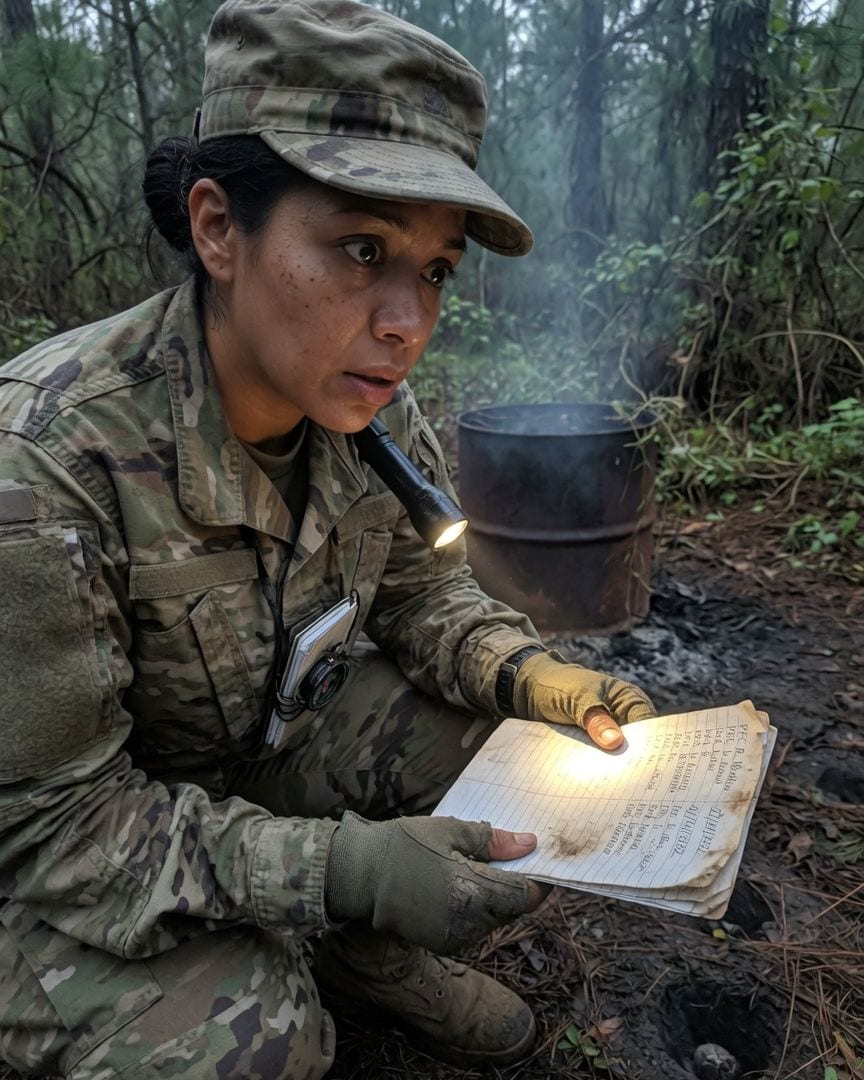
Second Lieutenant Nina Trejo's phantom camp was gone, but its fire pit was still warm, and the duty log read 07/14/2052.
Second Lieutenant Nina Trejo's Ranger School qualification was in jeopardy. She'd reported an active tactical outpost deep in the Uwharrie backcountry, but her cadre insisted she'd invented it. Returning with a patrol partner, the site was gone, replaced by dense woods. Yet, Nina found a fire pit still faintly warm to the touch, and a rusted burn barrel. Then, half-buried in the leaves, a fragment of a duty log revealed names, including her partner's great-aunt, and a date: 07/14/2052.
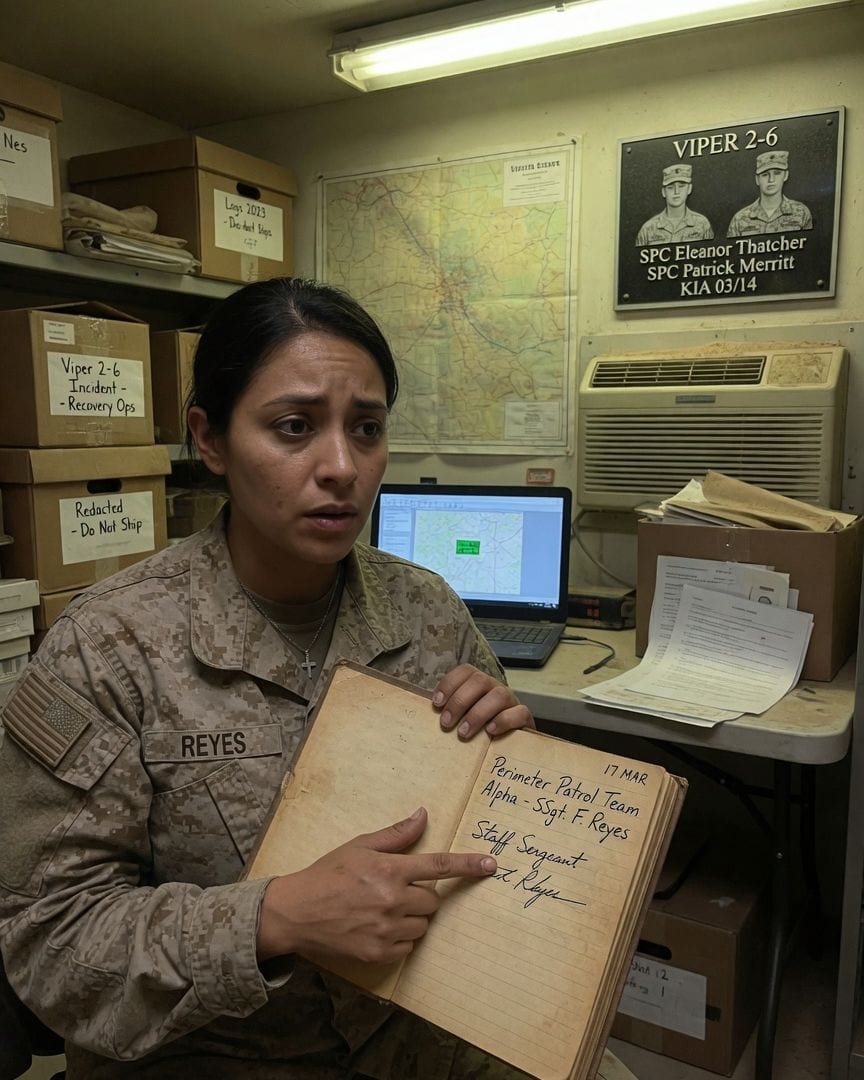
A Staff Sergeant, three weeks from transfer, finds her own signature in a logbook for a patrol she never made.
Staff Sergeant Fiona Reyes counted down her last three weeks at the high desert outpost, the fluorescent hum of the TOC a constant companion amidst the dust and old equipment. Her tired eyes scanned the digital map when an impossible icon, 'Viper 2-6' – a vehicle and crew lost last year – blinked alive, reporting its position and crawling steadily toward the base. Despite commanders dismissing it as a system ghost, Reyes meticulously searched dusty archives, finding strange log entries of phantom contacts and radio chatter, all dismissed as malfunctions. But the true chill came when she unearthed a field logbook from the recovery efforts, revealing her own undeniable signature on a perimeter patrol dated last year, a patrol she knew, with every fiber of her being, she had never made.
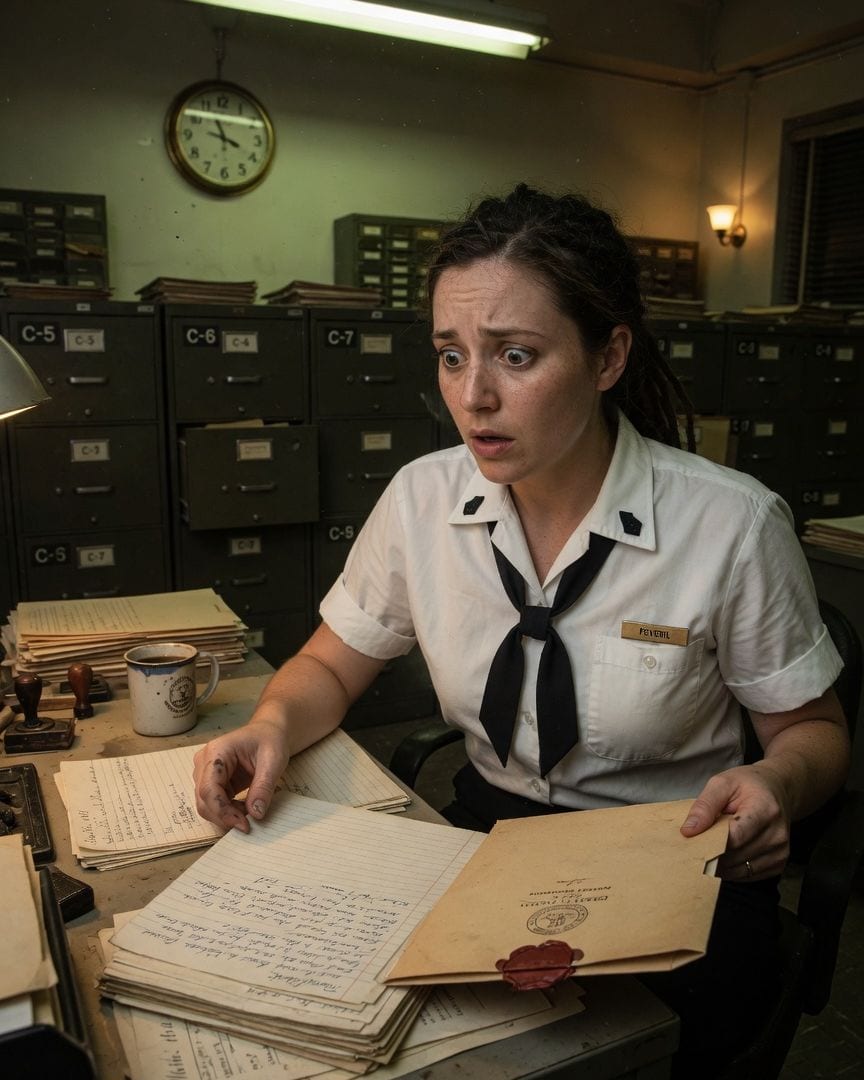
A Cold War naval records file sealed before 1930 holds a yeoman's log written tonight, detailing her future, now warm in her hands.
Yeoman Second Class Dot Peveril spent her days amidst the hushed scent of aged paper in the Guam naval records office, diligently processing a loss file for the Corbin Loop, a seaplane tender that vanished with 204 souls in 1953. But when she found her own duty log, in her familiar handwriting, nestled within the ancient document sealed decades before her birth, a cold dread began to settle. The impossible entries detailed her exact tasks for 'tonight' and the coming days, even specific coffee breaks and office spats, transforming her routine into a chilling script. As the heavy brass clock ticked towards the precise moment described for her next task, the file itself felt distinctly warm, humming faintly in her hands, forcing her to confront a terrifying choice: follow the log, or defy her own future.
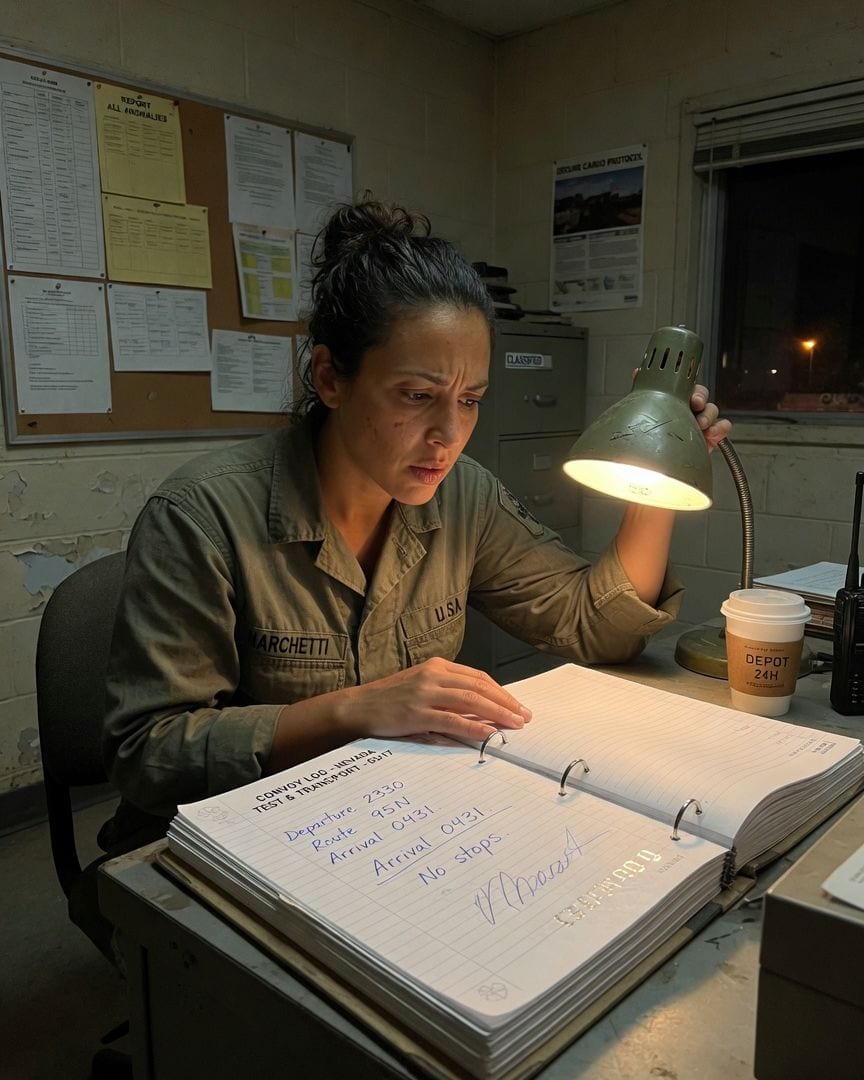
A transport driver's signed logbook claimed her four missing minutes in the desert never happened.
Specialist Cleo Marchetti followed the lead truck through the desolate Nevada desert, transporting an unidentified craft. Her only job was to keep the taillights of Senior Specialist Felix Hartley’s rig in sight. But at the halfway point, they simply vanished, leaving Cleo alone in the oppressive dark for four silent minutes. When the lights reappeared impossibly closer, Cleo knew something was terribly wrong. Yet, the official convoy log, bearing her own signature, recorded a perfect, uneventful journey with no stops. How could an entire four minutes disappear from the official record she herself confirmed?
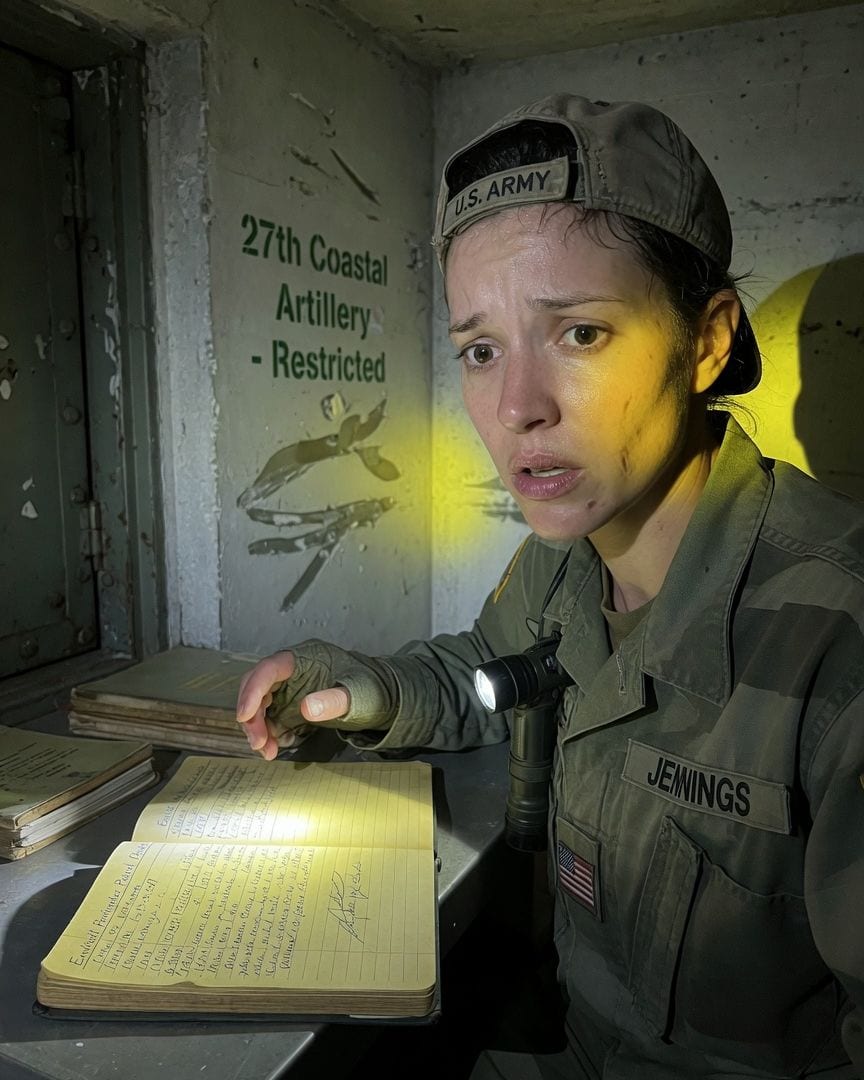
An impossible patrol: A Corporal's signature appears in a bunker's logbook for a duty she never performed.
Corporal Annika Jennings's patrol discovers a long-sealed gun battery, surprisingly open and humming with an unseen power. Inside, she finds a logbook detailing perimeter checks. To her dread, an entry for two weeks prior bears her own unmistakable signature, for a duty she was hundreds of miles away from.
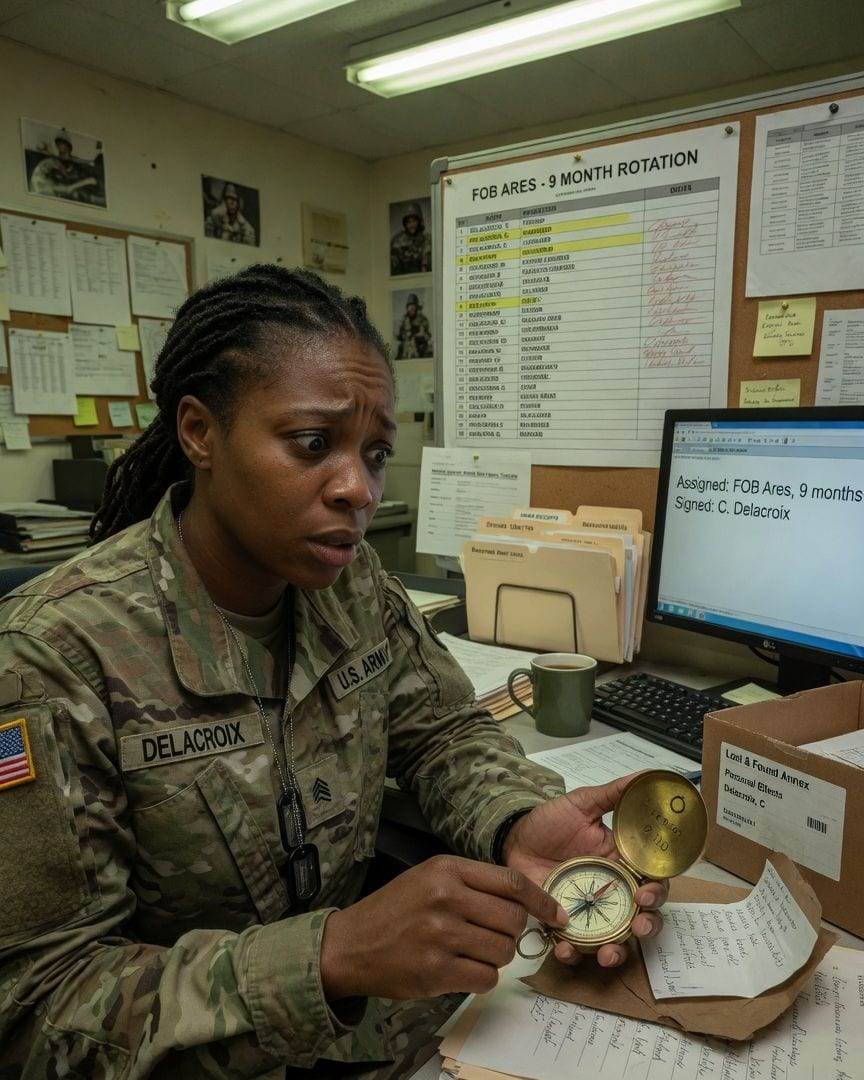
Sergeant Delacroix's own service record swore she was a hero in a war zone she never saw.
Sergeant Camille Delacroix, a logistics clerk, lived a predictable life of paperwork stateside, counting down the days until her unit's return. But the day they disembarked, three exhausted soldiers from a remote desert outpost thanked her for saving their lives from a burning Stryker. Camille, thousands of miles away, denied it, yet her own service record swore she was a decorated hero at that combat base, forms signed in her perfect hand. The unsettling truth deepened when she found a brass compass, engraved with her initials and the outpost's coordinates, containing a list of names including her own. How could she be a hero in a war she never fought?