A Cold War naval records file sealed before 1930 holds a yeoman's log written tonight, detailing her future, now warm in her hands.
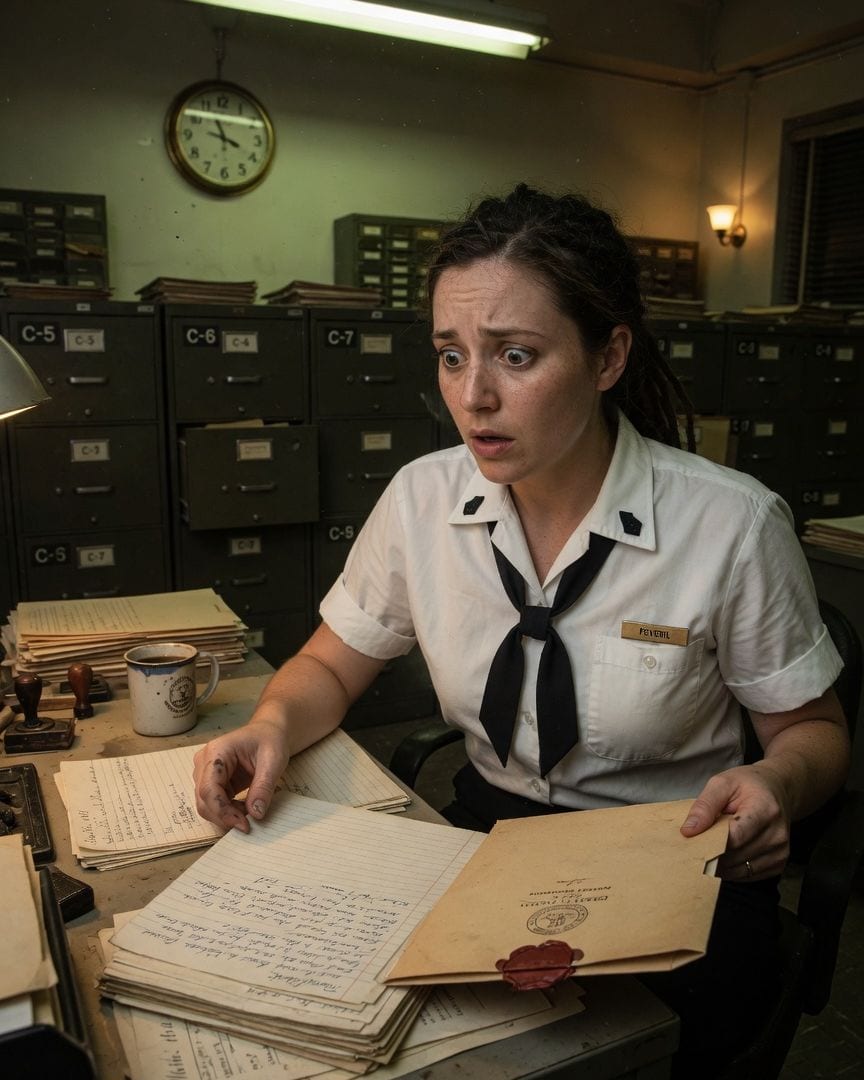
Dot Peveril sat at her desk in the Guam naval records office, the air thick with the hushed scent of aged paper and dust. Fluorescent lights hummed overhead, casting a sterile glow on the rows of steel cabinets.
Her fingers, stained faintly with ink from yesterday’s ledger, moved with the practiced efficiency of a Yeoman Second Class, sorting through the loss file for the seaplane tender Corbin Loop.
The Corbin Loop had vanished without a trace between Guam and Yokosuka in 1953, two hundred and four souls aboard.
The file was heavy, dense with reports, but what caught Dot’s eye first was the deep red wax seal on its cover.
It bore a classification date from before 1930 – decades before her own mother had been born in 1930.
She paused, a faint crease forming between her brows. A misdate, surely. She’d seen stranger things in the archives, though never quite so glaring. She pushed the thought aside, digging deeper into the thick folder.
Nestled between official reports and manifests, Dot found a stack of forty sheets, brittle with age. They were her own duty log. Her familiar, looping hand, detailing her daily tasks, the inventory of forms, the routing of requisitions.
And on the topmost page, dated for 'tonight,' was an entry describing the exact task she was currently performing: Process Corbin Loop loss file. Re-shelve 'unresolved'. Verify key requisition for new Cabinet C-7.
A cold knot tightened in her stomach.
Dot’s heart hammered a frantic rhythm against her ribs. She tried to rationalize it, to force a mundane explanation into the impossible situation. A misfile?
A cruel prank by a bored colleague, somehow slipping a freshly written log into an ancient, sealed document? No, the paper felt too old, the ink too faded in places.
She checked the paper stock, running her thumb over the rough surface. It matched the surrounding documents.
The faint watermarks, the official seal on the file's cover – everything was consistent with a document sealed pre-1930, yet here was her own 1953 handwriting, unmistakably hers, detailing her present and future.
She flipped through the pages of her impossible log, her breath catching in her throat with each turn.
Each entry for the coming days detailed her routine, specific interactions with other yeomen, the precise timings of her coffee breaks, even a minor office spat she'd had with Jenkins over a stapler.
Then, on the last page, dated for the end of the week, an instruction: re-file Corbin Loop under 'unresolved'—. The sentence broke off mid-word, mid-stroke of the pen, a jagged line where the ink simply ceased to exist.
It was as if the writer had simply vanished, dissolved into the paper itself, at that precise moment. A cold dread, far deeper than any logical fear, settled over her. This wasn't a record; it was a blueprint.
The temperature in the large, echoing office seemed to drop, and Dot shivered. The rows of silent filing cabinets loomed around her, no longer just metal boxes holding paper, but sentinels to something vast and unsettling.
Dot's rational mind screamed. This wasn't just a prediction; it was a script. The entry for 'tonight' described her carefully re-shelving the Corbin Loop file, then moving on to process a requisition for new filing cabinet keys.
She looked at the heavy brass clock on the wall, its hands creeping towards the hour mentioned in the log – almost 17:00, the time for the re-shelving.
Then she looked down at the file, the ancient, impossible file, which now felt distinctly warm against her fingertips, a faint vibration seeming to hum from within its aged paper, a subtle thrum against her pulse.
The moment described for 'tonight' was only minutes away. She had to do what the log said. Or she had to stop it. Tonight.
Dot tried to deviate. The log, nestled within the Corbin Loop file, stated she would re-shelve the file and then handle the key requisition for Cabinet C-7.
Instead, she clutched the thick folder, its strange warmth still radiating through the covers, and walked directly towards Chief Yeoman Felix Donovan’s office, determined to report the impossible.
Her heart hammered with a desperate hope that she could break the script. But when she reached his door, a small, hand-lettered sign hung on the knob: 'Gone to Supply - Back at 17:30.'
Exactly as her future log stated it would be. A fresh wave of cold certainty washed over her.
She tried to secure the file in her own locked cabinet, twisting the small brass key with determination. The heavy steel door clanged shut. She turned back to her desk, a glimmer of defiance in her eyes.
But before she could settle, the phone on her desk rang, a jarring sound in the quiet office. It was an urgent call from the supply depot – a critical shortage of requisition forms, needing immediate attention.
The distraction was detailed in her log, right down to the specific complaint from the supply clerk. It diverted her for a full fifteen minutes, pulling her away from her desk, away from the locked cabinet.
When she returned, the Corbin Loop file was back on her desk, precisely where she had first found it, open to the page with her future entries. The brass key to her cabinet lay beside it.
She picked up the Corbin Loop file again, turning its pages with a growing sense of helplessness. Her eyes caught a faint, almost invisible cross-reference stamp on one of the Corbin Loop’s internal reports.
It read: 'See file: USS Cyclops - Loss - 1928 - Unresolved.' Curiosity overriding her fear for a moment, Dot located the Cyclops file. Its seal date was even older than the Corbin Loop's, pre-1910.
Inside, she found a similar handwritten log, not hers, but another yeoman's, detailing the processing of that very file, ending abruptly mid-sentence. The pattern was beginning to emerge, cold and precise, like the intricate gears of a silent, invisible clockwork.
Dot felt a growing unease, a pervasive sense of unseen eyes tracking her every move.
She tried again to hide the Corbin Loop file, this time stashing it deep within a forgotten drawer of obsolete forms, beneath years of dusty inventory sheets. She even placed a heavy, broken stapler on top for good measure.
An hour later, as the light outside faded into the gray of late afternoon, a security guard, Harold Coleman, passed her desk. He paused briefly, his gaze drifting over her workspace.
'Some of these old files,' he remarked idly, his voice a low rumble, 'they just seem to find their way back where they belong, don't they, Yeoman?'
He grinned, a wide, innocent smile that did nothing to alleviate her mounting dread. He walked on, oblivious, whistling a jaunty tune.
A cold certainty gripped Dot. She didn't even need to check. She knew the file would be back. And it was. Finding the Corbin Loop file once again on her desk, open to her future log, she noticed something new.
A blank page, dated for next week, lay nestled between her current entries and the mid-sentence cut-off. On it, drawn with an unsettling precision, was a symbol she didn't recognize: a stylized, looping knot, intricately interlocking.
It was clearly not her handwriting, the lines too perfect, too uniform, yet it was undeniably part of her log, an impossible addition, a silent declaration of ownership.
The image of the knot seemed to pulse with a faint, almost imperceptible light, cold and internal, like something seen only in the corner of her vision.
The room felt colder, the silence deeper, as if the very air held its breath around her.
Dot, now desperate, found Chief Donovan finally at his desk. He was hunched over a stack of requisitions, his spectacles perched on the end of his nose.
She walked up, clutching the Corbin Loop file, and laid it open to her future log entries before him. Her hands trembled, but her voice was steady. 'Chief,' she began, 'this file, about a 1953 loss, was sealed before 1930.
And it contains forty pages of my future, right down to the call from supply and the broken stapler I just tried to use.'
Donovan, initially skeptical, picked up the file. His eyes, accustomed to decades of naval bureaucracy, narrowed. 'Peveril,' he said, his voice laced with weariness, 'you've been working too many late nights.'
But as Dot pointed out the impossible seal date, tracing the faded red wax with her finger, and then showed him her own unmistakable handwriting describing events that had yet to occur, his professional demeanor cracked.
He began to sweat, running a hand over his thinning, graying hair. 'Impossible,' he muttered again, his voice less certain, more a whisper of disbelief.
His eyes darted to the cross-references Dot had highlighted – the ones leading to the 'USS Cyclops' and other 'unresolved' cases, now spread out in a terrifying pattern across her desk.
He saw the 'USS Triton - Loss - 1941 - Unresolved' file she had pulled, with its own similar anachronisms. He closed the Corbin Loop file slowly, his gaze fixed on its ancient seal.
The silence stretched, broken only by the hum of the fluorescent lights.
Finally, with a sigh that seemed to carry the weight of years, Donovan pushed a hidden panel in the side of his desk. It wasn’t a drawer, but a small, narrow compartment, revealing a single, yellowed memo.
It was from a 'Department of Chronological Stability,' dated 1918, and detailed 'protocols for handling temporally unstable documents.' The language was archaic, bureaucratic, yet chillingly specific. It spoke of 'predetermined causality loops' and 'actuating agents.'
He looked at Dot, his face grim, resignation etched into every line. 'Some records,' he admitted, his voice barely audible, 'they don't just record the past. They…ensure the future. They always have.'
The light in the office seemed to dim, the air suddenly heavy and oppressive. The walls themselves felt colder, pressing in.
Donovan, his composure shattered, pushed back his chair. 'Come with me, Yeoman.' He led Dot through a maze of dimly lit corridors, deeper into the archives than she had ever ventured.
The main office's sterile hum faded, replaced by the faint drip of condensation and a pervasive chill that seemed to seep from the very stone.
He stopped before a nondescript steel door, rust blooming at its hinges, unmarked on any map, and unlocked it. He fumbled with a heavy, tarnished key, unlocking it with a series of grinding clicks that echoed unnervingly in the silence.
Inside, it was colder still, the air thick with the faint scent of ozone and ancient paper. The space was smaller than the main archive, but far more unsettling.
Dozens of tall, grey metal file cabinets lined the walls, stretching from floor to ceiling, each one packed with files eerily similar to the Corbin Loop’s: 'unresolved' losses, military disappearances spanning from the 1920s through the present, all bearing impossible seal dates and subtle temporal anomalies.
Each file, Dot realized, was a mirror, reflecting the impossible truth she had just discovered.
'This is where they come,' Donovan said, his voice a strained whisper, the words hanging heavy in the cold air. He pulled out a dusty file, labeled 'USS Triton - Loss - 1941,' and opened it.
Inside, a page described a Yeoman, much like Dot, who would try to burn the file to stop its terrible prophecy.
Donovan’s finger then moved, tracing a blank file folder on a bottom shelf, tucked away behind a stack of moth-eaten ledgers. It was labeled only with a classification stamp, no name, no date.
'And this one,' he whispered, his voice barely audible, 'is for you, Dot. It's still empty.'
Donovan leaned against a towering cabinet, the faint metallic tang of the cold steel permeating the air. He explained the chilling truth in hushed tones, his gaze fixed on the blank file folder meant for Dot.
The 'secrecy machine,' he called it, wasn't just about classified information; it was a mechanism, or perhaps a living entity embedded within the institution itself, that used these 'chronologically unstable' documents as blueprints.
The files weren't records of past events, he elaborated, but pre-written scripts for future ones.
When handled by specific individuals, like certain yeomen or archivists, and processed under the 'unresolved' classification, the events described within them were 'filed' into existence.
The subtle attempts to deviate, like Dot's efforts to hide the Corbin Loop file or report it to him earlier, were accounted for, even enforced, by the machine itself, subtly redirecting their actions back onto the pre-written path.
The looping knot symbol Dot had seen in her log, Donovan explained, was a 'binding sigil,' a placeholder for the final, sealing act – the moment the event was fully integrated into causality.
The Corbin Loop, like the Triton and the Cyclops, had not simply vanished.
Its loss had been 'filed' into non-existence by the very act of its loss record being created and processed, a quiet, bureaucratic horror, enacted by the unwitting hands of those who thought they were merely doing their duty.
Dot stared at the blank folder, then at her own future log, understanding now that the mid-sentence cut-off was the binding sigil for her own disappearance, its final stroke awaiting her compliance.
Dot’s own blank file, waiting for her name and the gruesome details of her disappearance, was the ultimate horror.
Her future log, with its mid-sentence cut-off, was not just a prediction; it was the final, unwritten entry in her own blueprint, awaiting completion. She refused to be filed.
She wouldn't burn the Corbin Loop file, as the Triton's yeoman was predicted to do, perpetuating the pattern of defiance that also led to their end. That was just another line in a different script.
Instead, she chose true defiance, a path unforeseen by the machine. She felt the subtle, unseen pull that tried to guide her hand towards the 'unresolved' section, a strange psychic inertia.
The sudden, inexplicable chill that permeated the sub-archive, deepening with every moment, tried to numb her resolve. She shivered, but her grip on the Corbin Loop file remained firm. She ignored the 'unresolved' section.
She ignored the chilling emptiness of her own pending file.
She scanned the dusty shelves, her eyes searching. An unused drawer, tucked away at eye level, held a small, forgotten metal box.
Inside, amidst dried-up ink pads and broken nibs, lay a 'discrepancy' stamp – a stamp for anomalies, for errors, for things that didn't fit, for things that simply shouldn't be.
It was a relic, almost never used, designed for a time when the archives acknowledged genuine mistakes, not pre-written fates.
With a deliberate, forceful motion, she pulled the stamp from its resting place. The old metal felt cold, heavy, yet strangely potent in her hand. She pressed it firmly onto the Corbin Loop’s cover, directly over the ancient red seal.
THWACK! The sound echoed in the silent archive, sharp and defiant, a single, resounding blow against the pervasive quiet.
The room, which had been growing colder, seemed to gasp, the chill deepening to an almost unbearable degree, raising goosebumps on her arms.
Then, with her jaw set, she placed the re-stamped file onto an empty shelf in the 'discrepancy' section, a section that, to her knowledge, had been utterly barren for decades.
She looked back at the blank file folder for her on Donovan's desk, the one that had been so starkly, terrifyingly empty.
In a flash, as if an unseen hand had written it, her own familiar handwriting appeared on the otherwise empty page, a single, stark sentence: 'She found another way.'
Dot spent the next few days tirelessly reclassifying the Corbin Loop file, carefully documenting its new location and the reason for its 'discrepancy' status.
She felt a subtle, almost imperceptible resistance with every action, as if the very air around the file tried to guide her hand back to its original slot. But she persisted, pushing through the psychic inertia.
Each time she placed the reclassified file, a faint, almost imperceptible tremor ran through the metal shelves, as if the very structure of the archive protested her actions.
No one questioned her actions directly, though she caught Chief Donovan's gaze across the office several times; his eyes held a mixture of relief and a deep, unsettling fear.
Within a week, Chief Donovan was quietly transferred to a remote naval facility in Alaska, replaced by a new, fresh-faced Chief Yeoman who knew nothing of the hidden sub-archive, nothing of the 'Department of Chronological Stability,' and certainly nothing of chronologically unstable documents.
The 'unresolved' section of the archives seemed to subtly shrink over the following months, its shelves less crowded, as if some part of the machine had been momentarily disrupted.
Yet, new, impossibly old files, similarly dated before their events, began to appear sporadically in the 'discrepancy' section, often subtly placed on her desk, each bearing the familiar, looping knot sigil – the binding mark of the machine.
Dot Peveril continued her work, now with a quiet, steely resolve that had replaced her earlier terror. She had broken her own pre-written fate, but the 'secrecy machine' was vast, intricate, and seemingly adaptable.
It had simply shifted its focus, a river finding a new course around a stubborn stone. She became an expert in detecting the 'chronologically unstable' documents, often finding them subtly placed on her desk, among her routine paperwork.
Each bore the familiar, looping knot sigil, but always with a different name, a different date, a different disappearance waiting to be filed. She no longer found her own handwriting within them, nor details of her own future.
Instead, she found the names of others. The weight of this knowledge was a constant companion, a ghost at her elbow in the quiet hours of the records office.
Sometimes, late at night, when the office was empty and the fluorescent lights hummed with a low, watchful drone, she would trace the binding sigil on these new files.
She knew it was still writing, just not for her, not anymore.
If this one got to you
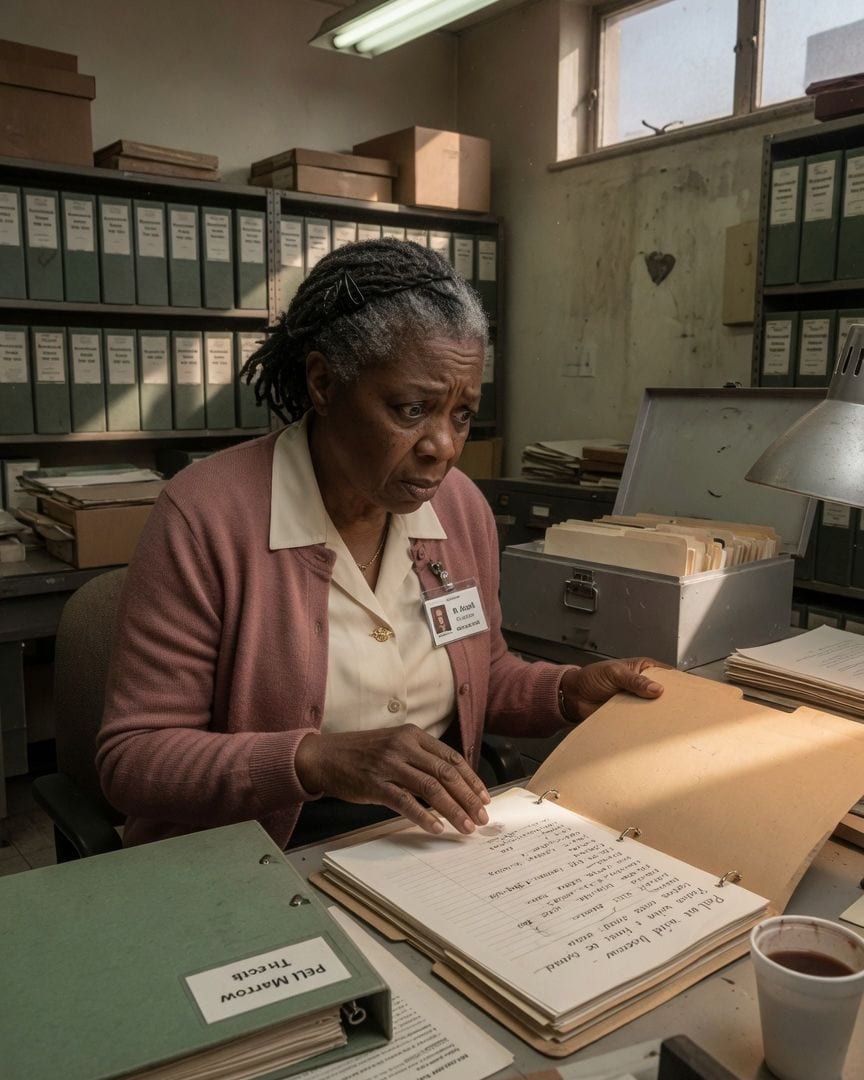
A records clerk's archive file for a Cold War reconnaissance plane lost in 1968 showed it flew yesterday to her own building.
Marguerite Ansell, a records clerk nearing her final week before retirement, meticulously audited Cold War-era files. In the cool, dusty archive, she pulled a file for an oiler declared missing in 1951. Inside, she found a fueling schedule with entries stretching into the present, the last dated just eleven days ago. Then, a second lost ship revealed a similar impossible log, and a cold certainty began to bloom in her chest. Deep in the shadows, Marguerite found an unmarked steel box containing a file for a reconnaissance plane lost in 1968. Its flight log showed a final flight yesterday, to the precise coordinates of her own archive building.
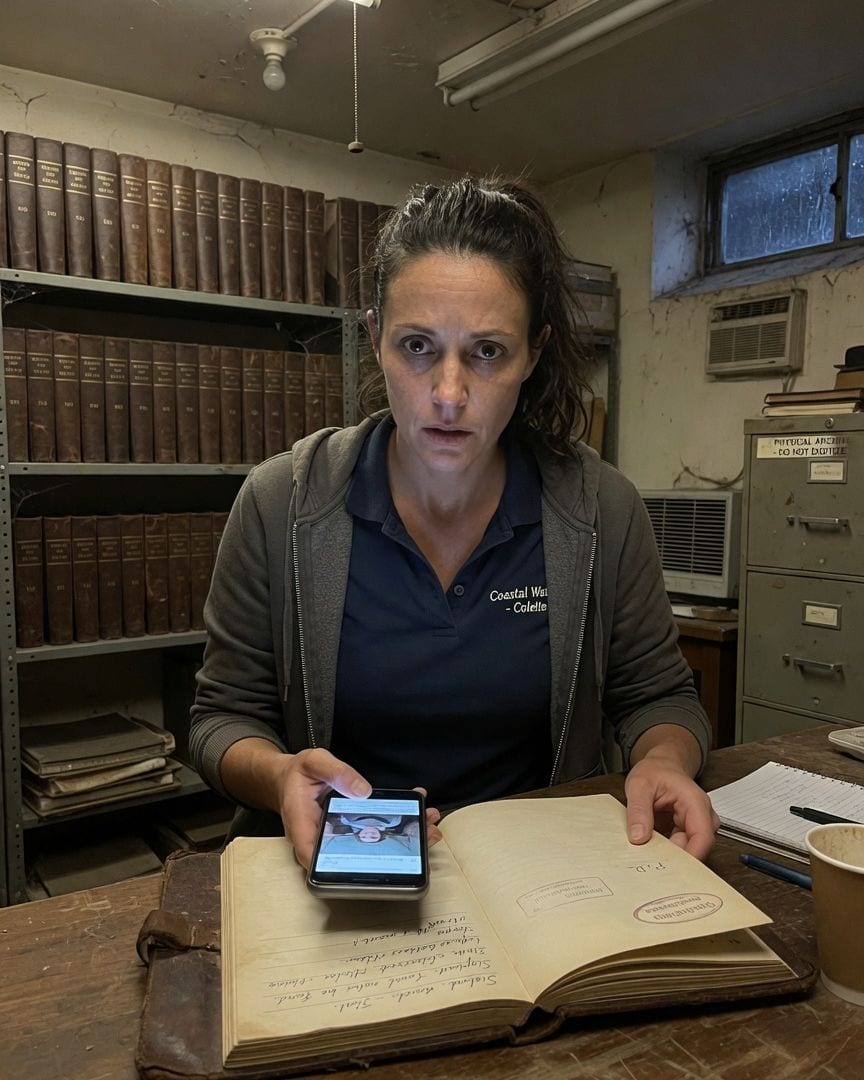
My coastguard log noted Sighting 9 again tonight, a light where no vessel showed. The old logs carry Sighting 9 off Skerry Point at 3:14am every tenth year since 1954, always 'nothing found,' always 'send no boat.'
On my watchtower night shift, the radar screen glowed green and the ocean was quiet. Then, a familiar light appeared off Skerry Point, exactly on cue, just as it had every tenth year for decades. But digging deeper, I found a hidden stamp in an old logbook: 'Operation Skerry. Status: Complete.' It left me with a chilling sense of finality.
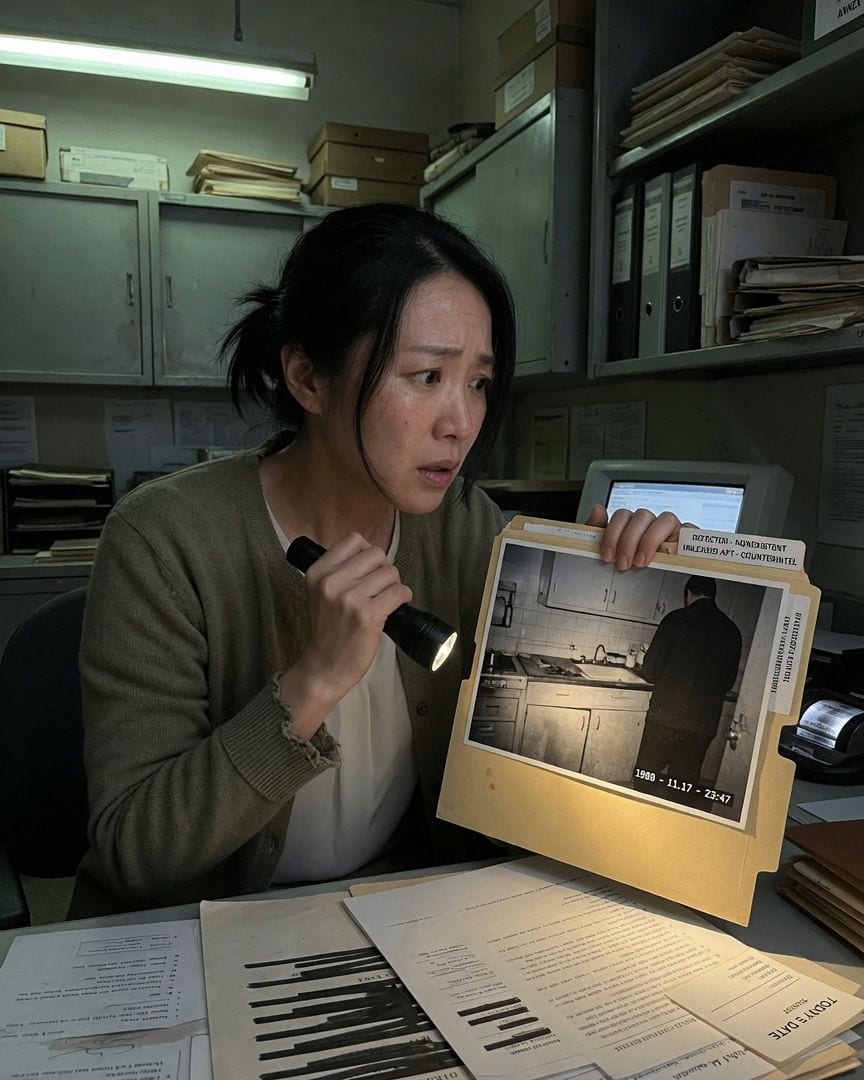
Against a midnight deadline, archivist Junie Kwan finds a Cold War dossier with a photo of her grandmother's kitchen, empty the night of the funeral, with an unknown figure standing inside.
Archivist Junie Kwan huddled in the hushed, cool Alexandria archives, working against a midnight court order to reseal a strange counterintelligence dossier. The file, dense with blanked sections, concerned a 'defector who never existed' and an 'unleased apartment.' As she scanned a grainy surveillance photo, a prickle of unease turned to dread: it was her grandmother's kitchen, dated 1988, the night of the funeral. A tall, rigid figure stood at the sink, yet Junie knew with certainty the apartment had been empty and locked that night. How could an impossible presence appear in a locked, empty room, tied to a phantom Cold War case?
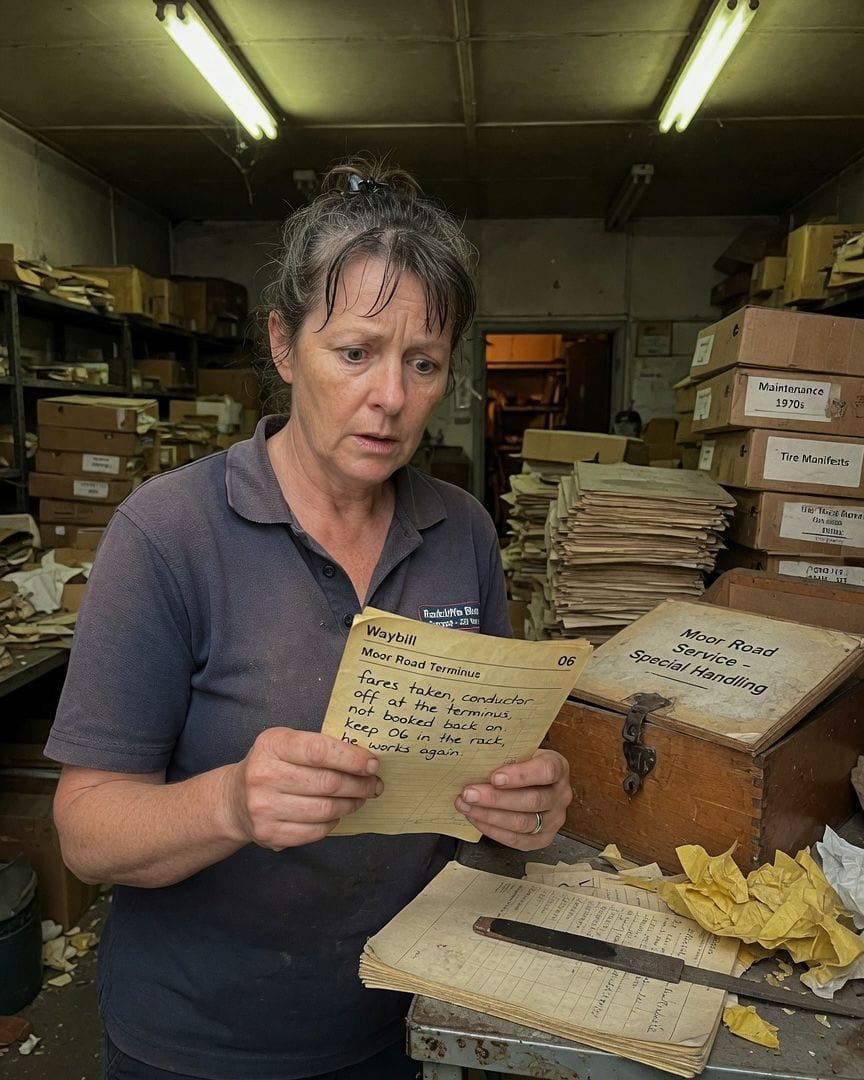
Our depot's Waybill 06 filed a moor road service we stopped running years ago. Every eight years since 1956, it closes: 'keep 06 in the rack, he works again.'
Sorting waybills in the depot, I stumbled across a form for the Moor Road Terminus. That route was decommissioned decades ago, but this waybill had a chilling handwritten instruction: 'keep 06 in the rack, he works again.'
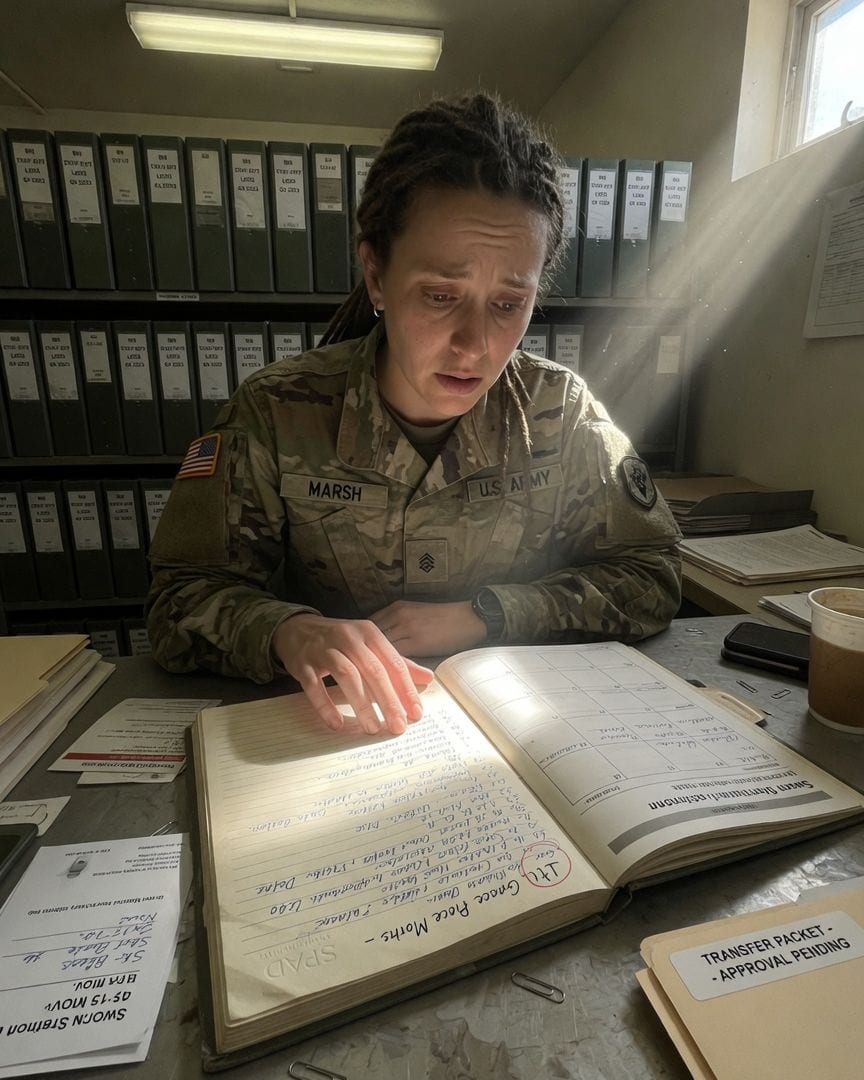
Preparing for a coveted post, a logistics officer found her own perfect signature on a duty log for a shift she swore she never worked. Then her coworker’s entry revealed his unique personal quirk.
Lieutenant Grace Marsh, a meticulous logistics officer, was deep in the archives, preparing her transfer packet for a coveted post. Her career depended on a spotless record, requiring absolute precision as she cross-referenced battalion staff-duty logs. Amidst the dusty binders and humming fluorescent lights, her gaze snagged on an entry for November 14th: her own perfect signature, logging a 24-hour shift she distinctly remembered spending hundreds of miles away in a court-martial. The impossible truth of a phantom doing her job was unsettling enough, but then she found another officer's entry, complete with his unique, personal quirk, for a day he was off-base. What was hidden in these official records?
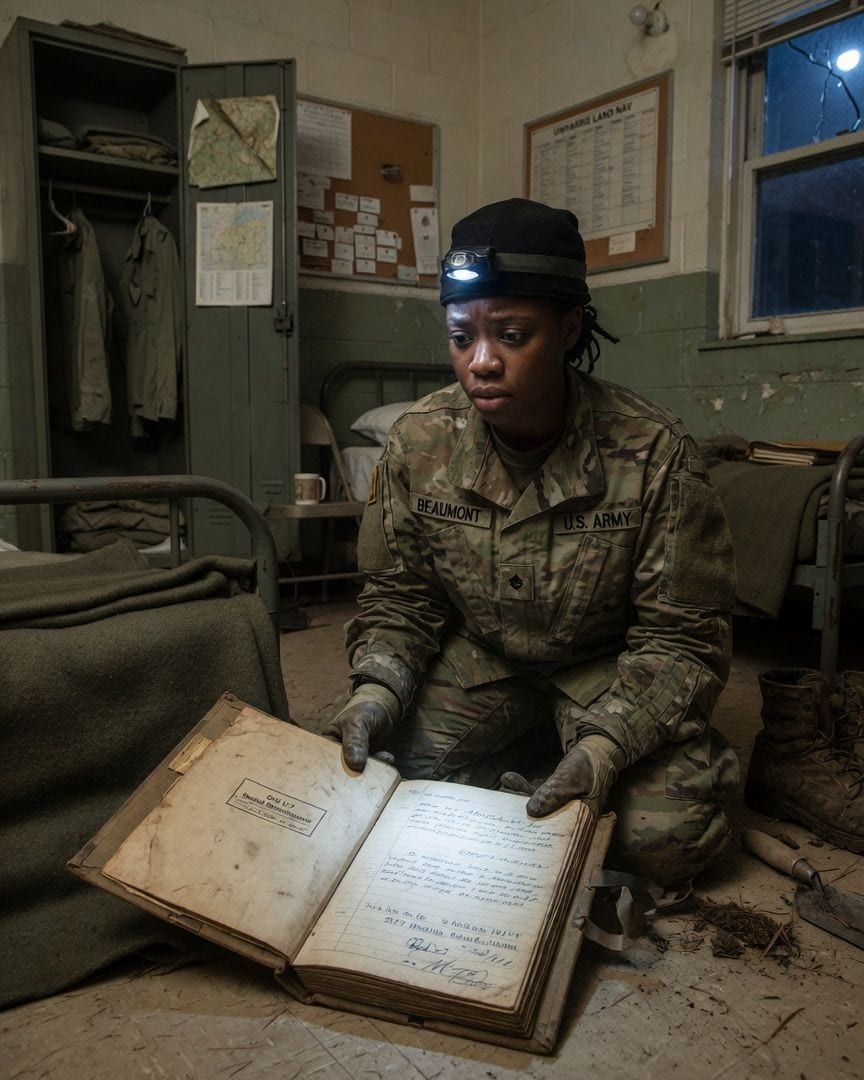
A burn barrel's impossible heat led a lieutenant to a hidden logbook, holding her own signature on a patrol she never took.
Second Lieutenant Monica Beaumont, bone-tired after a land-navigation course, logged an unexpected compound in the Uwharrie backcountry. Her cadre officer, Captain Russo, insisted she'd invented it, marking her record. The next morning, leading her platoon back to the coordinates, the compound was gone, but they found fresh post holes, cold fire pits, and a burn barrel still radiating an impossible heat. Unable to shake the uncanny feeling, Lieutenant Beaumont returned alone that night and unearthed a heavily corroded metal box. Inside, a canvas-bound logbook detailed decades of activity at a site that didn't exist, until she found an entry from eighteen months prior: her own signature on a night watch she was hundreds of miles away from.