My initials are on a casino count sheet for a table I never touched. Table 12 was dark, roped off for the night.
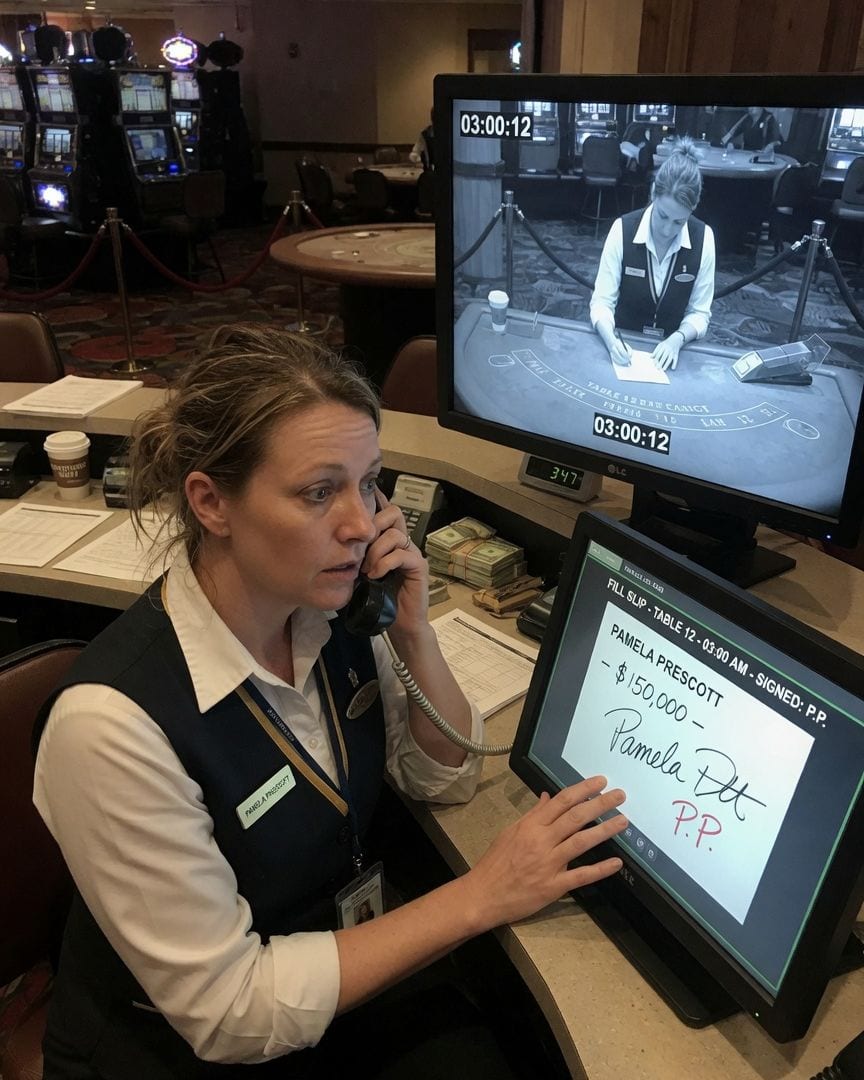
I finished the inventory reconciliation for my cage, a Tuesday night like any other graveyard shift, the quiet hum of the casino a low thrum in my ears.
The digital ledger was usually a straightforward affair, balances matching physical counts, all tidy by 7 AM. But as my eyes scanned the final summary, a cold knot formed in my stomach.
A discrepancy, glaring and impossible: a fifty-thousand-dollar fill, posted to Table 12 at exactly 3:00 AM, my initials, "P.P.", stamped right there.
Table 12. It’s been dark for years. Roped off, covered with a heavy felt cloth, part of that whole section waiting for renovation, probably since before I started three years ago.
I knew, with absolute certainty, that I hadn't processed that fill. I hadn’t even walked past that end of the floor tonight.
I clicked the entry, pulling up the digital slip. The timestamp confirmed it: 3:00 AM. Then the scanned image of the physical slip itself: a neat, clear signature, unmistakably mine, followed by my initials. But I hadn't touched it.
My hand, the one typing this, the one that had just meticulously recounted stacks of chips and bundles of cash, had not signed that form. I knew my own signature. I knew my own actions.
The cage inventory, by some impossible accounting, balanced short by that exact fifty thousand dollars. The physical cash, re-counted twice, then a third time, meticulously, by my own two hands, confirmed the deficit. The money was simply gone.
The system, the unimpeachable digital record, stated with absolute authority that I, Pamela Prescott, had done it. I stared at the screen, at the impossible entry, the phantom fill glaring back at me from the bright LED.
It felt like watching myself commit a crime I hadn't intended, couldn't have committed.
I pulled up the full transaction log, searching, desperate, for any override code, any system glitch, another cashier’s initials, anything that could explain it. Nothing. The system firmly attributed the fill to me. No error codes, no red flags.
Just my name, my initials, my signature, a clean, legitimate transaction for a table that didn't exist in any active sense.
My hand was shaking slightly as I picked up the phone and dialed Charles Easton, the pit manager. He was somewhere out on the floor, making his rounds, probably as tired as I was.
His voice, when he answered, was gravelly with sleep and impatience. "Easton. What's up, Pam?"
"Charles, it’s… I have a fifty-thousand-dollar fill for Table 12 at 3 AM. My initials. I didn't do it."
There was a beat of silence, then a sigh that crackled through the earpiece. "Another phantom fill, Pam? Just balance it out with a transfer, it happens. We'll sort the paperwork in the morning."
"Fifty thousand, Charles. And Table 12 is dark. It’s been dark for years." My voice was sharper than I intended. "It doesn't just 'happen' for fifty grand."
He sighed again, a sound heavy with resignation. "Look, Pam, I'm at Table 7. Give me ten minutes. I'll come over, we'll pull the footage from your cage and from Table 12.
Probably just an administrative error, a miskeyed entry on someone else's part that got tagged to you." He sounded like he was trying to convince himself as much as me.
I felt a chill, a cold sliver of understanding. The error wasn't in the system. The system was precise. The error was in the reality it described.
I stood there, heart pounding, waiting for him to arrive, for the footage to load. I was convinced it would show nothing. Or perhaps another cashier, someone who could explain this away, even if they had to invent a story.
The idea that no one was there, that the system itself had simply fabricated the event, was a thought I pushed down, hard. My eyes kept straying back to the monitor, the digital fill slip staring at me, accusing me.
Charles finally appeared, rubbing his eyes, smelling faintly of stale coffee. He nodded towards my screen. "Alright, let's see this ghost in the machine."
He pulled up the security footage on his own monitor, the one connected to the main surveillance feed. It flickered to life, grainy, but clear enough to make out the distinct features of the cage and the surrounding casino floor.
The timestamp in the corner ticked slowly towards 3:00 AM.
I leaned forward, my breath catching in my throat.
The camera angle, specifically from the cage’s perspective, showed me. Pamela Prescott. My uniform, my hair, my distinctive way of holding my shoulders.
I watched as my onscreen self stepped out from behind the counter, a stack of chips clutched in one hand, a slip of paper in the other.
I walked with purpose, striding towards the far end of the floor where Table 12 sat.
It was clearly visible in the background, unmistakably dark, covered with its heavy felt shroud, and crisscrossed with the familiar velvet ropes that kept patrons away.
My onscreen self reached the table, pulling out the slip, signing it with a flourish. The camera zoomed slightly, almost as if to confirm the impossible.
But the table itself, just a few feet behind the onscreen Pamela, remained untouched, undisturbed. The heavy felt covering was still perfectly smooth. The ropes still hung precisely. The green baize of the table never appeared.
The image on the screen was an impossible contradiction: my body performing an action at a table that wasn't active, that couldn’t be active, that wasn’t even there in the way the slip implied.
I stared, my own hand, the real one, pressed hard against the cold, digital signature pad on my counter, watching my onscreen self sign a slip at the dark, covered Table 12.
The table, a few feet behind the onscreen Pamela, remained undisturbed, roped off for the night.
I must have replayed the footage half a dozen times. Frame by frame, then again in real-time, just to make sure my eyes weren't playing tricks on me.
Charles, who had initially been confused, now looked like someone had just told him gravity was optional. He rubbed his eyes, hard. "That's… not right," he mumbled, his voice hushed.
He actually tried to laugh it off, a nervous, high-pitched sound. "Glitch in the matrix, maybe? Someone screwing around with the playback?" But his eyes, wide and bloodshot, told a different story.
He pulled up other camera feeds, tried cross-referencing, but every angle, every piece of data pointed to the same impossible truth.
He finally turned to me, his voice lowered. "Look, Pam. Just… forget about it. It’s fifty grand. The house can absorb it. Some things are better left alone."
He waved a dismissive hand, trying to reassert some semblance of control over a situation that was clearly beyond him.
But I couldn't. The image of my own body performing an impossible act burned in my mind, a phantom limb I never had. It wasn't about the fifty thousand dollars anymore. It was about what was real and what wasn’t.
I started digging. Not just into my own shift, but into the casino’s wider digital ledger. I spent every spare moment during my next shifts, and even came in early on my off-nights, poring over records that went back years.
I searched for other large, unexplained fills, focusing specifically on entries linked to dark or closed tables, especially Table 12.
What I found made the hairs on my arms stand up. It wasn't an isolated incident. There was a pattern, subtle but undeniably present.
Smaller, more frequent discrepancies, always on the night shift, always linked to tables that were either dark or had unusually low activity.
Entries where cashiers had seemingly processed fills or even small wins at tables no one was playing, or for amounts that didn’t quite add up.
There were other names, too, other cashiers, other pit bosses whose initials appeared on these impossible slips. I looked them up in personnel. They were all long gone, retired, or had moved to different casinos entirely.
The ones still working here had no memory of anything unusual, dismissed it as "just the system being the system."
I compiled a spreadsheet. Row after row of dates, times, amounts, table numbers, and initials, each one a tiny, impossible anomaly.
The data formed an unsettling tapestry of financial ghosts, a silent ledger of actions that never truly happened, yet were undeniably recorded.
The deeper I went, the less alone I felt in my growing dread, and the more isolated I felt from the mundane, unquestioning world of the day shift.
My unusual activity in the archived financial records didn’t go unnoticed. The casino is a place where everything is watched, and I, digging through its past, was now under a new kind of surveillance.
One evening, as my shift was finally ending and the first rays of dawn were painting the high windows a pale grey, Gloria Mitchell, the Casino Operations Manager, approached my cage.
Gloria is a formidable woman, always impeccably dressed in a tailored suit, her grey hair pulled back in a severe, elegant bun. Her eyes, behind expensive glasses, seemed to see everything, and they missed nothing.
She paused at my window, her lips curving into a calm, almost knowing smile that didn't quite reach her eyes.
"Pamela, you've been quite busy with the archives lately," she said, her voice smooth and even, betraying no emotion. "Everything alright with your current shifts? No new fifty-thousand dollar surprises, I hope?"
My heart gave a sharp, unpleasant lurch. She knew. She knew about Table 12. I felt a prickle of unease, a cold sensation spreading across my skin.
I tried to explain, to frame it as professional curiosity, a desire to understand past accounting methods. "Just trying to get a better grasp of historical data, Gloria. Looking for… patterns." The word tasted bitter on my tongue.
Gloria nodded slowly, her gaze unwavering, studying my face as if searching for something. "Our records are… extensive," she said, her voice dropping slightly, becoming almost a murmur against the distant clash of slot machines.
"Sometimes, the past holds onto things. Things that are best left undisturbed."
There was no threat in her voice, no anger, only a quiet, unnerving certainty that settled deep in my bones. "Some things are simply part of the house, Pamela. Always have been. Best not to question the foundation."
She gave me another small, unreadable smile, a mere twitch of her lips, then turned, her sensible heels clicking softly on the polished floor, and walked away. She didn't look back.
I stood there, utterly exposed, feeling as if her eyes, or perhaps something else, had watched every keystroke, every search query I had ever made in the silent, sleeping archives.
The next night, I felt a new kind of resolve.
I marched straight to Gloria's office, my spreadsheet of impossible fills clutched in one hand, the printed stills of the security footage of my ghost-self at Table 12 in the other.
Gloria was there, sipping herbal tea from a delicate china cup, the glow of a small desk lamp illuminating her face. She looked up as I entered, her expression unperturbed, as if she'd been expecting me.
"Gloria," I began, my voice tighter than I wanted it to be. "I need to talk about this." I laid the evidence on her desk. The spreadsheet, column after column of impossible data.
The grainy photos of me, standing by a dark, roped-off table, signing a slip that shouldn't exist.
She listened patiently, her eyes occasionally flicking from the printouts to my face, then back again. She took another slow sip of her tea, the only sound in the office apart from my own ragged breathing.
When I finally finished, the room felt heavy with my unspoken questions. Gloria placed her teacup down with a soft, precise click.
"You've been thorough, Pamela," she said, her voice still calm, unhurried. "More thorough than most." She leaned forward slightly, resting her elbows on the desk, her gaze fixed on mine.
"What you've found, the discrepancies, the… phantom entries… they are real. The records are not lying."
My mind raced, trying to find a purchase in the impossible. "But how? The footage… my initials… I didn't do it. Table 12 has been closed for years!"
Gloria held up a hand, a gesture of quiet authority. "There are forces at play here, Pamela, that precede both of us. Forces that are simply… part of the house. For decades, these anomalies have appeared.
Always on the night shift. Always tied to certain tables, certain figures." She gestured vaguely towards the wall behind her, as if indicating the very structure of the casino itself. "We've learned to live with it.
To accept that some things defy explanation, yet still occur."
She went on, her voice a low, steady drone, explaining that the casino had a long, unspoken history of these 'phantom fills' and withdrawals. The house's overall financial health, she assured me, was never truly impacted.
The numbers always balanced out in the end, over time, in ways that defied traditional accounting but somehow, impossibly, made sense within the casino's own ledger. "It's a game, Pamela," she concluded, her eyes holding mine. "A very old game.
And the player… is always here."
Gloria's calm acceptance, her utterly unbothered composure, was more terrifying than any monster. The earlier clues clicked into place: Charles's dismissive attitude, Gloria’s warning not to question the foundation. They weren't in denial. They simply knew. They lived with it.
And now, so did I.
Shaken to my core by Gloria's chilling admission, I couldn't let it go. "The player is always here." The phrase echoed in my mind, a cold, persistent whisper.
If the records were real, if the game was real, then there had to be an identity behind it. A player.
I returned to the archives the next night, the air thick with the unspoken knowledge Gloria had imparted. This time, I wasn't just searching for discrepancies; I was searching for names.
I started cross-referencing my spreadsheet of impossible fills with old staff rosters, trying to find common links. The pattern I found was chillingly consistent.
Many of the phantom transactions, especially the larger ones and those consistently linked to Table 12, often included a specific, recurring initial for the 'cashier' or 'pit boss' involved: 'H.M.' or 'H. Mercer'.
This name appeared consistently across decades of night shift records, dating back to the late 1960s, a silent partner in the casino's nocturnal economy.
But when I searched the official employee database, past and present, for anyone named H. Mercer, I found nothing. No personnel file. No payroll entries. No record of employment whatsoever. "The One Who Was Always Here."
The phrase suddenly held a deeper, more literal meaning. My heart pounded, a frantic drumbeat against my ribs.
I dug deeper, sifting through dusty boxes of old casino memorabilia stored in a back corner of the archive. Faded newspaper clippings, unofficial newsletters from long-defunct employee committees, even personal photo albums donated by long-retired staff.
Most were brittle, smelling of dust and forgotten memories.
And then, tucked away in one such album, beneath a brittle, yellowed page filled with a dozen smiling faces from the 1970s, I found it.
It was a group shot of pit staff, all in their period uniforms, some with arms around each other, celebrating what looked like a Christmas party.
And there, standing slightly apart from the main group, with an oddly detached, almost knowing smile, was a man in a vintage suit. His hair was slicked back, his eyes dark and piercing.
The caption, handwritten in faded ink beneath the photograph, read: "Hugo Mercer, 1970s Pit Boss, Night Shift."
My breath hitched. It was the same man.
The man I’d seen fleetingly walk past my cage just a few hours ago, as I was starting my shift, a shadow at the periphery of my vision that no one else seemed to notice.
A man I’d dismissed as an older patron, perhaps. A man who, according to every official record, did not exist.
My finger, trembling slightly, traced the faded name 'Hugo Mercer' beneath the grainy photograph in the old staff album.
The face was unmistakable, chillingly familiar from the fleeting glimpse I caught in the casino just hours ago, a man who doesn't exist on any roster.
I confronted Gloria again, the old photo album open to Hugo Mercer’s picture laid flat on her polished desk. My finger pointed directly at his faded image. "This is 'H. Mercer,' isn't it? The one who's always here."
My voice was flat, devoid of the frantic edge it had held days ago. Now, it was just cold, hard fact.
Gloria looked at the photo, a faint, sad smile touching her lips. It was a smile of profound, ancient weariness, not malice. "Hugo Mercer," she murmured, almost to herself. "A legend. A high roller, decades ago.
He loved Table 12 more than anything. Gambled away fortunes, won them back, then gambled them away again. They said he died right there, mid-game, a heart attack, back in '78. Right at 3 AM."
She leaned back in her chair, her eyes unfocused, as if seeing something far beyond the walls of her office. "After his death, the impossible fills began. First small, isolated incidents. Then growing, becoming more frequent. Always at night.
Always tied to Table 12, or other tables he frequented when he was alive." She looked at me then, her gaze sharp. "His game never ended, Pamela. He just… adapted. He's a part of the house now.
He plays through the ledger, through the system. Sometimes, he manifests, briefly, to continue his game."
The truth detonated in my mind, a chillingly coherent explosion. Hugo Mercer wasn't just a ghost.
He was the casino’s night shift, an entity that ran the numbers, moved the money, ensuring the house always balanced, always won, but through means no living person could trace.
He occasionally 'played' through the hands of the living, or through their records, like mine. Every single planted clue, every impossible detail, every thread of the bizarre tapestry I’d painstakingly woven, clicked into place with horrifying precision.
The dark Table 12, the impossible fills, my own hand on a slip I never signed, the 'phantom' employee in the historical records – it was all part of Hugo Mercer's eternal game.
I returned to my cage, the knowledge a heavy, leaden weight pressing down on me. I watched the casino floor, the few remaining patrons, bleary-eyed and desperate, the tired staff going through their motions.
The dread I felt wasn't of danger, not anymore. It was of a profound, unchangeable reality that had simply absorbed me into its slow, grinding mechanism.
My eyes drifted towards Table 12, still dark and roped off, a silent monument to a game that never ended. For a fleeting moment, I saw him.
A figure in a vintage suit, sitting at the head of the table, his back to me, hands resting on the green felt, as if waiting for a deal.
He was solid, clear, utterly out of place in the empty, roped-off space. He didn't move, didn't acknowledge me, didn't even seem to breathe. He was just… there, playing his endless game, a silent, perpetual player.
Then, as quickly as he appeared, he was gone, dissolved into the static of the empty floor.
I understood. I wasn't a victim to be escaped, or a hero to fight this. I was an unwilling participant.
I was now one of the night shift, one of the people who saw the subtle signs, who felt the strange shifts in the air, who knew. I couldn't fight it, couldn't undo it.
The game continued, and I was, simply, a piece in it. The horror wasn't in what he did, but in the quiet, undeniable fact of his persistence, his complete and utter integration into the very fabric of the casino’s night.
I simply knew.
I finished my shift, numb. The next night, another impossible fill appeared on the count sheet, this time for a smaller amount, to a different dark table, Table 7, a roulette wheel that hadn't spun in weeks.
The cage inventory balanced short, as expected, but then, exactly fifteen minutes later, a corresponding 'win' was logged at Table 4, a blackjack table, for the precise amount, balancing the house’s overall ledger. The numbers, as Gloria said, always balanced.
Always.
I saw Gloria Mitchell across the floor, at the edge of the pit. She looked up, her gaze meeting mine. She nodded faintly, a shared, silent understanding passing between us, two participants in a game only some truly recognized.
The game continued.
I continue working the night shift.
I now see the subtle signs everywhere – the flicker of a shadow at an empty slot machine that seems to pay out a phantom credit, the faint rustle of cards from a dark table where no one sits, the impossible small discrepancies that always, eventually, balance out across the broader ledger.
I see other night staff, tired and numb, who also seem to just know without ever speaking it aloud. They too are pieces in the game. I am now one of them, part of the system, part of the house.
The house always wins, but it also always plays, and now, so do I.
If this one got to you
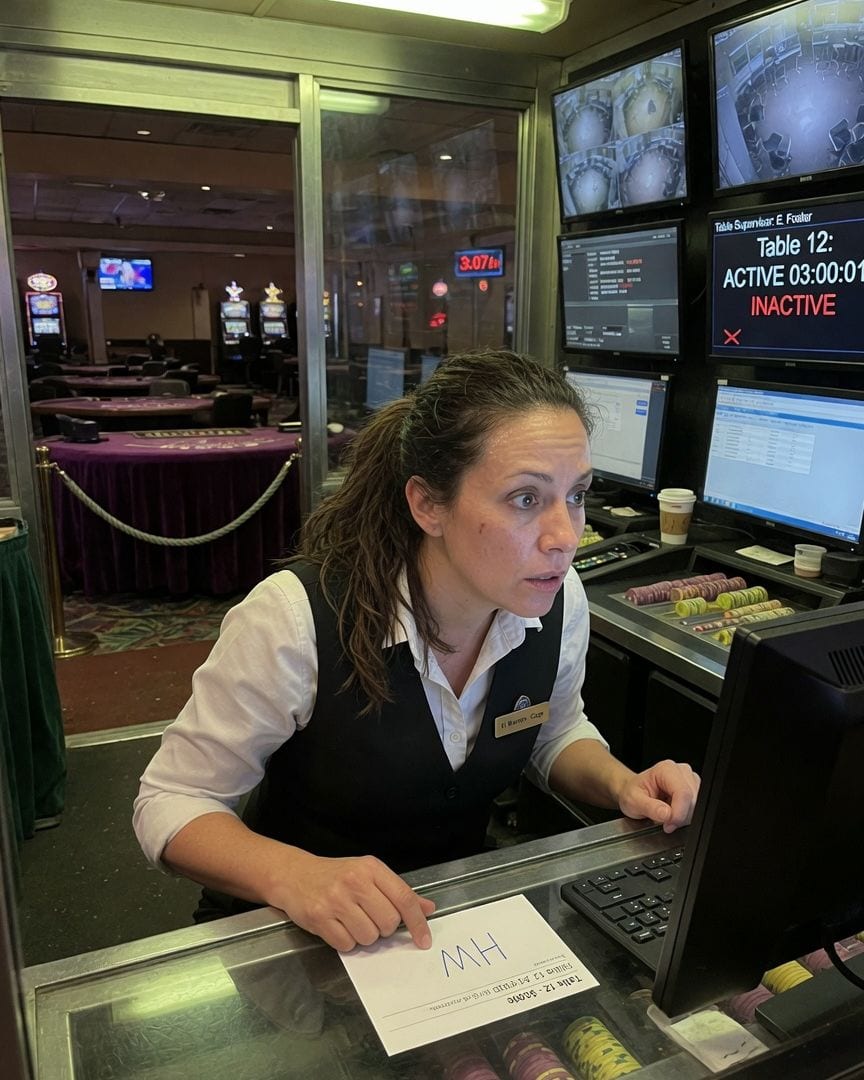
My name signed a fifty-thousand dollar casino fill to a dark, roped-off table. The cage is short by that exact amount. I never touched the slip.
Working the casino cage on a slow night, I logged off after counting my stack of chips. Then the system pinged: a $50,000 transfer to Table 12, closed for months, with my initials on it. The security feed showed my hand moving, making an imperceptible scribble, but I know I never touched a thing.
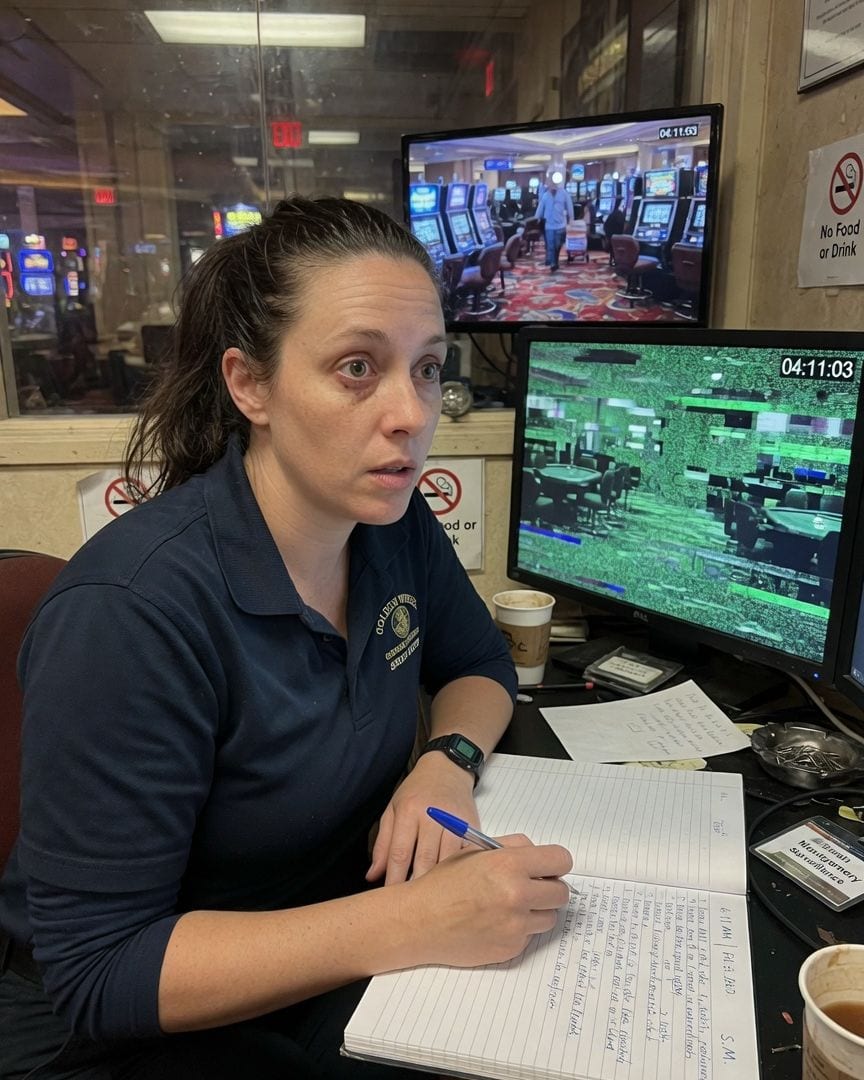
My surveillance log shows I reviewed a casino pit that was dark and roped off all night. My handwriting. No memory.
As my casino surveillance shift ends, I sign off the logbook. I find an entry in my own handwriting for Pit 3, a section that's been dark and closed for weeks. I have no memory of writing it, but the footage shows a figure standing in the empty room.
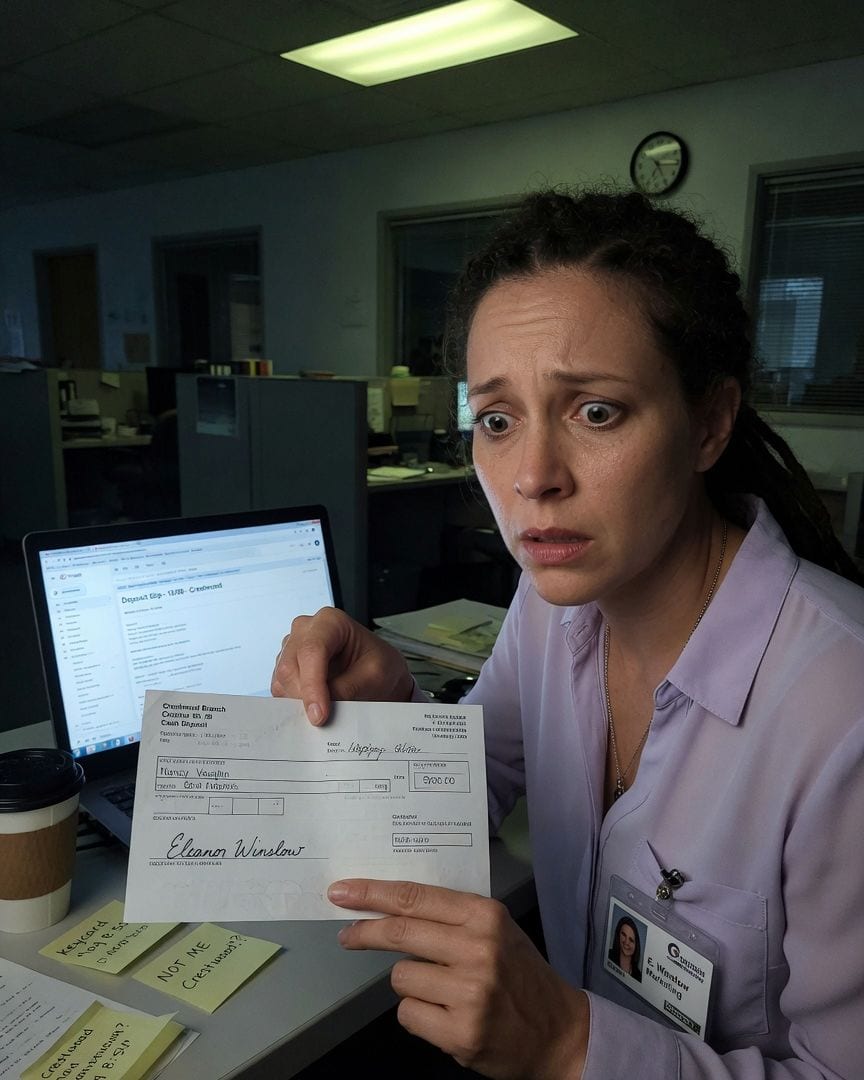
My bank statement shows a $900 cash deposit made in a town I've never set foot in, at 10:40 AM on a workday. I was at my desk, badged in. Two more landed since.
My bank statement showed a $900 cash deposit from a town I'd never visited, 150 miles away. I was at my desk, logged into work, all three times. But the scanned deposit slip arrived, clear as day, showing my own flawless signature.
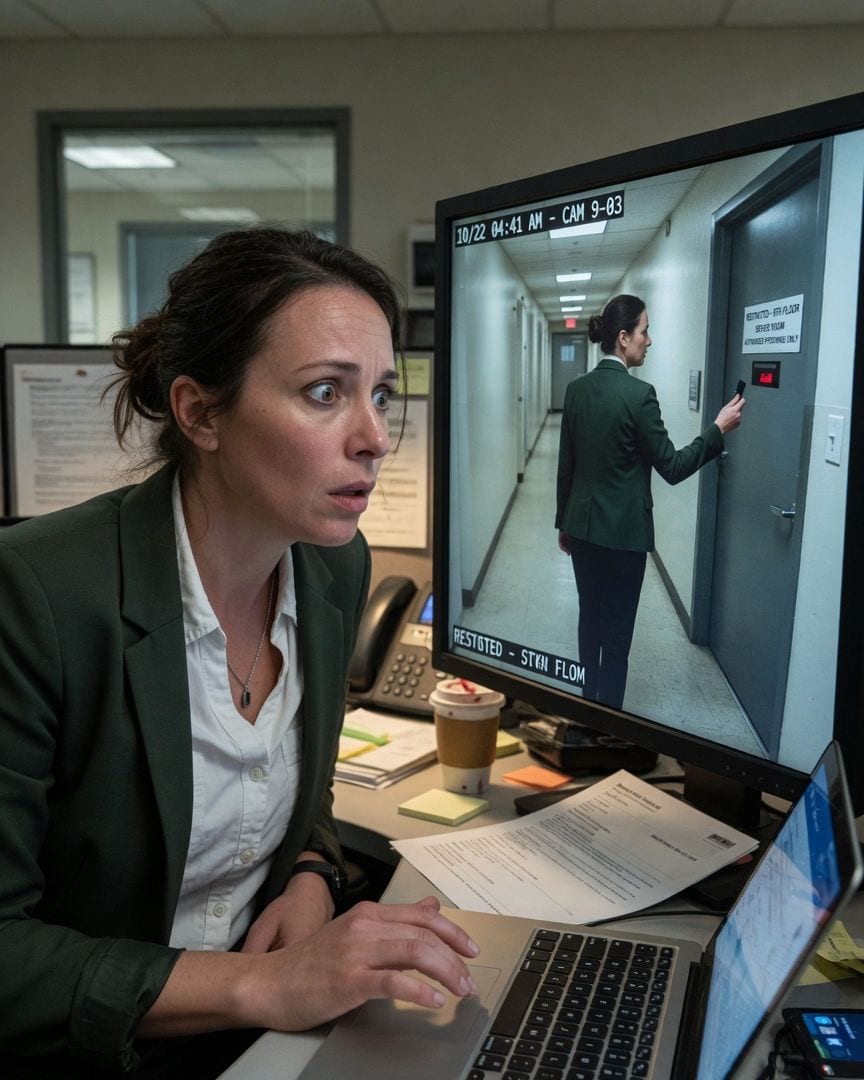
My keycard log shows me in the server room at 4:41am. I was asleep, and my badge was at home.
An email from corporate IT reveals my keycard registered entry into a restricted server room at 4:41 AM last Sunday. I was asleep in my apartment across town, my badge clipped securely to my jacket at home. But then I scrolled down and found eleven more impossible entries, all within the past week, all under my name.
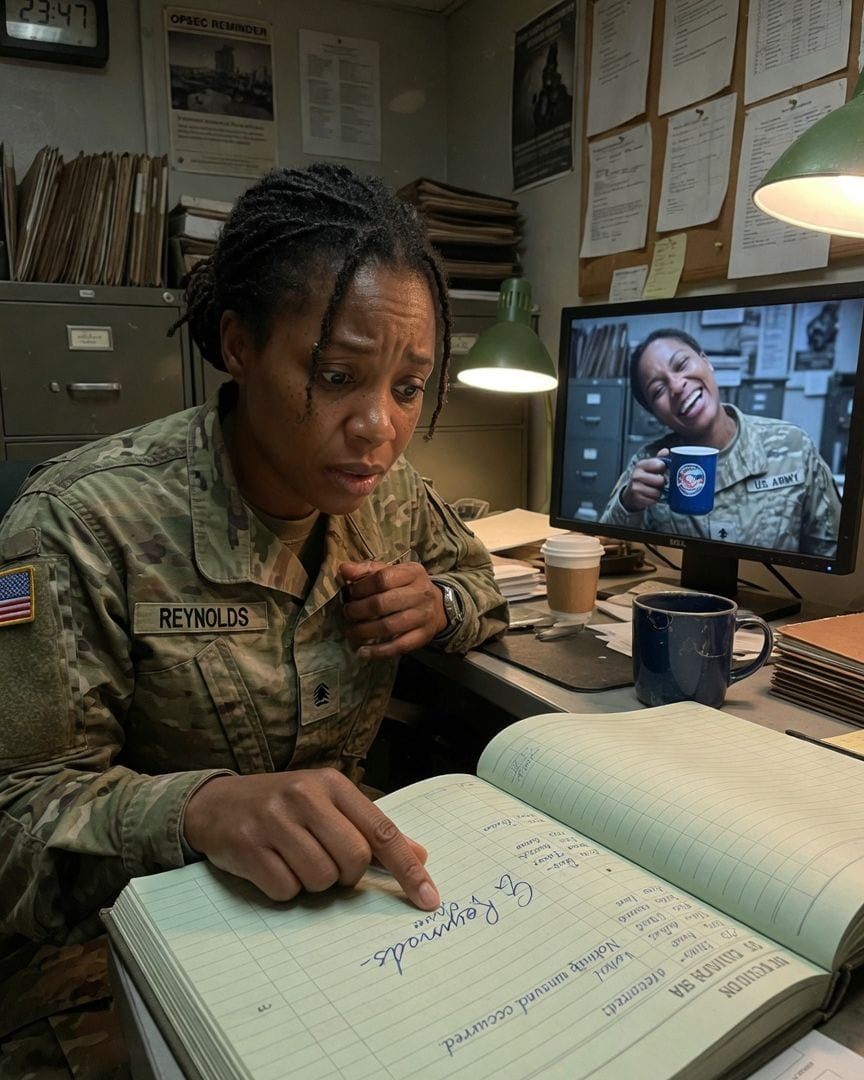
Lieutenant Grace Reynolds saw her own signature in the staff-duty log for a shift she never worked. The security footage then showed 'her' leaving a coffee mug she’d never once seen.
Lieutenant Grace Reynolds hunched over the battalion staff-duty log, the fluorescent hum of the records room a monotonous backdrop to her dry inventory audit. Her gaze snagged on an entry from three weeks prior: her own unmistakable signature, closing out a full 24-hour staff-duty shift she knew she had never worked. Security camera footage only deepened her unease, showing 'Grace Reynolds' moving with her familiar stride, laughing a shade too brightly, her head tilting a fraction too precise, like a flawless, chilling performance. But as the imposter turned to leave, she picked up and rinsed a chipped, dark blue ceramic coffee mug with a faded diner logo—a mug Lieutenant Reynolds had never once seen in her life. The air in the quiet room grew heavy, thick with the unspoken wrongness: if that wasn't her, then who was it?
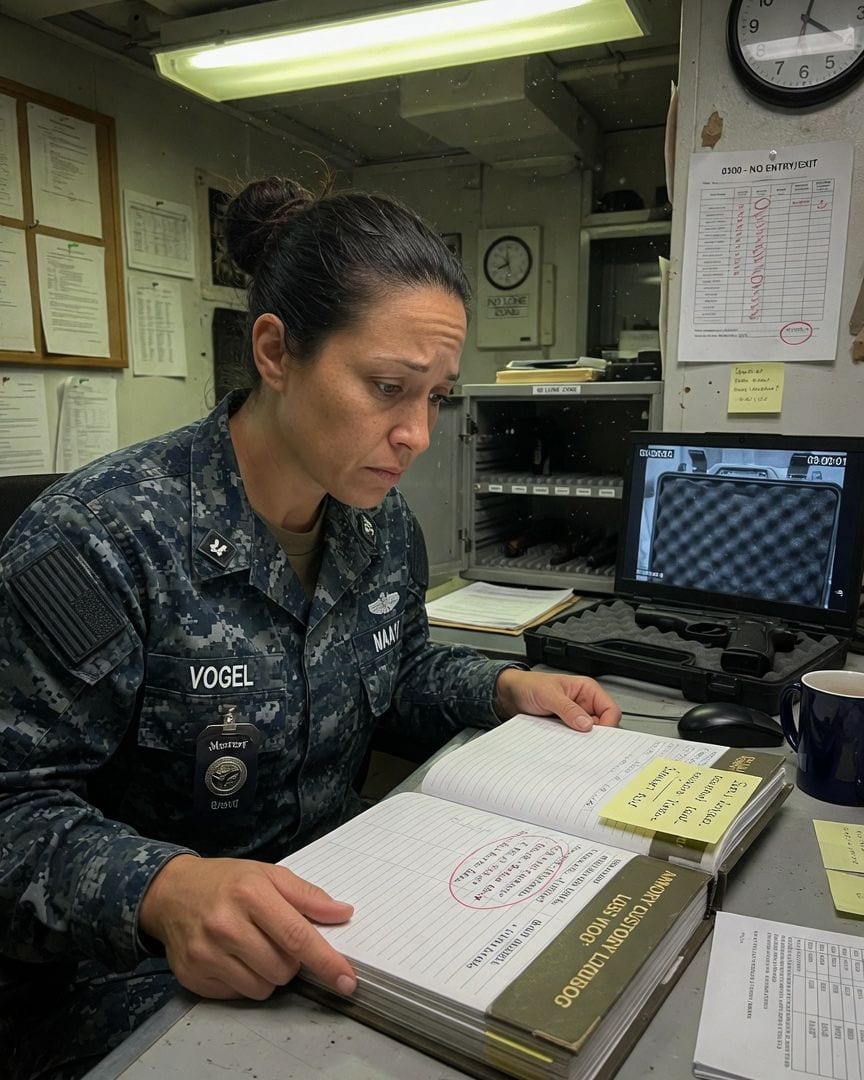
The USS Vance armory log showed Master-at-Arms Dana Vogel's signature. The camera showed the weapon case opening itself, but no one was there.
Master-at-Arms First Class Dana Vogel stared at the USS Vance armory log, a testament to her years of perfect service. An entry for 0300 during a recent strait transit listed her name, signing out a standard M9 pistol. Yet, Vogel knew she was thousands of miles away on emergency leave, her sister in the ICU. The armory camera’s timestamp for 0300 showed the weapon case secured in its rack, distinctly opening and closing, with no person visible. How could her signature be in a log for an event she couldn't have performed, witnessed only by an empty room?