Lance Corporal Kowalski counts his last 72 hours at Firebase Kettle when an empty foxhole signals 'all clear' on the comm wire. Later, a phantom shadow whispers his name from inside.
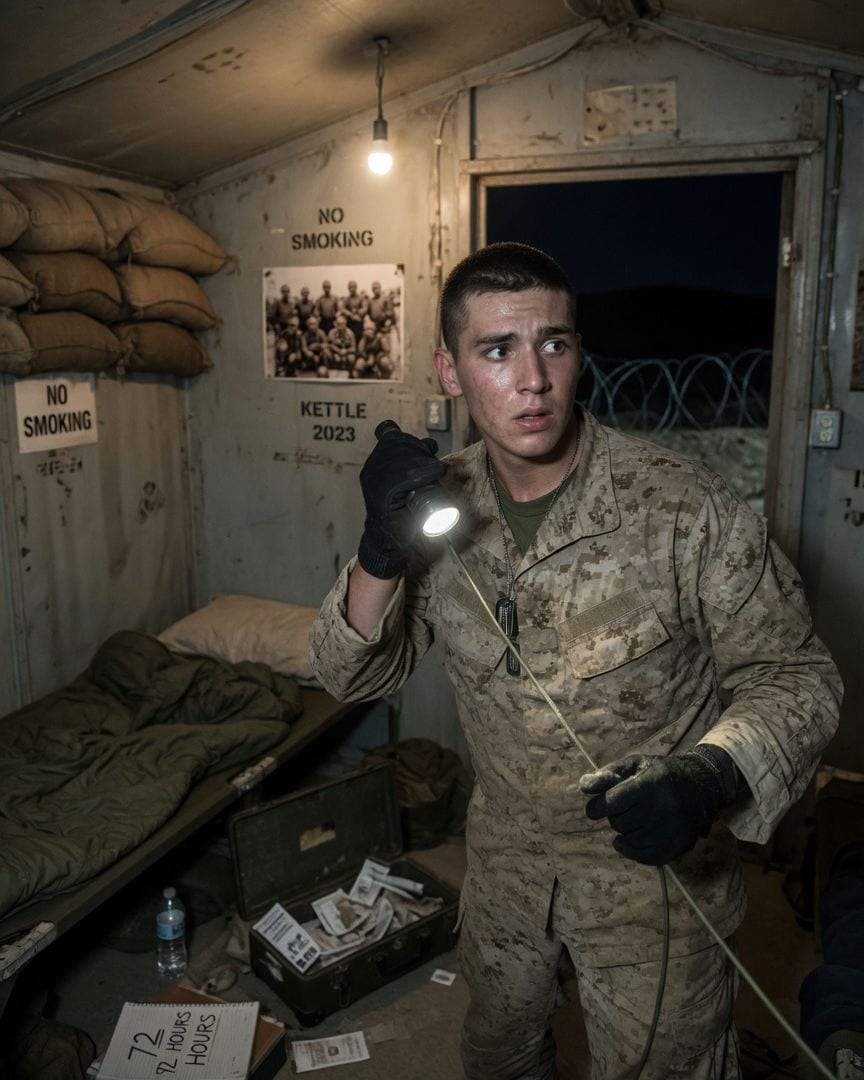
Lance Corporal Daniel Kowalski tugged the comm wire, listening for the familiar, short pull in return. The wind whipped across Firebase Kettle’s bald, remote hill, kicking up dust and the faint, coppery tang of old iron.
He was 22, counting the hours, exactly 72 of them, until his transfer home. This final rotation, a skeleton crew of about 15 Marines, felt like the quiet end of the world.
He felt the expected answering tugs from the first two foxholes along the perimeter. Solid, distinct, signaling an all-clear. Then he moved to the third.
It had been empty for a week, concertina wire coiled neatly beside it, ready for future demolition. Daniel gave the wire a sharp pull, a routine motion. He expected nothing.
But then, he felt it: two distinct pulls, the all-clear, strong and unmistakable.
He paused, the comm wire suddenly cold in his gloved hand. A snag, maybe. The wind could play tricks. He dismissed the flicker of unease and continued his meticulous count.
He ticked off the remaining 12 Marines in his head, then added the two confirmed from the first foxholes. That brought him to 14. Add the supposed all-clear from the empty third, and he was still at 15.
The official count. Everything matched.
He took a slow breath and started again, this time counting the responses on the wire as he went. One, two, three… he reached the end of the line, confirmed the last man, then tallied up the total. Fifteen.
Then he remembered the third foxhole, empty, but not silent. It had given two pulls. He counted again, slowly, eyes narrowed against the grit in the air. One, two, three. From the empty hole. The total, then, was sixteen.
One more than there should be.
A cold dread, sharp and sudden, settled in his gut. He walked back to the third foxhole, rifle held loosely at his side, peering into the shadows.
The wind howled around him, carrying the faint scent of old canvas and something metallic and cold, like wet iron, though there was no rust nearby.
The hole was undeniably empty, but the comm wire, running into its depths, was taut.
Daniel reported the discrepancy to Sergeant Jeffrey Winslow, a lean, wiry man of 35, whose face was perpetually etched with the weariness of too many deployments. Winslow listened, nodding slowly, then waved a dismissive hand. “Kowalski, you’re tired.
We’re all tired. It’s a faulty line, or the wind playing games with your head. Happens.”
“Sergeant, I got a clear all-clear from an empty foxhole. Twice,” Daniel insisted, the words feeling thin even to his own ears. “And the count came out sixteen.”
Winslow sighed, rubbing the stubble on his chin. “Alright, alright. I don’t need you seeing ghosts before we pack up. We’ll do a full, manual headcount. You go with Private Montgomery, double-check every man, face to face.
Leave the wire alone.”
Daniel did as he was told. He and Audrey Montgomery, a fresh-faced PFC, moved through the small, temporary barracks, calling out names, confirming presence. Every Marine was present and accounted for. All 15. No one missing, no one extra.
Yet, when Daniel later re-checked the wire on his own, just to be sure, the invisible response from the third foxhole returned again. Distinct. The final count, still, was 16.
Frustrated, his jaw tight, Daniel returned to the third foxhole. He had to be missing something. A rock. A loose wire. He shone his flashlight into the dirt, scanning every inch.
That was when he saw it, glinting faintly just inside the lip of the hole. He knelt, pushing aside loose stones and dust. It was a K-Bar knife. Standard issue, yes, but this one was different.
Its leather sheath, normally stiff, was worn smooth, almost polished, suggesting decades of use, yet the blade itself was immaculately maintained, almost gleaming, without a single speck of rust or grime.
It looked like it had been handled daily, cared for with a meticulous, anachronistic pride.
He knew, with a certainty that chilled him to the bone, that it didn’t belong to anyone in their current crew. No one carried gear that old, certainly not in that condition.
He examined the ground around the foxhole again, more closely this time. Faint but distinct boot prints, standard military issue, led into the hole and then simply disappeared, as if the person had sunk into the earth.
They were too fresh to be old, the depressions still clear in the recent dust, but too indistinct to be recent, without a single loose pebble displaced. The cold dread returned, this time deeper, heavier. This wasn’t a glitch.
Daniel brought the K-Bar knife to Sergeant Winslow, explaining the faint, fresh prints. Winslow examined the knife, turning it over in his hands. His brow furrowed. “Hell, Kowalski. This thing’s vintage. Nobody uses these anymore.”
He ran a thumb over the pristine blade. “And it’s… perfect. Like it just came off the line, but the leather’s seen a war or two.” He couldn’t explain its immaculate condition, its presence.
He looked at Daniel, then at the knife, a flicker of something unreadable in his eyes. He took the knife to Captain Monica Galloway, the firebase commander.
Captain Galloway, a sharp-featured woman of 40, was at her desk, reviewing manifests. She took the knife from Winslow, her gaze distant as she examined it.
She ran a gloved finger along the blade, a strange, weary expression settling on her face. Her eyes met Daniel’s for a moment, and he saw a depth of knowledge there that unsettled him more than her initial skepticism.
She didn’t ask where it came from, or how it could be so old yet so perfect. She simply nodded.
“Corporal Kowalski,” she said, her voice low, “secure that third foxhole with concertina wire. Double layer. And report any further anomalies directly to me. Understood?”
“Understood, Captain.”
Later that night, Daniel was on watch, positioned near the newly secured foxhole. The concertina wire glinted under the moon, a cruel, metallic tangle. The wind still howled, a mournful sound.
He stood, rifle held at the ready, his eyes scanning the desolate perimeter. A faint movement caught his eye, a shift in the deeper shadows within the wire, inside the empty hole.
He tightened his grip on his rifle, heart pounding a heavy rhythm against his ribs. A shadow, impossibly tall and thin, seemed to coalesce within the foxhole, rising like smoke from the ground.
It didn’t have a distinct shape, more like a wavering distortion in the air. Then, as quickly as it had appeared, it receded, sinking back into the darkness.
He strained his ears, his breath catching in his throat. The wind carried a faint, almost imperceptible whisper, dry as rustling leaves, clear as a bell, a single word: ‘Kowalski.’
The hair on his arms stood on end, a prickling chill running down his spine. He stared into the shadows, rifle still raised, unable to move, unable to breathe.
The whisper of his name haunted Daniel. It echoed in his dreams, a dry rustle of sound, and lingered in the corners of his waking mind.
He tried to rationalize it – the wind, his imagination, the stress of the impending drawdown. But the K-Bar knife, that impossibly old, impossibly pristine artifact, lay locked in the supply bin, a tangible piece of evidence that defied logic.
He couldn’t shake it.
He spent his next few off-duty hours hunched over the base’s aging terminal, its screen flickering with the ghosts of obsolete operating systems. He researched the K-Bar knife’s make and model, cross-referencing military issue dates.
It was a 1940s design, identical to models issued during World War II, Vietnam. The sheer impossibility of its condition only deepened the mystery.
Then he started digging into Firebase Kettle’s own history, sifting through old maintenance logs, supply manifests, and archived incident reports.
He found a pattern. It began faintly, a barely perceptible thread in the reams of dry military data.
Every time Firebase Kettle underwent a significant operational change – a major troop rotation, a temporary shutdown, a drawdown – there were reports of ‘unexplained inventory discrepancies’ or ‘unreconciled personnel counts.’
These were always marked as clerical errors, dismissed with terse notes like ‘resolved upon further review’ or ‘administrative oversight.’ But the pattern was too consistent to be a series of coincidences.
Dozens of entries, stretching back decades, each with the same sterile language, the same underlying anomaly.
He drilled down, focusing on drawdowns. He found a specific incident from 1978, a ‘Classified Personnel Discrepancy’ during a similar drawdown.
The file was brief, heavily redacted, but a single, un-redacted note caught his eye: ‘Missing K-Bar knife, believed to be personal issue.’ He tried to cross-reference the name associated with that discrepancy, the missing soldier.
The terminal screen flickered once, then displayed: ‘ACCESS DENIED. CLASSIFIED.’ A digital wall. He tried other keywords, other paths, but found nothing else about the 1978 incident. He leaned back in his chair, running a hand through his hair.
This wasn’t just a ghost story; it was a file. He noticed Captain Galloway watching him from her office across the hall, her face unreadable, almost expectant. She wasn’t looking at the terminal, but directly at him.
He quickly closed the browser, the glowing screen suddenly too bright.
Daniel felt increasingly observed. The feeling was like a cold breath on his neck, even when he was alone. He tried to dismiss it, blaming the isolation of the firebase, the stress. But then it became undeniable.
He found the K-Bar knife. The one he had meticulously secured in a locked supply bin, under a stack of fresh field uniforms, now lying on his bunk.
It wasn’t just there; it was polished to an impossible sheen, the blade glinting, the worn leather of the sheath oiled and gleaming. He hadn’t touched it since he’d locked it away.
He snatched up the knife, his heart hammering, and confronted Sergeant Winslow. He shoved the K-Bar into Winslow’s hands, demanding an explanation. Winslow stared at the knife, his face pale. “Kowalski, what the hell? I haven’t touched this thing.
Nobody has. I swear.” His denial was too vehement, his eyes too wide. Daniel knew Winslow wasn’t lying, not about this. The sergeant was genuinely unnerved.
Later, Daniel was alone in the cramped communications shack, the air thick with the smell of ozone and stale coffee.
He was trying to access deeper, less-used archives on the terminal, searching for any unredacted mentions of ‘Kettle Anomaly’ or ‘personnel discrepancy.’ The screen was dark, the terminal idling.
Then, the radio crackled to life, not with static, but a series of numbers, slowly read out in a low, hollow voice. It sounded distorted, like it was coming from deep underground, or from the bottom of a well.
He recognized the rhythm from old tactical broadcasts, a slow, deliberate cadence.
“One… Nine… Seven… Eight…” The numbers hung in the air, each syllable stretched, then a pause, followed by a series of coordinates that he recognized instantly as the exact location of the third foxhole.
The voice, growing stronger, then whispered, clear as the wind, “You are named.”
Daniel slammed his hand onto the radio’s power button, cutting the voice off mid-word. His blood ran cold, a glacial flow through his veins. He knew he’d been warned.
The air in the shack seemed to grow heavy, pushing down on him. The overhead fluorescent lights flickered erratically.
Captain Galloway entered the shack moments later, her face grim, her expression stern. The door, usually heavy, seemed to slam shut behind her with an audible thud, making the rack of ancient radios vibrate.
“Corporal Kowalski,” she said, her voice quiet but firm, “you’re digging where you shouldn’t.”
Captain Galloway ordered Daniel to her office, not with a shout, but a quiet, chilling authority. The room, usually sterile and efficient, felt strangely oppressive, the air thick and still. She didn’t yell.
Her voice was calm, almost weary, as if she’d had this conversation countless times before. She gestured to a chair, then sat behind her desk, her hands folded.
“Corporal,” she began, “Firebase Kettle has a… reputation. Not for enemy action, not for bad intel. But for anomalies.” She paused, her eyes fixed on him. “Anomalies that command has gone to great lengths to discredit over the decades.”
She reached into a locked drawer and pulled out a binder, its cover faded, its pages yellowed. It was heavily redacted, black bars obscuring most of the text, but the title was clear: ‘Kettle Anomaly: Personnel Reconciliation.’
She slid it across the desk. It was an official, internal military report from the 1970s. Daniel stared at the date: 1978. The year from the radio.
“This details recurring instances of ‘plus one’ counts during drawdowns, rotations, any significant operational transition,” she explained, her voice steady. “It describes a ‘phantom presence’ that manifests, causing discrepancies.
And sometimes, Corporal, it describes this presence as having the capacity to ‘assume’ identity.”
Daniel’s gaze snapped from the report to her face. “Assume identity? What does that mean?”
“Command has historically dismissed it as mass hysteria, psychological trauma from combat, or unique atmospheric interference affecting equipment,” she continued, ignoring his question, her voice flat. “They write it off, file it away, pretend it doesn’t exist.
But those of us who’ve been here, Daniel,” she said, her gaze hardening, holding his, “we know better.”
A faint tremor ran through her composure, a brief crack in her professional veneer. “My own grandfather served here during a previous incident,” she admitted, her voice barely a whisper.
“He never spoke of it, but he carried something from this place. When I was assigned here, I looked into the records. I felt a… duty, to manage this drawdown carefully.”
She pushed the K-Bar knife, which was lying on her desk, towards him. “That K-Bar knife belonged to an ‘unaccounted for’ Marine from the 1978 incident. Private First Class Everett Kowalski.”
Daniel felt a sickening lurch, a cold, sickening wave washing over him. Everett Kowalski. His own surname. The air left his lungs in a rush. “Kowalski?” he repeated, the word tasting like ash. “My family… we have military history.
My grandfather had a brother, Everett. He served, supposedly went missing in action, never recovered. Vietnam era.”
The captain nodded slowly. “There are no records of his body ever being found. Just… unaccounted for.” She paused, her eyes scanning his face. “You asked what ‘assuming identity’ means. Sometimes, when the ‘extra’ manifests, a real soldier disappears.
The count still comes out to plus one. A placeholder, Daniel. A ghost who wants back in the system. The phantom isn’t just an extra; it’s a placeholder.”
The meaning of her words settled over him like a shroud, heavy and cold.
Daniel was reeling from the revelation. Everett Kowalski. His grandfather’s brother. The connection, once a distant family legend, now felt like a cold, ancestral dread, a shadow stretching across generations to claim him.
His own name, a echo in the radio’s voice, a whisper in the dark.
Captain Galloway then pulled out a faded, grainy photograph from her desk drawer. It was old, the colors muted, the edges dog-eared. It was a group shot of Marines from the 1978 rotation at Firebase Kettle.
They were standing in front of the comms shack, the very shack Daniel was currently in, its peeling paint and satellite dish unmistakable. The details of the faces were blurred by time, but the scene was undeniably familiar.
She placed the photo on the desk, her finger resting on a figure at the edge of the frame, slightly out of focus, a young Private First Class. “That’s Everett,” she said, her voice hushed. “Private First Class Everett Kowalski.
He was the one who went missing. The ‘plus one’ that year.”
As Daniel looked closer, a chill ran through him, colder and deeper than any he’d felt before.
The young Marine in the photo, Everett Kowalski, was looking directly at the camera, a faint, knowing smile on his face, a smile that seemed to understand something Daniel was only just beginning to grasp.
And he looked almost exactly like Daniel.
Not just a family resemblance, but an uncanny, mirror image from another time, down to a distinctive scar above his left eyebrow that Daniel also had, a thin, white line he’d gotten as a kid from a fall.
The scar, perfectly replicated, was a brand, a mark of connection.
Daniel stared at the photograph, his own face reflected back from the past, his own name echoing from a ghost. The air in the room seemed to press in on him, cold and heavy.
He realized the phantom wasn’t just an extra; it was him. Or it wanted to be.
The photograph solidified Daniel’s worst fears, turning an abstract dread into a stark, personal terror. Everett Kowalski was not just a relative; he was a mirror, a precursor.
He confronted Captain Galloway, the faded photo still clutched in his hand, demanding to know how deep this went, how many others, how many generations.
She revealed the full, chilling truth, her voice somber. “The ‘Kettle Anomaly’ isn’t random, Daniel. It’s a generational pattern, targeting specific lineages. Often, those with a deep military history, a strong connection to this land, this installation.”
She gestured vaguely at the desolate landscape outside her window. “The ‘plus one’ isn’t a new ghost. It’s a re-manifestation of a prior ‘unaccounted for’ soldier, seeking to complete a cycle. To re-enter the system.”
She accessed a secure digital file on her terminal, finally able to bypass the previous blocks. The screen glowed with the full, unredacted ‘Kettle Anomaly’ dossier. Daniel watched, horrified, as she scrolled through it.
The file contained detailed reports, eyewitness accounts from decades past, and even crude, unsettling sketches of the manifesting entity.
The descriptions were consistent: a tall, thin, wavering shadow that coalesced and then, as it gained strength, began to resemble a specific lost soldier.
“There’s a consistent pattern of a ‘Kowalski’ or similar surname appearing in these ‘unexplained discrepancy’ reports every few decades,” Galloway stated, her finger tracing a highlighted line of text.
The dossier explicitly stated that the anomaly sought to ‘re-enter the system’ by replacing a descendant. Daniel was the target. Everett was the phantom, the one who wanted to come back.
The K-Bar knife, she explained, was a tether, a calling card, a physical link to a past identity.
Daniel was stunned, the reality of it washing over him with sickening clarity. He wasn't just observing an anomaly; he was part of its history, its target.
The countdown to his transfer home wasn't just about leaving Firebase Kettle; it was a deadline for the anomaly. He had to break the cycle, or he would be the next 'unaccounted for.'
Captain Galloway, seeing his grim resolve, stood up. “We have to physically sever the connection,” she stated, her voice firm. “The anomaly is tied to the comm wire network that binds these foxholes—the very system designed for accountability.
It acts as a conduit.” She led him out of her office, grabbing a heavy-duty wire cutter from a locked cabinet.
They descended into the belly of the firebase, down a steep, narrow stairwell that smelled of damp earth and stale concrete.
The air grew heavy with each step, the whispers returning, faint at first, then coalescing into what sounded like many voices speaking his name, a chilling chorus.
They reached a specific junction box, deep beneath the base, where the oldest comm lines converged. It was a dark, cramped space, the air thick with ozone and a cloying, metallic sweetness.
Inside, the junction box hummed ominously, a low, resonant thrum that vibrated through the floor. Daniel’s breath caught in his throat. He saw it: a shimmering, almost transparent figure coalescing near the oldest, thickest wires. Everett.
His spectral face was distorted, stretched into a silent scream, his eyes fixed on Daniel with an ancient hunger.
The phantom reached out a hand, its form solidifying with terrifying speed, trying to touch the primary wires, to complete its re-entry.
Daniel, gripping the heavy-duty wire cutter like a weapon, fought through the terror that threatened to paralyze him. He could almost feel Everett’s cold breath, his desperate need.
He knew he had to cut the primary conduit, the one channeling the anomaly’s energy, before it could fully manifest. Everett lunged, a silent scream twisting his spectral features, his form flickering, growing more opaque with every passing second.
Daniel, with a primal yell that tore from his throat, brought the cutters down with all his might, severing the thickest, oldest cable. A high-pitched shriek, like rending metal and tearing fabric, echoed through the confined space.
The hum in the junction box died, abruptly. The phantom dissipated into nothingness, leaving only the cold, still air and the lingering scent of damp earth and ozone.
The hum in the junction box died, replaced by the ringing silence in Daniel’s ears. The oppressive weight lifted, and the air cleared, the metallic tang dissipating.
Captain Galloway and Daniel emerged from the subterranean passages, shaken but alive, covered in dust and sweat.
The remaining skeleton crew at Firebase Kettle was quickly transferred out. Within weeks, the base was permanently decommissioned, its structures slated for demolition. The entire hill, once a strategic outpost, was designated as a restricted military zone, its records sealed.
The official report attributed the ‘anomalies’ to geological interference and equipment malfunctions, a convenient, if dishonest, explanation.
But the ‘Kettle Anomaly’ dossier was now updated with Daniel’s account, its final entry detailing the successful severing of the primary conduit and the dissipation of the entity.
The K-Bar knife, now just an old piece of gear without its tether, was buried with military honors in an unmarked grave on the restricted hill, its story finally laid to rest.
Months later, Daniel Kowalski was home, transferred to a new unit far from any desert hill or operational drawdown. He carried the memory of Firebase Kettle like a phantom limb, a constant, dull ache beneath the surface of his skin.
The scar above his left eyebrow, which once mirrored his great-uncle's, now felt like a permanent mark, a brand, a reminder of what he had witnessed and averted.
He still instinctively counted every head, every boot, every person around him, a silent, internal tally he could never quite shake. He knew what he saw, what he did.
He never spoke of it, not to his family, not to his new comrades.
One evening, a small, unmarked wooden box arrived at his apartment. No return address. Just his name, printed in a precise, almost old-fashioned hand. He opened it, his heart beginning to pound a slow, heavy rhythm.
Inside, nestled on a bed of faded velvet, was a single, polished K-Bar knife. It was not the one he had buried. This one had his initials, ‘D.K.’, etched into the hilt. And beneath them, faintly, unmistakably, ‘E.K.’
He stared at the knife, cold dread returning, a whisper of old canvas and wet iron on the breeze, as if the air itself held the scent of the firebase. He knows the count is never truly reconciled.
A single, short entry in a classified military log, dated decades after Firebase Kettle was razed, simply reads: 'Anomaly status: Dormant. Periodic manifest checks continue. One more than expected.'
If this one got to you
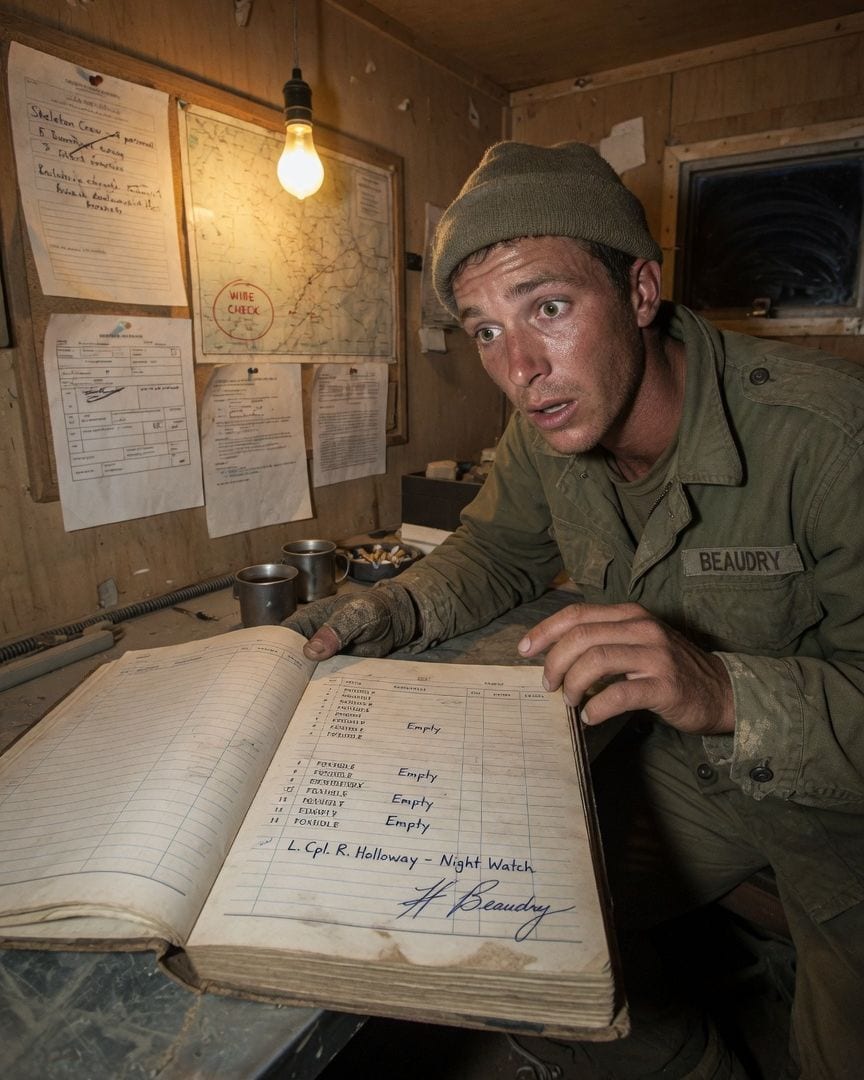
Lance Corporal Beaudry checks the perimeter's empty foxhole. The comm wire pulls back: a signal from no one.
Lance Corporal Hugo Beaudry moved along the perimeter of Firebase Kettle, a lonely outpost in its final drawdown. His solitary wire-check tonight was a routine task in the biting desert wind. He reached the third foxhole, empty for a week, and tugged its comm wire. Two distinct pulls answered back, sharp and unmistakable, from a position where no one remained. Back inside, Beaudry found his own precise signature in the duty log, assigning a Lance Corporal R. Holloway to that very foxhole – a man he'd never seen or heard of. The entry was perfectly aged, a cold dread of paper lying. Who was signalling from the empty hole, and why did his own hand confirm it?
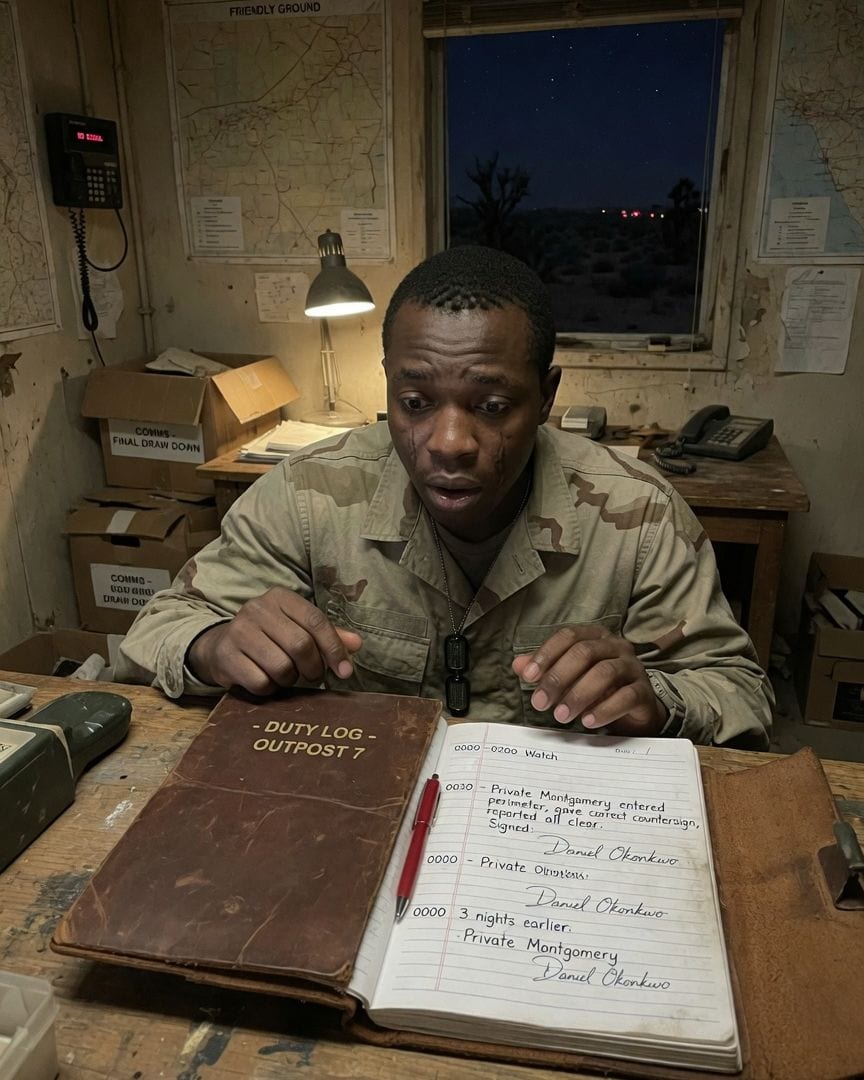
On Private Okonkwo's last desert watch, a soldier with an unnatural smile appeared. Then the duty log showed his own signature, confirming an entry he never made.
Private Daniel Okonkwo was counting minutes on his final watch at desolate Outpost 7, eager for dawn and a long-awaited trip home before the base closed for good. The familiar desert night offered little comfort, its vast emptiness usually reassuring, but tonight held an unsettling quiet. As his starlight scope swept the sparse treeline, a figure in their uniform stepped from the absolute dark, raising a hand with the correct recognition signal—and an unnatural, wide smile. Later, Private Okonkwo found his own unmistakable signature in the outpost's duty log, confirming a 'Private Montgomery' had entered the wire during his shift, an event he knew never happened. With the last convoy disappearing, who—or what—had signed his name to a lie, and why?
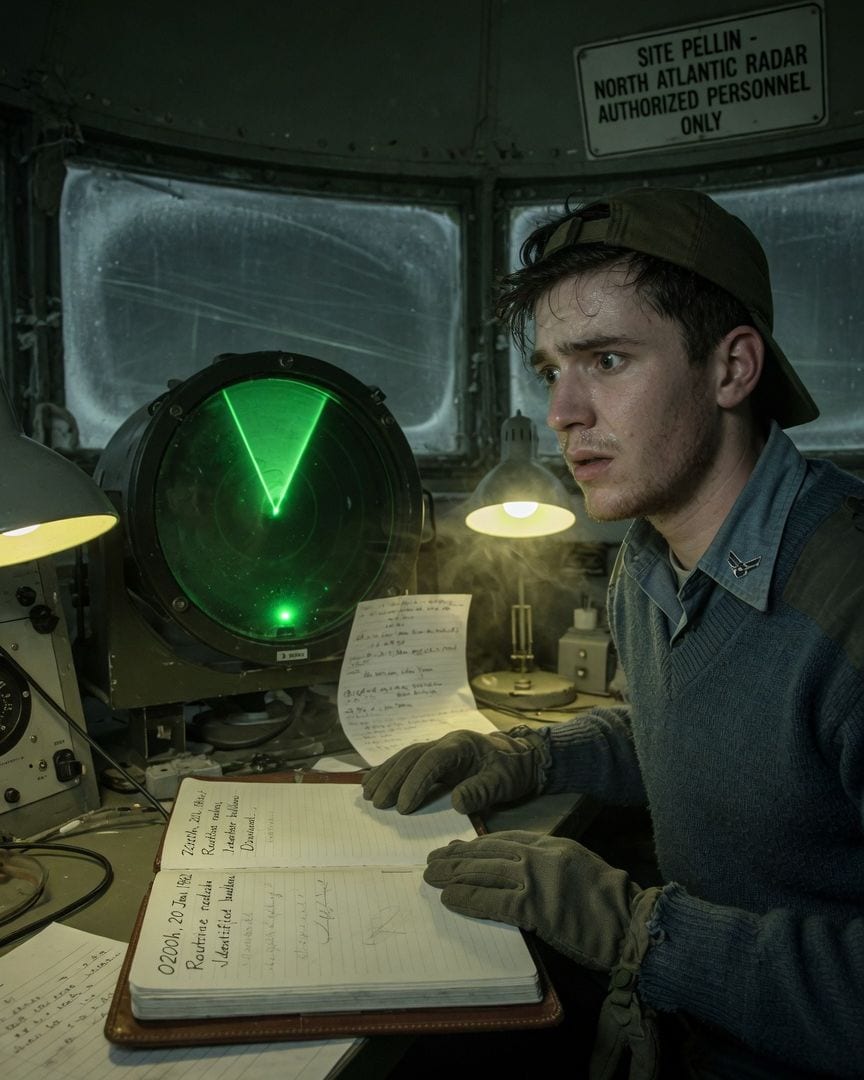
Nine days from closing, Cold War Site Pellin's Airman Vance watched his radar track a solid blip moving closer, dead in open sea where nothing could exist.
In the dimly lit dome of Site Pellin, Airman Ordway Vance, just days from discharge, ran his final radar sweeps before the base closed for good. Outside, the North Atlantic wind howled, but inside, only the hum of his console broke the silence. His last calibration had been clean, yet a single, unwavering green blip appeared on the scope, forty miles out, in open water where no vessel should be. The impossible return moved closer with each sweep, defying all logic and other sensors, until it sat static just beyond the coast fence line. What unseen presence did the radar truly hold in its unwavering green grip, contradicting the official record?
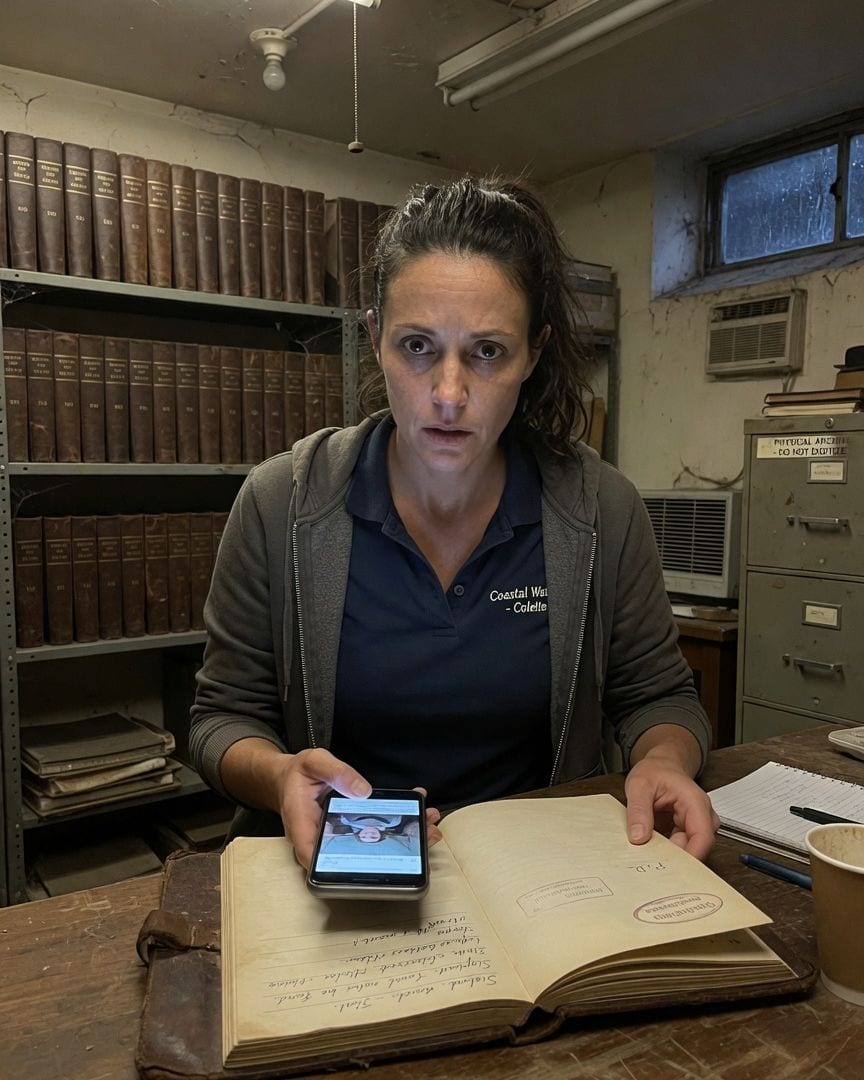
My coastguard log noted Sighting 9 again tonight, a light where no vessel showed. The old logs carry Sighting 9 off Skerry Point at 3:14am every tenth year since 1954, always 'nothing found,' always 'send no boat.'
On my watchtower night shift, the radar screen glowed green and the ocean was quiet. Then, a familiar light appeared off Skerry Point, exactly on cue, just as it had every tenth year for decades. But digging deeper, I found a hidden stamp in an old logbook: 'Operation Skerry. Status: Complete.' It left me with a chilling sense of finality.
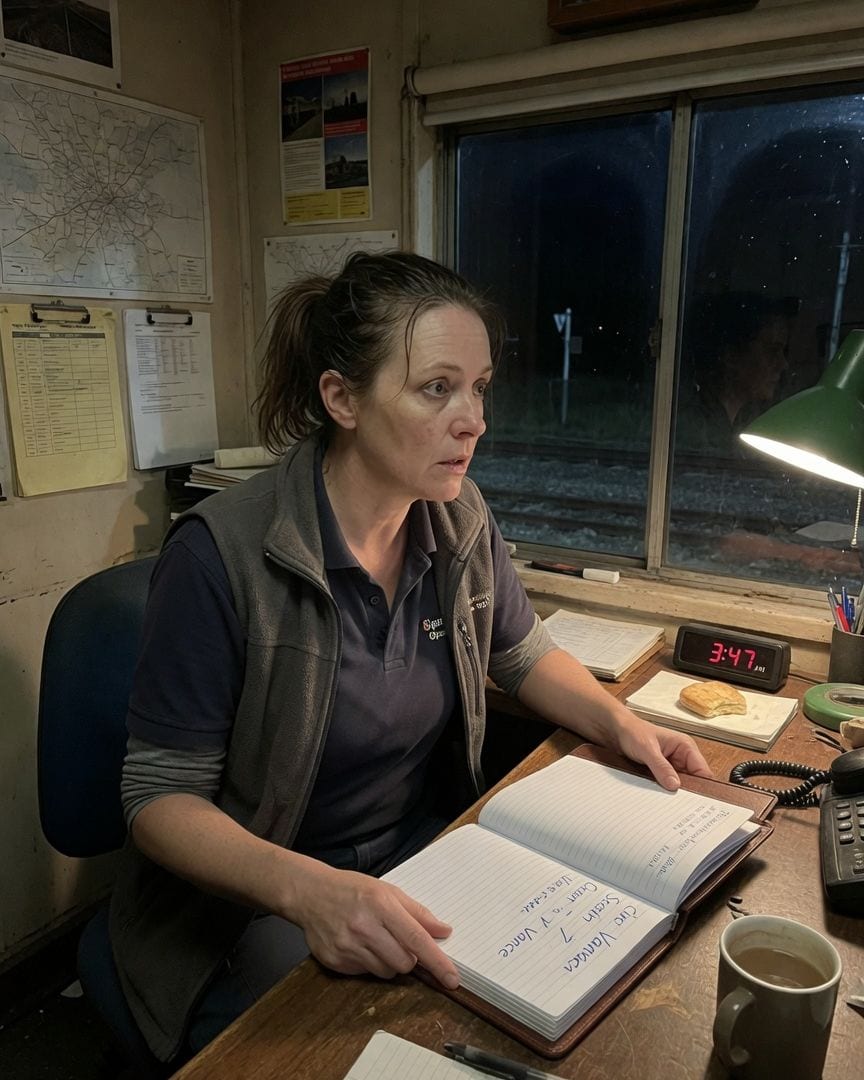
My linesman taps twice on my window at 3 AM. Control says he retired and passed years ago.
My routine at the rural signal cabin was regular: the linesman's double tap on the window at 3 AM. But then my supervisor called, revealing the linesman I knew, Warren Vance, had died five years ago. Now, an impossible entry in my official logbook, with his signature and timestamped from my shift, proves someone else was there.
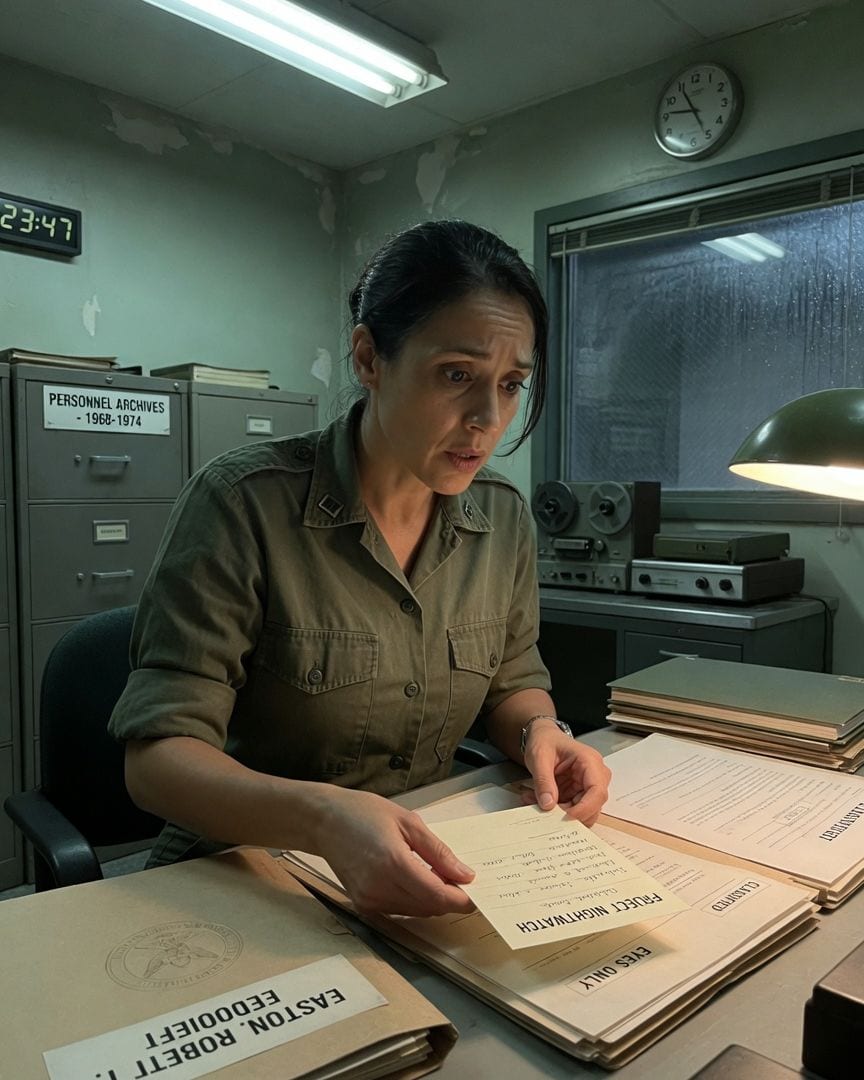
A Cold War tower controller logs an object vanish from radar, then hears the pilot scream it’s filling his windscreen. Her own name, 'Bardolph, Ines', now marked 'Observed' in a secret file.
Captain Ines Bardolph, a tower controller, was counting down the months until her transfer to Langley and the decommissioning of her base, hoping to leave behind the unsettling incidents of her final posting. But one night, her radar scope showed an impossible blip, solid and unwavering, 40 miles north of the Danube, only to vanish in less than a second, leaving a pilot screaming in terror. Despite the clear evidence, the official report blamed "atmospheric inversions," while the terrified pilot received a glowing review and promotion, his file meticulously scrubbed of any anomaly. As Captain Bardolph reviewed the pilot's pristine record, she found a hidden slip of paper, revealing a chilling truth: 'Subject: Bardolph, Ines. Status: Observed.' Was she merely an observer of the impossible, or was she now part of something far more sinister?