On his last rotation, Airman Kowalski heard a pilot cleared for landing by a tower that had vanished decades ago.
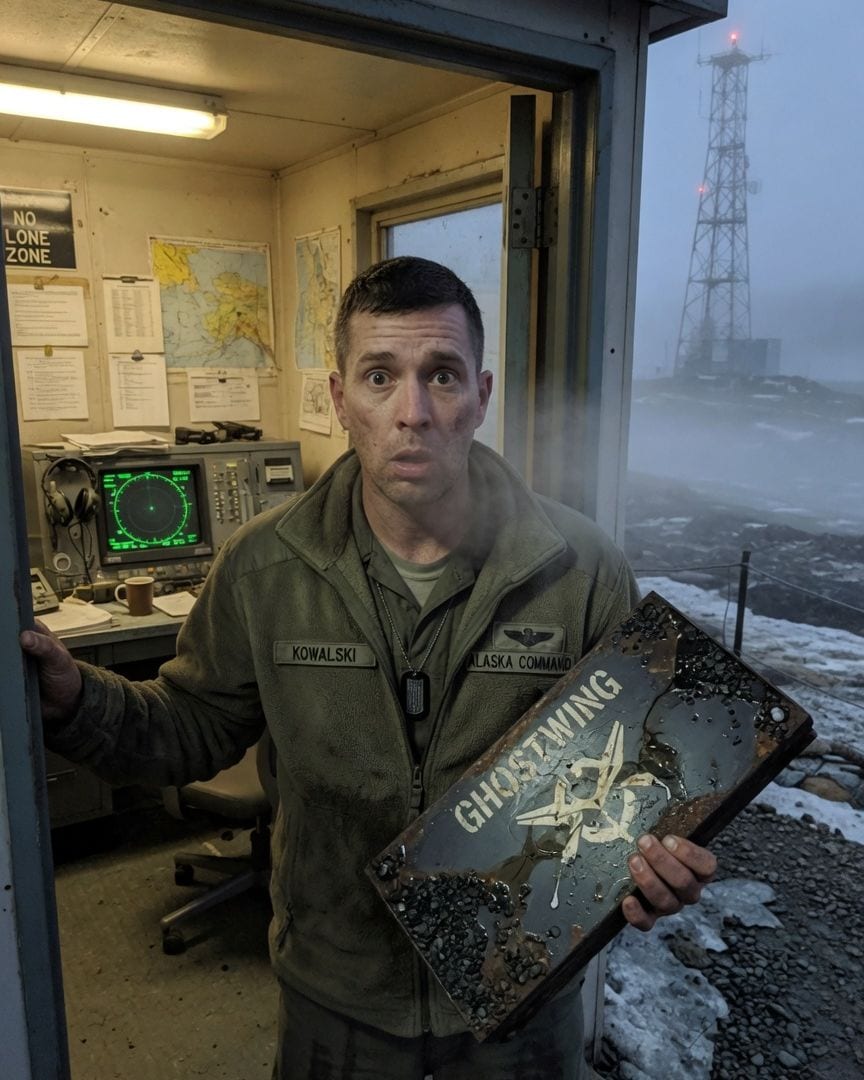
Airman Eric Kowalski sat alone in the dim glow of the relay station atop Mount Chugach, the Aleutian fog a thick shroud outside his window.
His last rotation before transfer was almost done, and the silence of the empty airwaves was a familiar comfort. He leaned back in his worn chair, the low hum of the equipment a constant companion.
Suddenly, his headset crackled to life, not with static, but with two voices, clear and urgent. A pilot declared a full emergency, engines failing, and a controller, calm despite the crisis, talked them down with practiced precision.
The exchange was textbook, ringing with a chilling authenticity. "Flight 7-0-Alpha, you are cleared for an emergency approach, Runway Two-Six, expect crosswinds." "Two-Six, roger. Losing hydraulic pressure fast." Kowalski’s blood ran cold. There was no aircraft in his airspace.
Not a single blip on his radar screen. And the controller’s facility, he knew, had been decommissioned decades ago, buried under a layer of history and permafrost.
The pilot acknowledged a safe landing, the controller signed off, their voices fading like ghosts. Then, in the profound silence that followed, a third voice, calm and deep, cut through the static, addressing him directly.
“Sowell, did you get all that?”
Kowalski ripped off his headset, heart pounding against his ribs. Sowell? That wasn't his name. He ran a diagnostic on his console, checking the relay logs; nothing. The equipment diagnostics ran clean, reporting optimal functionality across all bands.
He tried to rationalize it, pushing the impossible event to the edges of his mind. Fatigue, perhaps. The long hours, the isolation of the outpost.
Or maybe a prank, some rogue signal ghosting from a distant frequency, playing tricks on his ears. But the clarity of the voices, the precision of their exchange, and the impossible question persisted, refusing to be dismissed.
He knew the Aleutian airwaves intimately, their quirks and their silent stretches. This wasn't a glitch. This felt entirely, fundamentally wrong.
Driven by a gnawing unease that refused to settle, he decided on an unscheduled perimeter check. It was a breach of protocol, sure, but he needed fresh air, something to shake the lingering feeling of dread.
The fog had thinned to a damp mist as he stepped outside, revealing the jagged, ice-covered slopes of Mount Chugach. The cold bit at his exposed skin, a welcome shock of reality.
He walked the wire fence that enclosed the station, his breath pluming in the frigid air. As he rounded the base of the main relay tower, his boot caught on something protruding from a patch of melting permafrost.
He knelt, scraping away the slush and gravel. It was a piece of metal, dark and strangely shaped, unlike any modern component he had ever seen.
Even in the biting cold, it hummed faintly, a low, almost imperceptible vibration against the frigid air.
Kowalski pulled the object free. It was surprisingly heavy, cold from the ice, but a faint, internal warmth seemed to pulse from it, an almost imperceptible vibration against his palm.
He brushed away more dirt, revealing faded, intricate markings etched into the metal: a symbol he didn't recognize, and a partial, archaic call sign—'GHOSTWING.' This wasn't a piece of local debris, nor was it anything from the base's inventory.
This was something else entirely, something that shouldn't exist, and it felt profoundly, terrifyingly wrong. He clutched it, his breath clouding in the cold, the impossible object now a tangible link to the impossible voices.
Back inside, Kowalski placed the artifact on his desk, its faint hum now a low thrum against the quiet. The sound seemed to fill the small room, a counterpoint to the distant howl of the wind outside.
He spent the next few days in a desperate, covert search, using the station's limited, outdated archives. He cross-referenced the 'GHOSTWING' marking, the archaic design, the material composition of the dark metal.
He found nothing in standard military records, no unit, no experimental craft.
Expanding his search to historical aviation, sifting through microfiche and digitizing ancient documents from the station’s neglected storage, he eventually stumbled upon a heavily censored, obscure technical manual for a highly experimental jet project from the late 1960s.
The codename emblazoned on its yellowed cover: 'Ghostwing.'
The manual detailed a specific, advanced flight recorder component – a component that bore an unsettling resemblance to the artifact on his desk, down to the oddly shaped vents and the peculiar alloy.
The project was officially decommissioned without ever seeing active service, especially not in the Aleutians. The official story stated that no 'Ghostwing' ever flew outside a controlled test range, let alone crashed in Alaska.
Yet, the artifact was here, on his desk, humming. He found a single, vague reference in a declassified report to a 'lost flight' during the project's testing phase, with all details heavily classified, obscured by black redaction marks.
The ordinary explanations for what he had heard, for what he held, were dissolving with every new piece of information he unearthed.
Kowalski’s persistent, unusual queries into obscure military history didn't go unnoticed. Days after his deep dive into the 'Ghostwing' project, his secure terminal chimed with an incoming call from an encrypted line.
Major Thornton, a regional command officer Kowalski had never spoken to, his voice clipped and precise, was on the other end. "Airman Kowalski," Thornton began, his voice devoid of any warmth, "we've noticed some... atypical data access from your station.
Your interest in historical anomalies, specifically regarding Project Ghostwing, is noted. Is there a reason for this deviation from your operational duties?" There was no direct threat, but the underlying warning was palpable, a chilling undercurrent in his calm tone.
Kowalski stammered a half-truth about a personal interest in aviation history, the words feeling thin and transparent even to himself. Thornton's response was chillingly calm, delivered with the practiced ease of someone who knew more than he would ever say.
"Your service record is exemplary, Airman. We trust you understand the importance of discretion. Certain histories are best left undisturbed. Carry on with your duties." The line clicked dead, leaving a ringing silence in the small room.
Kowalski felt a cold knot in his stomach. He wasn't just investigating a mystery; he was being watched. He checked his system logs, finding faint traces of remote access, a shadow in the digital periphery.
Someone knew what he was looking for, and they were trying to stop him.
Undeterred by Thornton's thinly veiled warning, a sense of urgency now driving him, Kowalski reached out to an old contact, a tech sergeant at a larger base known for his ability to navigate obscure digital archives.
After several tense days of waiting and coded messages, a heavily encrypted file landed in Kowalski's inbox – a declassified, yet still extensively redacted, incident report. He devoured it, his eyes scanning for keywords. 'Project Ghostwing.' 'Aleutian Incident.' 'Lost communication.'
The report detailed a catastrophic test flight in 1968, the experimental jet, call sign 'Ghostwing,' experiencing critical systems failure over Mount Chugach.
The pilot, Lieutenant Commander Richard Muller, and his ground controller, Sergeant Audrey Fontaine, maintained communication until the very end, their voices recorded in some long-lost black box, their ground facility ultimately destroyed in the ensuing chaos.
The report confirmed the exact date and time of the incident, aligning perfectly with the phantom transmission Kowalski had heard. The anomaly wasn't a glitch or fatigue; it was a re-enactment, a persistent echo of a forgotten tragedy.
The air in the relay station seemed to grow heavy, as if the past was pressing in.
A chilling detail jumped out from a small, almost overlooked footnote: a brief mention of previous reports of 'phantom signals' from the Mount Chugach relay station, always dismissed by higher command as atmospheric interference or operator fatigue.
Kowalski stared at the dates, a pattern forming, a terrifying coherence to the impossible event he had witnessed. His own experience wasn’t isolated; it was part of a terrifying, recurrent loop.
As Kowalski scrolled through the supplementary files attached to the declassified report, a new document materialized on his screen: a scanned copy of an old, faded station log from Mount Chugach.
He recognized the familiar layout, the handwritten entries for duty rosters and incident reports. The paper itself seemed fragile, almost transparent with age. He began to cross-reference the dates of the 'phantom signal' reports mentioned in the main document.
Each one corresponded to an entry in this log. And next to each date, a name, a note. 'Airman Felix Sinclair, reassigned to undisclosed facility.' 'Airman Oscar Russo, reassigned to undisclosed facility.'
The phrase 'reassigned to undisclosed facility' appeared again and again.
And then, his blood ran cold. An entry for 1968, just weeks after the 'Ghostwing' incident: 'Airman Thomas Sowell, reassigned to undisclosed facility.'
The last line, scrawled in a different hand, squeezed in at the bottom, read: 'Reported persistent, interactive phantom comms.' Kowalski remembered the voice from the static, calm and deep, asking, 'Sowell, did you get all that?'
It wasn't asking him for his name. It was asking them. It had been asking Airman Thomas Sowell, all those years ago. He looked at the date of Sowell's 'reassignment,' then at the current date.
The pattern was clear, terrifyingly cyclical. And the next blank space in the pattern was now.
The artifact on Kowalski's desk, the 'Ghostwing' flight recorder fragment, began to hum louder, its internal glow intensifying. The sound vibrated through the desk, rattling the coffee cup at his elbow.
The relay station's systems flickered, the monitors displaying garbled data, the communication channels filled with a rising tide of static.
The 'voices' from the phantom transmission were clearer now, no longer just an echo but a chorus, panicked and desperate, calling out Richard Muller's name, then Audrey Fontaine's. The air grew colder, thick with an almost electrical charge.
Kowalski realized the anomaly wasn't merely replaying a past event; it was a loop, an unfinished circuit, and the artifact was the key component, drawing energy from the active relay to try and complete itself.
The 'Ghostwing' incident wasn't just a crash; it was a moment frozen in time, trying to break free, searching for a way out of its perpetual re-enactment.
The previous airmen, the 'Sowells' and 'Sinclairs' and 'Russos,' hadn't been reassigned; they had been absorbed, their consciousnesses drawn into the loop, becoming part of the chorus of the lost, their names now tools for the anomaly.
The entity needed a live conduit, a mind to complete the final, desperate transmission, to bring the 'Ghostwing' home. And now, as the static intensified, it was calling his name, not 'Sowell,' but 'Eric.'
The artifact pulsed, a beacon drawing him in, promising something profound and terrifying.
The hum of the artifact became a deafening thrum, vibrating through the floor, rattling the metal panels of the relay station. Loose papers skittered across his desk.
The voices were a cacophony now, swirling around Kowalski, calling his name, promising understanding, completion, a final resolution to the endless loop.
He staggered towards the main console, fighting a strange, compelling pull, a yearning to answer, to join the chorus, to finally understand.
The relay's main power conduit pulsed with an eerie, orange light, feeding the artifact, acting as a direct channel for the anomaly. He had to sever the connection.
He reached for the emergency shutdown switch, but his hand felt impossibly heavy, resisting him, as if another will guided it.
The artifact glowed with an blinding orange light, projecting phantom images onto the walls of the small room: a cockpit view of a spiraling plane, the earth rushing up, a controller's frantic face distorted by static.
He saw the face of the 'Sowell' from the old log, his features contorted in a silent scream, then fading into the static, his eyes wide with a terrible understanding.
This wasn't a recording; it was a living, hungry thing, reaching for him, demanding him.
With a primal roar, Kowalski wrenched his hand free from the unseen grip, grabbed a heavy wrench from beneath his console, and brought it down with all his might on the glowing artifact.
The metal shrieked, sparks showered, and the hum abruptly cut out, replaced by a profound, ringing silence that seemed to absorb all other sound.
But as the light died, he felt a chilling, lingering echo in his own mind, a sense of having almost stepped across the threshold, a whisper of a final, desperate flight plan that was now irrevocably etched into his deepest consciousness.
Days later, the relief crew found the Mount Chugach relay station silent and dark.
Eric Kowalski was discovered slumped against the console, catatonic, his eyes wide and vacant, the shattered remains of the strange artifact scattered nearby like dark, broken glass.
He was medically discharged, sent home in a haze of official secrecy and hushed medical reports that spoke of severe psychological trauma.
The station was permanently decommissioned, its equipment dismantled, the mountain left to the fog and the ice, its secrets once again buried.
Kowalski never spoke of what happened, his eyes distant, his spirit irrevocably altered by the impossible truth he had faced. He carried the silence of the mountain within him.
Eric Kowalski lived quietly with his sister, Lorraine, in the years that followed. He was withdrawn, rarely spoke, and often stared blankly at the sky, as if searching for something unseen.
His family attributed it to trauma, the isolation, the sheer stress of military life. They hoped he would heal, that time would soften the edges of whatever horror he had endured.
One night, Lorraine heard him talking in his sleep from his room. Not to himself, but in hushed, calm tones, responding to an unheard voice, the words a low murmur of technical jargon.
He spoke of atmospheric pressure, of vectors, of a safe landing. Then, in the silence that followed, he stirred, opened his eyes, and looked directly at the wall, a faint, wrong smile touching his lips.
He whispered, clear as a radio transmission, "Did you get all that, Lorraine?"
If this one got to you
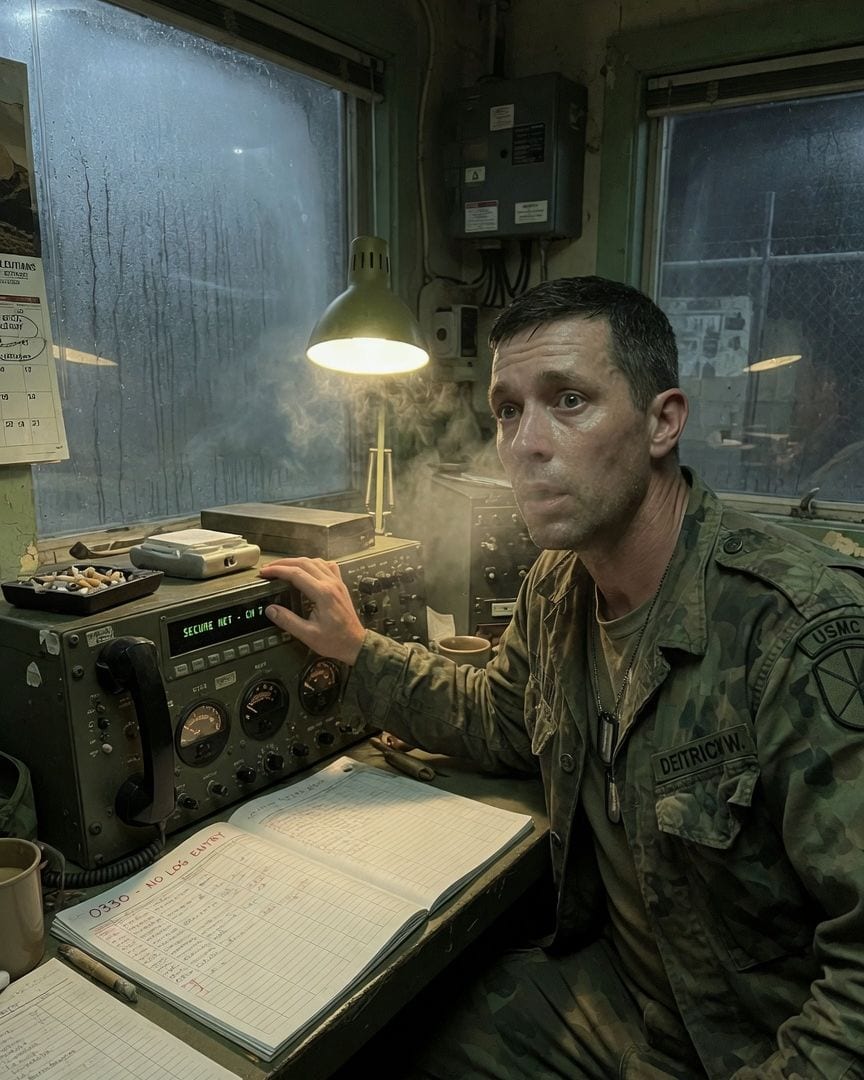
A corporal finds a dog tag with a name read on his secure channel, but no one by that name is on the outpost roster.
Corporal Warren Deitrick was accustomed to quiet watches at the remote Aleutian outpost, the rhythmic hiss of static a familiar companion. But at 0330, a sharp, clean click cut through the silence on his secure net, and a flat, emotionless voice began to read the outpost's roster, name by name. The voice paused, then announced "Corporal Warren Deitrick." Shaken, the corporal later found the radio logs showed no record of the transmission, an empty channel. His unease solidified when an unscheduled perimeter check revealed unfamiliar boot prints leading into the dense fog, ending at a cold, muddy dog tag bearing a name not on any current roster: SULLIVAN, J.
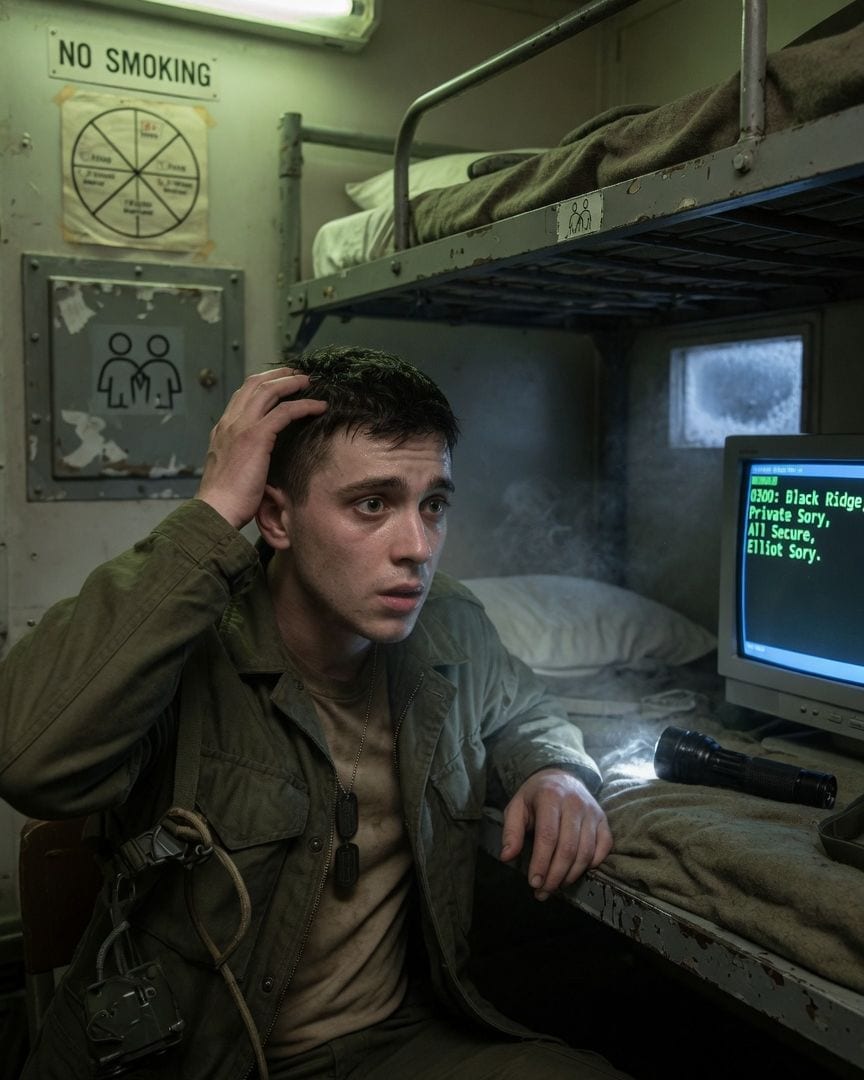
Private Sory's own voice answered his radio check, speaking his name before he could. Then the official log swore he had said it.
Private Elliot Sory shivered in the cold comms shack, three weeks into his first remote posting at Black Ridge. He knew the outpost's strange, strict rule: never say your name on the net after dark. But during his solitary 0300 radio check, a voice undeniably his own filled his headset, stating 'All secure, Elliot Sory,' before he'd even finished keying the mic. The official log later confirmed the transmission, showing no sign of his attempt to speak, only the seamless record of his name being broadcast. What force in the desolate outpost had spoken for him?
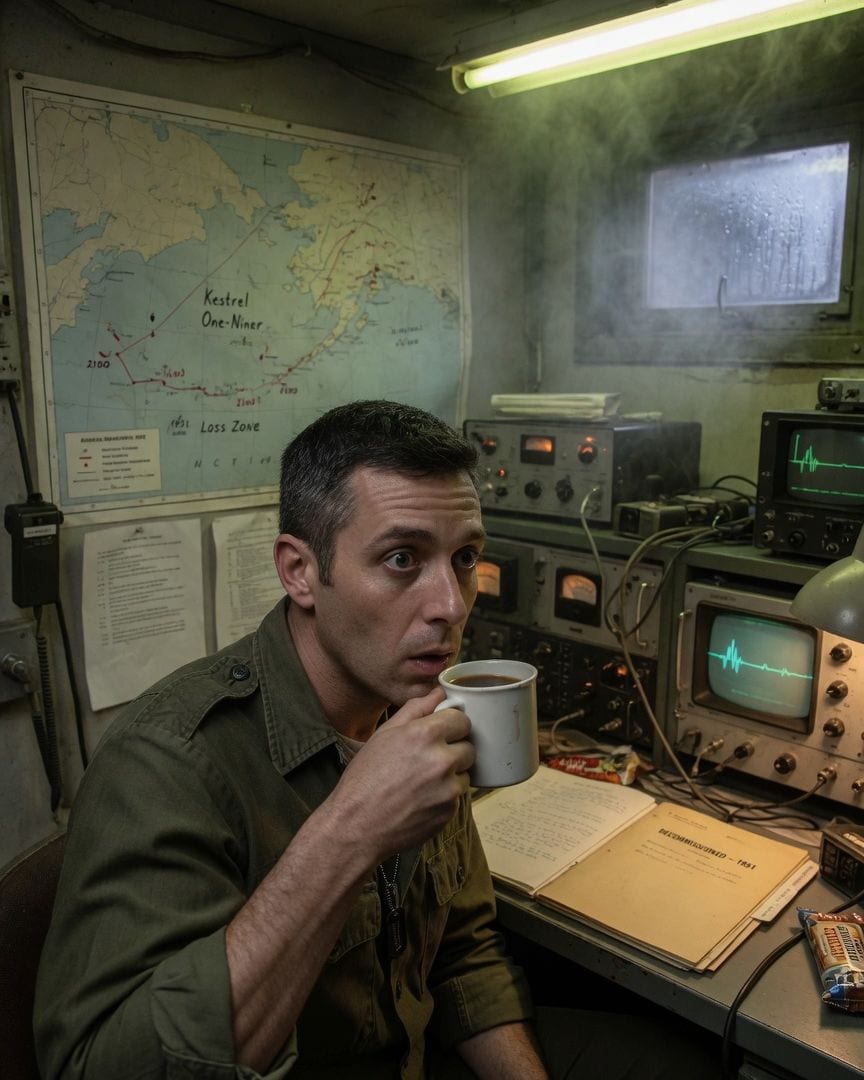
A communications lieutenant hears a Cold War reconnaissance plane, lost in 1951, transmitting clear reports seventy years later.
Lieutenant Aaron Suvak's shift in the isolated Aleutian communications bunker was usually quiet, a lonely vigil against the thick, silent fog that had closed the strip. But precisely at 2000 hours, the low hum of his radio equipment broke with a clear, professional voice. The signal came from "Kestrel One-Niner," a Cold War reconnaissance plane officially lost over the Bering Sea in 1951. Suvak plotted its impossible progress across his old paper chart, realizing the signal wasn't a glitch, but the same plane, still transmitting its route seventy years later.
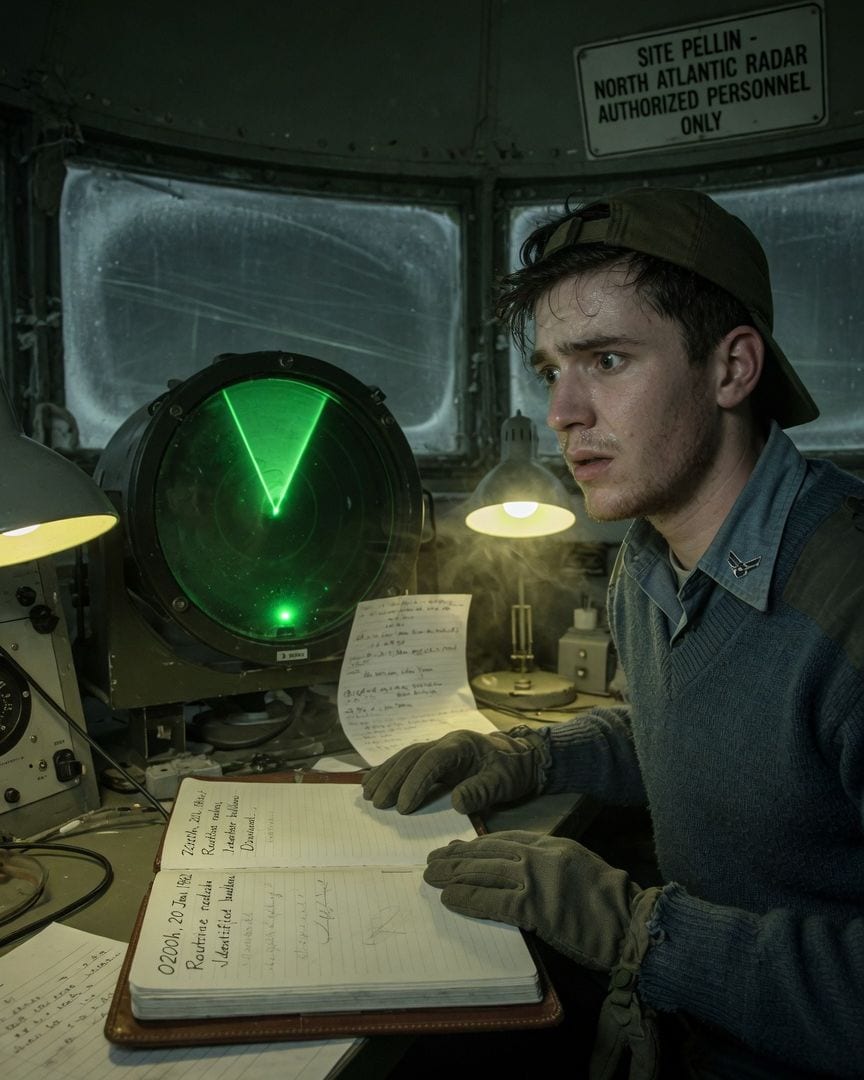
Nine days from closing, Cold War Site Pellin's Airman Vance watched his radar track a solid blip moving closer, dead in open sea where nothing could exist.
In the dimly lit dome of Site Pellin, Airman Ordway Vance, just days from discharge, ran his final radar sweeps before the base closed for good. Outside, the North Atlantic wind howled, but inside, only the hum of his console broke the silence. His last calibration had been clean, yet a single, unwavering green blip appeared on the scope, forty miles out, in open water where no vessel should be. The impossible return moved closer with each sweep, defying all logic and other sensors, until it sat static just beyond the coast fence line. What unseen presence did the radar truly hold in its unwavering green grip, contradicting the official record?
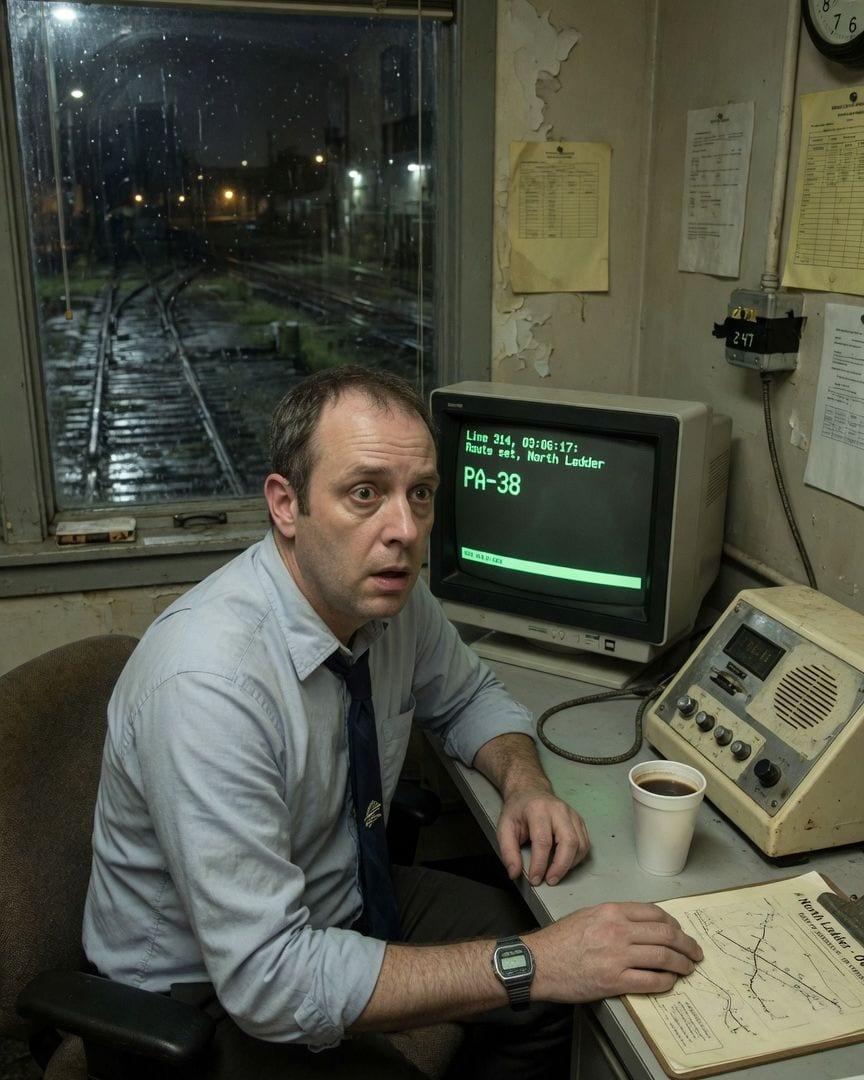
The log says my lever set a route at 3:06 AM through a track that's been shut for repair work — and the circuits show something moved down it. I never touched that lever; I sat there still.
I, Preston Abbott, a night dispatcher, was running a routine signal log check when I saw my code had set a route. It was for the North Ladder, a track decommissioned twenty years ago and physically impassable. Then, the yard's old, physically severed intercom system crackled to life, whispering a specific routing instruction for that very track.
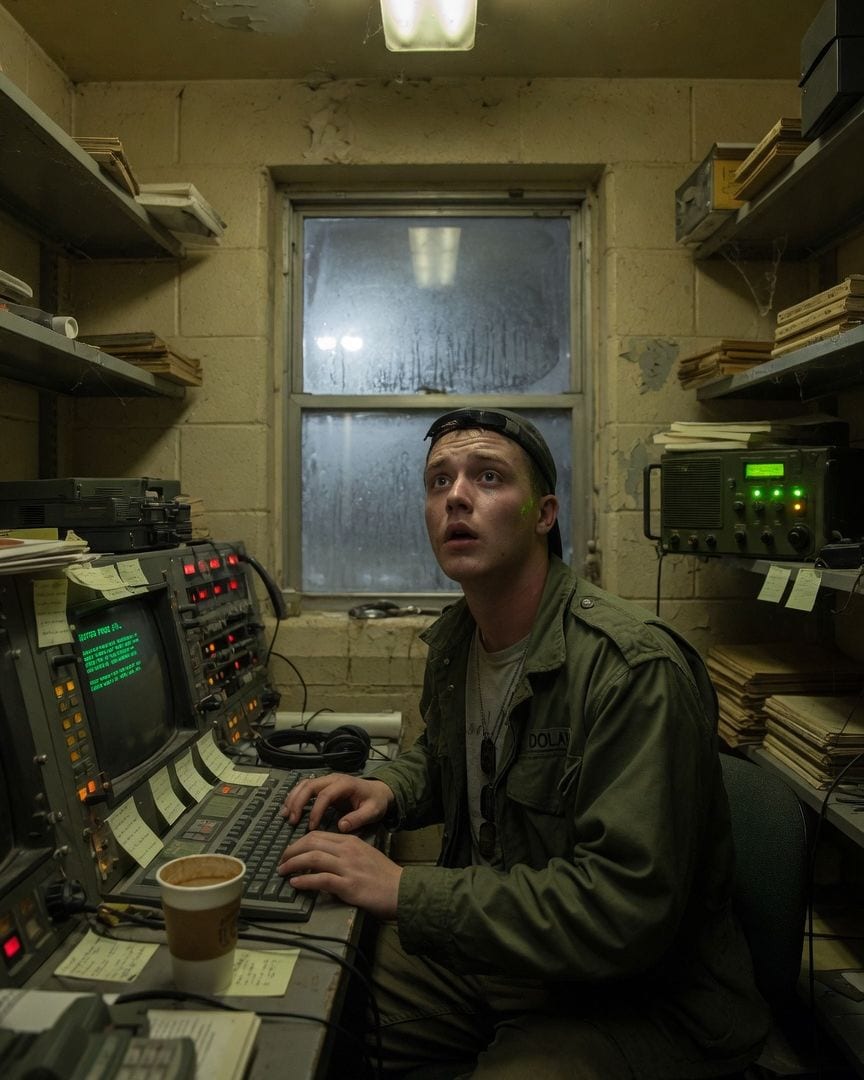
On his last watch, Specialist Dolan heard a dead soldier's voice from an old radio, a week too late.
Specialist Raymond Dolan was on his final watch at Firebase 7, a remote mountain outpost swallowed by a thick, oppressive fog, before its permanent closure. The fire-direction center should have been silent, but strange calls began routing directly to his console, reporting an enemy element in the draw where the 'Ghost Patrol' was lost just a week prior. While Control heard only Dolan's voice echoing into a void, the panicked voices in his ear were terrifyingly real. As he tried to purge the system, an old, unpowered field radio on a dusty shelf inexplicably powered on, its small light glowing green. From its speaker, the voice of Private Abigail Foster, a soldier from the Ghost Patrol, burst through—a week-old transmission, a final warning from the dead.