On his last watch, Specialist Dolan heard a dead soldier's voice from an old radio, a week too late.
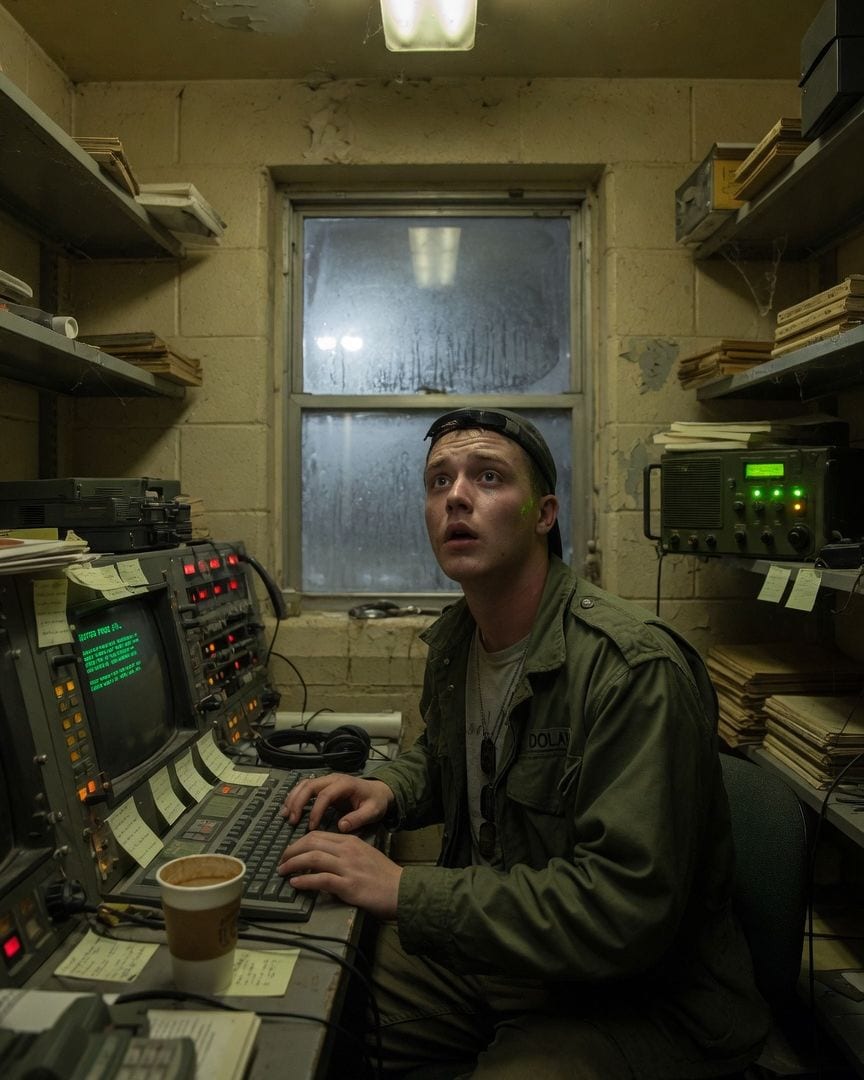
Specialist Raymond Dolan, 24, hunched over the main console in Firebase 7's fire-direction center, felt the damp chill of the fog-choked mountain seep into the room.
It was nearly midnight, his last watch before the base closed for good, and the FDC was supposed to be quiet.
Outside, the fog pressed against the windows like a thick, gray shroud, muffling all sound, making the remote outpost feel even more isolated. The silence had been absolute for hours, the kind that hummed with its own oppressive weight.
Then the calls began. They didn't route through the main network, didn't pass through Control as they should have.
Instead, they cut directly to Dolan's console, bypassing the net's single control station, crackling into his earpiece like raw static given voice.
Each call came from a different observer post, each in a distinct voice, distorted by the interference but unmistakably human.
And each one reported the same thing: an 'enemy element' moving through the narrow draw to the west—the draw where the 'Ghost Patrol' had been wiped out just a week before. Panic laced every word.
Dolan frowned, tapping his earpiece, a jolt of adrenaline cutting through his fatigue. This wasn't standard procedure. He keyed his mic, trying to route the incoming signals, to establish proper protocol. "Control, this is FDC.
Why are you letting the OPs talk over the top of you? I'm getting direct feeds from Observation Posts Three, Seven, and Eleven."
Sergeant Marco Sullivan, 32, answered, his voice tinny and edged with irritation, a familiar weariness that came from overseeing a base in its final days. "FDC, this is Control.
We've had lost comms with every one of those posts for hours, Dolan. They're dead silent on our end. We've been sitting in silence, listening to you talk to no one, relaying phantom reports. What exactly are you picking up?"
Raymond felt a cold knot tighten in his stomach. He looked at the flashing indicators on his console, the spectral voices still crackling in his ear, reporting coordinates, movements, a growing crescendo of terror.
He was talking to them, they were talking to him. But Control heard nothing but his own voice echoing into a void.
A prickle of unease snaked up Raymond’s spine.
He tried to rationalize it – fatigue from too many long shifts, a failing comms unit struggling in the damp mountain air, maybe even a twisted prank by the departing crew, though that last thought felt wrong, disrespectful.
No one joked about the Ghost Patrol. He pushed it away. The calls had been too specific, the fear in the voices too real, too raw.
He ran a full diagnostic on his console, watching lines of code scroll across the screen, his fingers flying over the keys. The FDC’s internal logs, mirroring Control’s external net, confirmed no incoming calls from those observer posts.
Nothing but outbound signals from his own mic, responding to voices that, officially, weren’t there. Yet, as he scrolled through the raw data streams, a faint, almost subliminal echo of the voices seemed to register within the internal recording system.
It wasn't audibly clear, more like a ghost in the machine, a pattern of data fluctuations that suggested speech, but without any corresponding external audio signal.
He shook his head, blaming static interference, a faulty sensor, anything but what his ears had heard so vividly.
His gaze drifted to a forgotten corner of the comms room. On a dusty shelf beneath a stack of defunct, yellowed field manuals, a piece of old equipment lay half-hidden.
It was an olive-drab field radio, a chunky RT-524, a model he recognized from grainy photos in historical documents. It looked like something from decades ago, a relic out of place amidst the sleek, modern comms gear.
Dust motes danced in the dim overhead light around it. "Just junk," he muttered, dismissing it, thinking it was probably slated for scrap.
But a strange cold spot seemed to emanate from its direction, a pocket of damp, heavy air that defied the room's steady climate control, sending a shiver down his back.
He pulled his jacket tighter, telling himself it was just a draft from a poorly sealed window, or his own mounting weariness.
Determined to clear whatever phantom data lingered in the system, Raymond decided to purge the FDC's internal buffer.
He initiated the command, watching the progress bar fill slowly across his main screen, hoping to erase the impossible echoes from the system entirely. He wanted a clean slate, a rational explanation.
As the system purged, a sudden, sharp crackle ripped through the FDC's speakers. It wasn't from the main console, nor from his earpiece. It came from the old field radio on the shelf.
Raymond froze, his fingers hovering over the keyboard, his breath caught in his throat. The radio, which should have been dead, completely unpowered and obsolete, was now inexplicably powered on.
Its small, round indicator light, usually dark, glowed a faint, impossible green, a dim beacon in the gloom of the comms room.
Then a voice, distorted by static and sheer terror, burst through the radio's tinny speaker, echoing in the suddenly silent FDC. "It's coming... through the draw... God, they're everywhere..."
Raymond’s blood ran cold. He recognized that voice with a sickening certainty. He’d heard it just days ago on the official, recovered comms logs from the Ghost Patrol’s final moments, reviewed in a morbid, mandatory debriefing.
It was Private Abigail Foster, 21, her last transmission, playing from a radio that shouldn’t have been there, or working, at all. And it was a week too late.
Raymond Dolan stared at the old field radio, his heart thundering a frantic rhythm against his ribs, a drumbeat of pure adrenaline. The green indicator light flickered once, then settled into a steady, impossible glow, defying all logic.
He recognized Foster's voice from the Ghost Patrol's official comms logs, a chilling sound he hadn't wanted to hear again, now amplified by the impossible circumstances.
Carefully, as if touching something fragile and ancient, he reached out and picked up the olive-drab radio. It was heavy, worn, its casing scarred with faint scratches and dried mud, the kind that might have clung to it for years.
An RT-524, indeed, a model he’d seen in museums, phased out decades ago. Yet, as he listened closely, he could hear the faint, frantic static of an open channel, clearly tuned to the Ghost Patrol's old frequency.
It was functional, somehow. And it shouldn't have been.
He felt a desperate, primal need to show it to someone, to prove he wasn't imagining things, wasn't succumbing to fatigue or stress.
He found Sergeant Sullivan, who was sorting through an overflowing box of decommissioning paperwork in the main office, looking even more haggard than usual.
"Sergeant," Raymond began, his voice a tight whisper, holding out the radio, "you need to see this. Hear this. It's Foster's radio. It's working. I just heard her last transmission."
Sullivan, already stressed by the impending base closure and the mountain of logistics, barely glanced at the ancient object. He waved a dismissive hand, not even looking up from his forms. "Probably some old gear left behind, Ray.
Power surge, static discharge, who knows. Just junk. Don't go chasing ghosts, son. We've got enough real work to do without you inventing problems." He gestured vaguely at the piles of forms, clearly wanting to be left alone.
Unconvinced, Raymond retreated. Sullivan's casual dismissal only fueled his resolve, making the hairs on his arms stand on end. He knew what he’d heard. He knew what he held in his hands.
He returned to the FDC, the old radio cradled in his arm, and began digging through the firebase's archived records, specifically after-action reports for the Ghost Patrol incident.
He found Abigail Foster's name, her service number, confirming it was indeed her radio, or at least one issued to her unit. He cross-referenced the RT-524 model with old equipment manifests. It shouldn’t have been here.
It should have been recovered with her body, if it hadn't been destroyed.
As he delved deeper into the faded, brittle files, the stench of dust and old paper filling his nostrils, he stumbled upon fragmented mentions of other 'lost comms' incidents in the same draw. Always during heavy fog.
Always coinciding with accelerated base closures or transfers. The records were sparse, often heavily redacted, but the pattern was too specific, too recurring, to be coincidence.
The dates stretched back decades, hinting at a hidden history the official reports stubbornly ignored. The pattern began to feel less like a series of unfortunate events and more like a deliberate, cyclical nightmare.
As Raymond's investigation deepened, the FDC began to feel less like a safe haven and more like a stage, the audience unseen but ever-present.
The air grew heavier, colder in patches, as if an invisible curtain had fallen, isolating him within the room.
The main console, on occasion, would flicker, displaying phantom 'contact' pings originating from the draw, only to clear them milliseconds later, as if the system itself was trying to hide something, or struggling to process data that contradicted its own logic.
Raymond would tap the screen, restart the diagnostics, but the ghost pings never registered in the permanent logs. They were fleeting, ephemeral, but he saw them, indisputable evidence of something profoundly wrong.
One night, while reviewing a particularly sparse after-action report from an incident in the 70s—another 'lost patrol' in the draw, during a heavy fog—a sudden, profound chill swept through the FDC.
It wasn’t the usual damp cold of the mountain seeping in; this was a deep, internal cold that seemed to emanate from within the very walls, raising the hairs on his arms and the back of his neck.
He heard a faint, rasping breath behind him, too close, a sound like dry leaves skittering across pavement, or parched lungs struggling for air.
He spun around, his flashlight beam cutting a frantic arc through the shadows that clung to the corners of the room. The shelves, the empty chairs, the silent equipment – the room was empty.
But the feeling of being watched, of not being alone, was palpable, a heavy weight on his shoulders, an icy prickle at his nape.
He felt an intense, irrational urge to call out to the presence, to demand it reveal itself, but a colder, wiser part of his mind, the part that had heard Foster’s voice, kept him silent.
Later, tucked into the spine of a dusty field manual from a similar incident twenty years prior – a manual he’d pulled for its vague mention of 'environmental interference' in the draw – he found a faded, handwritten note.
It was almost a whisper on the brittle page, folded several times, the ink bled into the paper like old blood. The words were stark, unsettling, penned in a shaky hand: 'They answer back. Don't listen.'
Raymond clutched the note, the words burning into his mind. He found Sergeant Sullivan again, still wading through paperwork, but this time Raymond was insistent.
He slapped the faded note onto Sullivan's cluttered desk, then recounted the phantom pings, the cold spots, the rasping breath he'd heard. Sullivan, initially attempting his usual dismissive calm, faltered.
He picked at a loose thread on his uniform, his gaze darting away from Raymond’s intense stare, a subtle tremor in his hand.
"Look, Ray, these old places… they have stories," Sullivan mumbled, trying to wave him off again, his voice lacking its usual conviction.
Raymond pressed him, his voice low and firm, betraying the fear coiling in his gut. "This isn't a story, Sergeant. This is active. Calls from dead men. My console showing contacts that aren't there.
A radio that plays a last transmission a week late. And this." He tapped the note, its message echoing in the quiet office. "'They answer back. Don't listen.' What does that mean, Sergeant?"
Sullivan finally sighed, the pretense crumbling completely, leaving him looking older and more tired than his 32 years.
He leaned back in his chair, rubbing his eyes with a weary hand, the sound of paperwork rustling around him the only interruption to the heavy silence. "Alright, alright. You're not going to let this go, are you?"
Raymond just looked at him, unblinking, his gaze unwavering. Sullivan exhaled slowly, a long, ragged breath. "There are… rumors. About the draw. About 'echoes' from lost patrols. Something that happens during the heavy fogs.
The brass, they always chalk it up to equipment failure, bad morale, mass hysteria, whatever. They write it off as the mountain messing with soldiers' minds. But some of us… we know better."
Sullivan's voice dropped, hushed, almost ashamed. He confessed that Firebase 7's decommissioning wasn't just about age or budget cuts.
It was a quiet abandonment, a cut-and-run operation due to the recurring 'anomalies' that spiked during fog, always centered on the draw. "It's why we're out here in the middle of nowhere, Ray. Hidden. Forgotten.
Because nobody wants to deal with it."
He confirmed Raymond’s deepest fear. "Abigail Foster's field radio… yeah, it was hers. Standard issue for her patrol.
It was supposed to have been recovered with her body, with all the other gear, but it was never found at the site. Just vanished. Like it was never there to begin with."
Sullivan’s eyes, grim and tired, finally met Raymond’s, holding a depth of knowledge that chilled Raymond to the bone. "The calls you heard? They’re real. But they’re not from the living. They’re from… something else.
Using their voices, caught in a loop. It’s like the place is trying to complete a circuit, Ray. Pulling in anything that can still hear. Anyone who listens too closely."
The truth, as Sullivan delivered it, was a cold, hard knot in Raymond's gut, tightening with each word. He knew.
The impossible calls, the old radio, the phantom pings – it all fit into a horrifying, impossible mosaic that now formed a single, coherent picture.
The draw was a place of perpetual echo, a loop that ensnared the dead, or worse, something mimicking them, endlessly replaying their final terror.
And the base, Firebase 7, was not just on a mountain; it was on the edge of an abyss, a place of impossible, terrifying recursions.
He retreated to the FDC, the silence of the room now a suffocating weight, the knowledge of what he was dealing with pressing down on him.
Driven by a desperate, morbid need to understand more about these 'echoes' and the historical anomalies Sullivan had hinted at, he pulled up an archived, heavily redacted manifest from a lost patrol incident in the same draw, dated 1983.
The screen glowed with an eerie blue light, illuminating the faded names, some barely legible through the digital haze of the old scan.
He scanned the list, his eyes searching for any pattern, any familiar thread, his mind racing through the fragments of old reports he'd read, searching for a connection, a way out.
His breath hitched. Near the bottom, beneath a smear of age and static, one name stood out, stark and unmistakable in its block lettering: 'Dolan, Raymond.'
His own name. Raymond Dolan. On a manifest from decades before he was even born. He stared, frozen, the room suddenly colder than the mountain fog outside, a chill that had nothing to do with drafts or failing heating.
It was a cold that had seeped into his very bones, a profound, existential cold that told him he was already part of something he could not escape.
Raymond’s own name on the 1983 manifest was a punch to the gut, the air driven from his lungs, leaving him breathless with a horror that transcended logic.
The 'accountability that cannot be' wasn't just about official records being wrong; it was about the system trying to account for something that defied time and death itself.
The names on those manifests weren't just the lost; they were those to be lost, or perhaps, those who had been lost, over and over, caught in a recursive pattern that echoed through decades, a grim roster from which there was no discharge.
The voices, the phantom pings, the impossible calls—they weren't just echoes of the past, but the past reaching into the present, a hungry, invisible hand trying to pull in those whose names were already 'written' into its dark ledger.
The fog was the veil, thickening the barrier between worlds, muffling the screams of the living and amplifying the whispers of the dead.
And the FDC, with its complex comms, acted as a nexus, a point of convergence for these recurring tragedies, a switchboard for the damned.
He remembered the first calls he heard, the desperate voices reporting an 'enemy element' moving through the draw, their fear palpable.
He frantically cross-referenced the exact timestamps of those initial calls from his watch with the Ghost Patrol's last known comms logs. They matched perfectly, down to the second.
The 'enemy' was not an external force, but the patrol itself, or something mimicking their final, horrifying moments, forever replaying their terror for anyone unlucky enough to listen.
He was caught in it now, too, his own name a grim premonition of his place in this impossible history.
The silence in the FDC felt less like peace and more like a predator holding its breath, waiting for its cue.
The realization that his name was on the 1983 manifest, that he was implicated in this recursive horror, sent a jolt of primal fear through Raymond, a terror that resonated deep in his bones.
He was no longer just an observer, an impartial operator; he was a potential victim, pulled into a predetermined fate that had been waiting for him, decades in advance.
His hands trembled as he looked at Abigail Foster’s old field radio again, its olive-drab casing a contrast to the modern equipment.
The battery indicator, which had shown a faint green glow just hours ago, was now completely dead, a dark, empty circle, as if its power had been expended for its purpose.
It was a temporary reprieve, or perhaps a sign that its dark work was done, at least for now.
He ran his fingers over the grimy casing, searching, desperate for any further link, any detail that might offer an explanation, or a way out.
His thumb brushed against a faint, almost invisible serial number etched into the metal, partially obscured by decades of wear and dirt.
With a newfound, chilling clarity, he meticulously wiped away the grime with the cuff of his sleeve and read the faded numbers.
Then, with a cold certainty that made his blood run to ice, he quickly cross-referenced it with the equipment list he’d found attached to the 1983 manifest where his name appeared.
His breath hitched in his throat as the numbers matched perfectly. The serial number on Foster's radio was identical to a piece of equipment listed for 'Dolan, Raymond' on that decades-old manifest.
It was the same radio. Somehow transported across time, or always there, an enduring anchor, waiting for its next owner to claim it from the currents of history. He understood then: the calls he heard weren't just echoes.
They were the anomaly drawing him in, making him part of the loop.
The 'enemy element' the lost patrols reported was not just the Ghost Patrol, or any single unit; it was the recursive nature of the draw itself, a consuming entity, absorbing anyone whose name appeared on its dark roster.
Firebase 7 wasn't just closing; it was being abandoned, and he had nearly become another one of its silent voices, another name on a manifest, forever trapped in the fog.
A chill, heavier than any he had felt before, settled deep in his bones, a cold that would never truly leave him.
A week later, Firebase 7 was systematically torn down. Heavy machinery roared across the fog-choked mountain, razing every building, every structure, leaving nothing but churned earth.
Every piece of equipment, from the smallest comms wire to the largest generator, was removed or destroyed, carted away in sealed containers, ensuring no trace remained.
The entire site was leveled, then covered over, a raw scar on the mountain erased from all but the most obscure, unofficial records.
Sergeant Sullivan was quietly transferred to a desk job far from any mountains or fog, looking older and more haunted than his 32 years, a man who had seen too much.
Raymond Dolan received an honorable discharge, his service record clean, with no mention of the impossible calls, the old radio, or the manifest with his name on it. He never spoke of what happened in the FDC.
Raymond tried to put it behind him, to build a normal life. He married Marie, found a civilian job in a bustling city, and moved far from any remote, fog-choked mountains or military outposts.
But the memory of his name on that old manifest never truly left him, a silent whisper at the edge of his thoughts, a constant, low thrum beneath the surface of his new, quiet life.
Sometimes, late at night, in the quiet of his new home, he would hear faint static in the silence, like a radio searching for a signal, or the distant, distorted whisper of voices, just beyond the edge of hearing, almost an invitation.
He sometimes felt a cold spot pass through a room, a pocket of impossible chill, and for a fleeting moment, he was back in the FDC, listening to calls that weren't there, caught in that endless loop.
He knew the draw was still out there, waiting, a hungry silence in the fog, and that his name was once, inexplicably, on its list.
Years later, his wife, Marie Dolan, noticed him staring out the window, listening to nothing but the night. "What's wrong, Ray?" she asked gently, touching his arm.
He just shook his head, a faint, wrong smile touching his lips, his eyes distant, fixed on something unseen. "Nothing," he said. "Just waiting for a call."
If this one got to you
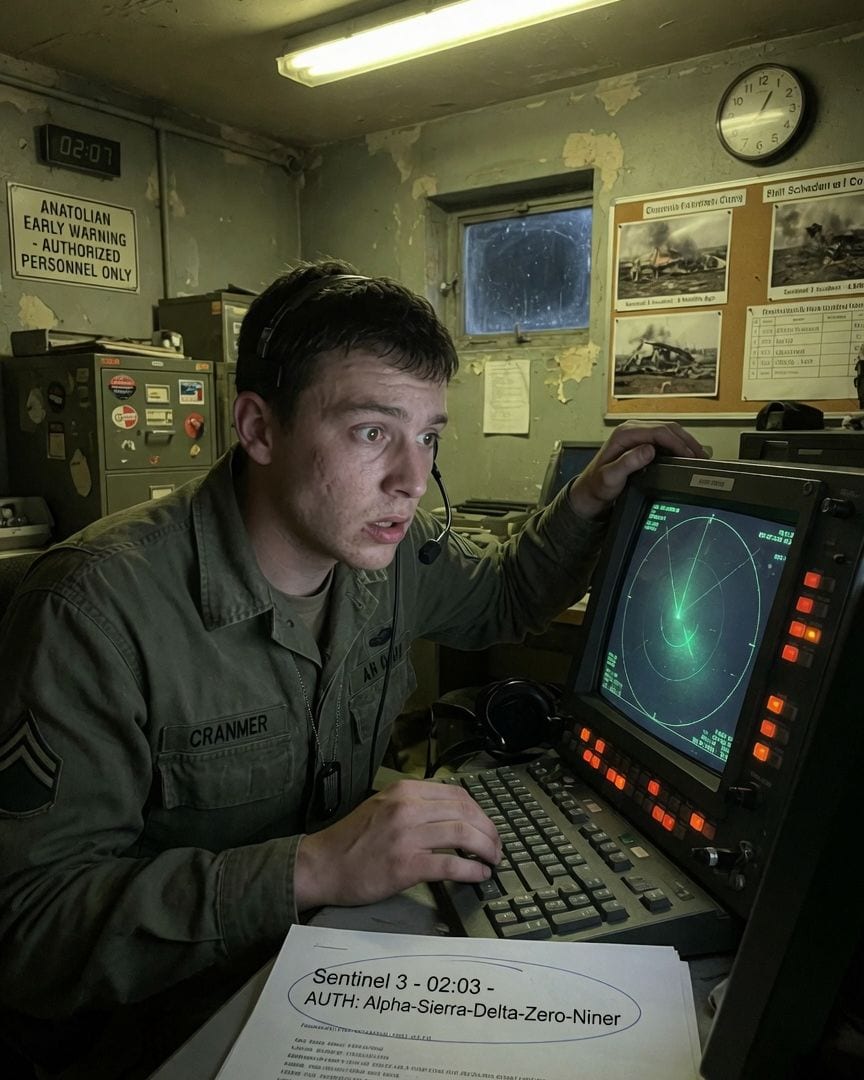
A radar specialist uncovers a dead man's logbook entry, dated two weeks after the fire that killed him. It asks, 'We're still here. What happened to us?'
Specialist Gideon Cranmer, just three weeks from his rotation, endured his overnight watch at an air-defense radar site in the desolate Anatolian highlands. As he monitored his radar console, a secure line crackled with a voice check from Sentinel 3, an adjacent early-warning station. Cranmer's blood ran cold: Sentinel 3 had burned to the ground eight months prior, killing its crew. Yet the voice gave exact coordinates and then whispered, "And has anyone ever found out what happened to us?" Despite his superior's dismissals, the call log confirmed the impossible.
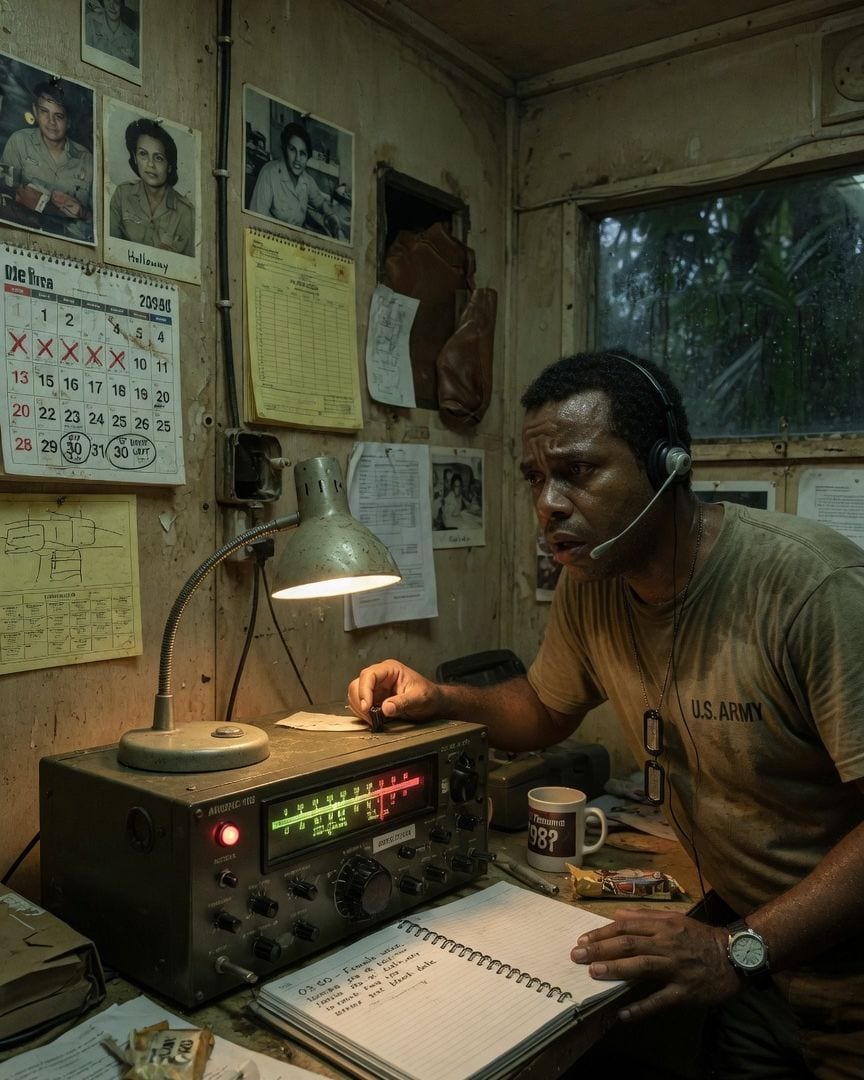
Three months from his tour ending, a sergeant's Cold War radio lists his name with a blank 'ceased answering' date. A hidden logbook warns: 'It knows my name.'
Sergeant Kevin Brooks was three months from finishing his year-long tour at a remote Panamanian jungle station. He meticulously marked each passing day, eager to escape the humid nights and unseen blossoms pressing against the comms shack walls. But at 0300, his old radio crackled to life with a woman's calm voice, listing names of past operators who 'ceased answering.' Then the voice spoke his own name, leaving a chilling blank space where his date should have been. What grim roll call had Sergeant Brooks stumbled upon?
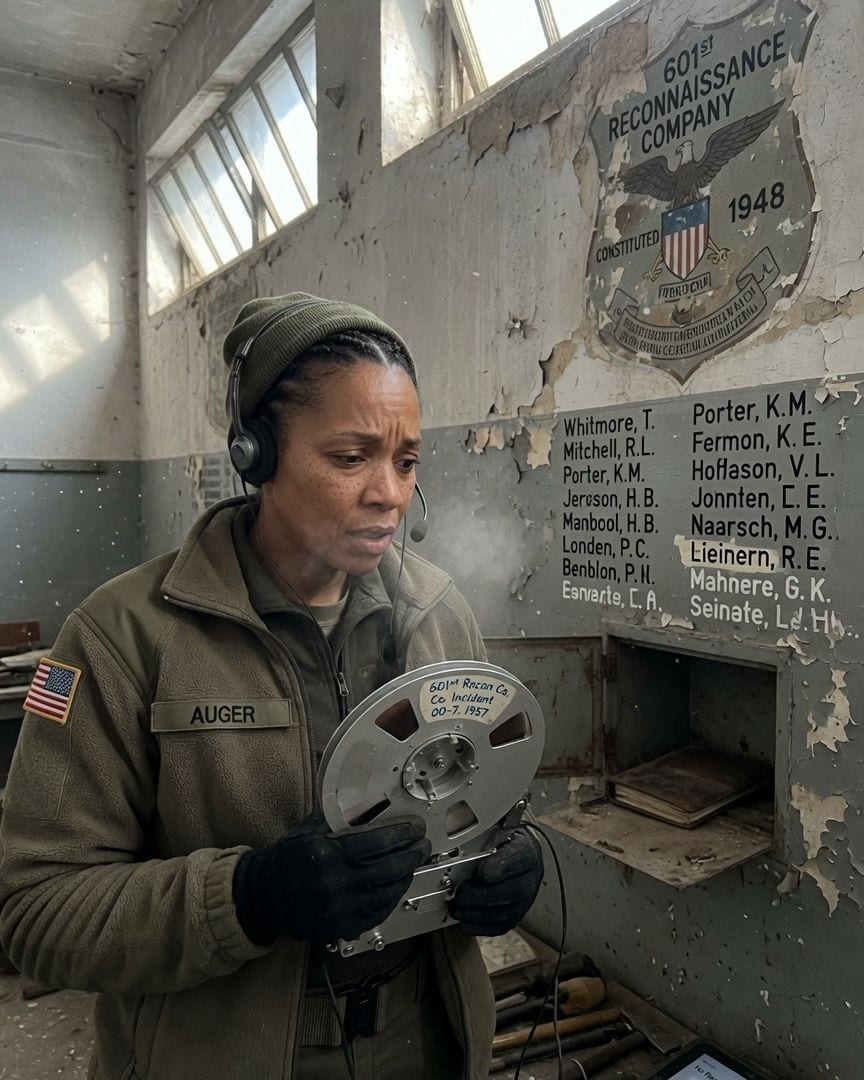
A demolition sergeant found a hidden Cold War tape in a drill hall wall. It played a voice shouting, 'not obeying physics,' then numbers, not human.
Sergeant First Class Delphine Auger was on her final assignment, overseeing the demolition of a Bavarian drill hall before her transfer stateside. While prepping the walls, her team uncovered a unit crest for the '601st Reconnaissance Company,' a designation Delphine knew the US Army had never constituted. Beneath it, a list of a hundred and four names included twelve painted only months ago, the whitewash still tacky under her touch. Her search led to a hidden panel, revealing a reel-to-reel tape that, once played, broadcast a distorted, non-human vocalization, then a frantic voice shouting, 'not obeying physics!' What impossible truth did this ghost unit's tape hold, echoing a service number with terrible finality?
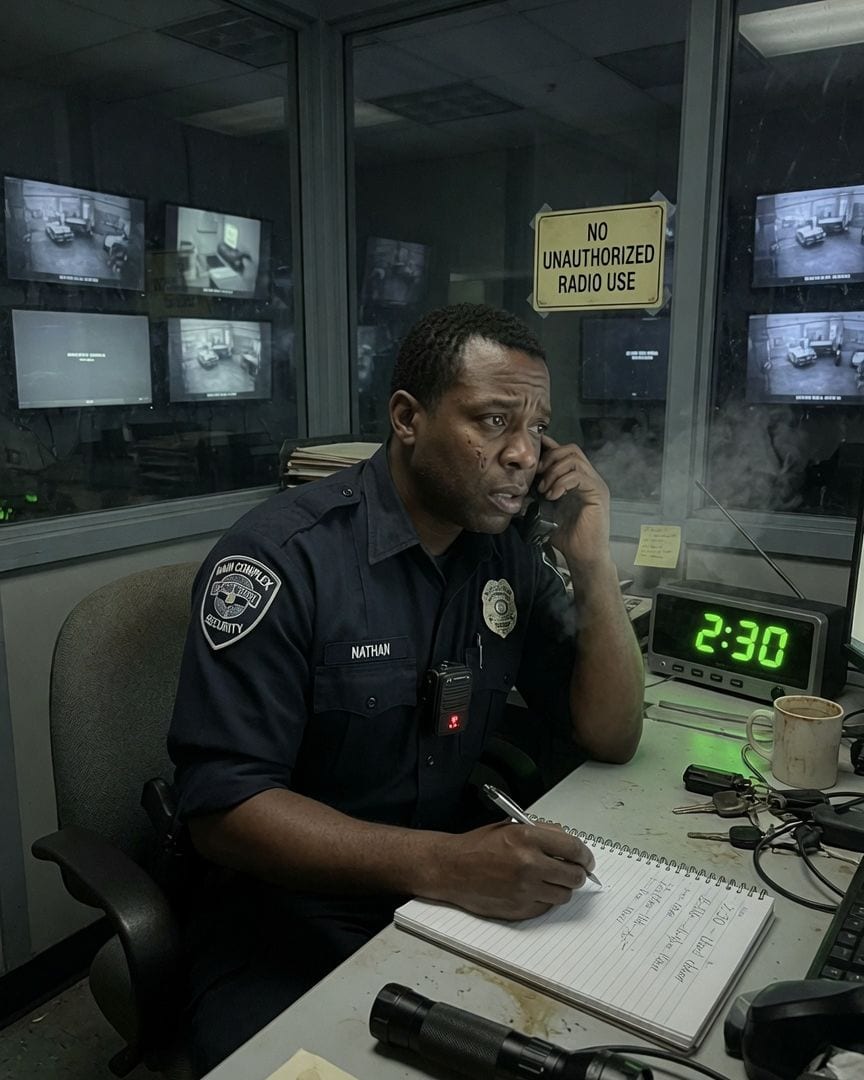
I radio Cole every night. My supervisor says his dock post was cut two years ago, and no Cole exists. But I just found Cole’s old logbook.
My graveyard shift usually consists of monotonous hourly check-ins with Cole, the guard at the loading dock. But my supervisor just revealed that the dock post was cut two years ago, and no one named Cole has ever worked for the company. I've been talking to someone who simply isn't there.
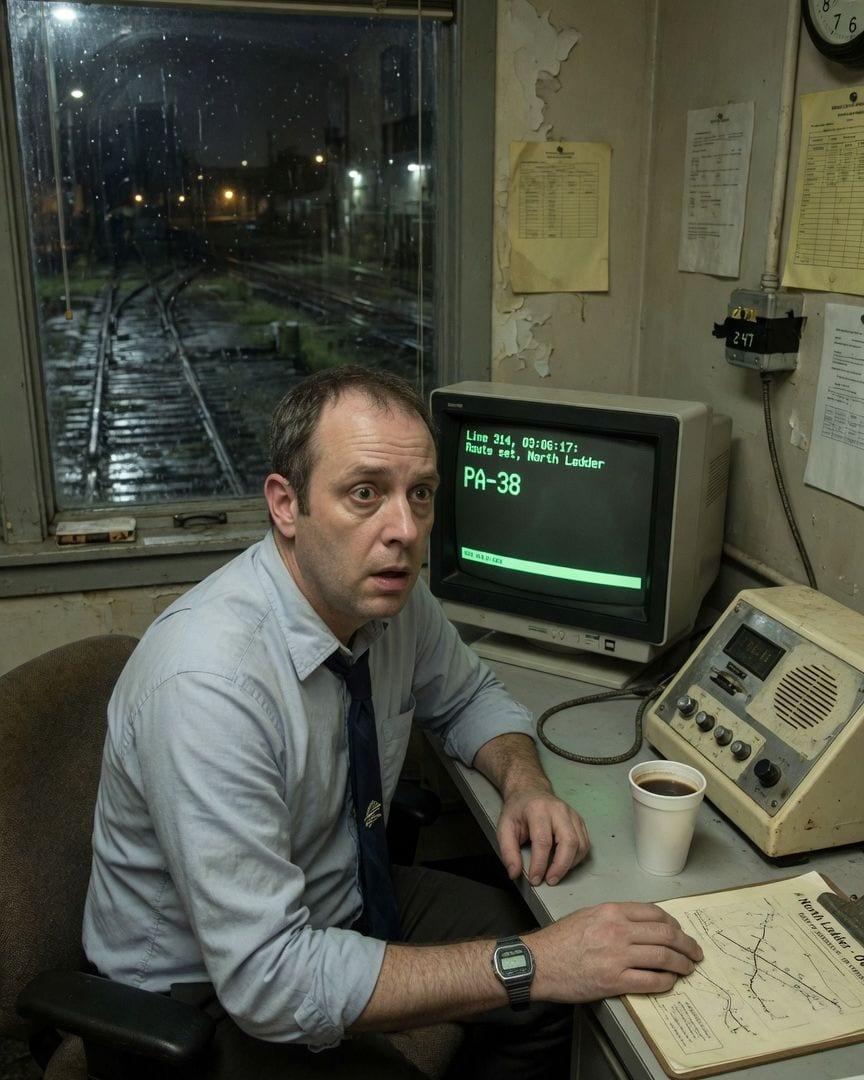
The log says my lever set a route at 3:06 AM through a track that's been shut for repair work — and the circuits show something moved down it. I never touched that lever; I sat there still.
I, Preston Abbott, a night dispatcher, was running a routine signal log check when I saw my code had set a route. It was for the North Ladder, a track decommissioned twenty years ago and physically impassable. Then, the yard's old, physically severed intercom system crackled to life, whispering a specific routing instruction for that very track.
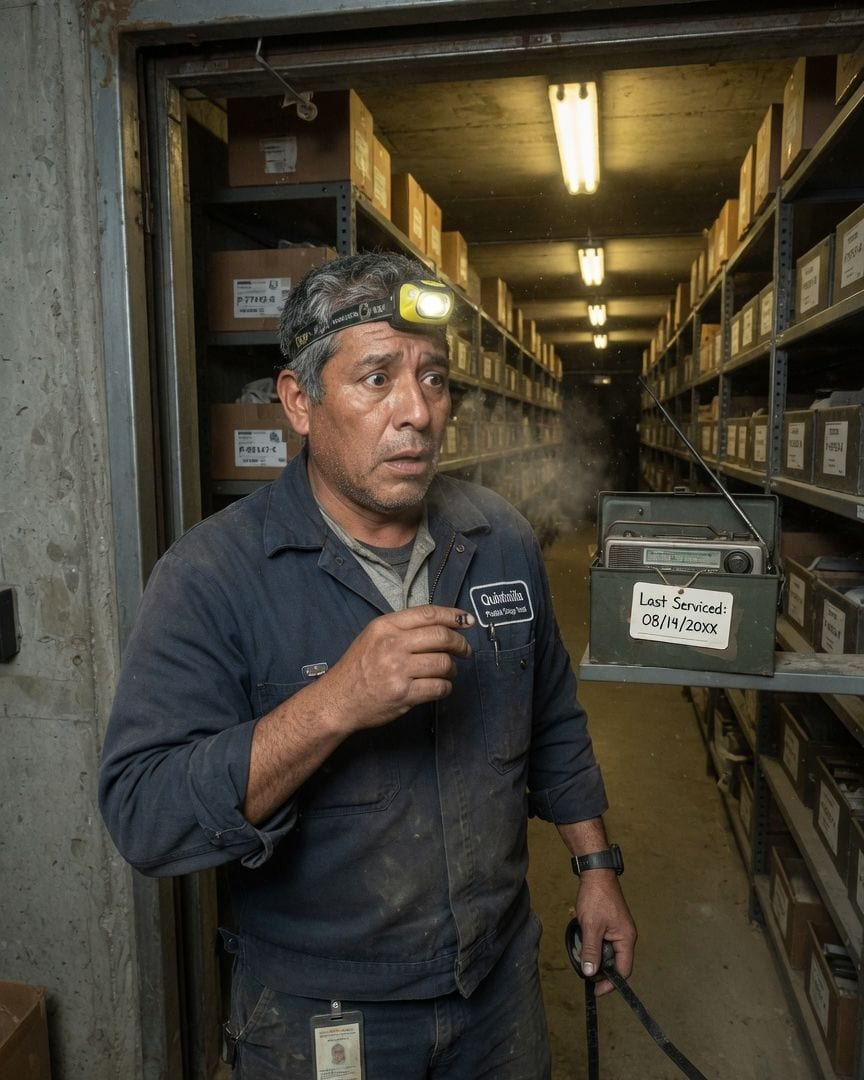
A Cold War bunker worker found a field radio serviced three years in the future, its ink still wet.
Salvador Quintanilla, one of the final two men at the Pueblo storage yard, was tasked with clearing Igloo 7, the last bunker before the facility's imminent closure. As he rolled back the heavy steel door, he discovered not an empty space, but metal racking extending impossibly far past the concrete wall, under the empty prairie, lit by a wan, humming light. Venturing into the profound chill, he found an old field radio with a service tag dated three years in the future, its dark ink still wet to the touch. The radio hummed faintly in his hands, and from deep within the impossible corridor, a metallic click echoed, confirming he was not alone.