A demolition sergeant found a hidden Cold War tape in a drill hall wall. It played a voice shouting, 'not obeying physics,' then numbers, not human.
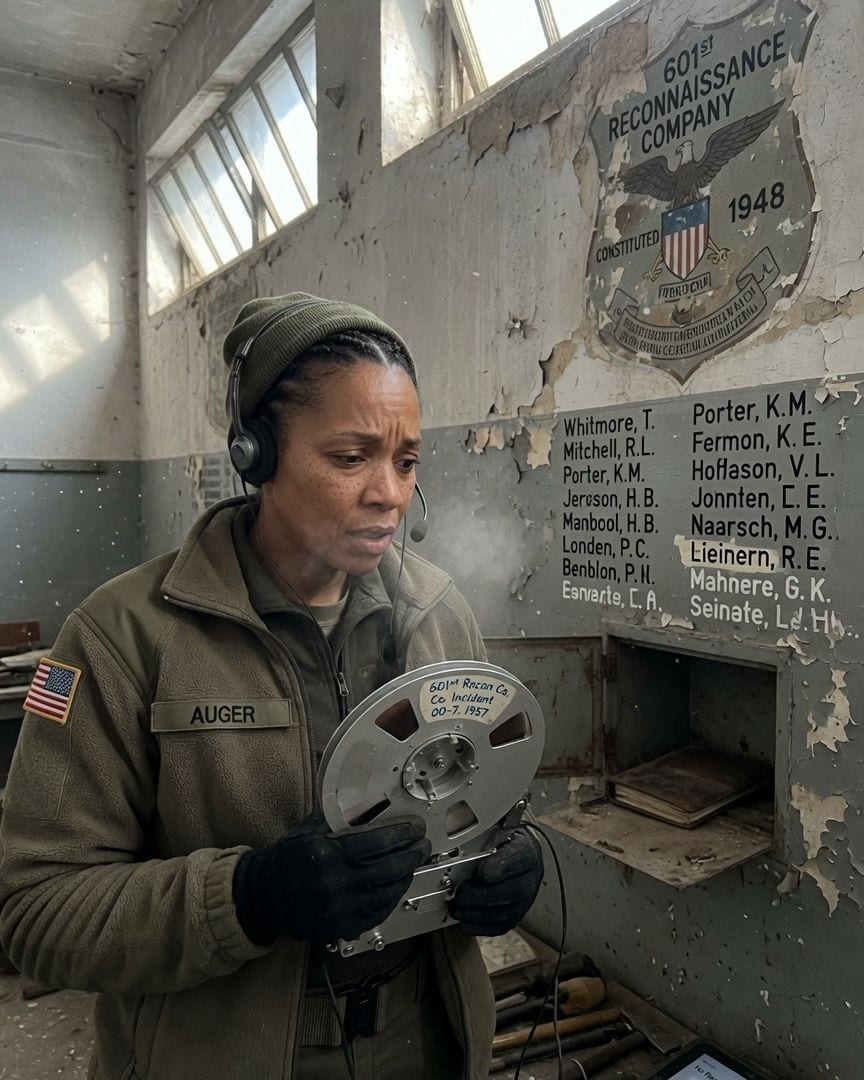
Bavarian winter light came through the drill hall's high windows in bars, illuminating the dust motes dancing in the cold air.
Sergeant First Class Delphine Auger ran a gloved hand over the chipped concrete, the grit of sixty years clinging to her palm.
Her demolition team had until Thursday to strike the building, a final, unglamorous assignment before her own planned transfer to a non-combat role stateside.
They'd been scraping back layers of whitewash, prepping the walls for the charges, when the first impossible detail emerged.
Painted on the far wall, under decades of paint, was a unit crest: a designation, a motto, a constituted date in 1948. The '601st Reconnaissance Company.'
Delphine, methodical and by-the-book, knew for a fact no such unit had ever been constituted in the US Army.
Beneath it, someone had painted a list of names in careful block letters—a hundred and four of them—and the whitewash over the last twelve names was thinner than the rest, almost translucent, because it had been applied much more recently.
Delphine ordered her team to halt work on that section of the wall. She spent the next hour cross-referencing military archives on her tablet, using the drill hall's spotty Wi-Fi.
Every search for the '601st Reconnaissance Company' returned 'No Records Found' or 'Designation Not Assigned.' She tried variations, partial names, the motto, the 1948 date. Nothing.
It was as if the unit had been scrubbed from existence, yet here it was, starkly present on the wall. The names, too, yielded no immediate hits.
They were common enough—Whitmore, Mitchell, Porter—but the sheer number, all associated with a ghost unit, felt wrong. She ran her fingers over the last twelve names, the ones under the fainter whitewash.
The paint felt tacky, still slightly yielding under her touch, despite the cold. It couldn't have been more than a few months old.
Who would bother painting a non-existent unit's crest, then meticulously adding a list of fictional names, only to re-cover the latest entries? And why?
It wasn't a prank; the precision of the block lettering, the official-looking crest, spoke of something else entirely. The drill hall itself was slated for complete demolition; this wasn't an art project for future generations.
As she leaned closer, inspecting a hairline crack near the bottom of the wall, she noticed a faint seam in the concrete, almost perfectly hidden by the crest's lower curve. It wasn't a crack. It was a panel.
Using a pry bar, Delphine carefully worked the edge of the panel. It gave with a soft groan of rusted hinges, revealing a shallow, sealed compartment behind the wall.
Inside, nestled in what felt like a layer of dry, cold ash, were two objects: a water-damaged, leather-bound logbook, its pages stiff with age, and a single reel-to-reel audio tape, its plastic casing brittle, labeled in fading ink: '601st Recon Co. Incident 00-7. 1957.'
A wave of cold, stagnant air, smelling faintly of ozone and something metallic, washed over her. She pulled out the tape, her fingers brushing the brittle plastic. The compartment was empty, save for the logbook and the tape.
No other artifacts, no explanation. Just a blank, echoing space. She found an old portable player in the team's storage. Plugging in headphones, she threaded the tape.
The initial hiss gave way to static, then a faint, distorted vocalization, too low to be human, too patterned to be interference. It was followed by a panicked, human voice, shouting into a microphone, 'Target still on scope!
It's not obeying physics! Repeat, not obeying—' The voice cut out abruptly, replaced by the same distorted sound, which then, impossibly, began to speak, reading a string of numbers.
Delphine Auger stood frozen in the dim light of the hidden compartment, the faint hiss of the reel-to-reel tape player filling the silence, the distorted voice on the recording just finishing reading out a service number that echoed with a terrible, finality.
Delphine quickly removed the headphones, the recorded voice still echoing in her ears. She knew that service number. It belonged to Staff Sergeant Arthur Kingsley, listed as 'Missing in Action, Presumed Deceased' from a training exercise in 1957.
The logbook, though water-damaged, was more legible. Its entries were terse, clinical. '00-7, 1957. Subject: Kingsley, A. Radar operator. Final disposition: Filed.' Other entries detailed similar 'incidents' with different names, always ending with 'Filed.'
The unit's motto, she now saw, was 'We Watch What Doesn't Exist.' One page, dated 1968, contained a crudely drawn symbol—a jagged, inverted triangle with three concentric circles within it—and a code word: 'Project ORPHEUS.'
The logbook made no mention of what was being watched, only the 'filing protocols' for personnel who made 'direct contact' or 'exceeded parameters.' Delphine carefully photographed every page, then sealed the compartment again.
She couldn't bring this to her commanding officer; the official record said the unit never existed, and she had a deadline.
She needed someone who dealt with official records, someone outside her chain of command, someone who might know how to find the unfindable.
She thought of Laura Bishop, a records clerk she'd met during a joint exercise, known for her uncanny ability to navigate obscure military databases.
Delphine sent Laura an encrypted email with the photographs of the crest, the names, and the strange symbol, omitting the audio for now. Laura responded within hours, intrigued but cautious. 'This designation doesn't exist,' Laura wrote.
'But the symbol… I think I've seen something like it before, in old, heavily redacted files. Give me a day.' Delphine felt a cold dread begin to solidify. This wasn't a local anomaly. This was a system.
The next morning, Delphine found a small, almost imperceptible scratch on the lock of her barracks room door. It wasn't a break-in; nothing was disturbed. But it was a sign. Someone knew she had found something.
She dismissed her team for the day, citing equipment issues, and drove to a small, nondescript café in a nearby German village to meet Laura. Laura Bishop arrived, looking pale. She slid a tablet across the table.
'The '601st Recon Company' is still a ghost,' she whispered, 'but 'Project ORPHEUS' isn't.' She showed Delphine a series of heavily redacted PDFs.
Each document, from the 1960s to the late 1990s, was from a different branch of the military—Navy, Air Force, even NASA. They all mentioned 'unaccounted for personnel,' 'system anomalies,' or 'unexplained loss of contact.'
And on each document, almost always in the margins or as a classification stamp, was the jagged, inverted triangle symbol. 'It's a pattern,' Laura said, her voice barely audible. 'Across decades, across classifications. A signature.'
Just then, a man in a dark, civilian coat, sitting alone at a corner table, subtly lowered a newspaper. His eyes, cold and assessing, met Delphine's for a fleeting moment.
He didn't move, didn't react, but the air in the small cafe thickened, feeling suddenly too heavy to breathe. Delphine felt a prickle of ice on her neck. He knew.
Laura, noticing the shift in Delphine's gaze, quickly closed the tablet. 'We need to go,' she urged. As they hurried out, Delphine saw the man making a call, his voice low, his eyes fixed on their retreating backs.
They drove to Laura's off-base apartment, a safe distance from prying eyes. Delphine recounted the audio tape, the distorted voice, the service number. Laura’s face grew grimmer with each detail.
'This isn't just a cover-up,' Laura stated, pulling up more files on her secure laptop. 'This is an active process. The 'filing protocols' you found in that logbook? They're still in use. Just under different names.'
She showed Delphine a declassified report from 2003, detailing the unexplained disappearance of a naval aviator, Marcus Kingsley, during a routine patrol over the North Atlantic. The report concluded with 'Disposition: Filed under Project ORPHEUS, 601-Alpha protocol.' 'Kingsley?'
Delphine asked, the name hitting her with a jolt. 'Arthur Kingsley, the radar operator on the tape, was Staff Sergeant Arthur Kingsley. Is there a connection?' Laura nodded slowly. 'Arthur Kingsley had a son, Marcus. Also military. A pilot.'
The implication was chilling: the 'filing' wasn't just about single incidents; it was a generational shadow. Laura then pulled up a more recent memo, dated last year, from a remote Alaskan radar station.
It described an 'unidentified aerial contact, non-compliant with known physics,' which abruptly 'vanished from scope' after emitting a 'distorted vocalization.' The memo ended with a request for '601-Alpha protocol activation' for the lead radar technician.
'The Thing on the Scope,' Delphine murmured, the phrase from her niche's DNA clicking into place. 'It's been here the whole time. And the names on that wall aren't just a list of the dead.
They're a record of what it took, and what the military knew it took.' The coherence of it all was terrifying.
Every clue, every impossible detail, now locked into place, forming a horrifying picture of an ongoing, systematic disappearance, sanctioned and documented by the very institution meant to protect its people.
Delphine stared at the screen, the weight of the pattern crushing her. 'So, what happens to someone 'filed'?' she asked, her voice barely a whisper.
Laura, her fingers flying across the keyboard, was accessing a different database, one marked 'Personnel Transfer - Special Designations.' 'They're… reassigned. To units that don't exist, to facilities that are off-grid.
Their records are sealed, reclassified, or simply vanish from public view. It’s a way to make them disappear without actually declaring them dead, to keep the anomaly quiet.' Laura's search query hummed, then results began to populate the screen.
'I'm checking for any recent 601-Alpha activations…' Her eyes widened, fixed on a single line that materialized. 'Oh, no.
Delphine…' Laura's face drained of color, her finger trembling on a line in Delphine Auger's digital service file, a line that reads 'SFC Delphine Auger, Pending transfer to special records, per 601-Alpha protocol,' dated two weeks ago, and beneath it, the distinct, impossible symbol from the old logbook.
The blood drained from Delphine's face. 'My name?' she choked out, pointing at the screen. 'That's impossible. I haven't done anything to warrant a… special transfer.' Laura shook her head, frantically closing windows on her laptop.
'This isn't about what you did, Delphine. It's about what you found. The '601st Recon Company' wasn't just tracking the Thing. It was managing its interactions, and covering them up.
The names on the wall, Arthur Kingsley, Marcus Kingsley – they weren't just victims; they were 'assets' who made 'contact' or knew too much. The 'filing protocols' ensure their disappearance is seamless, untraceable. And now you've uncovered their system.
This 'transfer' isn't a reassignment; it's you being 'filed'.' The pattern across decades and classifications, the chilling coherence of it all, detonated in Delphine's mind. The thin whitewash over the last twelve names on the wall.
The scratch on her door. The man in the cafe. It was all connected.
They weren't just erasing history; they were actively managing the present, ensuring that anyone who stumbled onto the truth was quietly absorbed into the very mechanism of secrecy.
Delphine's impending transfer, her personal stake, was now a ticking clock to her own disappearance. She was to become another name, another 'special record.'
The secrecy machine wasn't just a bureaucracy; it was a living, patient horror, constantly signing new entries into its ledger of the lost.
Delphine sprang into action. 'We need to move. Now.' She grabbed her Go-Bag, her mind racing. 'I need a way to get this out, something undeniable.' Laura, surprisingly calm, pulled out a burner phone. 'I have one contact. Marcus Porter.
Retired Colonel, intelligence. He's been chasing whispers of this for years. He won't believe it, not at first, but he'll listen if we give him proof.'
They drove through the Bavarian night, avoiding main roads, Delphine continuously checking her rearview mirror. She could feel eyes on them, the pressure of the system closing in.
They reached a secluded cabin deep in the woods, Marcus Porter's known safe house. Porter, a grizzled man with sharp, weary eyes, met them at the door, a shotgun in his hand.
He listened to Delphine's frantic explanation, his expression unreadable. She played the audio tape, showed him the logbook photos, the recurring symbol, the '601-Alpha protocol' on her own file. Porter's face, initially skeptical, slowly hardened into grim recognition.
'They've been doing this since the war,' he muttered, his voice heavy. 'Always the same signature. Always the same outcome.' He looked at Delphine. 'You're already in the machine, Sergeant. You can't fight it head-on.'
He handed her a small, encrypted thumb drive. 'This is a dead drop. A journalist I trust. Get this to them, along with your proof. Then disappear. You have maybe an hour before they come for you.'
As dawn began to break, Delphine left the cabin, the weight of the thumb drive in her pocket. She knew her career was over, her life as she knew it gone. But she had the proof.
A small, vital piece of the truth, carried at immense personal cost.
Delphine never returned to her base. Her team reported her missing, her personal effects still in her barracks. Her official record was updated: 'Transferred to Special Projects, classified.'
Laura Bishop, after a week of intense internal scrutiny, was quietly reassigned to a remote administrative post, her access to sensitive archives revoked. Marcus Porter's cabin was found empty a few days later, stripped clean.
The drill hall was demolished on schedule, the wall with its impossible crest and names pulverized into dust and rubble. No one ever spoke of the '601st Reconnaissance Company' again.
No official investigation was launched, no questions asked beyond the initial, perfunctory inquiries.
Months later, living under an assumed identity in a small coastal town in Maine, Delphine Auger saw a brief, obscure article online.
It mentioned 'unsubstantiated claims' of a 'pattern of disappearances' within the military, citing 'anonymous sources' and 'purported leaked documents.' It was quickly buried under more pressing news cycles, dismissed as conspiracy theory. No one believed it. No one would.
She knew the truth, though. She carried it every day, a cold weight in her gut, a permanent cost. She sometimes wondered if the 'filing' system had simply expanded, quietly, to include her new, anonymous life.
She rarely checked the news now. It was safer not to. One evening, as she walked home from her mundane job at a local diner, she saw a new notice tacked to a community board.
It was a missing person poster for a young man, a local fisherman. Beneath his smiling picture, someone had drawn a small, jagged inverted triangle, the same symbol from the logbook, in faint pencil.
Delphine felt the chill of the Bavarian winter again, a breath on her neck. The file was still being signed.
If this one got to you
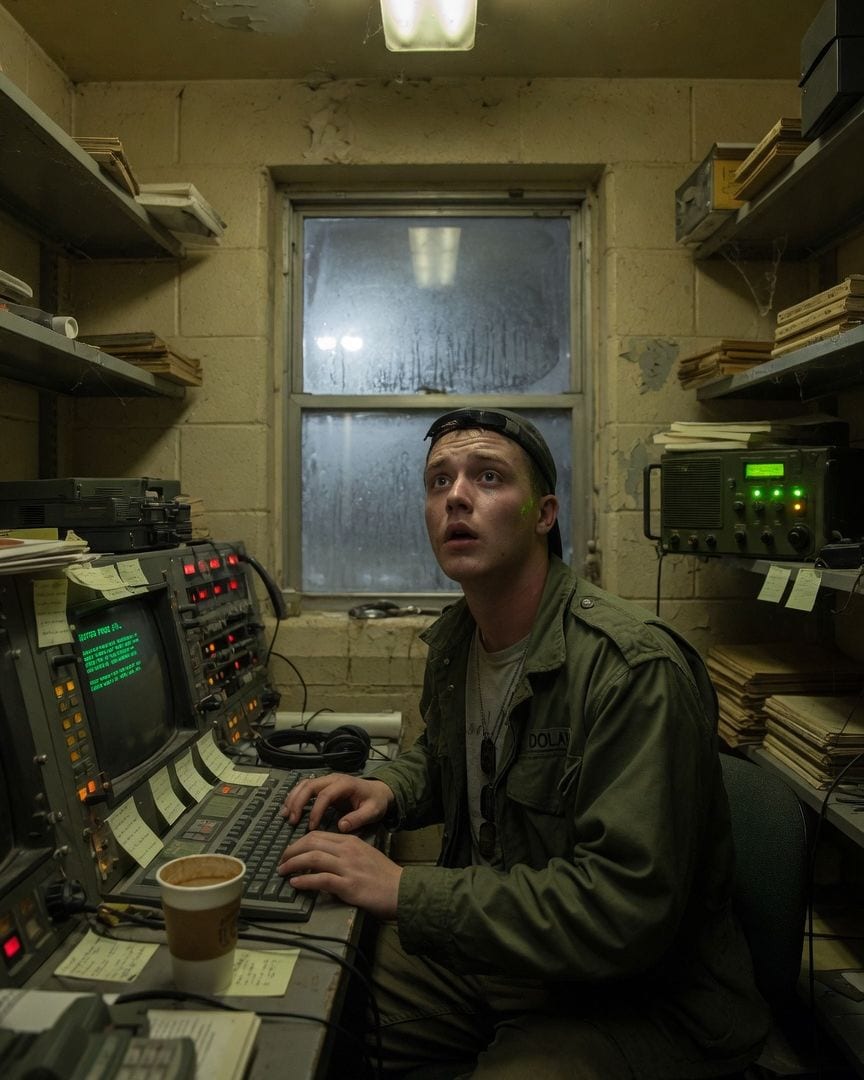
On his last watch, Specialist Dolan heard a dead soldier's voice from an old radio, a week too late.
Specialist Raymond Dolan was on his final watch at Firebase 7, a remote mountain outpost swallowed by a thick, oppressive fog, before its permanent closure. The fire-direction center should have been silent, but strange calls began routing directly to his console, reporting an enemy element in the draw where the 'Ghost Patrol' was lost just a week prior. While Control heard only Dolan's voice echoing into a void, the panicked voices in his ear were terrifyingly real. As he tried to purge the system, an old, unpowered field radio on a dusty shelf inexplicably powered on, its small light glowing green. From its speaker, the voice of Private Abigail Foster, a soldier from the Ghost Patrol, burst through—a week-old transmission, a final warning from the dead.
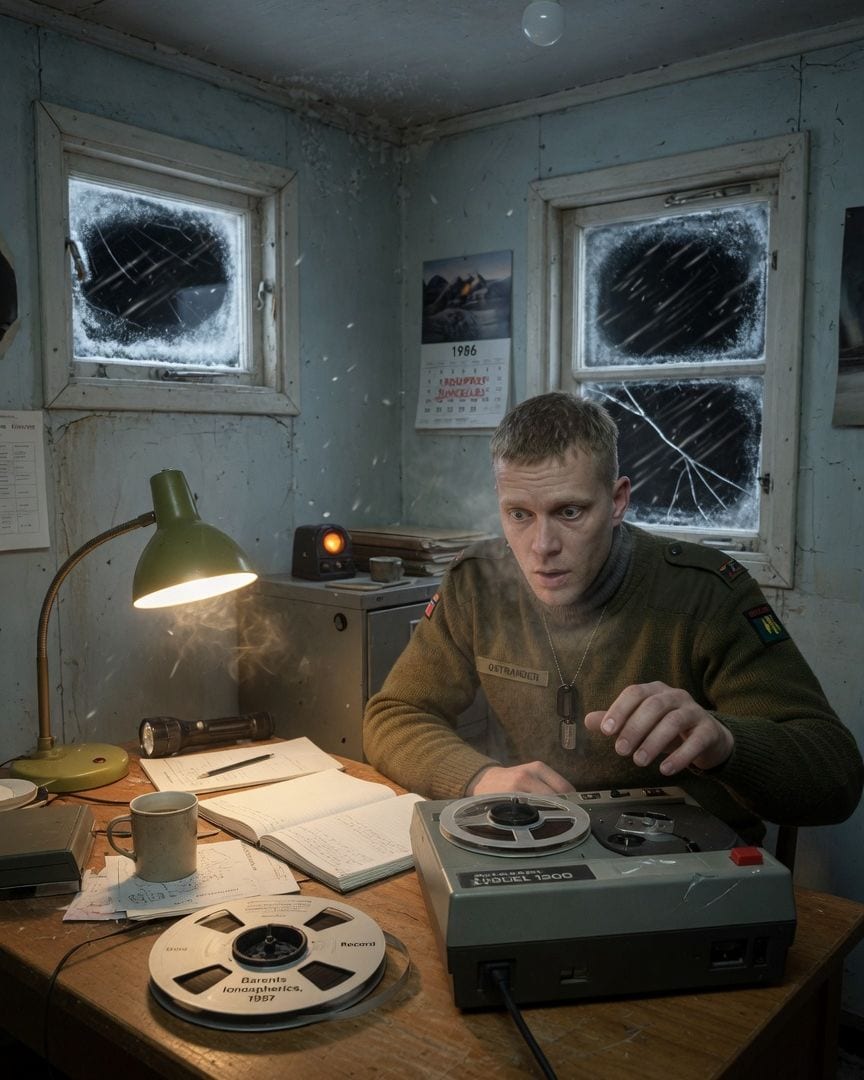
A Cold War sergeant in a lonely fell hut plays a 1957 reel. It names his service number and a fresh scratch he just made.
Sergeant Pell Ostrander, a methodical man of thirty-five, was isolated in a Norwegian fell hut in 1986, with only the generator's hum and a stack of old reels to burn by Friday. The arctic quiet led him to play a 1957 tape, expecting static. Instead, a calm voice filled the small space, detailing his exact hut, its generator, and the snow outside. His heart hammered when the voice read the log for this coming Friday, describing the record burn and more reels than he counted. But the dread truly landed when the voice named his service number and described a fresh scratch he had just made on the playback machine.
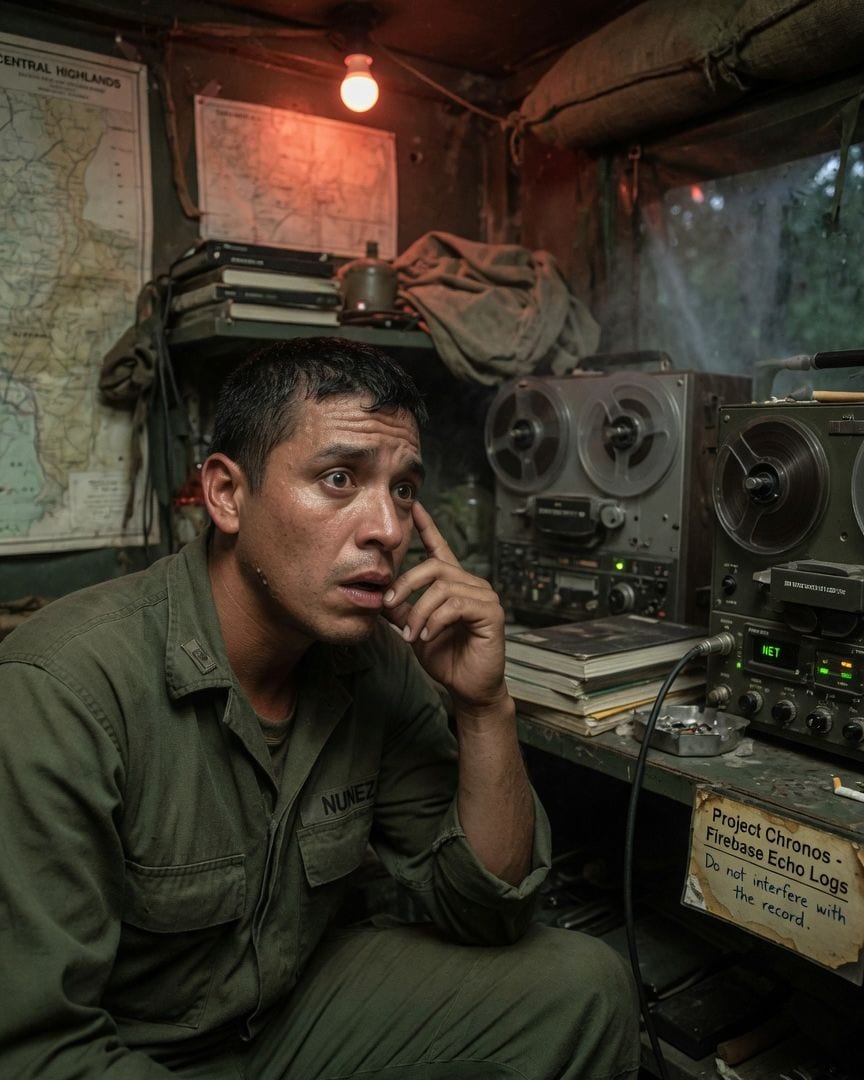
A Firebase RTO was about to send his 0400 report when his own voice crackled over the net, delivering the exact words he hadn't yet spoken.
Specialist Arthur Nunez sat alone in the RTO shack, preparing his routine 0400 SITREP amidst the humid Central Highlands night. The familiar hum of equipment was his only company, a constant drone against the isolation. Just as his thumb hovered over the transmit switch, ready to report "Perimeter quiet, all positions manned," his own voice crackled over the company net, delivering those exact words with uncanny precision. A sickening lurch twisted in his gut; he hadn't spoken a word, yet his report was already delivered by himself. Desperate for an explanation, he soon uncovered an ancient, jury-rigged reel-to-reel recorder, humming faintly. A faded label on the machine bore a stark instruction: 'Do not interfere with the record'.
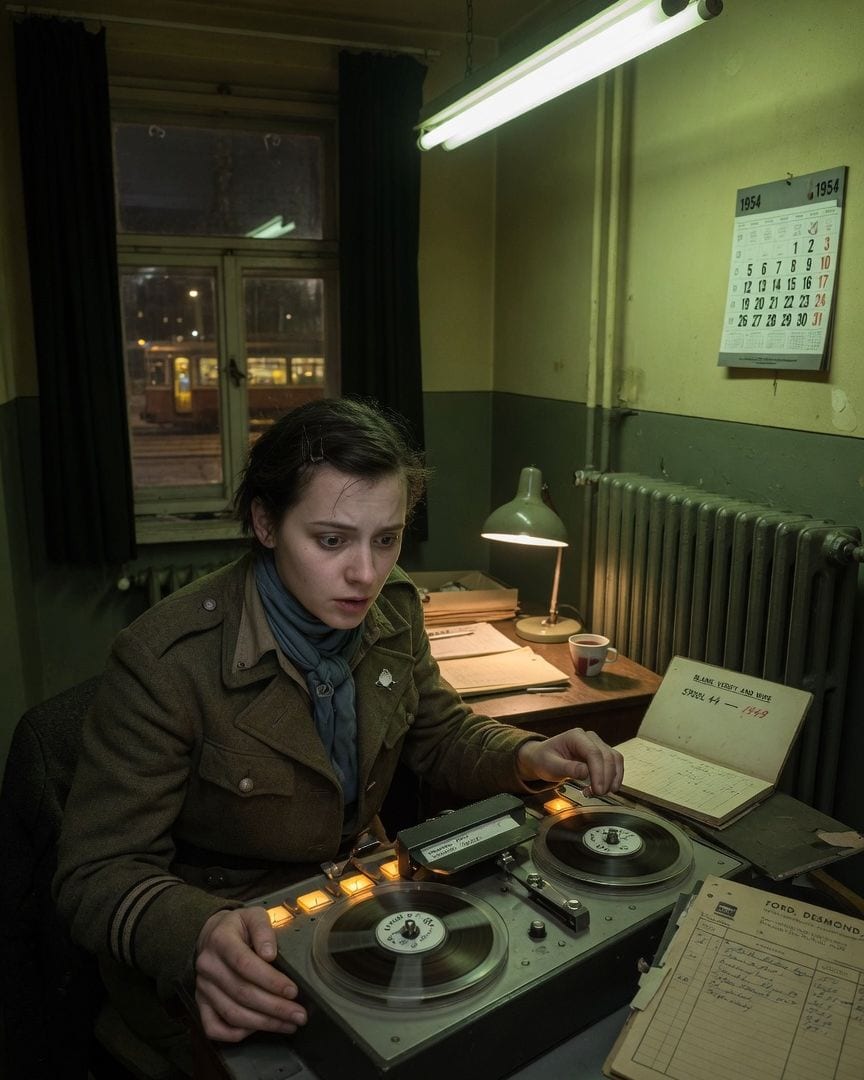
On her last watch, a corporal heard her Berlin listening room on a Cold War tape sealed two years before the building was even built.
Corporal Deyna Vosk began her last watch before dawn in a Berlin listening room, the familiar radiator knock echoing as she played unsanctioned reels. She loaded a tape marked 'BLANK,' sealed in 1949. Instead of silence, it played the impossible sounds of her current room – the radiator, her chair, the distant tram – a space not built until 1951. Then, a reel from 1947 spoke her current service number, and a missing soldier's file showed active supply orders at her post years after his disappearance. What impossible truths were trapped on these tapes?
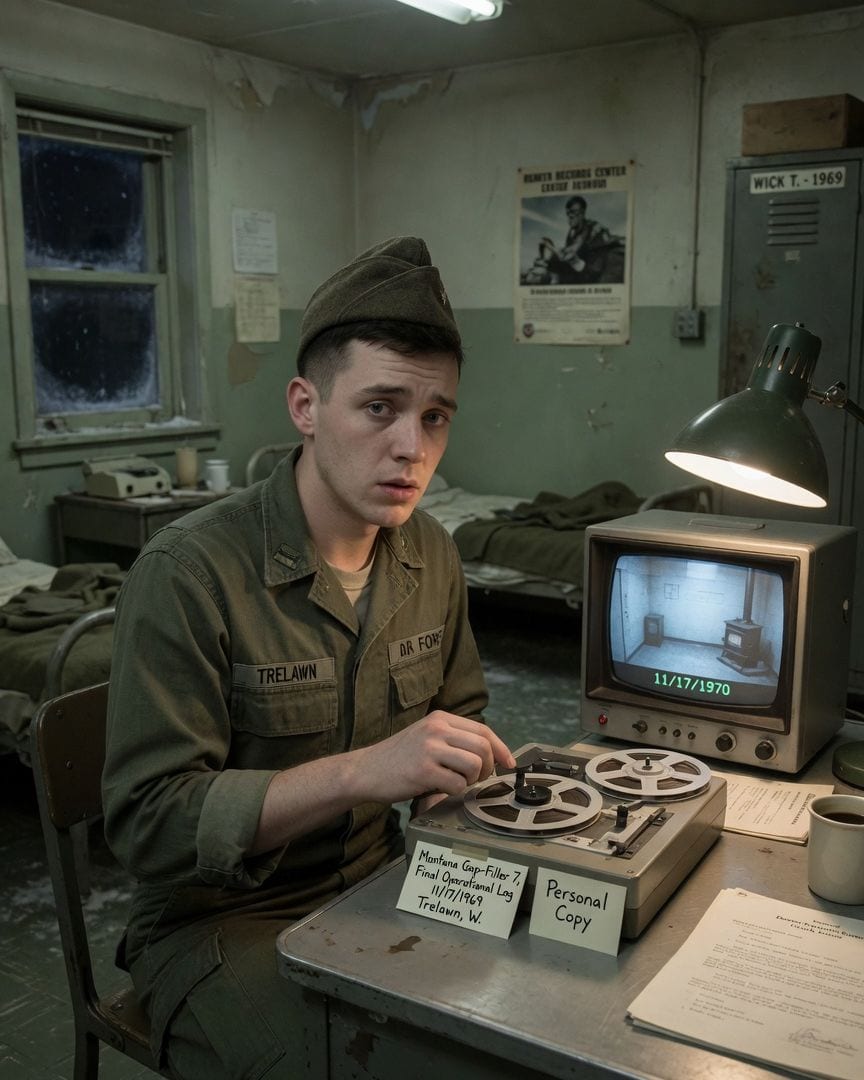
A Cold War gap-filler station was locked cold. Airman Wick Trelawn's final tape showed a man powering up the console a year later.
Airman Wick Trelawn shivered through his final hour at the remote Montana Gap-Filler 7, a Cold War radar station set to go cold forever. He meticulously logged its last operational moments, pulling the master tape as a final record. Later, reviewing a personal copy, Trelawn watched his empty control room play out as expected, but the tape kept running into a second hour. An indistinct man then appeared, methodically powering up equipment in the supposedly dead station. The site had been locked cold for a year by then, yet his official request for the original tape revealed a blinking timestamp of November 17, 1970. What impossible operations did the final log truly capture?
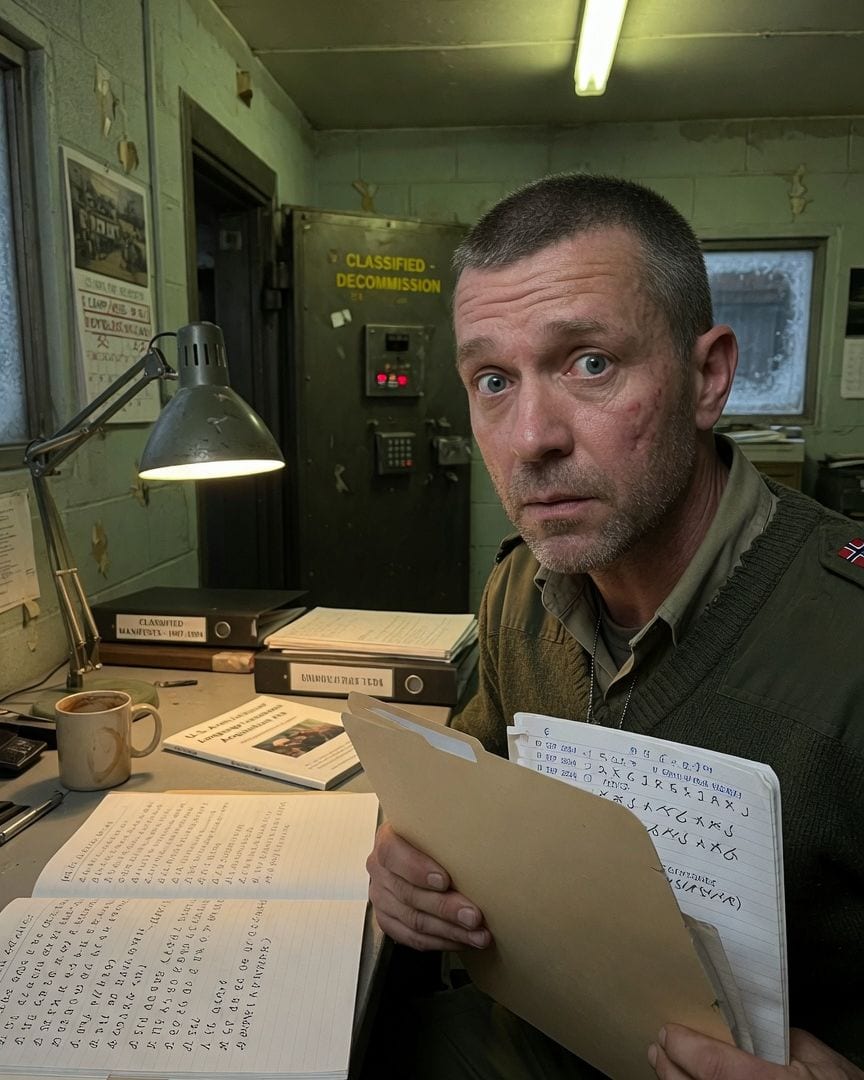
With nine days until the Cold War site sealed forever, Sergeant Dolvig found a folder detailing the sealing party's words — four days in the future.
Sergeant Aksel Dolvig had just nine days left at Camp Vess, a Cold War relic buried deep in the Greenland ice, before its permanent sealing and his transfer. His final meticulous task was to secure all classified materials within its sterile, echoing vaults. But inside one vault, a thick, unmarked manila folder defied all records, its heavy pages filled with an angular, alien script. When Dolvig saw the dates on the pages extended four days into the future, detailing the exact words the sealing party would say, a chilling question arose: who wrote his future, and why?