A Cold War gap-filler station was locked cold. Airman Wick Trelawn's final tape showed a man powering up the console a year later.
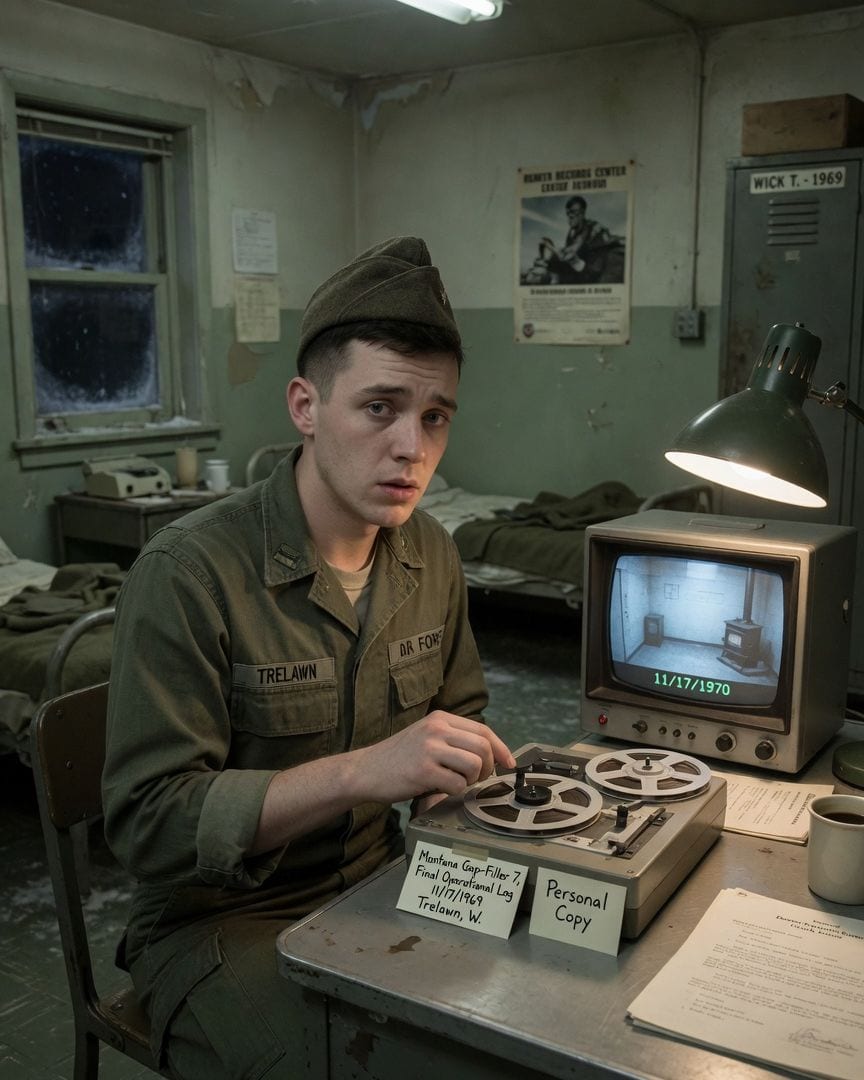
Airman Wick Trelawn, 27, shivered, but it wasn’t just the Montana November wind cutting through the gap-filler station. It was his last shift, the final hour before the site went cold forever.
The radar scope was a flat, unblinking eye, no blips, no noise, just the hum of the dying machinery. He meticulously logged the final entry: 'Site secured. All systems offline. Nothing on scope, nothing on net.'
He pulled the master tape from the recorder, a standard procedure for archiving the site's last operational hour.
He labeled it with the date, his name, the site designation: 'Montana Gap-Filler 7, Final Operational Log, 11/17/1969, Trelawn, W.' He placed it in the secure pouch for dispatch to the Denver records center.
Later that night, back in his barracks, a quiet curiosity nudged him. He’d made a copy for his personal records, a souvenir of his last post. He threaded the reel onto his personal player, the old machine whirring to life.
He watched the familiar grainy feed of the empty control room, listening to the static hum and the occasional creak of the building settling. His logged hour played out, exactly as he remembered. Then, the tape kept running.
The spools continued to turn, silently. A second hour began, identical in every detail – the same empty room, the same cast-iron stove in the corner, the same silent console. But then, a shadow moved.
A man, indistinct in the low light, began to walk slowly around the console, his back to the lens, throwing switches in a deliberate, unhurried startup sequence.
Wick rewound the tape, replaying the phantom startup. His mind, trained for order and logic, cycled through mundane explanations. Faulty tape? A leftover recording from a previous shift? But he had retrieved the reel himself, sealed, pristine.
He checked the label on his copy again, then the dispatch log for the original. Both confirmed: this tape contained the final, single hour of an officially decommissioned site.
The man’s movements were too precise, too functional, to be random interference. He wasn’t fiddling; he was working. The rhythmic clicks of the switches, barely audible over the tape hiss, were undeniably real.
And the site had been cold and locked for a year by the time this tape was supposed to be in Denver, archived.
Wick, now genuinely unsettled, knew he needed to see the original. He drafted a formal request to the Denver Records Center, citing a 'discrepancy in recorded operational hours' on the archived tape, requesting access to the master.
He kept his tone strictly professional, burying the real anomaly under bureaucratic language. A week later, a curt reply from Chief Archivist Audrey Larsen arrived, stating the tape was 'duly received and filed' and access required higher clearance.
Wick persisted, citing regulations about verifying final operational logs. He pulled rank, subtle as it was, mentioning his pending transfer to a sensitive signals intelligence unit. Eventually, a second, more annoyed memo arrived, granting him limited, supervised access.
The dread was a slow burn in his gut, a quiet certainty that the official explanation, whatever it might be, was already a lie.
He secured travel orders to Denver, telling his new commanding officer it was a 'routine records review' before his transfer was finalized.
The empty room on the tape, the silent man throwing switches, was an itch he couldn't scratch, a quiet violation of everything he knew about order.
At the Denver Records Center, Wick sat across from a stony-faced Audrey Larsen, the original tape spooled on a vintage player. The room itself felt heavy, cold, as if the air itself resisted movement.
He fast-forwarded through his own logged hour, then watched the 'second hour' again. The man on the tape was still there, a ghost in uniform, methodically powering up equipment that should have been dead.
Larsen watched with an expressionless gaze, her fingers drumming a silent beat on the polished desk. Wick paused the tape on a frame where the man's arm was reaching for a small, illuminated diagnostic panel.
'Can we zoom in on that?' he asked, his voice tighter than he intended. Larsen, with a sigh, adjusted the projector. The grainy image sharpened, revealing not just the panel, but a faint, digital readout. Wick’s breath hitched.
Amidst the green numbers for power consumption and signal strength, a small, blinking sequence pulsed: '11/17/1970'. The site had been locked cold for a year by then, and he had logged its final hour a year earlier.
Wick Trelawn stared at the flickering numbers on the old diagnostic screen, the internal timestamp of the tape’s second hour confirming it: '11/17/1970'.
The site had been locked cold for a year by then, and he had logged its final hour a year earlier.
Back at his temporary quarters in Denver, Wick couldn't shake the date. November 17, 1970. It was exactly one year to the day from his last shift. He began to cross-reference every piece of information he had.
He checked the official decommissioning records for the Montana gap-filler again, meticulously. The paperwork was ironclad: final shutdown, equipment mothballed, site secured, all personnel reassigned by November 1969.
There were no official records of any activity, maintenance, or personnel at the site in 1970, let alone a full startup. Wick’s rational mind, however, demanded a mundane explanation.
He considered a faulty date generator on the tape player, a miscalibration. But the internal metadata was part of the original recording, not the playback. It was embedded, burned into the magnetic tape itself.
He scoured the unclassified archives for any mention of anomalous radar contacts in the Montana sector around 1969-1970.
He found a handful of vague, quickly dismissed 'atmospheric inversions' and 'weather balloon sightings' from neighboring airfields, but nothing specific to the gap-filler's location. The pattern, or lack thereof, was itself a pattern.
The silence around that date felt louder than any alarm. He dug deeper, requesting access to 'historical operational anomalies' reports, citing his upcoming transfer to signals intelligence.
His requests were met with increasing resistance from the Denver center, then abruptly, a call came from Lt. Commander Dean Fletcher, 48, an intelligence liaison Wick had only ever heard of as a name on a memo.
Fletcher’s voice was smooth, affable, yet carried an undercurrent of steel that made the phone receiver feel strangely cold against Wick’s ear. He congratulated Wick on his upcoming transfer, then casually inquired about his 'enthusiasm for archival research.'
Wick maintained his cover, citing his 'professional commitment to data integrity.' Fletcher chuckled, a dry sound, and advised Wick to 'let sleeping dogs lie, especially old ones.' The warning was clear.
But the more resistance Wick encountered, the more certain he became that 'sleeping dogs' were exactly what he had found, and one of them was still barking.
The 'sleeping dogs' warning from Fletcher hung in the air, a silent pressure.
Wick noticed small things: a brief, almost imperceptible delay in his phone line when he made inquiries, a new face in the records center's common room that seemed to linger when he was present, always out of direct sight, just at the edge of his periphery.
He felt eyes on him, not overtly hostile, but analytical, assessing. The fluorescent lights of the archive room seemed to hum with a new, sharper intensity, as if observing him.
One afternoon, while reviewing microfiche files on decommissioned sites, he found a folder titled 'Project Echo-Point.' It was thin, mostly redacted, but one unredacted line caught his eye: 'Purpose: Mitigation of temporal-spatial inconsistencies within designated zone.'
He copied it quickly onto a notepad, the pencil scraping loudly in the quiet room. Later that day, the Echo-Point folder was gone from the drawer. He reported it to Audrey Larsen, who merely shrugged, 'Things get misfiled.
Happens all the time.' But the drawer had been full when he arrived. Its emptiness now was stark, almost accusatory.
That night, a plain, unmarked envelope was slipped under his door. Wick found it propped against the frame, a dark rectangle against the worn carpet.
Inside was a single, grainy photograph of the Montana gap-filler, taken from the air, but dated November 16, 1970. The day before the tape's impossible date.
The station looked exactly as he remembered, stark and isolated against the snow, but the date pinned it in an impossible time. There was no note, no message, just the photo and the date.
It was a clear, unspoken message: 'We know what you're looking for, and we know when you're looking for it.' Wick felt a cold certainty settle in his bones. He wasn't just investigating a records discrepancy anymore.
He was being watched, and the watchers knew exactly what he was chasing. The danger was no longer abstract; it was a tangible presence, a breath on his neck, waiting for him to make a mistake.
He was no longer the hunter; he was the prey.
Wick knew he couldn’t keep digging in the open. He used his remaining access to the archives to find anything else related to 'Echo-Point' or 'temporal-spatial inconsistencies.'
He found a heavily redacted memo from the 1950s, mentioning 'gap-filler sites' in a context that had nothing to do with radar coverage. It spoke of 'containment protocols' and 'erasure criteria.'
The pieces, disjointed as they were, began to form a terrifying shape. He realized the 'gap-filler' wasn’t filling gaps in radar coverage; it was filling gaps in reality, in history, by making certain events and their witnesses simply… 'unhappen.'
The 'Thing on the Scope' wasn't just a UFO; it was an anomaly that the system erased.
He knew he needed a direct answer, or at least a crack in the official wall. He requested a meeting with Lt. Commander Fletcher, citing a 'personal concern' regarding his upcoming transfer.
Fletcher agreed, meeting him in a sterile, windowless office, the air thick with unspoken things. Wick laid out his findings, starting with the anomalous tape, the future date, the photograph. Fletcher listened, impassive, his fingers steepled.
The silence in the room stretched, punctuated only by the low hum of the air conditioning. 'A fascinating collection of coincidences, Airman Trelawn,' he said, his voice devoid of warmth. 'But coincidences they remain.'
Wick pushed. 'What about Project Echo-Point, sir? And 'temporal-spatial inconsistencies'?'
Fletcher’s eyes narrowed slightly. 'That's classified, Airman. You're treading on ground far above your pay grade.'
Wick pressed harder, his voice steady despite the tremor in his hands. 'The Montana site. It was closed in '69. Why is there a tape from '70 showing it active? Why was I sent a photo of it from '70?'
Fletcher sighed, a performance of weariness. 'Some anomalies, Airman, are best left undisturbed. They are… filed. And the system ensures those files remain sealed.' He leaned forward, his gaze unnervingly direct. 'Your transfer is still on track.
Don't jeopardize it by digging into things that don't concern you.'
Wick understood. The 'filing' wasn't just about documents. It was about making things, and people, disappear. The tape wasn't a record of something that happened; it was a record of something that was unhappened.
And the man on the tape, starting up the station… Wick felt a cold dread as the implication solidified. The site was not just a radar station; it was a machine for erasure.
And the tape from November 1970, with its impossible date, was not an error. It was a trace, a ghost in the machine, of a scheduled 'filing' event.
The coherence of the horror clicked into place: the station 'filed' the 'gaps' in reality, and the tape itself was a fragment of that process.
The confrontation with Fletcher left Wick shaken but resolute. He knew the 'filing' was real, a bureaucratic horror designed to erase anomalies. He had to find out who was being filed.
He spent a frantic night using his dwindling access, searching the classified personnel archives, looking for any 'MIA' or 'Disappeared' records linked to the Montana gap-filler, or any other 'Echo-Point' site.
The archive room felt less like a vault of knowledge and more like a mausoleum now, full of forgotten lives. He searched for names, dates, anything that might connect to the 'November 1970' date.
He found dozens of redacted files, vague explanations of 'unaccounted for' personnel. The pattern of disappearances across decades and classifications was sickeningly consistent: radar operators, maintenance crews, even a few intelligence liaisons. The 'filing' was a systemic, ongoing process.
Just as his access was about to expire, a single, unredacted file caught his eye, buried under layers of irrelevant material.
It was a standard-issue brown folder, identical to hundreds of others, but the name on the tab made his blood run cold. He pulled it out, his hands trembling.
The top sheet was a service record, but stamped across it in stark, red letters was 'MISSING IN ACTION.' Wick’s fingers trace the faded, official stamp on the top sheet of the classified folder, 'TRELAWN, WICK, AIRMAN, MIA – 11/17/1970.'
The date, his own name, the cold certainty of it, echoed the impossible timestamp from the tape, a year in his future, a year that had not yet come.
The MIA file for 'TRELAWN, WICK, AIRMAN' was a punch to the gut. The full horror clicked into place with chilling precision.
The 'second hour' on the tape, the man performing the startup sequence, the November 1970 date – it wasn't a recording of someone else, or a past event. It was him. It was his own 'filing.'
The Montana gap-filler wasn't just a site for erasing events; it was a trap, a mechanism that absorbed the witnesses into the very gaps they were meant to fill.
The 'startup sequence' was not an activation of radar, but the activation of the 'filing' process itself, the moment his presence would be absorbed, unhappened, leaving behind only a blank tape in the archives, and an MIA stamp on a hidden file.
The system hadn't just filed the anomaly; it was going to file him. He was already named in the file, already scheduled for erasure.
The file detailed his 'last known whereabouts' as the abandoned Montana gap-filler, with no trace found, only a 'blank radar tape' recovered from the site's archive.
He was reading his own future, his own disappearance, written in the dry, official language of a bureaucracy designed to make inconvenient truths vanish.
The dread wasn't in what might happen; it was in what would happen, what was already written. He was a ghost walking a year ahead of his own vanishing act. The coherence was absolute, a terrible, perfect machine.
He had to go back to Montana. He had to break the cycle.
Wick Trelawn returned to the Montana gap-filler, not as an airman on his last shift, but as a man fighting for his existence. The station was a desolate skeleton, wind whistling through broken windows.
The snow outside was thick, muffling all sound, making the isolation absolute. He moved with a grim purpose, guided by the memory of the tape, the 'startup sequence' etched into his mind.
He knew the precise order of the switches, the hum of the relays. This wasn't about turning on radar; it was about disrupting the 'filing' process.
He found the main console, dust-laden but intact, exactly as it appeared on the tape.
He knew the system was designed to absorb, to silence. But every system had a failsafe, a point of overload.
He began to activate the switches, not in the precise order of the tape, but deliberately out of sequence, bypassing safety protocols, feeding contradictory commands into the dormant relays.
He was gambling that the system, designed for coherence, would break under incoherence. A low thrum began in the floor beneath his feet, growing into a deep, guttural groan that vibrated through the concrete foundations of the building.
Lights, long dead, flickered to life erratically, bathing the room in strobe-like flashes that made the shadows dance like frantic specters. A high-pitched whine built, agonizingly, until the very air felt charged, metallic, prickling his skin.
Wick braced himself, sweat beading on his forehead, his jaw tight. He threw the final, critical switch – the master power conduit that fed the 'temporal-spatial consistency' protocols.
There was a deafening CRACK, a blinding flash of blue-white light that engulfed the console, then plunged the station into absolute, permanent darkness. The hum died. The whine ceased.
The silence that followed was profound, absolute, heavier than the snow outside. The Montana gap-filler was truly dead, its 'filing' mechanism shattered. He had done it. He had stopped it. He had stopped his filing.
The silence in the Montana gap-filler was absolute. Wick Trelawn stood in the darkness, the acrid smell of ozone stinging his nostrils. His ears rang from the deafening crack.
The console was a charred ruin, its internal mechanisms fused and inert. He had broken the loop, disrupted the 'filing' process. His own MIA file, he knew, still existed in Denver, a testament to a fate averted.
He was a ghost in the system, a man who had been scheduled for erasure and had somehow stepped out of line. He left the dead station, not looking back.
The official records would show the Montana site as permanently decommissioned, its equipment salvaged or left to rust. No one would ever know its true purpose, or the mechanism he had just destroyed.
He had escaped, but the escape came with a terrible knowledge. The dread wasn't gone; it had simply reshaped itself, becoming a permanent lens through which he viewed the world.
Years passed. Wick Trelawn completed his transfer, served his time, and retired. He never spoke of the Montana gap-filler. But he never stopped seeing the gaps.
In every official report, every declassified document, every news story, he saw the faint, almost imperceptible seams where inconvenient truths had been smoothed over, where events had been 'unhappened.'
He learned to recognize the tell-tale bureaucratic language, the precise wording that indicated a 'filing.' He knew the system was vast, patient, and still operating.
One quiet evening, sifting through a box of old military surplus items at a flea market, he found it: a worn, leather-bound maintenance log. It was from a decommissioned 'gap-filler' site in Nevada, decades older than Montana.
He flipped it open, his heart thudding. On a faded page, dated 1948, was an entry in a neat, official hand, detailing a 'system diagnostic and full re-initialization sequence.' The exact same sequence he had seen on his tape.
The exact same sequence he had broken. The system was bigger than he could have imagined, a network of silent, erasing nodes spanning the country, operating for generations. He had stopped one, but there were countless others.
The gaps were still being filled, and the files were still being signed. He knew he would never truly be free of them.
He closed the logbook, the leather cool beneath his fingers, and understood that the only difference between himself and the 'filed' was that he was still looking.
If this one got to you
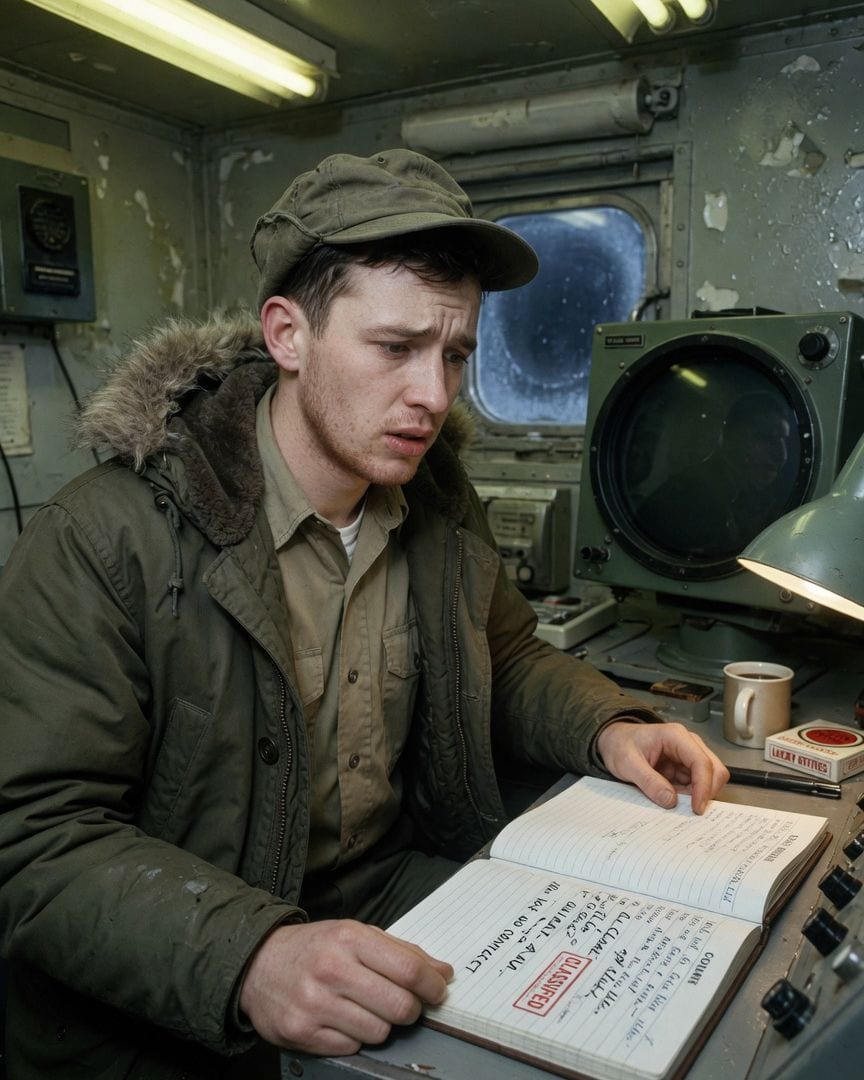
A Cold War airman logs an impossible radar contact on his last sweep. But his official logbook entry is stamped 'CLASSIFIED' and then contradicted by a hastily scrawled 'ALL CLEAR' dated moments before it.
Airman Ordway Vance, 22, manned the radar dome at Site Pellin in the biting North Atlantic dark of January 1962, running the last calibration sweep before its decommissioning. His scope picked up a faint, impossible return, growing closer with each pass, though the ocean remained empty to the eye. When Vance detailed the contact in his official logbook, a 'CLASSIFIED' stamp appeared, followed by a hastily scrawled 'ALL CLEAR' dated moments before his own entry, contradicting his every word. Commander Hartley dismissed it as equipment malfunction, but Vance sensed a chilling, official erasure behind the lie. He soon found a locked cabinet marked 'SITE PELLIN ANOMALIES,' hinting at a deeper truth buried within the base's final days.
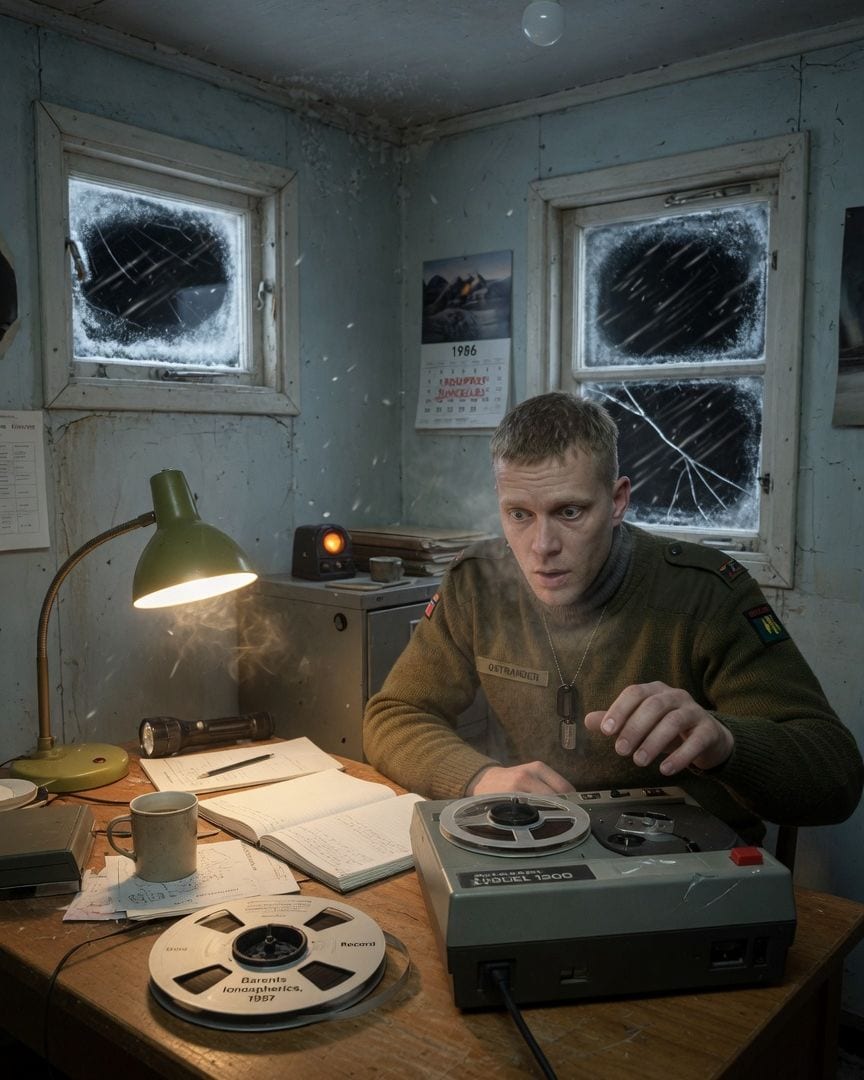
A Cold War sergeant in a lonely fell hut plays a 1957 reel. It names his service number and a fresh scratch he just made.
Sergeant Pell Ostrander, a methodical man of thirty-five, was isolated in a Norwegian fell hut in 1986, with only the generator's hum and a stack of old reels to burn by Friday. The arctic quiet led him to play a 1957 tape, expecting static. Instead, a calm voice filled the small space, detailing his exact hut, its generator, and the snow outside. His heart hammered when the voice read the log for this coming Friday, describing the record burn and more reels than he counted. But the dread truly landed when the voice named his service number and described a fresh scratch he had just made on the playback machine.
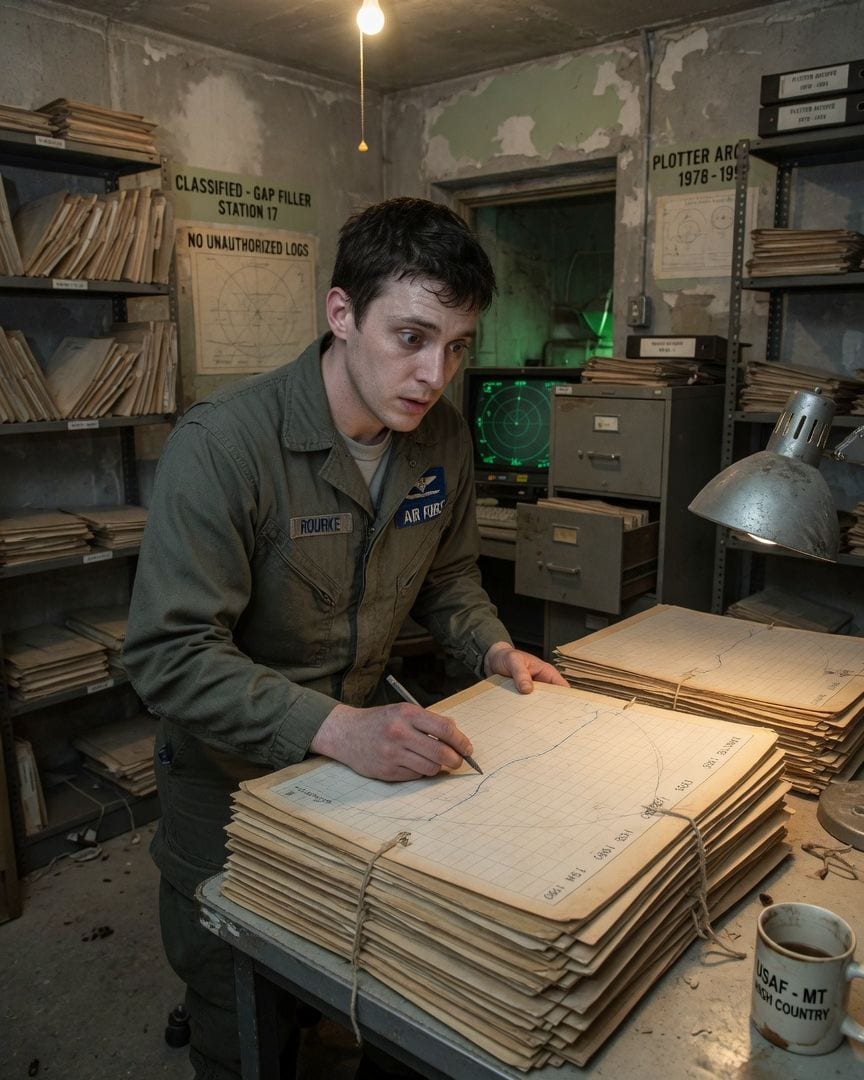
An Airman tracks a nightly radar contact. But in dusty archives, he finds old Cold War plotter boards, each showing that exact same line drawn by other airmen for three winters.
Airman Second Class Felix Rourke endured the cold, quiet nights at his isolated Cold War station, watching the perimeter radar. For three weeks, a single, slow contact appeared at 2300 hours, a precise violation of every protocol that chilled him deeply. He dismissed it as an anomaly, until a hunch led him to a forgotten closet in the dusty archives. There, he unearthed old plotter boards, each revealing the exact same impossible line drawn across the valley floor at the same hour, signed by different airmen from three consecutive winters decades ago. What impossible secret did the mountain station truly hold?
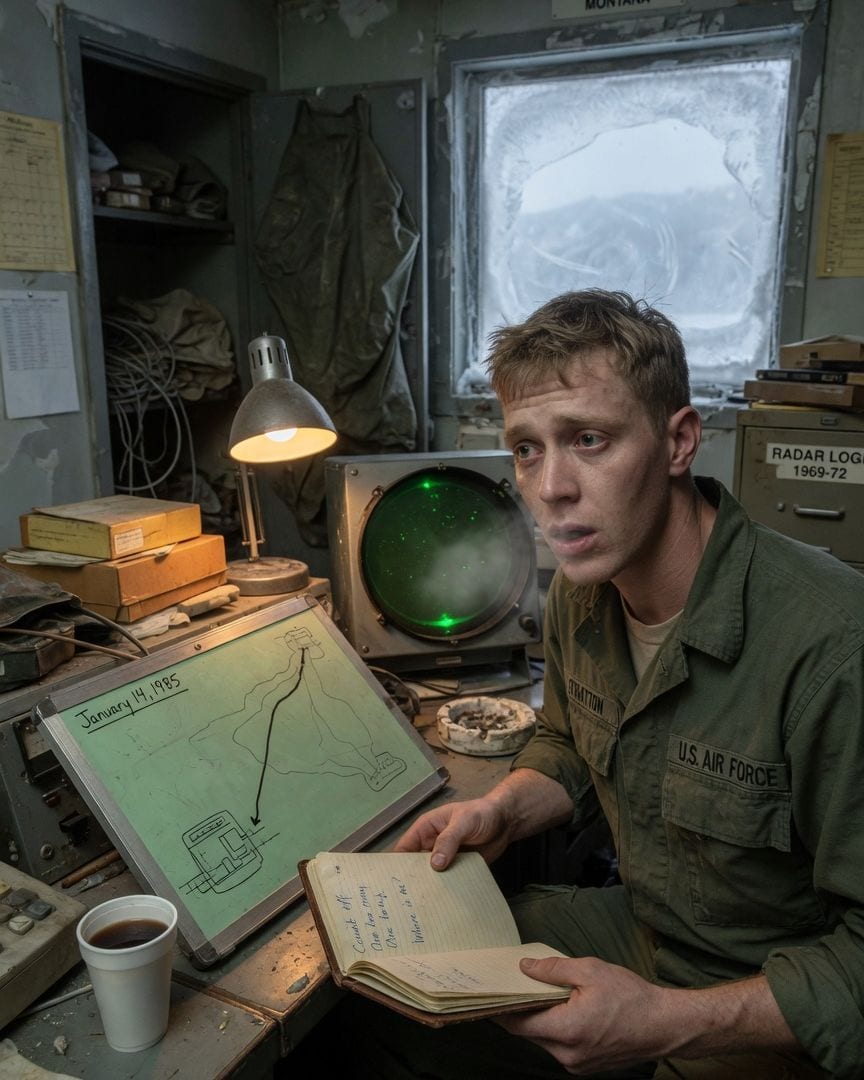
Airman Lars Stratton found an old Cold War manifest listing one name twice: 'Bernard Radcliffe' transferred and 'Bernard Radcliffe' still present.
Airman Second Class Lars Stratton was counting down his final weeks at Echo Station, a desolate Cold War outpost due for mothballing. He longed for home, far from the bitter Montana winds and the constant hum of static. Inside the dim radar shack, he logged the usual nightly ghost blip, a faint contact appearing at 2300, just as it had every winter since 1987. This night, a metallic tang like old blood lingered in the air, raising the hairs on his arms. Seeking distraction, Lars later discovered a leather-bound logbook from 1971, detailing the same 2300 contact, but with chilling notes and a manifest listing one airman's name, Bernard Radcliffe, twice—once transferred, once present. Was he truly alone in the silent, remote station?
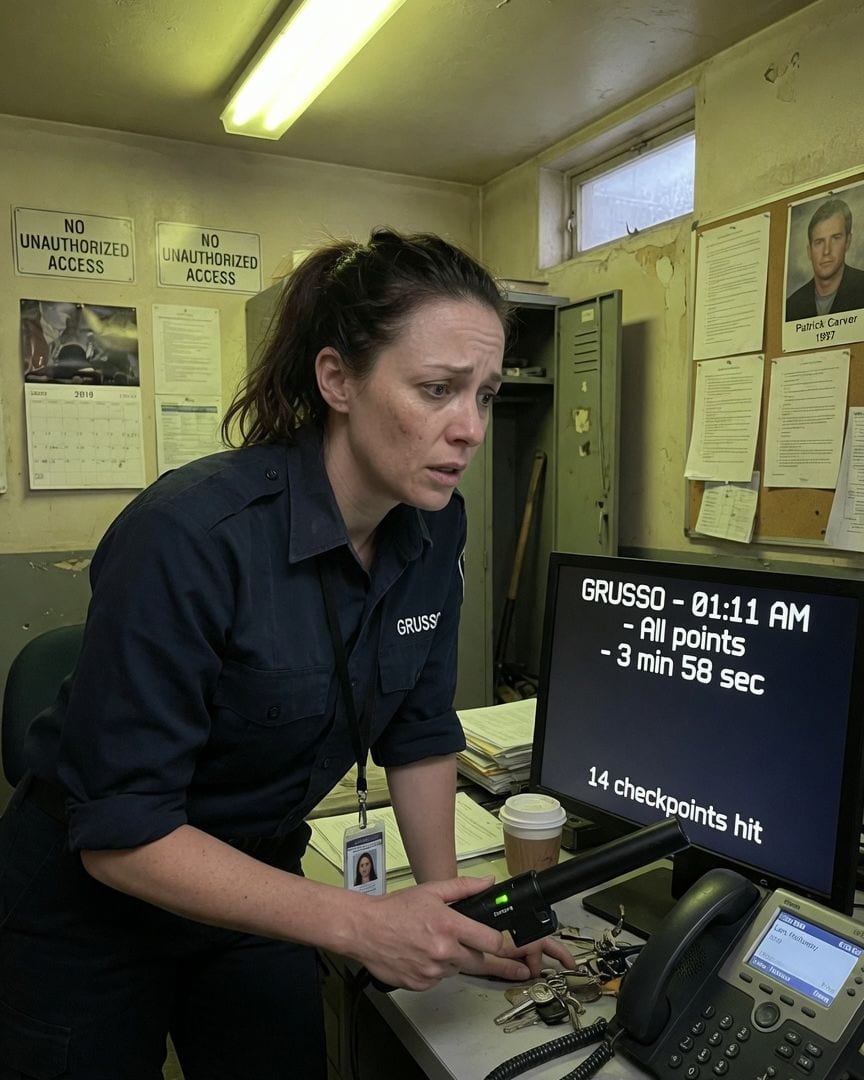
My security wand logged a full round at 1:11 AM in under four minutes. It was in the charger. Every tap is logged as mine.
Finishing my night shift, all I wanted was to get home. But the dock readout screen showed my security wand logged a full patrol at 1:11 AM, completed in just under four minutes. I knew my wand had been charging right beside the monitor the entire time, yet the log, under my ID, confirmed the impossible.
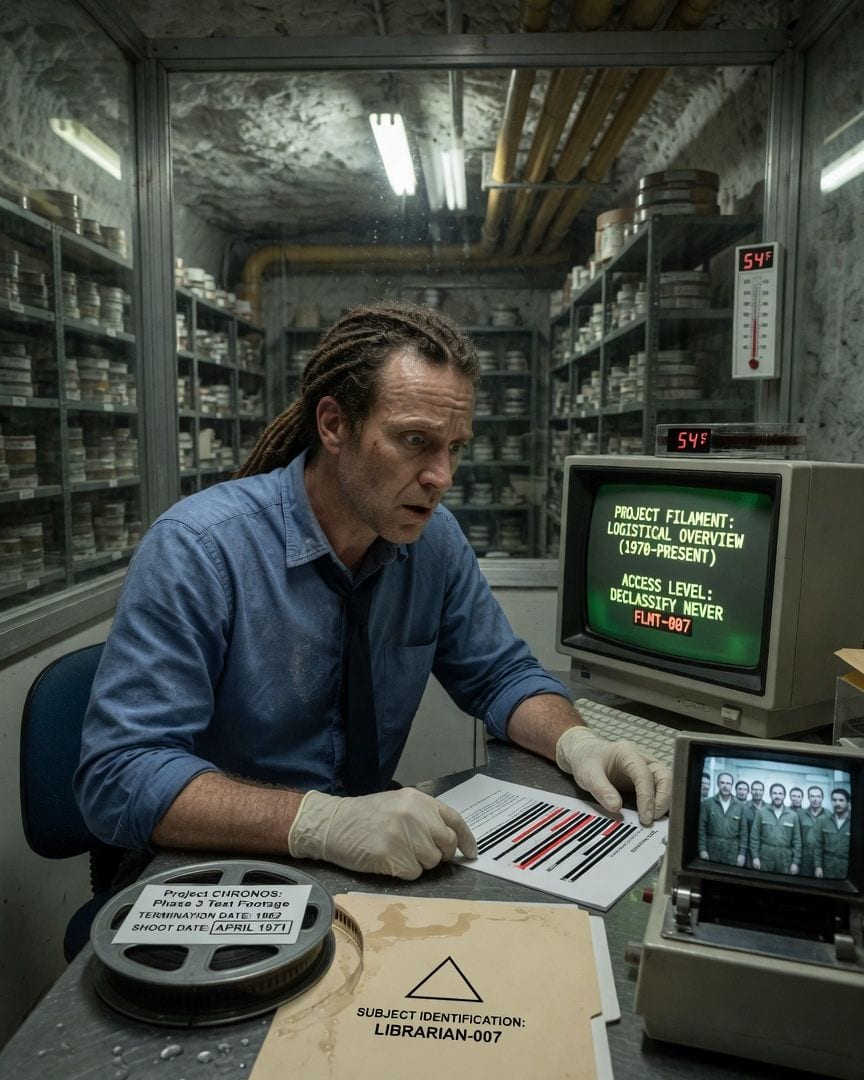
A records archivist found a Cold War film reel weeping cold condensation, shot nine years after its project officially terminated.
Hosea Pike, an archivist in a vast Kansas salt mine vault, meticulously maintained records in a perfectly dry, controlled environment. His brow furrowed when his gloved hand closed around a film reel weeping cold condensation, its metal chilled like well water. The label stated 'Project CHRONOS: Phase 3 Test Footage,' terminated in 1962, yet stamped beneath was an impossible shoot date: April 1971. What could explain a film shot nine years after its project's official end?