A Cold War sergeant in a lonely fell hut plays a 1957 reel. It names his service number and a fresh scratch he just made.
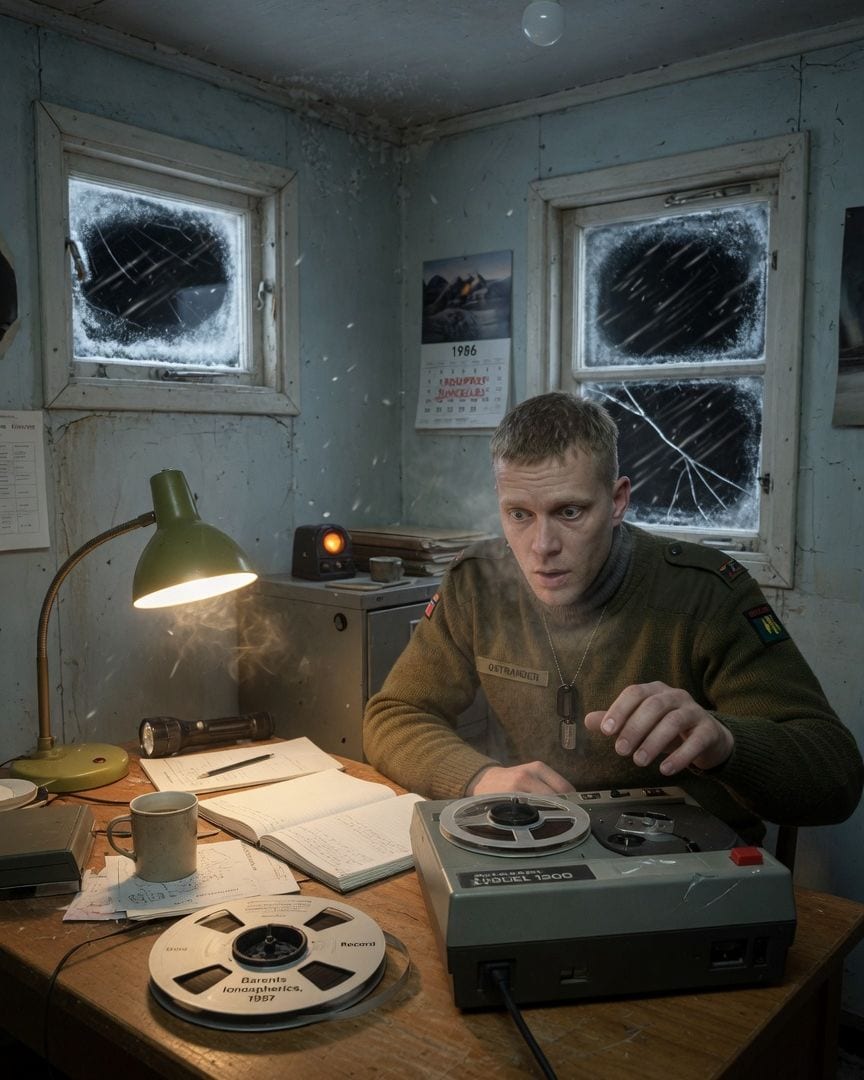
Sergeant Pell Ostrander, a methodical man of thirty-five, was alone in the Norwegian fell hut in 1986.
The resupply had already turned back, leaving him with nothing but the low hum of the station generator and a stack of old reels slated for the burn barrel come Friday.
The isolation was a constant, but he preferred it to the usual base chatter. He picked one reel, its cover sheet starkly marked 'Barents Ionospherics, 1957.'
Curiosity, or perhaps the deep quiet of the arctic night, led him to thread it onto the playback machine, an antique Model 1200 that hummed to life with a familiar, mechanical sigh.
Instead of the expected atmospheric static, a calm, dispassionate male voice filled the small space. The man was reading a station log, detailing weather, wind, and watch relief.
Ostrander froze, a chill unrelated to the arctic air tracing its way down his spine. The voice was describing his own hut, the very one he stood in.
It spoke of the generator’s low thrum, the precise readings of the wind vane just outside the north window, the way the snow drifted against the east wall. Then the voice read the entry for Friday, the day after tomorrow.
It detailed the burning of records, and the number of reels in the barrel. There were more reels than Ostrander had counted.
Ostrander snatched his own current logbook from the desk, heart thrumming against his ribs like a trapped bird. He flipped to the blank pages for the coming Friday.
He replayed the reel, meticulously comparing the spoken entries to his present reality.
The voice described the precise temperature outside, a specific crack in the hut’s south-facing window, even the exact time of his last watch relief from two days prior. Mundane details, but impossible. His rational mind scrambled.
He tried to rationalize it—a mislabeled reel, a sophisticated prank designed to test his composure, a bizarre coincidence of epic proportions.
He even considered a time-slip, a ripple in reality, but his training, his very nature, recoiled from such a fanciful notion. There had to be an explanation.
The voice then detailed the planned disposal of records, referencing a 'secondary burn protocol' and a 'discrepancy in the main inventory count.' Ostrander knew the standard procedure, the single, authorized burn barrel behind the hut, the strict inventory checks.
This tape was describing an official routine that didn't exist in any of his manuals or directives, yet it was somehow more real, more chillingly authoritative, than the one he followed.
The hut, once a predictable, reassuring structure, now seemed to press in on him, its familiar sounds taking on a sinister edge.
He rewound the tape to an earlier section, his fingers clumsy on the aged plastic, listening for any other impossible detail. The voice droned on, listing equipment checks, its cadence unwavering, its tone utterly devoid of human inflection.
Then it paused. 'Unit 70-Gamma-9, Sergeant Pell Ostrander,' it stated, calm as a weather report, each syllable landing with the weight of granite. Ostrander’s breath hitched, caught in his throat. That was his service number, his rank, his name.
The voice continued, 'Observation: faint, new scratch noted on the casing of the Model 1200 playback unit, upper right quadrant, near the 'Record' button.' Ostrander’s eyes darted to the machine he had just fumbled with.
Just moments ago, in his nervous fumbling with the reel, his thumbnail had scraped the plastic. The faint, thin line was undeniably there, fresh against the aged gray casing.
The tape wasn't just predicting the future; it was recording him, right now.
The hut, once a sanctuary from the vast, empty fell, now felt like a cage, its walls closing in, its very air thick with unseen observation.
The scratch on the playback unit was a cold, physical confirmation, an undeniable proof that shattered any remaining pretense of coincidence or prank.
Ostrander forced himself to move, to investigate the 'secondary burn protocol' mentioned on the tape, a detail that resonated with the eerie precision of the impossible log entries.
The standard burn barrel, a heavy steel drum, sat outside the hut, half-filled with ordinary refuse, its rusted surface gleaming faintly in the pale arctic light. It had no secondary compartment, no hidden section.
But the tape had been so specific, so official in its chilling pronouncement. He checked the hut's blueprints, then old maintenance logs, searching for any mention, any hint of an auxiliary disposal unit. Nothing.
Yet the detail nagged at him, a persistent itch in his mind that refused to be dismissed.
He began to systematically search the hut, tapping walls, checking floorboards, his flashlight beam cutting through the shadows, revealing nothing but dust and the familiar wear of decades.
Behind a loose panel in the generator room, one he had always assumed held only wiring diagrams, he found it: a smaller, older burn barrel, crudely camouflaged by a layer of tarred canvas.
Its bottom was encrusted with a thick, sooty layer of ash and a few half-melted, unidentifiable objects. This barrel was full of charred fragments of what looked like old magnetic tape, far more than the official tally for 1957.
The discovery confirmed the reel's impossible count and, with a terrifying certainty, the existence of a hidden operation.
Ostrander tried to contact his command, Colonel Malcolm Rutherford, using the hut's long-range radio. His calls, however, were met with an unusual, persistent static that scrambled his words into incomprehensible bursts.
He tried the satellite phone, a newer model, but the line dropped repeatedly, cutting off mid-sentence with an infuriating electronic sigh. When he finally reached a junior records clerk, Nina Hayes, her voice was clipped, almost impatient.
"Sergeant Ostrander, your communications are showing anomalies," she said, her tone devoid of real concern. "We'll send a tech support team next week." Next week. After Friday's burn.
The timing felt less like a coincidence and more like a deliberate delay.
Back in the main cabin, a glint of yellow caught his eye under his bunk's mattress. He pulled out a small, folded piece of paper. It wasn’t his; the paper was too old, too yellowed, its edges brittle.
On it, in precise, official script, was a single word: 'Compliance.' No signature, no date, no context. Just the stark, chilling instruction.
He felt a prickle on the back of his neck, the distinct sensation of being watched, not by a person, but by the very walls of the hut itself, by the unseen eyes of the system that had documented his every move.
The silence of the fell hut was no longer empty; it was listening.
The word 'Compliance' felt like a cold hand, pressing against his will. Ostrander remembered the hidden barrel, the discrepancy between the official count and the charred evidence.
He returned to the generator room, his eyes now scanning for anything else out of place, for another hidden seam in the carefully constructed façade.
Behind another, more securely fastened panel—this one requiring a pry bar and a few grunts—he found a small, rusted metal box. Inside, carefully preserved in oilskin against the damp and the years, were several brittle, yellowed documents.
One was a station manifest, dated 1957, listing not just equipment and supplies, but personnel: 'Ionospheric Data Collectors,' 'Asset Transferees.' He saw names, service numbers, specific dates of arrival.
He cross-referenced them with official military archives he could access from the hut's secure terminal, his fingers flying across the old keyboard. For every 'Asset Transferee,' the trail went cold after their listing here.
No subsequent postings, no discharge papers, no death certificates. They simply vanished from the system after being listed at the fell hut.
The horror tightened its grip. The 'ionospherics' was not atmospheric data; it was a classification, a bureaucratic label for people who disappeared. He saw dates that stretched back decades, a chilling pattern of 'transfers' from this remote outpost.
The logs were a detailed record of human erasure, filed with bureaucratic precision, a quiet void where human lives once were.
His hands trembled as he sifted through the old, classified documents, each page a fresh layer of dread. The rustle of the paper seemed deafening in the otherwise silent hut.
He found what appeared to be a separate, more restricted section within the archive, marked simply 'Subjects.' His blood ran cold.
He pulled out a slender file, its cover sheet starkly marked in the familiar, dispassionate script that now haunted him: 'Subject: Ostrander, Pell.' He opened it.
Inside, his own name and service number were listed, followed by a series of 'observations' that perfectly mirrored the impossible entries from the audio reel, including the scratch on the playback unit.
Then, below them, a single line, stark and precise: 'Transfer Date: Friday, 0700 hours.' The date was the coming Friday. His own name, his own fate, had been filed and recorded decades ago.
The 'Subject: Ostrander, Pell' file was disturbingly comprehensive. It detailed his arrival at the hut, his routine, even his specific thoughts and observations, all precisely matching the audio reel and his own experience, down to the faintest scratch.
It wasn't a prediction; it was a pre-written script, an outline of a life already lived, already decided.
The file meticulously outlined the 'processing' of 'ionospheric data assets' – a chilling euphemism for individuals deemed sensitive or anomalous, discreetly removed from the official record.
The fell hut, and others like it, were not just observation posts, but collection points, quiet cogs in a vast, decades-old institutional machine that simply 'filed' people away.
The 'burns' were for their discarded records, their former identities, their very existence. The file stated that his own 'transfer' on Friday was the final stage, a quiet, bureaucratic erasure from the world.
Every clue, every impossible detail, every missing person from the classified manifests clicked into place with horrifying clarity. The horror wasn't a random event; it was a meticulously planned, long-running operation, and he was its next, perfectly recorded, subject.
With the knowledge of his pre-ordained fate chilling him to the bone, Ostrander knew he couldn't wait until Friday. He had to break the script, to defy the cold, precise calculations of a system that had already written his end.
His movements were swift, born of desperation and a lifetime of military efficiency. He systematically sabotaged the hut's communication systems, tearing out wires, smashing components, ensuring no outgoing signals could betray his flight.
He then disabled the generator, plunging the hut into absolute darkness and silence, severing its connection to the outside world, to the listening ears of the institution.
He grabbed emergency rations, a heavy-duty flashlight, and his cold-weather gear, prioritizing survival essentials over sentiment.
Using a snowmobile, tucked away in the shed for emergency patrols, he fled into the vast, unforgiving fell, the biting wind whipping at his face, stinging his exposed skin.
He knew the terrain intimately, every crevasse and hidden path, every deceptive patch of ice.
Behind him, emerging from the direction of the abandoned hut, he soon spotted the distant headlights of an unmarked vehicle, its engine a low, persistent growl in the arctic night, like a predator on the hunt. They had been watching.
They had expected this. He pushed the snowmobile harder, weaving through treacherous ice fields and rocky outcrops, using his intimate knowledge of the area to evade his silent pursuers, becoming a blur against the endless white.
He was no longer just running from a threat; he was fighting against a meticulously documented destiny, an escape from his own file.
Days later, frostbitten, emaciated, and near collapse, Ostrander stumbled into a small, remote fishing village on the coast.
His story of a classified hut, a pre-recorded fate, and a shadowy institution was met with polite disbelief, attributed to exposure and trauma, perhaps a touch of delirium from the cold.
He was honorably discharged from service, his medical file citing 'stress-induced psychosis,' a convenient and unchallengeable explanation. The fell hut was later reported 'abandoned due to structural damage,' its contents 'lost in a routine burn-off' that erased any trace.
No mention of the hidden barrel, the classified files, or the impossible audio reel ever surfaced in official reports.
Pell Ostrander tried to restart his life, far from the military, far from any official record that might flag him. He took a quiet job, living simply, anonymously. But the silence of the fell hut followed him.
He saw patterns in local news reports of 'missing persons' and 'unexplained disappearances,' small, isolated incidents that echoed the files he had discovered. He knew the system was still operating, still filing.
He could never shake the feeling that somewhere, in a sealed archive, a file with his name on it remained open, awaiting its final entry.
The quiet hum of the server farm always sounds like a tape playing in an empty room, and I know my file is still open.
If this one got to you
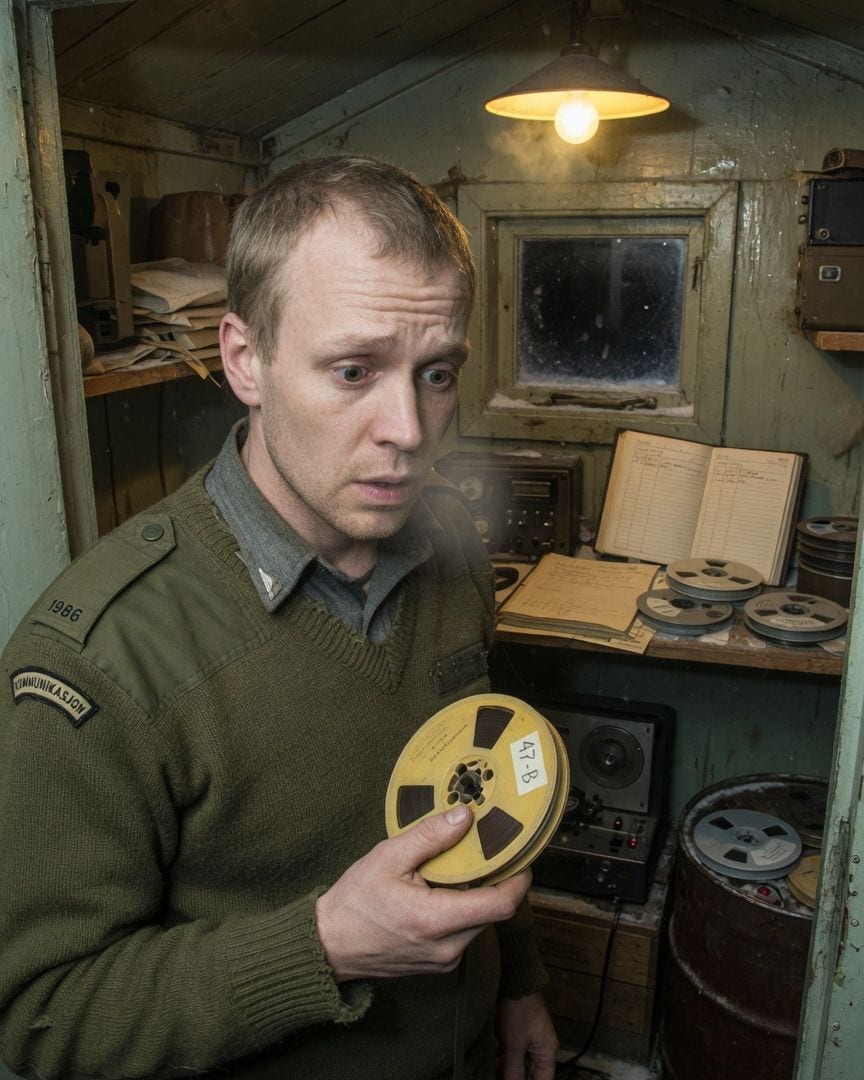
A Cold War specialist heard a tape describing tomorrow’s burn, then found the missing reel. It was warm and humming in his hand, on Thursday night.
Sergeant Pell Ostrander, a methodical communications specialist, shivered in the damp chill of a remote Norwegian fell hut in 1986. It was his last night before the facility was decommissioned, and the last resupply chopper had left him alone with crates for tomorrow's burn. Playing an old magnetic tape, Ostrander heard a station log for his very outpost. The calm voice on the recording began to read "Friday's entries," detailing a disposal count for the next day – yet it was only Thursday night. Moments later, he discovered a specific missing reel, unnaturally warm and thrumming with a faint vibration in his hand.
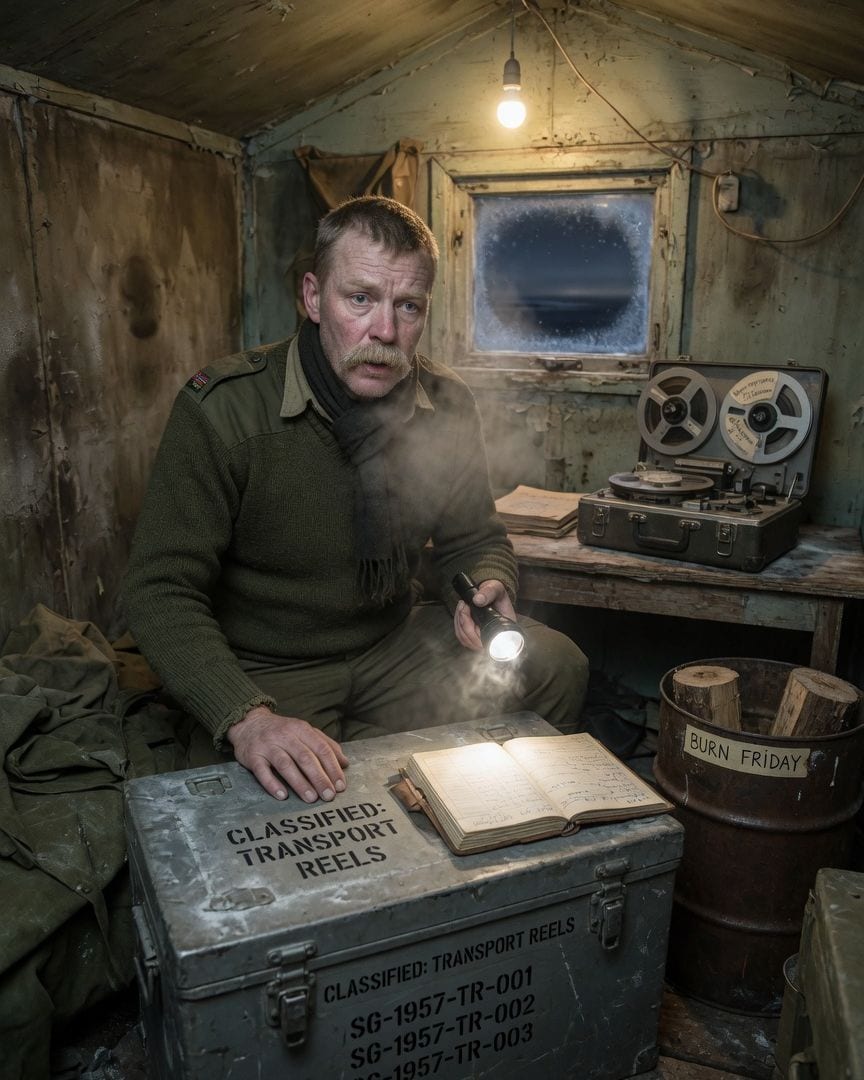
A Cold War sergeant, alone at his remote fell hut, hears a 1957 voice describe his future burn. Then he finds the 'classified' items waiting.
Sergeant Pell Ostrander shivered alone in a remote Norwegian fell hut in 1986, the Barents Sea his only company. With a stack of old reels to burn by Friday, he threaded one labeled "Barents ionospherics from 1957." A dry baritone voice crackled through the speaker, reading mundane log entries from decades past, until it detailed "three sealed transport reels" for disposal on Friday at 1600. Ostrander, a man of routine, checked his watch: it was only Wednesday, and no such reels existed in his hut. Then, in a dusty closet, he found a heavy metal box, sealed and marked 'CLASSIFIED', with the exact serial numbers of the reels the voice had described, waiting for its appointed burn.
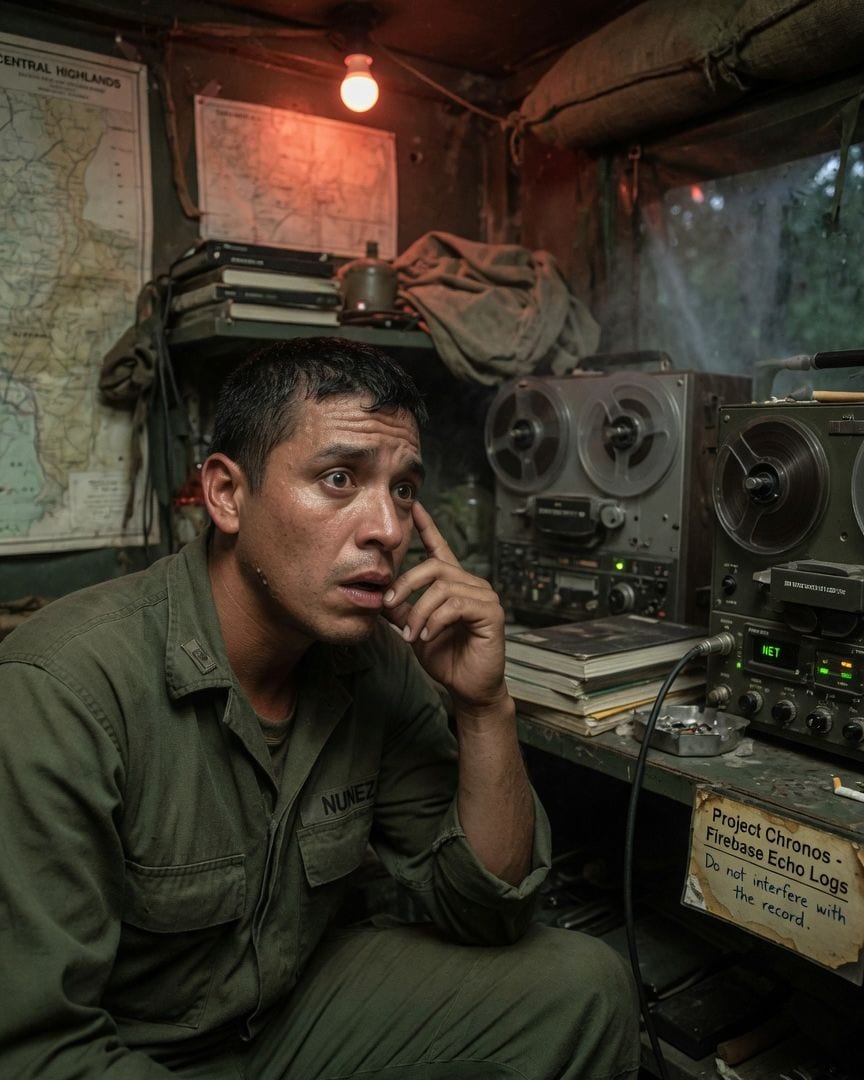
A Firebase RTO was about to send his 0400 report when his own voice crackled over the net, delivering the exact words he hadn't yet spoken.
Specialist Arthur Nunez sat alone in the RTO shack, preparing his routine 0400 SITREP amidst the humid Central Highlands night. The familiar hum of equipment was his only company, a constant drone against the isolation. Just as his thumb hovered over the transmit switch, ready to report "Perimeter quiet, all positions manned," his own voice crackled over the company net, delivering those exact words with uncanny precision. A sickening lurch twisted in his gut; he hadn't spoken a word, yet his report was already delivered by himself. Desperate for an explanation, he soon uncovered an ancient, jury-rigged reel-to-reel recorder, humming faintly. A faded label on the machine bore a stark instruction: 'Do not interfere with the record'.
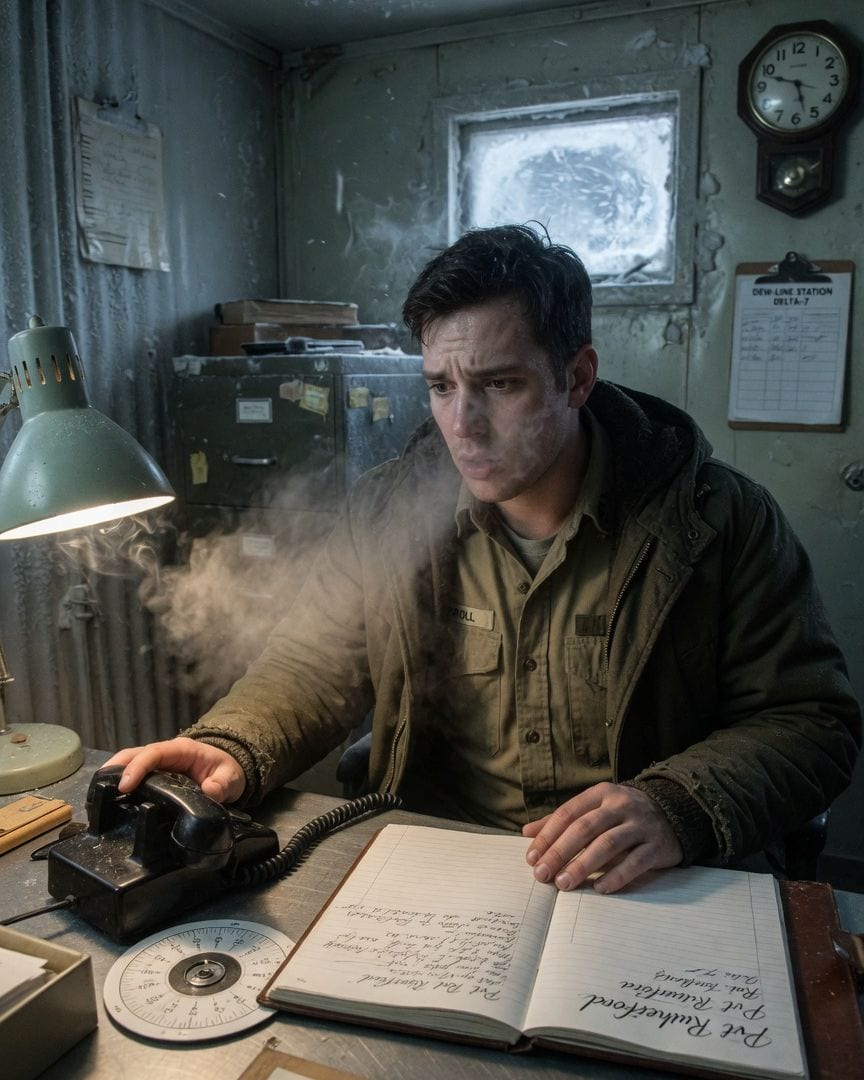
A communications specialist saw his last line go dead. Then the old Cold War field phone rang with a voice from 1966, naming a man freshly signed into his current shift log.
Specialist Walter Kroll shivered in the frigid communications room of DEW-line Station Delta-7, completely cut off by a historic Arctic blizzard. He had personally watched the last hard-wired connection to the outside world snap earlier that day. Now, past midnight, the old field phone at his position began to buzz, impossible from a line he knew was dead. A calm, unfamiliar voice spoke, reading a crew roster Kroll didn't recognize, including Private Rutherford. His search through decades of dusty logbooks revealed Rutherford was assigned to this exact watch in 1966, but then Kroll found the same name freshly inked into his *current* shift's sign-in sheet.
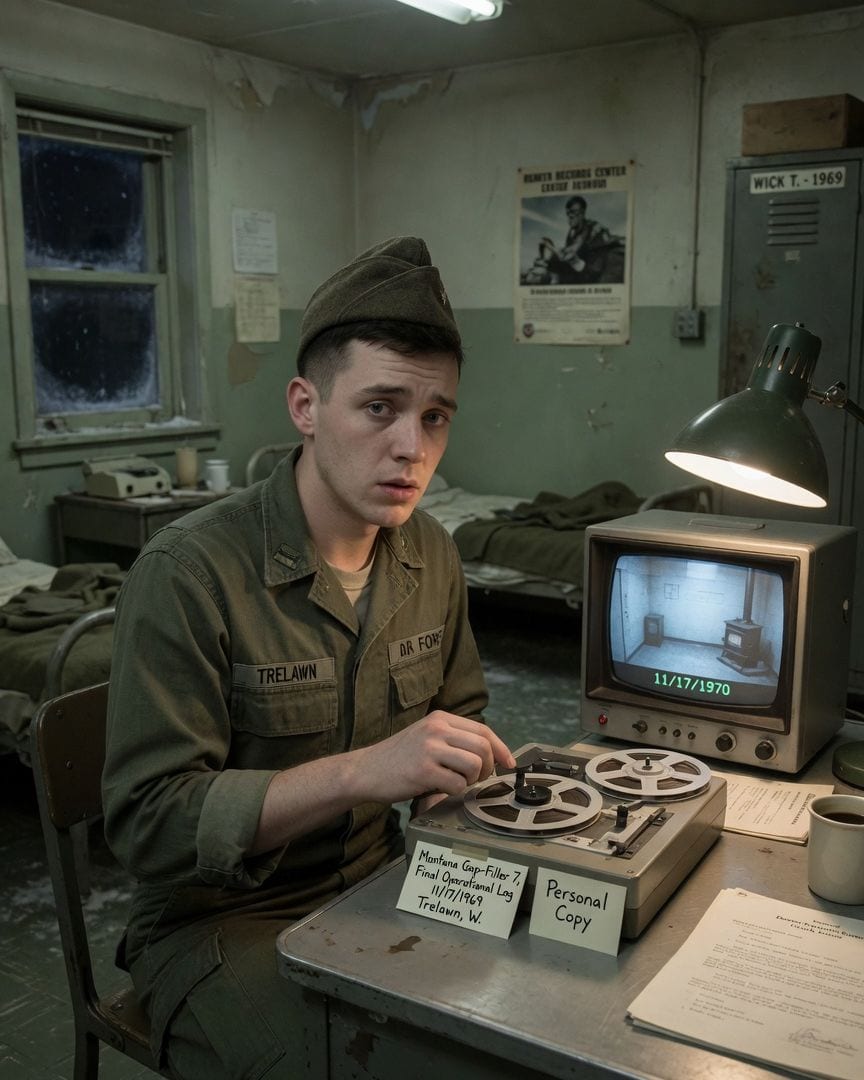
A Cold War gap-filler station was locked cold. Airman Wick Trelawn's final tape showed a man powering up the console a year later.
Airman Wick Trelawn shivered through his final hour at the remote Montana Gap-Filler 7, a Cold War radar station set to go cold forever. He meticulously logged its last operational moments, pulling the master tape as a final record. Later, reviewing a personal copy, Trelawn watched his empty control room play out as expected, but the tape kept running into a second hour. An indistinct man then appeared, methodically powering up equipment in the supposedly dead station. The site had been locked cold for a year by then, yet his official request for the original tape revealed a blinking timestamp of November 17, 1970. What impossible operations did the final log truly capture?
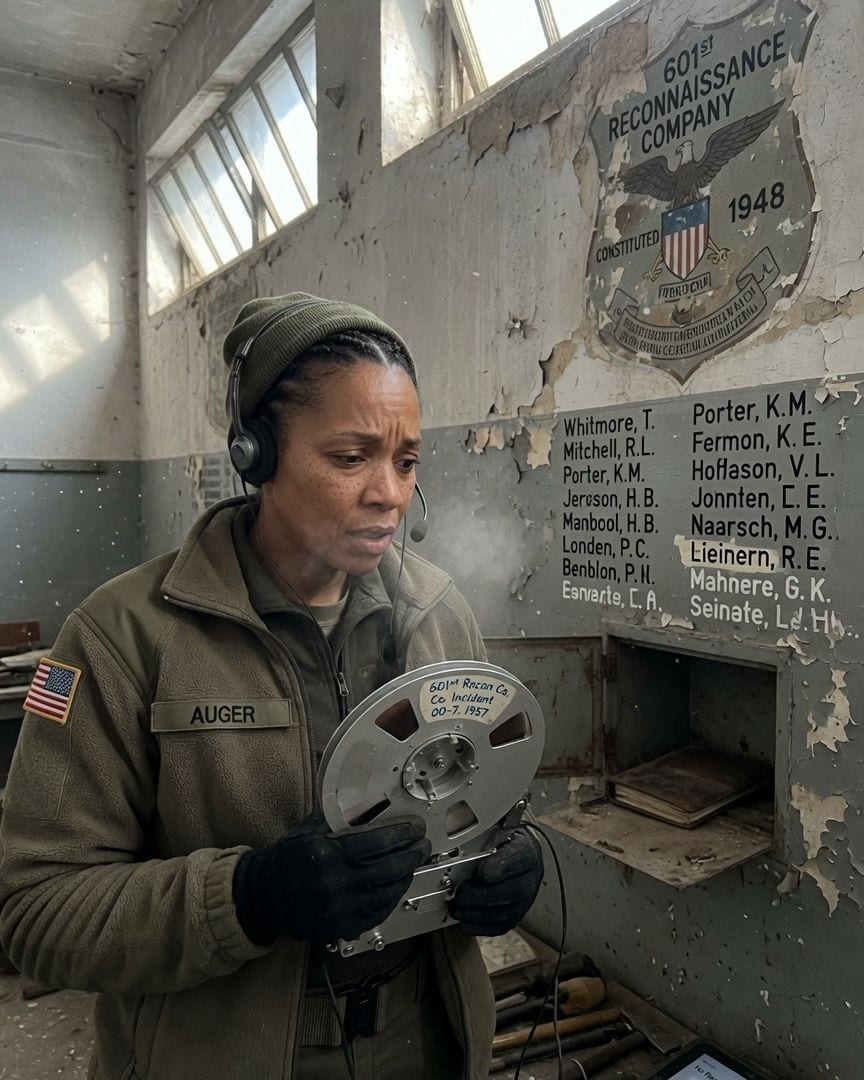
A demolition sergeant found a hidden Cold War tape in a drill hall wall. It played a voice shouting, 'not obeying physics,' then numbers, not human.
Sergeant First Class Delphine Auger was on her final assignment, overseeing the demolition of a Bavarian drill hall before her transfer stateside. While prepping the walls, her team uncovered a unit crest for the '601st Reconnaissance Company,' a designation Delphine knew the US Army had never constituted. Beneath it, a list of a hundred and four names included twelve painted only months ago, the whitewash still tacky under her touch. Her search led to a hidden panel, revealing a reel-to-reel tape that, once played, broadcast a distorted, non-human vocalization, then a frantic voice shouting, 'not obeying physics!' What impossible truth did this ghost unit's tape hold, echoing a service number with terrible finality?