My log flagged two readings for Number 30. Its second meter, freshly set in solid pavement, fed a pipe under a house whose front door I cannot find.
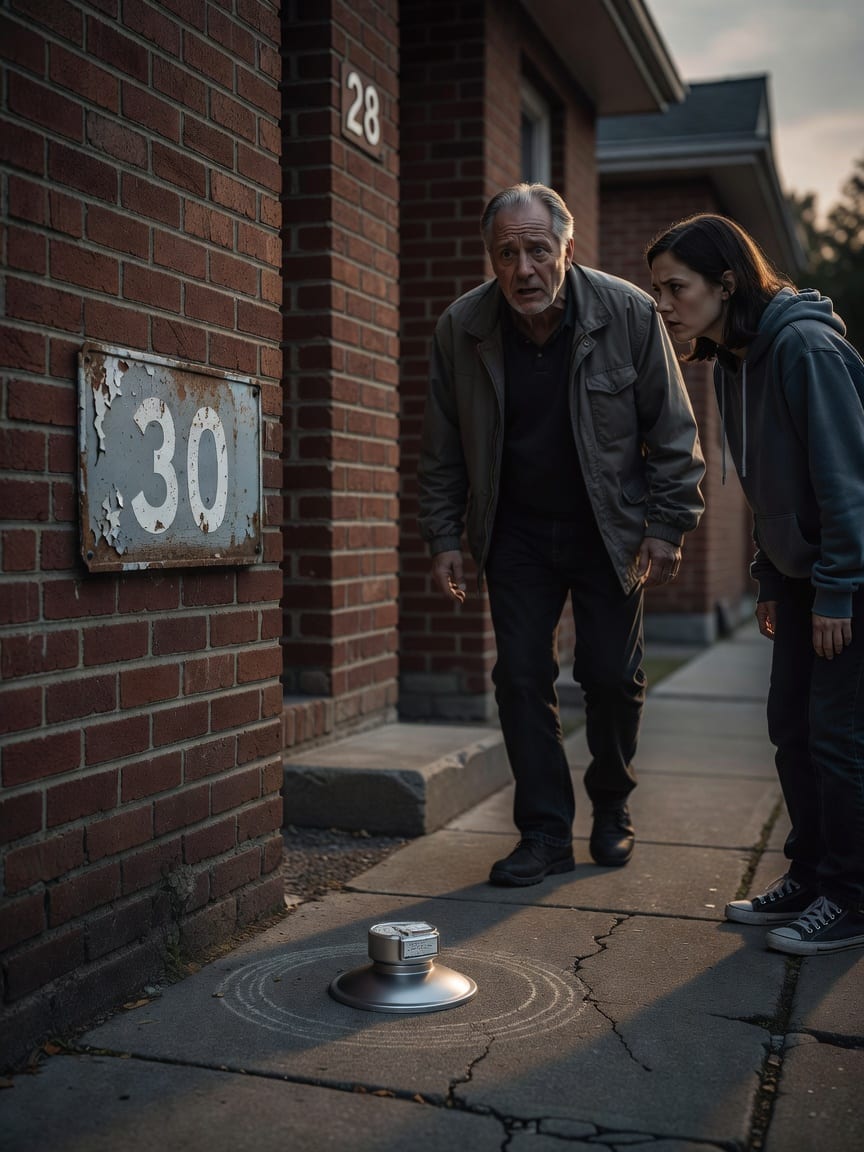
The sun was already baking the asphalt on Elm Street, but a cold prickle ran up my spine as I knelt at Number 30.
My logbook, open to the page for this month’s route, showed two readings for a house that had always, always, only had one meter.
I’d scrawled the second reading in myself, convinced it was a typo, a phantom entry from the dispatch system. Now, seeing it there, staring back from the grimy page, felt like a dare.
I ran a gloved hand over the spot where the meter should be. There it was: the usual dull, circular metal cover, scarred with years of boot scrapes and road salt.
The numbers inside were high, just as I remembered logging them last month. But then my eyes darted a foot to the left, to a patch of impossibly fresh asphalt. Black, smooth, pristine, as if poured this morning.
And embedded in it, a second meter cover. Shiny, almost gleaming in the morning light, stamped with the same water company logo, looking like it had materialized out of thin air.
“What the hell?” I muttered, kneeling to inspect it. The new asphalt formed a perfect circle around the cover, meeting the old, cracked pavement with a stark, clean line. It wasn't just new; it was too new.
I’d walked this route last month. That spot was solid.
My wrench bit into the bolts, and I lifted the cover. Beneath, a brand-new brass meter, ticking away. The dial already showed a significant consumption.
A thick, dark pipe ran from it, disappearing into the ground right under where Number 30’s front porch should be. But there was no porch. No front door.
Number 28, a two-story with faded blue siding, stood flush against what should have been #30’s western wall. And #32, a squat brick bungalow, abutted its eastern side.
Where #30 should have been, there was just a seamless stretch of brickwork belonging to #28, and a patch of vinyl siding that seemed to extend from #32.
It looked like the two houses had simply swallowed Number 30 whole, their walls merging without a seam, like they were always meant to be one unbroken facade.
I stood, pulling off my gloves. The street felt wrong. I walked the frontage, trying to force my brain to make sense of the geometry. Number 28. Then… nothing that looked like a house entrance, just more wall.
Then Number 32. I counted again, from the corner. 20, 22, 24, 26, 28… then the blank space. Then 32. There was no 30.
My eyes kept snapping back to the second, freshly set meter, its pipe burrowing into the ground beneath the phantom house. The numbers refused to align.
I walked into the district office, ignoring Reginald Brooks’s usual booming "Morning, Franklin!" from his glass-walled office. My head was still buzzing with the phantom meter and the missing house.
I went straight to the archive room, a dusty closet smelling of old paper and stale coffee. I pulled my logbooks, going back five years. Each page, each month, confirmed it: Number 30, one meter, one reading. Never two.
Never this ridiculous, impossible blank space where a house should have been.
I hammered at my keyboard, pulling up the digital records. Account for 30 Elm Street. One active service. One meter. The system was clean, unblemished, telling me everything was normal. I called dispatch. "Elm Street, Number 30.
How many active meters do we have listed?"
The dispatcher, Kelly, sounded bored. "One, Franklin. Same as always. Why?"
"No reason," I mumbled, hanging up. My stomach twisted. The digital world and the paper world, even the very people I worked with, were telling me I was wrong. But I had seen the second meter.
I had felt the new asphalt.
I drove back to Elm Street, determined to prove myself. The sun was higher now, beating down. I parked across the street and started counting again, methodically, from the corner. #20, #22, #24, #26, #28.
Then, a long, unbroken stretch of brick wall that clearly belonged to #28, running right up to #32. No gap, no driveway, no front door. No #30.
But there, in the narrow strip of neglected curb grass between #28 and #32, was the pristine, new meter cover. A dark, perfect circle of untouched asphalt around it, mocking me. The pipe, undeniably, ran back under the wall.
It wasn't under #28, or #32. It was under the space where #30 should be. The grass around it was overgrown, a tangle of weeds and ivy, as if nature itself was trying to reclaim a secret.
I walked closer, my eyes scanning the brickwork of #28. It was old, weathered red brick, painted a faded cream decades ago, now peeling.
But I saw it then: a faint, almost invisible outline in the brickwork, running vertically, then horizontally, then vertically again. A rectangle. Not a shadow, not a trick of the light.
An indentation, a slight change in the brick pattern, as if someone had filled in a space. A ghost of a doorframe, where no door could logically be.
It was so subtle, I’d have missed it if I hadn't been looking for something impossible.
My gaze dropped to the thick ivy spilling over the curb, right near the phantom meter. Something metallic glinted. I knelt, pushing aside the thick, green leaves.
Half-buried in the soil, clinging to a stray vine, was a small, rusted plaque. Chipped paint, faded bronze. It looked old, damn old. A house number.
A cold dread, sharp and sudden, settled in my gut.
I carefully pried the plaque free from the stubborn ivy. It wasn't easy; the roots were wrapped around it like tendrils. When it finally came loose, I scraped away the dirt and peeling green paint.
The numbers were clear, unmistakable: '30.' Old, chipped, but undeniably '30'. I held it in my palm, feeling its weight, its coldness.
My eyes darted from the plaque to the solid brick wall of #28, where it had been attached. There was no door, no window, no indentation where it could have belonged. Just seamless, unbroken brick.
But the plaque had been there, and the faint outline of a door was still there, a phantom etching in the masonry.
I looked from the rusted '30' in my hand to the shiny, newly set meter cover, then back to the blank wall, the ghost of a door, a single chill running straight down my spine.
The next week was a blur of dust and frustration. I spent every spare moment digging, not for pipes, but for answers. City Planning was my first stop.
Paige Carver, the records manager, a woman with neat blonde hair and an even neater smile, was polite to a fault. I asked for old street maps of Elm Street. "Digitized, of course," she chirped, tapping at her computer.
"But not always accurate, you know, for the older ones. Building codes change, property lines shift."
The maps she pulled up online showed #30 as a distinct house, but its footprint seemed to wiggle across different decades, like it couldn't quite decide where it wanted to sit.
One map from 1970 showed a peculiar, elongated lot for #28 and #32, with no #30 at all. Just a blank, stretched-out space. It felt like the city itself was trying to erase a mistake.
Unsatisfied, I drove to the municipal archives, a cavernous building smelling of aged paper and forgotten secrets. I requested physical blueprints, the heavy, crinkling kind. I found the same shifting footprints. #30 was there, then not, then slightly different.
It made no sense.
Then I visited Lydia Sinclair at 26 Elm Street. An 80-year-old dynamo with eyes that missed nothing, even if her memory sometimes skipped. "Number 30?"
she squinted, sipping her tea on her front porch, her gaze drifting to the blank spot between 28 and 32. "Oh, that one… always a bit of trouble, that house.
Used to be a lovely little place, bright yellow, I remember. Then it… went quiet for a while. Not like someone moved out, just… quiet. Came back different, too.
Not quite the same roofline when it returned, if you ask me. I thought I was losing my mind."
Her words sent a shiver through me. Came back different. The impossible geometry, the shifting footprint, it wasn't just old maps. It was a memory etched into the street itself.
Meanwhile, my daily meter reports for the second reading at #30 continued to climb. Reginald, my supervisor, kept brushing them off as "glitches" or "faulty equipment." But the meters weren't faulty. The street was.
My persistence didn't go unnoticed. The following Tuesday, Reginald Brooks called me into his office, a space usually reserved for disciplinary action or performance reviews.
He was leaning back in his chair, a tight, unreadable smile on his face, hands steepled under his chin. "Franklin," he began, his voice smooth, "I hear you're taking a keen interest in Elm Street.
More than the usual meter readings, anyway."
It wasn't a question. It was an observation, delivered with the weight of a warning. "Just trying to clear up a discrepancy, Reg," I said, trying to keep my voice even.
He steepled his fingers a little higher. "Some things are best left to the official channels, wouldn't you say? We've got protocols for these kinds of… oddities." His eyes, usually friendly, were cold. He didn’t threaten, he merely implied.
The air in his office felt suddenly heavy, like a humid summer day that promised a storm.
Later that week, while I was checking another meter on Elm Street—ironically, Number 22, just a few doors down—I noticed an unmarked dark sedan parked down the block. Its tinted windows were impossible to see through.
It sat there for an hour, engine off, just watching. I kept glancing up, pretending not to notice, as I logged readings. When I finished my rounds and got back to my truck, the sedan slowly pulled away.
Its brake lights flashed once, then it turned the corner and was gone.
I opened my door, and something fell from under my windshield wiper. A small, folded note. No envelope, no stamp. Just a piece of plain white paper. My heart hammered against my ribs. I unfolded it. Stark, typed words.
No signature.
"Some doors are meant to stay closed."
I ignored the warning. The note, crumpled in my fist, only hardened my resolve. I drove straight back to Paige Carver’s office, the note still tucked into my pocket, a burning coal.
I spread the old, contradictory maps across her desk. "This isn't a zoning error, Paige," I said, my voice low. "And Lydia Sinclair remembers it coming and going.
What's in that 'Anomaly' file you mentioned when I first asked about Elm Street?"
Paige’s composure, usually so pristine, finally cracked. Her neat blonde hair seemed to loosen a fraction. Her eyes darted to the door, then back to me. Her voice dropped to a near whisper. "Look, Franklin, there's… a file.
An old one. We're told to keep it buried. It's… not for public consumption."
"I don't care about public consumption," I snapped, pointing to the maps. "I care about the two meters on a house that isn't there, and the fact that my great-grandmother's neighbor remembers it blinking in and out of existence!"
She sighed, a shudder running through her. "Fine. But you didn't hear this from me. And you never saw it."
She walked to a locked filing cabinet in the back corner of her office, the one she'd always said was "just for historical tax documents."
She fumbled with a heavy brass key, the silence in the room pressing down on us. The ancient lock groaned open. From inside, she pulled a thick, brittle folder, its label faded but legible: 'Elm St. Anomaly - Site 30.'
She placed it on the desk. Inside were dozens, maybe hundreds, of internal memos, re-mapping requests, and utility reports, all yellowed with age. They spanned decades. One memo from 1972 detailed "spatial inconsistencies" at #30.
Another from 1985 referred to an "unaccounted for resource draw." A utility report from 1998 simply listed the consumption as "unassigned."
"It's always been like this, Franklin," Paige admitted, her voice barely audible. "Since before my time. The house… it's not always there. Or not quite right, when it is.
We just… update the maps, reassign the numbers, pretend it's a zoning error or a survey mistake. And the water company," she gestured vaguely in the direction of my office, "they just log the readings as 'unassigned' or 'test site.'
Everyone knows, but no one talks about it."
My logbook’s flagged readings, the phantom meter, the shifting house numbers, Lydia’s memory—it all snapped into chilling focus. The pieces of the puzzle weren't just fitting; they were slamming into place, each click louder than the last.
This wasn't a glitch. This was a cover-up. A decades-long, systematic denial of something impossible.
Paige, still visibly shaken, mentioned a single, unique document. "There's one thing. It was never digitized. Too… strange, I guess. Locked away in a forgotten sub-archive." She bit her lip. "They called it the 'Foundation Survey.'
It’s from the early 50s."
I convinced her. Begged, really. We drove to a disused municipal storage building, a forgotten concrete box on the edge of town.
Deep in the dusty backrooms, past shelves of obsolete equipment and forgotten city records, she pointed to a single, heavy, rolled parchment, brittle and yellowed with age. It felt ancient in my hands, almost fragile.
I carefully unrolled it on a workbench. It was a hand-drawn survey of Elm Street, dated 1952. My breath hitched. The geometry of the entire block was radically different.
Houses angled impossibly, distances that didn't reconcile, sidewalks that bent at acute angles where they should have been straight. A peculiar, non-Euclidean layout. It was a map of a street that couldn't exist.
And right at the bottom, in elegant, looping script, a signature: 'F. Bishop, Surveyor, 1952.'
My own surname. My great-grandfather’s first initial. Staring back at me from a map that described impossible wrongness. The geometry on the paper seemed to shift, pulling me in, the impossible lines blurring, the room suddenly cold.
A cold dread coiled in my stomach as I stared at the signature on the 1952 survey. F. Bishop. My great-grandfather. I remembered my grandmother mentioning him, a quiet man who was a city surveyor.
"He saw things others didn't," she'd said once, with a wistful, almost sad smile. I’d always dismissed it as an old woman's sentimental remark. Now, it echoed in the dusty archive, chilling me to the bone.
This map wasn't just an anomaly; it was a record of the anomaly's root, its earliest documented manifestation. The impossible angles, the shifting distances, the houses angled impossibly—they weren't errors.
They depicted the true, unstable nature of the space at #30. The geometry that stubbornly refused to align with reality.
Paige, now fully on my side, her initial reluctance replaced by a frantic need to understand, found corresponding entries in the 'Elm St. Anomaly' file. 'Bishop's Observations,' from the 1950s.
They weren't trying to fix it; they were trying to contain it, to re-map reality around it, to make the numbers add up where they simply refused. The second meter wasn't a mistake or a glitch.
It was the city's grim acknowledgement that the impossible space at #30 was a constant drain, a hungry void they had to account for, year after year, cycle after cycle.
My own family had been part of this, trying to document what couldn't be explained.
I confronted Reginald Brooks one last time. I laid out the stack of evidence on his desk: my logbooks with the double readings, the maps with the shifting footprints, Paige’s brittle 'Anomaly' file, and finally, the rolled-up 1952 survey.
Reginald’s face was unreadable, a mask of practiced indifference. He didn't even flinch when I unrolled the map with my great-grandfather’s signature.
"You think we haven't tried, Franklin?" His voice was flat, devoid of emotion. "We've sealed it off, demolished it, rebuilt it, re-zoned it. Every damn thing. It always comes back. The geometry reasserts itself.
It’s a part of the city, now. Always has been, always will be."
He leaned forward, his voice dropping to a low rumble. "The city's goal isn't to understand it, or to stop it. It's to manage the 'resource bleed,' as you've seen. To keep the public from noticing.
To make sure the property taxes get paid, and the water bills don't raise too many questions." He picked up the 1952 survey, tracing the impossible lines with a finger. "Your great-grandfather," he continued, "he understood.
He tried to warn them. He documented what he saw. They just buried his reports. Too inconvenient."
A chill went through me, colder than anything I’d felt before. I realized then I couldn't fight an impossible geometry, or an institution that had known and adapted for decades, silently managing the unmanageable.
The wrongness wasn't a problem to solve; it was a fact of the place, a slow, quiet consumption.
I saw my own future, endlessly logging the phantom meter, knowing what it meant, or worse, becoming another 'F. Bishop' on a forgotten record, swallowed by the bureaucracy of the impossible. I made my choice.
I would leave.
Franklin Bishop submitted his resignation the following week, citing 'personal reasons.' He packed his belongings from his small apartment on Elm Street, a place that now felt entirely alien to him, and left without a backward glance.
The water company quietly reassigned his route, slotting a fresh, eager face into the pattern. The second meter cover at Number 30 remained, pristine and unmoving in the pavement, its dials ticking away beneath the earth.
His successor, a young man named Henry Walsh, logged the two readings for Number 30 at the end of the month, frowning at the discrepancy but shrugging it off as an administrative error, like all the others before him.
Franklin moved to a small town upstate, taking a job in a completely different field, far from water pipes and impossible geometries. He tried to forget Elm Street, the impossible angles, the endless, quiet consumption.
He avoided anything that felt 'off,' any pattern that didn't quite fit. One evening, he was walking home, past a row of old brick houses, identical in their faded charm.
He noticed a new lamppost, installed recently, casting a strange, elongated shadow. The shadow stretched across three houses, but somehow, it seemed to miss the door of the fourth entirely, leaving it in an impossible, perfect darkness.
He stopped, a familiar coldness prickling his skin. The numbers always add up, until they don't.
If this one got to you
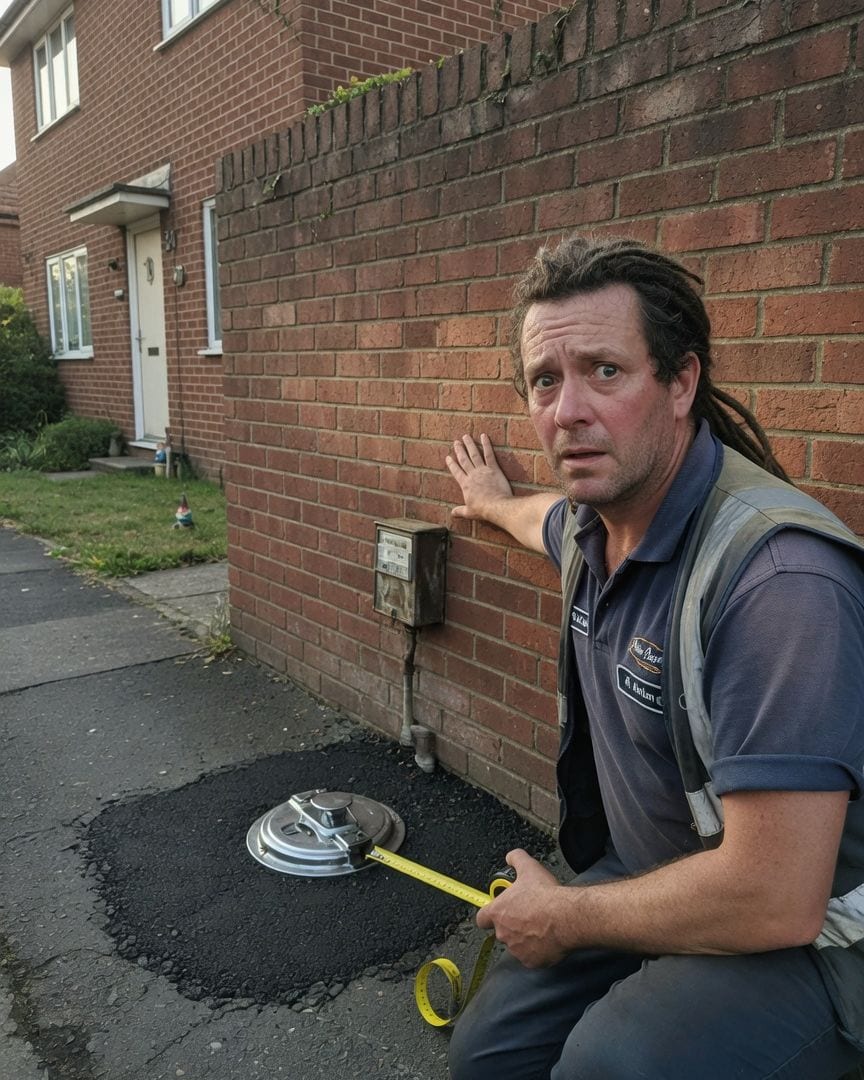
Number 30's second water meter appeared last month. Its pipe runs under a house I cannot find.
My routine meter check on Maple Street became anything but ordinary when I found a second, active water meter at Number 30. My log only showed one, and the official blueprints confirmed a standard layout. Yet, this new meter's pipe disappeared under a solid, unbroken expanse of brick, where no entrance or connection could possibly exist.
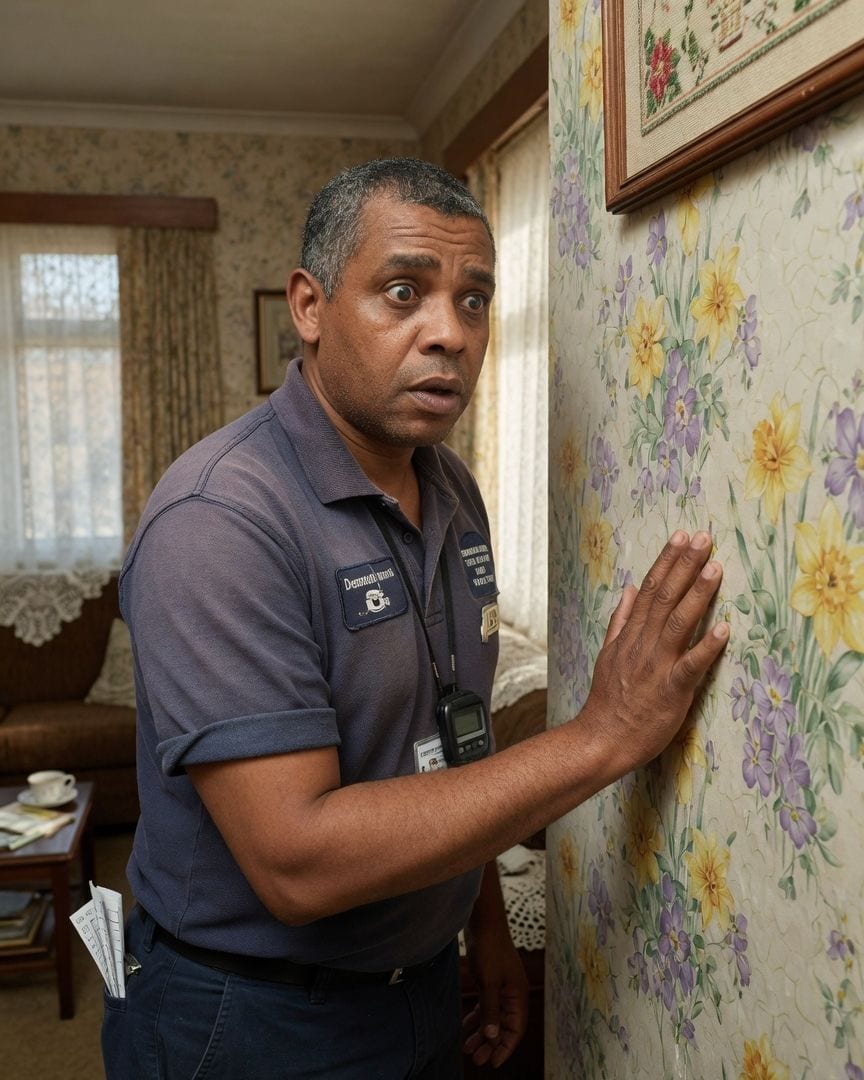
I read the water meters on this street, and this month number 30 grew a second one in pavement that was solid last month — its pipe runs back under a front door I cannot find.
I'm Desmond Drummond, a city water meter reader, used to the predictable rhythm of my fifteen-year route. But this month, Mrs. Crane's house on Elm Street showed a second meter reading. It led to a new meter pointed at a blank brick wall, and later, to a hidden door behind her living room wallpaper where no door should exist.
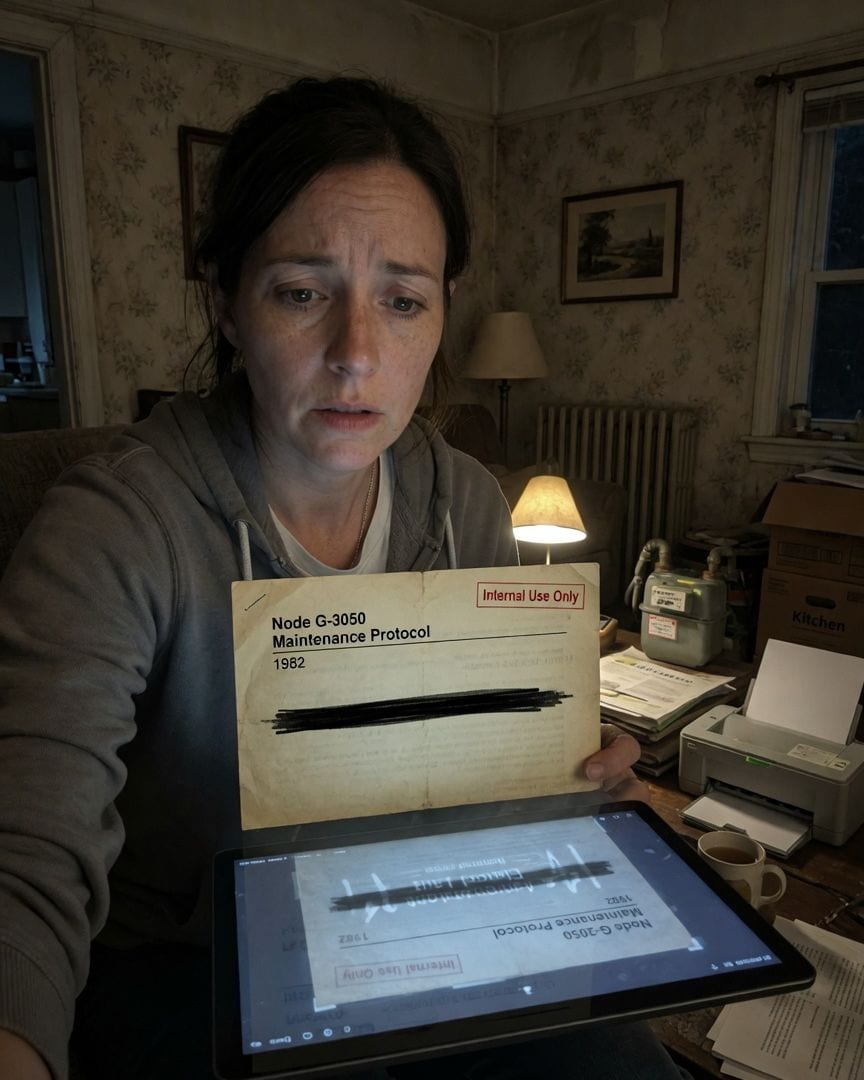
A different tenant every decade since 1949, each one gone — yet our gas meter's final reading comes back identical every time, though the house sat empty in between.
My new house at 14 Elmwood Lane was meant to be a fresh start, a normal home. But the gas bill was wrong. It showed my account, G-3050, active since 1949, with a meter reading of 3050 that had never changed, even when the house stood empty for decades.
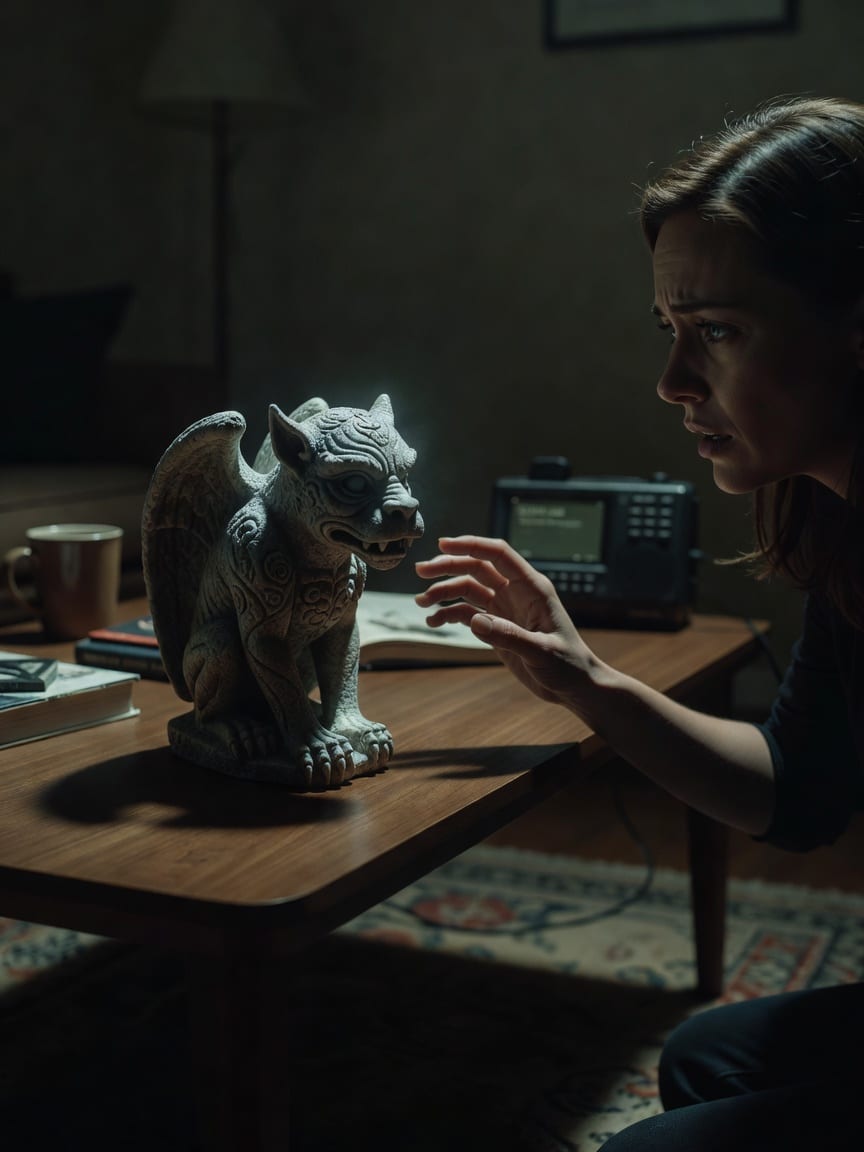
My radio scanner spoke my address at 2 AM. A flat voice read local homes, all with past dates. Mine was the only one in the future.
It was two in the morning, and my quiet house was filled with the usual hum of my weather scanner. But the static broke, replaced by a flat, synthesized voice reading a list of local addresses and dates. My hand froze when it spoke my own address, 181 Foster Drive, followed by a date: October 27th. That date was three weeks from now.
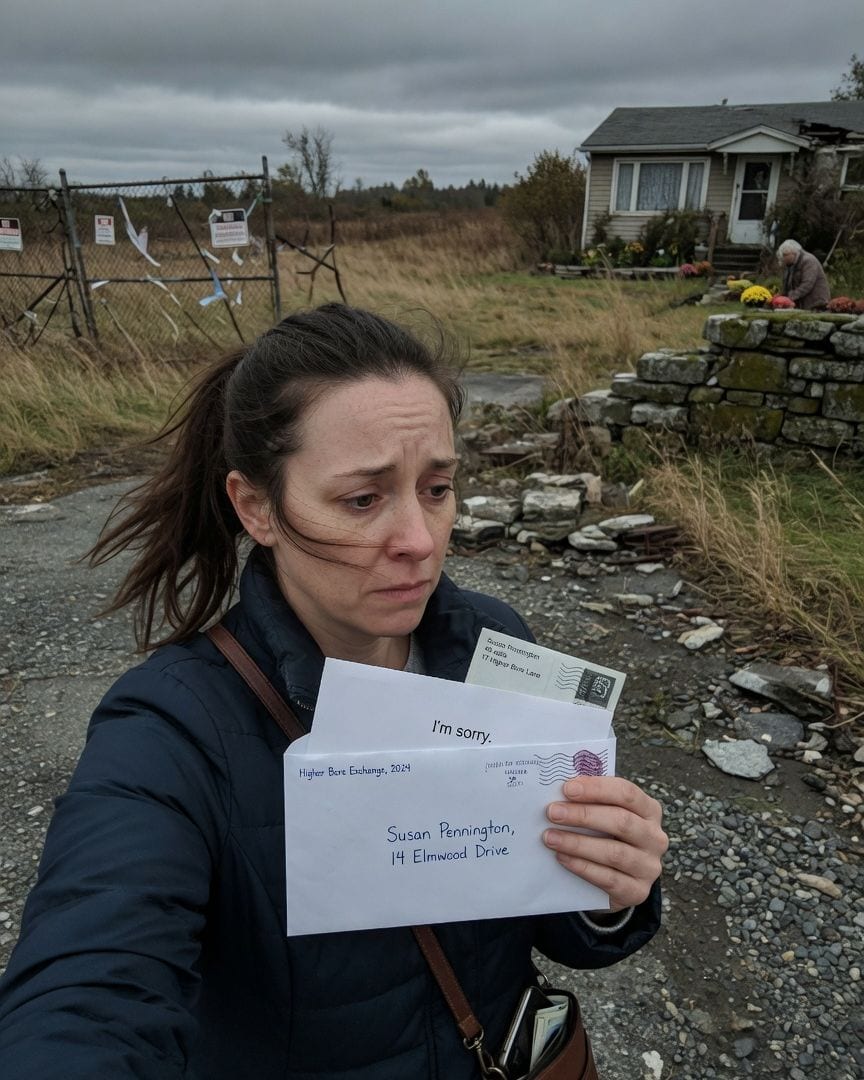
My phone bill listed forty calls made at 3:14 AM to a house demolished in 1990. The paper bill came from a flattened building. My name is on it.
I stared at my phone bill, my morning coffee forgotten. It detailed forty calls, each at 3:14 AM, to an address I knew was a vacant lot where a house had stood decades ago. But the real dread began when I saw the bill's return address: a telephone exchange flattened years before.
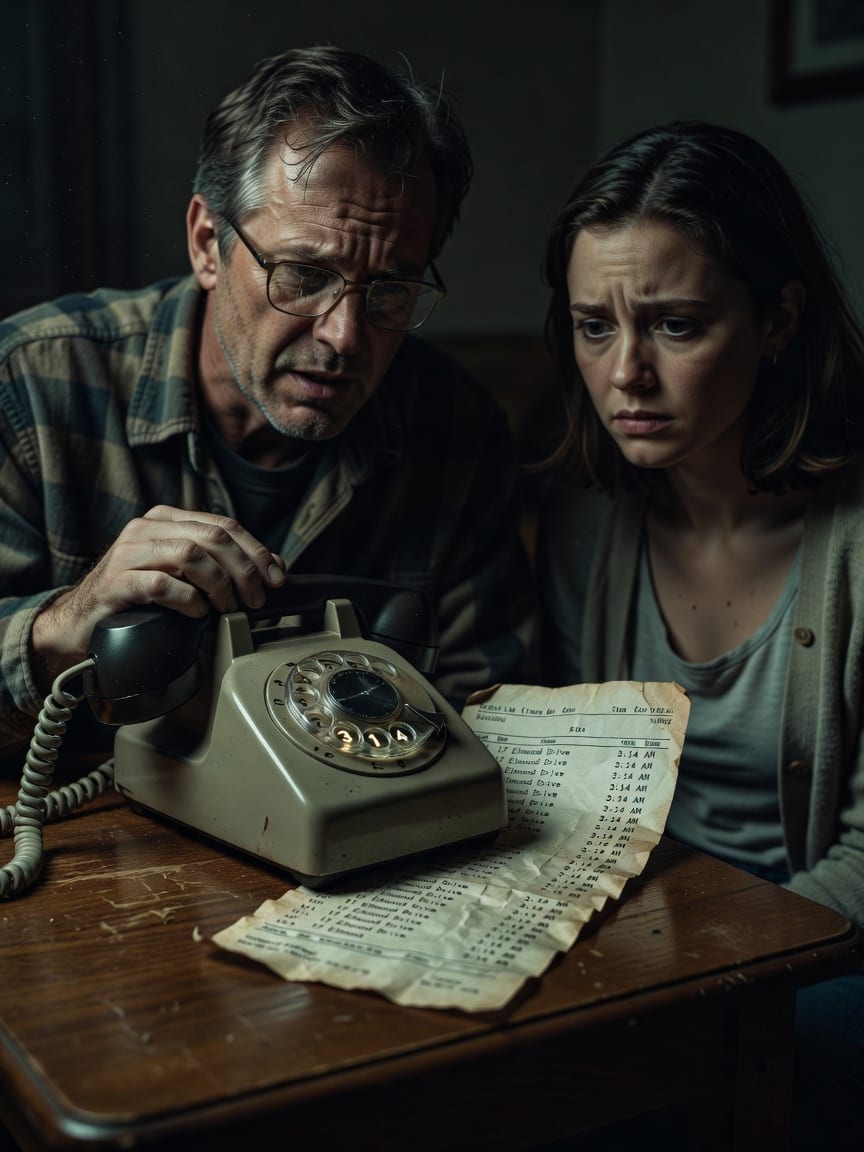
My phone bill itemised forty calls from my number to a house demolished in 1990. Each call at 3:14 AM, lasting eleven minutes. The bill arrived postmarked from a flattened building.
I expected the usual mobile bill, but my landline statement listed forty calls from my number to '17 Elmwood Drive.' That address was for a house torn down in 1990, a vacant lot I remembered from childhood. The phone company insisted the calls were legitimate, leaving me profoundly unsettled by the impossible charges.