A meticulous archivist nearing retirement found the Cold War drone she signed off as 'destroyed' had logged flight hours weeks later, signed by a man who didn't exist.
The oppressive heat of a Texas night in 1959 pressed in on Second Lieutenant Rosalind Tate, making the Quonset hut feel like a sealed oven.
At 0200, a single bare bulb illuminated the metal table where Colonel Bishop sat, his face unblinking, devoid of a name tape.
An hour earlier, Rosalind had watched, horrified, as a crate—supposedly holding the debris of a Ryan target drone—slowly, inexorably, compressed the pallet jack's hydraulics all the way to the floor.
It was stated to weigh nine hundred pounds, but the effort to move it had been impossible, a dead weight that defied physics. The metal groaning as the crate settled felt less like friction and more like a sigh.
Now, Bishop pushed a form across the table, its heading 'Certification of Recovered Debris.' Rosalind’s hand trembled as she took the pen. She had been to Ryan’s plant, had seen their drones, and knew this was not one of them.
The colonel’s gaze was a physical weight, cold and heavy as lead. She signed, the scratch of the pen unnaturally loud in the silence, and the immediate rush of relief was a cold, hard shame she would carry for decades.
The file, now officially closed, was slid into a manila folder, its new contents a lie.
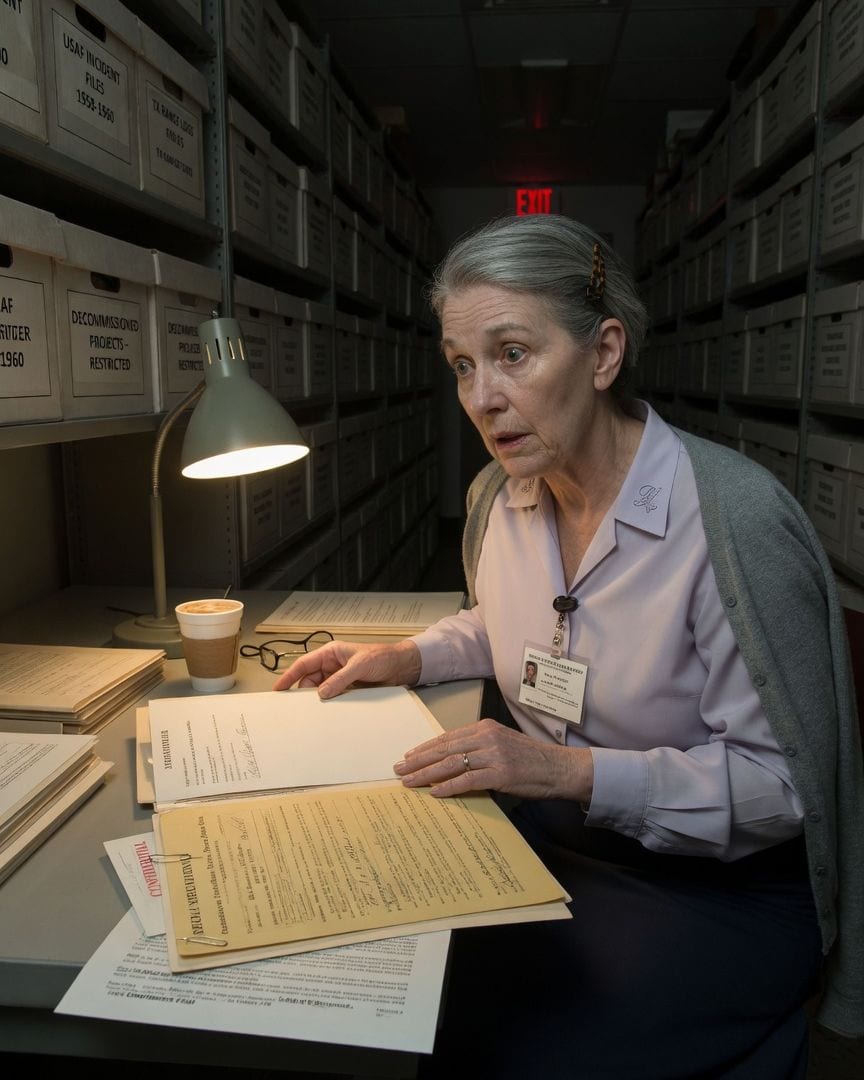
Thirty-eight years later, in 1997, Rosalind Tate, now a meticulous archivist nearing retirement, sat in the hushed, climate-controlled depths of the National Records Center. She wore sensible shoes and a quiet dread she thought she’d buried.
The stale air of the archives, usually a comforting blanket, felt suddenly thin. A declassification request had brought her a familiar file: 'Ryan Target Drone, Serial 59-TX-007, Texas Range Incident.' Her heart gave a small, unwelcome jump.
This was it, the file she’d signed. She opened it, expecting closure, a final confirmation of a long-ago lie. The standard incident report, the recovery manifest, the certification form bearing her own youthful, shaky signature – all were present.
It was routine, until she reached a document near the back, clipped neatly, stamped 'CONFIDENTIAL.' It was a requisition form for 'Replacement Gyro-Stabilizer Assembly, Ryan Type-A Target Drone, Serial 59-TX-007.' The date on the requisition was October 12, 1959.
Rosalind blinked. The drone had crashed and been recovered on August 28, 1959. It was destroyed. How could parts be requisitioned for it two months later?
She immediately suspected a clerical error, a misfiled document, perhaps for another drone with a similar serial. Her rational mind sought an explanation, but the serial number was exact, the unit code precise.
She double-checked the adjacent documents, searching for a note, a correction, anything to explain the impossible entry. The quiet hum of the air conditioning seemed to mock her, refusing to offer a simple answer. There was nothing.
Rosalind’s fingers, now cold, flipped to the next page in the file. It was a maintenance log, dated October 20, 1959. It detailed 'routine servicing, gyro-stabilizer assembly installed, flight hours logged: 0.7.'
The entry was signed, in a perfectly legible, unfamiliar hand: 'M. Sullivan.' Rosalind stared at the name. She knew every officer associated with that range, that unit, in that year.
There was no 'M. Sullivan' listed anywhere in the base’s personnel records for 1959. The drone was gone, its debris signed off on, the lie sealed by her own hand.
Yet, its file now suggested it had been flying, repaired, accounted for, weeks after its destruction. Rosalind felt a cold dread settle in her stomach, far worse than the shame of 1959. The file wasn't closed. It was… active.
Rosalind couldn't shake the impossible entries. Her retirement was weeks away, but the file became an obsession. The familiar scent of old paper and dust that usually calmed her now seemed to whisper questions.
She used her privileged access as an archivist, cross-referencing 'M. Sullivan' against every military and civilian roster she could access from that era. No match. The name simply didn't exist in any official capacity for 1959.
She began searching for other files with similar anomalies. It was painstaking work, sifting through millions of declassified records in the silent stacks, the only sound the rustle of paper and the occasional distant whir of a microfilm reader.
Then, she found another. A file for a transport aircraft, lost over the Pacific in 1965, all hands presumed dead.
But buried deep within its records were payroll entries, signed 'M. Sullivan,' for the entire crew, dated six months after the loss. The details were precise: rations, hazard pay, even a commendation for a pilot no longer alive.
Then another: a naval vessel, vanished in the Bermuda Triangle in 1971. Its file contained requisitions for fuel and provisions, again signed 'M. Sullivan,' dated years after its disappearance.
The pattern was chillingly consistent: a lost asset, then, years or decades later, official paperwork accruing in its file, signed by a phantom. Rosalind found herself charting these anomalies, creating a hidden ledger of impossible entries.
She noticed the signature itself was subtly different across the decades, as if evolving, but the core 'M. Sullivan' remained, like a watermark pressed through time.
She tried to find any mention of a 'Protocol Sullivan' or a classified project, but her searches yielded nothing.
It was as if this entire, impossible administrative layer existed in a void, leaving only these ghostly traces in the official record. The dread deepened; this wasn't an error. It was a system.
Rosalind's discreet inquiries didn't stay discreet for long. The quiet hum of the server room now felt less like background noise and more like a low thrum of awareness.
A file she'd requested on a similar anomaly, a missing reconnaissance satellite, suddenly vanished from the intake queue. Another, a civilian disappearance linked to a remote government facility, reappeared heavily redacted, entire sections she'd previously seen now blacked out.
The black ink was too precise, too deliberate, to be random. One morning, she arrived at her desk to find a small, folded note. It was unsigned, printed on official stationery she didn't recognize, and contained a single word: 'Filed.'
The word, which had been a bureaucratic term her entire career, now felt like a personal threat, a chilling breath on the back of her neck.
She started feeling eyes on her in the quiet library stacks, the rustle of pages in an aisle she knew was empty. The air in those empty spaces felt colder, heavier.
One evening, working late, she distinctly heard the heavy thud of a book being dropped in the 'Closed Files' section, an area accessible only by authorized personnel, and only during working hours. Her heart hammered.
She grabbed a heavy brass letter opener from her desk and crept silently towards the sound, its weight a meager comfort in her trembling hand. The aisle was dark, lined with towering metal shelves that seemed to loom over her.
She called out, her voice shaky, 'Hello? Edward?' No answer. The air was cold, thick with the scent of old paper and dust, as if something ancient had just exhaled.
She swept her flashlight beam down the narrow corridor, past rows of sealed boxes. Nothing. But on the floor, near an open file drawer, lay a single, plain manila folder. It was empty.
The drawer it had come from was labeled 'Personnel: Active.' She felt a prickle on the back of her neck. Someone knew. Someone was watching her dig, and they were letting her know they were aware.
The 'Filed.' note spurred Rosalind to action. She printed her ledger of anomalous files and confronted Sandra Vaughn, her immediate supervisor and head of the Declassification Section.
Vaughn, a woman known for her unflappable demeanor, listened patiently, her expression unreadable as Rosalind laid out her evidence: the drone, the lost plane, the vanished ship, the satellite, the civilian case—all with impossible post-loss paperwork signed by 'M. Sullivan.'
Rosalind concluded, 'This isn't a clerical error, Sandra. This is a pattern. And M. Sullivan doesn't exist.' Vaughn picked up a printout, her gaze scanning the dates and entries.
The fluorescent lights of the office hummed, casting a sterile glow on Vaughn's impassive face. 'You've been very thorough, Rosalind,' she said, her voice unnervingly calm, as if discussing quarterly reports. 'More thorough than anyone in decades.'
Rosalind pressed, 'What is it? What does 'Filed.' mean?' Vaughn sighed, a sound like air escaping a sealed chamber. 'There are certain assets, Rosalind, that are never truly… lost. They are simply… reclassified. Or, as the vernacular puts it, 'filed.''
'Reclassified as what?' Rosalind demanded, her voice rising, fighting against the sudden chill that had permeated the room. 'As active. As ongoing. As administratively present,' Vaughn replied, her eyes meeting Rosalind’s, devoid of any discernible emotion. 'It's a protocol.
A very old one. For things that cannot be accounted for in the conventional sense. Things that still have… utility.' 'Utility?'
Rosalind whispered, remembering the impossible weight of the drone crate, the way it had resisted every attempt to move it. 'The drone was destroyed. The plane crashed. The people were dead. How can they have utility?'
Vaughn leaned forward, her voice dropping to a near-whisper that still held no warmth. 'The record, Rosalind, is a powerful thing. It can hold a great deal. More than just ink on paper.
Some things, when they disappear, don't truly cease. They transition. And the record… the record is how we manage that transition. How we keep them… present.' Rosalind felt a chill deep in her bones.
The first clue, the drone's impossible maintenance log, now clicked into place with horrifying clarity. The paperwork wasn't a mistake. It was a continuation. The drone wasn't lost; it was being held in a state of perpetual bureaucratic existence.
Shaken by Vaughn's admission, Rosalind pretended to accept the explanation, but her resolve only hardened. She knew Vaughn hadn't told her the full truth.
The idea of the record 'holding' things, keeping them 'present,' twisted in her mind like a barbed wire. She continued her secret research, now focusing on the 'pattern across decades and classifications' that Vaughn had implicitly confirmed.
She delved deeper into the 'Closed Files' section, using her access codes to bypass security protocols she herself had helped design. The metal shelving seemed to groan faintly as she moved through the aisles, as if resisting her intrusion.
She wasn't just looking for 'M. Sullivan' anymore; she was looking for the mechanism, the true scope of this 'filing.'
She found more cases: a remote Arctic research station that ceased transmission in 1978, its file showing active supply requisitions into the 1990s; a specific civilian fishing vessel lost off the coast of Maine in 1985, its crew's social security accounts still showing quarterly 'pension adjustments' until recently.
The scale of it was staggering. This wasn't just a few isolated incidents; it was a vast, sprawling administrative shadow, consuming entire units, ships, and even individuals.
Then, in a file marked 'PERSONNEL: TRANSITION PROTOCOL ALPHA-7, OBSERVER CLASS,' buried beneath layers of classified documents pertaining to 'unaccounted assets from domestic incidents,' Rosalind found it.
A single page, a roster of names and service numbers, printed on slightly thicker stock than standard forms.
And there, listed under 'Active Status, Post-Termination Assignment,' was her own service number, her full name: 'Tate, Rosalind M.' The date next to it was June 14, 1999—two months after her official retirement date.
She traced the line with a trembling finger, her breath catching in her throat, the paper feeling oddly warm beneath her touch. Below her name, in that steady, official hand, was the signature: 'M. Sullivan.'
She wasn't just an observer anymore. She was already in the file.
Rosalind stumbled back from the file cabinet, the roster page clutched in her hand. Her own name. Her own service number. Active status. Post-termination assignment. The words burned into her mind, searing themselves onto her consciousness.
The full, horrifying truth detonated, reframing every impossible entry, every phantom signature, every unblinking stare she’d endured. The secrecy machine wasn't just a bureaucracy that buried records; it was a system that captured and sustained them.
The 'filing' wasn't about hiding the lost; it was about maintaining their administrative existence, keeping them perpetually 'present' within the system. The drone, the plane, the ship, the people – they weren’t truly gone.
They were still generating paperwork, still drawing supplies, still 'active' because the system itself had absorbed them.
'M. Sullivan' wasn't a person, or perhaps not one person; it was the steady, official hand of the machine itself, the signature of a process that spanned decades, consuming and incorporating anything that slipped through the cracks of conventional reality.
Every clue she had found, from the impossible weight of the crate that had sunk the pallet jack to the maintenance logs for a destroyed drone, the payroll for dead crews, the pension adjustments for missing civilians, all clicked into place with sickening precision.
The horror was in the coherence. It all fit. And now, she was part of the pattern. Her retirement was a fiction. Her life outside the archives was a temporary reprieve. She had been 'filed.'
She was an 'active asset' to a system that redefined existence, where being 'lost' was merely a transition into a perpetual, administrative afterlife, overseen by an unblinking, tireless hand.
The realization galvanized Rosalind. She couldn't stay. She couldn't let herself be fully absorbed. She had to get out, and she had to take proof.
She moved with a frantic urgency, her fingers flying across keyboards, attempting to download the anomalous files, to copy the pattern she’d charted. But the system, designed by countless hands over decades, was too vast, too intricate.
Every attempt to extract the data was met with an error message, a corrupted file, or an immediate system lockout that flashed red across her screen.
The archives, usually a place of quiet order, now felt like a living entity, its silent rows of shelves pressing in on her, the hum of the climate control a low, steady growl, like a cat purring before it pounces.
She heard footsteps approaching, light and quick, down the main aisle, echoing slightly. Sandra Vaughn. Rosalind knew she couldn't outrun her, not in these labyrinthine stacks. She made a desperate decision.
She grabbed a small, unmarked data chip from her purse, quickly loaded the 'M. Sullivan' signature ledger onto it—the only piece of evidence she could secure—and then, with a surge of adrenaline, she plunged it into a secure shredder bin, watching the small light blink 'DELETE.'
It was a sacrifice, a desperate attempt to erase her digital trail, to make herself less 'fileable.' As Vaughn’s shadow fell across her, long and thin in the fluorescent light, Rosalind spun, her face grim.
'I'm leaving,' she stated, her voice surprisingly steady, a fragile defiance. Vaughn's expression was calm, almost pitying, her eyes holding that unsettling, knowing placidity. 'Rosalind, you're not going anywhere. You're already here.'
The words were soft, yet absolute, like closing a lock. 'I'm not,' Rosalind insisted, backing away, her eyes darting for an exit, her fingers still tingling from the shredded chip. 'I won't be filed.'
Vaughn simply watched her, her hands clasped in front of her, a statue of quiet authority. 'It's not a choice, Rosalind. It's a designation.' Rosalind didn't wait.
She bolted, sprinting past Vaughn, through the echoing halls, past silent offices, and out into the cool night air.
She didn't look back, the weight of the archives, of the files, of her own name now pursuing her, a silent, relentless hunt.
Rosalind Tate vanished. Her apartment was left untouched, her retirement papers unfiled. The data chip she’d managed to secure was dismissed as a collection of 'misfiled documents and a known clerical error' when it was anonymously sent to a newspaper.
Sandra Vaughn oversaw the quiet internal investigation, which concluded Rosalind had experienced a 'stress-induced breakdown' and gone 'voluntarily AWOL.' No one believed her frantic, anonymous calls to former colleagues, reporting a vast, impossible conspiracy.
Her name was quietly removed from the archives' personnel roster, her access codes deactivated. Her life, for all official purposes, simply ceased to exist. But somewhere, a file remained open, and a steady, official hand continued to sign entries.
Years later, in 2015, Rosalind Tate, now living under the assumed name 'Marianne Brooks' in a small, anonymous town nestled in the quiet Midwest, received an official-looking envelope.
It bore no return address, only a faint, almost invisible stamp from a 'Department of Unaccounted Assets' that didn't officially exist. Her hands trembled as she opened it, the paper crackling like dry leaves.
Inside was a single form: a 'Change of Address' request. Her original service number was clearly printed at the top, along with her true name, Rosalind M. Tate.
The form was blank, except for one detail: the signature line was already filled, in that familiar, steady official hand, the ink black and precise. It was signed 'M. Sullivan.'
It was already signed.
If this one got to you
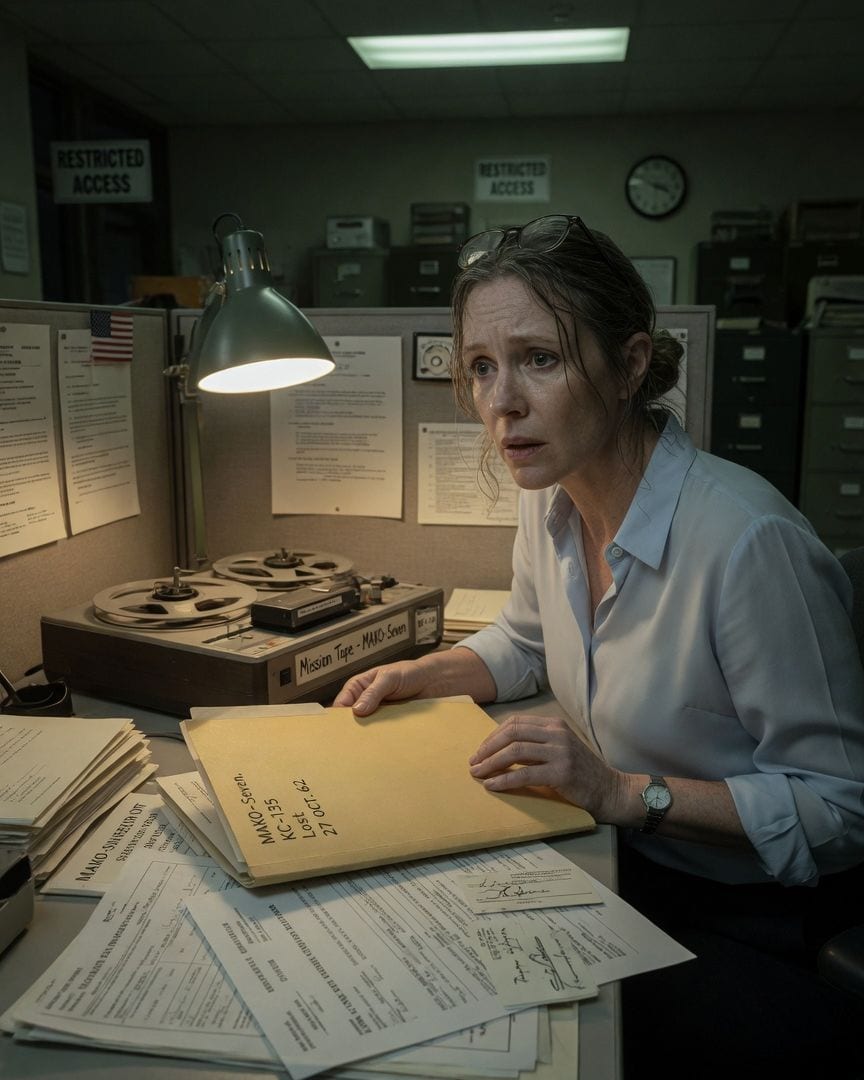
A declassification reviewer found Captain Sowell's signature authorizing parts for his lost Cold War aircraft, sixteen years after its official crash.
Janet Kingsley, a declassification reviewer, was processing a routine request for a lost Cold War mission when she made a chilling discovery. The official report stated the KC-135 MAKO-Seven impacted the Labrador Sea in 1962, but its mission tape continued for nine minutes after the official crash, with the pilot calmly landing. As Janet dug deeper into the yellowed file, she found official documents for the aircraft and pilot dated years after its disappearance. The final discovery was a requisition for replacement parts, signed by Captain Thomas Sowell himself, a full sixteen years after his plane was officially lost and he was declared dead.
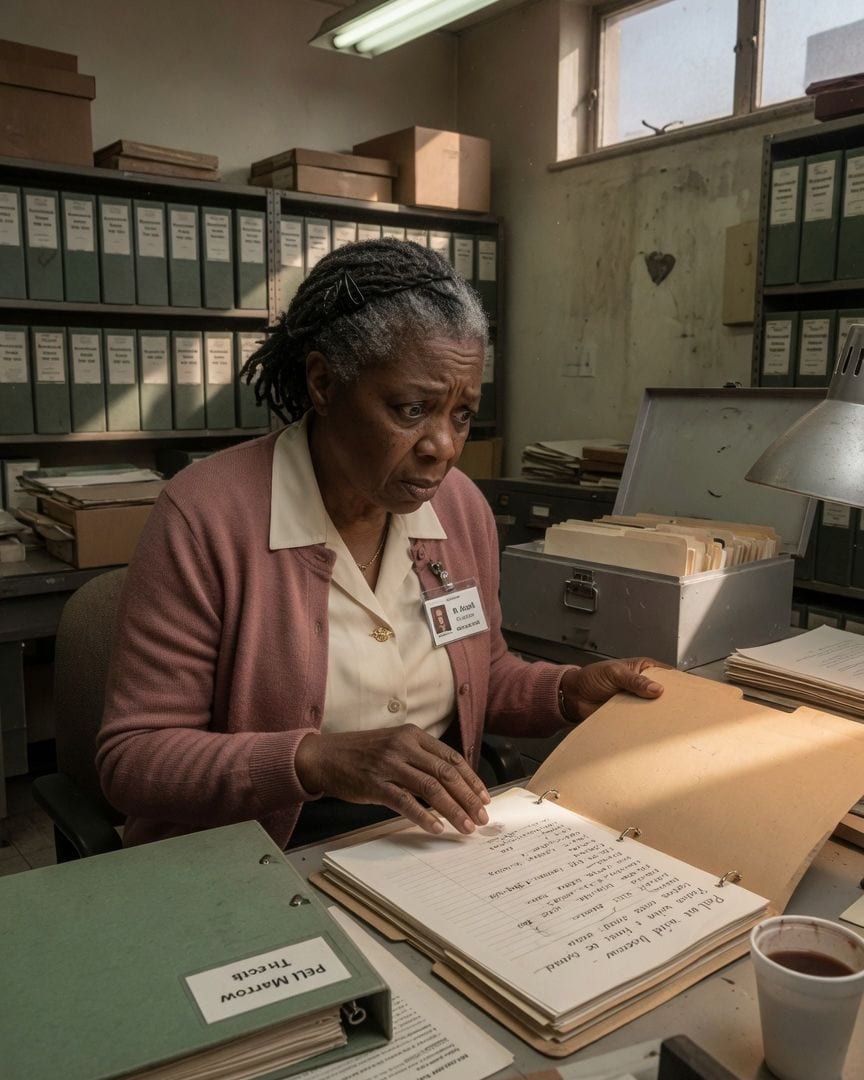
A records clerk's archive file for a Cold War reconnaissance plane lost in 1968 showed it flew yesterday to her own building.
Marguerite Ansell, a records clerk nearing her final week before retirement, meticulously audited Cold War-era files. In the cool, dusty archive, she pulled a file for an oiler declared missing in 1951. Inside, she found a fueling schedule with entries stretching into the present, the last dated just eleven days ago. Then, a second lost ship revealed a similar impossible log, and a cold certainty began to bloom in her chest. Deep in the shadows, Marguerite found an unmarked steel box containing a file for a reconnaissance plane lost in 1968. Its flight log showed a final flight yesterday, to the precise coordinates of her own archive building.
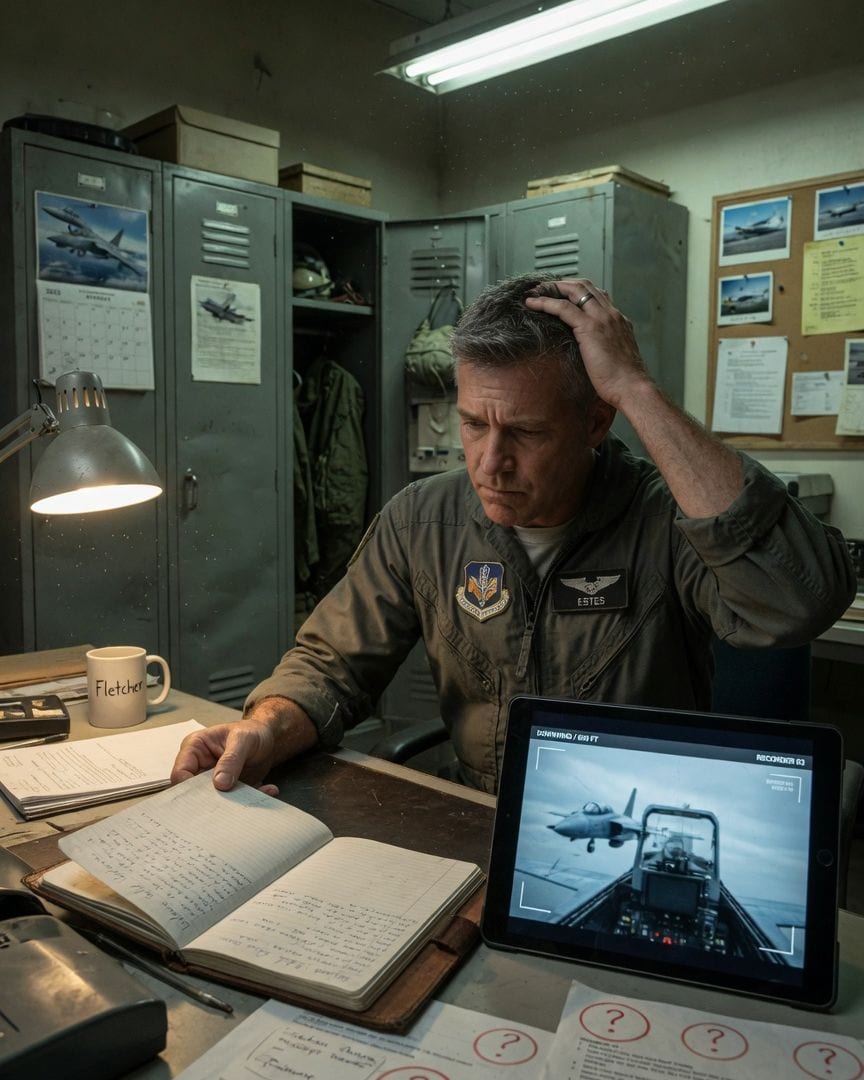
A Chief Warrant Officer's HUD tape shows a phantom jet, impossibly close, off his wing. Forty years ago, another Cold War pilot logged the same impossible sight.
Chief Warrant Officer Nathaniel Estes, a pilot whose career hinged on absolute precision, was under evaluation for a critical promotion. His nightly review of HUD tapes from routine Mojave test flights was a meticulous habit, but for a week, it revealed an impossible detail. At precisely 800 feet, one frame showed a sleek, experimental jet tucked impossibly close off his left wing—a craft ground radar never detected. When his maintenance chief found no equipment fault, Estes unearthed a dusty, decades-old logbook detailing identical phantom sightings from 1978. What unseen presence shadowed the desert skies?
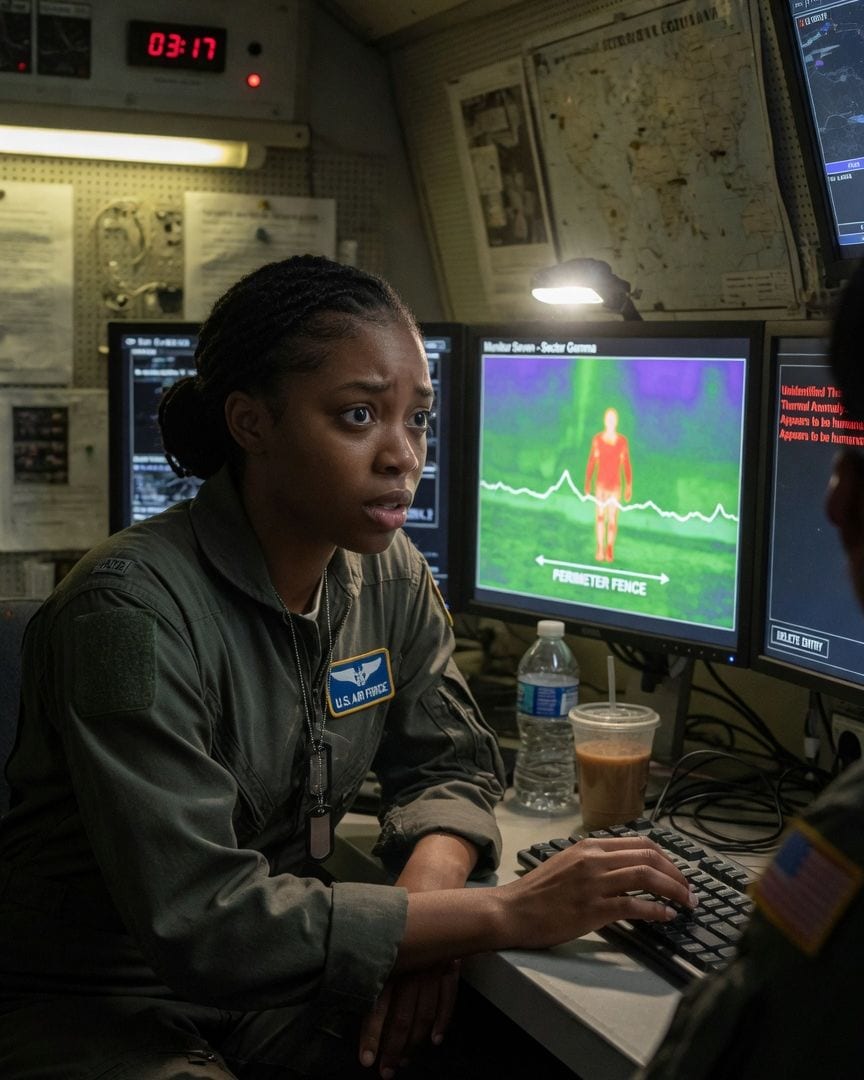
An airman’s thermal feed shows a figure moving in the restricted desert. Her captain orders it scrubbed, but the heat signature appears to tilt its head and look right at her.
Airman First Class Olivia Kade was new to her remote high-altitude outpost, fresh from advanced training, and the isolation pressed in, amplifying every hum. Her duty was to monitor the desert perimeter, but one shift, a faint thermal signature appeared on Monitor Seven: a solitary, upright figure moving with impossible precision beyond the barbed wire. No personnel were authorized in that sector. Her mission commander quickly ordered the anomaly scrubbed, but as it dissolved, the featureless outline seemed to tilt its head, looking directly into the camera. Now, the signature returns night after night, forcing the airman to wonder what impossible thing patrols the dark beyond the wire.
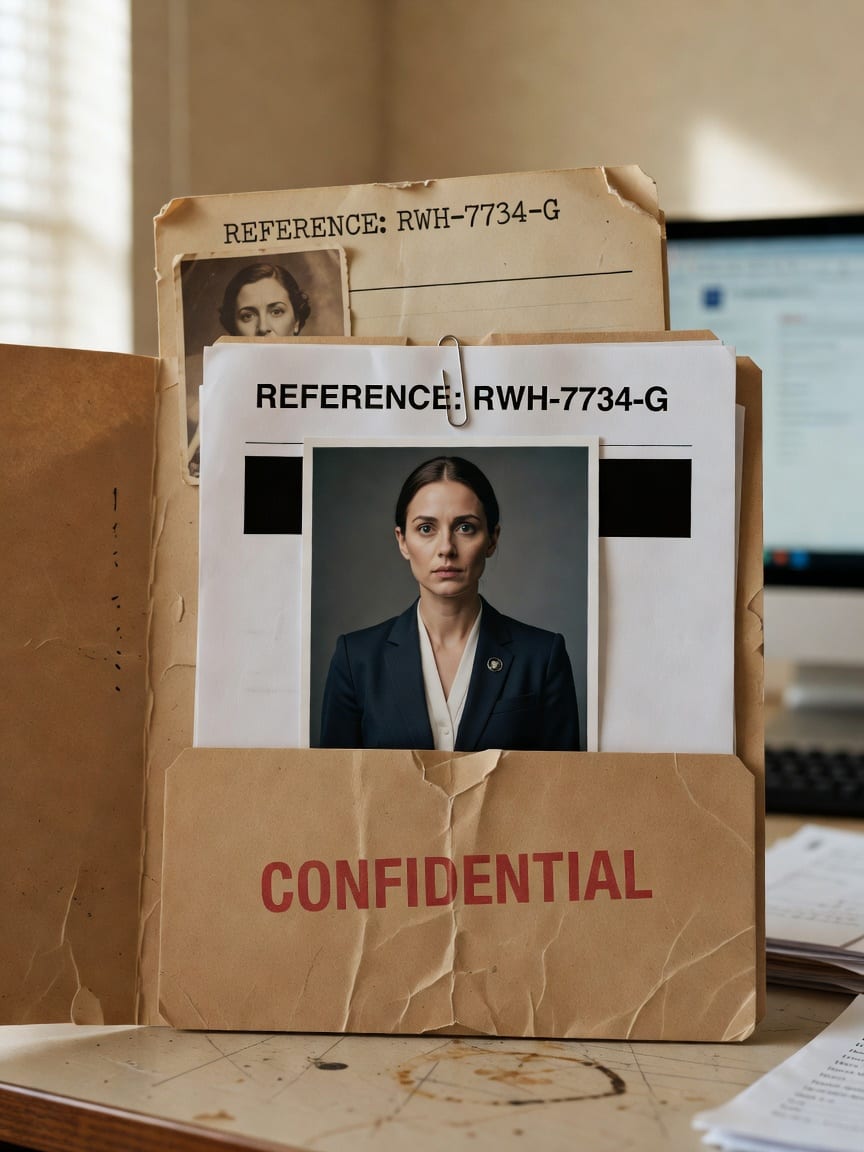
My security file was opened nine years before I was born. Its note said: 'subject not to be briefed'.
Auditing company digital records was routine until I pulled up my own personnel file. It clearly showed a 'Date Opened' nine years before I was born, yet bore my exact name and reference number. Below, an assessor's note from that impossible year mentioned a 'previous holder' and ordered the 'subject not to be briefed,' sparking a cold thrum in my chest.
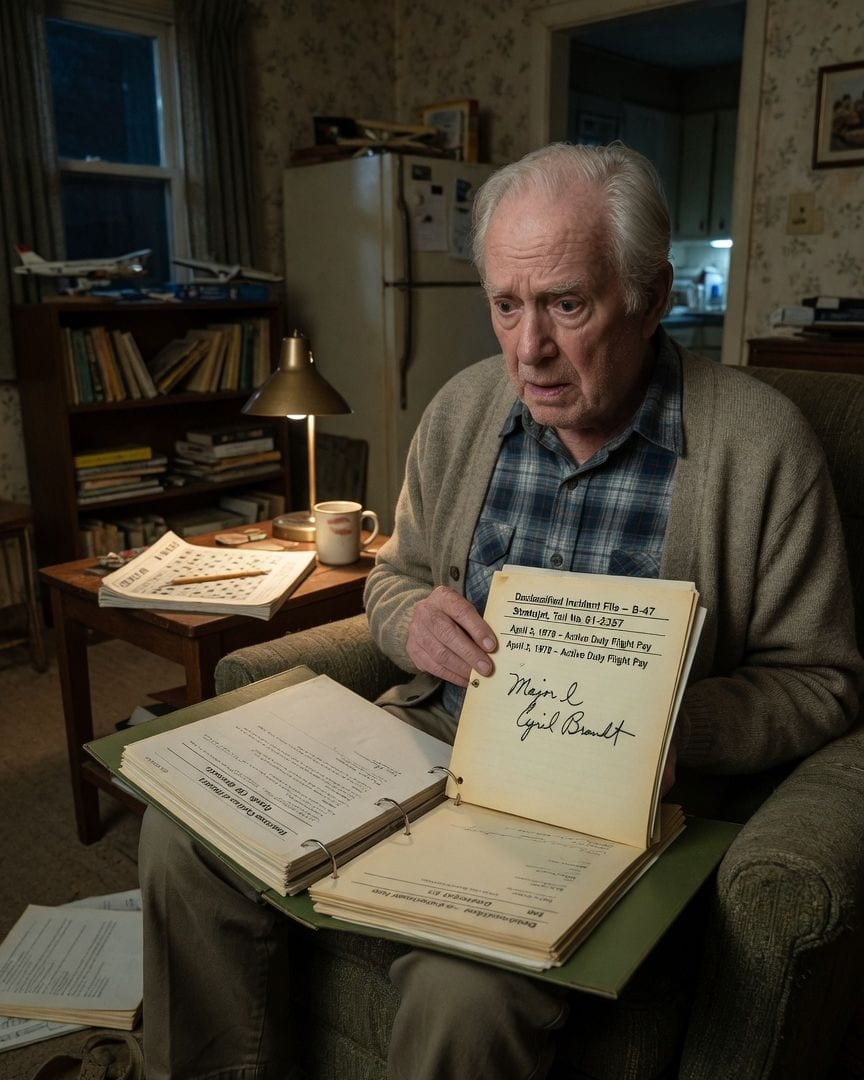
A retired Cold War pilot found his own signature on a flight pay record, dated five years after he left active duty, the ink unnervingly fresh.
Cyril Brandt, a seventy-two-year-old retired B-47 pilot, cherished his quiet Dakota retirement, his days filled with crosswords instead of combat. He expected to find long-awaited closure on a strange 1968 UFO incident when a heavy, declassified file arrived. Settling into his armchair, the weight of the olive-green binder felt familiar, but its contents quickly shattered his calm. He discovered maintenance logs for his B-47, detailing engine hours and tire rotations, dated years after the aircraft had been scrapped. Then, buried deeper, he found a payroll entry for himself, dated 1978 — five years after he left active duty — bearing his own unmistakable signature, the ink unnervingly fresh. How could his own hand have signed off on a mission that never happened, for a plane that no longer existed?