My milk float wakes me at 4:10 AM, delivering to the empty house three doors down. Pearson's Dairy closed in 1988.
It started subtly, like most things that burrow under your skin. I’d moved to Oakhaven just a few months ago, seeking quiet, a break from the city drone.
What I got instead was the clatter and hum of a milk float at precisely 4:10 AM every single morning. It was an old-fashioned thing, bright white with faded blue lettering: “Pearson’s Dairy.” Quaint, I thought, a charming anachronism.
My bedroom window faces the street, and from my bed, I could see it pull up three doors down, to the little cottage with the overgrown garden.
A single bottle would be placed on the porch, a quiet thud against the wood, and then the float would hum away, leaving behind the pre-dawn silence.
The problem, which I initially dismissed as a misunderstanding, was that the cottage had been empty since I arrived. Not just empty, but visibly disused. Peeling paint, a garden choked with weeds, windows grimy with years of neglect.
There were no lights on, no mail piling up, no sounds of life. Every local I’d spoken to confirmed it: "Oh, that old place? Been empty for ages, dear." So, why the daily delivery?
One Tuesday morning, after watching the float pull away, a prickle of unease finally outweighed my British politeness. I opened my laptop, typed "Pearson's Dairy Oakhaven" into the search bar. The results were immediate, unambiguous.
Pearson’s Dairy, a local institution, had officially closed its doors in 1988. The newspaper clipping from the local archives confirmed it. Its yard, the article mentioned, had long since been converted into a municipal car park. A municipal car park.
Not a functioning dairy. And certainly not one still operating a daily delivery route in a pristine, vintage float. My stomach tightened.
Yet, every single morning, it was there, faithfully delivering a single bottle to a house where nobody had lived for years.
I tried to rationalize it. Maybe it was an old float, repurposed by a new company, keeping the nostalgia factor? Or perhaps a local eccentric, a prankster with an elaborate, long-running joke? The thought felt thin, even to me.
That evening, seeing Fiona Vance, my neighbor, watering her prize-winning hydrangeas, I decided to test the waters.
"Odd thing, isn't it?" I started, gesturing vaguely down the street. "That old milk float, still delivering to the empty house three doors down. Pearson's Dairy, too. Didn't they close decades ago?"
Fiona paused, her watering can still. Her smile, usually so warm, seemed to falter for a beat. "Oh, that," she said, a little too quickly. "Just an old tradition, love. Some local quirk, I suppose.
Oakhaven's full of them, you know. Nothing to worry your pretty head about." She offered a vague, dismissive wave of her hand, then launched into a detailed explanation of her new organic compost, steering the conversation away with practiced ease.
Her cheerfulness felt strained, a performance.
My unease solidified. This wasn't a quirk. This was something people actively avoided discussing. The next morning, as the float departed, I didn't just watch from my window.
I waited five minutes, then crept out, walking briskly down to the supposedly empty house. The air was cold, damp. The porch creaked under my weight. I peered through a grimy window, cupping my hands around my eyes.
Nothing but dust, cobwebs, and the deep, stale smell of disuse. The house was undeniably abandoned. The floorboards inside were bare, the walls streaked with damp.
But then, my gaze fell to the porch itself. Nestled against the front door, glinting in the pale morning light, was a pristine glass bottle. Unopened.
It bore the distinctive "Pearson's Dairy" label, the blue lettering as vibrant as if it had been printed yesterday. My heart hammered against my ribs. I pulled out my phone, my fingers fumbling slightly, and snapped a quick photo.
I zoomed in on the silver cap. Printed clearly, unmistakably, in black ink, was today’s date. Fresh. Impossible.
That night, sleep was a battlefield of rattling milk floats and grimy windows. The image of that pristine bottle, with its impossible date, kept replaying in my mind. The bottle from the porch. It had been there, clear as day.
But now, it wasn't. I had walked past the house on my way home, barely an hour after my discovery, and the porch was empty. It had simply vanished.
A gnawing, cold dread had taken root. I knew, with a certainty that prickled my scalp, that I had to go back. Not in the bright, rational light of day, but in the thick, suffocating dark.
Around midnight, I slipped out of my house. The streetlights cast long, distorted shadows. The air was colder, quieter.
The house three doors down loomed, darker than the night around it. I approached cautiously, my heart pounding a frantic rhythm against my ribs. I checked the porch. Empty.
My gaze drifted to the back of the house, where a faint, almost imperceptible sliver of light seemed to escape from somewhere. Hope mingled with terror.
The back door. It was old, weathered, the paint long gone. I reached for the handle, expecting resistance, a lock. But it turned with a soft, metallic click. Unlocked. A subtle invitation, or a deliberate omission?
I pushed it open slowly. The air inside hit me first: thick, cold, heavy with dust and the cloying, sweet decay of long-dead things.
I stepped into the absolute darkness, my phone’s flashlight beam cutting a shaky path before me. The rooms were barren, stripped of furniture, hollow echoes answering my footsteps. Each dust mote dancing in the light felt like a watching eye.
I moved through the empty living room, the dining room, towards the kitchen. And there it was.
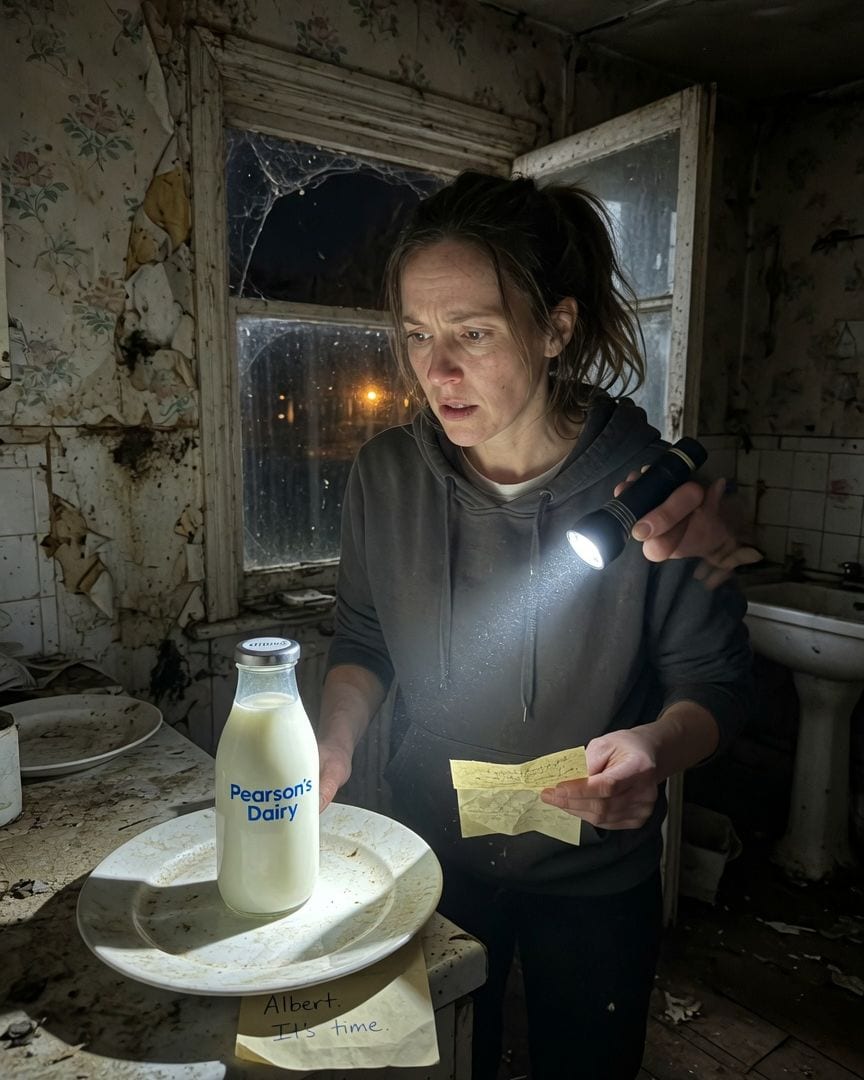
On a counter, thick with grime, a chipped ceramic plate sat. And on the plate, another pristine Pearson's Dairy bottle. Identical to the one from the porch, save for one detail.
The cap, in the harsh glare of my phone, bore an older date. A week prior. And tucked underneath the plate, folded, a faded, handwritten note. My hand trembled as I picked it up.
The neat, precise script read simply: 'Albert. It's time.'
The note chilled me to the bone. Albert. Albert who? And what exactly was 'time' for him? The quiet, rational part of my brain, the part that still insisted on logic, pushed me to investigate.
I spent the next few days holed up in the Oakhaven library, diving into local records. Albert Whitaker. Property records confirmed him as the previous owner of the house three doors down. He'd lived there for decades.
When I cautiously questioned a few of the older neighbors – Mrs. Davies with her perpetually half-drawn curtains, Mr. Henderson from the corner shop – they offered vague, almost rehearsed answers. "Albert?
Oh, he moved away suddenly a few weeks ago," Mrs. Davies mumbled, her eyes darting away. "Couldn't say where, dear. Just packed up and left." Mr. Henderson gave a similar, equally unhelpful reply.
No one knew where, no one knew why. Just… gone.
The official records offered no forwarding address, no trace. Only the clear ownership transfer, dated weeks ago. It was as if Albert Whitaker had simply ceased to be.
I found the old newspaper clipping again, the one detailing Pearson's Dairy’s 1988 closure. It only deepened the impossible nature of the float. This wasn't some repurposed local company. This was Pearson's. A ghost.
Driven by a desperate need for a mundane explanation, I even drove out to the old Pearson's Dairy site. Just as the article stated, it was a sprawling, anonymous municipal car park.
Not a single building, not a shed, not even a forgotten delivery truck remained. The air smelled of exhaust fumes and damp asphalt, not milk and hay.
There was absolutely no trace of any active operation that could house such a float, let alone a fleet. The dread solidified, growing heavy in my chest. This wasn't a mistake. It wasn't a prank.
It was something profoundly, impossibly wrong, and the town, I realized, was actively, silently avoiding the truth.
My questions grew more pointed. I started asking about Albert Whitaker's sudden departure, then, more broadly, if there had been any other similar, unexplained 'moves' in Oakhaven's past. People shifted uncomfortably, changed the subject, or just offered blank stares.
I started noticing Joseph Calloway, an elderly local known for his long memory and penchant for sitting on his porch, watching the street. He’d always give me a serene, almost unnervingly calm nod as I passed.
Now, he seemed to watch me with a new, almost possessive intensity.
One afternoon, as I walked past his house, he called out. "Laura, dear! Lovely day for a stroll, isn't it?" His smile was too smooth, his eyes holding a depth that felt ancient.
He made small talk about the weather, about the price of eggs at the market, but his gaze never quite left mine. "You've been asking a good many questions lately," he remarked, his voice soft, almost a whisper.
"Some things in Oakhaven are best left undisturbed, dear. Old roots run deep here." His eyes held mine for a beat too long, and I felt a chill that had nothing to do with the cool autumn air.
He then deftly steered the conversation back to the upcoming village fete, his composure absolute.
Later that day, when I returned home, I stopped dead on my doorstep. There, faintly drawn in white chalk on the rough stone, was a symbol. A simple, almost childlike drawing: a circle with three parallel lines bisecting it vertically.
My breath hitched. I knew that symbol. I distinctly remembered seeing it, faintly etched into the dusty kitchen wall of Albert's house, right near where I'd found the impossible bottles.
My hand flew to my mouth, a silent scream caught in my throat.
Unnerved beyond anything I'd ever felt, I printed the photo of the chalk symbol from my phone and walked straight back to Joseph Calloway’s house. He was still on his porch, rocking gently. I didn't bother with pleasantries.
"What is this?" I demanded, holding out the photo. "I found it on my doorstep. I saw it in Albert Whitaker's house, too. What does it mean, Joseph?"
His placid facade finally, mercifully, cracked. A flicker of something ancient, something weary and resigned, darted in his eyes before settling back into a calm, yet grim expression. He sighed, a sound that seemed to carry the weight of generations.
"You've been asking too many questions, child. Some truths are meant to stay buried, for everyone's sake." He motioned for me to sit on the step, his voice dropping to a low, even tone.
"Oakhaven has… an understanding," he began, without a hint of emotion. "With the land. A pact, made generations ago. Long before my time, long before even my great-grandparents. This town, its prosperity, its peace… it comes at a cost."
He paused, his gaze sweeping over the quiet, picturesque street. "The milk float, Laura, it's not delivering milk. It's marking houses. That symbol you found, it confirms it. The deliveries began long before Pearson's Dairy was even established.
The name, the branding, it was merely adopted as a convenient local identity, a cover that made sense to outsiders."
My mind reeled, trying to process his words. "Albert Whitaker," he continued, his voice flat, "he fulfilled his obligation to the pact. He isn't coming back, Laura. No one ever does, not truly."
The words hung in the air, heavy and final. "And the 'milk' in those bottles? It's not for consumption. It's… a vessel. A collection." He looked at me, his eyes holding a terrible, calm knowing.
"The town, we maintain our bland, dismissive story, just as Fiona did, to avoid drawing attention. To ensure the pact continues undisturbed. It's the only way we know to survive."
The first truth landed with a horrifying, sickening weight. The milk float was not a quaint anachronism or a prank. It was the herald of a generations-old, recurring ritual. And the chosen recipient simply vanished.
"What obligation?" I whispered, my voice barely audible. "What's the tithe? What did Albert… give?"
Joseph Calloway’s face hardened, losing even the last vestiges of its placid nature. It was grim now, a mask of grim determination. "Come," he said, rising. "Some things are better seen than heard."
He led me out of his house and down the street, past my own house with its chalk-marked doorstep, to a small, unassuming building near the village green. The Oakhaven Town Archives.
Inside, the air was cool and thick with the smell of old paper and dust. He led me to a back room, pulling a heavy, leather-bound ledger from a high shelf.
Its cover, faded and worn, read in elegant, looping script: "Oakhaven Parish Records - Tithe Years." The title alone sent a jolt of ice through me.
He laid it open on a dusty table. Its pages were brittle, yellowed with age, filled with handwritten entries in various hands, some faded ink, some starkly fresh. My breath caught in my throat. I saw a chilling, undeniable pattern.
A series of names, dates, and addresses, stretching back centuries, occurring cyclically, approximately every 30-35 years. Each entry marked a household. I saw Albert Whitaker's name, dated a few weeks ago, corresponding precisely with his disappearance.
My blood ran cold. My eyes, almost against my will, traced down the page, past Albert's entry. There, beneath it, freshly entered in a stark, modern hand, was my own address. No name attached. Just the street number and Oakhaven.
My heart hammered against my ribs, a frantic drumbeat against the silence of the room. And then, I saw it. Beneath my address, faint, almost erased, but undeniably there, dated for next week: 'Laura Fontaine.'
Joseph Calloway’s voice, when he spoke again, was utterly devoid of sympathy. It was just a statement of fact, a recitation of ancient law. "The pact ensures Oakhaven's prosperity and peace," he explained, his gaze fixed on the ledger.
"But it demands a terrible toll. The 'tithe' is not an object, Laura. It's a piece of the chosen individual's very essence. Their vitality. Their memories. Their consciousness." He looked up, his eyes meeting mine.
"Extracted by the presence, tied to this land."
My stomach lurched. "Extracted?"
"The phantom float is its herald," he continued, as if explaining a mundane farm chore. "The impossible bottles are the vessels for this extracted essence. The house where you found the bottles, Albert's house, that was his collection point.
The accumulating bottles were his 'tithe' being collected, piece by piece, until… it was complete." He gestured to the faint, erased entry under my name.
"The note, 'It's time,' was not a warning from the town, but a direct command from the presence itself to Albert. His time was up. And now, yours is coming."
He closed the ledger with a soft thud. "The cycle is ancient, predating written history. Your name being entered… it means you are the next chosen. The town will not interfere. We cannot. The 'agreement' is absolute.
It is the cost of our quiet lives, our safe streets, our abundant harvests."
I stumbled out of the archives, the heavy truth crushing me. The chalk symbol on my doorstep, a simple marking, now pulsed with a malevolent intent, a countdown.
I knew, deep down, that I couldn't escape the town's ancient agreement, not really. But I had to try. One last, desperate attempt at a mundane explanation, a scientific refutation of the impossible.
I rushed home, my heart hammering, retrieved the impossible 'milk' bottle from its hiding place – the one I'd found in Albert's kitchen, the one Joseph confirmed contained the 'tithe'. My hands trembled as I clutched it.
I drove straight to Charles Fairfax, the local chemist. Charles, a man of science, precise and pragmatic, was initially skeptical and dismissive. "Pearson's Dairy? That's impossible, Laura. Probably just some old bottle filled with… what, water? Or a prank."
But something in my frantic urgency, the stark terror in my eyes, must have swayed him. He agreed to analyze its contents.
He took the bottle into his lab, his face a picture of detached professionalism. I paced the small waiting room, every minute stretching into an eternity. Then, a long silence.
Finally, he reappeared, his face, usually so composed, drained of all color.
"Laura," he said, his voice a strained whisper. "This… this isn't possible." He described the substance: biologically active, yet unlike any known organic compound.
"It contains cellular structures that simply shouldn't exist in liquid form, or in any form I recognize," he stammered, running a hand through his thinning hair. "I've dated its components… decades, some even older.
Yet it remains perfectly preserved, perfectly viable." He couldn't explain it. As he turned back, attempting to re-run the tests, a subtle shift occurred.
The bottle, still on the counter, began to subtly pulse with a faint, internal light, like a dying ember. And the liquid within, already impossibly thick, visibly darkened and thickened further, swirling sluggishly within the glass.
Charles gasped, recoiling. He dropped the bottle in shock, the glass clattering loudly against the tiled floor, but not breaking. It just lay there, pulsing softly. I stared at the "Pearson's Dairy" label, at the impossible liquid within.
In that moment, the ordinary explanation died forever.
I stumbled out of the chemist's shop, the impossible bottle clutched to my chest, Charles Fairfax's terrified face burned into my memory. I got into my car and drove.
I left Oakhaven, not looking back, the chalk symbol on my doorstep a fading memory. I never returned. The town continued its quiet, prosperous existence. Joseph Calloway is often seen on his porch, watching the street.
The Pearson's Dairy milk float continues its rounds at 4:10 AM, every morning, without fail.
I left Oakhaven that day, the impossible bottle wrapped carefully in a blanket in the back seat. I drove until the town was a speck in the rearview mirror, then kept driving for hours, days.
I sleep with the blinds drawn now, and I never answer the door after midnight. The memory of the pulsing liquid and Charles Fairfax's terrified face is a cold knot in my stomach.
I keep the bottle, hidden away, a constant reminder. Sometimes, late at night, I think I hear a faint, rhythmic clinking, far off in the distance, like glass on glass, getting closer.
The unfinished post was recovered from Laura Fontaine's laptop, found in her apartment after neighbors reported a strange, sweet smell. A single comment appeared beneath the draft, just before the file became corrupted:
the end.
If this one got to you
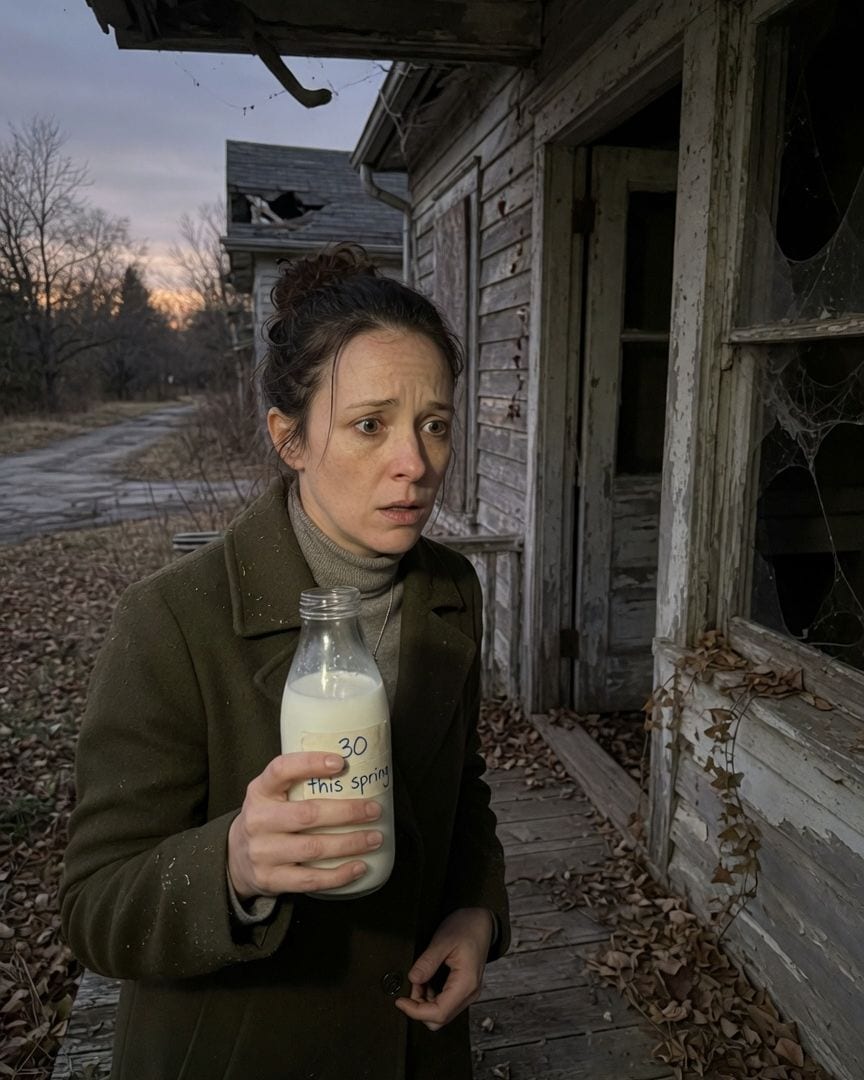
My grandfather's old milk ledger shows Account 30 reissued to the same house every ten years since 1930. Different names, same number. The last entry, unpaid, is dated this spring.
Sifting through my grandfather Howard's old things, I found his milk ledger. One account for a house long abandoned on Foldyard Lane showed a strange pattern of recurring 'stopped taking milk, gone' entries, ending with 'unpaid' this spring. Driving out to the decades-old ruin, I found a pristine, sealed milk bottle, dated 'this spring,' on its crumbling porch.
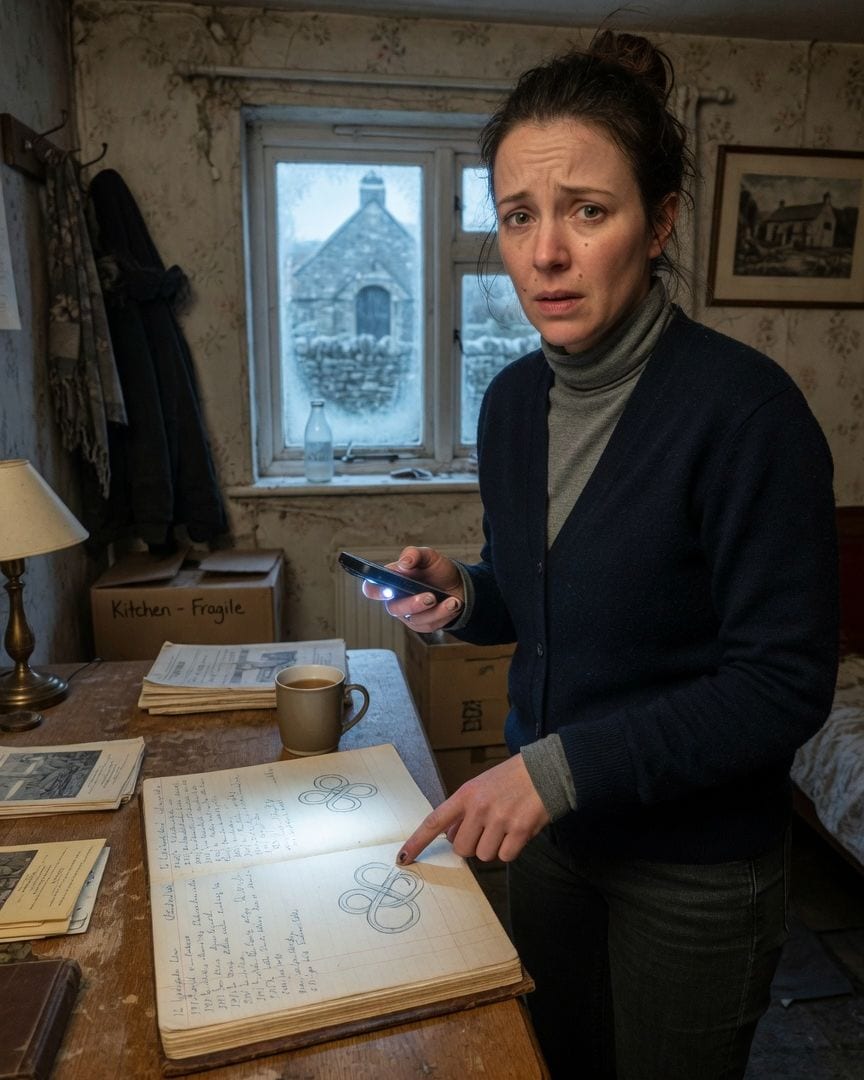
Milk appears daily by my lychgate. The dairy closed in '79. My address is handwritten into their old delivery book, starting the day we moved in.
Moving to Blackwood Creek, I loved the quaint charm, especially the unexpected morning milk delivery to my lychgate. But when I mentioned it to Eleanor at the village shop, her smile froze. She told me Willow Creek Dairy closed decades ago, in '79.
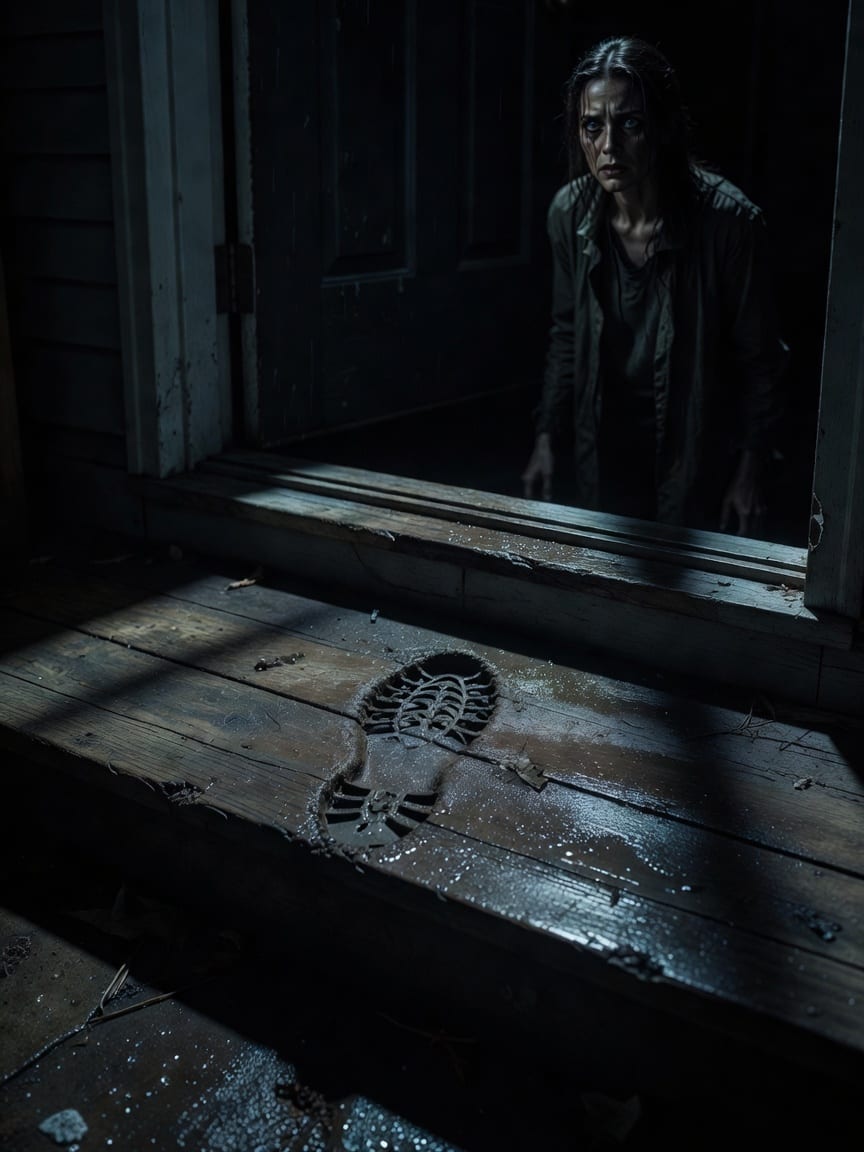
My landlord's only rule: never let the outside tap run after sundown. Last week it dripped. This morning, wet bootprints ringed the back step from the tap to my door, all the same size. The tap was off.
We'd just settled into Waterside House, with its strange landlord rule about the outside tap. After the washer broke, I found perfect, wet bootprints leading from the tap to our back door, but the tap was cranked completely off, tighter than I could manage.
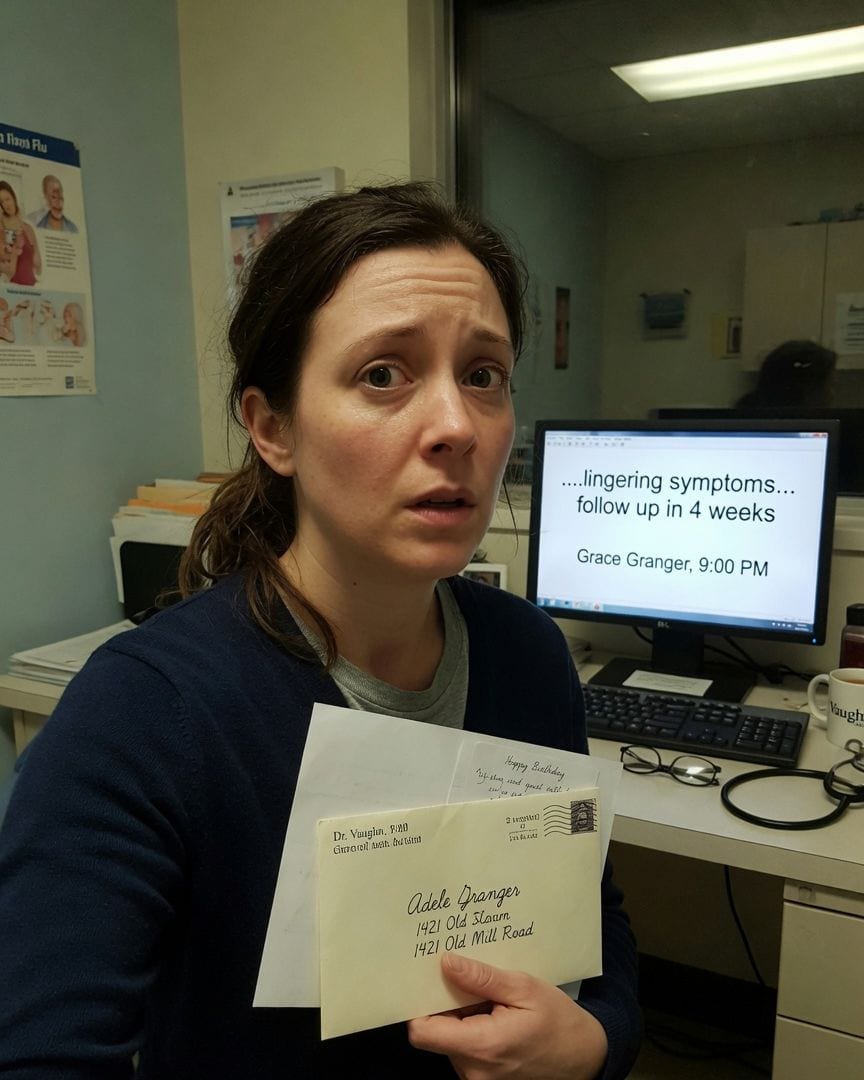
Mid-appointment about my cough, my doctor told me to call my estranged sister tonight — a sister I'd never mentioned to him. The note on his screen ended with her name and a time.
My doctor dismissed my cough as a lingering virus, but then he said something impossible: "You should call your sister tonight." I hadn't spoken to Grace in years, and I'd never mentioned her to him. When I saw her name on his screen with a specific time, a cold dread began to claw at me.
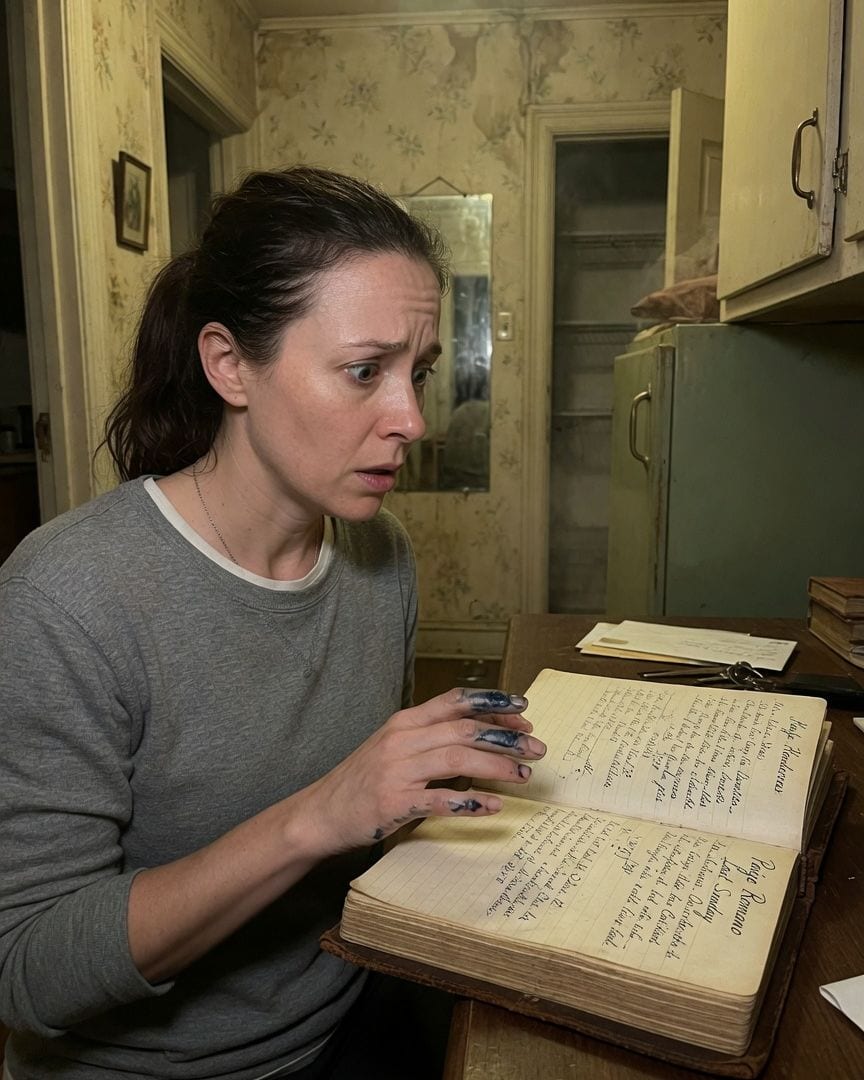
My visitors' book records guests who arrive in the future. Last Sunday, my own name appeared at the bottom, the ink still wet.
I bought an old house last March, complete with a dusty, leather-bound visitors' book. It seemed a charming relic, until I found new entries appearing, dated months into the future, the ink still wet. Then, my own name, Paige Romano, appeared, dated 'Last Sunday,' with a bead of ink shimmering at the 'R'.
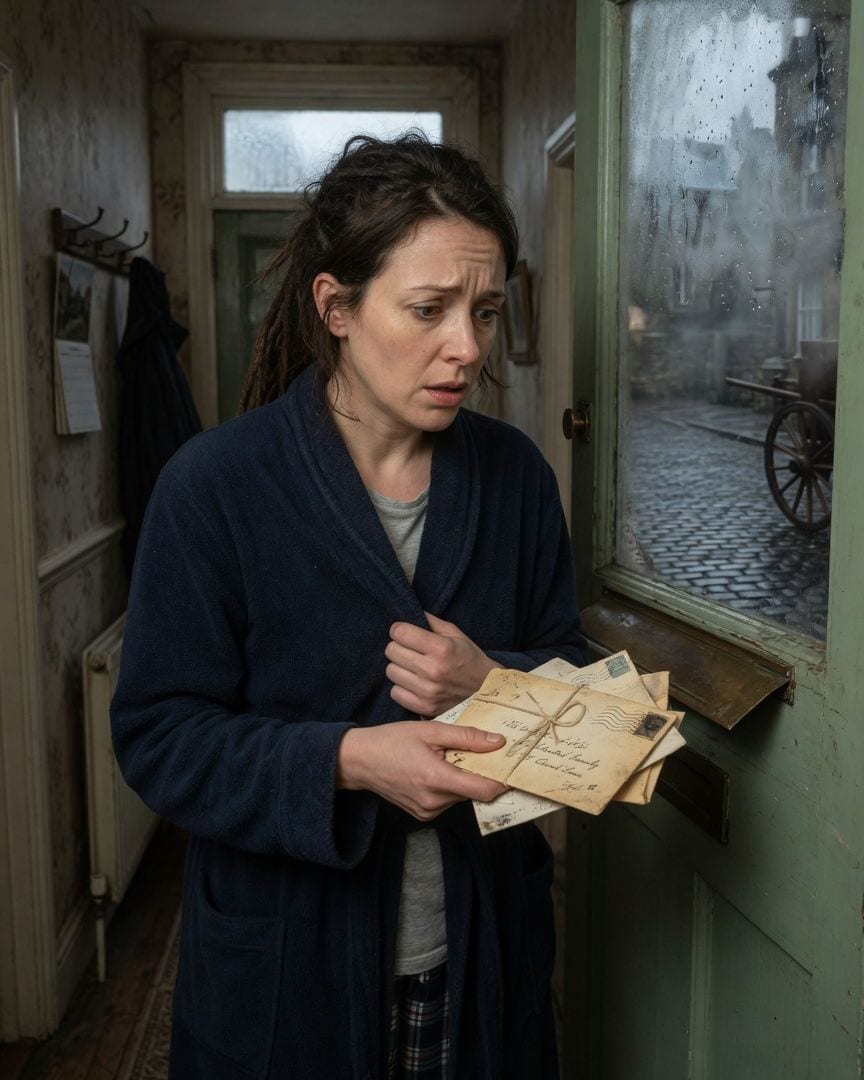
Seventy years ago, a hidden journal recorded my door opening to the wrong street and receiving Lockwood post.
I'd only recently moved into my inherited house, a quiet place on the edge of town. One grey morning, a distinct clatter from the front door's post flap caught my attention. Reaching down, I expected my gravel path, but instead, the flap showed a dark, cobbled street that wasn't mine. A bundle of warm, old letters, addressed to 'The Lockwood Family,' slid through, before the vision flickered and was gone.