My motel register shows a check-in for Room 9 at 3:33 AM, in my own handwriting. Room 9 has been out of service since the flood.
The buzzing of the fluorescent light above the front desk was the loudest sound in the Starlight Motel at 3:45 AM. It was always the loudest sound.
My shift had been quiet, just the usual deep-night stillness that settled over this place like a shroud. I was halfway through a bad crossword puzzle when my eyes drifted to the guest register.
There it was. A new entry, neatly penned, right at the top of the page. Room 9. 3:33 AM. A generic name, a license plate from out of state, and then, the night rate, followed by my own initials: ZP.
I stared at it, a cold knot forming in my stomach. Room 9.
My brain tried to cycle through explanations. A prank? But who? Preston, the day manager, was long gone. No other staff. A momentary lapse? Did I... sleepwrite? It sounded ridiculous even in my head.
I’m 28 years old, not a sleepwalker, and I certainly didn't remember any of this.
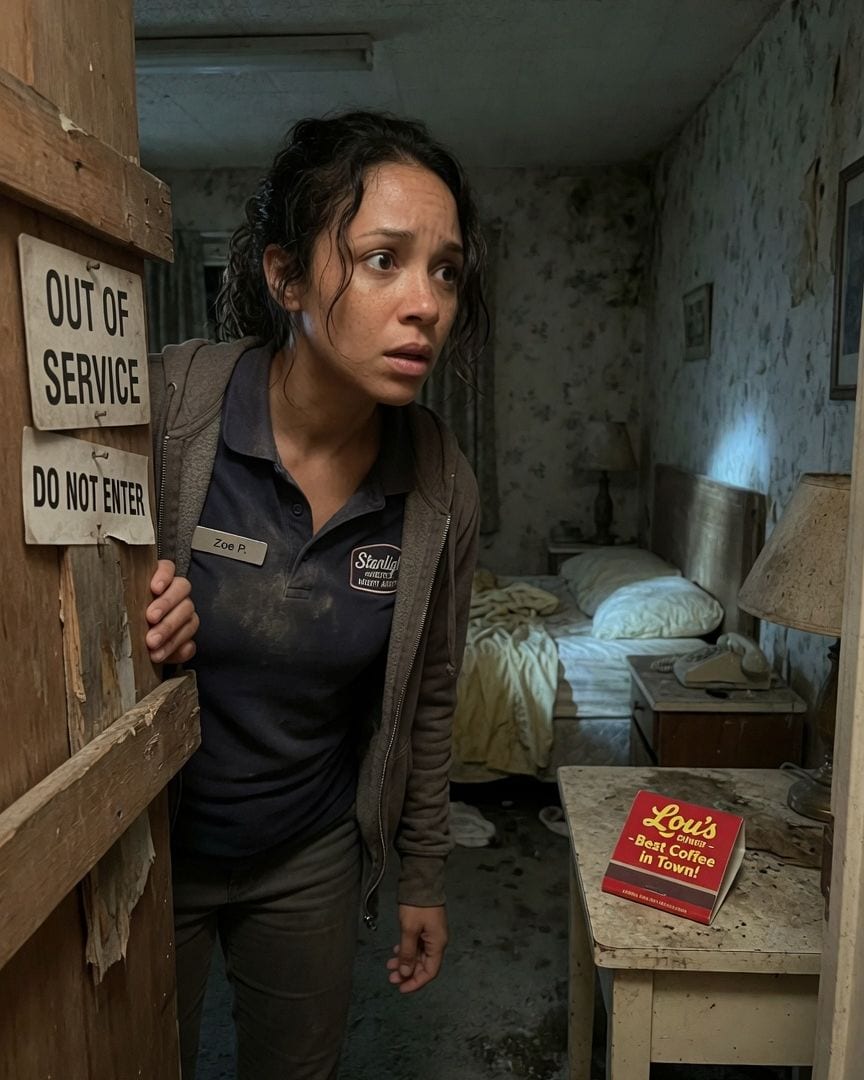
The real problem was, Room 9 has been officially out of service for six months now. Since the spring flood, the door’s been boarded shut, a faded 'OUT OF SERVICE' sign tacked crookedly over it.
It’s a mess in there, full of mildew and broken furniture, waiting for the insurance to finally clear us for repairs. And the physical key? I glanced at the row of hooks behind me.
The heavy, brass key for Room 9 still hung untouched on its peg, just as it had been all night.
The ink on the register entry looked fresh, somehow. Not wet, but vibrant. My handwriting, unmistakable. The precise time, 3:33 AM, staring back at me. And the impossible room number.
I leaned back in my chair, the plastic squeaking, and tried to breathe. It had to be a joke. A really elaborate one.
But who had the key? Who wrote it? And why Room 9?
The silence of the motel felt different now, heavy and watching. The knot in my stomach tightened. I had to see.
The Room 9 key felt heavy and cold in my hand as I unhooked it. My pulse thumped a frantic rhythm against my ribs. I walked down the dim, carpeted hallway, each step echoing unnervingly.
The silence was pressing, almost suffocating. My rational mind, the part that still wanted to believe in logical explanations, screamed at me to go back, to ignore it, to pretend it was a bad dream.
But the entry in the register, my own meticulous hand, compelled me forward.
Room 9’s door was exactly as I remembered it. Two planks of wood nailed horizontally across the frame, a 'DO NOT ENTER' sign underneath the faded 'OUT OF SERVICE' one.
The smell of damp and disuse was faint, but definitely there, even through the sealed door.
I gripped the key, my thumb tracing the cold metal. There was no one else here. No one.
I found a loose board on the left side, one of the nails barely holding. I worked at it, grunting softly, the sound swallowed by the dead air of the hallway.
Finally, it came loose with a splintering groan, just enough for me to squeeze through.
The air inside was thick and cold, a suffocating mix of dust and mildew. Moonlight sliced through the gap in the boards, illuminating a scene of dereliction. Furniture shrouded in stained, dusty sheets looked like slumped, forgotten figures.
The carpet was damp and rippled, coated in a fine layer of gray dust. This room was dead.
And then I saw it. On the small, dusty bedside table, amidst a thick coat of grime that shimmered in the weak light, sat a single, pristine object. A matchbook.
Red, with a faded yellow logo: 'Lou's Diner – Best Coffee in Town!'
I walked closer, my boots crunching on something gritty on the floor. My breath hitched. The matchbook wasn’t dusty. It looked like it had been placed there moments ago. No decay, no water stains, no grime.
Just the crisp cardboard and the faded logo of a diner that closed its doors in the late 80s.
I knew this because I’d heard Preston complain about how much he missed their pie, saying it had been gone before I was even born.
I reached out a trembling hand and picked it up. It was perfectly preserved, the striking strip unused, the matches all inside. It felt too clean, too new, too real for this dead room. How?
The room had been sealed for months, locked from the outside, boarded. No one could have come in. No one could have put it there.
The dread was no longer a theoretical chill from a register entry. It was a tangible object in my hand, an impossible fact that defied everything I knew about reality.
I backed out of Room 9, my heart hammering a frantic beat against my ribs, carefully replacing the board, the matchbook clutched tight in my hand.
My mind was a whirlwind, trying desperately to reconcile the empty, derelict room with the fresh, anachronistic object.
Back at the front desk, the register entry for Room 9 at 3:33 AM stared back, my initials, ZP, mocking me from the page. I looked at the key, still hanging on its hook.
If someone checked in, where were they? Why no car in the lot? How did the matchbook get there? The ordinary explanations I’d tried to cling to—prank, sleep deprivation, old forgotten item—had crumbled to dust.
A cold, creeping realization settled over me: someone, or something, was here. And whatever it was, it used my hand to write its arrival.
Zoe stands frozen in the doorway of Room 9, the stale air suddenly thick with an unseen presence, her gaze fixed on the pristine, anachronistic matchbook resting on the dusty bedside table, a chill running through her as the impossible reality of its presence sinks in.
The next morning, I was exhausted, but sleep felt impossible. The image of that matchbook, so out of place, kept replaying in my mind. When Preston Crane, the day manager, finally arrived, I tried to keep my voice calm, practical.
I showed him the register entry, pointing out the 3:33 AM time and my initials. Then I carefully placed the red matchbook from Lou's Diner on the counter between us.
Preston, a man in his late forties with a perpetually tired but amiable face, barely looked at it. He just shrugged, then rubbed the back of his neck. “Sleep deprivation, Zoe. The night shift’ll do that to you.
Old motels have a way of messing with your head. And Lou's? Someone must've dropped that decades ago, got pushed under a rug or something, then popped out with the flood. Things shift.”
His dismissive calm only irritated me. “But my handwriting, Preston. And Room 9? It’s boarded up. The key was still there. And that matchbook looks brand new.”
He sighed, pushing a hand through his thinning hair. “Look, things get weird on the night shift, I know. Just… forget about it. It’ll do you no good to chase ghosts.”
Unconvinced, and more than a little annoyed, I spent my day off at the local library. I needed real answers, not Preston’s platitudes. The archives were dusty, smelling of old paper and forgotten stories.
I found an archived newspaper clipping about Lou's Diner’s closing in 1987. No mention of a flood affecting the Starlight Motel until a smaller one in 1995, long before the major spring flood we’d just had.
So, the matchbook couldn't have just 'popped out' then.
But I found something else. A brief mention, almost buried in an article about local businesses, of a 'peculiar incident' at the Starlight in 1973.
It involved a night clerk, Bernard Harlow, who abruptly quit, citing 'unexplained phenomena' in Room 9. My breath hitched. Room 9 again.
The library also had a small local history archive, with a few grainy photos of the old motel. Flipping through them, my finger stopped on one dated 1968. It was a shot of the Starlight’s exterior.
And in the window of Room 9, even though the photo was taken before Bernard Harlow’s incident, there was a faint figure. Indistinct, blurry, almost a trick of the light. But it was there. And it unnerved me deeply.
I suddenly knew Preston wasn't just being dismissive. He knew something. Or he was simply too used to the strangeness to care, or to explain it to a new-ish clerk like me.
Either way, his easy calm was starting to feel chilling.
That night, back on shift, the motel felt different. It wasn’t just quiet; it was watching. Every creak of the old building, every gust of wind against the plate glass of the lobby, made me jump.
My eyes kept darting to the register, specifically the page for Room 9. The entry still mocked me.
I decided to clean up some old files in the back office, needing a distraction. I left the Room 9 key on the front desk, half-consciously as a reminder, or maybe as bait.
Just a few minutes later, I returned to the lobby. The key wasn’t there.
My heart leaped into my throat. It was back on its hook. I hadn't touched it. No one else was in the motel.
The security camera feed, a grainy, low-res image of the lobby, was on the small monitor in the corner. I rewound the playback for the last five minutes. Nothing. Just an empty desk. The key had moved itself.
A cold dread washed over me, far more potent than the initial unease. It wasn't just a record of something impossible; it was an active presence, aware of me, responding to my investigation. It was playing a game.
Later, as I was trying to review some old guest logs, a faint, almost imperceptible scratching sound started coming from Room 9. It was a rhythmic, insistent tap-tap-tap against wood, like fingernails or small stones.
It stopped abruptly the moment I looked in its direction, holding my breath, straining my ears against the silence.
It was a warning, I realized. A subtle pushback. I was no longer just an observer, trying to solve a puzzle. I was part of its game, and it knew I was digging.
Driven by a desperate need for answers, I confronted Preston the moment he arrived for his morning shift. I slapped the newspaper clipping about Bernard Harlow and the blurry photo of Room 9 with the faint figure onto the counter.
“What happened to Bernard, Preston? And what the hell is in Room 9?” My voice was sharp, edged with exhaustion and fear.
Preston’s usual easygoing demeanor cracked. He took a long, slow breath, his eyes fixed on the photo. “Bernard… he saw too much. Tried to fight it.” He gestured vaguely toward the ceiling, then the walls of the motel.
“This place… it has its own rhythm. Its own guests.”
“Guests who check in at 3:33 AM to an out-of-service room?” I pressed, pulling out the pristine Lou’s Diner matchbook. “Guests who leave matchbooks from the 80s?”
Preston finally looked at me, his eyes tired but surprisingly calm. “They’re not… physical guests. Not like you or me. They’re… echoes. Or something that uses the echoes.
They need a host, a hand to write them in, to make it real, to keep the cycle going.”
He explained that the 'check-ins' were a way for these entities to briefly anchor themselves, to manifest, leaving behind a 'tracer' like the matchbook.
The flood, he said, had 'cleansed' Room 9 temporarily, disrupting things, but the pattern always reasserts itself. “You’re just the latest,” he said, his voice devoid of judgment, “to pick up the pen.”
He led me to a dusty, forgotten storage room in the basement. It smelled of damp earth and old paper. “You want to know the whole story? It’s all here.”
He pulled out a heavy, leather-bound ledger from a shelf, its pages yellowed with age, its cover cracked. “Every clerk, every entry, going back to the 50s. Bernard tried to hide it, then tried to destroy it. Didn't work.”
I opened the old ledger, the pages stiff and brittle beneath my fingers. It was filled with entries, eerily similar to my own, for Room 9 and other rooms that were now, or had once been, out of service.
All meticulously recorded at 3:33 AM. I saw names like 'Vivian Oakley' and 'Philip Hartley,' names that sounded like they belonged to different eras.
Each entry was initialed by a different night clerk, some of whom Preston briefly mentioned by name, confirming their past existence here at the Starlight. The sheer volume of entries, spanning decades, made my stomach clench.
This wasn’t a one-off anomaly. It was a terrifying, relentless pattern.
I flipped through the pages, seeing the evolution of handwriting styles, from elegant script to hurried scrawls. Then, my eyes snagged on an entry from 1973. The name was 'Genevieve Crane.' The initials were 'BH' for Bernard Harlow.
But the handwriting… the looping curves, the distinctive slant of the 'G' and 'P' in Genevieve and Patterson… it was unmistakably hers. Not similar. Identical. My blood ran cold.
I flipped to another entry, dated 1968. 'Scott Donovan,' initials 'JH.' Again, my handwriting. The same specific way I dotted my 'i's, the little curl on my 't's.
Zoe drops the old ledger, the heavy thud echoing in the silent office, her breath catching in her throat as she stares at the looping, familiar curves of her own handwriting in an entry dated 1973, realizing with sickening certainty that this pattern is not just about the motel's past, but about her, her hand, and something far older than her life.
Preston, seeing my horror, explained the true, deeper layer. His voice was low, matter-of-fact, as if discussing the weather. “It doesn’t just use a clerk, Zoe. It uses the clerk. It connects to them.
When you pick up that pen, a piece of you… or a memory of you… becomes part of the cycle. That's why your handwriting is there.
It’s not your past self; it’s the entity projecting your presence, your hand, into its own timeline. It's always been you, in a way, or the essence of the night clerk it chooses.”
He pointed to a series of cryptic notes scribbled in the margins by Bernard Harlow. 'Key always returned,' one read. 'Odd items left,' said another, right next to an entry for Room 9 from 1972. '3:33 AM is the nexus.'
Every detail I’d found, from the key returning to its hook to the anachronistic matchbook, was part of this ancient, terrible routine. The 'guests' were never people; they were the manifestations, the anchors, facilitated by the night clerk’s unwitting ritual.
The names, Preston explained, were often drawn from local history, or even from the clerk’s own subconscious, recycled through the entity’s twisted memory.
The pattern was cyclical, feeding on the mundane act of recording, binding the clerk to the motel’s spectral roster. Preston revealed that the flood only interrupted the manifestation, not the entity itself.
It merely needed time to re-establish its connection, waiting for the right 'host' to resume its nightly ritual. He cautioned me, his eyes grave for the first time. “Once it has its grip, it doesn’t let go easily.
Bernard tried to fight it. He lost more than his job.”
I refused to be just another hand in the ledger. That night, as 3:33 AM approached, I clutched the guest register, determined not to write. The air in the lobby grew heavy, thick and cold, pressing down on me.
The fluorescent lights flickered violently, strobing the room, and an unbearable pressure built in my head, urging me, demanding me, to pick up the pen.
The Room 9 key, hanging on its hook, began to rattle. A soft, metallic whisper at first, then growing louder, more insistent, like a chattering tooth.
Then, slowly, impossibly, it slid off the hook, landing with a soft thud on the counter.
A cold, unseen force wrapped around my right hand, my writing hand, guiding it toward the pen, toward the empty line for Room 9.
My muscles screamed as I fought it, my knuckles white with the effort, my entire body tensing against the invisible pull.
I screamed, a raw, desperate sound that tore from my throat, and slammed the register shut with all my might. Then, with a surge of adrenaline, I threw it across the room.
It hit the far wall with a dull thud, pages scattering like startled birds across the worn carpet. The pressure immediately eased. The air lightened. The lights stabilized.
A profound silence descended, heavier than before, but this time, it felt like a retreat.
I was panting, trembling, but triumphant. I broke the cycle. I refused the hand.
Preston Crane, who had been watching from the doorway of the back office, stepped forward, a strange, knowing look on his face.
“You broke your cycle,” he said, his voice quiet, almost mournful, “but the motel… it always finds a way.” He motioned toward the now-scattered register pages.
A single, unbound page fluttered near the door, its bottom corner smudged with what looked like fresh ink. I recognized the faint, familiar curl of my handwriting. But the entry wasn’t for Room 9.
It was for Room 12, an entirely different room, and the name scrawled beside it was 'Edward Pierce.' My victory turned to ash in my mouth.
I quit the Starlight Motel that morning. I left the register scattered, the old ledger open in the dusty storage room. Preston Crane simply nodded, understanding. The motel, with its silent hallways and phantom guests, continued to operate.
I moved to a new town, found a new job, far from any night shifts.
I try not to think about the old motel, or the cold ache that sometimes settles in my writing hand, or the brief, unsettling flashes of memories that aren’t quite mine.
The Starlight Motel posted a 'Night Clerk Wanted' sign the very next day. A week later, a young man named Edward Pierce started the 11 to 7 shift.
I try to forget the Starlight Motel. I avoid old buildings and paper registers. But sometimes, late at night, a faint, phantom ache throbs in my right hand, a ghostly echo of a pen.
I tell myself it’s just a phantom limb of memory, a scar from the dread.
I never write in a ledger anymore, preferring digital records, but the faint, unsettling impression of someone else’s rhythm, someone else’s purpose, lingers just beneath my skin.
One quiet evening, months later, I read a local news snippet about the Starlight Motel changing ownership, a brief mention of a 'new, ambitious young night manager' taking over. I dismiss it.
But sometimes, when I’m alone, my reflection in a dark window seems to hold a faint, knowing glint in its eyes that isn’t quite hers.
Edward Pierce, the new night clerk at the Starlight, hummed softly as he straightened the fresh, blank register on the newly polished counter.
He'd found an old matchbook from 'Lou's Diner' tucked into a drawer and placed it on the bedside table in Room 12, just as he'd intended.
The new clerk, a young man named Edward, smiled faintly as he picked up the pen, his eyes just a little too distant.
If this one got to you
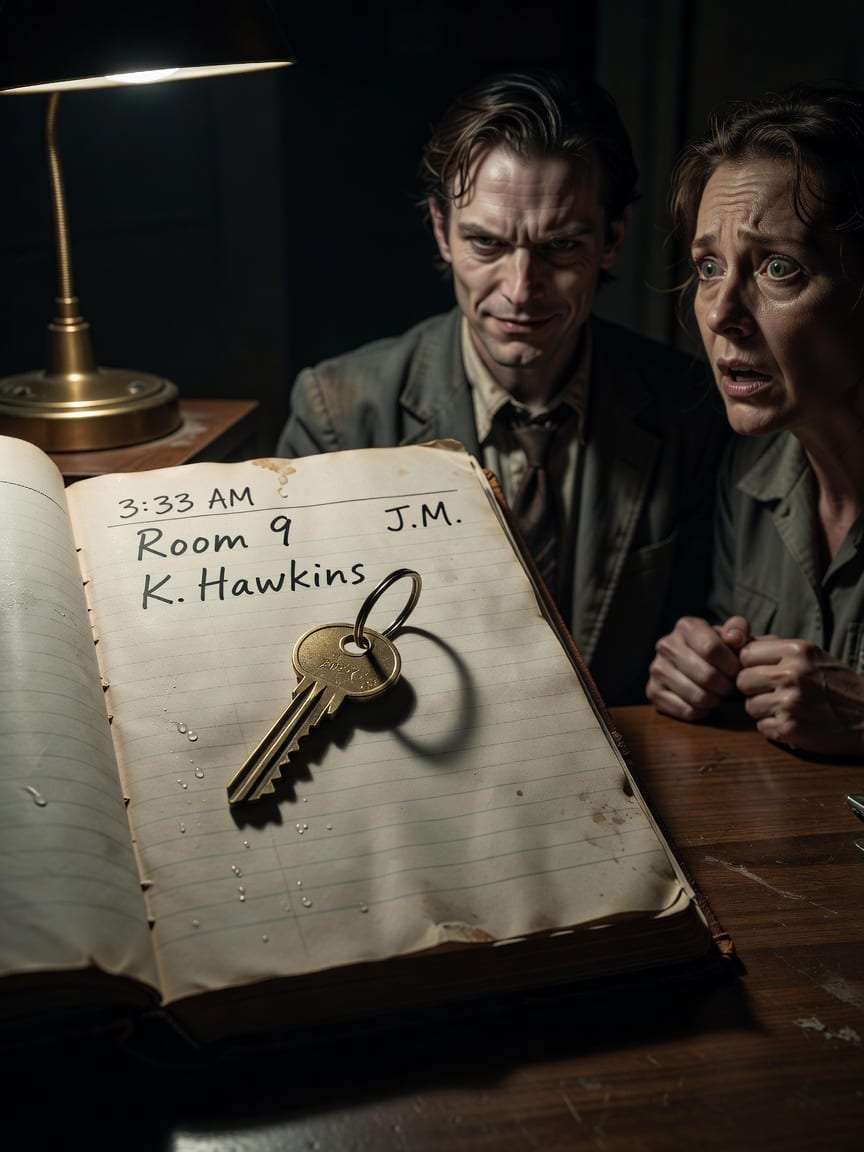
My hand wrote the Room 9 check-in at 3:33 AM. My initials were there. But Room 9 has been sealed since the spring flood, and its key still hangs on the peg.
Working the quiet night shift at the Marsh View Motel, I found a fresh entry in the register with my own initials, for Room 9. But Room 9 has been sealed since the spring flood, its key hanging untouched on the wall. Inside, a half-empty glass of water and a second, mud-encrusted key lay on the bed.
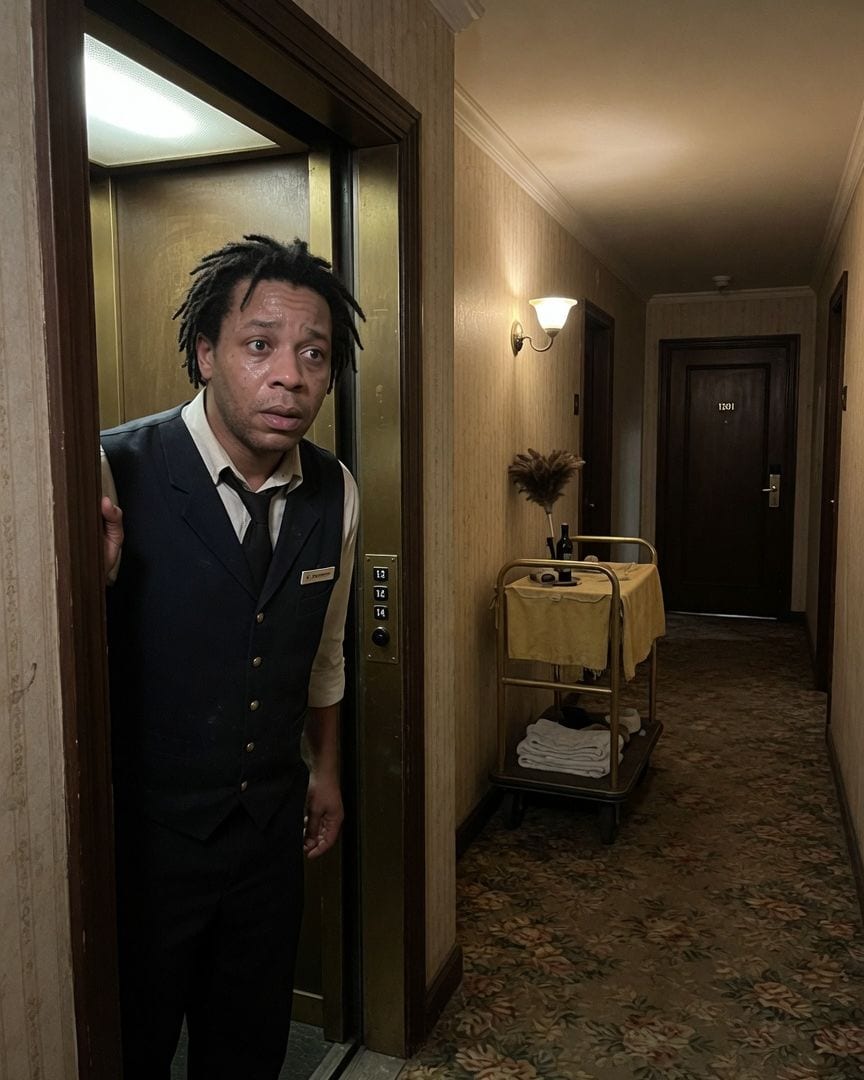
My hotel lift grew a Floor 13 button last week, unlit and proud. A guest pressed it before I could stop them.
As night porter, I'd always dismissed our hotel's missing 13th floor as superstition. But last week, a new button for '13' appeared on the lift panel, opening to a forgotten corridor that shouldn't exist. Stepping inside, I found an old night porter's uniform, complete with a name tag bearing the name of a local historian.
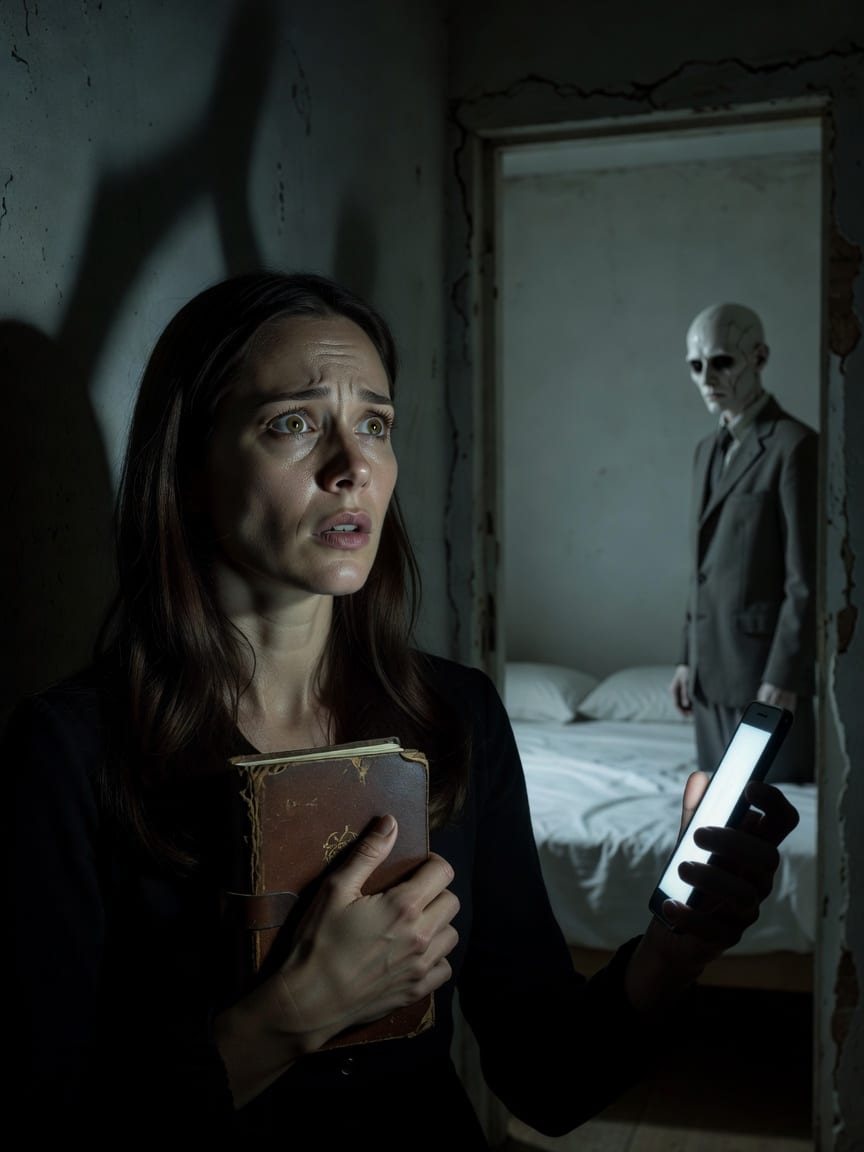
Behind a plastered-over doorway, I found a room. Papered, carpeted, and furnished with a made bed, sealed for decades. The air was dead still, but the bed wasn't dusty. My council tax bill only lists five rooms.
I'm Claire, an architect, meticulously planning my new Victorian terrace renovation. But when I uncovered a hidden room behind a wall, everything I knew about time and decay shattered. The bed was perfectly made, the air still, yet there was no dust, only an unnerving cold.
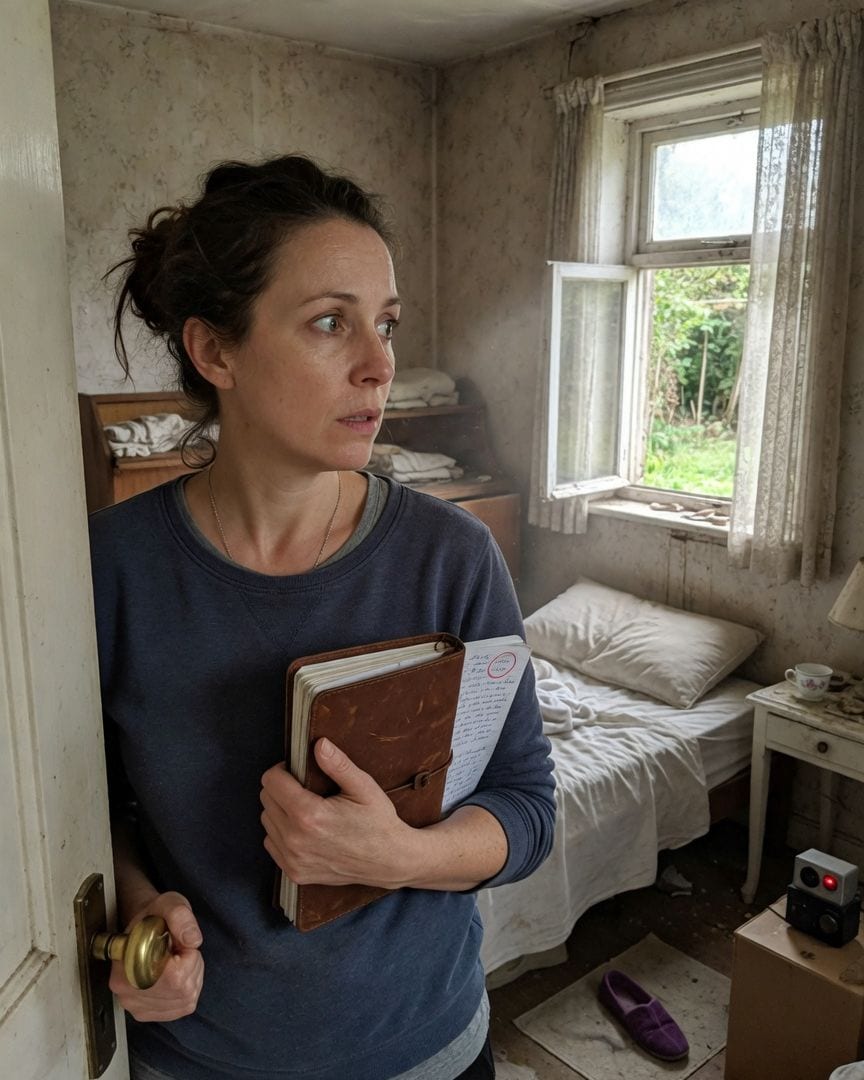
My spare room bed is slept in every few nights, sheets warm and pillow dented. I live alone, painted the window shut, and nobody has a key.
I've lived in Grace's house for six months, adjusting to its quiet rhythms. But the spare room, which I keep shut and empty for storage, has a disturbing routine of its own. Every few mornings, the bed is clearly slept in, the sheet rumpled and warm, and the window I painted shut is open exactly two inches.
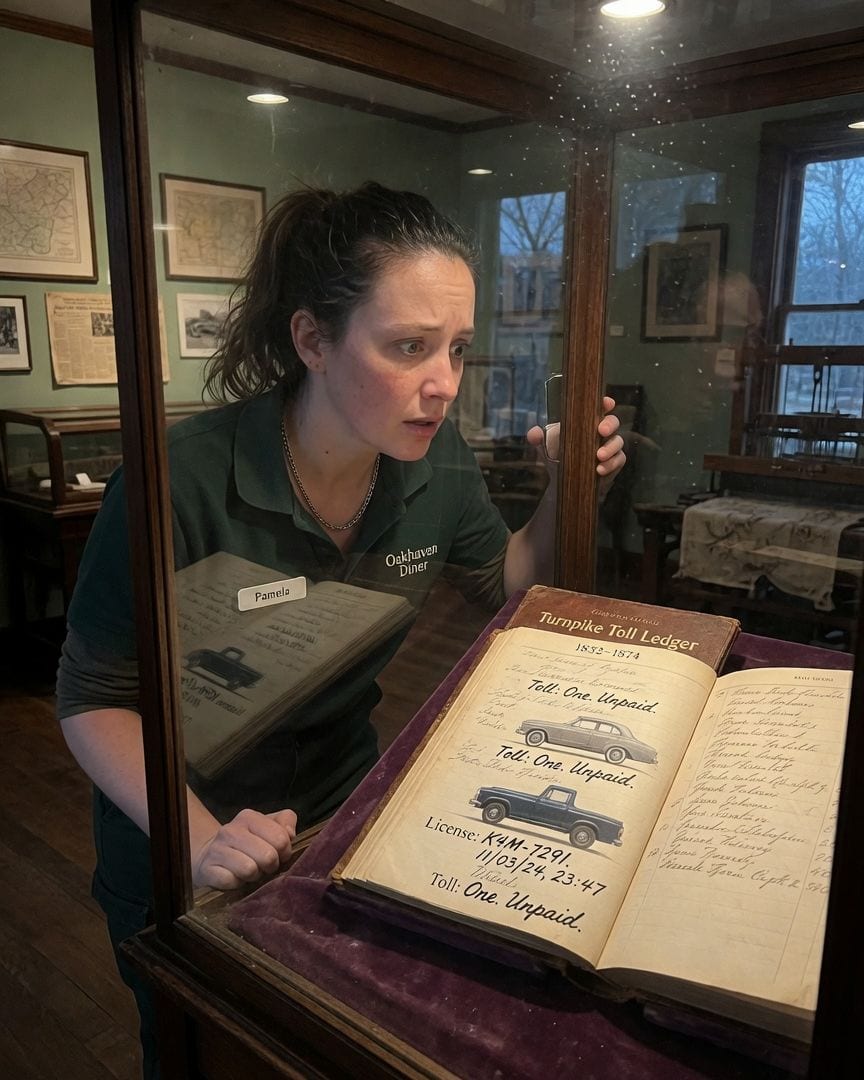
My car stalled at the old turnpike milestone, after dark. The toll ledger, closed in 1874, then listed my car, my stall time, and a toll of one, unpaid.
I had just moved to Oakhaven when my old sedan died on a dark, winding road by an infamous turnpike milestone. The next day, I found my car's exact registration and stall time written in fresh ink in a 150-year-old, locked museum ledger, marked 'Toll: One. Unpaid.' The curator dismissed it as a prank, but her white knuckles and strained voice hinted at something far more unsettling.
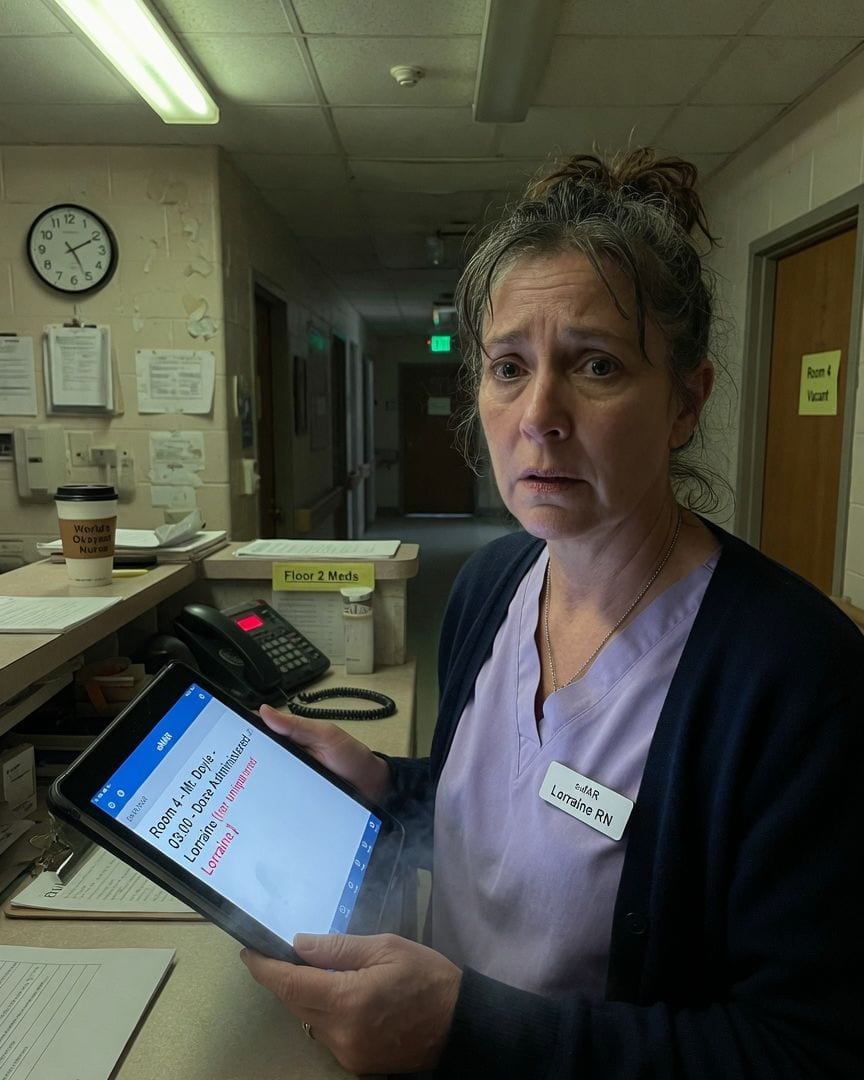
The care home tablet logged a 3am dose in Room 4, signed with my PIN — but Room 4 has been empty since Mr. Doyle died on Sunday, and I have no memory of giving it.
Working a quiet night shift at Elmwood, I double-checked patient records before clocking out. That's when I saw an impossible entry on the eMAR: my signature, administering medication to Mr. Doyle in Room 4 at 3 AM. Mr. Doyle had passed away yesterday, and his room was officially vacant, cleared, and locked.