My mother-in-law's photo frame saved a picture none of us took: our kitchen at night, and a tall man we don't know in the doorway, facing the camera it doesn't have.
The kitchen was quiet that morning, the only sound the low, reliable hum of the fridge.
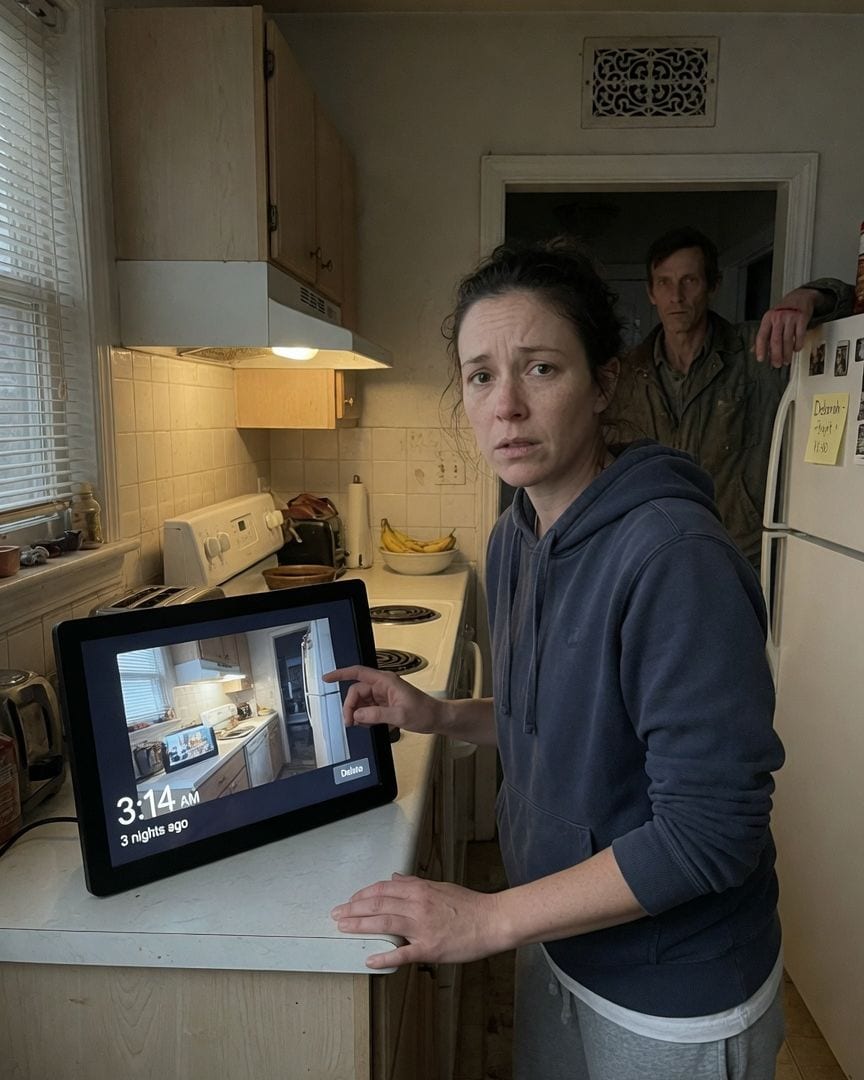
My mother-in-law, Deborah, was visiting, and her digital photo frame, a gift Carl and I had given her two years ago, sat on the counter between the toaster and the fruit bowl.
It was meant to cycle through happy family photos – birthdays, holidays, our toddler learning to walk. But it had frozen.
It was displaying a picture none of us had taken, a picture that shouldn't exist. It was our kitchen, late at night, empty and still.
The under-cabinet lights cast a soft, familiar glow across the pristine quartz, but everything felt profoundly wrong. Standing in the doorway, where Carl usually leaned while he drank his morning coffee, was a tall, unfamiliar man.
His face was shadowed, but I could feel his gaze, directed squarely at whoever held the camera. Only, the frame has no camera.
I'd stared at it for an hour last night, a cold, hard knot tightening in my stomach. I tried to find a rational explanation. A trick of the light? A corrupted file from the cloud?
But the man was too clear, too solid, his presence too deliberate. I live in this house. I know every shadow, every creak. He didn't belong. The date on the photo was three nights ago, timestamped 3:14 AM.
I couldn't unsee it.
I checked the frame’s settings again, scrolling through menus I barely understood, hoping for a clue, a log, anything that would explain an image from nowhere.
But it was just a photo, a perfectly normal-looking JPEG, indistinguishable from the dozens of happy family shots it was meant to display. The man in the doorway was gaunt, his expression unsettlingly still.
He wore what looked like old, faded work clothes, a style out of time.
Our kitchen, with its chipped tile by the stove and the faint scuff on the baseboard, felt profoundly alien with him standing there, a stage set for something I couldn't comprehend.
I reached out, my finger hovering inches from the screen, an irrational urge to wipe him away.
“Carl,” I called, my voice tighter than I meant it to be. He came in, yawning, rubbing sleep from his eyes. I just pointed at the frame.
He stared at it, frowning. “What the hell is that?” He, ever the pragmatist, initially suggested a prank by one of Deborah's friends, a faulty frame, or a bizarre download error from the cloud.
He took the frame, scrolling through its internal memory. The picture was undeniably there, a full-resolution JPEG, dated and timestamped, showing no metadata suggesting it was uploaded from an external device. It simply… was.
“Okay, delete it,” I told him, trying to sound calm.
He tapped the screen, but the 'delete' option was greyed out, inaccessible. “Huh.” He tried again. Nothing. He went to get his laptop, intending to connect the frame via USB, but the device wouldn't recognize it.
It just wouldn't acknowledge its presence. It displayed the picture of the man, and that was it.
Meanwhile, I found myself fixating on a small detail I hadn't noticed before: a faint, almost invisible scratch on the man's left hand, just above the knuckles. It looked like a recent injury, a thin red line against pale skin.
Carl dismissed it as a pixel artifact, a trick of the low light, but I felt a distinct prickle of unease, a cold certainty that it was real.
I also found myself looking around our kitchen, comparing it to the image. A peculiar detail, visible in the photo, caught my eye: a high, decorative vent grate on the wall above the pantry.
I’d always thought it was purely aesthetic, part of the house's older charm, but now, it seemed to draw my eye, a pattern I'd never quite deciphered, hinting at something more.
We even tried a factory reset on the frame, wiping all other photos, but the impossible picture of the man remained, stubbornly present, a digital ghost in the machine.
Frustrated, Carl gave up and went to make coffee, muttering about returning the 'defective' frame. Alone with the device, I continued to stare at the man in the doorway.
I tried to zoom in on the faint scratch on his hand, pressing the frame's touch screen. The image flickered, then abruptly shifted. A new photo, timestamped only minutes after the first, slid into view, pushing the original aside.
It was the same kitchen, the same doorway. But the man, Roland Sinclair, had moved, his head tilted slightly, his eyes now fixed directly on me, a faint, knowing curve on his lips.
His scratched hand was raised, palm slightly open, almost as if he’s acknowledging me, or perhaps warning me.
A sudden, intense cold washed over me, like an invisible draft had just passed through the room, chilling me to the bone, despite the warmth of the kitchen.
My scream brought Carl running back into the kitchen, coffee forgotten. He saw the second photo, his face draining of color as he recognized the terrifying shift in the man's gaze. We scrutinized both images, comparing every detail, every shadow.
The faint scratch on the man's hand was clearer in the second photo, a distinct, thin line against his pale skin.
We also noticed a subtle difference in the background of the second image – a small, dark, almost circular stain on the floorboards near the far wall that wasn't present in our actual kitchen.
We spent the next day checking every corner, every board of our kitchen floor, searching for the stain, for any sign of forced entry. Nothing. Our house was secure, the floorboards pristine.
My mind kept going back to Deborah's photo frame. I called her, my voice strained. "Mom, where exactly did you get that digital frame?"
She thought for a moment. "Oh, you know, at that estate sale a few months back. From that old Sinclair place, on Elm Street. The one with the funny layout. The old man, Roland Sinclair, disappeared decades ago, you know.
House was empty for ages before it was renovated and bought by those new people."
Roland Sinclair. My heart leaped, a cold, sickening jump. I immediately started researching the old Sinclair house.
Online records were sparse, but I found an old newspaper clipping from 1995 about the reclusive former owner, Roland Sinclair, who lived alone and "disappeared without a trace," the house left vacant for years before being renovated and sold.
The article mentioned his eccentricities, including having "two of everything" and a "tendency to talk to himself in empty rooms," often heard having full conversations with no one present.
The dread deepened: this wasn't just a random man; this was the former owner, long gone, watching us through a frame that shouldn't work this way. This was personal.
I felt an incessant sense of being watched. I found myself constantly glancing at the kitchen doorway, half-expecting to see Roland Sinclair. Every shadow felt longer, every creak in the house sounded deliberate.
One evening, after putting our toddler to bed and clearing the dinner dishes, I was at the sink, the kitchen window slightly ajar to let in the cool evening air.
I distinctly heard a faint 'click' sound from outside, like a camera shutter, followed by a rustling in the overgrown bushes beneath the window. I froze, peering out into the deepening twilight, but saw nothing beyond the swaying branches.
Just the wind, I told myself, just the wind.
The next morning, the photo frame cycled to a third image. This one was taken from outside their kitchen window, looking in.
It was a blurry, distant shot of me at the sink, doing dishes, my back to the camera, the toddler's high chair visible in the background. The timestamp was from last night, barely an hour after I'd heard the sound.
The image was too dark and distant to make out Roland Sinclair, but the perspective was undeniable. Someone was outside, watching us, documenting our lives. I felt a surge of cold terror, a primal fear that tightened my chest.
This wasn't just a glitch; it was deliberate, invasive surveillance. Carl, now deeply unnerved, suggested we check the attic.
The old Sinclair house was known for its 'funny layout,' and our attic had a strange, sealed-off section we'd never explored, covered by a plasterboard wall that looked like a later, crude addition.
It felt like a place where secrets might be kept.
Carl, armed with a pry bar and a flashlight, began to carefully remove the plasterboard in the attic. The dust was thick, decades old, clinging to everything. Behind it, not an empty void, but a small, dusty, completely finished room.
It was dark and airless, smelling faintly of old wood and stagnant air. It was clearly part of the original house, but it had been sealed for decades, never appearing on any property plans.
In the corner, under a thick layer of dust, sat an impossibly old, rotary-dial landline telephone, plugged into a wall jack that looked equally ancient.
It was made of a dark, cold wood, like some strange, alien material, feeling out of place and time, yet undeniably connected to something real.
As we stared, dumbfounded, the phone rang, a jarring, archaic sound that echoed loudly in the quiet, sealed space. I jumped, dropping the pry bar with a clatter. Carl cautiously, almost reverently, answered it.
A crackle of static, then a recorded voice, calm and even, began to speak. It was Roland Sinclair.
“Hello? Is anyone there? I’ve been trying to reach someone about the house.” He paused, a long, unnerving silence, then: “I know you’re new, but you must understand, some things must be maintained. The line must stay open.”
He mentioned the vent grate I had noticed in the kitchen, describing it as a “connection point,” a crucial anchor. He talked about “the other side of the wall,” and the “thinness” between them, a place where realities could bleed.
The recording cut off abruptly, leaving us in stunned silence, the only sound the frantic thumping of my heart.
The three photos on the frame now clicked into horrifying focus: Roland Sinclair wasn't in their kitchen; he was looking into it, from this sealed room, through the frame.
The frame was a window, and he was on the other side, diligently observing, documenting, maintaining his unseen connection.
Carl, his face pale, immediately replayed the voicemail. Roland Sinclair’s calm voice filled the small, dusty attic room again, every word now imbued with a chilling new meaning.
This time, the message continued past the general admonitions and the vague talk of 'maintenance.'
“...and Rachel,” the voice said, clear and unsettlingly personal, “I saw you leave the window open again just last night. You really must be more careful with the drafts, darling.”
The line clicked dead, the archaic answering machine whirring softly before falling silent.
Carl stared at the ancient phone clutched in my hand, its dark, cold wood feeling utterly alien and heavy, the faint scratch on its surface mirroring the one on the man’s hand in the impossible photos.
I traced the thick, braided cord disappearing into the solid plaster, a wall that should be empty, a phone that shouldn’t exist, a direct channel from a world that shouldn’t be.
This wasn’t just about a hidden room or a strange, old house. Roland Sinclair didn’t just know about us; he knew us.
He had been observing us, documenting our habits, speaking our names, from a space that was simultaneously in their house and entirely separate from it.
The phone itself, this impossible object, hummed faintly in my hand, a cold, unnatural vibration, a tangible link to the unseen observer and his terrifying awareness of our lives.
Beside the old telephone, Carl found a series of thick, brittle ledgers, bound in faded leather. Roland Sinclair’s precise, looping handwriting filled page after page.
These weren't just maintenance logs; they were meticulous observations for "the other side," referring to Rachel and Carl's house as "the Primary." The entries detailed the habits of previous residents, their minor repairs, even their emotional states.
And then, there were entries about "the shifts," brief, unpredictable moments when the two realities would align, allowing for visual or auditory bleed-through.
Roland Sinclair, the ledger revealed, was not just observing; he was actively managing and maintaining a separate, parallel house that shared their foundation, a twin structure existing slightly out of phase.
The decorative vent grate I had noticed in the kitchen was described as a "focal point," a stable anchor between the two realities, allowing for the "thinness" that the digital photo frame had inadvertently exploited.
The ledger confirmed Sinclair's deeply held belief that "the Primary" – the world Carl and I inhabited – was a temporary illusion, and "the other side" was the true, enduring structure, a "real" house that merely overlapped theirs.
The scratch on his hand, visible in the photos, matched an entry where he described "a minor cut while adjusting the frame," not the digital photo frame, but a physical boundary frame he had meticulously built around the vent grate, a "window" into our reality.
His entries grew more frantic in the weeks before his disappearance, detailing a "weakening barrier" and the need for "more direct intervention." He had been trying to reinforce his world, not invade ours.
We found a series of complex diagrams in the ledger, showing how to "stabilize" the thinness, centered on the vent grate.
Roland Sinclair’s goal wasn't to harm us, but to ensure the "integrity" of his parallel existence, to keep his world from collapsing.
The digital photo frame was simply a receiver, inadvertently placed near a "focal point," a portal that had opened without his direct intent.
We realized the only way to stop the bleed-through, to sever the connection between the two houses, was to dismantle the vent grate and the hidden structure behind it, as detailed in Sinclair's meticulous notes.
Carl, with a heavy hammer and a grim determination, began to carefully break apart the plaster around the vent grate in the kitchen.
With each strike, a strange, metallic groan echoed from within the walls, a deep, resonant sound as if the house itself was protesting, writhing under the assault. Dust rained down.
As the grate finally came loose, a wave of intense, bone-chilling cold washed over us, and a faint, shimmering distortion briefly appeared in the gaping hole where the grate once was, like looking through heat haze on a summer road.
It was a fleeting, terrifying glimpse of the "echo" kitchen, identical to ours but eerily silent, devoid of any modern appliances, bathed in a strange, muted light.
We saw a figure standing in that doorway, silhouetted, watching us, its head tilted in silent acknowledgement. Carl, with a final, desperate effort, finished the job, sealing the hole with new plaster and insulation, cutting off the connection.
The cold receded, leaving only the faint scent of old dust and plaster. The phone in the attic fell silent, its faint hum dying away to nothing.
The ledger's last pages described similar "focal points" in other properties on the street, each with their own "caretaker," each maintaining their own parallel existence.
Roland Sinclair wasn't unique; he was just one of many, a network of observers maintaining an unseen reality.
The photo frame on the kitchen counter has returned to cycling only through our legitimate family photos. The impossible pictures are gone, wiped from its memory as if they were never there.
The old phone in the attic is now completely inert, a cold, dark relic, its line permanently dead. Carl and I had the attic room professionally sealed and insulated, ensuring no further access, no accidental reopening of the conduit.
We sold the digital photo frame, telling Deborah it was 'too glitchy' and buying her a new, simpler model. Life slowly, tentatively, returned to normal.
But the quiet, chilling knowledge of what lies just beyond the walls, the unseen spaces, never truly left us.
We now scrutinize every unusual detail, every unexpected shadow, in our house and in others, forever marked by the thinness we discovered.
We still live in the house. We have to. It's our home, our life.
But sometimes, when the house is quiet and the light hits just right, I catch myself looking at the wall where the vent grate used to be.
I imagine the other kitchen, just beyond the plaster, still existing, still waiting, perfectly maintained in its silent, parallel world.
And I remember Roland Sinclair's ledger, his meticulous notes on other 'focal points' in other houses, other caretakers, other silent observers. We closed our window, we sealed our crack in reality, but I know there are others.
I see them sometimes, in the corner of my eye, a flicker of wrongness in a neighbor's window, a brief distortion in a reflection. We are not alone. They are not gone.
They are just out of phase, waiting for another thin spot, another unwitting conduit. Sometimes, when the house is quiet, I can almost hear the hum of another kitchen, just beyond the wall.
If this one got to you
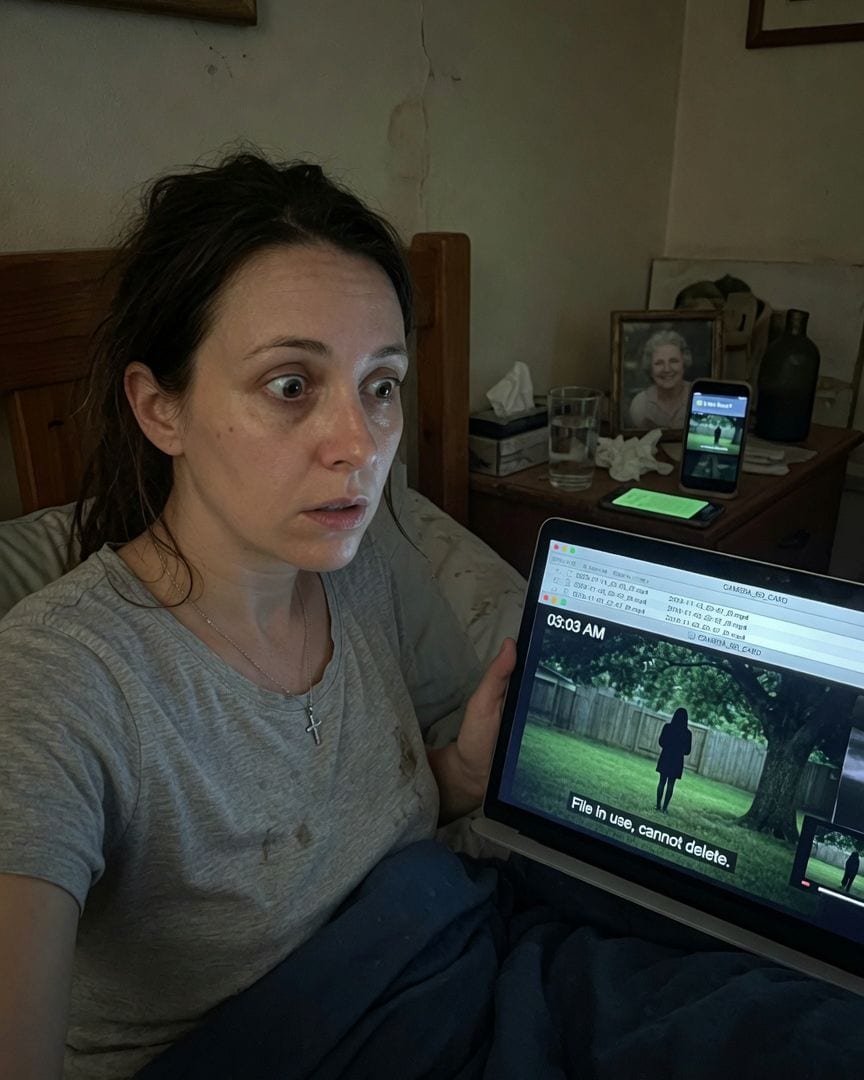
My security camera emailed a clip at 3:03am: a woman stood in the garden, back to the house. The subject line read 'Is this Mum?' My mother died in March. I can't delete the file.
My security camera sent an alert at 3 AM: 'Is this Mum?' But my mother, Constance, died in March. The grainy clip showed a woman in the garden, perfectly still, her back to the camera. The impossible question coiled a sick dread in my gut.
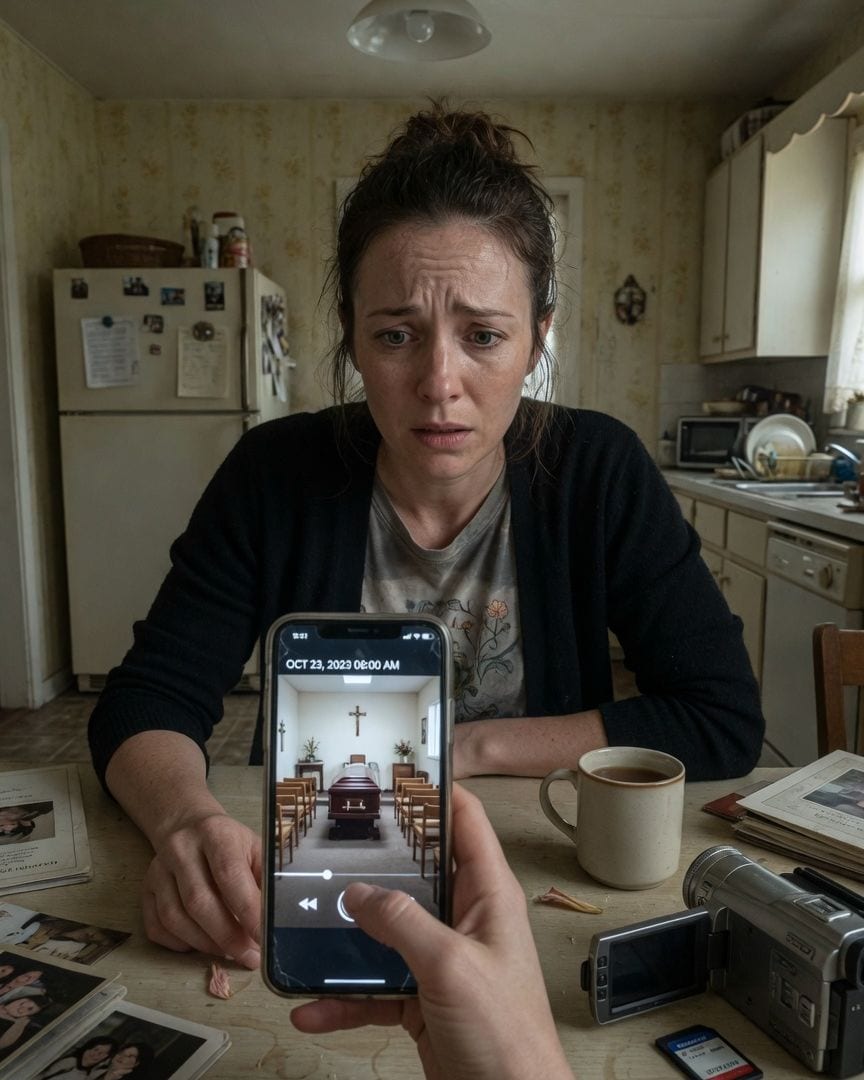
On my dead mother's phone I found a video of her funeral — steady, shot from the back over the mourners' heads, holding on her coffin. The timestamp says it was filmed an hour before any of us had arrived.
Days after my mother's funeral, I sifted through her digital life, hoping for comfort. Instead, her old camcorder revealed a video of my living room, timestamped for tomorrow morning. The abstract landscape I'd just hung was already there, waiting on the wall, a cold dread tightening in my gut.
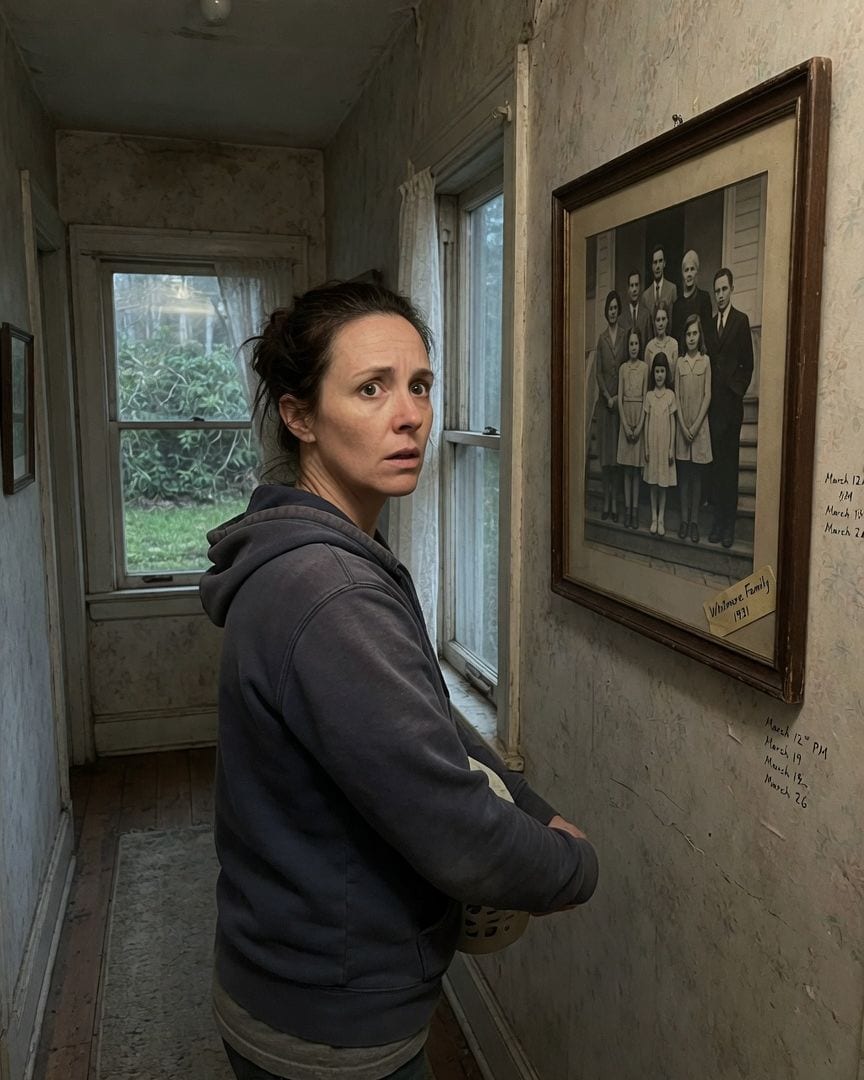
My inherited family portrait. The child's face in it is slowly, steadily turning to watch me.
I inherited an old New England coast house, a quiet place full of history. Among boxes, I found a 1931 family photograph; soon, the child's face in it began to slowly, undeniably, turn towards me.
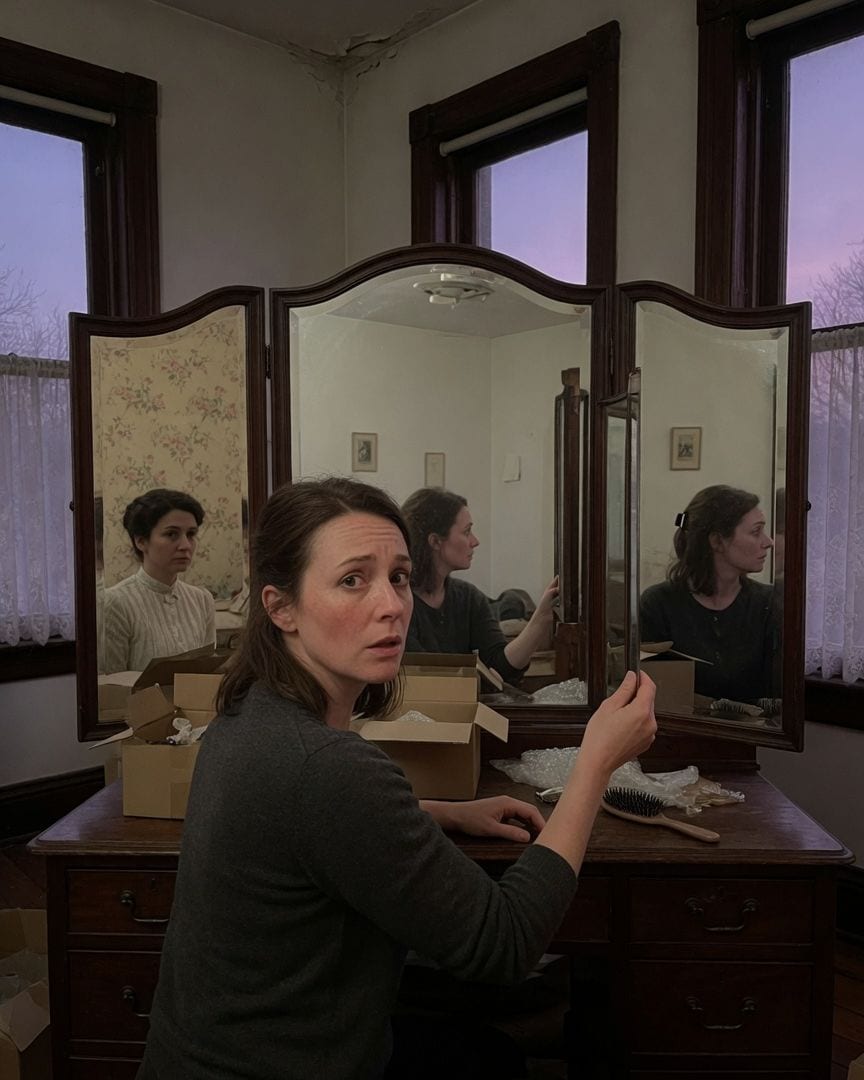
My dressing table mirror shows a woman in a high-necked blouse, doing her hair in a room papered differently from mine. She moves a half-second late, catching up to a memory of the gesture.
Settling into my inherited, old house, I found myself drawn to an antique dressing table with a three-winged mirror. But when I angled the mirror, it showed a woman from another time, brushing her hair in a room unlike my own. Her every movement in the reflection was a half-second too slow, an unsettling temporal stutter across the decades.
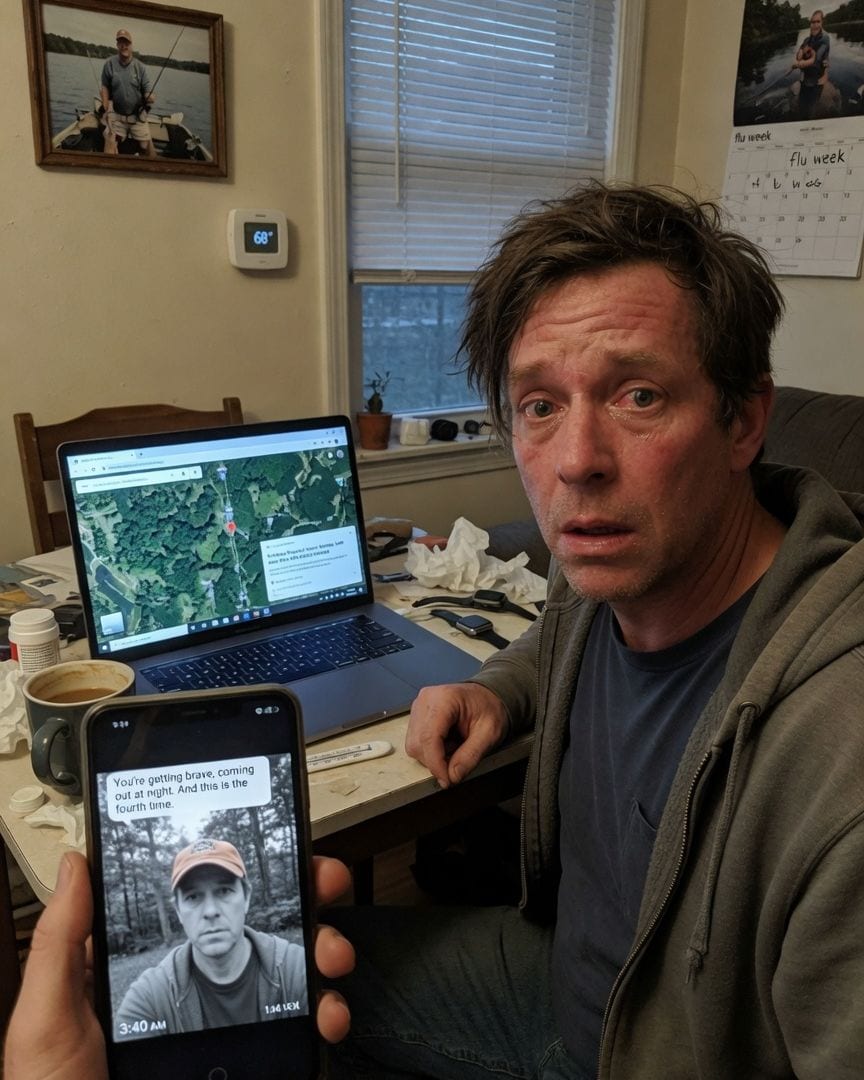
My brother-in-law's camera caught my face in Montana at 3:40 AM. I was asleep in Ohio, but it's the exact orange cap I lost, and he's seen me there four nights running.
I was just making coffee when my brother-in-law sent a photo from his Montana hunting land. It showed my face, wearing my lost baseball cap, timestamped 3:40 AM. I was home in Ohio, sick in bed, and hadn't been to Montana in years. And this was the fourth time.
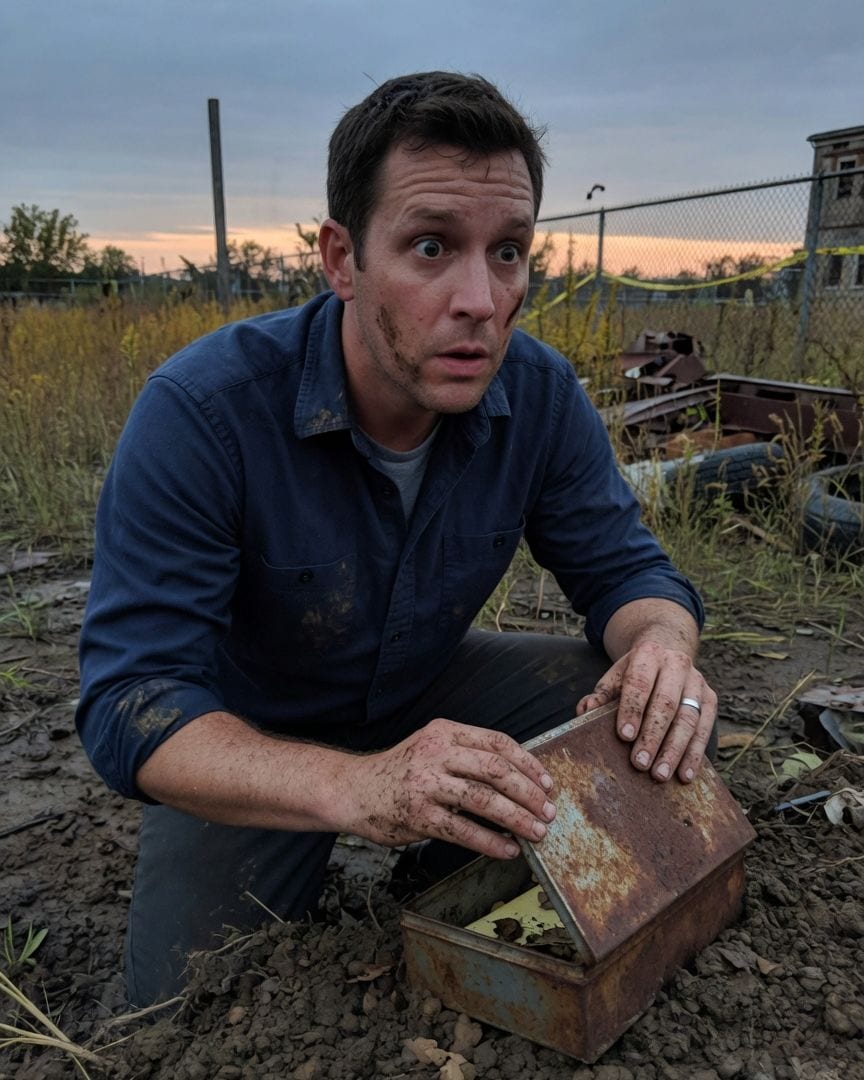
My ancestors' photo shows a letter addressed to me, dated 1972.
My birthday card arrived a day late, from a small town an hour north, nowhere we knew. Inside, an elegant, unfamiliar script read: 'Happy Birthday, Robert. The Field remembers.' It was postmarked from the site of my ancestral homestead, demolished decades before I was born.