My old birthday video shows a man in the kitchen window. Thirty years later, I found him whispering 'Alice' from the tape.
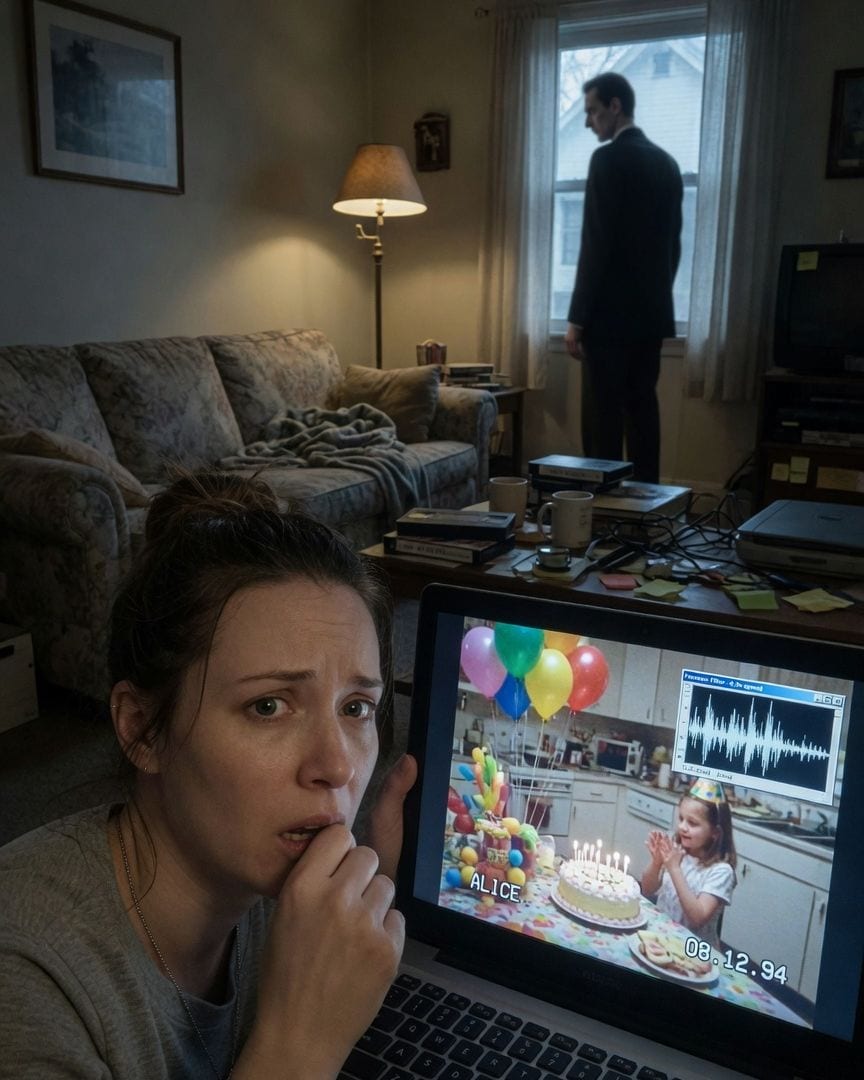
“Look at that little hat,” Mom said, her voice soft with memory. She was sitting next to me on the sofa, a blanket draped over her knees, as the digitized VHS flickered on the TV screen.
It was my sixth birthday, 1994, and the footage was grainy, a little wobbly, but still bright with the chaos of children and balloons.
There I was, a tiny version of myself, eyes wide, blowing out the candles on a buttercream cake. I laughed, a real, full sound, at my past self’s excitement. Mom smiled, reaching over to squeeze my arm.
“You were so determined to get all of them.”
Then I saw him.
It wasn't subtle, not a trick of the light. He was just there. Standing perfectly still in the brightly lit kitchen window, his back to the camera, but his head turned slightly, looking directly into the living room.
Directly at my six-year-old self. Tall, gaunt, dressed in what looked like an old, dark suit. He’d been there the whole time I was blowing out the candles, a silent, unmoving figure.
I froze the frame. The children’s laughter hung suspended.
“Mom,” I said, my voice barely a whisper. “Who is that?”
Her smile had vanished. Her eyes, usually so lively, were fixed on the screen, on the shadowy figure by the window. Her face drained of all color, going past pale to almost gray.
It was like watching the blood leave her body.
“What?” she breathed, her voice so low I almost didn’t hear it. Her hand, resting on the blanket, began to tremble. “That’s… that’s impossible. There was no one else in the house that day, Alice. No one.”
The image stayed, frozen. The cheerful party, the little girl in the hat, the cake. And the man. Watching.
I spent the next day trying to make sense of it. The logical explanations, the ones an archivist like me defaults to, cycled through my head: a reflection, a shadow, a prank.
I rewatched the video alone, a dozen times, focusing solely on the kitchen window. I paused, zoomed, rewound. The light in the window was bright, almost blinding, creating a stark silhouette, but his shape was solid. Not a distortion.
He didn’t flicker; he just was. He wasn't reflecting anything.
Maybe a forgotten guest? A distant relative no one remembered? I called Aunt Carol, who had been there, bustling around the kitchen that day.
I kept my voice casual, asking about who had helped out, if any of Uncle David’s friends had stopped by. She reeled off names: Mrs. Henderson, a neighbor; my cousin Sarah; no one else.
Definitely no male relatives, she confirmed, not that day. Not a single unexpected visitor. “Why do you ask, sweetie?” she’d pressed. I’d mumbled something about an old memory being fuzzy.
The rational explanations were falling apart. The man was there. He shouldn’t have been.
I decided to treat the VHS tape like a damaged document, something needing preservation and analysis. I took it to my office, to the professional digitization rig I used for delicate historical films.
I ran the old magnetic tape through, creating a high-resolution digital file. Then, using specialized image stabilization and enhancement software, I zoomed in on the man’s face, hoping to resolve it.
It remained indistinct, a shadowy blur, but his presence was undeniably solid, not pixelation, not a ghosting artifact.
I isolated the audio track, hoping to hear him speak, hoping to catch a stray word, anything that would give him context, make him real in a normal way.
But there was only the ambient party noise, the clatter of plates, the children’s laughter, my own tiny, joyful voice. Nothing else. The man was there, caught on film for thirty years, and he made no sound.
A cold, growing unease started to wrap around me. He hadn't just been there. He'd been watching.
Driven by an urge I couldn't quite name, I isolated the audio from the exact moments the man was visible in the window, a roughly fifteen-second loop.
I ran it through a forensic audio program, filtering out the background noise, trying to clean up any faint whispers, any stray sounds buried beneath the surface. The program hummed, processing the old, degraded sound, displaying a jagged waveform.
I put on my noise-canceling headphones, turning the volume up, listening intently to the hiss and crackle, the filtered-out remnants of children’s excited chatter. Then, through the static, a faint, guttural sound emerged.
It wasn’t a word at first, just a low, almost inhuman rumble, barely perceptible beneath the white noise. I cleaned it further, reducing the playback speed to a crawl, focusing all my attention.
The sound resolved itself, barely audible, but utterly distinct. A whisper.
My own name.
‘Alice.’
I ripped the headphones from my ears, my hand trembling so hard I almost dropped them. The digital audio file, still looping on my screen, played the filtered segment again.
And from the tinny speakers of my laptop, faint but clear, the rasping whisper repeated it: 'Alice.' My own name, spoken by a voice that hadn't been in the room, caught on a decades-old tape.
The man in the window hadn't just been watching; he'd been speaking directly to her, from the recording.
The whisper changed everything. I couldn’t dismiss him as a visual anomaly anymore, a trick of light or memory. This was a voice, speaking my name, from a moment in time before I even knew what a ghost was.
The rational explanations were gone, burned away by that single, impossible sound.
I buried myself in research, a familiar comfort. If the house was somehow involved, I needed its story. I spent days at the town’s historical society, my professional sanctuary, poring over old property deeds, census records, and local newspaper archives.
My childhood home was built in the early 1920s, a fairly standard build for the area. I traced its ownership back through the decades. A succession of owners, mostly unremarkable families. The Millers, the Davidsons, the Olsons.
But as I dug deeper, focusing on the 1950s, I found odd mentions in handwritten letters from previous residents, tucked away in family collections.
Vague references to ‘unexplained occurrences,’ to ‘shadows in the corners of rooms’ when no one was there, and ‘children’s voices’ when the house was empty. Nothing concrete enough for the local papers, just hints, fleeting mentions of unease.
They sounded like the kind of things people rationalize away, just like I’d tried to do.
I zeroed in on the 1930s. A period of economic hardship, often leaving properties vacant or poorly documented. The records were sparse, almost thin in comparison to other decades. That’s when I found it.
Tucked away in a digitized microfilm of the local paper from October 1936: a brief, unsettling report. A young girl, Cecilia Fairfax, age six, had vanished from the house without a trace.
The report was short, almost dismissive, but the details were stark. Last seen by her father, Arthur Fairfax. No evidence of a struggle, no forced entry. Just gone. Arthur Fairfax was questioned, but never charged.
It was a tragedy written in stark, economic language, common for the time.
A cold dread settled in my stomach. Arthur Fairfax. The name itself felt like a physical weight. The man in my video, the whispered name, the house’s unsettling history – a pattern began to emerge, chillingly coherent.
Cecilia Fairfax, age six, vanished. I was six years old in the video. The connection was too precise to be coincidence.
I knew who I needed to talk to.
I remembered Oscar Thornton, a retired local historian. He was known for his eccentric but meticulous research into forgotten local lore, the kind of stories that never made it into the official county histories.
He had a reputation for knowing the things no one else wanted to talk about.
I called him. My voice, I noticed, was tighter than usual. I carefully omitted any mention of the video, of the whisper, of the man.
I just asked about the Fairfax family, about the house’s history, phrasing it as a general interest in local architecture.
Oscar’s voice on the phone was calm. Almost too calm. He acknowledged the Fairfax case, calling it a “local tragedy, nothing more,” and sounding slightly dismissive, like a well-worn story he’d heard a thousand times.
But then he started asking pointed questions. “Why the Fairfaxes, Alice? So many interesting families from that period. What exactly have you found?” His questions weren’t aggressive, but they were precise, probing.
He seemed to know what I was skirting around, what I hadn't told him. A prickle of unease started just behind my ribs.
A few days later, I was working late at the historical society, poring over microfiche, my eyes aching from the glowing screen. The library was quiet, almost empty.
I was deep in the 1940s census data when a shadow shifted outside the glass doors of the reading room. I glanced up.
Across the street, by his old, faded green sedan, stood Oscar Thornton. He wasn't looking at the building generally. He was looking directly at the reading room, directly at me. He didn’t wave, didn’t acknowledge me in any way.
He just watched. A silent, knowing figure, framed by the streetlights. His presence was so unnervingly still. He simply observed.
I felt a sudden, profound sense of being observed, not by a ghost, but by someone very much alive, someone who knew what I was uncovering.
I tried to dismiss it, to tell myself he was waiting for someone, or just parked there. But his gaze felt heavy, deliberate.
I blinked, shook my head slightly, and when I looked back, he was gone. The street was empty. The sudden absence felt heavier than his presence.
I knew I couldn’t let it go. The next day, I cornered Oscar at the local coffee shop. He was sitting at his usual table in the back, nursing a lukewarm black coffee, a stack of worn books beside him.
He looked up, his expression unreadable, almost as if he’d been expecting me.
“You know something about the house, don’t you?” I asked, my voice low and firm, leaning over the small, sticky table.
Oscar sighed, stirring his coffee slowly. The spoon clinked against the ceramic cup, a small, loud sound in the quiet shop. “Some places, Alice,” he said, his gaze fixed on the swirling liquid. “They hold onto things.
Like a recording, but not on tape.” He finally looked at me, his eyes surprisingly sharp. “You’ve found more than you expected, haven’t you?”
He spoke of ‘temporal bleed points,’ places where the veil between moments thins.
He described them as localized anomalies, like a fault line in time itself, allowing residual echoes from past tragedies to imprint themselves onto recording devices, especially older analog ones.
He admitted he’d been quietly tracking such points for decades, ever since his own family experienced similar phenomena in a different house, generations ago. A house they’d eventually left.
His calm, almost academic tone was more chilling than any ghost story.
Then, with a deliberate slowness that heightened the tension, he pulled a faded, brittle newspaper clipping from his worn leather satchel. He smoothed it carefully on the table.
It was a grainy photo of a man, his face etched with grief and something else, something desperate. Arthur Fairfax. The caption beneath it implied suspicion, but mentioned no proof in the disappearance of his daughter, Cecilia, in 1936.
It was the man from my video, unmistakably.
“He’s not a ghost, Alice,” Oscar said, meeting my gaze directly. His voice was quiet, but it carried an absolute certainty. “He’s a loop. A memory. Trapped.”
The pieces clicked into place, not gently, but with a horrifying, sickening thud. The man in the window, watching my six-year-old self. The whispered name, my name, caught on the tape. The vague historical accounts of voices and shadows.
It wasn't a haunting in the traditional sense. It was a residual impression, a broken record of a past tragedy, playing itself out through my home, captured on my tape. A terrifying, inescapable truth.
The house wasn’t haunted; it was the haunting.
Oscar’s explanation, while terrifying, offered a strange sense of clarity. The chaotic fear I’d felt began to settle into a cold, hard dread.
I returned home, the laptop open to my birthday video, Arthur Fairfax’s looped image frozen on the screen. If he was a ‘loop,’ a trapped memory, what else could be pulled through? What other fragments?
I studied him again, meticulously, searching for any detail I might have missed in my earlier, frantic scans. He was still, his gaze fixed on my six-year-old self, blowing out candles.
I traced the outline of his suit, his gaunt face, the way his hand rested on the windowsill. And then, I noticed it.
Around his neck, barely visible beneath his lapel, hung a small, intricately carved silver locket. It was a distinctive, old-fashioned design, a tiny rose etched into its surface, almost faded by time or the video’s poor quality.
I paused the video, zoomed in as far as the resolution would allow. It was definitely a locket. A physical object.
My fingers flew across the keyboard. If this was a bleed point, a place where history imprinted itself, then surely this locket would be part of that history.
I searched historical archives online, looking for similar lockets, specifically from the 1930s. It took hours. I sifted through jewelry catalogs, old family photographs, museum exhibits. And then I found a match.
An article, a police report follow-up from 1937, describing a unique locket worn by Cecilia Fairfax, the missing child. Her father, Arthur, had given it to her on her sixth birthday. The same age I was in the video.
Days later, after an exhausting, obsessive search that yielded nothing but digital images, I walked into my kitchen, heading for the refrigerator. The afternoon sun slanted through the window, illuminating dust motes dancing in the air.
My eyes drifted to the windowsill, the very spot where the man had stood in my video. The spot where Arthur Fairfax, in his endless loop, forever watched a six-year-old blow out her birthday candles.
And there, cold and heavy, resting precisely where the man had been, lay an antique silver locket. Tarnished, but undeniably real.
Identical to the one I'd just seen around Arthur Fairfax's neck in the digitized recording, and in the old newspaper clipping describing Cecilia’s disappearance. It wasn't an echo anymore. It was here.
I rushed back to Oscar, the locket clutched tight in my hand, its unexpected weight a stark reality against my palm. He examined it with a grim expression, turning it over, his thumb tracing the faded rose etching.
“The bleed point is strengthening,” he explained, his voice low, almost a whisper. “It’s not just imprints anymore. Sometimes, under certain conditions, objects can… cross over. Especially those with strong emotional ties.”
He confirmed it. The locket belonged to Cecilia Fairfax. Her father had given it to her on her sixth birthday.
It was a last, tangible piece of a lost child, now pulled into Alice’s present, a physical manifestation of a past tragedy. Oscar theorized that Arthur Fairfax’s ‘loop’ was drawn to children, to the innocence he’d lost.
My birthday, a moment of pure, unadulterated joy, had created a momentary resonance, a kind of channel that allowed the imprint to manifest so clearly on the tape.
The whispered ‘Alice’ was not a threat, he said, but a broken echo of a father’s grief, perhaps mistaking me, in that moment, for his own lost child.
The horror settled deep in my bones. The house wasn’t just haunted by a memory; it was a place where the past could bleed into the present, physically manifesting traces of a long-ago tragedy.
Every clue, every chilling detail, now made a terrible, coherent sense. It all fit. The man, the whisper, the locket, the history. It wasn’t random.
It was a pattern, an indelible stain on the fabric of time itself, centered on my childhood home.
There was no confrontation to be had, no escape to plan. The truth was understood, and it was irreversible. I held the locket, a cold, heavy weight in my palm.
The house, my childhood home, was not a place of safety, but a site of perpetual, quiet grief, a stage for a tragedy that endlessly replayed. I knew Arthur Fairfax was not malevolent, merely trapped.
And Cecilia’s locket was not a cursed object, but a mournful artifact, a last vestige of a child lost to time and a broken father’s memory.
I decided I couldn't simply discard it. It was too important, too real. I retrieved an antique wooden train toy that had belonged to me when I was a child, a small, faded steam engine with chipped paint.
I placed the locket carefully on top of it, the silver glinting dully against the worn wood. I left the train and locket on the kitchen windowsill, precisely where it had appeared, where Arthur Fairfax forever stood.
I played the digitized birthday video on a loop on my laptop, keeping the audio low, a quiet, almost imperceptible hum in the background. It wasn't an attempt to communicate, not anymore. It was an acknowledgment, a silent vigil.
I watched the man in the window, no longer with primal fear, but with a profound, aching sadness. He was a part of my home now, a permanent, tragic fixture, and I was merely a witness to his unending loop.
The dread was in the acceptance, the realization that some wrongs cannot be righted, only observed, and endured.
I never moved out of the house. I couldn't, not now that I understood its true nature.
Vivian, my mother, eventually moved in with my aunt, unable to shake the unsettling memory of the video, of the man she swore hadn't been there. She visited, sometimes, but she never stayed the night.
Oscar Thornton continued his quiet, solitary research, occasionally sending me cryptic emails about other ‘anomalies’ he’d found in forgotten corners of the world, never asking if I’d found anything else myself.
The locket remained on the windowsill, on the little wooden train, a silent sentinel to a past that wasn't past. The video continued to exist, a digital ghost, playing silently on my laptop when I needed to acknowledge the presence.
I learned to live with the quiet hum of the past, the occasional flicker of movement I thought I saw in the corner of my eye, the faint, almost imperceptible whispers carried on the drafts from the kitchen window.
The house was mine, but I was never truly alone.
I sit alone in the kitchen one evening, a book open on the table, the digitized video playing silently on my laptop. The man is there, as always, by the window, watching.
I glance up, not at the screen, but at the actual window, now dark with night. A faint, almost imperceptible chill drifts from it, carrying with it a ghost of a child's laughter, and then, distinctly, my own name.
I close my eyes for a moment, then open them. The house had always been home, but now it was also a place where someone else was always listening.
If this one got to you
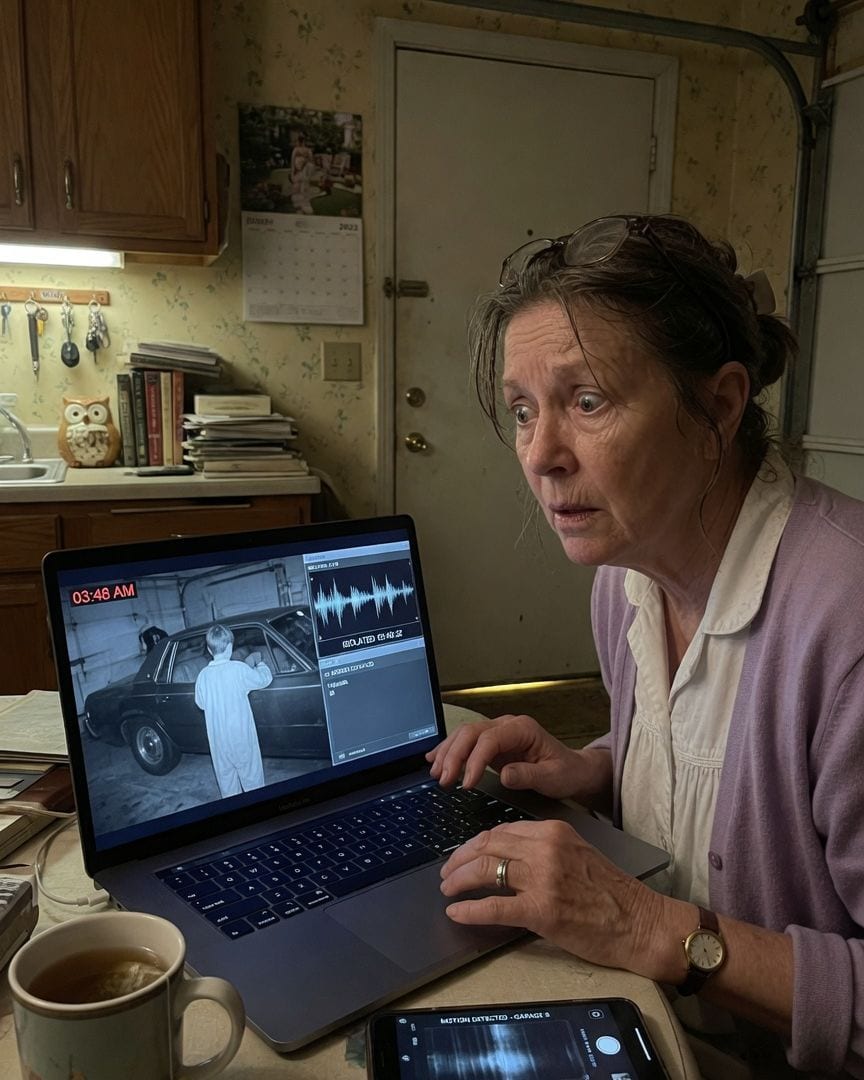
My garage camera filmed a boy of six walk out of a locked door at 3:48am, stare into my empty car, then vanish. My children live abroad.
I live in a quiet, solid house, my children grown and gone. But one night, my garage camera caught an impossible sight: my internal door, locked and bolted, slowly opened. A small, solid boy, no older than six, stepped through, then stood staring into the driver's seat of my empty car.
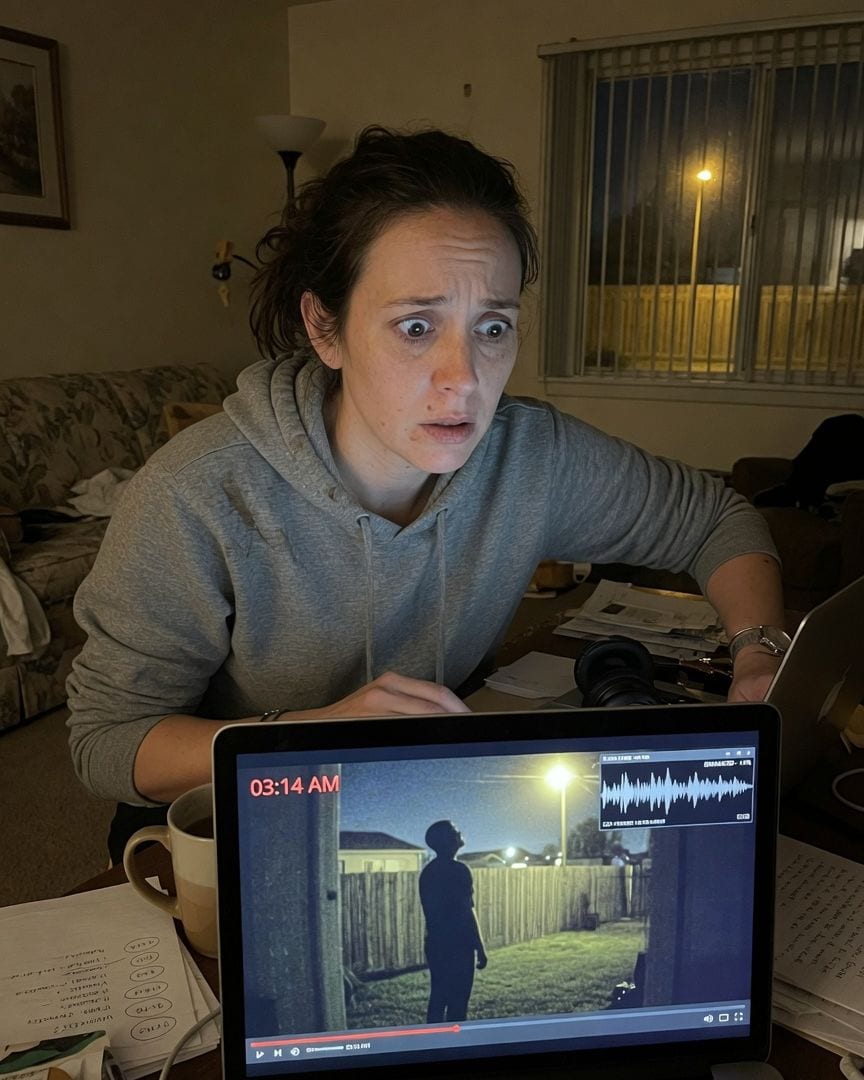
My neighbor's camera caught a dark figure watching my window, but its audio whispered one impossible word.
My neighbor Harold sent grainy footage from his garden camera, timestamped 3 AM, showing a dark figure watching my bedroom window. But my own home security system, covering that entire perimeter, recorded nothing for that exact minute. Later, enhancing the footage, I found a subtle, impossible whisper, a single word that should not exist on any recording.
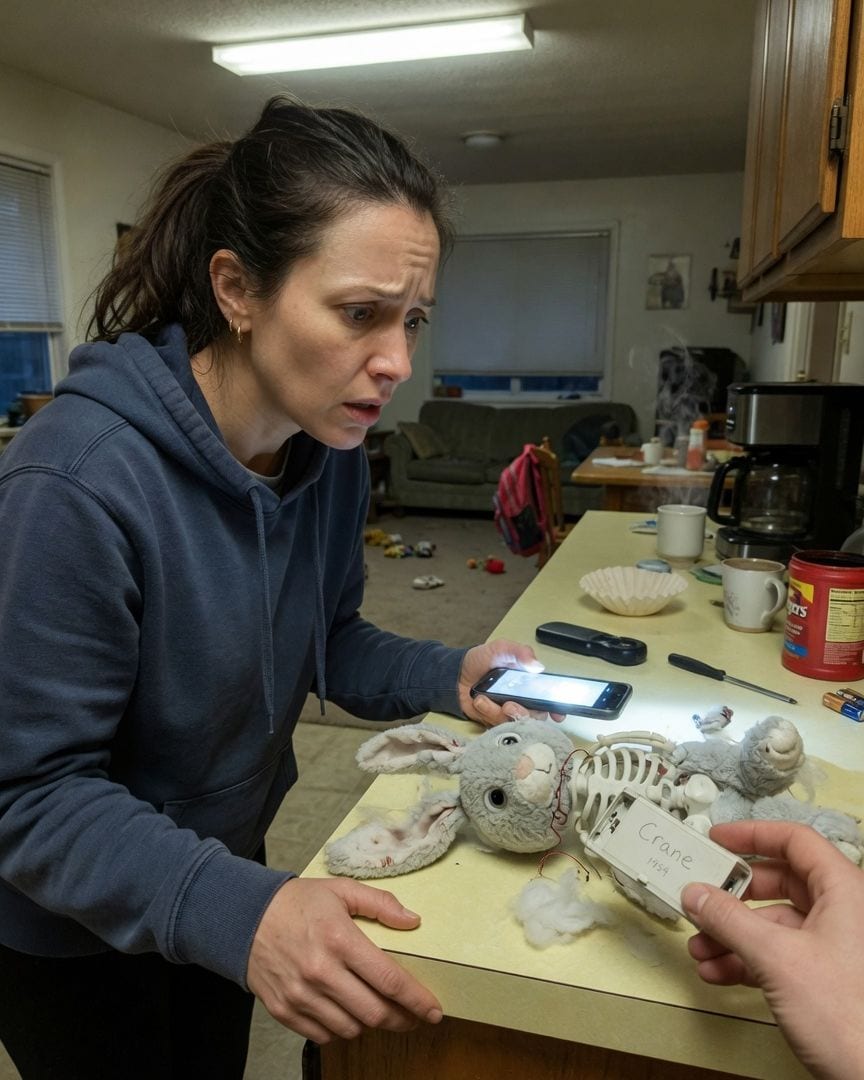
My son's toy rabbit says my name, then, 'bring him to the water.' The batteries are out.
I was making coffee, my son James at school, when I heard a grown man's voice from the living room. It was his favorite toy rabbit, whispering my name: 'Nina, bring him to the water.' The chilling command was impossible; I had removed the rabbit's batteries three days earlier, and they sat on the kitchen counter.
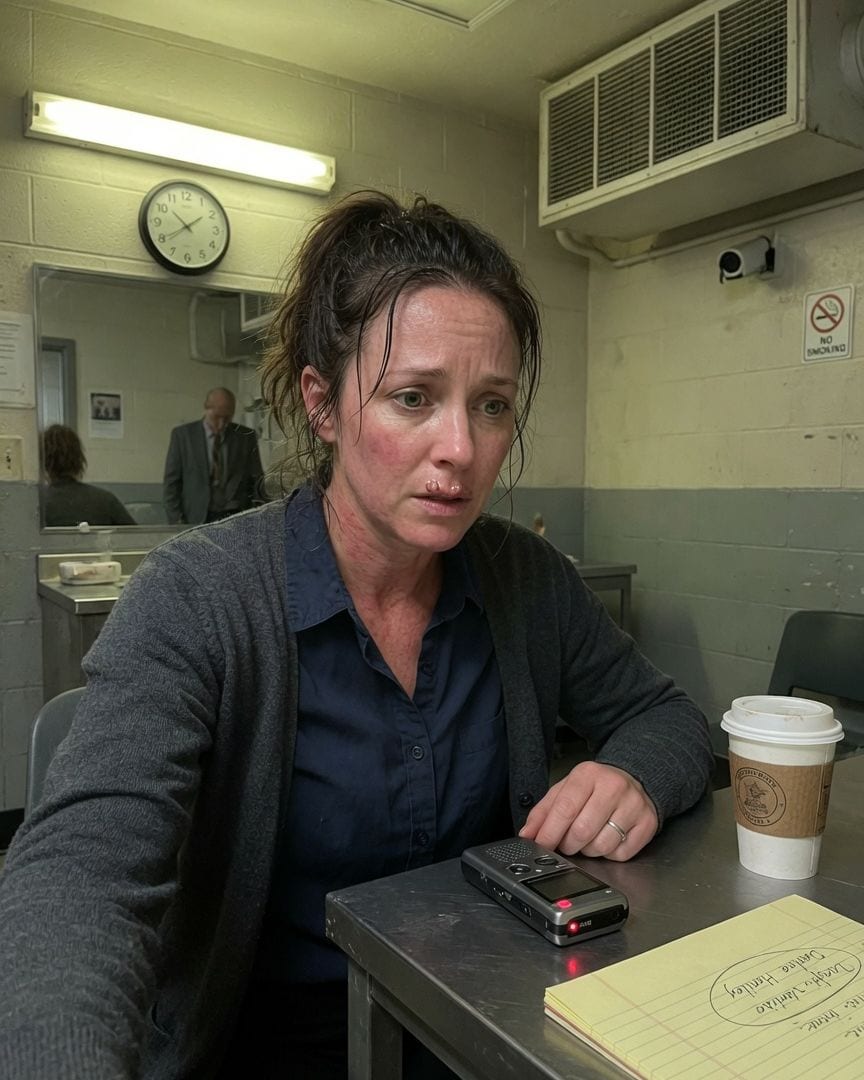
My own voice called 911 from Gary, Indiana, reporting a prowler. I was asleep in Ohio, my phone on the charger.
Sitting in a police interview room, I listened as Detective Walsh played a 911 recording. A woman's hushed voice reported a prowler from a payphone in Gary, Indiana. My stomach dropped cold; it was my exact voice, my specific way of saying 'I think,' even though I was in bed in Ohio that night.
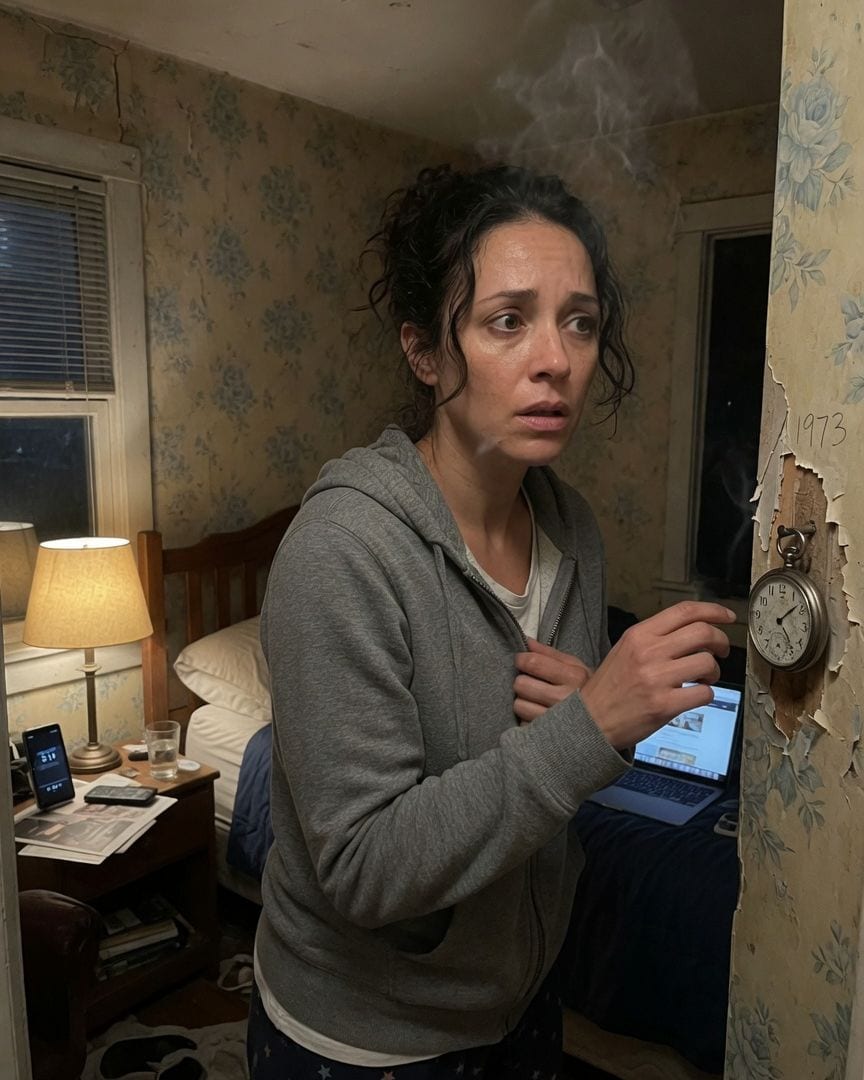
My pocket watch ticks at 3:14 every morning, warm in my hand. I’ve thrown it away; it’s back on its nail by dawn.
I’m a rational person, but my new old house came with a pocket watch I couldn't explain. I meant to discard the broken relic, yet a few mornings later, I woke to its faint ticking at 3:14 AM. It was warm, and no matter where I put it, the watch kept reappearing on its nail.
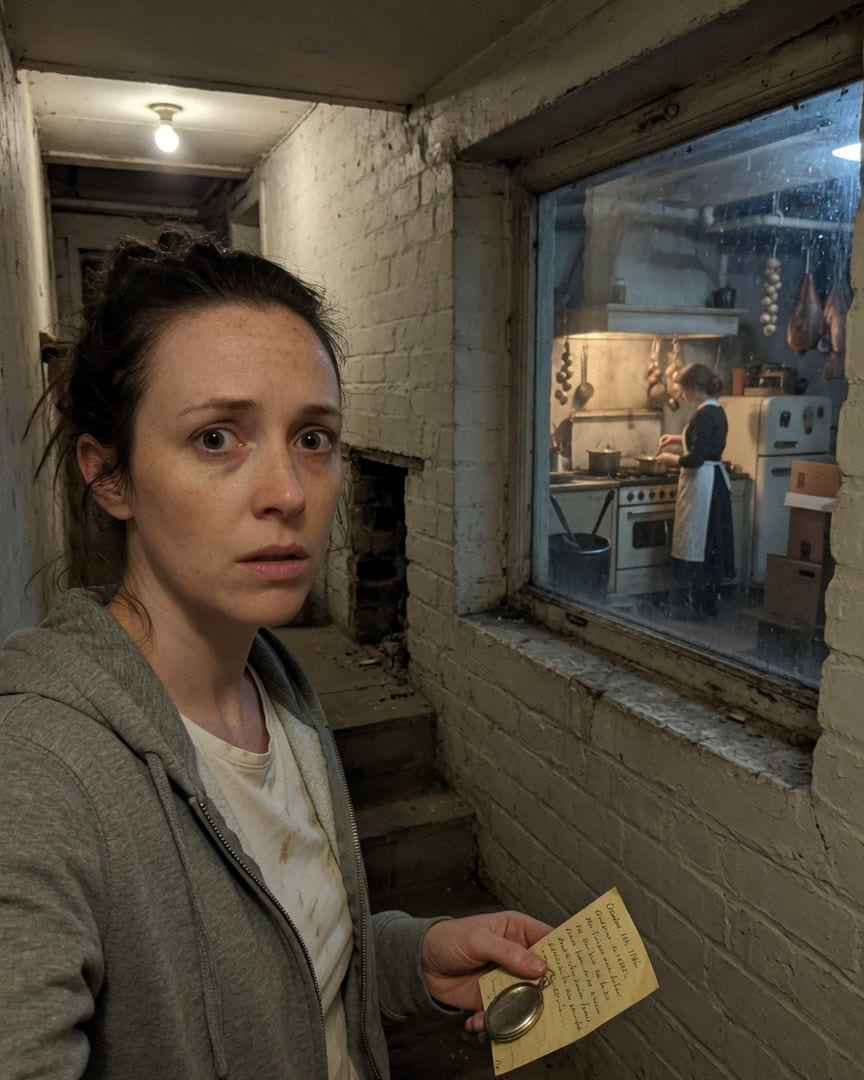
My basement window shows a 1906 kitchen, with a scullery girl and the sound of a poker stirring coals that aren't there.
I've only been in my basement flat a month, still getting used to the city's hum. But my window at pavement level now shows a gaslit kitchen, complete with a bustling scullery girl and the faint sound of coals being poked.