My neighbor's camera caught a dark figure watching my window, but its audio whispered one impossible word.
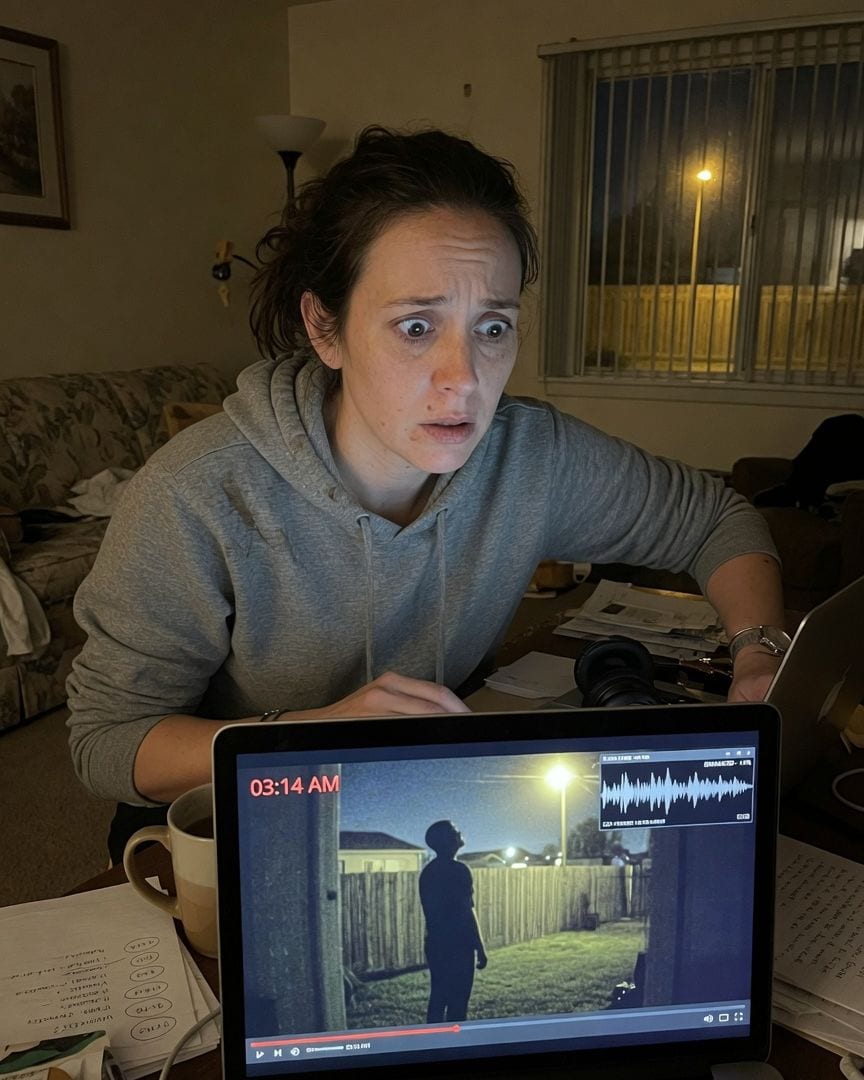
The footage Harold Ellsworth sent was grainy, taken from his garden camera. It was 3 AM, according to the timestamp, and my street was bathed in that artificial yellow glow of the old sodium lights.
He’d called, profusely apologetic, explaining his motion sensor often tripped on stray cats or raccoons. But this wasn't a cat.
A figure stood motionless by the fence separating our properties, perfectly still, looking directly at my bedroom window. It was man-shaped, a dark silhouette against the faint streetlights, utterly unmoving. Not a twitch, not a shift of weight. Just… standing.
Watching.
The first jolt of cold wasn't from the night air Harold’s camera recorded; it was the realization that followed. My own home security system, which covers the entire perimeter of my house, including the side facing Harold's, recorded nothing.
Not a flicker. Not a motion alert, not a single second of footage for that exact minute.
Harold’s clip was irrefutable, timestamped 3:14 AM, yet my own digital log was a blank space, a void where a record should have been. It was like whatever Harold's camera saw simply hadn't existed for mine.
I replayed it. The figure remained, a dark, silent sentinel. I replayed it again, my own system’s silence deafening in comparison. Every rational explanation dissolved into the strange, unnatural quiet of that empty minute.
I tried to rationalize it. A trick of light, maybe? A shadow from Harold’s own garden shed, exaggerated by the infrared lens?
Perhaps the angle made it look like it was facing my window, when really it was just a strange perspective. I called Harold back, the tremor in my voice something I fought to suppress.
"Harold," I started, "you're sure about your camera? It's not... glitchy?"
He swore by it. "Never had a problem, Iris. Infrared's crystal clear. I went out first thing this morning, before you were even up, checking for footprints, anything. Nothing. Ground's a bit soft after that rain yesterday, too.
Would've seen something." He paused, and I could hear the edge in his voice now, the same unease I felt. "It's like it was never there at all."
I spent the rest of the day poring over the footage, hunched over my laptop, the screen a sickly blue in the quiet of my living room.
I zoomed in, pixel by painstaking pixel, searching for a seam, a blur, anything that would scream 'glitch' or 'refraction.' But the figure held its impossible form, a dark silhouette, its head tilted ever so slightly, as if listening.
There was no texture, no clothing detail, just an absolute absorption of light. It was just there.
I enhanced the audio, hoping for the rustle of leaves, the hoot of an owl, anything natural that might explain a sound that wasn't there. There was only static, a low, constant hiss, then a subtle, almost imperceptible shift.
A breath. Not Harold's. Not the wind, which I knew from my weather app had been negligible that night. Something else, barely there, caught in the white noise. My skin crawled.
I cranked the volume, pushing the limits of the audio software until the speakers crackled. The static intensified, then receded slightly, and for a fraction of a second, a sound emerged. A whisper.
So faint, so delicate, I almost missed it, dismissing it as feedback, a trick of the overloaded speakers. But then it came again, undeniably. It was a voice, not Harold’s, not mine, not any voice I recognized.
A second voice, impossibly clear despite its low volume, uttering a single, impossible word. It wasn't a name, not a place, but a word that seemed to have no meaning, yet resonated with an ancient, terrifying weight.
I froze, my finger hovering over the replay button, as the barely audible whisper from the footage repeated in my mind, a single, impossible word that should not exist on any recording.
The impossible word haunted me. It clung to the edges of my thoughts, a sound that made no sense yet felt profoundly significant.
I wrote it down phonetically, a string of nonsense syllables, then scoured online dictionaries, historical texts, even the digital archives of the town library for local folklore. Nothing.
It was as if the word itself was a phantom, an auditory hallucination that nonetheless felt entirely real.
The footage, with its silent, unmoving figure and that impossible whisper, became an obsession.
I would replay it in the dead of night, the sound turned so low it was almost a vibration, hoping to glean some new detail, some forgotten context. But there was nothing.
Only the figure, the silence of my own cameras, and the whisper.
Then I started noticing other things. Small details, easily dismissed at first. A persistent, inexplicable cold spot in my living room, near the mantelpiece, even with the heating on full blast.
It wasn’t a draft; the windows were sealed, the fireplace flue closed. It was a distinct pocket of icy air, a physical chill that raised goosebumps on my arms. And objects.
Nothing overtly alarming, just enough to prickle at my sense of order. A framed photo of my parents, usually centered perfectly on the side table, would be subtly shifted a fraction of an inch to the left.
A book I’d been reading, left spine-down on the coffee table, would be found turned face-down, a subtle rearrangement that made no logical sense.
Each time, I’d tell myself I was just tired, forgetful, but the small shifts accumulated, building a quiet, nagging unease.
I started researching the house’s history, convinced that the answers lay in the very foundation of the place. I dug through old property records at the town hall, faded deeds and handwritten ledgers.
My house, built in the late 1800s, had passed through several hands, but one name kept reappearing with unsettling frequency: Marsh. A family, the Marshes, had owned the land for generations before the current structure was even built.
I found a single, faded newspaper clipping from the 1930s, yellowed and brittle, reporting on a local 'peculiar incident' involving a 'disappearing heirloom' from the Marsh estate, dismissed as a family eccentricity. No further details, just that baffling, vague mention.
The unease, once diffuse, grew specific, anchored now to the land beneath my feet.
My digging, it turned out, didn't go unnoticed. One evening, I returned home from the library, the last light fading from the sky, to find a small, folded piece of paper tucked neatly under my doormat. No name, no address.
Just three words, neatly printed in block capitals: 'LEAVE IT ALONE.' My heart hammered against my ribs, a sudden, frantic drum. I scanned the street, but it was empty, the familiar houses quiet and shadowed. I felt exposed, watched.
The next day, as I was researching again, cross-referencing names in old census records, I caught sight of an older man across the street, sitting on a bench, facing my house.
He wasn't looking at me in the library window; his gaze was fixed squarely on my home. Samuel Marsh. I recognized the name from the property records, a distant relative of the original Marshes, still living in the area.
He was an elderly man, with sharp, intelligent eyes that seemed to hold a lifetime of observation. He didn't wave, didn't acknowledge me, didn't even shift his gaze when I met his from across the road.
He simply watched my house with an unnerving stillness.
Later that week, as I was gardening, pulling weeds from the flowerbeds near the front porch, Samuel approached my fence line. He moved slowly, deliberately, his presence suddenly looming over the low picket fence.
"Lovely day for it," he said, his voice calm, almost placid, a contrast to the racing of my own pulse. "Old houses have their ways, don't they, Miss Porter? Secrets they keep. Best not to disturb them too much."
His eyes, ancient and knowing, held mine for a beat too long, and his smile, a faint, thin line, didn't quite reach them. The warning was clear, unspoken, and utterly chilling.
I couldn’t ignore Samuel’s cryptic warning, not after the note, not after the impossible word. The next day, I found him pruning roses in his own meticulously kept garden. I took a deep breath, pushing down the prickle of fear.
"Mr. Marsh," I began, my voice firm despite the tremor I felt deep in my stomach, "I need to know what you meant. About the house. And the secrets."
Samuel straightened, his movements slow and deliberate, a man with no need to rush. He held the pruning shears loosely, a glint of metal in the afternoon sun.
He didn't try to evade, didn't pretend not to know what I was talking about. "Ah, the house," he said, a faint, almost pitying smile on his lips. It was a smile that promised understanding, but no comfort.
"It's a hungry place, always has been. The land, you see, it remembers. And sometimes, it calls."
"Calls what?" I pressed, stepping closer to the fence, my voice barely above a whisper. "The figure outside my window? The one your camera caught?" I described the silent recording on my system, the cold spot, the objects shifting.
He listened, nodding slowly, his gaze distant, as if seeing something beyond my words, beyond my fence.
"The figure," he confirmed, his voice a low, even murmur, "is a calling card. A trace. It appears when the land is ready to reclaim something, or to manifest something that was lost."
He explained that the persistent cold spot I felt was simply where the presence was strongest, a localized distortion. "Like a ripple in a pond, but in the air itself."
"And the voice?" I demanded, my breath catching in my throat. "The second voice. The impossible word?"
Samuel looked at me then, his eyes unblinking, suddenly focused. "That's the key, Iris. Always has been. The voice, it names what it seeks. What it needs to become... real. A conduit. An anchor."
He paused, his gaze drifting towards my house, specifically to my living room window. The sunlight, previously warm, seemed to falter, and the air around us grew still, expectant.
"And it seems to have found what it was looking for in your house, Iris."
I followed his gaze, a knot of dread tightening in my stomach, pulling me taut. Samuel continued, his voice a low, even drone, carrying across the fence as if it were meant only for my ears.
"The impossible word the voice whispers, it's not truly a word in our tongue. It's a name. The name of an object. An object that, once found, becomes... impossible. It shouldn't exist, not truly. But it does.
And it becomes real. Real in a way that changes everything."
My eyes darted to my mantelpiece, through the living room window. There, sitting unobtrusively between a couple of modern ceramic vases, was an ancient, intricately carved wooden box.
It was a relic I’d inherited with the house, part of the dusty estate sale contents, always considered mere decoration.
Its dark wood was worn smooth by centuries, etched with strange, interlocking patterns that I'd never really looked at closely before. It had been there, innocuous, since I moved in.
Samuel's gaze followed mine, unwavering, settling on the box. "That old box," he said, his voice dropping to a whisper, a sound more chilling than any shout, a sound that seemed to snake its way into my very bones.
"It was never truly empty. And now, I believe, it’s full."
I stared at the wooden box on my mantelpiece, its surface worn smooth by centuries of touch, its carvings no longer merely decorative but strangely menacing, depicting what now looked like strange, interlocking patterns of containment.
Samuel Marsh watched me from across the fence, his expression a mixture of calm observation and a profound, ancient weariness that seemed to have settled deep into his bones.
"It's a vessel, Iris," he explained, gesturing to the box with a gnarled finger, as if it were the most natural thing in the world. "For the fragments. The echoes. The house, the land—it holds pieces of what once was.
When the conditions are right, when someone like you, with a certain... resonance, inhabits it, the fragments coalesce. The figure calls, the voice names the vessel, and the vessel becomes active."
He revealed that the box had been crafted by his ancestors, long ago, not necessarily to contain these 'lost voices' that manifested from the land, but to manage them. To give them a focus, a direction.
To guide their manifestation, perhaps. It was never meant to hold them forever, only to offer a temporary receptacle. The 'impossible word' that had haunted me?
It was the box's true name, its activation code, a specific vibration that opened it not physically, but spiritually. Now, with my unwitting participation, the box was no longer dormant. It was open. It was ready to receive.
Or perhaps, to release.
Every strange occurrence, every inexplicable cold spot, every subtly shifted object in my house, now clicked into place with horrifying precision. They weren't random events, no more than the figure at my window was a glitch.
They were the subtle machinations of something far older, far more purposeful, orchestrating its own return, its own completion. The coherence of it all was the real terror.
As Samuel spoke, the air in my living room grew heavy, charged with an unseen presence that pressed against my skin. Outside, the streetlights flickered, plunging the garden into deeper, more absolute shadow. Then, it reappeared. The figure.
Closer this time, its form more defined, less shadow, more substance. It stood directly at my window, its head still tilted, but now its gaze felt like a physical weight, a chill pressing against the glass.
From the wooden box on the mantelpiece, a low hum began. It wasn't a sound heard with my ears so much as a vibration felt through the floorboards, through the very bones of the house, through my very bones.
The impossible word, the 'second voice,' now emanated from the box, clearer, more insistent, no longer a faint whisper but a soft, seductive murmur that seemed to tug at the edges of my mind, urging me, pulling me.
Samuel remained impassive, his face a mask of calm. "It wants an answer, Iris," he stated, his voice barely audible over the hum, yet cutting through it with chilling clarity. "It wants completion. The box demands to be filled.
Or it will take." He offered no help, no escape, only the terrible, calm truth. He knew. He had always known.
I knew I couldn't run. The presence was already inside, emanating from the box, surrounding me, permeating the air I breathed. The impossible word resonated within me, resonating with a deep, echoing emptiness I hadn't known I carried.
With a trembling hand, drawn by an irresistible force that was both alien and strangely familiar, I reached out and touched the ancient wood of the box.
The hum intensified, vibrating violently through my fingertips, up my arm, into my chest. The impossible word echoed not just in the room, but within my own skull, filling the space where my thoughts used to be.
I felt a profound emptiness, a chilling vacuum, rushing towards me from the box, ready to engulf me, to fill that void it had found. I opened my mouth to scream, but no sound came out.
Instead, a different voice, ancient and resonant, seemed to rise from deep within me, answering the call.
The figure outside vanished. The humming from the box ceased. The house fell silent, a stillness deeper, more profound than before.
I stood by the mantelpiece, my hand still resting on the smooth wood of the box, a faint warmth now emanating from it. I looked out the window at the now empty garden, then back at Samuel.
My eyes, though, held a depth that hadn't been there before, and my expression was subtly, chillingly altered.
Harold Ellsworth, seeing me a few days later while I was getting the mail, remarked that I seemed "lighter, somehow," but also "a little distant, like she was listening to something no one else could hear."
He couldn't quite place the change, but it settled an uncomfortable feeling in his stomach.
I walked through my house, the familiar rooms now imbued with a new, quiet purpose. The cold spot by the mantelpiece was gone, replaced by a faint, steady warmth that permeated the entire living room.
The wooden box sat, closed and silent, on the mantelpiece, but I knew it was no longer empty. I felt a quiet understanding, a deep connection to the land, to the house, to the whispers that had once terrified me.
They were now a part of me, and I, a part of them. Samuel Marsh occasionally saw me in my garden, and I would offer a small, knowing smile that mirrored his own.
Iris Porter continued to reside in the old Marsh house. She seemed content, almost serenely so. Her eyes, though, held a depth that hadn't been there before, and when she smiled, it was a slow, knowing thing.
If this one got to you
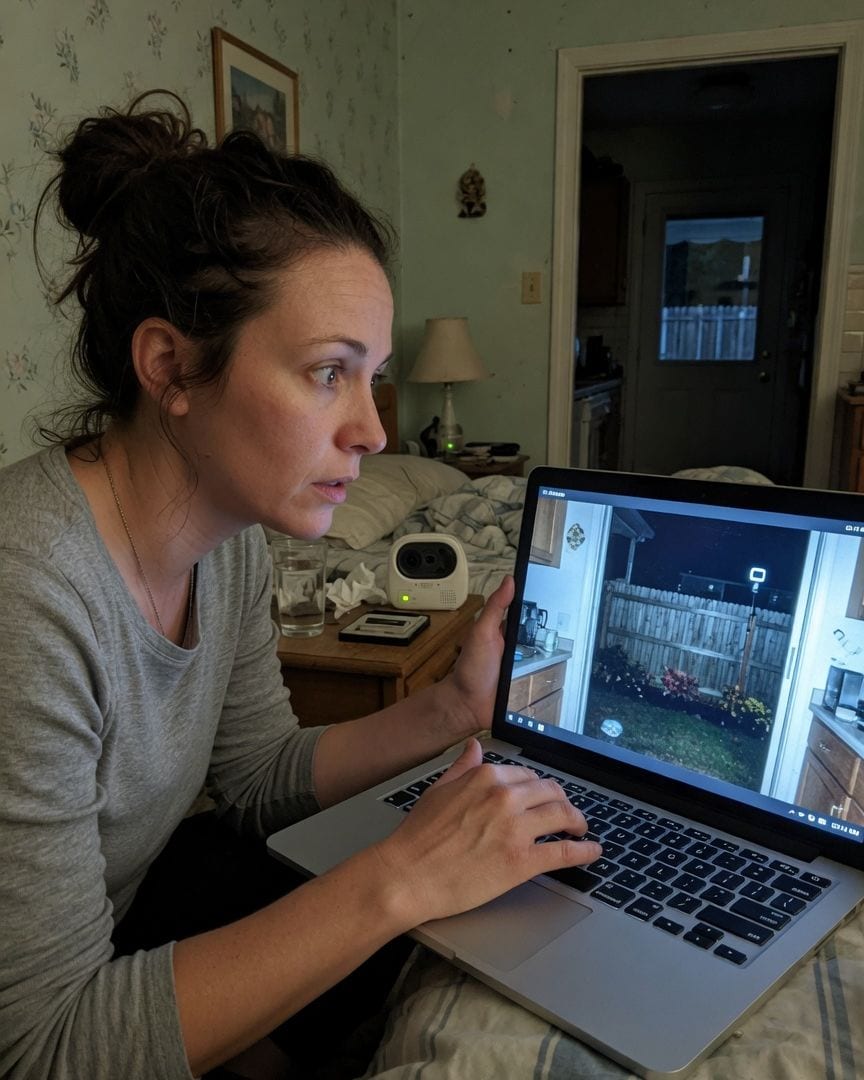
My game camera caught my back door from the inside. For three nights, it showed my door from the yard, getting closer. The last picture is from inside the glass, looking out at the fence.
I had set my game camera on the back fence, aimed at my house, to catch whatever I'd seen moving outside my kitchen window. But the last photo, taken after midnight, showed my kitchen from *inside* the locked back door, looking out.
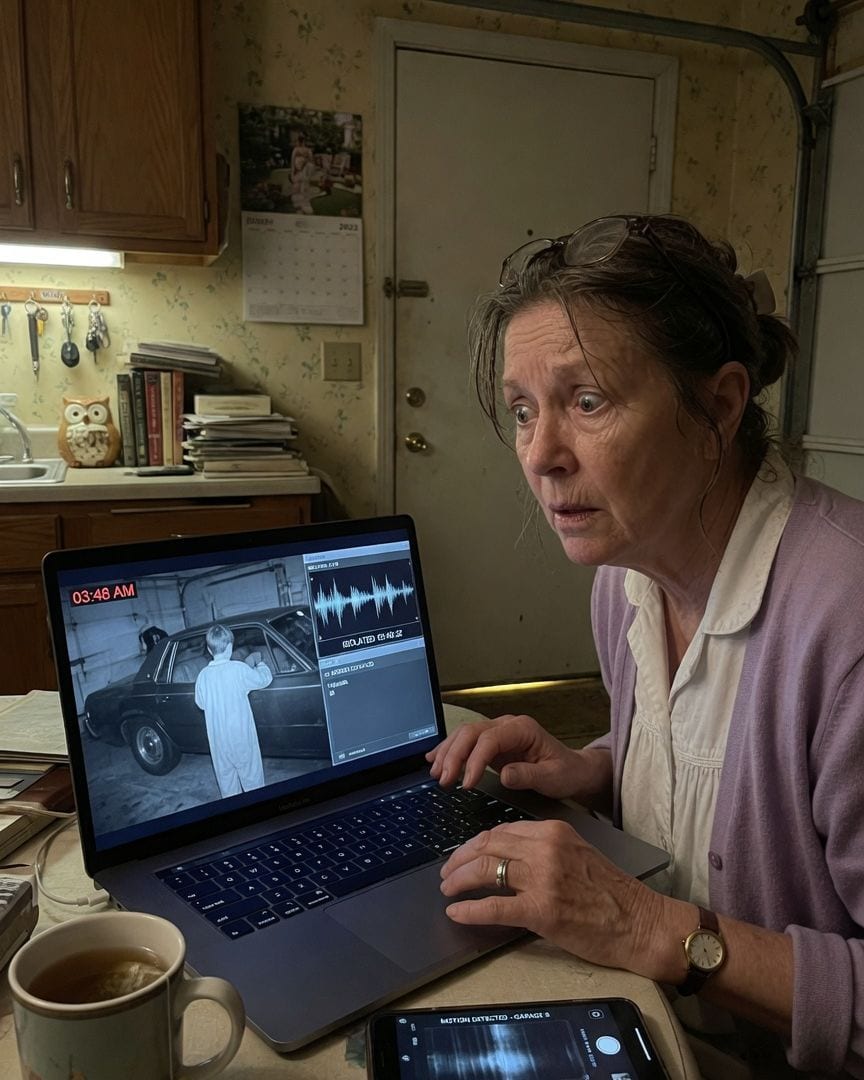
My garage camera filmed a boy of six walk out of a locked door at 3:48am, stare into my empty car, then vanish. My children live abroad.
I live in a quiet, solid house, my children grown and gone. But one night, my garage camera caught an impossible sight: my internal door, locked and bolted, slowly opened. A small, solid boy, no older than six, stepped through, then stood staring into the driver's seat of my empty car.
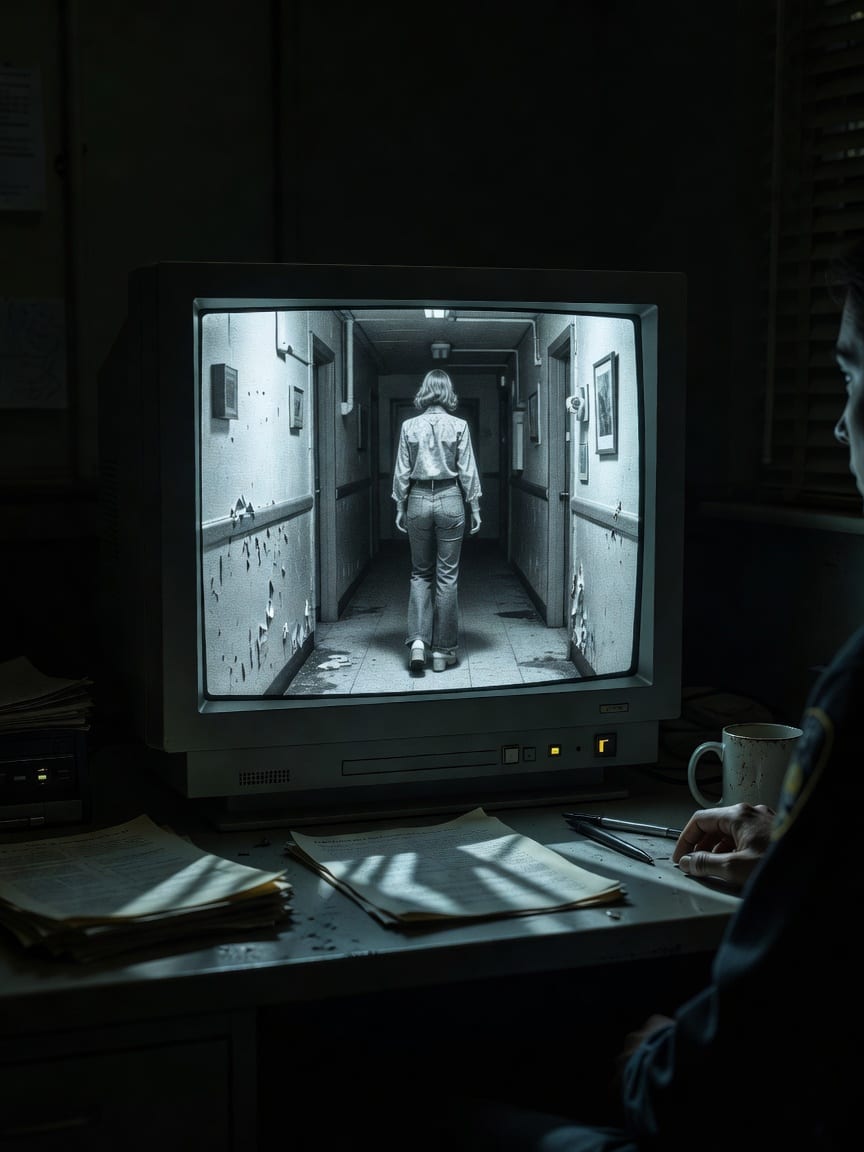
My intercom buzzed at 3 AM, a voice asking to step out for air. The station manager insists no one works the newsroom overnight, and no Cheryl is on payroll.
My shifts as the night security guard at WMVX are usually quiet, the TV station a tomb from 11 PM to 6 AM. But a late-night intercom call from a woman named Cheryl, who my manager says doesn't exist, was unsettling enough. The next night, my digital security log showed a new entry for 'Producer Cheryl Hartley'—a line I never typed, with details I couldn't have known.

Private Sory's own voice answered his radio check, speaking his name before he could. Then the official log swore he had said it.
Private Elliot Sory shivered in the cold comms shack, three weeks into his first remote posting at Black Ridge. He knew the outpost's strange, strict rule: never say your name on the net after dark. But during his solitary 0300 radio check, a voice undeniably his own filled his headset, stating 'All secure, Elliot Sory,' before he'd even finished keying the mic. The official log later confirmed the transmission, showing no sign of his attempt to speak, only the seamless record of his name being broadcast. What force in the desolate outpost had spoken for him?
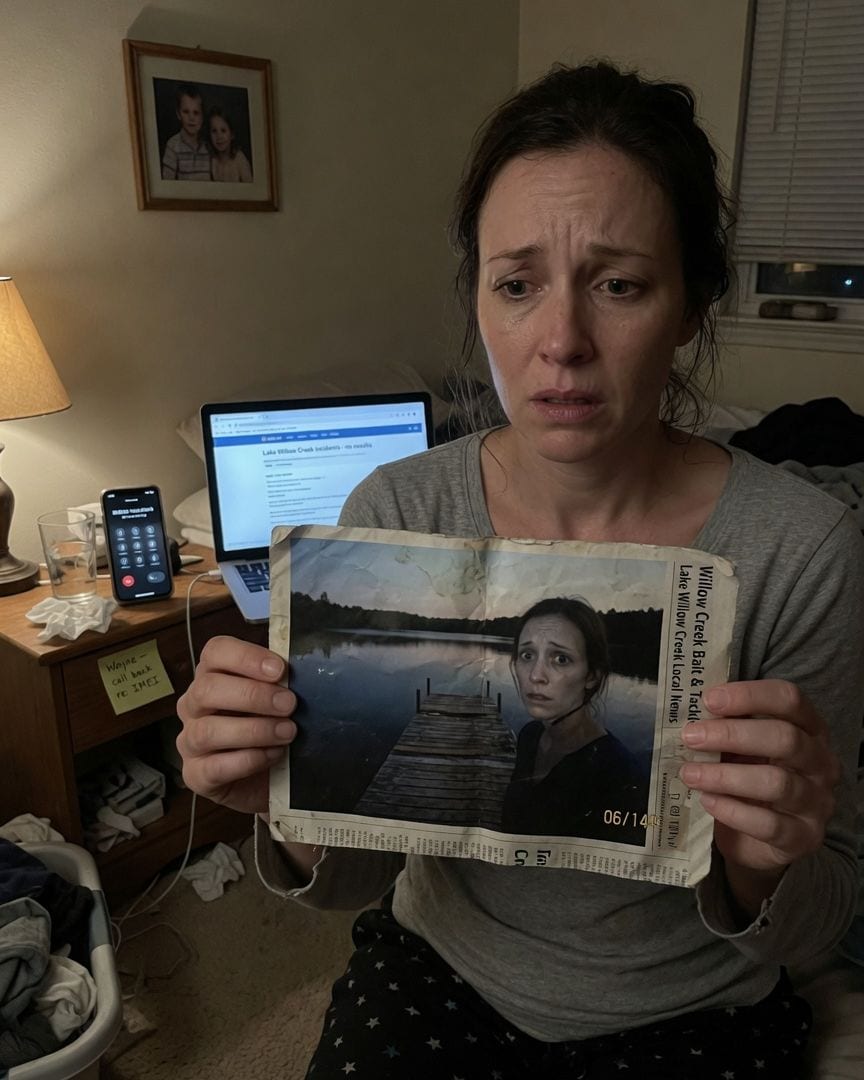
My voice called my sister at 3 AM, telling her not to worry about 'the lake.' I was asleep, my phone off, and nothing happened at any lake.
My sister received a chilling 3 AM call from my phone, my own voice warning her about a lake I'd never been to. I was asleep in my bed, hundreds of miles away. Then, a water-damaged package arrived containing a photo of me, terrified, at that very lake, dated a day I was three states away.
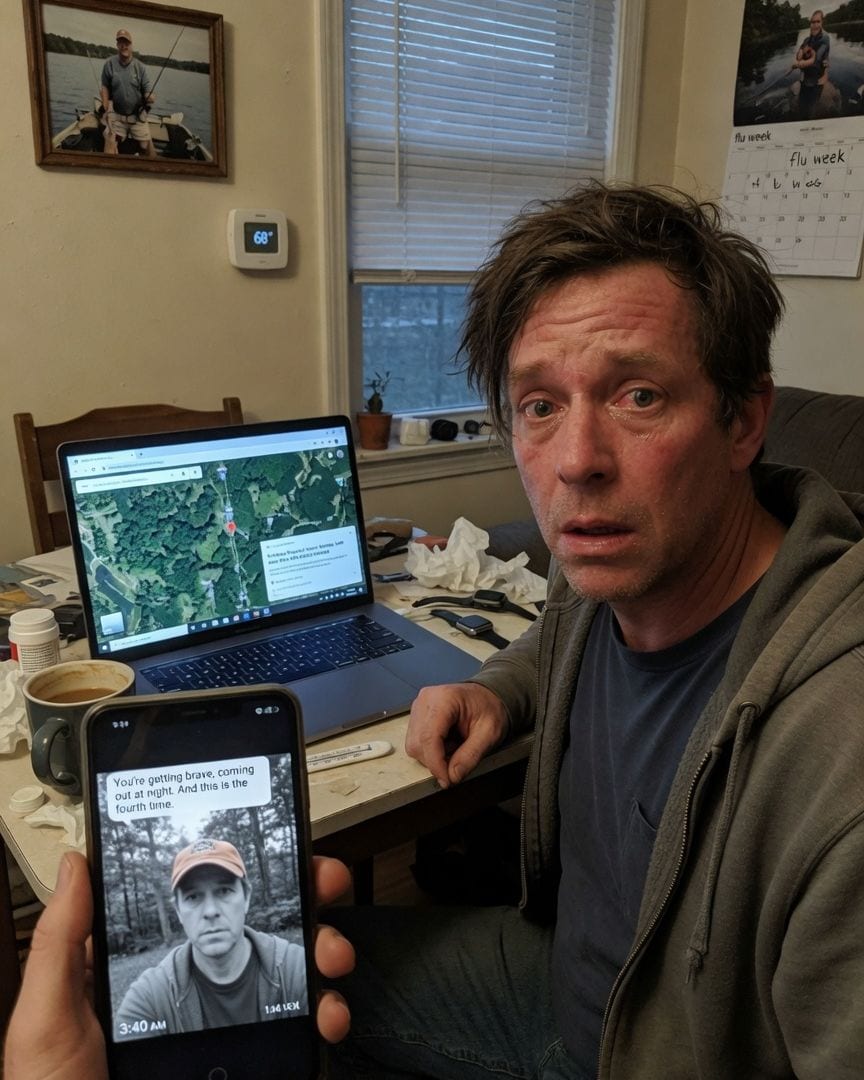
My brother-in-law's camera caught my face in Montana at 3:40 AM. I was asleep in Ohio, but it's the exact orange cap I lost, and he's seen me there four nights running.
I was just making coffee when my brother-in-law sent a photo from his Montana hunting land. It showed my face, wearing my lost baseball cap, timestamped 3:40 AM. I was home in Ohio, sick in bed, and hadn't been to Montana in years. And this was the fourth time.