My porch light was on, held by old, yellowed tape. Then children sang, 'Tom Aldous keeps the light.'
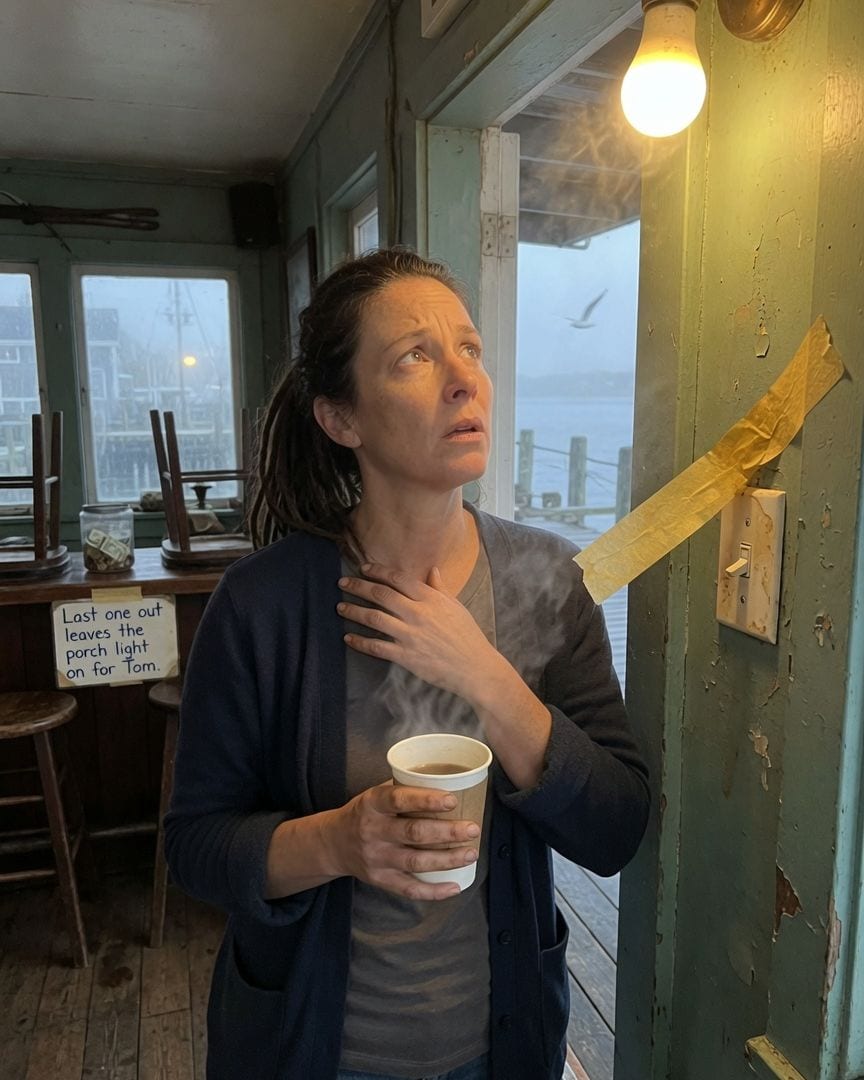
The light was on again. I stood in the doorway of the Old Dockside Bar, coffee steaming in my hand, staring at the porch light over the entrance.
I’d walked around this place for weeks before closing the deal, moved my life from Des Moines to this tiny coastal town called Wraye, and I knew every inch of it, every switch.
And I knew, with an absolute certainty that rattled me, that I had flipped that switch off last night. The last customer left at 1:17 AM. I remembered the exact click of it.
But there it was, burning. Not just burning, but bright, almost accusatory. A low hum came from the bulb, a subtle vibration I could feel in the floorboards under my bare feet. I walked over, my brow furrowed.
The switch was inside, right by the main door. And there it was: a strip of old, yellowed masking tape, stretched tight over the plastic plate, holding the switch firmly in the 'on' position.
It looked ancient, brittle, cracking at the edges. Not new. Not a prank. I hadn’t seen it yesterday.
A shiver traced its way down my spine, despite the warmth of the early morning sun filtering through the windows. I reached out, my fingers hovering an inch from the tape, then I pulled back. What the hell?
I’d have remembered taping it. Or untaping it.
Outside, the first sounds of Wraye waking up started. A splash from the dock. A gull crying. And then, the faint, high-pitched voices of children.
They were skipping, somewhere just down the street, their rhyme carrying clearly on the cool air: “...round and round the Old Dockside, water deep and ocean wide... and Tom Aldous keeps the light.”
The last line, sung with a strange, lilting emphasis, seemed to hang in the air, aimed directly at my brightly burning porch.
Marcus Vaughn, the milkman, pulled his truck up at 6:45 AM, exactly on schedule. He saw me standing under the porch light, still staring up at it.
I watched him unload the crates, waiting for him to say something, anything, about the taped switch or the fact the light was on. He didn't. He just stacked the milk quietly.
"Morning, Eleanor," he said, handing me the receipt with his usual pleasant, but distant, politeness. He’d never been one for small talk. I signed, then gestured vaguely at the light.
"Funny thing," I started, trying to sound casual. "This light was off last night. Swore I turned it off."
Marcus paused, his hand on a crate of cream. He looked up at the bulb, then at me. His gaze lingered for a moment, not on my face, but somewhere past my shoulder, towards the building itself.
He cleared his throat. "It... it tends to stay on, around here," he murmured, almost to himself. Then, a little louder, he added, "Tom Aldous drowned in '58."
He said it so quickly, so quietly, it almost sounded like he was talking to the light itself. Before I could ask who Tom Aldous was, or what any of that meant, he was already pivoting.
"Looks like it'll be a clear day, though. Good for the fishing boats." He gave a tight, almost imperceptible nod and then was back in his truck, rumbling off down the street.
I walked back inside, Marcus's words echoing. Tom Aldous drowned in '58. What a strange thing to say. I glanced at the tip jar on the counter.
Beside it, taped to the wood, was a small, laminated sign I’d barely registered since I took over the bar.
It was handwritten, in a neat, old-fashioned script, and it read: 'Last one out leaves the porch light on for Tom.'
It hit me then. The rhyme. The sign. Marcus’s hushed tone. It couldn't just be a memorial. Not with that tape.
I tried to rationalize it – a local quirk, maybe Tom Aldous was a beloved regular who always made sure the light was on.
But the tape, old and yellowed and deliberately holding the switch in place, felt less like a quirk and more like an instruction. And Marcus's face, the way his eyes darted, wasn't about a beloved regular. It was something else.
Something older. I decided I needed to know more about Tom Aldous. Local archives. Old newspapers. Anything.
The 'still burning lantern' detail was a hook in my brain, pulling at me constantly. It twisted the simple story of a man who drowned into something grotesque.
I couldn't stop seeing the image: a dead man, cold and waterlogged, yet somehow, the flame in his hand continued to defy the dark.
I went back to the Old Dockside Bar that afternoon, and the porch light felt different, heavier. It wasn't just a bulb anymore.
I started to observe. Really observe. The locals were friendly, in their reserved Wraye way, but whenever Tom Aldous or the porch light came up, their answers were identical. "Oh, that? Just a tradition."
"Old Tom, bless his heart, he loved that light." Their smiles were too quick, their eyes shifting away the moment I pressed for more. It was like they'd all learned the same lines from a play.
Every evening, before closing, I saw it. Not just my staff, but a few of the regulars. Someone would glance at the porch light, a subtle, almost imperceptible nod of reassurance. Never a word.
Just that silent acknowledgment, as if confirming it was still there, still doing whatever it was supposed to do.
I tried asking about the children's rhyme too. The one that ended, 'and Tom Aldous keeps the light.' The parents I spoke to, the old timers, they all offered the same explanation, delivered with the same forced lightness.
"Just a silly old song kids sing," they’d say. "Doesn't mean anything." But the coherence of their evasions, the way they all presented the same too-smooth, too-easy answers, began to feel far more unsettling than any outright hostility.
It was a wall, made of polite smiles and vague traditions, and I was rattling at it.
My questions became more pointed. I was digging, asking around, trying to find anyone who remembered Tom Aldous personally, anyone who could tell me more than the rehearsed lines.
One afternoon, I was outside, on a rickety stool, examining the porch light fixture more closely. I wanted to see if there was a timer, or some hidden wiring, anything that would explain the light turning itself back on.
The wiring looked old, but straightforward. Nothing unusual.
Just then, a car slowed down. Not a local truck or a tourist vehicle, but an older model sedan, well-maintained but clearly from another era. It was Sylvia Maddox, an elderly woman I'd seen around town.
She was known for having lived in Wraye her whole life, for a memory like a steel trap, and for a quiet, almost regal presence.
She stopped right by the curb, lowered her window with a slow, grinding whir, and looked at me.
Her eyes were a pale, watery blue, but sharp. Without preamble, without a greeting, she said, "Some things are better left alone, dear. The light, for example." Her voice was soft, almost gentle, but it carried an undeniable weight.
There was no anger, no warning in her tone, only a deep, unreadable knowledge that pricked at my skin.
I stared back at her, the stool suddenly feeling unstable beneath me. I opened my mouth to ask her what she meant, but she simply nodded, her gaze unwavering, and slowly, the window whirred back up.
Then she drove off, just as calmly as she’d arrived.
The prickle of unease spread, chilling me. My investigation hadn't been unnoticed. And Sylvia Maddox, the quiet witness, knew it. Knew about me. Knew about the light.
Later that evening, after a particularly slow Tuesday, I went to switch off the porch light, even though I knew it was futile. I reached for the switch and stopped.
The old, yellowed masking tape was still there, but now, a fresh strip of clear packing tape had been laid over it. Stronger. Tighter. Like a new seal. It was an unspoken, chilling message: This is not to be undone.
The next morning, I found Sylvia Maddox at the town's small general store, buying her usual assortment of tea and biscuits. I walked right up to her, my heart hammering, and simply said, "Can I buy you a coffee, Sylvia?
My place."
She looked at me, her pale eyes assessing, then gave a small, almost imperceptible nod. "Very well, Eleanor." Her composure was unsettling.
Back at the Old Dockside Bar, I led her to a quiet booth. I didn't waste time.
I pulled the yellowed newspaper clipping from my bag – the one about Tom Aldous’s drowning, the one with the detail about the burning lantern. I laid it on the table between us.
Sylvia picked it up, her fingers surprisingly steady. She read the headline, then her gaze drifted to that specific sentence. "Clutching a lantern that still burned brightly," she read aloud, her voice flat, devoid of surprise.
She looked at me, her eyes ancient and sad.
"The children’s rhyme," I pushed, my voice tighter than I meant it to be. "The sign. The tape. Marcus, the milkman. What the hell is going on, Sylvia? Who was Tom Aldous, really?"
She set the clipping down, aligning it precisely with the edge of the table. "Tom Aldous was a Keeper," she said, her voice soft but firm. "Not a caretaker, Eleanor. A bound guardian."
I frowned. "A guardian of what?"
"The light," she replied, as if it were the most obvious thing in the world. "It isn't just a symbol. It’s a ward. A barrier." She paused, her gaze drifting towards the window, where the porch light burned steadily.
"Against something in the waters here. Something that came with the first settlers. Something that demands a continuous tether to this world, to keep it contained."
My stomach churned. "His drowning," I whispered. "It wasn't an accident, was it?"
Sylvia shook her head, a slow, deliberate movement. "It was his passing into service. A ritual. It has kept Wraye safe for generations. The town... we agree to it. Because the alternative, Eleanor, is unthinkable. It has always been unthinkable."
She looked back at me, her expression unyielding. "The children's rhyme? It’s a mnemonic. A way to remember the truth without speaking it aloud, generation to generation. A secret held in plain sight."
The clues clicked into place then, each small, wrong detail snapping into a horrifyingly coherent pattern. The light's constant burning. The town's unified front, their evasions. The significance of Tom’s death, clutching a lamp that wouldn't die.
It was all real. All by design.
My head spun. "Who chose Tom?" I asked, the words feeling thick in my throat. "And who chooses the next Keeper?"
Sylvia rose slowly, her movements deliberate, unhurried. She walked past me, behind the bar. My gaze followed her, my eyes fixed on her back.
From a locked drawer beneath the counter, one I’d never bothered with, she pulled out a small, hand-bound leather ledger. Its pages looked brittle, the leather cover cracked with age. It felt heavy, somehow, even from where I sat.
She placed it on the counter, then slid it across to me. The leather was cool under my trembling fingers. She opened it to the last page.
My eyes scanned the elegant script. A list of names. Each with a date. And beneath each name, the chilling note: 'Light Keeper.' The earliest entry was from the late 1700s.
The last one on the main list was 'Tom Aldous, 1958.'
Sylvia’s finger, gnarled with age, hovered over the blank line beneath Tom's name. She looked at me, her pale eyes ancient and sad, but with a terrifying certainty. There was no pity there. Only purpose.
Then, with deliberate precision, she reached into her apron pocket. She pulled out a pen, its cap clicking softly.
In elegant, flowing script, right beneath Tom Aldous's name, she wrote the current date. My breath hitched. Below that, on the very last line of the page, she wrote my full name.
"Eleanor Easton. New Keeper."
I stared, horrified, at my own name in the ledger. The ink was still wet, a stark black against the yellowed page. "No," I breathed, the word barely a whisper. "No, you're wrong. This is insane."
Sylvia's voice was soft, but firm, cutting through my rising panic. "By turning off the light, Eleanor, you didn't just break the ward. You signaled your availability. To the presence."
She looked around the empty bar, as if the very air held ancient secrets. "It's always listening. Always waiting for a flicker. A weakness."
"The presence?" My mind reeled. "What is it?"
"It's ancient," she explained, her composure unwavering. "Tied to the original settlement of Wraye. It demands a continuous tether to this world, a 'light' to keep it contained. The drownings, as you call them, are not sacrifices.
They are a binding ritual. The Keeper's spirit becomes infused with the light. Their duty... it is eternal."
The town, she continued, had learned to manage this over generations. To ensure the light never went out. To quietly guide the next 'candidate' into place when the old 'light' wavered, when the Keeper's tie began to fray.
My accidental act – turning off the light – had sealed my fate. I had become the unwitting successor.
Every planted clue, every whispered word, every odd detail now made monstrous sense. The taped switch, enforcing the ward. Marcus Vaughn’s hushed tone, his fear. The laminated sign, a constant reminder. The children's rhyme, a generations-old mnemonic.
It all clicked, cold and precise, into place around my name.
"I can't," I choked out, pushing the ledger away. "I can just... leave. I'll sell the bar. I'll go back to Des Moines. You can find someone else."
Sylvia simply watched me, her gaze unblinking. "The 'presence' will not allow it, dear," she said, her voice still quiet, but with an underlying steel. "It will draw you back. Or it will claim someone else. Someone innocent.
And the town will suffer. The ward will break. And Wraye..." She trailed off, but the implication hung heavy in the air. Desolation. Worse than drowning.
I felt a surge of desperate defiance. "I won't let it!" I stood up, my chair scraping loudly on the wooden floor. My hand went to the switch, where the fresh packing tape gleamed over the old yellowed strip.
I would rip it off. I would turn the damn light off for good. I would break this cycle.
As my fingers brushed the new, stronger tape, a chill swept through the bar. Not a draft, but something far deeper, colder. The porch light outside flickered violently, once, twice.
Then it burned with an unnatural, blue-white intensity, a searing glow that made the glass in the windows hum. The entire room seemed to press in around me, a sudden, immense, unseen pressure that stole my breath.
A cold dread settled over me, deeper than anything I'd felt before. It wasn’t just a beacon. It was a tether. And something was already pulling at me from the other side. My hand fell away from the switch.
I couldn't escape what the town had agreed to, what I had unwittingly become a part of.
Days turned into weeks. I remained at the Old Dockside Bar. The porch light never went out. I no longer tried to turn it off. I no longer even looked at the switch.
The townspeople, they resumed their polite, distant interactions. Their smiles were a little too smooth, their eyes holding a subtle watchfulness whenever I was in sight.
Whenever I walked past the windows, I could feel their gazes, not unkind, but assessing.
Marcus Vaughn continued his milk deliveries, every morning, offering a quiet, "Morning, Eleanor," his gaze lingering for a fraction of a second on the porch light before he moved on.
The children still skipped their rhyme, their voices carrying through the morning air, a sweet, innocent sound that now felt utterly monstrous: "...and Tom Aldous keeps the light."
I sit by the window in the bar's empty dining room, late at night. The porch light casts its steady glow through the glass, a constant, unwavering presence. I don't feel anger anymore, or fear, just a profound, cold understanding.
The hum of the bulb is a dull thrum in my bones.
I know now that Tom Aldous is not alone out there in the dark, and neither am I. I am simply waiting for my turn to truly keep the light. The quiet agreement of Wraye has claimed me.
Eleanor Easton was never seen leaving Wraye. The Old Dockside Bar continued to operate, the porch light burning faithfully. Years later, a new proprietor, clearing out an old locked drawer, found a hand-bound ledger.
On its last page, beneath Eleanor Easton's name, a new entry had been added, in elegant, flowing script. It simply read, 'New Keeper.'
If this one got to you
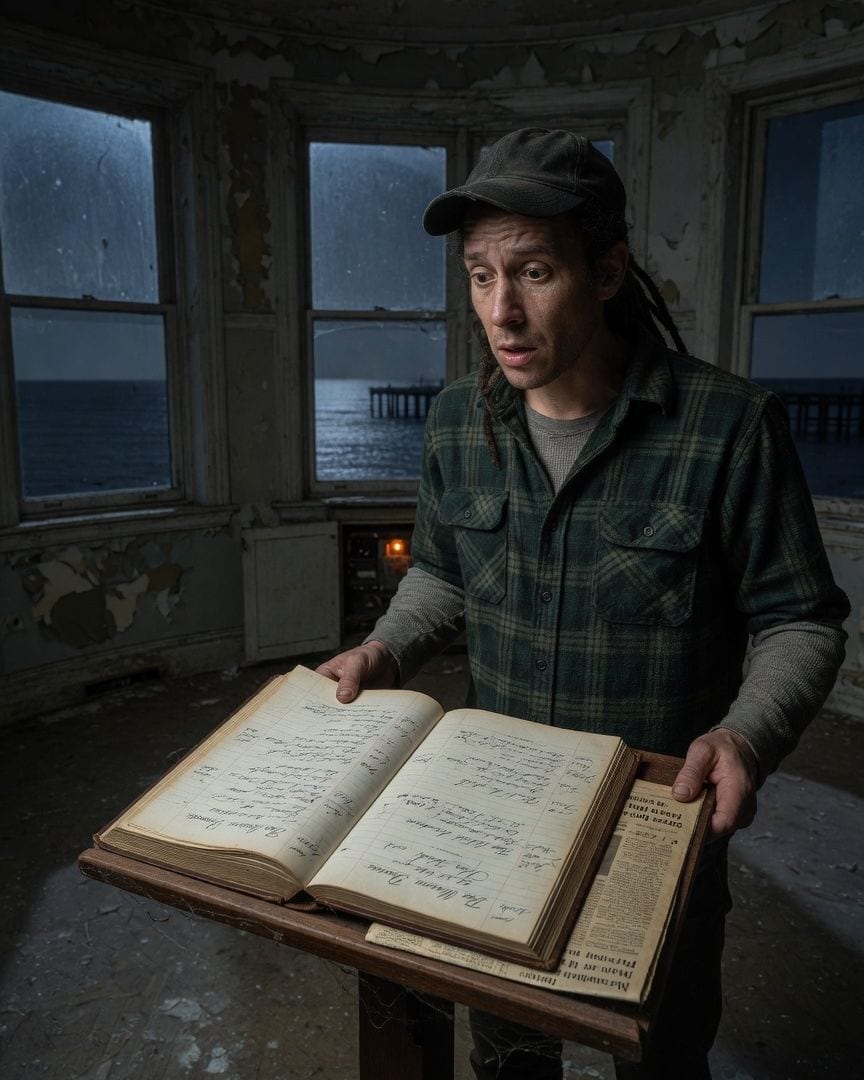
My pier's ballroom register books a new dance for Saturday, electricity meter running, but those lights are never on.
Taking over as pier caretaker, I was told one rule: never turn on the end pavilion's lights. But my first week, I noticed its electricity meter was steadily advancing every single night, even though the main breaker was off. Inside the dark, unused ballroom, I found an old ledger open to 'The Moonlit Waltz' for this Saturday, raising a chilling question: who was booking a dance and drawing power in a place that should be empty?
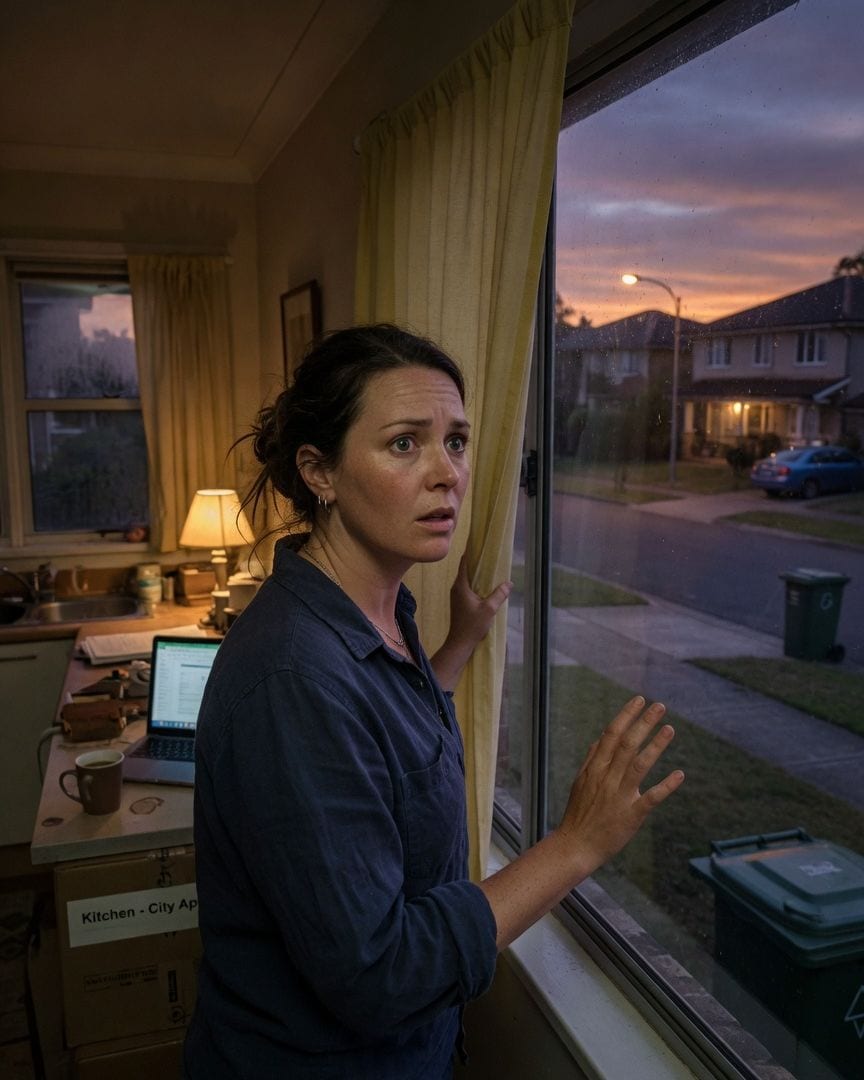
My bin was turned the wrong way Tuesday. The man three doors down hasn't been seen since, though his curtains still open.
New to Oakhaven, I dismissed the local warnings as charming quirks. But after I put my bin out first, my neighbor Joel Whitmore vanished, leaving only a cryptic 'My turn' note. The same strange symbol from his note was chalked on my bin, facing the street.
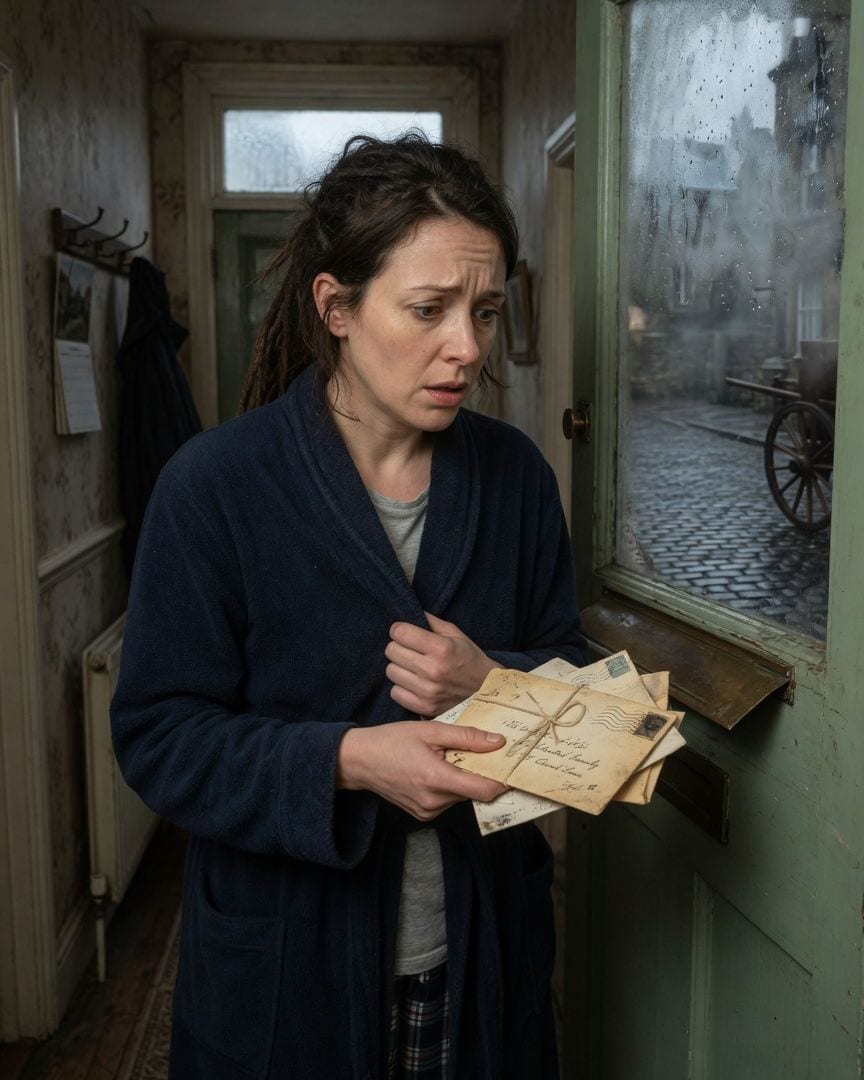
Seventy years ago, a hidden journal recorded my door opening to the wrong street and receiving Lockwood post.
I'd only recently moved into my inherited house, a quiet place on the edge of town. One grey morning, a distinct clatter from the front door's post flap caught my attention. Reaching down, I expected my gravel path, but instead, the flap showed a dark, cobbled street that wasn't mine. A bundle of warm, old letters, addressed to 'The Lockwood Family,' slid through, before the vision flickered and was gone.
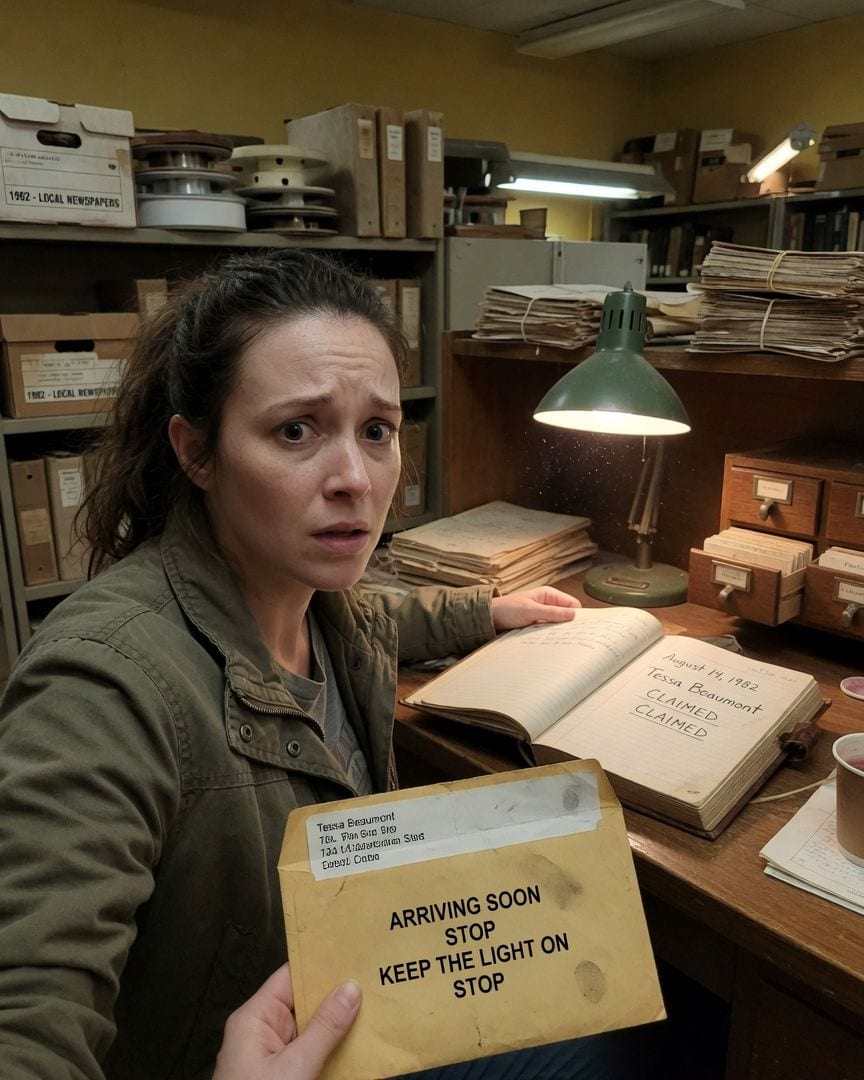
A boy in an unfamiliar uniform hand-delivered a telegram to my flat — the kind the Post Office stopped sending in 1982. It said only 'KEEP THE LIGHT ON.' Then he vanished before I could tip him.
My ordinary morning was interrupted by a sharp rap on the door. A boy in a dark uniform delivered a telegram addressed to me, but the Post Office officially stopped that service in 1982. Its message, 'ARRIVING SOON STOP KEEP THE LIGHT ON STOP,' felt like a premonition.
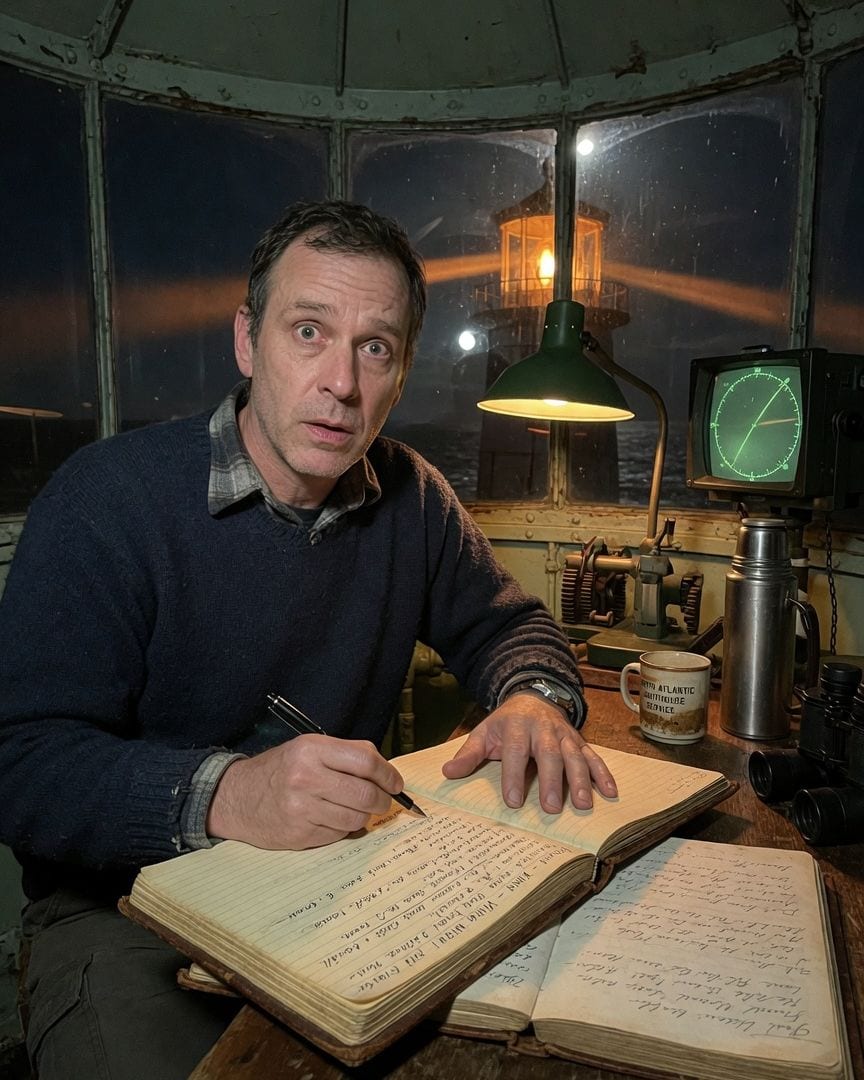
My lighthouse log has my own 3 AM entry for a phantom ship. I was alone in the tower, and I wrote no such thing.
Perched in the lantern room for my usual 2-6 AM watch, I reached for the thick logbook. But the 3:00 AM entry, under my own name, detailed a vessel I never saw. The words were in my own ink, yet I had never written them.
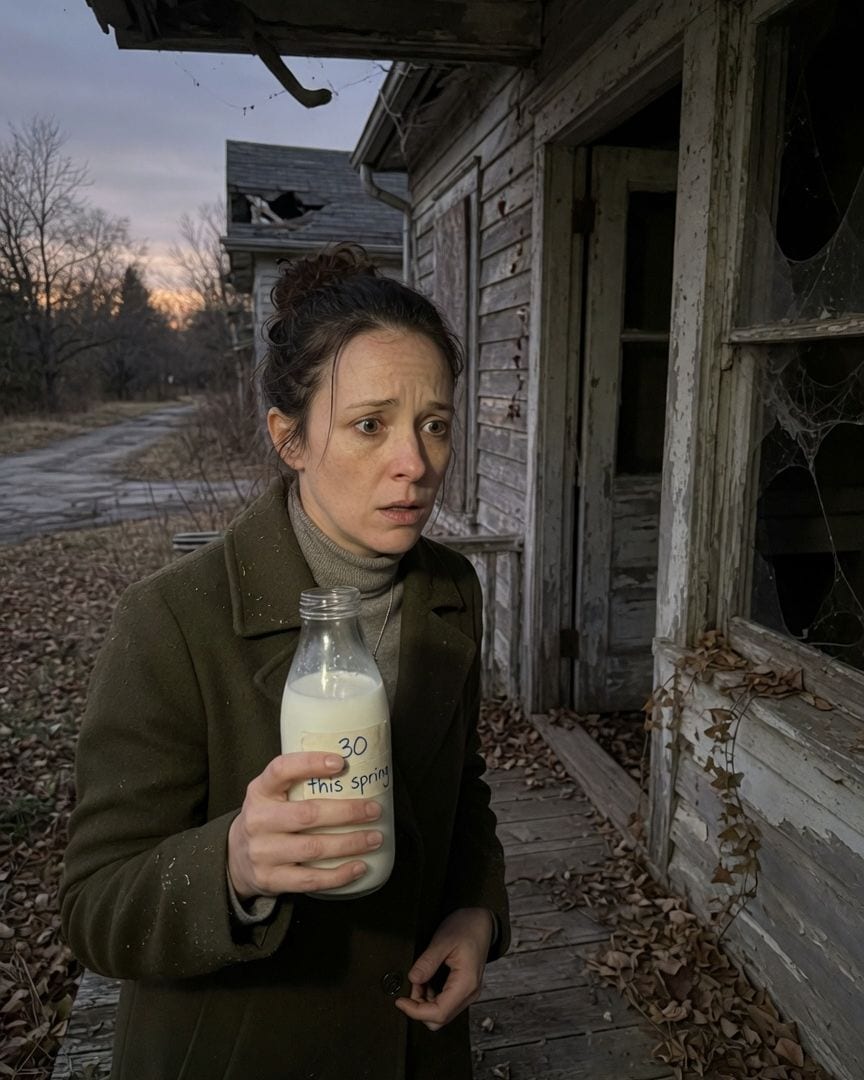
My grandfather's old milk ledger shows Account 30 reissued to the same house every ten years since 1930. Different names, same number. The last entry, unpaid, is dated this spring.
Sifting through my grandfather Howard's old things, I found his milk ledger. One account for a house long abandoned on Foldyard Lane showed a strange pattern of recurring 'stopped taking milk, gone' entries, ending with 'unpaid' this spring. Driving out to the decades-old ruin, I found a pristine, sealed milk bottle, dated 'this spring,' on its crumbling porch.