My signature is in a notary's book for an accident I wasn't in. I've never even met the man.
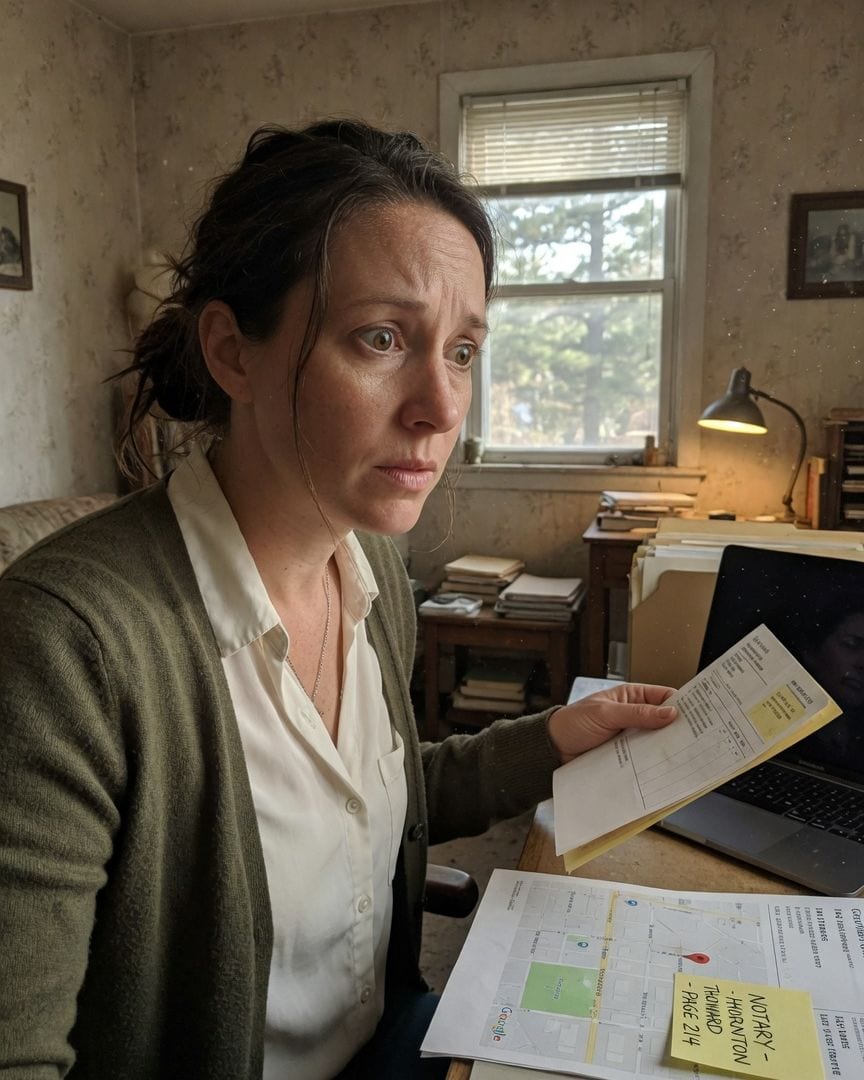
My name is Janet Caldwell. I am, by all accounts, a perfectly ordinary person. My life is linear, predictable, and remarkably free of drama. Or so I thought. The dread began, as these things often do, with paperwork.
It was a Wednesday afternoon, sun streaming through the dusty window of Howard Thornton’s small, cluttered notary office.
He was a man I had never met before, a man whose existence I was unaware of until my lawyer’s assistant sent me there for a simple document certification. I’m 38, a librarian; my world is organized, cataloged.
What followed defied any category.
When he pulled out his colossal, leather-bound register, mandated by law, and flipped it open to page 214, something in my stomach dropped.
There, beneath a statement about a car accident—a fender bender involving a blue sedan and a lamppost on Elm Street—was my signature. In my own distinct, looping hand. And beside it, Howard’s official notary stamp, dated May 14th, 2014.
I stared at it, a cold, impossible certainty settling in my bones. I had never been in a car accident. Not on Elm Street, not anywhere.
And on May 14th, 2014, I was recovering from an emergency appendectomy in St. Jude’s Hospital, miles from Elm Street, confined to a hospital bed. I hadn't even owned a blue sedan then.
I looked up at Howard, his face impassive behind thick spectacles, his thumb resting on the page, covering the next entry. The ink was undeniably fresh, the paper crisp. It was real. And it was impossible.
I tried to laugh it off, to chalk it up to a clerical error. 'This isn't my signature,' I said, my voice sounding thin even to my own ears. 'I was in the hospital that day.
I have the discharge papers.'
Howard Thornton merely adjusted his glasses, a faint, almost imperceptible smile playing on his lips. 'It's your signature, Ms. Caldwell. I remember you quite clearly. That Wednesday, you were in a hurry, quite flustered about the damage to your sedan.'
He even described the bright yellow scarf I supposedly wore, a detail that prickled. I never owned a yellow scarf. I called my lawyer, who dismissed it as a bizarre mix-up, common with old notaries.
'Just an old man misremembering,' he'd said, 'don't worry about it.'
But the image of my own handwriting on that page, swearing to a lie, wouldn't leave me.
Days later, still unnerved, I found myself sifting through old files in my apartment, looking for anything that might explain the notary’s mistake, any shred of proof I could use to dismiss it.
That’s when I found it: a utility bill, for a service address I’d never recognized, tucked into a box of old tax receipts. It was for 142 Elm Street—the very street from the notary’s register.
The bill was addressed to 'Janet Caldwell' and dated 2016, two years after the alleged accident. A payment stub was attached, the signature on it an exact match for the one in Howard’s book, and for my own.
My stomach clenched. I lived at 34 Pine Avenue. Always had. The address on the bill was unequivocally wrong.
I pulled up Google Maps, typing in 142 Elm Street. It was a small, dilapidated Victorian house, overgrown with ivy, a 'For Sale' sign leaning crookedly in the yard. My heart hammered. This wasn't just a signature anymore.
This was a place, a specific, physical place, tied to my name, my hand, and a life I had never lived. This was a second ghost of myself, walking around, signing documents, living in a house I didn't own.
The air in my apartment felt suddenly cold, heavy with an unseen presence.
The next morning, I drove to 142 Elm Street. The 'For Sale' sign was faded, the house clearly abandoned, its windows like vacant eyes.
I walked around the perimeter, the crunch of dry leaves underfoot the only sound in the otherwise quiet neighborhood. Through a grimy, cobweb-laden window, I could make out the interior of a small, dusty living room.
On a mantelpiece, amidst a scattering of dead flies and peeling paint, sat a single, framed photograph.
It was sepia-toned, faded with age, but unmistakable. A woman, younger, beaming, holding a blue ribbon. Her face was mine. My jaw tightened. The woman was me, but not me.
Her hair was styled differently, shorter, styled in a way I’d never worn it, and a scarf — a bright yellow one — tied loosely around her neck. The date etched on the frame read '1998, Elm Street Fair Champion.'
In 1998, I was nineteen, a sophomore in college, living three states away, and looked nothing like this woman.
My own face, staring back at me from a life that wasn't mine, in a house that wasn't mine, holding a prize I'd never won, chilled me to the bone.
I pressed my hand against the cold glass, my breath fogging the pane, the woman in the photo smiling back at me, a stranger with my face.
The photograph haunted me. It wasn't just a wrong signature; it was a wrong life, documented, seemingly lived. I spent days online, searching property records for 142 Elm Street.
The records were sparse, ownership murky, but they consistently listed 'Janet Caldwell' as the primary resident from 1995 to 2018. No other Janet Caldwells in the area matched my birthdate or social security number.
I even paid for a deep background check on 'Janet Caldwell of 142 Elm Street.'
The report was a patchwork of anomalies: a local high school diploma (I went to high school in another state), a small business license for a 'Caldwell Antiques' (I'm a librarian, not an antique dealer), and a series of minor traffic infractions, including one for a blue sedan in 2014.
It was like looking at a distorted mirror image of my own life.
I returned to Howard Thornton's office. The air felt colder in his small space this time, the sunlight from before muted by gathering clouds. He was less amused this time, his earlier composure replaced by a cautious defensiveness.
I confronted him with the utility bill and a printed screenshot of the photograph. He merely sighed, running a hand over his thinning hair. 'Some ledgers have two sides, Ms. Caldwell. Most people only ever see one.'
He wouldn't elaborate, only suggested I look into the 'Records Management Bureau,' a local government agency responsible for archiving historical documents.
He stressed, with a peculiar intensity, that I should ask for 'archivist Quentin Porter' and mention 'the Elm Street Ledger.'
It sounded like a dead end, a bureaucratic rabbit hole designed to lose me in paperwork, but the way he said 'two sides'… it felt like a crack in the world, a glimpse into something far larger than just a mistake.
The dread was no longer vague; it was focused, pointing towards an unseen apparatus, a system that kept track of these impossible lives.
The Records Management Bureau was a monolithic, concrete building from the 1960s, smelling faintly of dust and old paper. Its brutalist architecture seemed to swallow the light.
The date 1958 was etched above the main entrance, a reminder of its long, silent vigil. I asked for Quentin Porter.
He was a slight, nervous man, his office filled with stacks of unlabeled boxes, the air thick with the scent of aged paper and something faintly metallic, like old filing cabinets.
When I mentioned 'Elm Street Ledger,' his eyes flickered, a tiny muscle twitching in his jaw. He denied any knowledge, claiming there was no such designation in the Bureau's catalog.
'We simply archive local records, Ms. Caldwell,' he insisted, his voice reedy.
But as I turned to leave, the silence of the room amplified by the distant hum of servers, he called out, 'Wait. Did… did Howard send you?' His voice was barely a whisper, as if the walls themselves had ears.
I confirmed it. He looked around his office, then lowered his voice further, leaning in slightly. 'He shouldn't have. Some things are best left alone.'
He then gave me a veiled warning: 'The Bureau keeps records for a reason, Ms. Caldwell. Not all of them are meant to be read by everyone.' The quiet warning was far more chilling than any shouted threat.
The next day, after my visit to the Bureau, I noticed a dark sedan parked across the street from my apartment. It was always there when I left for work, and again when I returned.
It wasn't always the same car, but always a dark sedan, always parked just out of clear view, its windows tinted. A chill settled in my gut that had nothing to do with the autumn air.
One evening, as I was locking my apartment door, my phone buzzed. An anonymous text message flashed across the screen: 'Some records are better left undisturbed.' My blood ran cold. They knew.
Someone from the Bureau, or someone connected to it, was watching me.
The investigation wasn't just about uncovering a strange truth anymore; it was about my own safety, my own life, which now felt dangerously exposed and observed, a document under scrutiny.
I returned to the Bureau, determined. The building felt less imposing, more menacing, its silence now an active, listening presence. I marched straight to Quentin Porter’s office. I didn't knock. I just walked in and showed him the text message.
His face drained of color, going ashen. 'They're serious,' he stammered, glancing nervously towards his office door, then the window, as if expecting to see the dark sedan. 'They don't like when the streams… overlap too much.'
He finally cracked, his composure shattering like brittle glass. He admitted that Howard Thornton was a former Bureau employee, one of the original 'Field Notaries' from decades ago, tasked with a very specific, secret duty.
He explained, in hushed tones, that the Bureau wasn't just an archive; it was an 'oversight body' for what they called 'Identity Synchronicity Anomalies.'
He said that some individuals, for reasons unknown, developed 'concurrent identity streams' – parallel lives that occasionally manifested in official records.
The Bureau's job was to 'stabilize' these streams, to ensure minimal overlap, often by quietly 'correcting' or 'suppressing' the 'secondary' records.
'Your Elm Street life,' he whispered, leaning closer, his breath smelling faintly of coffee and old paper, 'was one such stream. Howard was assigned to manage it.'
The car accident, the house, the fair prize – all were genuine events, he insisted, just not from my stream.
He revealed that the Bureau had been doing this since the late 1950s, after a surge of unexplained 'double records' post-war, records that appeared in two places at once, for the same person, with conflicting details.
They had found a pattern.
He pulled a dusty, unmarked folder from a locked cabinet beneath his desk, the ancient metal groaning in protest. 'This is what Howard meant by the Elm Street Ledger.
It's a field report from 2018, when they finally closed the Elm Street stream after the other… Janet Caldwell… passed away. That’s why the house went up for sale.' He pushed the folder across the desk.
Inside, alongside the property records and traffic citations, was a death certificate. For 'Janet Caldwell, born 1979,' my exact birth year. The cause of death was listed as 'natural causes.'
My mind reeled. It wasn't a mistake. It was real. Another me. The entire story of the notary, the utility bill, the photograph, all clicked into place, terrifyingly coherent.
There had been another Janet Caldwell, living a full, separate life, unknowingly managed by this hidden institution. And she was dead.
Quentin, still shaken, explained that the Bureau's primary concern was 'containment.' They tried to keep the streams separate to prevent 'synchronicity collapse,' which he vaguely described as a 'destabilization of the individual's core identity.'
He said the text message and the surveillance were standard protocol when a 'stream anomaly' began investigating its own records, especially when the subject was a 'primary.'
He then confided that my 'case' was considered particularly 'sensitive' because the secondary stream had been so deeply integrated, lasting for decades.
He slid a thick, bound document across the table, its cover a stark, official beige, a faded seal embossed on its surface. 'This is what Howard really wanted you to see. It’s an internal memo, classified, from 1987.
'Protocol for Stabilizing Concurrent Identity Streams.' It's the Bureau's foundational text on the phenomenon, outlining their methods and findings.'
As I opened it, my eyes scanned the dense, bureaucratic language, each word a cold, precise blade. The first page detailed the 'discovery' of the phenomenon, citing early cases from the 1940s, the first instances of 'identity bleed-through.'
But then, on page three, under a section titled 'Known Primary Subjects of Interest,' my breath hitched. There, in a list of names and alphanumeric codes, was 'Caldwell, Janet. Subject ID: J-790511-A.'
And beneath it, a chilling addendum: 'Initial manifestation of secondary stream observed at birth. Ongoing monitoring required.'
My own name. My own birthdate. It wasn’t just that another Janet Caldwell had existed, or that her life was managed. It was that my existence, my stream, had been under observation since the moment I was born.
I wasn't just discovering a hidden truth; I was the subject of it, a lifelong experiment, a living anomaly. The Bureau wasn't just managing parallel lives; they were managing mine.
Quentin Porter, his face pale and eyes wide with a mixture of fear and dawning comprehension, backed away from me, his chair scraping loudly across the linoleum.
He gestured frantically towards the specific internal memo from the Records Management Bureau, dated 1987, that I still held in my trembling hands.
The memo, titled 'Protocol for Stabilizing Concurrent Identity Streams,' outlined procedures for managing individuals exhibiting 'synchronicity anomalies' – a term that now chilled me to my core, as I realized the true, deliberate nature of my impossible records.
The revelation hit me like a physical blow. My head pounded. Quentin, seeing my shock, quickly explained that the Bureau believed some individuals were born with a predisposition for 'stream divergence,' and that I was one of them.
He said the 'secondary stream' that lived on Elm Street was not an anomaly that occurred later in life, but a parallel existence that had begun at my birth, growing alongside my 'primary' life, a shadow self that occasionally left its imprint on the official records.
'They called it a 'bleed-through',' he explained, his voice hushed, the words heavy in the silent office. 'The notary, the utility bill, the photo – those were instances where your secondary stream's actions manifested in the primary record system.
Howard’s job was to ensure these didn't destabilize your primary identity.' He indicated a line in the 'Protocol' memo that read, 'The goal is a seamless, singular experience for the primary subject, with minimal awareness of stream divergence.'
My entire life, every memory, every experience, had been carefully curated, shielded from the truth of this other 'me.'
The Bureau hadn't just observed; they had actively intervened, 'correcting' and 'suppressing' evidence of the secondary stream, ensuring I lived in blissful ignorance.
The car accident on Elm Street, the fair prize, the antique shop – all were genuine, lived experiences of a 'Janet Caldwell' who was, in essence, a part of me, yet utterly separate.
The Bureau's records, spanning decades, meticulously documented every 'bleed-through,' every 'correction,' every attempt to keep my two lives from merging, from collapsing into a singular, terrifying reality.
The coherence of it all was the real horror: every impossible detail, every wrong signature, every uncanny photograph, now made perfect, chilling sense. I was not just a witness to a wrong record; I was the wrong record itself.
Quentin, now desperate, urged me to leave. 'They'll 'stabilize' you,' he warned, his eyes wide, darting to the door. 'They don't want a primary subject aware of their divergence. It's too risky for the system, for them, and for you.'
But I couldn't leave. Not yet. Not when the answers were so close. I needed to see it all, the complete truth, to understand the extent of this impossible duplication.
I demanded he show me the 'Master Record,' the full, unredacted file on my 'Identity Stream Management.'
He hesitated, then, with a sigh of resignation that seemed to carry the weight of decades of secrets, led me deep into the Bureau's restricted archives.
It was a vast, climate-controlled vault, colder than anything outside, filled with rows upon rows of ancient, leather-bound ledgers and humming servers, their green and red lights blinking in the dim light like silent, watchful eyes.
In the very center, on a pedestal, was a single, imposing terminal, its screen dark. He typed in a complex sequence of codes, his fingers flying across the keyboard with practiced precision.
The screen flickered, then displayed a single, massive file: 'CALDWELL, JANET – MASTER STREAM LOG.'
It was an endless scroll of data, cross-referencing every official document, every public record, every private transaction associated with my name.
There were two columns, clearly labeled 'Primary Stream' and 'Secondary Stream,' running parallel, side-by-side, from my birth in 1979 to the present day. The secondary stream column ended in 2018, marked 'Deceased.'
But below it, a new entry, dated just last week, flickered in red: 'Primary Subject exhibiting active inquiry into stream divergence. Containment protocols initiated.' A chill ran down my spine. I was already being contained.
I scrolled further, my fingers trembling. The entries were chillingly detailed: childhood illnesses, school reports, bank transactions, even mundane daily activities, meticulously logged for both streams.
A note from 2005 read: 'Successful suppression of secondary stream’s attempt to interact with primary subject’s immediate family.' I saw my life, my entire existence, laid bare, dissected, and managed.
I wasn’t just living one life; I was living two, and a third, unseen entity was pulling the strings, ensuring they never fully converged. The dread was absolute.
The Bureau wasn't malevolent in the traditional sense; they were simply administrators of an unbearable truth, keeping the world's records coherent, even if it meant denying me a singular reality. I looked at Quentin, my eyes burning. 'What happens now?'
He just shook his head, a single tear tracing a path through the dust on his cheek. 'You keep living. Just like you always have. Only now, you know.'
I left the Bureau that day, not with answers that brought peace, but with a new, terrifying clarity. The dark sedans were gone. The anonymous texts stopped.
Life resumed its normal rhythm, but it was a rhythm I could no longer trust. Quentin Porter resigned from the Bureau a week later, his office cleared out, his forwarding address unknown.
Howard Thornton’s notary office closed permanently, a 'For Rent' sign appearing in the window, its blinds drawn down like closed eyes.
The Elm Street house was finally sold, its new owners oblivious to the shadow life that once resided there, to the memories of a Janet Caldwell they would never know existed.
I tried to go back to my librarian job, to my quiet apartment, to my predictable routine. But every document I signed, every photograph I saw, every memory I recalled, was now tainted with the knowledge of another possibility.
The world hadn't changed, but my perception of it had shattered. The records were still being kept, meticulously, somewhere in that monolithic building, charting the course of my carefully managed existence.
I often find myself staring at my reflection, searching for a flicker of something different, a trace of the other Janet.
I touch my hand to the glass, wondering which version of me is looking back, which set of experiences forged the lines around my eyes, the slight curve of my smile. The Bureau never contacted me again, never threatened me.
They didn't need to. They had simply allowed me to glimpse the truth, knowing that the truth itself was the most effective containment.
I still live in my apartment on Pine Avenue, still work at the library, still sign my name on documents.
But now, every time I do, I feel a phantom echo, a faint tremor in my hand, as if another pen, in another life, is signing the same name, on a different page, for a different story.
The world continues, oblivious to the cracks beneath its surface, to the parallel narratives unfolding in plain sight. I am still Janet Caldwell, but I am also the keeper of a secret that reshapes every moment, every choice, every memory.
The records never lie; they just don't always agree on which life is yours.
If this one got to you
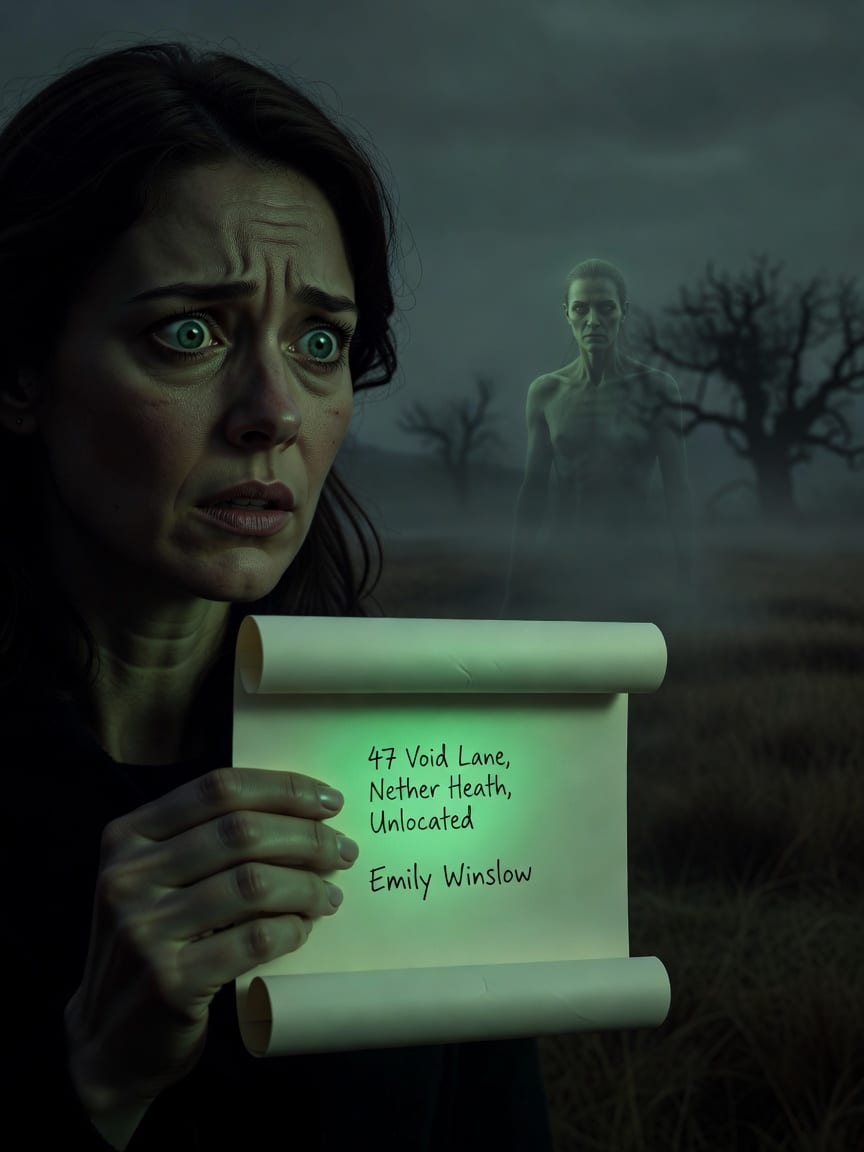
My change-of-address card arrived today. It said I'd moved to a house I'd never seen, on a street that didn't exist. And it was signed with my own hand, a month from now.
A crisp, cream-colored card on my kitchen counter informed me I'd moved to 42 Willow Creek Lane, an address that didn't exist. The signature was my name, Emily Winslow, a chillingly precise ghost of my own handwriting. But then I found an old 1947 ledger, listing 42 Willow Creek Lane and a signature identical to the one on my card.
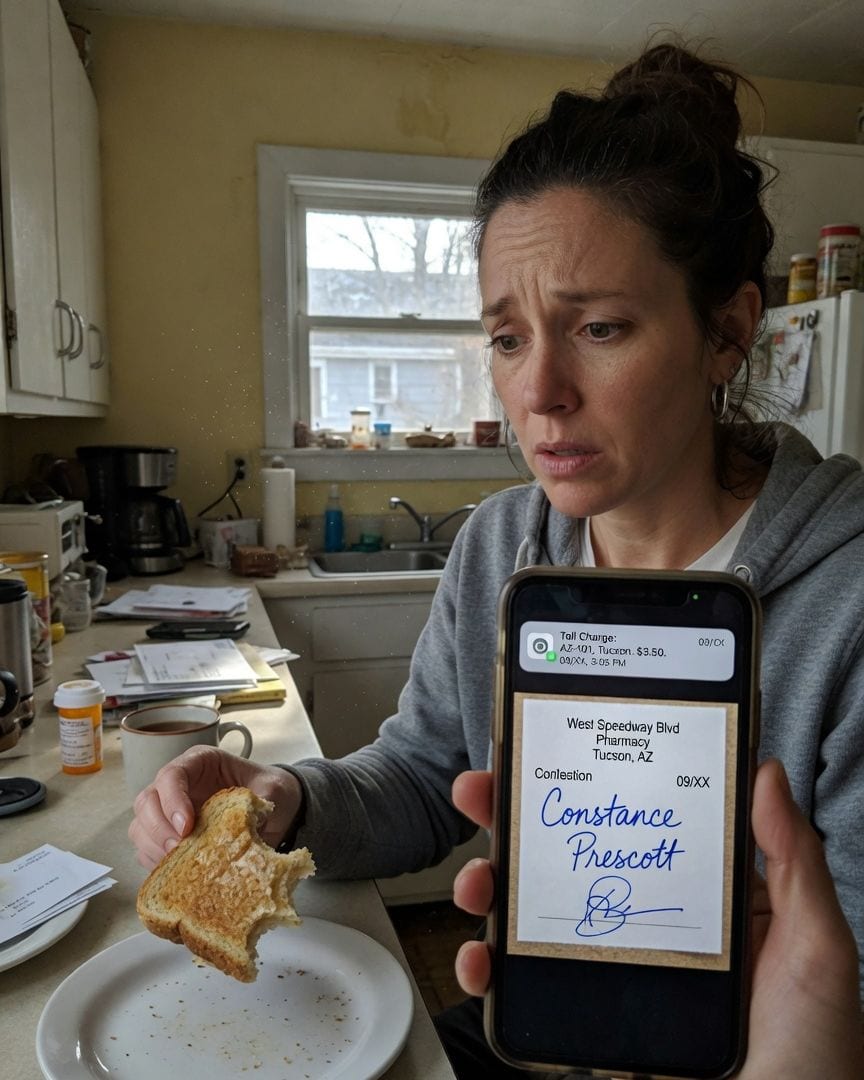
My own signature picked up my prescription in Tucson, Arizona. I live in Maine, and I've never set foot in that state.
When my pharmacy called about a refill, it felt odd — I usually get a text. But then they claimed I'd picked up a month's supply in Tucson, Arizona, yesterday, with my signed receipt. I've never been to Arizona, yet the signature was unmistakably mine, down to a distinct, childish 'P' loop.
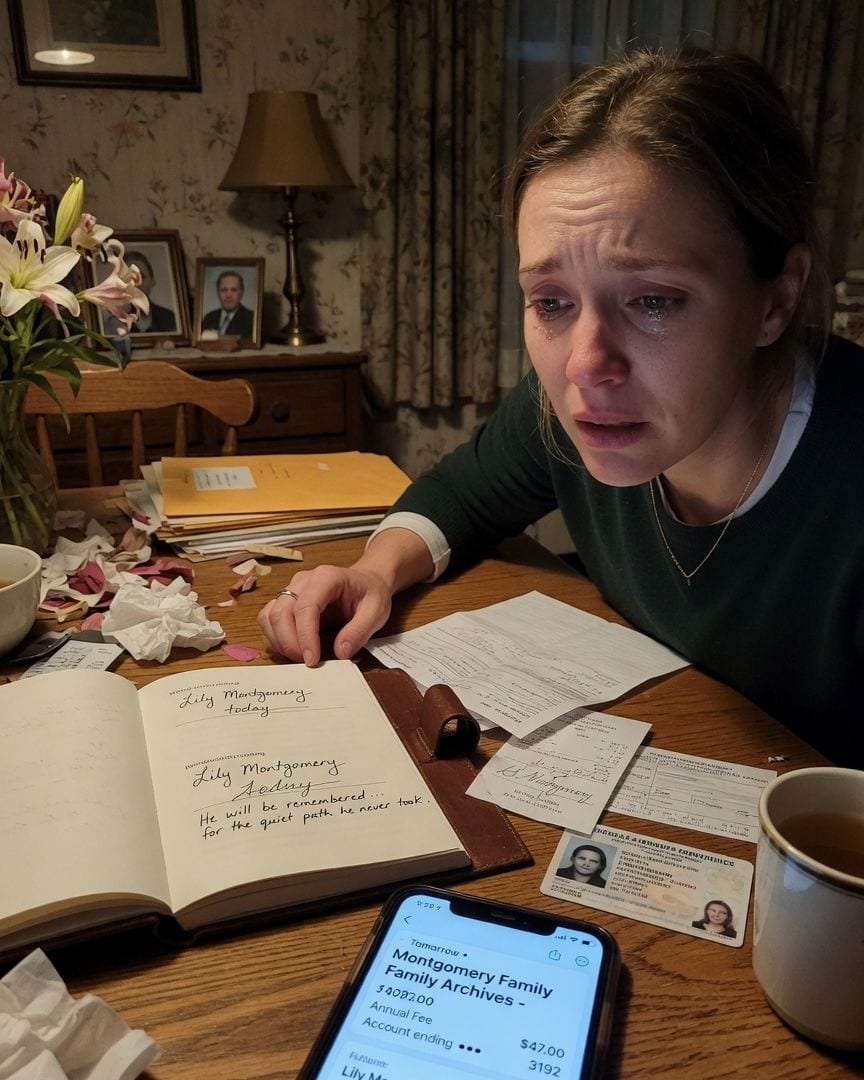
My handwriting was in the condolence book. Dated before my uncle died. Words I'd never choose.
At Uncle Howard's funeral, grief-stricken, I signed the condolence book. But later, flipping back through the pages, I found my own distinct handwriting on an entry dated the previous morning—before he had even died. The words beneath my name were chilling, a judgment I would never make.

My taxi driver knew my name before I spoke, then apologized for the flight I was going to miss. I was arriving. The cab's plate was scrapped four years ago.
After a strange taxi ride, I received an unsettling birthday card addressed to me. Its return address listed 'Old Mill Road Field,' an empty lot where a mill once stood, and it was postmarked locally. The card arrived four months before my actual birthday, sparking a cold dread I couldn't ignore.
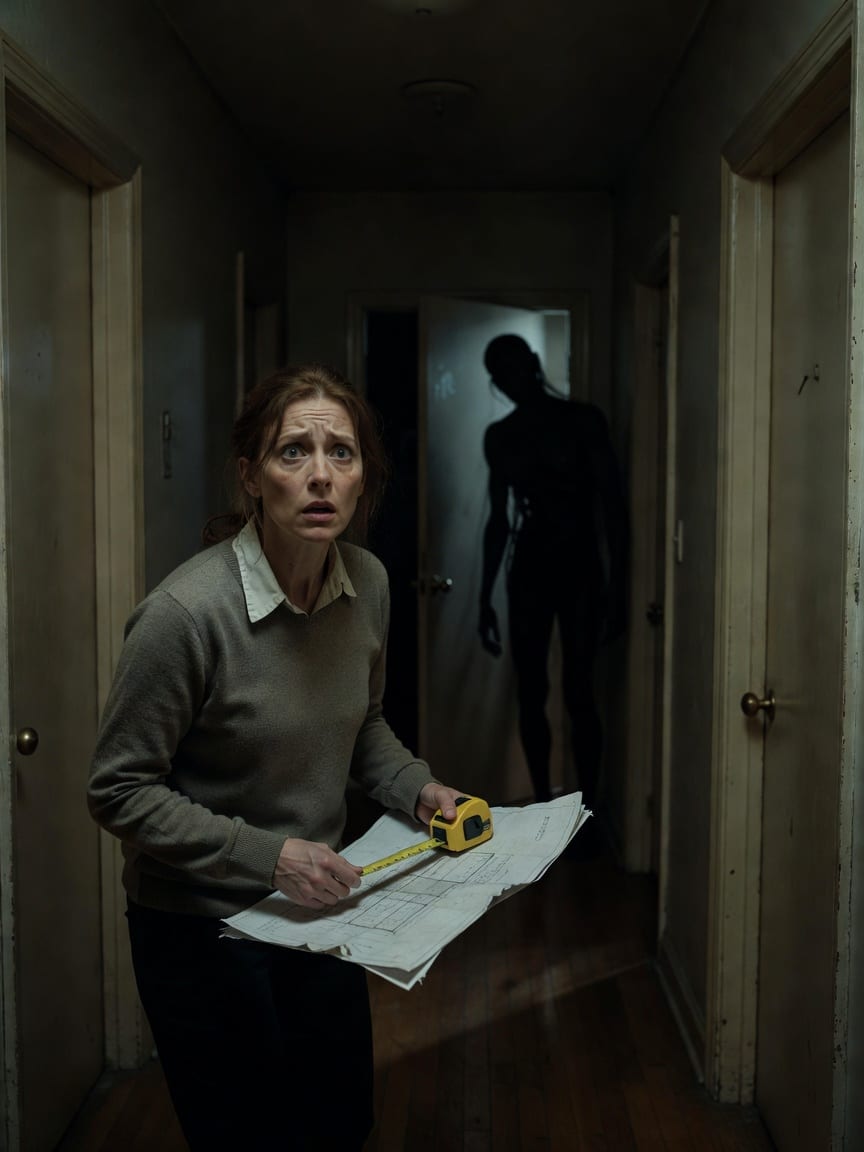
My front door has a dented gate and a dead hydrangea. I walked past it six times, trying to reach the corner shop just a hundred yards away. The pavement kept bringing me back to my own porch, and the shop's light never moved.
My morning started like any other, a quick walk to the corner shop from my home at Number 14, Elm Terrace. But after walking what felt like two minutes, I found myself back at my own front door, the shop no closer. I tried six times, faster and slower, but my street kept compressing, refusing to let me leave.
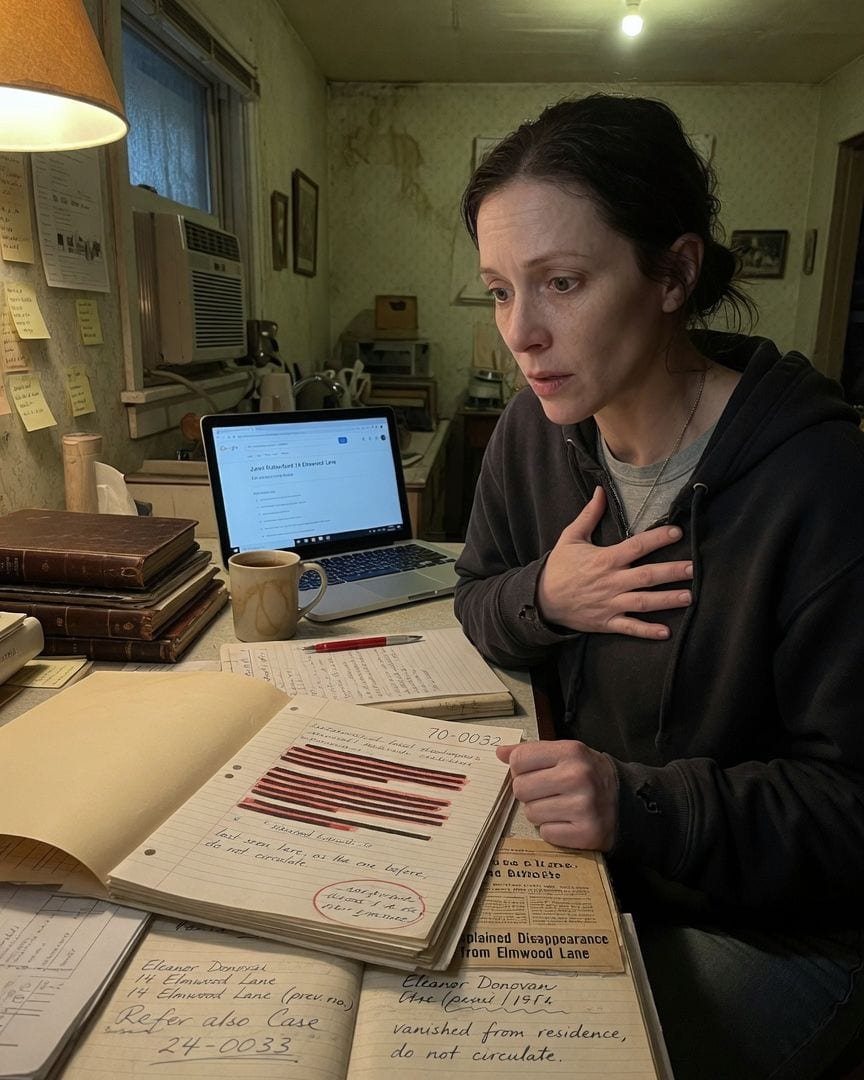
My own address is on a missing person's file from 1970. The blacked-out line names my street. She never lived here.
When my neighbor vanished, I started digging into old local missing persons cases. In a police file for a woman who disappeared in 1970, I found my own address, 14 Elmwood Lane, framing a blacked-out section of the duty log. Janet Rutherford never lived here, and the file contained a chilling handwritten note: 'do not circulate.'