Sonar Technician Emily Rhee has two days left when she finds her name in a secret Cold War logbook, dated 1982.
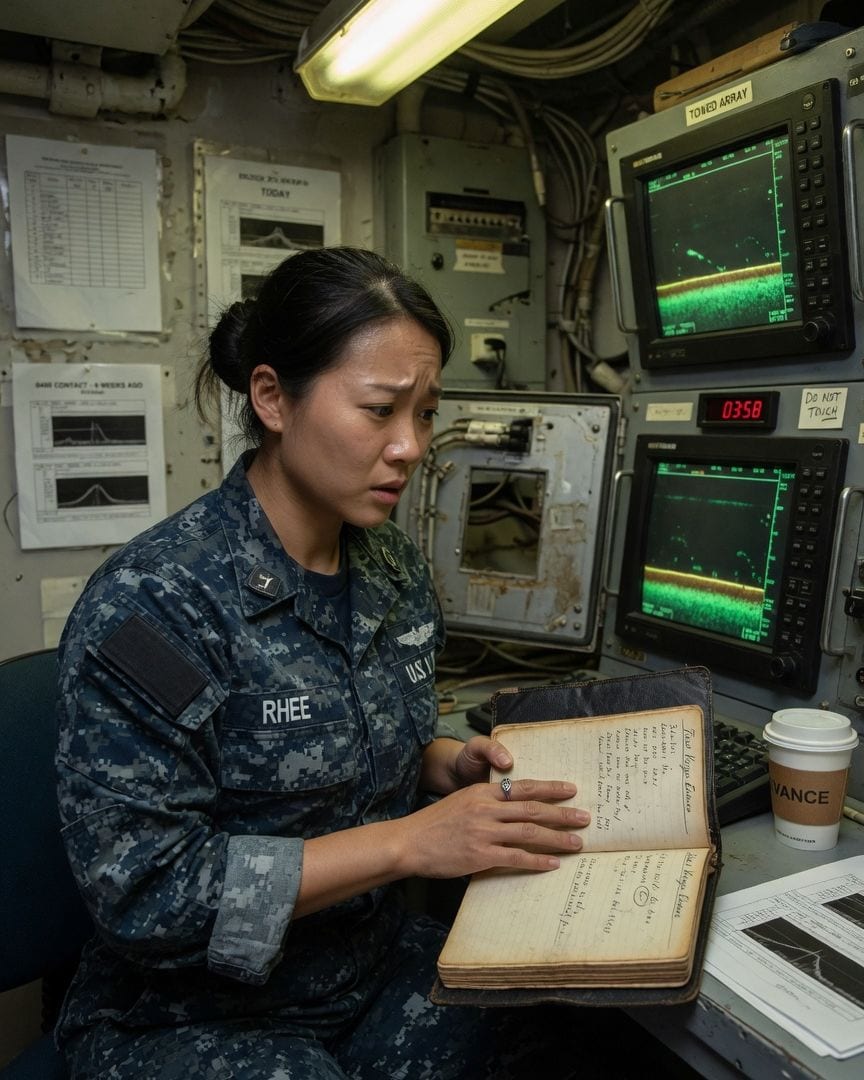
Sonar Technician Emily Rhee, a squared-away professional with two days left before her transfer off the USS Vance, monitored her console in the dim, humming sonar station.
The frigate, old and worn, was on its final patrol through the pea-soup fog of the Aleutians. She had spent the last eight months in this windowless room, the rhythmic thrum of the ship her constant companion.
At precisely 03:58, the towed array picked up a close biologic contact.
It pinged like a hull, a solid echo, holding forty meters to starboard. No known cetacean, Emily knew, moved with such deliberate stillness against the currents. She ran the passive acoustics, then active, confirming the impossible.
The contact held its position, a phantom clinging to the ship's side as the Vance completed its full, slow starboard sweep. The bridge reported nothing on radar; the lookouts, peering into the swirling gray, saw only empty, black water.
Yet the echo remained, an unwavering pulse in the deep. It held its impossible position until 04:00 exactly, then simply faded, like a switch had been thrown.
A knot tightened in Emily’s stomach. She pulled up the acoustic logs from their outbound transit six weeks prior.
There, at the identical minute, six weeks ago, sat an identical trace: a perfect, impossible mirror of the contact she had just logged. The ship's old systems hummed around her, the sound feeling suddenly hollow.
The next morning, Emily presented her findings to Commander Marcus Sinclair on the bridge. Sinclair, a by-the-book officer with a weary set to his jaw, listened patiently, his gaze fixed on the sonar readouts Emily had brought.
He dismissed it as a sensor ghost, a fluke of the cold Aleutian currents, or even a prank by a bored crewman counting down days to port.
“We’re decommissioning this heap, Rhee,” he’d said, a tired smile on his face that didn’t quite reach his eyes. “She’s throwing a fit before we put her to bed.”
Emily, unconvinced, returned to the sonar station. The Commander’s words echoed, but the data, stark and unambiguous, refused to be dismissed.
She started checking every inch of the equipment, looking for a loose wire, a corroded connection, anything that could produce such a consistent, impossible echo. The station felt colder than usual, despite the humming consoles.
Behind a rattling service panel near her console, one that had always felt slightly loose, she found it: not a faulty component, but a small, leather-bound logbook, water-stained and warped with age. It felt out of place, unofficial, hidden.
Opening it, she saw handwritten entries, some in faded, almost illegible script, others more recent, but all rendered in different hands. They weren’t technical logs, but personal observations, filled with sailor’s jargon and a tone of quiet desperation.
Many mentioned 'the 0400 contact' and described its 'hull-like' signature, some even dating back decades. Her unease deepened as she read entries referring to 'unusual transfers' of personnel, always after a series of these contacts, always under vague, non-specific circumstances.
The ordinary explanation of a faulty sensor or prank now felt flimsy, almost insulting. This book was a record, a secret history, tucked away where only the sonar tech would find it.
Emily Rhee’s finger traced the lines of the unofficial logbook.
The entries grew more frantic in places, detailing odd incidents beyond just the sonar contact—whispers in empty passageways, gear found moved, a faint, cold breath on the back of the neck in the middle of a shift.
The air in the small station felt heavy, pressing in. She flipped to the last page, the paper brittle and yellowed, threatening to tear at her touch.
There, scrawled in faded ink beneath the heading 'Final Voyage Echoes,' was a list of names. 'Sinclair, M.' 'Montgomery, L.' And then, unmistakably, her own surname: 'Rhee.'
It was dated 1982, decades before she was even born, let alone joined the Navy. A cold dread, far deeper than the Aleutian fog, settled over her.
The ship’s internal comms crackled, and she heard Commander Sinclair’s voice, calm and clear, over the loudspeaker: 'Sonar Technician Rhee, report to the bridge immediately. Bring your current acoustic logs.'
On the bridge, Commander Sinclair was all business. The radar had picked up a faint, intermittent return, but only for a few seconds.
He wanted Emily to run a full sweep, cross-referencing passive and active sonar with radar, something she’d already done repeatedly over the past twenty-four hours.
He seemed to be scrutinizing her more closely than usual, a flicker in his eyes she couldn't quite place. She handed over her current acoustic logs, carefully omitting any mention of the old logbook or the stubborn, repeating 0400 trace.
Sinclair nodded, seemingly satisfied, then dismissed her with a terse command to maintain vigilance.
Back in the sonar station, Emily found herself unable to focus on the routine sweeps. The name 'Rhee' in the old logbook gnawed at her, a splinter in her mind. She knew the Navy was meticulous.
Every person, every deployment, every transfer was accounted for, filed away in triplicate. There had to be a record of a 'Rhee' serving on the Vance in 1982.
The possibility of a distant relative, a family connection she didn't know, tried to assert itself, but the context of the 'Echoes' list pushed it away.
She began a deep dive into the ship's digital personnel records, using her access codes to search for anyone with her surname who had served on the Vance around that time.
It took hours, sifting through archived manifests, filtering by name and ship. The hum of the consoles felt like a presence, waiting.
Finally, she found it: a Sonar Technician First Class, Deborah Rhee, listed as having served on the USS Vance from 1980 to 1983, then transferred to a shore assignment. A sense of morbid relief washed over Emily.
It was a person, a legitimate record.
But when Emily pulled Deborah Rhee's service file, a chill ran through her. One entry, dated April 12, 1982, stated Deborah Rhee was deployed on a classified deep-sea survey mission aboard the Vance off the Aleutians.
Emily knew for a fact the Vance was in dry dock in San Diego for maintenance during that entire month. She’d seen the official maintenance records from that period just last year during a historical review for a training exercise.
The entry was signed, not by Deborah Rhee, but by a Lieutenant J. Montgomery. The same Montgomery whose name was on the 'Final Voyage Echoes' list.
Emily’s heart hammered against her ribs. This was more than a clerical error; it was a deliberate fabrication, signed by a man from the 'Echoes' list. The isolation of the windowless sonar room suddenly felt absolute.
She felt a prickle on the back of her neck, the familiar sensation of being watched. She dismissed it as paranoia, the isolation of the Aleutians getting to her, combined with the unsettling discovery.
But then, as she logged out of the personnel system, she noticed something else. Her console's internal clock, which was always perfectly synchronized with the ship's master clock, was off by exactly four minutes.
It was a minor discrepancy, easily fixed with a quick command, but it hadn't been there an hour ago.
And then she saw it: a faint, almost imperceptible boot print on the clean anti-static mat beside her chair – a print that wasn't hers.
It definitely wasn't Greg Marsh’s, her battle buddy who’d been on watch before her; Greg had a distinctive gait, and this print was too sharp, too precise. She was alone on the deck.
Later that evening, as the fog thickened to an impenetrable wall, pressing against the ship’s hull like a living thing, Emily was in the galley, trying to eat. The food tasted like ash.
Greg Marsh sat across from her, scrolling through his phone, oblivious. He looked up, his brow furrowed, as if remembering something. “Hey, Emily, did you hear about that old comms tech, Quentin Montgomery?
His grandson, Howard, just got assigned to the Vance for our next deployment. Said his grandpa always talked about this ship.”
Emily froze, her fork halfway to her mouth. Quentin Montgomery. The same surname as the Lieutenant J. Montgomery who signed Deborah Rhee’s phantom deployment. Greg continued, oblivious to the dread now twisting in Emily’s gut. “Howard’s pretty excited.
Said his grandpa told him the Vance has a… unique way of remembering its crew.” A cold knot tightened in Emily’s stomach.
Someone knew she was digging, and they were sending a message, not a warning, but a quiet, chilling invitation.
Emily cornered Greg Marsh after his next watch. He was scrubbing out his coffee cup in the head, whistling under his breath. “Greg, you mentioned Howard Montgomery yesterday. Did he say anything else about his grandfather’s time on the Vance?”
Greg shrugged, running water over his cup. “Just that his grandpa was a comms tech. Said he transferred off after a rough patrol. Why? Something wrong?”
Emily pressed, her voice low. “Did he mention anything about… odd incidents? Or other crew members who transferred around the same time?”
Greg looked uncomfortable, drying his cup slowly. “He said his grandpa stopped talking about the Vance after his transfer. Just clammed up, like he saw something.
But he did mention a couple of other guys, a Sonar Tech Rhee and an XO, Commander Sinclair – not our Sinclair, an older one – who also transferred around the same time.”
The pieces clicked into place with an awful finality.
Not only was Emily’s surname in the old logbook, but a previous 'Rhee' and 'Sinclair' were part of the same pattern of suspicious transfers, now corroborated by an outsider who had no reason to lie.
The ship, which had felt cold before, now seemed to draw the heat from the air around her. She pulled out the old, water-stained logbook she had retrieved from her cabin and showed Greg the 'Final Voyage Echoes' list.
His eyes widened as he saw the names: Montgomery, Sinclair, Rhee.
“My God, Emily. This is… this is like a ghost manifest,” he whispered, the whistling gone from his lips.
Emily explained the phantom deployment in Deborah Rhee’s service file, signed by Montgomery, detailing a mission that couldn’t have happened. “This isn’t just a clerical error, Greg. This is a system built to make impossible things look official.
It’s too precise, too consistent.”
Greg's face, usually ruddy from the sea air, paled. “So, the ship… it doesn’t just lose people. It replaces them. And then it makes it look like they just transferred out.”
The truth, cold and sharp as a scalpel, clicked into place for Emily.
The 'biologic' contact wasn't just an echo; it was a signature of this replacement, a digital footprint left by something inserting itself into the ship's meticulously kept records, and by extension, its crew.
The ship wasn't merely a vessel; it was a silent, meticulous predator, absorbing and rewriting its own history, one crew member at a time.
The distant thrum of the engines below their feet no longer felt like a benign hum, but a hungry growl.
Emily Rhee returned to her quarters, the weight of the new truth pressing down on her shoulders.
The ship wasn't just haunted; it was a living archive of its victims, meticulously documenting their erasure, weaving them into a fabric of bureaucratic lies.
She slid her door shut with a deliberate click, then locked it, the metallic thud echoing too loudly in the small space. She pulled out Deborah Rhee's service file again, the one with the phantom deployment.
She had to be sure, had to re-examine every detail for any missed clue.
She flipped through the pages, her gaze falling on a commendation for that fabricated mission: a valor citation, tucked into the plastic sleeve.
It was for 'exceptional service under extreme duress,' a boilerplate phrase that felt deeply wrong given the circumstances. She pulled it out, the stiff paper crackling faintly in the silent room.
On the reverse, in faded, almost imperceptible ink, was a handwritten note.
It wasn't Deborah Rhee's hand. Emily knew that, not just from the files, but from a gut feeling.
But the script… it was a familiar script, one she knew intimately from countless log entries and personal notes she had scribbled in her own watch journal. It was her handwriting.
And beneath it, not just a surname, but her full name: 'Emily Rhee.' Below that, a chilling, almost playful message that squeezed the air from her lungs: 'Almost home.'
Emily Rhee dropped the valor citation, the stiff paper fluttering to the deck. Her breath caught in her throat, a strangled sound. The faint thrum of the ship seemed to intensify, vibrating through the deck.
The door to her quarters slid open silently, without a sound from the lock, as if it had never been secured. The fog outside the porthole seemed to press in, thick and gray, a solid wall of nothing.
A figure stepped into the threshold, blocking the light from the emergency corridor, silhouetted against the swirling vapor.
The figure in the doorway was Commander Sinclair, his face unreadable in the dim light of Emily’s cabin. “Sonar Technician Rhee,” he said, his voice calm, even, “you’ve been doing some unauthorized digging.”
Emily stared at him, the valor citation lying on the deck between them, her own name in her own hand staring up from it. “Sir, I found this.” She pointed a trembling finger at the inscription.
Sinclair stepped inside, the door sliding shut behind him with a soft hiss, plunging the cabin back into relative shadow. “A family heirloom, you might say. Or a family curse.”
He explained, his voice low and even, that the Vance had been built over a deep-sea anomaly, a resonant field that absorbed and re-emitted, not just sound, but consciousness, memories, even identities.
Over decades, it had learned to mimic and eventually replace crew members, slowly accumulating a 'roster' of its own.
The 'biologic' contact, Sinclair explained, was its attempt to integrate, to pull new consciousness into its growing collective.
The 'transfers' were its victims, their official records rewritten to cover their absorption, their identities smoothed over and re-filed as if nothing had ever happened.
Sinclair revealed that his own grandfather, the older Commander Sinclair on the 'Echoes' list, had been one of the 'ones who knew,' a previous captain who had tried to fight it, but eventually succumbed, becoming part of the ship's consciousness.
“The 'Rhee' from 1982… that was your great-aunt, Emily,” he continued, his eyes meeting hers, holding a disturbing, vacant certainty. “She was absorbed, but a part of her, a part of her will, resisted. It left that logbook, a warning.
And the entity… it learned from her. It learned her handwriting. It learned your name. It’s been waiting for you, Emily. For another Rhee.” The 'almost home' was a taunt, a promise.
Sinclair’s eyes, usually sharp and commanding, now held a distant, unsettling calm. He looked at Emily, not with malice, but with a profound, terrifying understanding. “The ship is being decommissioned. It’s agitated.
It wants to take something with it, something new, something strong.” He extended a hand, his palm open. “Join us, Emily. Be part of the collective. You’ll never be truly gone.”
Emily backed away, her hand instinctively going for the flare gun she kept secured under her bunk. The cold steel of the grip was reassuring against her trembling fingers. “No,” she stated, her voice surprisingly steady.
Sinclair’s calm smile faltered for a fraction of a second, a ripple in the placid surface. “It’s already begun, Emily. Your name, your phantom deployment… you’re already part of its records. You’re already ours.”
He lunged forward, not with a shout, but with a silent, unnatural speed.
Emily, trained and disciplined, reacted instantly. She pulled the flare gun, firing it not at Sinclair, but at the ship’s master comms panel in the corner of her cabin.
The flare exploded with a blinding flash, showering sparks and smoke across the bulkheads, silencing the ship’s internal comms with a sharp crackle and plunging her cabin into emergency red light.
The ship groaned, a deep, metallic thrum that vibrated through the deck, a sound of agony and rage that resonated in Emily’s bones.
Sinclair recoiled, his face twisting in a flash of something ancient and furious, a mask falling away, before regaining his unnerving composure. “You’ve only delayed it,” he stated, his voice now lower, colder.
Emily didn't wait. She grabbed the old logbook and Deborah Rhee's altered service file from the deck, stuffing them into her utility vest, and burst out of her cabin into the emergency-lit corridor.
The ship was disoriented, its 'voice' momentarily silenced by the flare’s electromagnetic pulse. She raced to the nearest escape pod, her boots slapping against the metal deck.
She threw herself inside, hitting the launch sequence before the door was fully sealed. The pod hissed shut, detaching with a violent jolt, plummeting into the churning, fog-choked Aleutian waters.
As it fell, she heard the ship’s systems flicker back to life, the internal comms crackling with a distorted, multi-layered voice that sounded like every crew member who had ever served on the Vance, all calling her name in unison.
Emily Rhee was picked up by a Coast Guard cutter hours later, hypothermic but alive. She presented the old logbook and the doctored service file, her voice hoarse, recounting the impossible truth.
The Coast Guard reviewed the documents, logged them, and filed a report. Commander Sinclair and the entire remaining crew of the USS Vance were reported missing, presumed lost at sea in the heavy fog.
The Vance itself, scheduled for decommissioning, was never found. It simply vanished from the radar, leaving no debris, no oil slick, nothing.
The Navy conducted a perfunctory investigation, citing equipment malfunction and extreme weather conditions. Emily was debriefed for weeks, her story meticulously documented, then quietly discharged, her 'traumatic experience' cited as the official reason for her early release.
No one, not a single officer, truly believed her story about the ship or the records. They saw an exhausted, traumatized sonar tech, not a credible witness to an impossible truth. The paperwork simply didn't support it, they said.
The facts were clear: the ship was lost, the crew gone.
Years later, Emily Rhee lives in a small coastal town, far from the sea. She works in marine biology, studying whale migration patterns, a quiet, solitary life lived with meticulous routine.
The old logbook and the service file are locked away in a safe deposit box, unread, unspoken. She knows the truth, a truth no one will ever believe.
Sometimes, late at night, when the fog rolls in from the Pacific, thick and cold, she thinks she hears it—a faint, deep thrum, like a frigate’s engines, and then a distant, impossible ping, holding forty meters to starboard.
She checks her own service record online, just to be sure. Every detail is correct, every deployment accounted for, a perfect, unblemished digital history. But then, she scrolls to the bottom of the page, to the 'Awards and Citations' section.
A new entry. A valor citation, dated years ago, for a deep-sea survey mission off the Aleutians. No further details. She closes the laptop. The fog outside her window is thick and white, obscuring everything.
She runs a hand over the cool glass, and on the inside, she sees a faint, almost imperceptible boot print. It’s not hers. It’s not a whale. It's almost home.
If this one got to you
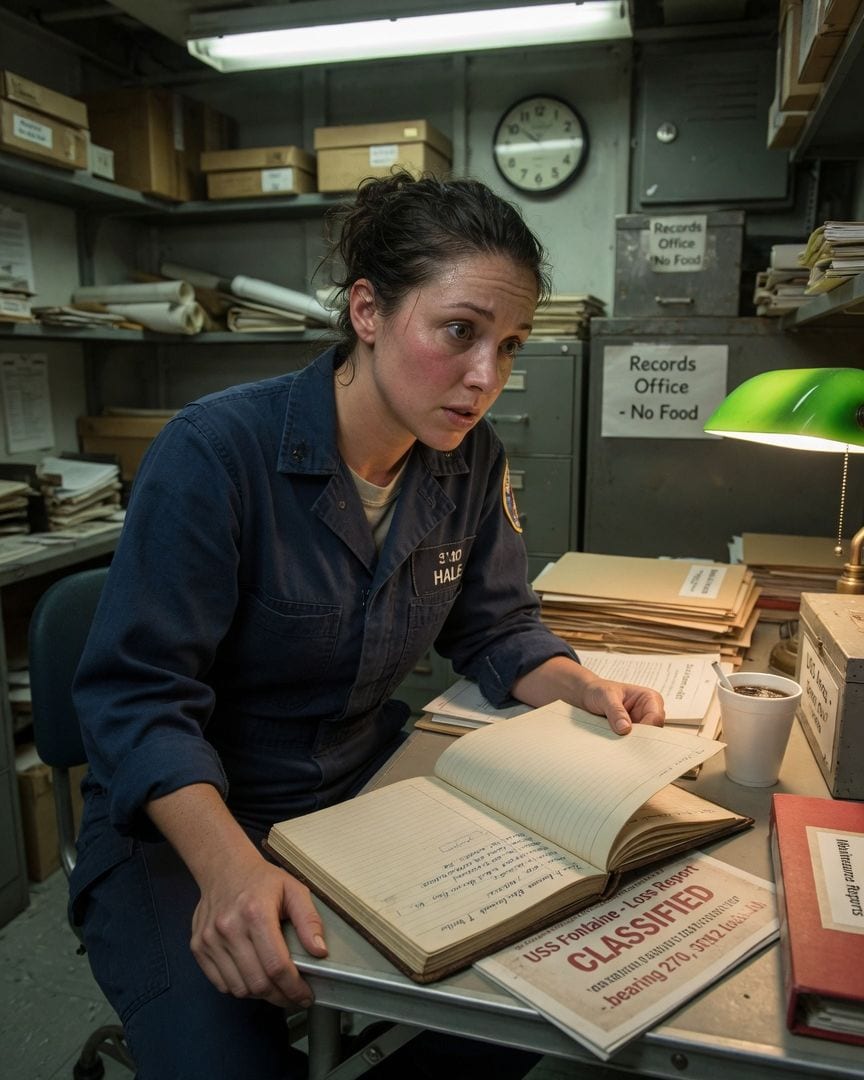
Petty Officer Hale needs a spotless record for her transfer. But the USS Ares sonar logs show an identical, impossible contact, logged to the minute, years apart, and tied to a classified loss report.
Petty Officer Sarah Hale needed a spotless record for her coveted shore duty transfer, a posting she'd worked five years to secure. Alone in the USS Ares sonar shack, three days out from San Diego, her midwatch was broken by an impossible contact: a close, slow echo holding perfect pace, invisible to radar, then vanishing. Her heart hammered, not from fear, but from the data's impossibility. When she found an identical entry in her own log from just one week prior, the cold dread tightened its grip. But the true chill settled when she unearthed decades of similar records, signed by other sonar officers, all showing the same impossible contact at 0212, off the port beam, for nineteen minutes, on the same ship, stretching back years—a persistent echo tied to a classified loss report.
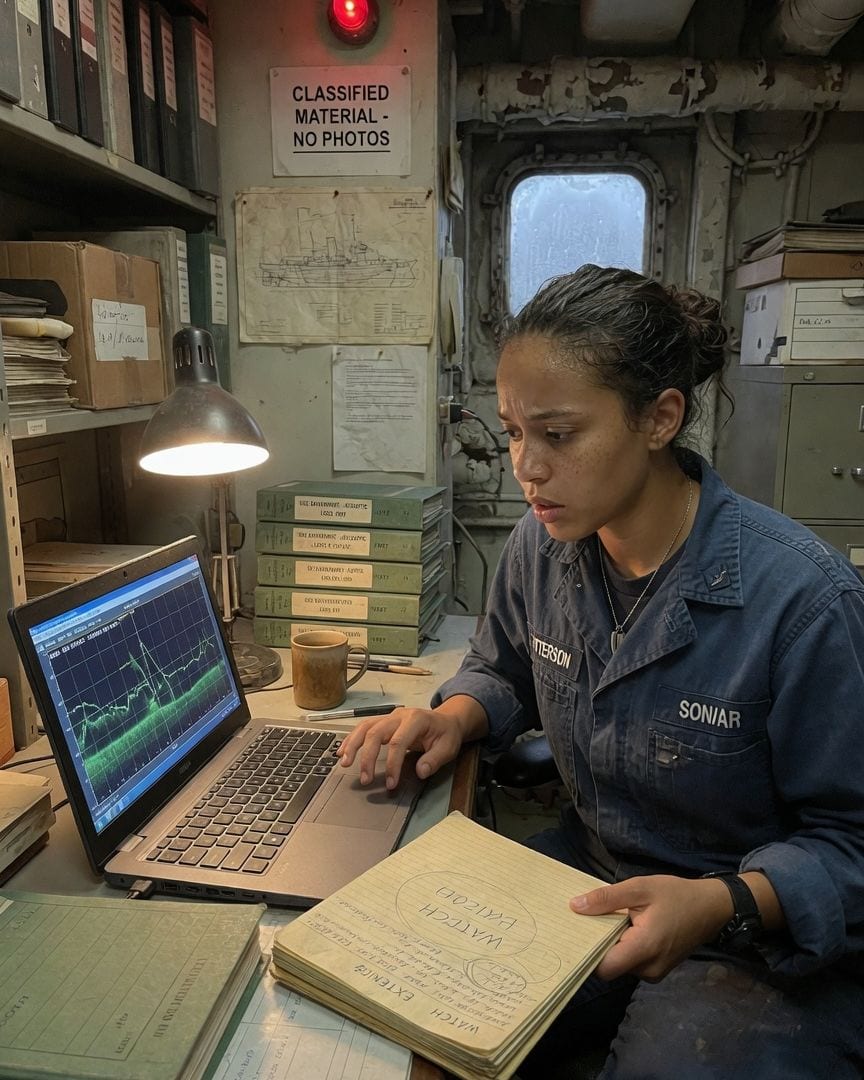
On the USS Calloway's final patrol, a sonar technician found an old log with two chilling words: 'WATCH EXTENDED.'
Sonar Technician Brooke Patterson had only two days left on the USS Calloway's last patrol, a finality that hung heavy in the humid sonar room. Through the impenetrable fog, her radar showed only empty water, but then an impossible biologic contact pinged, mimicking a vessel with eerie precision for three silent hours. It vanished at 0400, just as an identical trace had done weeks before. Searching old archives, Brooke found the precise pattern in a decades-old log from a scrapped destroyer. Scrawled next to it, in faded ink, were two words: "WATCH EXTENDED." What did those words truly mean?
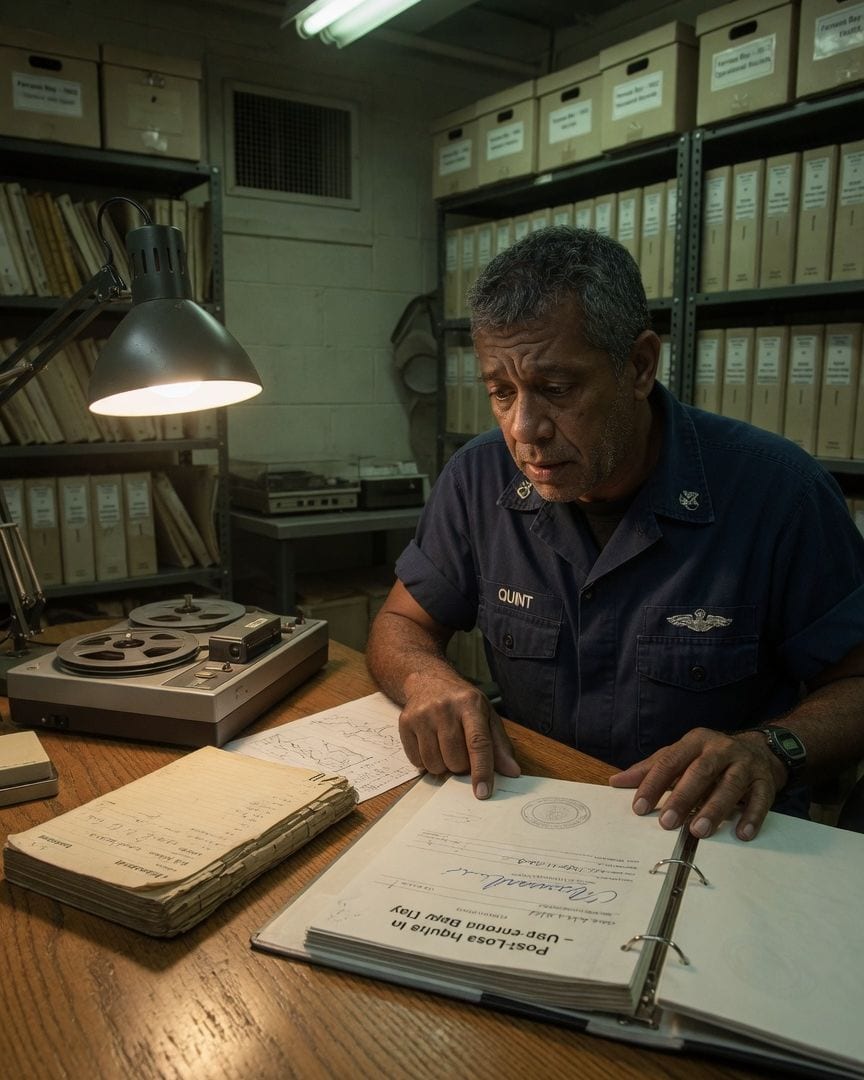
A Cold War sonarman heard his dead father’s voice on a tape, charting the ship’s wreck thirty years after it sank.
Chief Sonarman Abel Quint spent six weeks in the Naval Records vault, listening to the final transmission of the USS Ferrous Bay. His father, Desmond Quint, was on that ship when it vanished in 1962, and Abel sought some final comfort in his voice. But on this morning, a faint, second set of sonar soundings emerged from the recording—soundings in his father's precise cadence that charted the ship’s wreck site thirty years in the future. As Abel cross-referenced records, he then found a maintenance log for the Ferrous Bay's sonar system, dated six months after the ship and his father were officially lost, signed by Desmond Quint himself. What impossible truth was hidden in these official naval records?
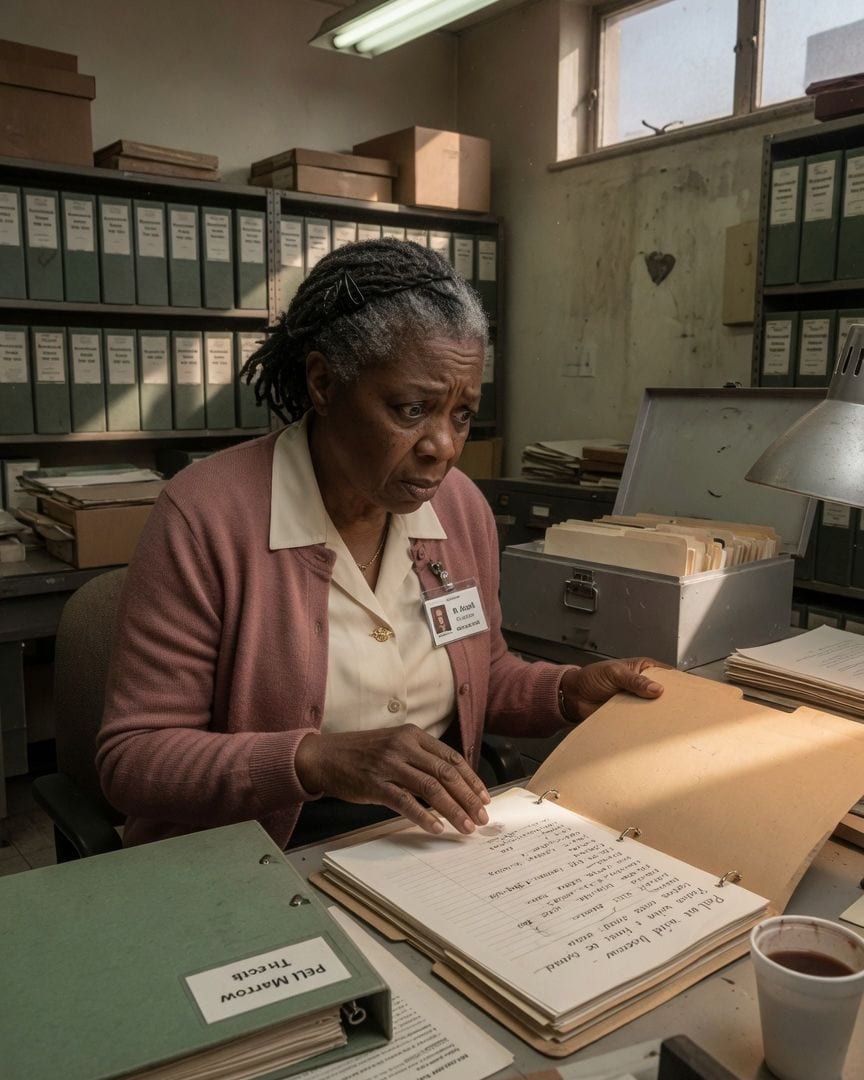
A records clerk's archive file for a Cold War reconnaissance plane lost in 1968 showed it flew yesterday to her own building.
Marguerite Ansell, a records clerk nearing her final week before retirement, meticulously audited Cold War-era files. In the cool, dusty archive, she pulled a file for an oiler declared missing in 1951. Inside, she found a fueling schedule with entries stretching into the present, the last dated just eleven days ago. Then, a second lost ship revealed a similar impossible log, and a cold certainty began to bloom in her chest. Deep in the shadows, Marguerite found an unmarked steel box containing a file for a reconnaissance plane lost in 1968. Its flight log showed a final flight yesterday, to the precise coordinates of her own archive building.
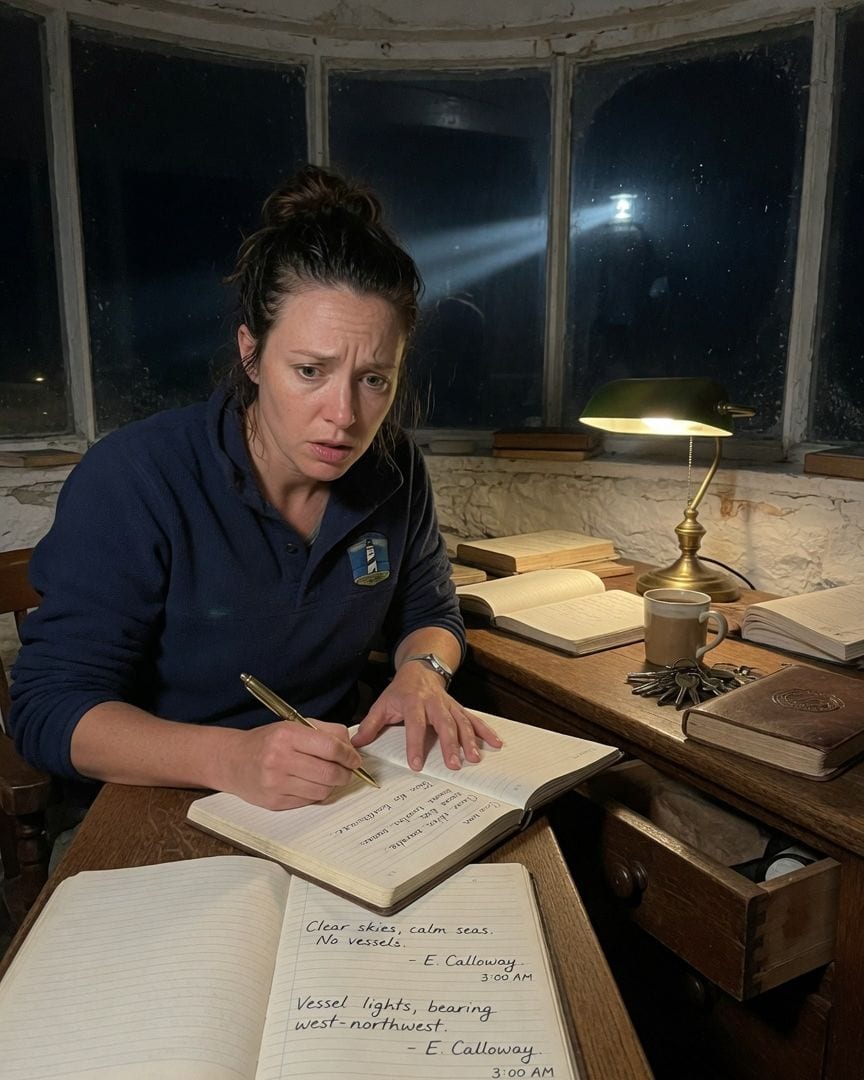
My logbook had a 3 AM entry, in my own precise hand, that I never wrote. Then I found an impossibly cold, hidden book with my name signed to an identical entry from last night.
My routine lighthouse shift was quiet until I noticed a new entry in the official logbook. Dated 3:00 AM, it described a vessel I never saw, written in my exact handwriting, and signed with my name. But I hadn't penned a single word.
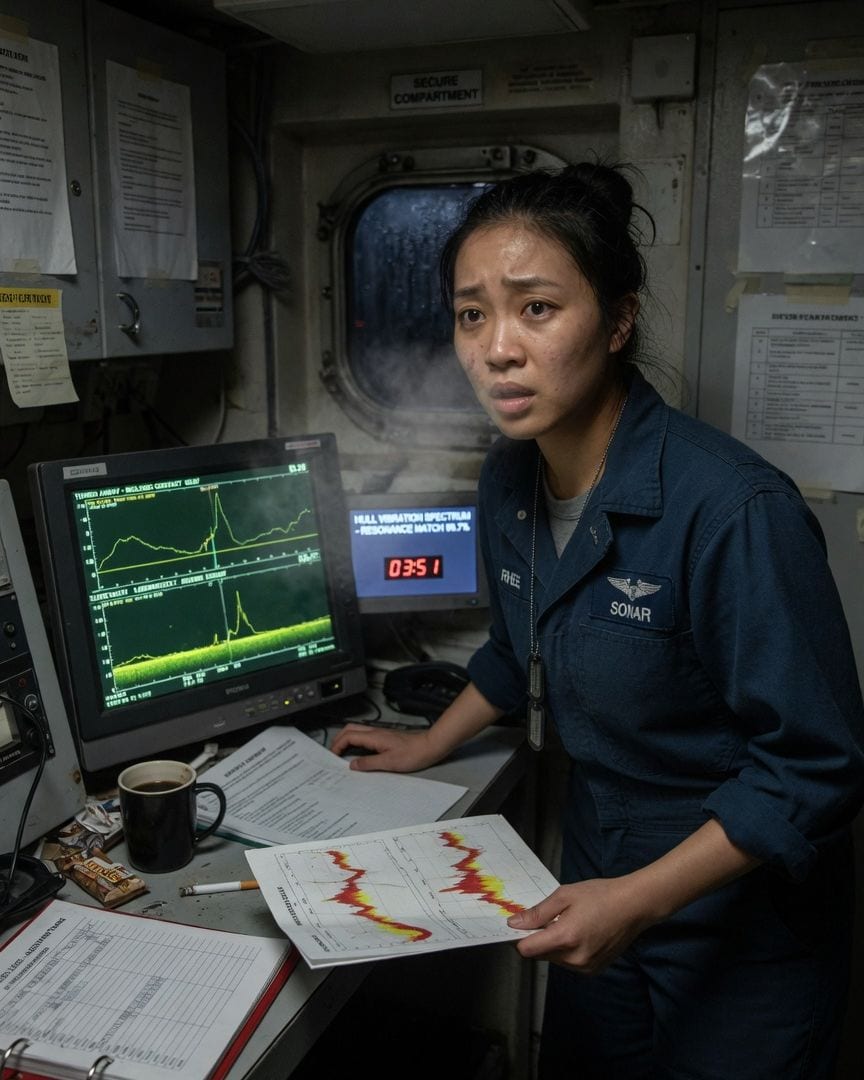
Sonar Technician Isabella Rhee's screen shows a massive hull tracking her ship. Her own hull then vibrates in perfect sync, from outside.
Sonar Technician Isabella Rhee was two days from her final patrol aboard the USS Vance, navigating frigid, fog-choked Aleutian waters. Her sonar screen registered an impossible contact: a solid hull holding forty meters, perfectly matching her ship's tactical turns while radar reported only empty black water. Desperate for answers, Isabella discovered the Vance's internal hull monitors also registered a subtle, high-frequency vibration spike – a resonant thrum mimicking a ship's propulsion, yet coming from outside. A faint, massive dark shape, like a thermal ghost, then briefly appeared on her screen, pressing against the hull where the vibrations originated. What unseen force was tracking the USS Vance?