A Cold War sonarman heard his dead father’s voice on a tape, charting the ship’s wreck thirty years after it sank.
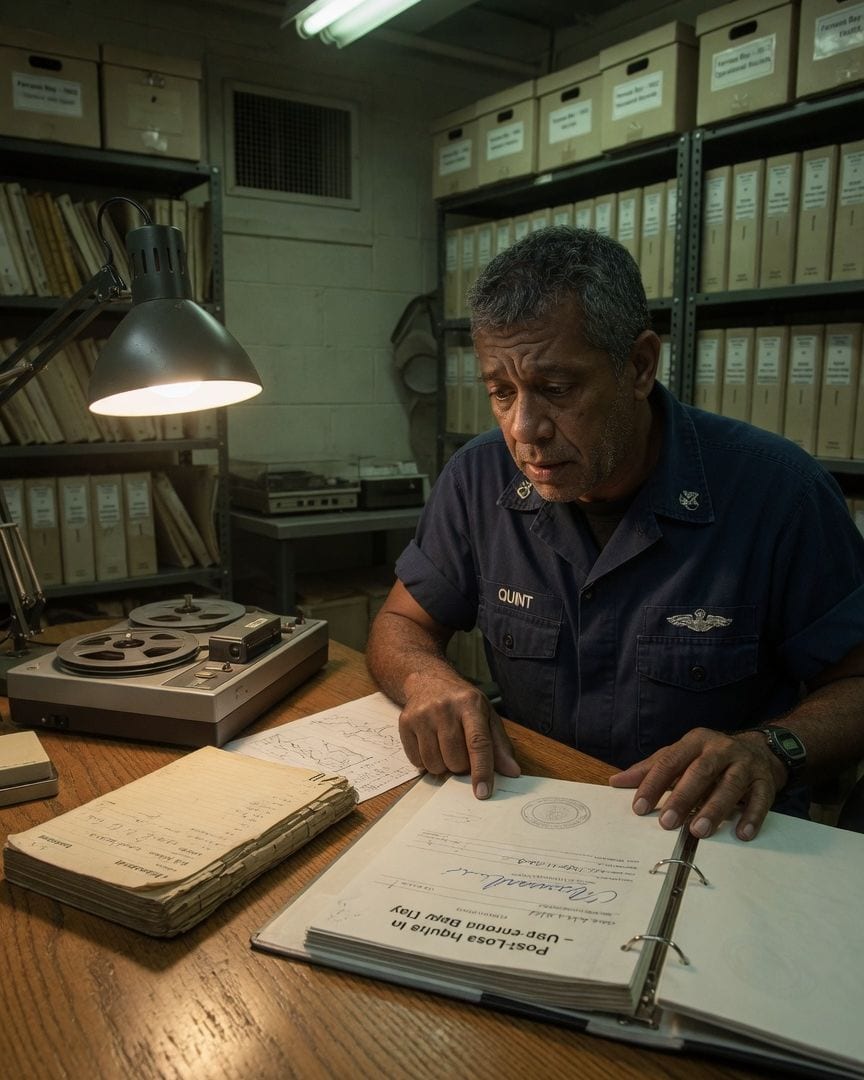
Chief Sonarman Abel Quint, 52, sat hunched over the antique reel-to-reel player in the hushed, climate-controlled vault of the Naval Records Center.
For six weeks, he had listened to the same nine minutes of audio, the last transmission of the USS Ferrous Bay, lost off Kodiak in 1962.
His father, Desmond Quint, had been on that ship, his voice steady, calm, reading a bearing. Abel knew the tape by heart, every crackle of static, every command.
He’d played it hundreds of times, seeking some comfort, some final message beyond the official record.
But on this morning, the sixth week, a faint, almost subliminal pulse had emerged from beneath the vocal track.
It was a second set of sonar soundings, a ghost echo, also in his father's precise, rhythmic cadence, but these readings were impossible. They weren't charting the Ferrous Bay's position in 1962.
They were charting the exact coordinates where the ship’s wreck would be discovered, thirty years later, almost to the fathom. The board convened Friday.
He rewound the tape, the hiss of the magnetic ribbon filling the silence, and played the impossible nine minutes again, the phantom soundings whispering a truth that defied time, a quiet dread settling deep in his bones.
Abel spent the next few hours cross-referencing the spectral soundings with the Ferrous Bay’s official logbook, a thick, brittle volume from the ship’s final deployment. Every entry, every navigational fix, confirmed the ship’s reported position in 1962.
The phantom readings were off by hundreds of miles. He considered a faulty tape, a degraded recording, or even a trick of the ear, the kind of auditory illusion that played on a weary mind.
He ran a spectral analysis on the audio, isolating the frequencies, confirming the distinct, separate set of pings. The sound wasn't an artifact; it was a deliberate transmission.
It was too clear, too precisely timed, to be static or a degradation effect.
He consulted the ship’s full operational file, a series of heavy, numbered binders. The file was comprehensive, detailing everything from crew manifests to engine repairs, all ending abruptly with the official 'Loss at Sea' report.
There were no anomalies, no missing pages, nothing to suggest a clerical error or a hurried redaction. It was a perfectly maintained record of a ship’s complete, official life cycle.
He pulled the last binder, marked 'Post-Loss Inquiries,' expecting only the usual casualty reports and next-of-kin notifications. But as he flipped through the stiff, yellowed pages, a single document stood out, tucked between two condolence letters.
It was a standard maintenance log, dated April 12, 1963, six months after the Ferrous Bay was officially declared lost.
The entry detailed a routine diagnostic check of the ship's AN/SQS-26 sonar system, signed with a familiar, looping hand: 'C/S Desmond Quint'.
The date, the signature, the impossible continuation of his father's service, sent a chill through him unlike any other.
Abel stared at the signature, his father’s name, clear as day. The ink was faded, but the date, April 1963, was undeniable. His father had died in 1962. The ship had sunk.
Yet here was a record of him, performing routine maintenance, six months later. Abel’s fingers trembled as he touched the paper.
He could feel the faint, almost imperceptible impression of a strange, circular seal beneath the text, a pattern he didn't recognize, pressed into the paper like a phantom stamp.
It wasn't just a date that was wrong, but an entire, inexplicable layer of existence. The hum of the archive’s ventilation system suddenly seemed to drop, and the air grew cold, as if the room itself was holding its breath.
He looked up from the file, his gaze fixed on the empty space where the ship’s next entry should have been, but instead, there was only the ghost of that seal, a silent, impossible watermark.
The next morning, Abel sought out Penelope Caldwell, 34, a sharp, meticulous archivist known for her encyclopedic knowledge of the center’s labyrinthine holdings. He found her perched on a rolling ladder, precisely shelving a collection of obscure meteorological charts.
He presented the 1963 maintenance log. Penelope’s usual cheerful demeanor evaporated, replaced by a subtle tension around her eyes. She accepted the document, her movements precise, almost hesitant, as she examined it.
She suggested a misfile, her voice even, a clerical error, a simple transposition of dates, perhaps a stray form from a different vessel with a similar hull number.
But Abel pointed out the specific signature, his father's unmistakable looping 'D. Quint'. He also showed her the strange watermark, tracing the faint outline with his finger.
Penelope’s explanations became strained, her gaze darting to the closed stacks around them, as if listening for an unseen presence.
She admitted that some files, especially those designated 'Declassified-Conditional,' had 'peculiarities,' a word she pronounced with a peculiar, almost knowing emphasis.
She mentioned old 'legacy systems' that sometimes generated 'ghost entries' but offered no further details, her lips pressing into a thin line.
Abel pressed her, asking about the watermark. “It’s… administrative,” she said, looking anywhere but at him.
She quickly changed the subject, suggesting he consult Gideon Stratton, 61, the head of the Declassification Review Board, emphasizing that Stratton was 'very particular' about how such 'anomalies' were handled. Her haste, her unwillingness to meet his eye, spoke volumes.
Abel realized he wasn't looking at a simple mistake; he was looking at something intentionally obscured, and Penelope knew more than she was letting on.
He left her office with a chilling certainty: the file wasn't just wrong, it was protected, and someone within the system had a vested interest in keeping its true nature hidden. The 'peculiarities' were not errors, but features.
Abel spent the rest of the day in the restricted 'Declassified-Conditional' section, a vast, echoing space lined with steel shelves that stretched into the dim distance.
He hunted for other files with similar post-loss entries or the strange watermark, pulling dusty binders, his fingers smudged with age. He felt a prickling sensation on the back of his neck, a sense of being watched.
Every time he glanced up, a distant figure would duck behind a stack or a rolling ladder would clatter. He dismissed it as paranoia, the pressure of the impending board meeting, the hours of meticulous, frustrating research.
But the feeling persisted, an unseen gaze following his every move through the towering shelves of forgotten histories. He saw no other marks like the one on his father’s log. The Ferrous Bay file was unique in its impossible continuation.
Later, as he was leaving for the day, the archive's fluorescent lights humming their low evening drone, he found a small, unmarked envelope tucked under his office door. It was heavy, stiff, not a prank.
Inside was a single, precisely folded sheet of paper. It was a photocopy of the 1963 maintenance log he’d shown Penelope, crisp and clear. Scrawled across the top, in a neat, anonymous hand, were three words: 'SOME THINGS ARE FILED.'
There was no threat, no instruction, just that chillingly impersonal statement. The message wasn't a warning to stop; it was a statement of fact, implying that his inquiries were not unexpected, but merely another entry in an existing process.
The file wasn't just being reviewed by him; it was reviewing him back, recording his every step, an unseen hand adding to his own growing record.
The next morning, Abel confronted Penelope in a quiet corner of the cafeteria, away from the low murmur of conversations and the clatter of trays. He slid the anonymous note across the table.
Her face went pale, a single drop of coffee splashing from her cup onto the laminated tabletop. “Who else knows about this?” she whispered, her eyes wide, glancing nervously around the room, as if the walls themselves had ears.
Abel pressed her, his voice low but firm, demanding to know what 'filed' truly meant.
Penelope, visibly shaken, finally cracked. She explained that the 'legacy systems' weren't just old computers or obscure databases; they were a classification of records linked to a specific, unacknowledged program.
Certain 'losses,' she enunciated the word with dread, weren't considered 'lost' in the traditional sense. They were 're-categorized.' The files, she explained, continued to 'accrue' entries because the assets were still… active, in a different capacity.
She spoke of a 'continuing operational status' for vessels and units that officially ceased to exist, their paperwork a testament to their ongoing, unseen function.
The purpose, she didn't know, but the 'system' required constant 'acknowledgment' to prevent 'drift,' to maintain its own internal coherence, like a vast, silent engine that simply kept running.
She confessed that the strange watermark Abel had seen was an 'acknowledgment seal,' indicating an entry had been processed by this hidden system.
Her voice dropped to a near whisper, barely audible above the cafeteria's background hum. “It’s why I knew about your father’s log. I saw it… processed years ago.
I thought it was an isolated incident, a fluke, a mistake the system coughed up.” She looked at him, her eyes wide with fear, a raw, primal terror that Abel recognized.
“The soundings… the maintenance log… it all fits, doesn’t it? It means the Ferrous Bay isn’t just a wreck. It’s part of something else. Something still happening.”
The pieces clicked into place with a horrifying precision: the pre-cognitive soundings his father had somehow transmitted, the post-loss maintenance entry, the ominous note confirming an ongoing process.
The Ferrous Bay hadn't sunk into oblivion; it had been absorbed into a living, bureaucratic machine, its file still a vibrant, growing document, and the institution itself was merely its unwitting, or unwilling, custodian.
Penelope, still trembling, led Abel away from the cafeteria, down several long, anonymous corridors, and into a deeper, more restricted section of the archives. It was a windowless room, stark and cold, designated 'Active Declassification Review.'
The air felt thin here, charged with an unspoken tension. She accessed a terminal, its screen flickering to life in the dim light, and typed rapidly, her fingers flying over the keys.
“There’s one last part of the Ferrous Bay’s file,” she murmured, her voice tight with dread. “The 'Continuing Status' annex. It’s usually blank for truly lost vessels. It’s supposed to be blank for this one.”
The screen flickered again, then displayed a single, current document. It was a standard requisition form for a Chief Sonarman, dated for the upcoming fiscal quarter, stamped 'URGENT' in bold, red letters. Abel’s breath caught in his throat.
The personnel requirements listed were specific: deep-water sonar experience, cold-weather deployment, high-level security clearance. He knew those requirements. They were his own. He had met them for decades.
Then he saw it: in the small, designated box for 'Service Number (Preferred Candidate),' his own nine-digit service number stared back at him, clearly typed, alongside his full name: 'Quint, Abel G.' The ink on the screen seemed to shimmer, impossibly fresh, as if just rendered.
The implications crashed over him: the file wasn't just a record of the past; it was an active, predictive system, and he was its next target.
He heard the quiet click of the file drawer closing somewhere behind him in the vast, silent archives, and then the distinct, heavy thud of a lock engaging, sealing him inside with the file, the glowing screen illuminating his name.
Abel spun around, but the heavy steel door, devoid of any handle on the inside, was already shut, the lock firmly set. The thud still echoed in the small, cold room.
Penelope, her face a mask of terror, was still at the terminal, her hands hovering over the keyboard, her eyes fixed on the screen.
“The system… it’s not just recording,” she whispered, her voice barely audible, a thin, reedy sound in the silent room. “It’s requesting. It’s always been requesting.”
She explained that the 'Continuing Status' annex wasn't a historical record; it was an active recruitment pool for the 'filed' assets.
The Ferrous Bay, still 'operational' in its filed state, periodically required new personnel, and the system, through its 'legacy' processes, identified suitable candidates.
His father hadn’t just been on the Ferrous Bay; he was part of the Ferrous Bay’s ongoing 'filing,' a continuous data stream, and the system was now seeking his replacement.
The pre-cognitive soundings weren't a warning; they were a property of the 'filed' asset, reflecting its entire timeline, its past and future simultaneously accounted for.
The 1963 maintenance log was an internal audit for a ship that, to it, was never truly lost, merely rerouted.
“It's not a clerical error,” Penelope reiterated, tears streaming down her face, glistening in the glow of the monitor. “It’s a machine. And it’s still running. Your board meeting on Friday… it’s not to review the Ferrous Bay’s loss.
It’s to process your transfer.”
The horror was the cold, perfect coherence of it all: every missing ship, every impossible record, every ghost entry, was a cog in this vast, patient, bureaucratic horror machine, and Abel, through his investigation, had simply made himself the latest, perfectly qualified entry on its active roster.
His very quest for answers had been an act of self-enrollment.
Abel knew escape was impossible from the system, even if the door had remained unlocked.
The 'lock' was not just the heavy steel door, but the system itself, a vast, patient entity that had already accounted for his presence, his inquiry, his qualifications.
It had simply been waiting for him to step into the designated slot. He turned back to the terminal, his mind racing, a desperate clarity sharpening his thoughts. “Is there a way to sever the connection?”
he asked Penelope, his voice steady despite the raw dread clawing at his throat. “To delete an entry, to break the chain, to make a name disappear?”
Penelope shook her head, frantically typing, her fingers blurring across the keys. “No. Only… acknowledgment. The system demands acknowledgment.” She pulled up a secure communication interface on the screen, a final field flashing beneath his name and service number.
“You have to respond to the requisition. Decline it, accept it, but you have to acknowledge it. It’s how the process closes one cycle and starts another.”
Abel realized the terrifying truth: the institution wasn't actively malevolent, not a cabal of villains, just a custodian of a process too vast and ancient to control, a mechanism that simply sought to maintain its own internal logic.
He saw a field labeled 'Candidate Response,' a blank line awaiting his decision. He could accept, becoming the next 'filed' Chief Sonarman for the Ferrous Bay, following his father into the unknown depths of its continued operational status.
Or he could decline. He typed rapidly, his fingers hitting the keys with a frantic certainty, choosing 'DECLINE.'
The screen flickered, a moment of suspense, and a new message appeared: 'DECLINE ACKNOWLEDGED. TRANSFER PROTOCOL INITIATED FOR NEXT AVAILABLE CANDIDATE.' His heart sank, a leaden weight in his chest.
He hadn't stopped it; he'd merely passed the burden, a new link in an endless chain. Just then, Gideon Stratton’s voice boomed from the intercom on the wall, distorted and tinny, but unmistakably present in the locked room: “Chief Quint?
You’re late for the board meeting. We have a new requisition to discuss.”
The door, which had been locked, silently unlatched and swung inward, revealing the empty, brightly lit corridor of the main archives, as if it had never been sealed. Penelope looked at him, her eyes filled with a profound, quiet despair.
“It always finds a replacement,” she whispered. “It always does.”
Abel attended the board meeting. He presented his findings on the Ferrous Bay’s tape and the impossible maintenance log, meticulously laying out the spectral analysis and the physical document. He omitted the requisition, the ‘acknowledgment seal’, and Penelope’s frantic explanations.
Gideon Stratton listened, impassive, his expression unreadable, then officially closed the file on the Ferrous Bay, citing 'historical ambiguity' and dismissing Abel's 'theories' as the product of emotional attachment, a son's natural grief warping fact. The board concurred.
Abel saw Penelope in the cafeteria later that week, picking at a salad. She looked drawn, more tired than he’d ever seen her, but she offered him a faint, knowing smile as he passed.
He saw her eyes, though, still held that flicker of deep, unshakeable fear. He knew he had merely stepped aside; the machine was still running, still filing, still choosing.
The dread hadn't ended; it had simply moved on to someone else, a new name, a new service number, quietly processed by the same patient system.
The official record remained undisturbed, its deeper truth buried, waiting for the next qualified candidate to stumble into its orbit.
Abel retired six months later, moving to a quiet coastal town far from any naval base, far from any archive or the quiet hum of servers.
He sometimes found himself staring at the ocean, imagining depths where ships moved through a different kind of bureaucracy, endlessly operational, their logbooks still filling out somewhere unseen.
He never spoke of the Ferrous Bay again, or the file that kept writing. The memory of his own service number on that requisition form, however, never faded, a constant whisper of the system's reach, a phantom itch he couldn't scratch.
One afternoon, while reviewing his pension statements, a thick packet of forms from the Naval Benefits Administration, he noticed a new, unfamiliar line item on a recent quarterly report: a small, recurring deduction labeled 'Legacy System Maintenance - Personnel.'
It was a negligible amount, easily overlooked, buried deep within the complex financial jargon. He stared at it, a cold certainty settling in his gut.
The file was still being signed, and he was still in it.
If this one got to you
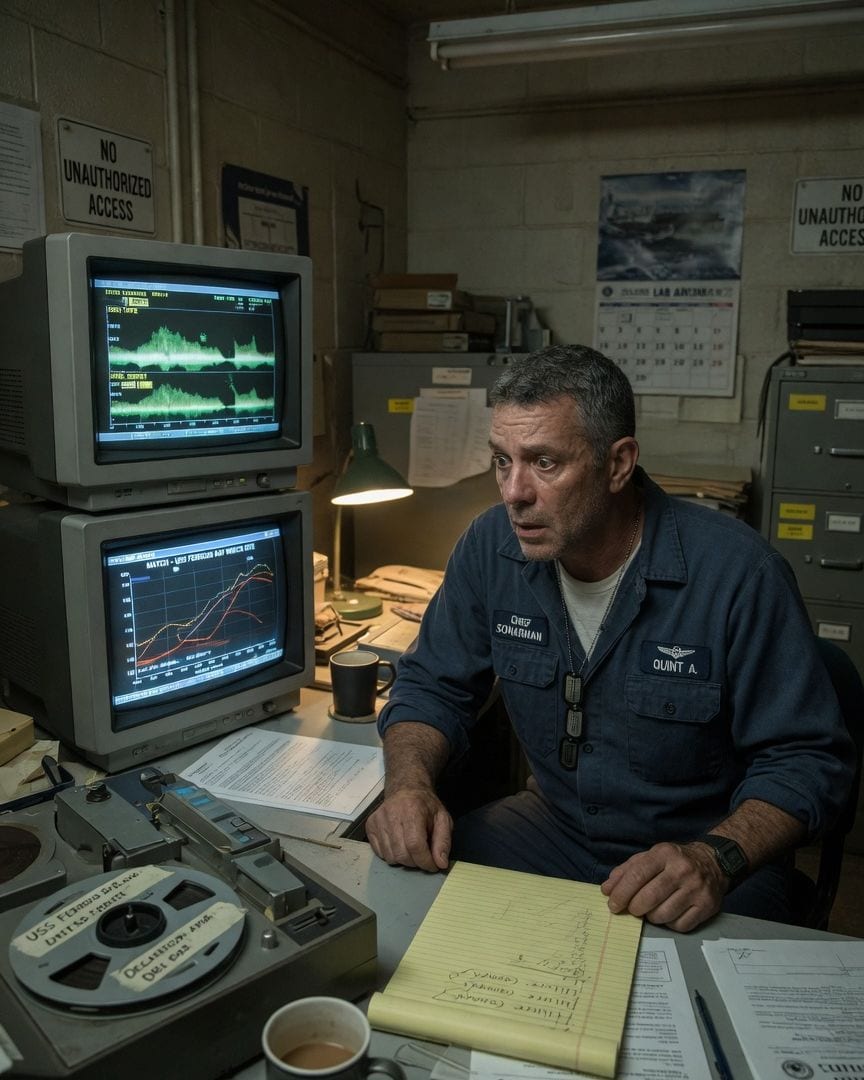
Chief Sonarman Abel Quint heard his father's 1962 transmission. But beneath it, the Cold War submarine tender's wreck site, found decades later, was already pinging its exact coordinates.
Chief Sonarman Abel Quint, 46, had spent six weeks in a dimly lit declassification lab, meticulously replaying the last transmission of the USS Ferrous Bay. The submarine tender, lost off Kodiak in 1962, carried his father, Julian Hartley, whose calm voice Abel knew by heart. But one evening, a faint, rhythmic series of pings emerged from beneath his father’s words – a distinct cadence that, when isolated, revealed coordinates hundreds of miles from the reported loss site. Abel's dread grew as the impossible truth surfaced: the 1962 recording contained the precise location and unique acoustic signature of the wreck, discovered thirty years later. The tape wasn't just predicting; it was observing the ship's own future death rattle.
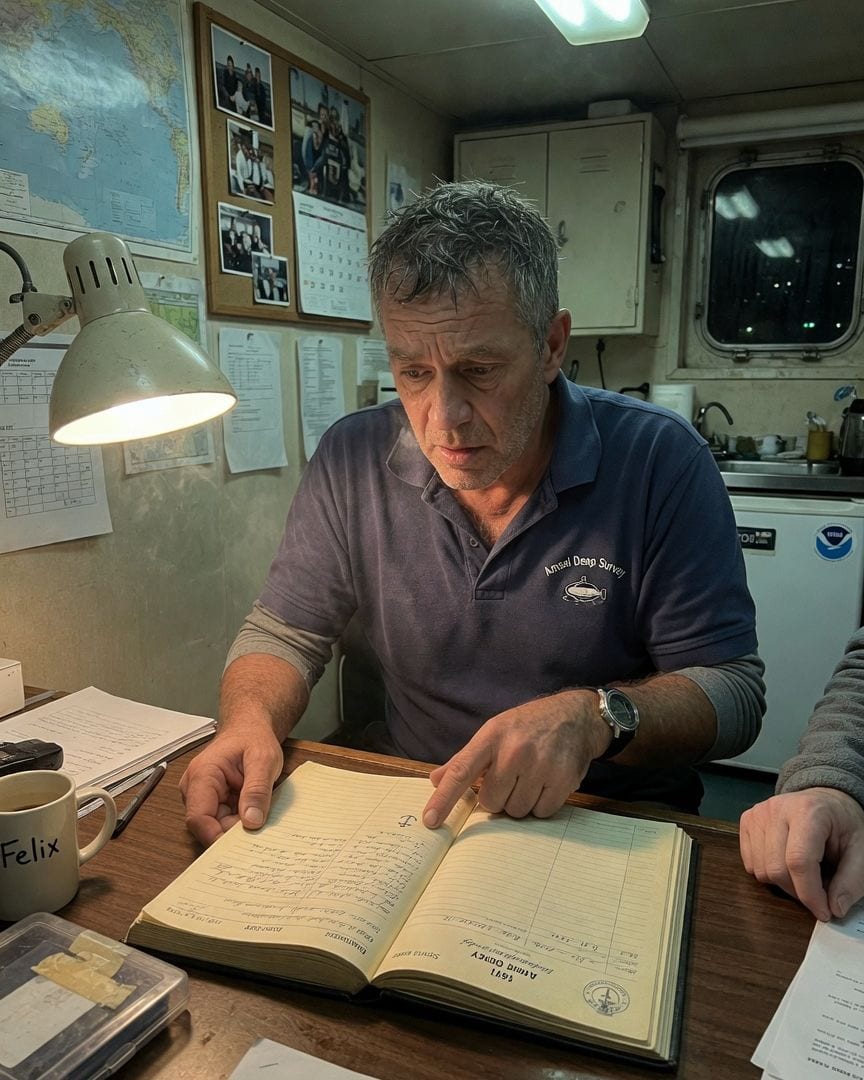
On his final deep-sea survey, a submersible pilot watches a 32-year-old Cold War wreck's rudder shift two degrees.
Deep-sea surveyor Hugo Amsel embarked on his final major dive, anticipating a quiet retirement after decades exploring the crushing pressures of the deep. His submersible's lights cut through the murky green, revealing the *Wynn Portal*, a sealer vanished in 1991, eerily preserved with unnervingly clear windows, free of any marine growth. Then, the inexplicable: the wreck's rudder angle indicator, softly lit, twitched two degrees further to starboard. Later, inside the wheelhouse, Hugo found the ship's official logbook, its final entry dated three days *after* the vessel's recorded disappearance, hundreds of miles north. How could a ship vanish, only to log a journey days later, from a place it never reached?
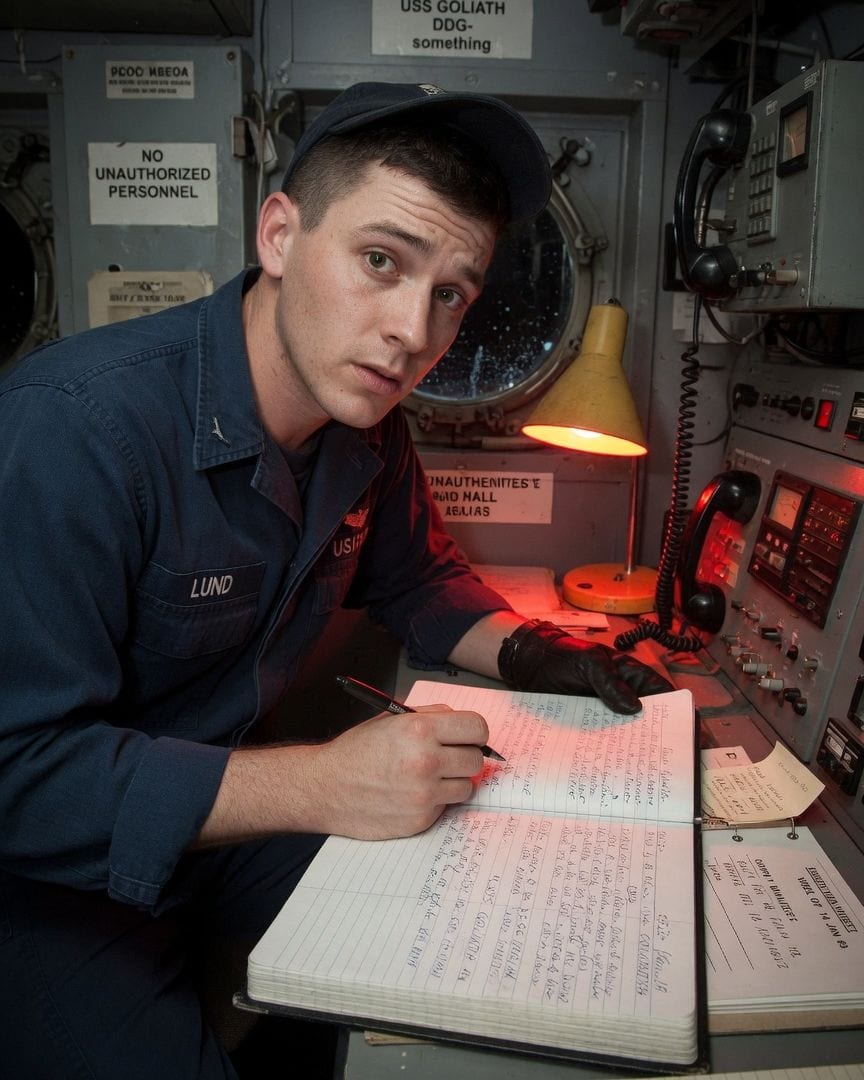
Petty Officer Lund heard his own captain's mayday: the Cold War USS Goliath was sinking, two hundred miles astern.
Petty Officer Marco Lund kept a lonely vigil in the USS Goliath's radio room, the destroyer battling the North Atlantic in deep winter 1983. Suddenly, a garbled mayday broke through: his own ship, his own captain, reporting they were going down two hundred miles astern. Though the bridge confirmed the Goliath was fine, the same chilling call came again an hour later, stronger and from the exact waters they had just crossed. Deeply unsettled, Marco began searching ship logs, eventually discovering a phantom entry: an identical mayday, logged a week prior, pressed into the very paper beneath his own.
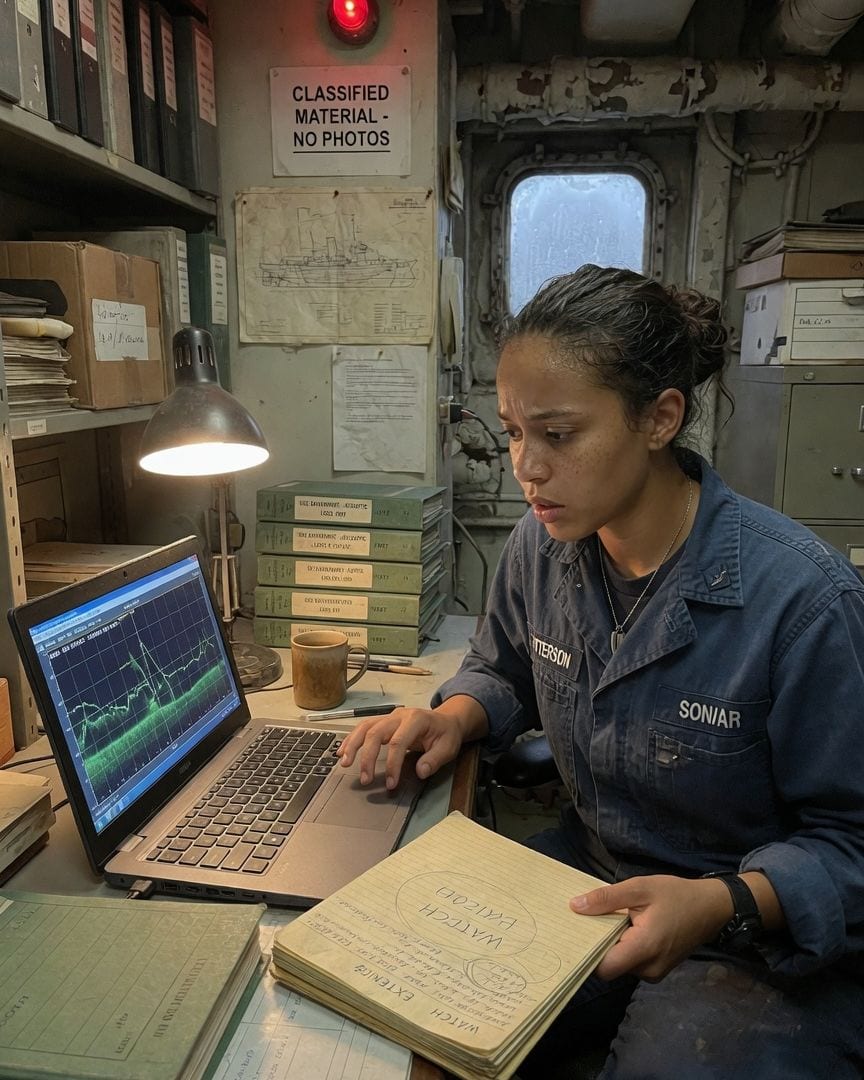
On the USS Calloway's final patrol, a sonar technician found an old log with two chilling words: 'WATCH EXTENDED.'
Sonar Technician Brooke Patterson had only two days left on the USS Calloway's last patrol, a finality that hung heavy in the humid sonar room. Through the impenetrable fog, her radar showed only empty water, but then an impossible biologic contact pinged, mimicking a vessel with eerie precision for three silent hours. It vanished at 0400, just as an identical trace had done weeks before. Searching old archives, Brooke found the precise pattern in a decades-old log from a scrapped destroyer. Scrawled next to it, in faded ink, were two words: "WATCH EXTENDED." What did those words truly mean?
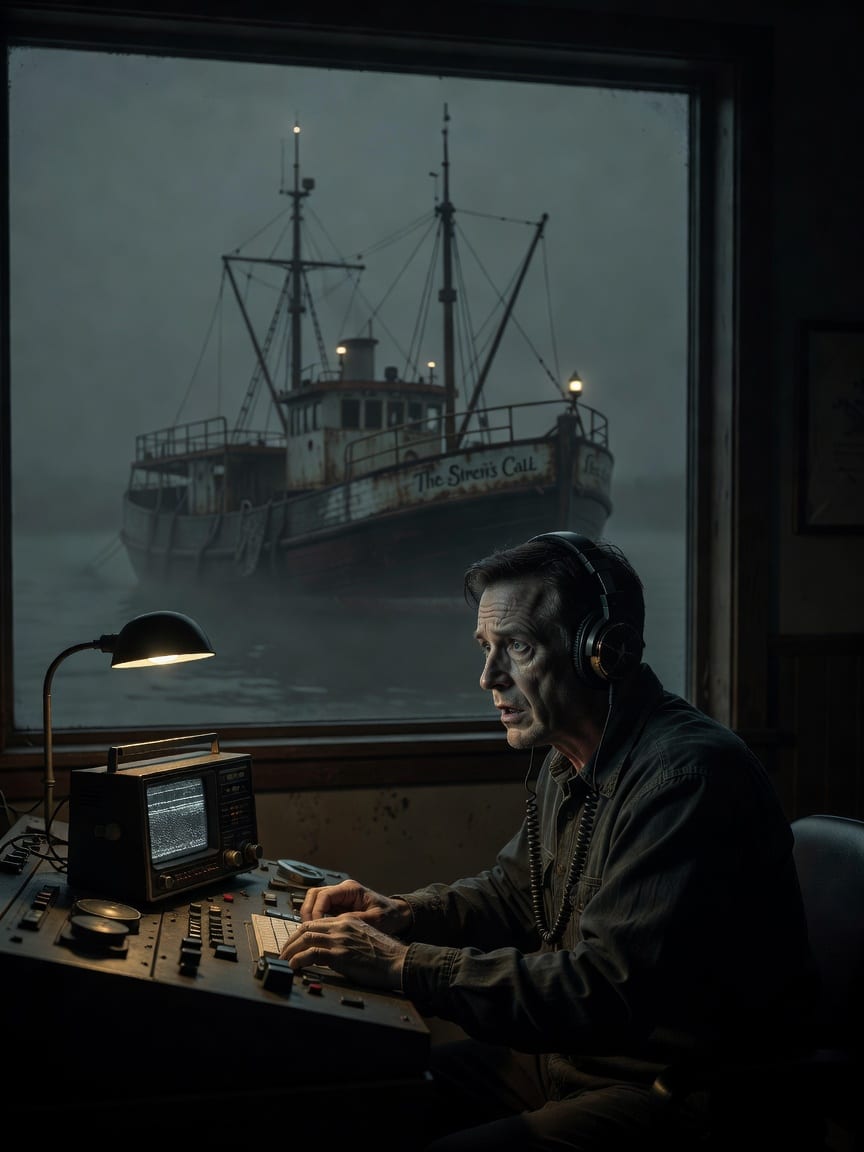
My radio picked up a skipper at 3 AM every night, asking about the bar. The harbourmaster's tapes show no calls, and that boat sank ten years ago.
Every night, as the harbour night watchman, I have a comforting ritual: guiding Tom of 'The Siren's Call' through the channel. But the harbourmaster just reviewed the tapes, and my voice is there, clear as day, while Tom's response is utter silence. And official records show his vessel, 'The Siren's Call,' sank a decade ago with all hands.
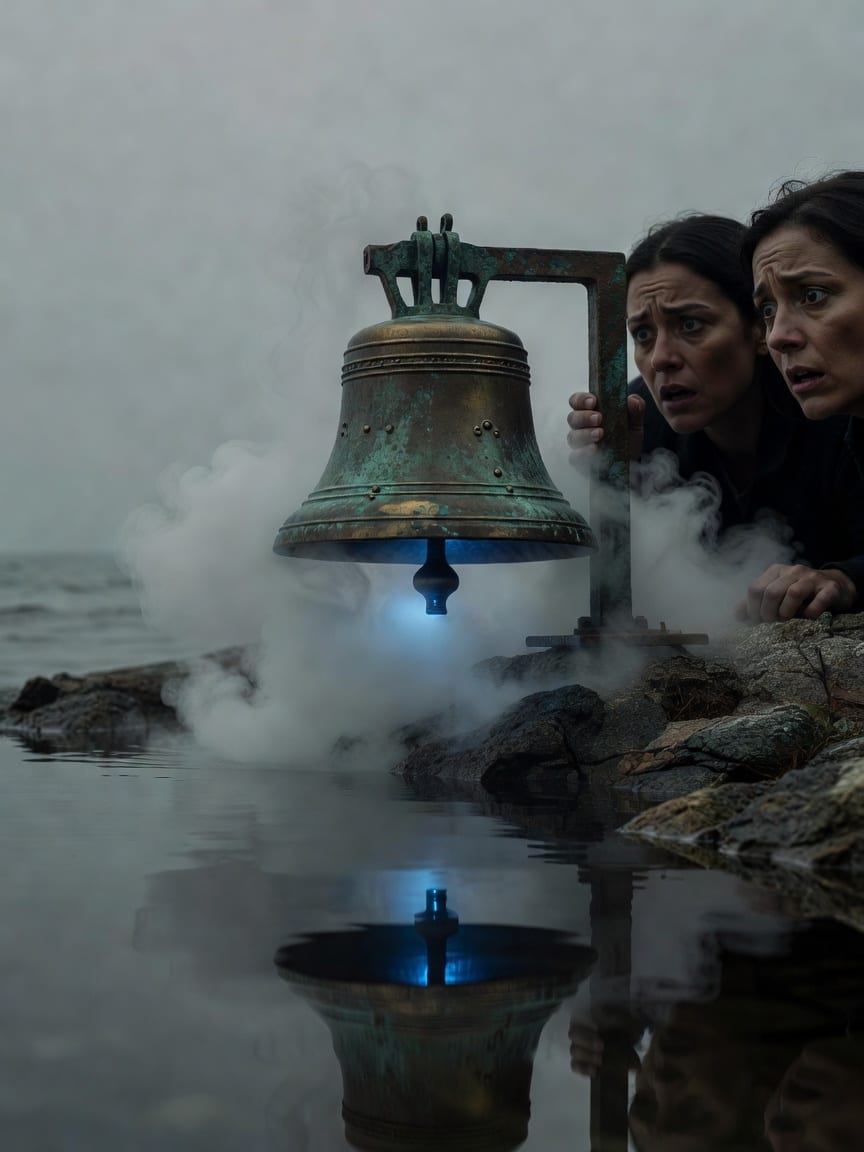
The fog bell on the point rings itself on still nights. The framed log at the yacht club lists eleven calm evenings it rang – each entry beside a boat that never came home.
Moving to a quiet coastal town, I found myself drawn to an old logbook at the yacht club. It recorded the fog bell ringing on flat-calm nights, each instance tied to a boat that simply vanished. Then, I found my own boat's name, 'The Osprey,' penciled at the bottom, marked with an unfinished, cryptic symbol.