Chief Sonarman Abel Quint heard his father's 1962 transmission. But beneath it, the Cold War submarine tender's wreck site, found decades later, was already pinging its exact coordinates.
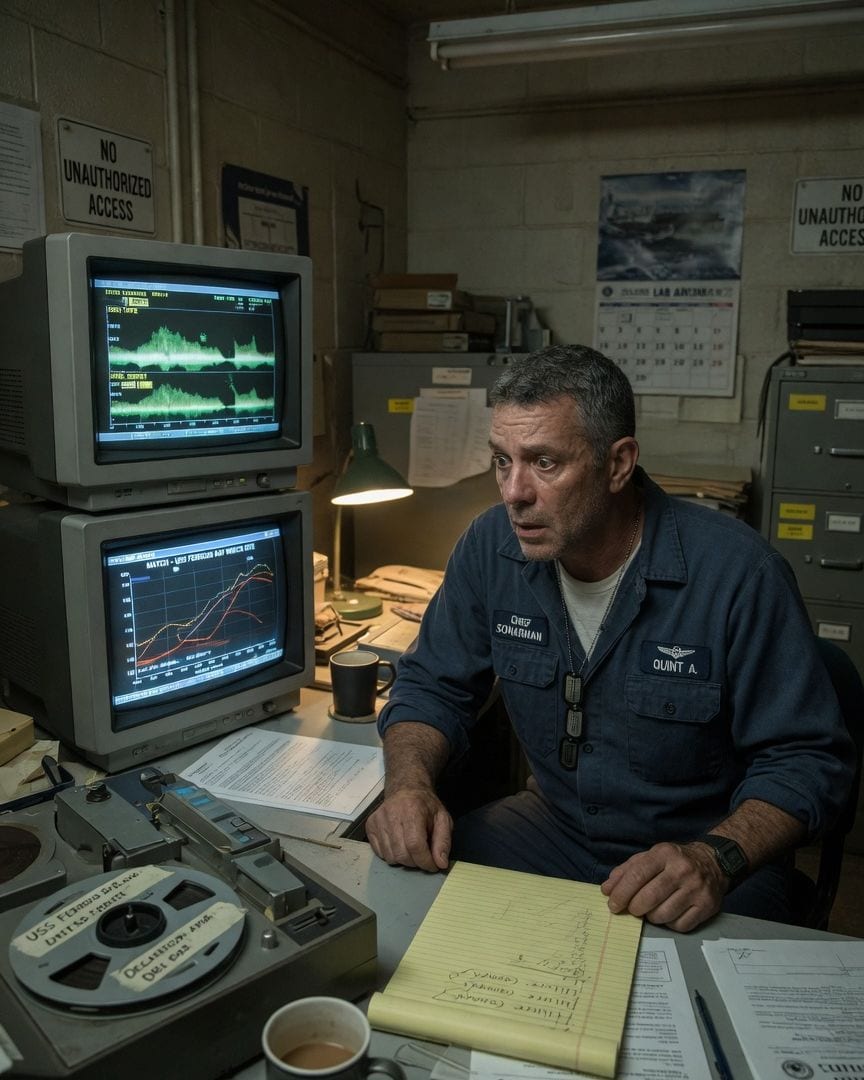
Chief Sonarman Abel Quint, 46, sat hunched over his console in the dimly lit declassification lab, the rhythmic hum of the machinery a steady drone.
For six weeks, he’d listened to the same nine minutes of tape, the last transmission of the USS Ferrous Bay, a submarine tender lost off Kodiak in 1962.
His father, Julian Hartley, 35 at the time, was on it, his voice calm, reading a bearing. Abel knew every crackle, every pause, the exact moment the static bloomed.
But this evening, as he focused, a faint, rhythmic series of pings emerged from beneath his father’s voice – not from the Ferrous Bay’s own sonar, but distinct, a different cadence.
He isolated the faint sound, running filters, his brow furrowed in concentration. The sound was clear, steady, a ghost echo from nowhere.
He amplified it, isolating it from the overlay of his father's transmission, the pings resolving into precise, measurable intervals. He plotted the data onto a digital chart. The coordinates didn't match the Ferrous Bay's reported position.
They didn't match anything current. A cold dread settled in his gut as he stared at the screen, the two sets of data overlaid, one familiar, one utterly alien.
Abel tried to rationalize the impossible. Equipment malfunction? Interference from another vessel? A mislabeled recording perhaps, something from a different incident slipped into the Ferrous Bay archives?
He pulled the original analog tape from its canister, handled it with reverent care, then meticulously cleaned the heads of the vintage player. He recalibrated his console, ran diagnostic checks on every sensor and input.
The faint pings were still there, unwavering, beneath the surface of the primary recording. He cross-referenced the Ferrous Bay's last known course with the trajectory implied by the ghost pings.
They diverged wildly, pointing to open water hundreds of miles away from the reported loss site.
He checked the Ferrous Bay’s log for any mention of unusual acoustic activity, any other vessels in the area. Nothing. The record was silent.
On a hunch, a desperate, illogical leap, he input the coordinates from the faint pings into the Navy's historical wreck database. He expanded the search parameters, including future dates, casting a net up to the present day. His breath hitched.
A match. The USS Ferrous Bay wreck site, discovered in 1992, exactly thirty years after its loss. The coordinates were precise, within meters of what the faint pings suggested.
He pulled up the official 1992 survey report, its cover stamped with a classified seal, signed by a Commander Constance Porter. His hands trembled as he read the finding, the official language confirming the location.
The tape, recorded in 1962, contained the precise location where the ship would be found three decades later. The sheer impossibility of it stole his breath.
Abel spent the next few hours poring over the 1992 survey data, comparing it with the faint soundings from the 1962 tape. It wasn't just the coordinates.
The faint pings contained a unique, complex acoustic signature – a specific resonance pattern from the wreck's hull, caused by a particular structural failure the 1992 report detailed in highly classified appendices.
This signature had never been released to the public. It was known only to a handful of recovery specialists, deep in the classified archives.
Yet, it was there, embedded in the 1962 recording, a ghostly echo of the ship's final moments. Abel stared at the two waveforms on his screen, decades apart, perfectly aligned.
His father's calm voice, reading the bearing, and underneath it, the ship's own future death rattle. He realized the tape wasn't just predicting a location; it was observing it.
The looming board meeting fueled Abel's frantic search. Commander Constance Porter, head of the declassification board, had already dismissed his initial findings as an 'unexplained acoustic anomaly,' hinting at misrecording or even a hoax.
Her voice had been polite, but dismissive, her eyes unreadable behind her spectacles. Undeterred, Abel used his access privileges to search for similar 'anomalies' in other declassified 'lost at sea' files.
He filtered for incidents where ships or aircraft disappeared mysteriously, only to have their wrecks or debris fields discovered years or decades later, with no plausible explanation for the interim silence.
He found scattered references: final transmissions with extraneous, unidentifiable data; log entries detailing impossible observations that had been dismissed as delirium or equipment failure. He focused on the cargo ship Orion's Wake, lost in 1975 in the Tasman Sea.
Its final log entry, initially deemed a hallucination by investigators, described a unique, crystalline barnacle growth pattern on its hull – a detail that only the 2005 recovery team, thirty years later, would meticulously document, classifying it as a biological anomaly never before seen.
Abel found three more cases: a reconnaissance plane whose last telemetry data included a precise, impossible atmospheric pressure reading that matched the conditions at its wreck site a decade later, deep in an unforecasted storm; a patrol boat whose final radio chatter contained a faint, rhythmic clang that corresponded to the unique, internal structural damage found during its 20-year-later salvage off the coast of Maine.
The pattern was undeniable, forming a chilling mosaic of pre-recorded losses. Each impossible detail, perfectly aligned with a future discovery, solidified a horrifying truth.
Abel’s unusual search patterns and frequent access requests didn't go unnoticed. He returned from a coffee break to find his workstation logged out, even though he'd been gone only minutes. He always locked his screen.
Files he requested were inexplicably delayed, then arrived mysteriously incomplete, crucial pages missing. The office, usually a hive of quiet activity, felt suddenly colder, the hum of the servers a low, watchful drone.
One evening, working late, the only sound the hum of the servers and the distant rattle of an old air conditioning unit, an anonymous email landed in his inbox. The subject line was simply 'Regarding Your Inquiries.'
The message itself was short, calm, and unsettlingly official: 'Some things are better left buried, Sonarman. The sea keeps its own secrets.' It wasn’t a threat, but a statement of fact, a quiet directive. The signature was 'Records Directorate.'
A cold chill traced Abel’s spine, a shiver that had nothing to do with the office air.
Someone was watching his every move, someone with deep access to his internal communications and his searches, someone with the authority to delay his files.
He knew Commander Constance Porter was the only one with that level of oversight within the declassification unit, the only one with the motive to silence him.
He felt a profound shift in his role; he wasn't just an investigator anymore, digging up old truths. He was becoming part of the very system he was trying to expose, an object of its attention.
Abel confronted Constance Porter in her austere, meticulously organized office. The room itself felt like an archive, hushed and airless, every object perfectly placed.
He laid out his compiled evidence on her polished mahogany desk: the Ferrous Bay, the Orion's Wake, and the three other distinct cases, each with impossible details of future wrecks embedded in prior transmissions or logs.
Porter listened, her expression calm, her eyes unblinking behind wire-rimmed glasses. She didn't deny the pattern. She simply watched him, her hands clasped on the desktop.
Instead, she opened a drawer in her mahogany desk and pulled out a thick, unmarked file, its edges worn smooth with age and handling.
'You're not the first to notice, Sonarman Quint,' she said, her voice devoid of emotion, as if delivering a standard briefing on naval bureaucracy. 'Your father was quite thorough.'
She handed him a document from the file: a formal report dated 1961, signed by Julian Hartley.
Abel’s heart pounded, a frantic drum against his ribs. The report detailed Julian’s discovery of 'second soundings' on a different vessel’s tape, years before the Ferrous Bay itself was lost.
Julian Hartley had been actively investigating this very phenomenon, even documenting the unique acoustic signatures. The report ended with a recommendation for 'internal classification and study,' noting the 'potential for significant implications regarding maritime safety protocols.'
Abel stared at his father's signature, the familiar, precise script, feeling a sickening lurch in his gut. His father hadn't just been a victim.
He had stumbled upon the system, had been actively, unknowingly, sucked into the very 'filing' mechanism he was now trying to expose.
The pieces clicked into place with horrifying precision: his father's calm voice on the Ferrous Bay tape, the second soundings beneath it – Julian wasn't just lost; he was, in his final moments, still recording, still part of the 'study.'
Porter calmly explained that Julian Hartley's findings had been integrated into a 'classification system' — a framework to understand, and perhaps manage, these 'predetermined events.' Her voice remained level, utterly detached, as if discussing weather patterns.
She gestured to a massive, steel-reinforced filing cabinet against her office wall, its drawers labeled with cryptic codes and dates. It loomed like a tombstone in the silent room.
'The file is still being written, Sonarman,' she said, a faint, unsettling smile playing on her lips, her gaze fixed on him.
Abel’s eyes drifted to a sequence of meticulously organized folders in one of the open drawers of the cabinet, a section labeled 'Active Cases.' His heart seized, a cold fist closing around it.
He saw a list of dates, names, and projected 'loss' events. His eye caught a familiar sequence of numbers, a unique identifier he knew too well.
It was his service number, followed by a date in the near future, and then a blank space under 'Event.' A cold, crushing certainty settled over him, heavier than any ocean pressure.
He looked up at Porter, her faint smile widening just a fraction, her eyes holding his.
He realized his father's investigation hadn't just been filed; it had continued, and now, Abel himself was simply the next entry, his own fate already recorded in the Directorate's patient, waiting ledger.
Porter continued, her voice a low, administrative drone that seemed to fill the silent office, pressing in on Abel from all sides.
The 'Records Directorate,' she explained, wasn't merely an archive; it was an institution that identified and documented 'predetermined events.' These 'pre-files,' she clarified, weren't predictions or prophecies. They were the actual records, written in advance, of what would inevitably occur.
His father, Julian, had stumbled upon this system, and his 'investigation' into the 'second soundings' had become his own pre-file, his eventual loss on the Ferrous Bay already logged.
The second soundings on the Ferrous Bay tape weren't a future observation, but Julian, in his final moments, inadvertently recording the pre-file's details, just as he had documented others.
Abel saw the horrifying coherence of it all, a meticulous, bureaucratic horror. Every 'lost at sea' event, every unexplained disappearance, every vessel that vanished without a trace – all were pre-written entries in this vast, patient ledger.
He saw the pattern across decades, the meticulous, cold-blooded efficiency, the quiet horror of a system that didn't prevent, but merely recorded.
The institution didn't cause the events, it simply knew them, and filed them away, absorbing anyone who got too close into its own meticulous documentation.
He understood now that his father hadn't been a victim in the traditional sense, but an unwitting recorder of his own predetermined end, just as he had documented others.
The system was a silent, unblinking eye, and his father had merely provided another entry.
Abel tried to challenge Porter, to expose the system, to scream that this was monstrous. But Porter merely offered a serene, almost pitying smile. The air in the room felt heavy, suffocating. 'Who would believe you, Sonarman?'
she asked, her voice soft, barely above a whisper, yet it cut through him. 'Every piece of evidence you've found is already classified, or will be. And your own file is quite complete.'
She gestured to the open folder with his service number, a gesture of quiet finality. 'You see, the records aren't meant to be discovered, only maintained. Your father understood that, eventually.'
Abel felt a profound, crushing sense of helplessness. The system was too vast, too patient, too deeply embedded in the very fabric of naval operations. There was no escape, no public exposure.
He was trapped within the record, his own fate already written. He made a desperate lunge for his father's original 1961 report, the document proving Julian had been an investigator, not merely a passive victim of the 'pre-file.'
He needed to reclaim that last vestige of his father's agency, a final act of defiance.
But before his fingers could brush the aged paper, two impassive men in crisp, dark uniforms, who had been standing silently by the door, moved with swift, silent precision, blocking his path.
One gently but firmly gripped his arm, his touch devoid of malice, purely efficient. Abel struggled, a raw, inarticulate cry rising in his throat, but the grip tightened, unyielding. He was caught. He was filed.
The board convened the next Friday, precisely as scheduled. Chief Sonarman Abel Quint's findings regarding the Ferrous Bay were officially classified as an 'unexplained acoustic anomaly,' filed away in the archives, sealed from further inquiry.
Commander Constance Porter chaired the meeting, her expression calm, professional, completely unburdened. The meeting concluded within minutes. Abel Quint was quietly reassigned to a remote, obscure naval listening post in the Aleutian Islands, his access to declassification files permanently revoked.
His colleagues heard he'd suffered a nervous breakdown due to the stress of his father's case, a polite fiction that smoothly explained his disappearance. The system moved on, seamless and undisturbed.
Abel Quint now sits alone in a small, windowless office on a desolate Alaskan coast, monitoring a sonar array that hasn't registered a single contact in years.
The wind howls outside, a constant, mournful sound, and inside, he listens to the rhythmic pings of the empty ocean, endlessly.
Sometimes, in the vast quiet, he hears his father's calm voice, reading bearings, and beneath it, the faint, distant echo of another set of pings, a cadence he knows too well. He knows the file isn't closed.
It's just waiting for its last entry.
Years later, a new Chief Sonarman, Gideon Novak, reviewing archived tapes from Abel Quint's old posting, noted an unusual, faint set of pings beneath the routine recordings.
The cadence was distinct, the coordinates precise, marking a place in the deep ocean where no ship had ever been recorded lost. Yet.
The file is still being signed.
If this one got to you
A Cold War sonarman heard his dead father’s voice on a tape, charting the ship’s wreck thirty years after it sank.
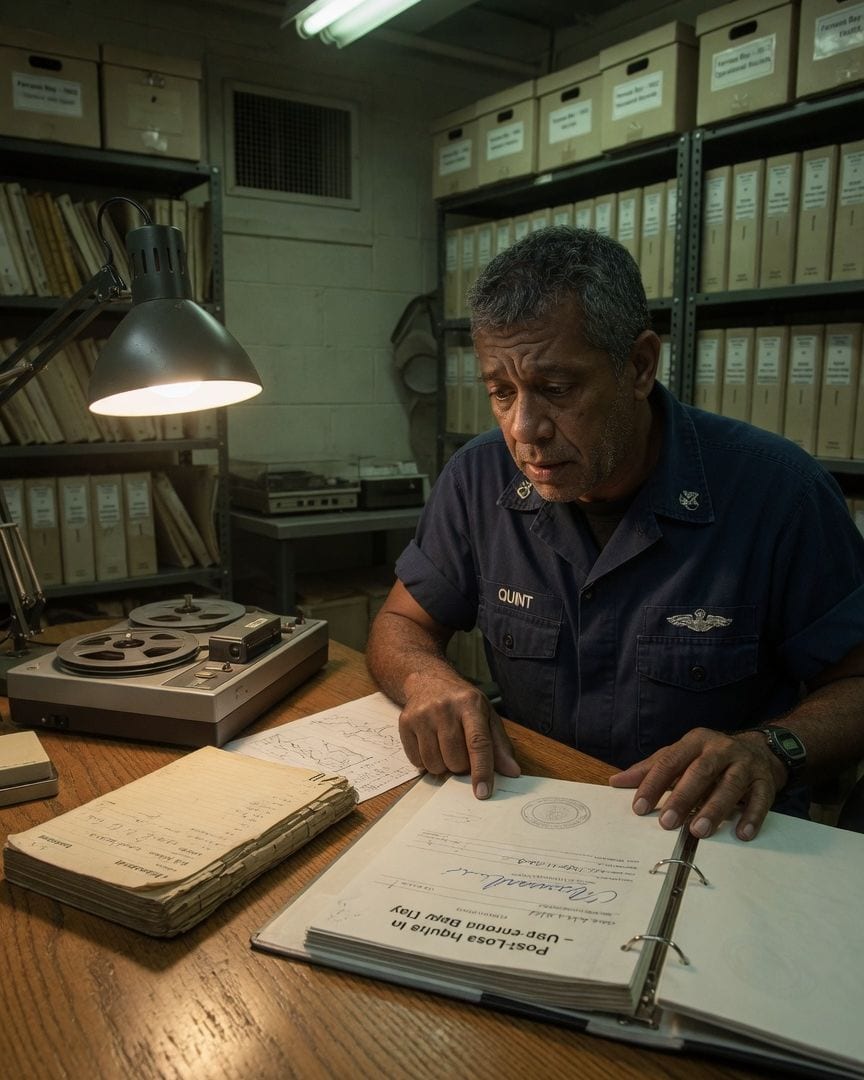
Chief Sonarman Abel Quint spent six weeks in the Naval Records vault, listening to the final transmission of the USS Ferrous Bay. His father, Desmond Quint, was on that ship when it vanished in 1962, and Abel sought some final comfort in his voice. But on this morning, a faint, second set of sonar soundings emerged from the recording—soundings in his father's precise cadence that charted the ship’s wreck site thirty years in the future. As Abel cross-referenced records, he then found a maintenance log for the Ferrous Bay's sonar system, dated six months after the ship and his father were officially lost, signed by Desmond Quint himself. What impossible truth was hidden in these official naval records?
On his final deep-sea survey, a submersible pilot watches a 32-year-old Cold War wreck's rudder shift two degrees.
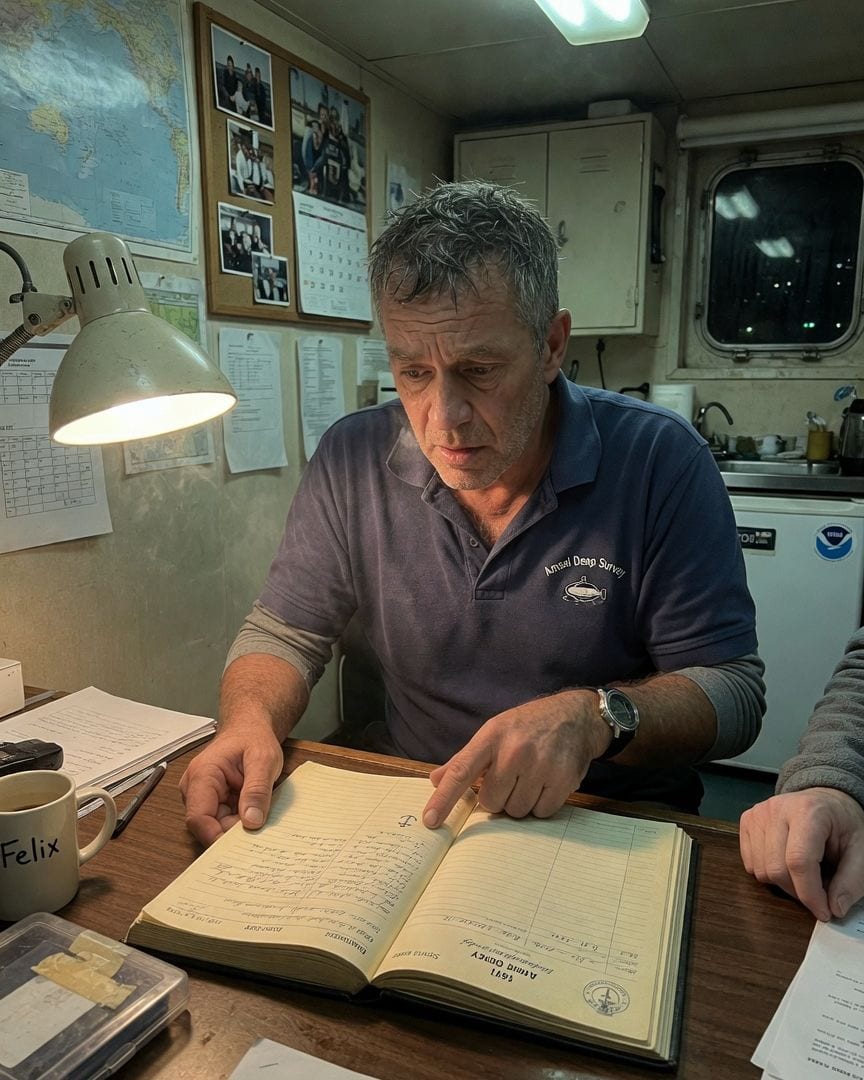
Deep-sea surveyor Hugo Amsel embarked on his final major dive, anticipating a quiet retirement after decades exploring the crushing pressures of the deep. His submersible's lights cut through the murky green, revealing the *Wynn Portal*, a sealer vanished in 1991, eerily preserved with unnervingly clear windows, free of any marine growth. Then, the inexplicable: the wreck's rudder angle indicator, softly lit, twitched two degrees further to starboard. Later, inside the wheelhouse, Hugo found the ship's official logbook, its final entry dated three days *after* the vessel's recorded disappearance, hundreds of miles north. How could a ship vanish, only to log a journey days later, from a place it never reached?
On the USS Calloway's final patrol, a sonar technician found an old log with two chilling words: 'WATCH EXTENDED.'
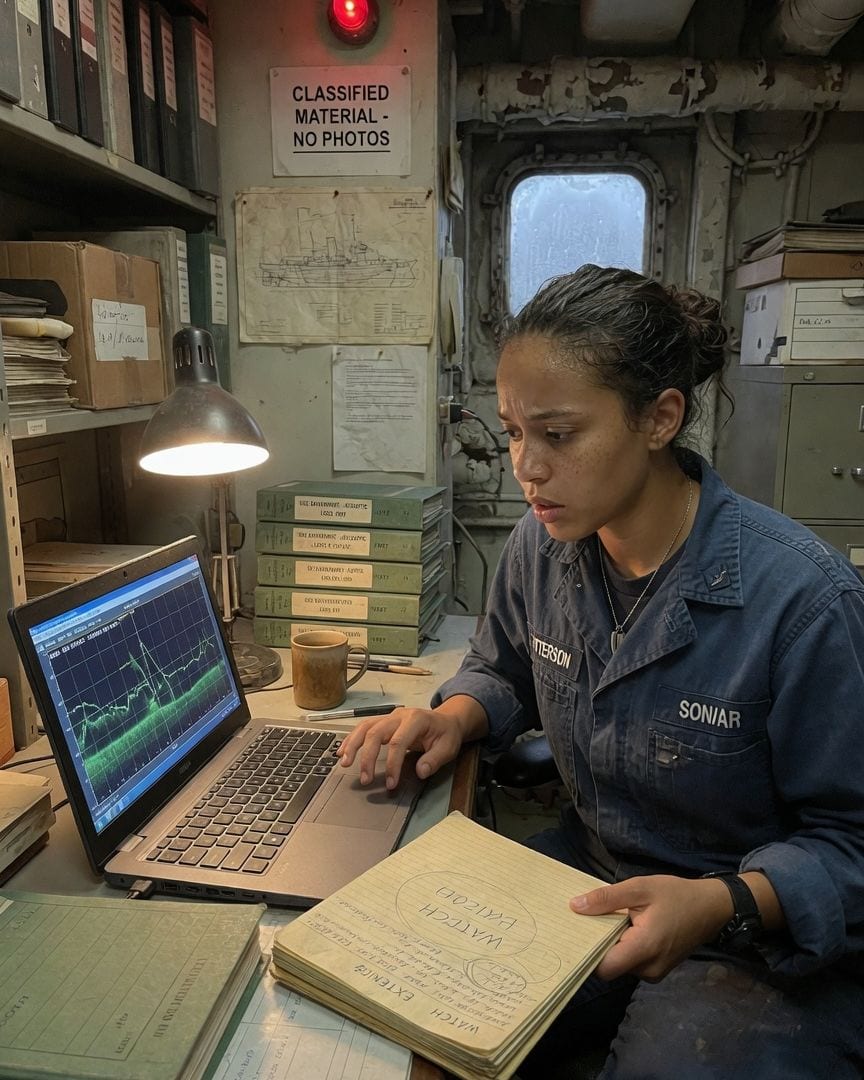
Sonar Technician Brooke Patterson had only two days left on the USS Calloway's last patrol, a finality that hung heavy in the humid sonar room. Through the impenetrable fog, her radar showed only empty water, but then an impossible biologic contact pinged, mimicking a vessel with eerie precision for three silent hours. It vanished at 0400, just as an identical trace had done weeks before. Searching old archives, Brooke found the precise pattern in a decades-old log from a scrapped destroyer. Scrawled next to it, in faded ink, were two words: "WATCH EXTENDED." What did those words truly mean?
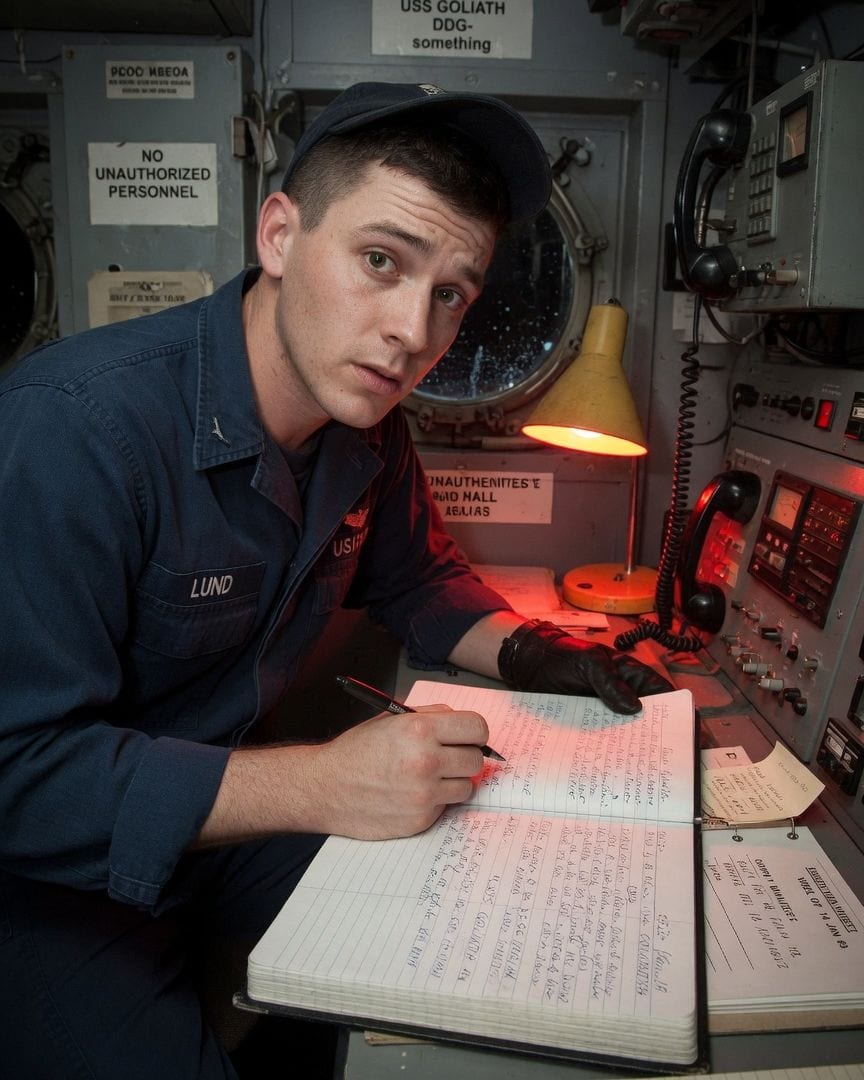
Petty Officer Lund heard his own captain's mayday: the Cold War USS Goliath was sinking, two hundred miles astern.
Petty Officer Marco Lund kept a lonely vigil in the USS Goliath's radio room, the destroyer battling the North Atlantic in deep winter 1983. Suddenly, a garbled mayday broke through: his own ship, his own captain, reporting they were going down two hundred miles astern. Though the bridge confirmed the Goliath was fine, the same chilling call came again an hour later, stronger and from the exact waters they had just crossed. Deeply unsettled, Marco began searching ship logs, eventually discovering a phantom entry: an identical mayday, logged a week prior, pressed into the very paper beneath his own.
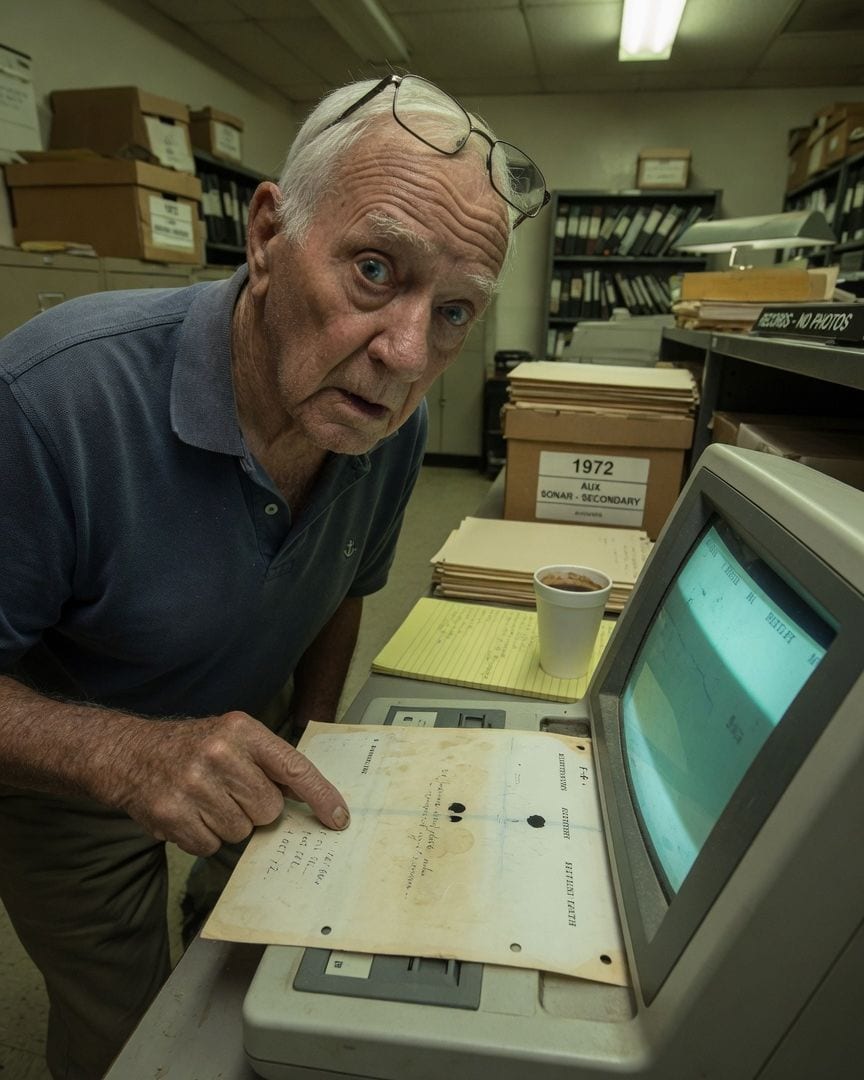
A Chief Petty Officer's salvage career ends when a Cold War fighter jet surfaces at sixty tons, perfectly intact.
Chief Petty Officer Walter Mabey, then 45, expected a routine salvage operation for a lost F-4 fighter jet off the Carolina coast in 1972. His long career was built on such lifts, but as the crane gauge climbed past twenty, then thirty, then an impossible sixty tons, a profound unease settled in. The object surfaced, not a mangled wreck, but a dark, seamless shape, perfectly intact. Mabey's salvage career abruptly ended soon after, replaced by a desk job, but the memory festered for forty years. Now 78, he dedicates his remaining time to finding the truth, uncovering a faint, rhythmic pulse on an old sonar log—a ghost beneath the official lie.
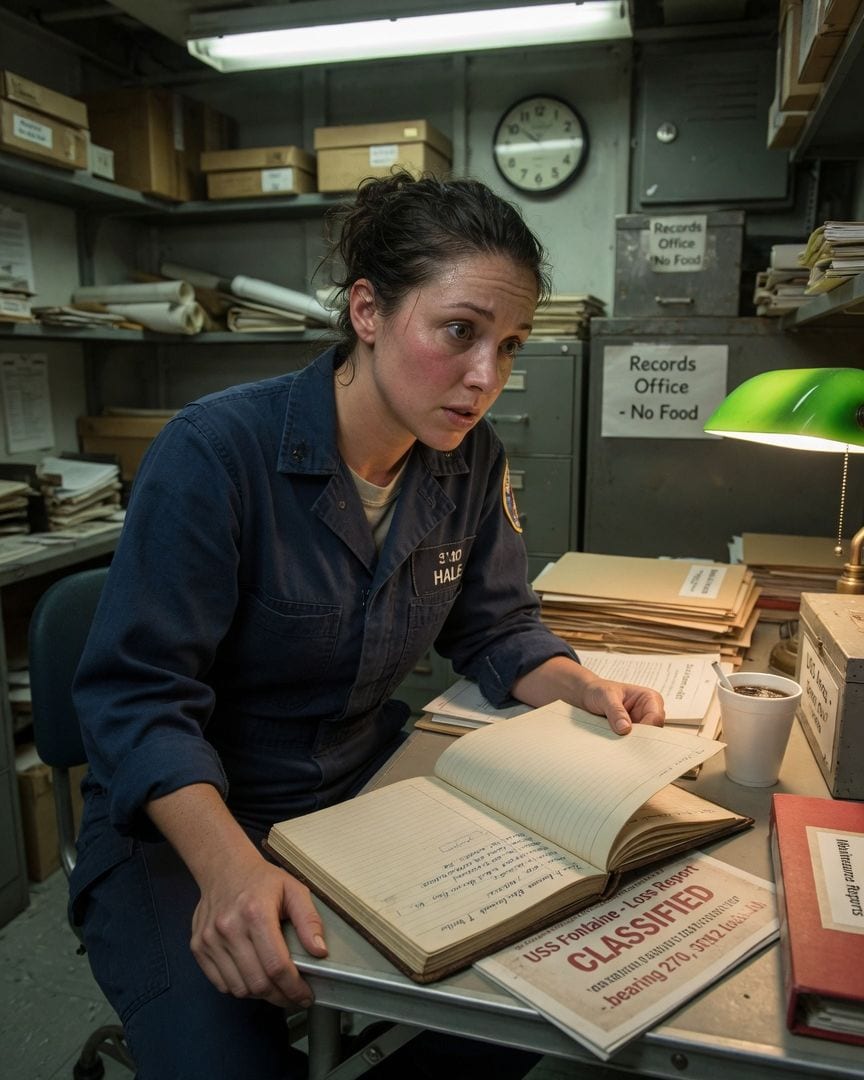
Petty Officer Hale needs a spotless record for her transfer. But the USS Ares sonar logs show an identical, impossible contact, logged to the minute, years apart, and tied to a classified loss report.
Petty Officer Sarah Hale needed a spotless record for her coveted shore duty transfer, a posting she'd worked five years to secure. Alone in the USS Ares sonar shack, three days out from San Diego, her midwatch was broken by an impossible contact: a close, slow echo holding perfect pace, invisible to radar, then vanishing. Her heart hammered, not from fear, but from the data's impossibility. When she found an identical entry in her own log from just one week prior, the cold dread tightened its grip. But the true chill settled when she unearthed decades of similar records, signed by other sonar officers, all showing the same impossible contact at 0212, off the port beam, for nineteen minutes, on the same ship, stretching back years—a persistent echo tied to a classified loss report.