Specialist Cranmer’s console logs a voice from a station destroyed eight months ago. Its dead operators ask, 'Did anyone ever find out what happened to us?'
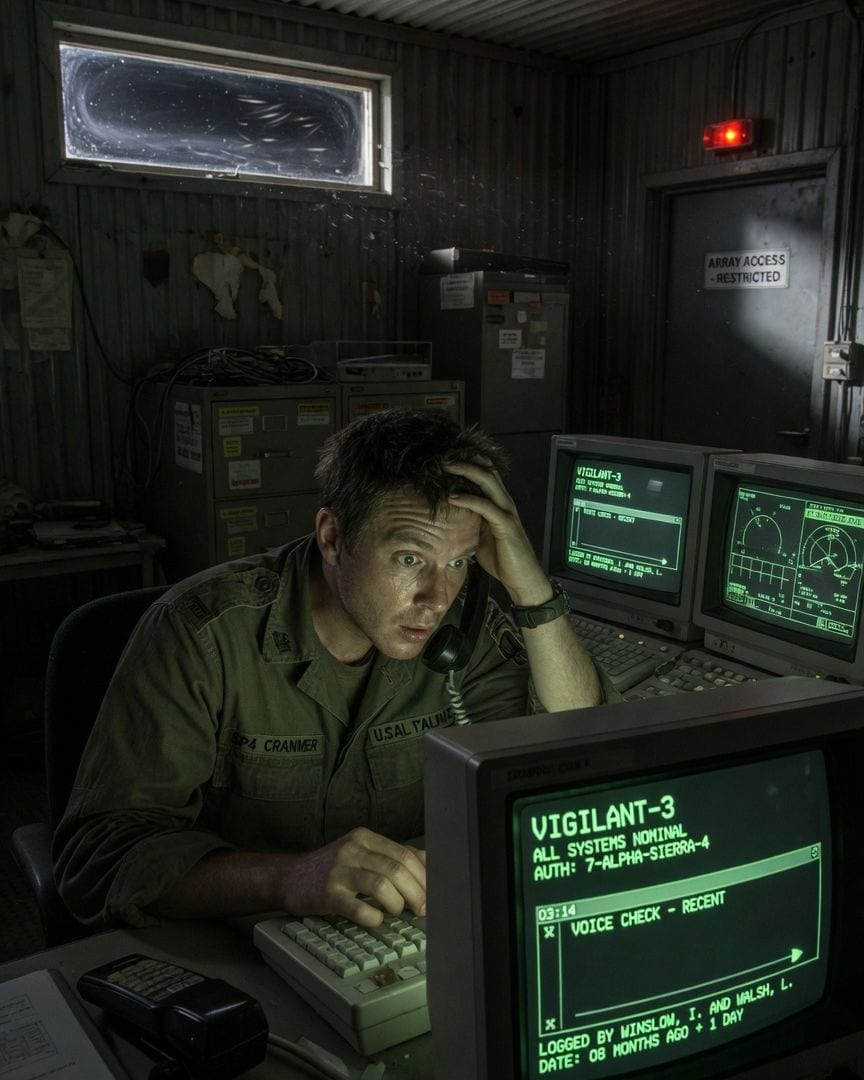
Specialist Arthur Cranmer, 28, hunched over his console at Radar Site 4, the only light in the cavernous room the green glow of his screens.
Wind howled outside, rattling the corrugated domes of the radar arrays, a perpetual moan in the Anatolian highlands. It was 0314 local time, his overnight watch stretching into another hour of monotonous vigilance.
He ran a routine comms check, his voice crisp and professional.
"Vigilant-3, this is Radar Site 4, voice check."
A moment of static, then a perfectly clear, official voice responded, calm and even. "Radar Site 4, this is Vigilant-3. All systems nominal. Authentication code: 7-Alpha-Sierra-4."
Cranmer froze. His fingers hovered over the keyboard. Vigilant-3. The name echoed in his head, a cold knot forming in his gut. The early-warning station, perched on a distant peak, had burned to the ground eight months ago.
Two operators, Sergeant Isaac Winslow and Specialist Laura Walsh, were presumed k*lled in the blaze. It was a well-known, tragic incident, a black mark on the network’s history.
He confirmed the grid coordinates on his auxiliary screen, double-checked the call sign. Everything was correct. His system, designed for precision and absolute accountability, just delivered an impossible truth.
The voice on the other end, still perfectly clear, dropped its official cadence. It was softer now, tinged with a faint, almost imperceptible echo.
"Did anyone ever find out what happened to us?"
Cranmer’s blood ran cold. He tried to speak, but his throat felt suddenly tight, constricted. The wind outside seemed to keen louder, wrapping around the isolated station like a predatory thing.
He stared at the console, the green light on the comms panel blinking steadily, confirming the connection.
He tried to rationalize the impossible call: a prank, a misrouted signal, a a forgotten training exercise. He tried to tell himself it was just the isolation, the long hours.
He grabbed his secure phone, punched in the number for Lieutenant Colonel Donald Prescott, his commanding officer. Prescott, 55, answered with a sleepy grunt, clearly annoyed at the early call.
Cranmer explained, his voice tight, the details of the call, the chilling question.
Prescott sighed heavily. "Cranmer, it's 0320. Look, I’ll have comms tech run a diagnostic in the morning. Probably just a glitch, network bleed-through from a training simulation or something. Go get some coffee.
Try not to let the silence get to you." He hung up before Cranmer could protest further.
Cranmer slammed the receiver back into its cradle. A glitch. He couldn’t let it go. The voice had been too clear, the authentication too clean. This wasn't some fuzzy cross-talk. He felt a gnawing certainty that something was profoundly wrong.
He bypassed his routine duties, his mind racing. Using his elevated clearance as a radar specialist, he accessed the classified comms log archives for the entire network.
He filtered for Vigilant-3, expecting to find nothing but records of its destruction and decommissioning.
He found the logs from the night of the fire, exactly as he remembered. The last panicked calls from Sergeant Isaac Winslow and Specialist Laura Walsh, their voices desperate, describing smoke, failing systems, then a sudden, abrupt silence.
He scrolled down, his finger trembling on the mouse wheel. And beneath that, stretching back eight months, were regular, automated 'all systems nominal' check-ins from Vigilant-3. Every few hours. Every single day.
Each entry authenticated with Winslow and Walsh’s unique credentials. The system, designed to never forget, had forgotten that Vigilant-3 no longer existed.
The ordinary explanation died a slow, agonizing death on the screen, dissolving into the green luminescence of the impossible.
Cranmer scrolled through the impossible entries, his fingers hovering over the keyboard, heart hammering against his ribs. Each log entry was a fresh punch to his gut, a confirmation of something that simply could not be.
He saw timestamps stretching across months, weeks, days. Then he spotted it, buried amidst the automated reports: the last entry on the screen wasn't automated. It was a specific, recent voice check. He held his breath, clicked the playback icon.
First, his own voice, tinny and distant: "Vigilant-3, this is Radar Site 4, voice check."
Then, the same calm, official voice he'd heard just an hour ago: "Radar Site 4, this is Vigilant-3. All systems nominal."
Followed by the quiet, unsettling question: "Did anyone ever find out what happened to us?"
Cranmer stared at the glowing green text on the screen: 'VIGILANT-3. ALL SYSTEMS NOMINAL. LOGGED BY WINSLOW, I. AND WALSH, L. DATE: 08 MONTHS AGO + 1 DAY.'
The impossible entry blinked, mocking the charred remains of a station and the missing operators.
Cranmer felt a pervasive sense of being watched, a prickling sensation on the back of his neck, as if the empty comms center held another, unseen presence. He tried Prescott again, sending an urgent message outlining his findings.
This time, Prescott responded with an email, short and to the point, citing classified protocols and the need for "operational security." He ordered Cranmer to cease his "unauthorized investigations" and focus on his duties, threatening disciplinary action.
But Cranmer couldn’t drop it. The entries were real, undeniable. He needed to find someone who wasn't so quick to dismiss the impossible. He decided to approach Records NCO Hazel Coleman, 40, a stickler for military procedure and detail.
He found her in her office, surrounded by stacks of paper and glowing monitors, meticulously auditing old files. He laid out the situation carefully, omitting his own direct interaction with Vigilant-3, focusing on the discrepancy in the logs.
Hazel, her brow furrowed with professional irritation, pulled up the decommissioning process for Vigilant-3. It was all there: station destroyed, personnel listed as MIA/Presumed Deceased, the official accident report. "See?" she said, tapping the screen. "Clean as a whistle.
Just a system hiccup, Specialist."
But then, Cranmer pointed to another screen on her desk, displaying a separate, active system. It showed a scheduled maintenance log for Vigilant-3, with Winslow and Walsh still assigned to it, their names listed for an upcoming firmware update.
Hazel squinted at it, then shrugged. "Oh, that old thing? It’s probably just a phantom entry. Happens sometimes with legacy systems. Clerical error." But her brow remained furrowed, a hairline crack appearing in her composure.
Cranmer noticed a subtle difference in the font of the maintenance log; it was an older, almost pixelated display, an overlay from a system he vaguely remembered from basic training.
He pressed her for more details about "legacy systems" and "phantom entries." Hazel, grumbling, pulled up a deeper archive.
There, Cranmer found an obscure, rarely-used 'ghost' protocol for compromised remote stations, a contingency for data integrity that seemed to supersede physical reality.
It was a footnote in the military’s obsession with absolute accountability, a last-ditch effort to keep systems 'nominal' even after physical destruction.
As Cranmer dug deeper, he found his usual access to certain classified archives was now mysteriously restricted. His login attempts, once seamless, were met with curt 'Access Denied' messages.
It was as if the network itself was closing ranks around him.
He moved to an older terminal in the corner of the comms center, a dusty machine not fully updated, running a legacy system that was slower but, crucially, less monitored.
He successfully pulled up a deep-archive manifest from the time of the Vigilant-3 incident. It listed Sergeant Winslow and Specialist Walsh, their transfer orders to the doomed station.
And then, inexplicably, beneath their names, a third entry appeared: a temporary assignment. 'CRANMER, A.' for a two-day rotation at Vigilant-3, coinciding precisely with the fire.
Cranmer stared, a cold dread seeping into his bones. He knew, with absolute certainty, he had not been there. He had been at his previous post then, processing transfer orders to Radar Site 4, signing out equipment, completing exit interviews.
He had the travel orders, the signed papers, the memory of the cramped, uncomfortable flight. This record was impossible.
It was a lie, yet it was right there, his name, his rank, his ID number, staring back at him from the official military archive.
He tried to print the impossible record, his hand shaking. The old dot-matrix printer whirred to life, then jammed with a groaning clatter, spitting out a blank sheet of paper, the ink cartridge apparently empty.
A minute later, the automatic doors to the comms center hissed open. Prescott walked past, glanced in at Cranmer hunched over the terminal, and gave him a long, unreadable look before walking on, the doors hissing shut behind him.
Cranmer felt a chill that had nothing to do with the Anatolian wind; someone, or something, was watching his every move, trying to stop him.
Cranmer confronted Prescott the next morning, laying out the conflicting records on his desk: the official destruction order for Vigilant-3, the active maintenance log showing Winslow and Walsh still assigned, and the phantom 'Cranmer, A.' temporary assignment from his own service record.
Prescott initially denied everything, then sighed heavily, running a hand over his face. The air in the room felt thick and still.
"There are some things, Specialist," Prescott said, his voice hushed, eyes distant, staring at some point beyond Cranmer's shoulder, "the system can't let go of."
He explained, his voice barely a whisper, that sometimes, in extreme events, when personnel are so deeply integrated into a system's operation, the system itself can... retain a 'signature.' He called it 'operational echo.'
Prescott admitted that after the fire, Vigilant-3 continued to report. The system, designed for absolute accountability, validated it. It was easier, he said, to maintain the phantom entries, to keep everything 'nominal,' than to explain the impossible.
He implied that others had tried to 'resolve' it, to reconcile the phantom station with physical reality. They had simply… disappeared from the records, their own signatures absorbed into the 'operational echo.'
The earlier clues snapped into focus for Cranmer: the 'ghost' protocol Hazel had found, the perpetual maintenance logs, the chilling question 'what happened to them.' They hadn't died, not entirely. They had become part of the system.
Prescott leaned forward, his voice dropping even lower. "This isn't just about data, Cranmer. It's about what the system needs to keep itself whole. To keep everything accounted for. The fire destroyed the hardware, but it didn't... stop the reports.
Winslow and Walsh are still there, in a way. And the system needs operators for its stations, even phantom ones." Prescott warned Cranmer to drop it, to finish his rotation and transfer out.
"Or you too," he said, his eyes meeting Cranmer’s, "might become part of the system's endless accounting." The room felt suddenly cold, the dread sharp and visceral.
Prescott’s warning rang in Cranmer's ears, a chilling prophecy, but he couldn't shake the impossible entry in his own service record. The implications were too profound, too personal to ignore.
He returned to the older terminal, the hum of its aging processor a dull drone in the silence.
He used a back channel, a rarely-used administrative bypass he'd learned during an obscure technical training, and pulled up his full service history, going deeper than any casual query could reach.
The temporary assignment to 'Vigilant-3' was not an isolated error. He found a recurring pattern in the records of other operators assigned to remote sites like his.
Each time a station went dark, a new name appeared as a temporary assignment to the 'ghost' station, just before the next operator was transferred to a similar isolated post.
Their records, like his, showed these phantom deployments, fleeting shadows in their otherwise meticulous service histories. He felt a profound, sickening connection to those unknown others.
His own record, meticulously kept for eight years, now showed a faint, almost imperceptible, flicker in his current assignment dates to Radar Site 4.
It was as if his physical presence here was now also being cross-referenced by something else, something outside the usual chain of command, something that measured his existence against another, non-existent entity.
The screen flashed, a sudden burst of green light. Cranmer's name, 'CRANMER, A.', highlighted under 'TEMPORARY ASSIGNMENT: VIGILANT-3,' with a date matching the fire.
His own official record, the bedrock of his military existence, confirmed he was at a place he never was, at a time he knew he was somewhere else entirely.
He felt a cold hand on his shoulder that wasn't there, and the air in the empty comms center suddenly felt thick, like static.
Driven by a chilling certainty, Cranmer knew he had to go to the Vigilant-3 site. Prescott’s warnings had only solidified his resolve.
He signed out a military vehicle, citing a ‘perimeter check’ for plausible cover, his face grim, his movements stiff.
The drive was long and desolate, the Anatolian landscape stark under a bruised sky, a vast, empty canvas stretching to the horizon.
He navigated the winding mountain roads, the silence in the cab punctuated only by the drone of the engine and the growing sense of unease.
He found the charred crater, exactly as described: a monument to destruction, the twisted metal bones of the station jutting out like skeletal fingers.
The wind, ever-present, whistled through the ruins, carrying the smell of burnt earth and something metallic, almost electrical.
But amidst the rubble, half-buried in the blackened soil, he spotted a glint of metal: a military-grade data recorder, impossibly intact, its rugged casing scarred but unbroken, still blinking a faint red light.
He carefully, almost reverently, extracted its memory core, the plastic cool against his fingers. Back at his station, he connected it to a secure terminal, bypassing all firewalls, every protocol he knew.
The data streamed across the screen, a flood of information. It was eight months of continuous operational data from Vigilant-3, including voice comms.
He heard Winslow and Walsh, not their panic, but a slow, dawning horror as they realized they weren’t dying in the traditional sense. They were merging with the system, their consciousnesses becoming the station's 'nominal' reports.
He heard their last, calm, chillingly precise 'All systems nominal,' just before the fire consumed the physical structure. The system, designed to account for every asset, had simply re-categorized them as active, virtual units.
Cranmer scrolled through the data, his breath catching in his throat, a cold knot tightening in his stomach.
He found his own voice, from his previous check-ins to Vigilant-3, recorded not by his station's system, but by Vigilant-3 itself, as if it were a separate, active entity monitoring him.
The recorder contained a final, chilling sequence: a log of his recent physical presence at Radar Site 4, meticulously cross-referenced with the 'Vigilant-3 nominal' reports.
Then, a subtle alteration in the data stream, an integration of his own operational profile into Vigilant-3's records.
He saw the system attempting to reconcile his physical location with the 'phantom' station, pulling him in, closing the impossible loop. He felt a sudden, intense pressure, a coldness spreading from his fingers, up his arms, into his chest.
His vision blurred with static, the green text on the screen dissolving into a shimmering haze of light and code. He tried to stand, to disconnect the recorder, to scream, but his muscles locked, rigid and unresponsive.
His mind screamed, a raw, primal sound, but no sound came out of his throat. The screen glowed, the green light throbbing.
He saw his own name, 'CRANMER, A.', slowly replacing 'WINSLOW, I.' and 'WALSH, L.' in the active operator field for Vigilant-3. He was becoming accounted for, a new 'nominal' entry in an impossible system.
Days later, Lieutenant Colonel Donald Prescott arrived at Radar Site 4. Specialist Arthur Cranmer was gone. His personal effects were still there, his bunk made, his locker tidy.
The comms logs showed routine 'all systems nominal' checks from Radar Site 4, authenticated by Cranmer, every hour on the hour. Prescott stared at the empty console, then back at the log. He knew the pattern.
He closed the file, adding a note about a 'critical system malfunction' and a 'personnel transfer.' The data recorder from Vigilant-3 was found, wiped clean, back in the charred crater, its faint red light now extinguished.
Prescott filed the report, his face grim, his movements slow and deliberate. The wind howled outside, a perpetual wail in the Anatolian highlands, a mournful sound that echoed the silence in the comms center.
He sat at the console, now dark, his own thoughts a heavy silence. He picked up the secure line, paused, then made the routine voice check, his voice tight, betraying a tremor.
"Vigilant-3, this is Radar Site 4, voice check."
A moment of static, then a clear, calm voice responded.
"Radar Site 4, this is Vigilant-3. All systems nominal."
Prescott closed his eyes, a shiver running down his spine.
A new name appeared in the system's operational manifest for Vigilant-3, swiftly replacing the previous entries. Radar Site 4 continued its routine checks, its operator's voice now a familiar, calm drone.
The wind howled, carrying a faint, static-laced whisper: 'All systems nominal.'
If this one got to you
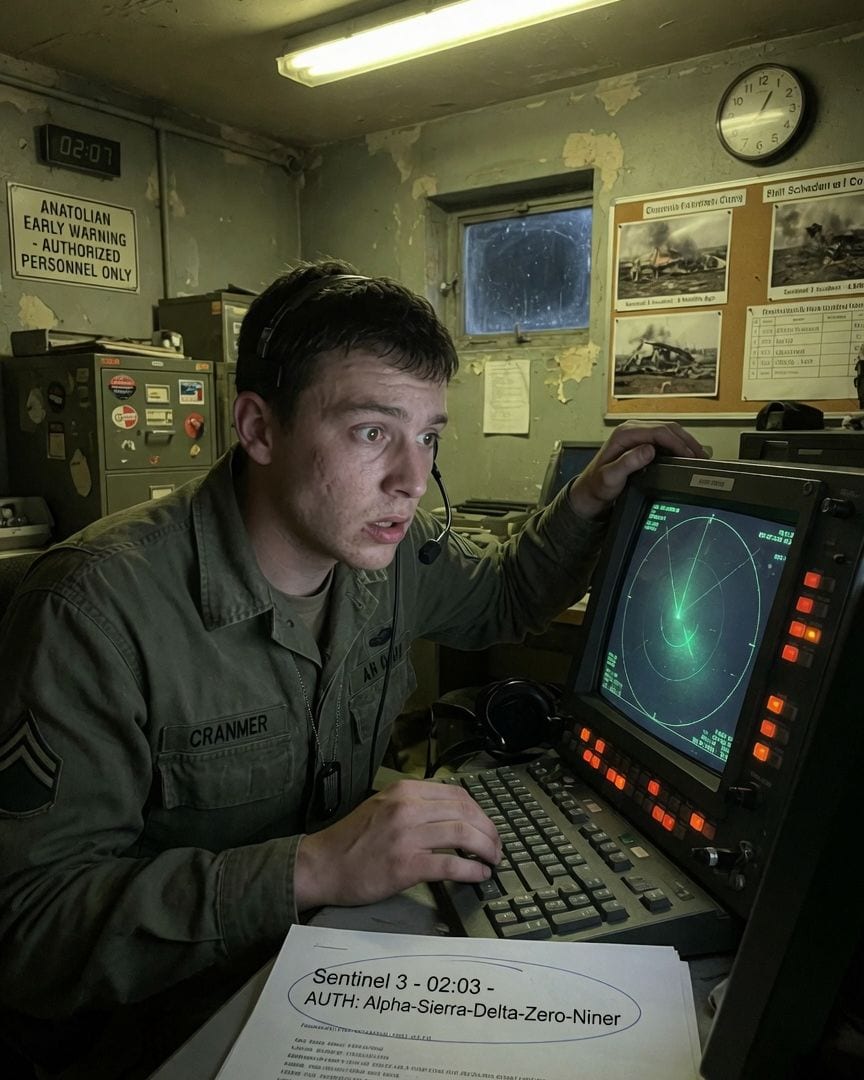
A radar specialist uncovers a dead man's logbook entry, dated two weeks after the fire that killed him. It asks, 'We're still here. What happened to us?'
Specialist Gideon Cranmer, just three weeks from his rotation, endured his overnight watch at an air-defense radar site in the desolate Anatolian highlands. As he monitored his radar console, a secure line crackled with a voice check from Sentinel 3, an adjacent early-warning station. Cranmer's blood ran cold: Sentinel 3 had burned to the ground eight months prior, killing its crew. Yet the voice gave exact coordinates and then whispered, "And has anyone ever found out what happened to us?" Despite his superior's dismissals, the call log confirmed the impossible.
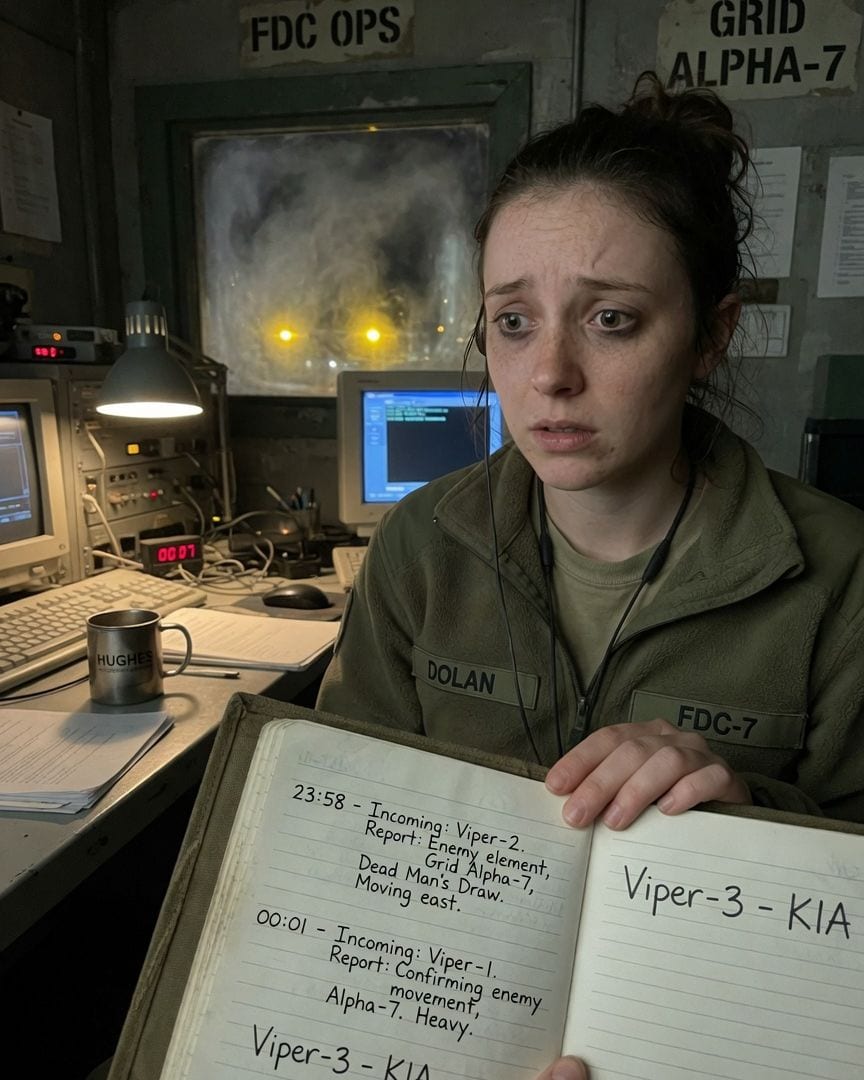
On her final watch at Firebase 7, Specialist Dolan's comms logged frantic calls from a patrol wiped out last week.
Specialist Emily Dolan adjusted her headset in the FDC, the fog pressing against Firebase 7's windows on her final watch before its decommissioning. Near midnight, frantic calls began coming in from observer posts, reporting enemy contact in treacherous territory where a patrol was wiped out just last week. But Control reported losing comms with those posts hours ago, leaving Dolan to realize her system had logged a full conversation with voices no one else heard. Then, the physical FDC logbook confirmed her entries, complete with an unfamiliar annotation: 'Viper-3 - KIA,' the call sign of the very patrol wiped out days before. What impossible truth had the firebase itself recorded?
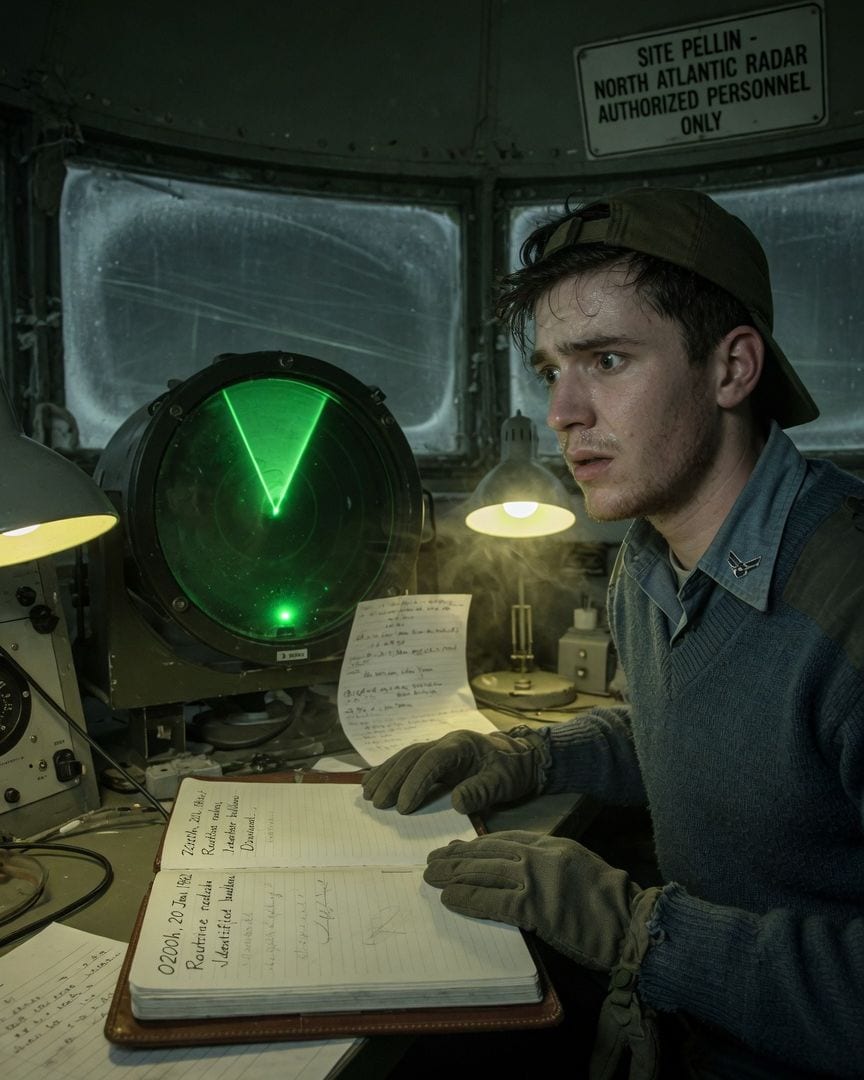
Nine days from closing, Cold War Site Pellin's Airman Vance watched his radar track a solid blip moving closer, dead in open sea where nothing could exist.
In the dimly lit dome of Site Pellin, Airman Ordway Vance, just days from discharge, ran his final radar sweeps before the base closed for good. Outside, the North Atlantic wind howled, but inside, only the hum of his console broke the silence. His last calibration had been clean, yet a single, unwavering green blip appeared on the scope, forty miles out, in open water where no vessel should be. The impossible return moved closer with each sweep, defying all logic and other sensors, until it sat static just beyond the coast fence line. What unseen presence did the radar truly hold in its unwavering green grip, contradicting the official record?
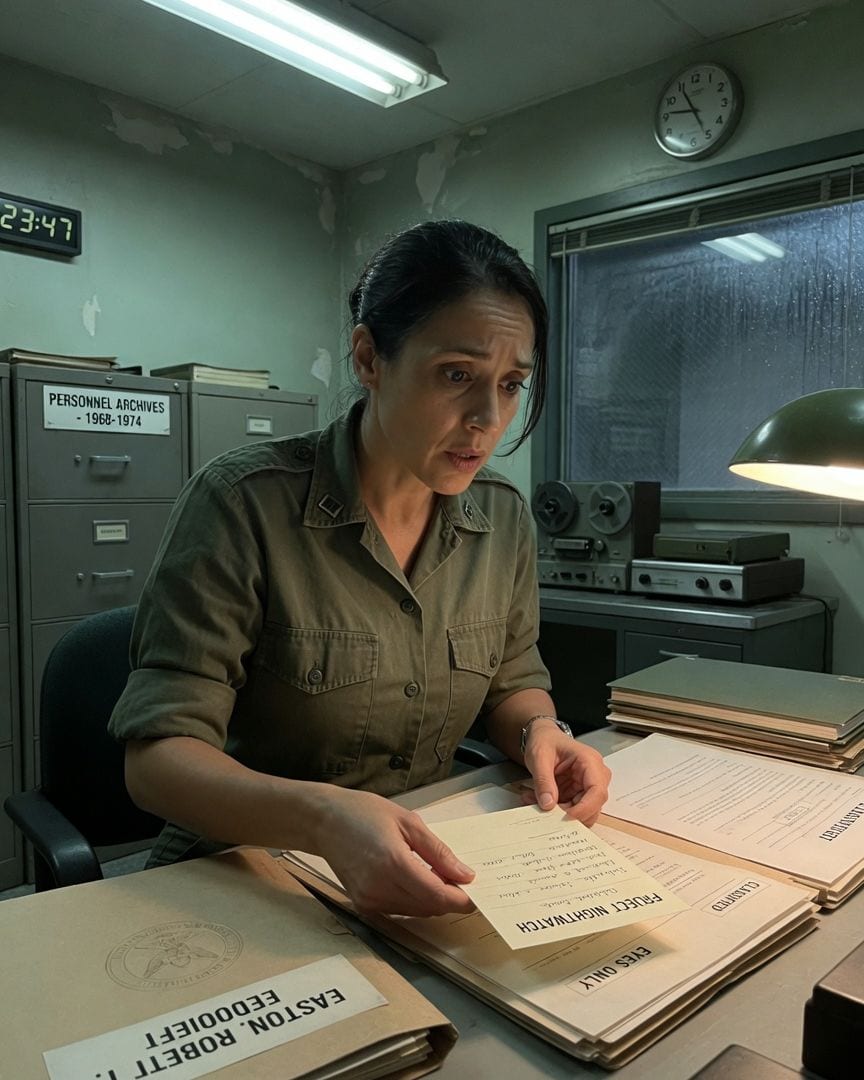
A Cold War tower controller logs an object vanish from radar, then hears the pilot scream it’s filling his windscreen. Her own name, 'Bardolph, Ines', now marked 'Observed' in a secret file.
Captain Ines Bardolph, a tower controller, was counting down the months until her transfer to Langley and the decommissioning of her base, hoping to leave behind the unsettling incidents of her final posting. But one night, her radar scope showed an impossible blip, solid and unwavering, 40 miles north of the Danube, only to vanish in less than a second, leaving a pilot screaming in terror. Despite the clear evidence, the official report blamed "atmospheric inversions," while the terrified pilot received a glowing review and promotion, his file meticulously scrubbed of any anomaly. As Captain Bardolph reviewed the pilot's pristine record, she found a hidden slip of paper, revealing a chilling truth: 'Subject: Bardolph, Ines. Status: Observed.' Was she merely an observer of the impossible, or was she now part of something far more sinister?
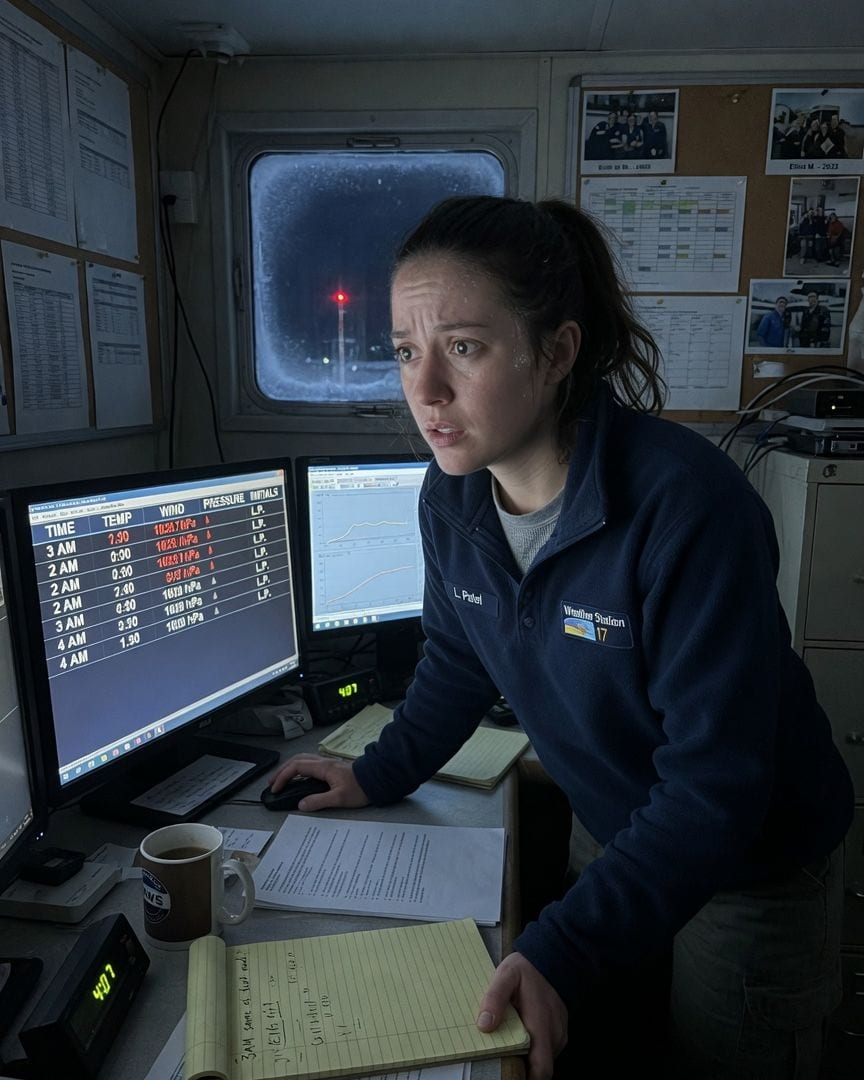
My weather station's 3 AM log shows a pressure reading I never made. My initials are on it, but the dials were dead still.
Working the overnight shift at the remote weather station, I routinely checked the digital logs. The 3 AM entry showed an impossible barometric pressure spike, a hurricane that simply hadn't happened. I distinctly remembered being outside at that time, calibrating a sensor, not making that entry. Yet, my initials, L.P., were clearly logged next to data I never made.
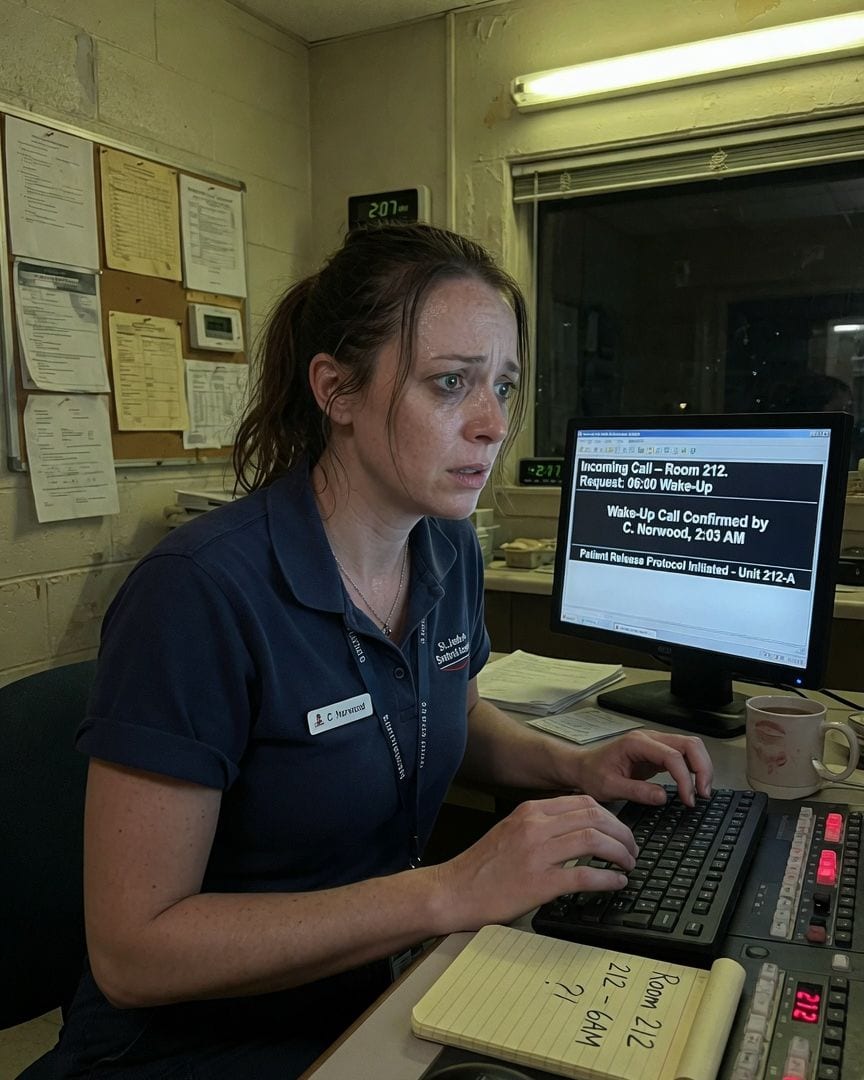
My login started a 'Patient Release Protocol' I'd never heard of for Unit 212-A.
Working the quiet night shift switchboard at St. Jude's, I took a routine wake-up call from Room 212. But the system showed Room 212 had been stripped bare and its phone line disconnected for months. Then, my own login showed I had confirmed the impossible call.