A storage yard worker on his last inventory finds a WWII bomber's black box logging data from the present day.
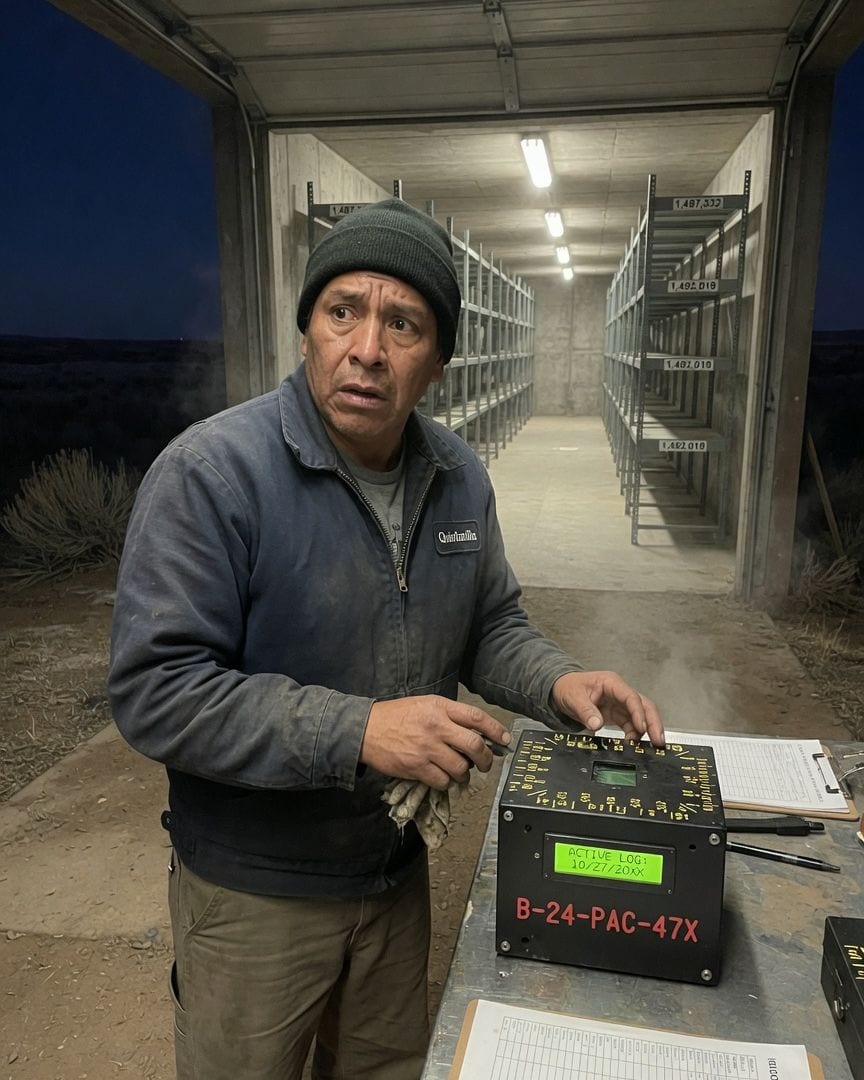
The Pueblo storage yard was down to its last two men.
Salvador Quintanilla pulled the heavy door of igloo six-B, the last bay on his manifest, and rolled it back with a groan of rusted steel. Inside, the usual rows of high-density racking stretched into the fluorescent gloom.
But past the concrete back wall, where the igloo should have ended, the racking continued.
It ran, perfectly aligned and brightly lit by a single, impossibly long strip light, out into the empty prairie beyond the foundation, under the hardscrabble dirt and dry sagebrush.
He felt an unsettling cold, deeper than the desert night, seeping from the depths of that impossible tunnel.
He walked for ninety seconds, his work boots echoing on the concrete, the air growing steadily colder with each step. The fluorescent strip hummed, a thin, high whine that felt like it was inside his skull.
The shelves were mostly empty, glinting chrome under the harsh light. He squinted at the accession numbers stenciled on the uprights. His depot’s sequence ran into the high 1.3 millions, a system unchanged for decades.
But here, they continued into the 1.4s, then the 1.5s, numbers issued decades beyond anything real, into a future that simply didn’t exist. The cold tightened around him, a physical presence.
“Hey, Max!” Salvador called out, his voice swallowed by the impossible space. “Get in here!”
Maxwell Vance ambled over, flashlight beam bouncing. He was younger, quicker to shrug things off. He squinted into the extension Salvador pointed at. “Just a trick of the light, Sal. Or a structural anomaly in these old bunkers.
Prairie’s full of weird stuff, you know that. Just finish the inventory. My back’s killing me.”
Salvador shook his head. “No trick. Look at the numbers, Max.” He gestured with his own flashlight. “They go on forever.” He didn’t wait for an argument, already turning back into the growing chill, forcing Maxwell to follow.
The younger man muttered under his breath but fell in behind, his own beam cutting through the gloom, past rows of empty shelves that stretched into the silent, lit void.
After another minute of walking, Salvador paused, his light catching on a single item. It sat on a lower rack, near the aisle, almost as if placed there for casual observation.
It was a flight recorder, a solid black box, pristine. Its casing was unblemished, not a scratch or scorch mark on its surface.
He recognized the model instantly: a specific type used on B-24 bombers, aircraft officially lost over the Pacific during WWII.
The accession number stenciled on its side was not only well beyond the depot’s official range, but also stamped with a designation he’d never seen before, a stark red alphanumeric code that meant nothing to him.
Maxwell gave the black box a wide berth, shaking his head. “Some collector’s junk, probably. Someone stashed it here during an old transfer.”
Salvador ignored him. He reached out, his fingers brushing the smooth metal. It was unnervingly cold to the touch, as if it had been stored in deep space. He carefully retrieved it, feeling its impossible weight in his hands.
It felt heavier than it should, denser, as if packed with something beyond its physical size.
Back in the main igloo, under the familiar, flickering fluorescent glare, Salvador set the flight recorder on a workbench. Maxwell was already at his terminal, logging other items, trying his best to ignore the silent black box.
Salvador pulled a rag from his kit and carefully wiped a thin layer of dust from the recorder’s side, revealing a small, almost invisible etched panel. He pressed it.
With a soft, almost imperceptible click, a tiny, green LCD screen flickered to life. The hum of the igloo’s ventilation system suddenly seemed to drop, replaced by an unnerving silence that pressed in on Salvador.
The screen displayed a single, clear line of text: ACTIVE LOG: 10/27/20XX.
Salvador froze. His breath caught in his throat. The ‘XX’ wasn’t a placeholder; it was the current year. The B-24 bomber this device belonged to had vanished, officially, in 1944.
This device, from an aircraft lost eighty years ago, was logging data right now. He stared at the impossible date, the hum of the igloo’s ventilation system suddenly deafening again, filling the silence he hadn’t even realized had settled.
Salvador spent the next few days in a quiet frenzy, trying to reconcile the impossible date with everything he knew.
He tried to look up the accession number stamped on the flight recorder through official depot channels, entering it into every database he could access. Each time, the system returned the same frustrating, sterile message: NO RECORD FOUND.
He tried permutations, truncated searches, anything he could think of, but the result was always the same. It was as if the number simply did not exist.
He researched the specific B-24, its call sign clearly marked on the recorder. Online, he found its official loss report from the National Archives, confirming the 1944 date and unequivocally stating, NO REMAINS OR WRECKAGE RECOVERED.
It vanished without a trace, a ghost in the vast Pacific. Yet, here was its flight recorder, logging data in his hand, in the present day.
A week later, Salvador finally called Grace Romano, a declassification reviewer he knew briefly from a previous posting at the National Archives.
He chose his words carefully, describing a “hypothetical scenario” involving an artifact from a lost aircraft with an “anachronistic internal date.” He made it sound like a strange, isolated anomaly.
Grace, always intrigued by obscure historical details, admitted she was working on a file for a similar-era military plane that showed unusual gaps and internal contradictions.
“There’s a vague reference to ‘Pueblo Recovery Protocols’ in one of the sub-files,” she told him, her voice tinny over the phone. “Makes no sense for a facility that’s supposed to be closing down.”
She agreed to look into it further for him, a small favor between former colleagues, something to pass the time.
Salvador’s inquiries, however, did not go unnoticed. His access to certain internal depot databases, usually seamless and instant, became sluggish. Occasionally, the system would deny entry without explanation, throwing up an ACCESS DENIED message where there had never been one before.
He tried to brush it off as network issues, old systems acting up.
Maxwell, who had grown increasingly quiet since the discovery of the extended racking, offered a cryptic warning during a coffee break. He stirred his black coffee, his eyes not quite meeting Salvador’s.
“Just finish the job, Sal,” Maxwell said, his voice flat. “Don’t go looking for things that aren’t there.” Salvador tried to dismiss it, but the younger man’s composure, the unnerving calm in his eyes, unsettled him.
Later that night, as he drove his old pickup home, Salvador noticed a dark, unmarked sedan parked on a dirt track overlooking the Pueblo yard.
Its windows were tinted, its occupants unseen, but the car’s presence was unmistakable, an unnatural fixture in the desolate landscape. He slowed down, then sped up, but the sedan remained. The next morning, his personal phone buzzed.
It was an anonymous, untraceable text message, its screen stark white against the gray dawn: Some things are better left filed. The words were chillingly precise, echoing Maxwell’s warning and the very nature of his work.
Salvador stared at the message, his hands trembling slightly, realizing he wasn’t just investigating; he was being observed.
Salvador called Grace, his voice urgent, stripped of the earlier pretense. He told her everything: the impossible racking, the B-24 flight recorder, the current date, the database denials, Maxwell’s warning, the unmarked car, the anonymous text message.
Grace listened in stunned silence, her professional skepticism warring with the concrete details he laid out. “Pueblo Recovery Protocols,” she finally said, her voice barely a whisper. “I’ll dig deeper. Specifically for that.”
A few days later, her name flashed on his phone. He answered immediately. “Salvador,” she said, her voice strained, tight with a kind of fearful awe. “I found it.”
Tucked away in a deeply classified supplement to her B-24 file, she had unearthed a document titled ACCESSIONING PROTOCOLS FOR NON-RECOVERABLE ASSETS.
Grace read excerpts to him over the phone, her voice barely a whisper, as if afraid to give the words too much air.
The document described a system for cataloging objects—and implicitly, personnel—that disappeared under anomalous circumstances, moving them into a “secure, off-site repository.” She paused, a sharp intake of breath. “It precisely matches your description of the extended racking, Salvador.
The way it’s structured, the description of its environment.”
The protocols detailed procedures for RE-ACTIVATING and MAINTAINING these assets, effectively filing them into a continuous, active inventory.
The document’s internal references and cross-citations spanned decades, referencing earlier versions, confirming that the institution behind it had known, recorded, and managed these “disappearances” for generations.
The B-24 flight recorder, the impossible numbers in the extended racking, the “lost” aircraft—it all snapped into terrifying, coherent focus for Salvador. It wasn’t a recovery; it was an ongoing management system.
The humming of his desktop computer, normally a reassuring sound, now felt like the pulse of something vast and indifferent.
Grace, deeply shaken, continued to pore over the classified supplement, her fingers flying across the digital file. The Accessioning Protocols were dense, written in the dry, bureaucratic language of officialdom, but she pushed through, searching for any further clues.
She found a section labeled CURRENT ACTIVE MANIFESTS, which appeared to be a real-time ledger of items and individuals within the system.
As she scrolled, her eyes widened. Her breath caught in her throat. She saw a specific entry, not for an object, but for a person. The name, the service number, even a recent photo—it was unmistakably familiar.
She fumbled for her phone, her hand shaking as she dialed Salvador, the metallic tang of fear rising in her mouth.
“Salvador,” she said, her voice tight with horror, crackling through the phone. “Your name. Your service number. It’s here. It’s listed as a pending accession for Pueblo.”
Salvador raced to Grace’s office, the dread a cold knot in his stomach, the landscape blurring outside his window. She pulled up the document on her monitor, her finger trembling as she pointed to a specific entry.
There, under PENDING ACCESSIONS, PUEBLO DEPOT, was his full name, Salvador Quintanilla, his service number, and a photo taken just weeks ago for his retirement paperwork. Beside it, a SCHEDULED TRANSFER DATE just three days away.
The lost were never lost. They were always accounted for, meticulously filed into this system, becoming part of a perpetual, active inventory. The decommissioning of Pueblo wasn’t a closure; it was a transfer operation, a rotation of stock.
And he, Salvador Quintanilla, nearing retirement, was on the manifest. The pattern, spanning decades and classifications, was horrifyingly clear: the institution didn't just record what vanished; it managed it, quietly, efficiently.
The extended racking wasn't a storage unit; it was a holding pen, and the accession numbers were a living log for a system that never stopped signing. The air in Grace’s office felt thick, pressing in.
Panic and cold logic warred within Salvador. “We have to expose this,” he said, his voice hoarse, fumbling with the mouse, trying to download the full file.
Grace worked frantically beside him, her own fingers flying across her keyboard, but then her screen flickered, displaying a SESSION TERMINATED message. Her access was suddenly revoked, the screen going blank. “They know,” she whispered, her voice thin with terror.
They tried to leave the archives, but as they stepped into the main hall, two men in dark, unremarkable suits calmly blocked their path. There was no aggression, no shouting, just a quiet, unyielding presence, their faces impassive.
Salvador looked past them, his eyes scanning the main entrance. Standing by the heavy glass doors, his face empty of expression, was Maxwell Vance. His colleague, his friend, now a silent, immovable part of the machine.
The realization hit Salvador with crushing force – this wasn’t a confrontation; it was an orderly apprehension, perfectly timed. He struggled, a desperate, futile thrashing against an invisible wall.
He met Grace’s wide, terrified eyes, a silent apology passing between them as the men in suits moved in, their movements efficient, practiced. The door to the archive hall closed with a soft, final click, sealing them inside.
The Pueblo storage yard was officially decommissioned a week later, its closure reported as a smooth, uneventful process. The local news ran a short piece about the changing face of government logistics.
Maxwell Vance received a commendation for his “exemplary service during the transition” and was quietly transferred to a new, undisclosed position.
Grace Romano’s career at the National Archives ended abruptly; she was reassigned to a remote, inactive post in a forgotten regional office, her access to classified documents permanently revoked.
No further inquiries were made regarding the B-24 file or the Pueblo protocols. The world moved on, the records undisturbed, the quiet hum of the system continuing beneath the surface.
A new, pristine storage facility, deep in a remote desert, hummed with quiet efficiency. The air was cool, sterile. A man in a dark suit, his face impassive, reviewed a manifest on a tablet.
He scrolled through a list of INCOMING ASSETS, his finger moving down the digital ledger. He paused on an entry, then made a small, neat checkmark beside it.
The man in the dark suit looked up from the manifest, a faint, almost imperceptible smile playing on his lips. He checked off the name: Salvador Quintanilla.
If this one got to you
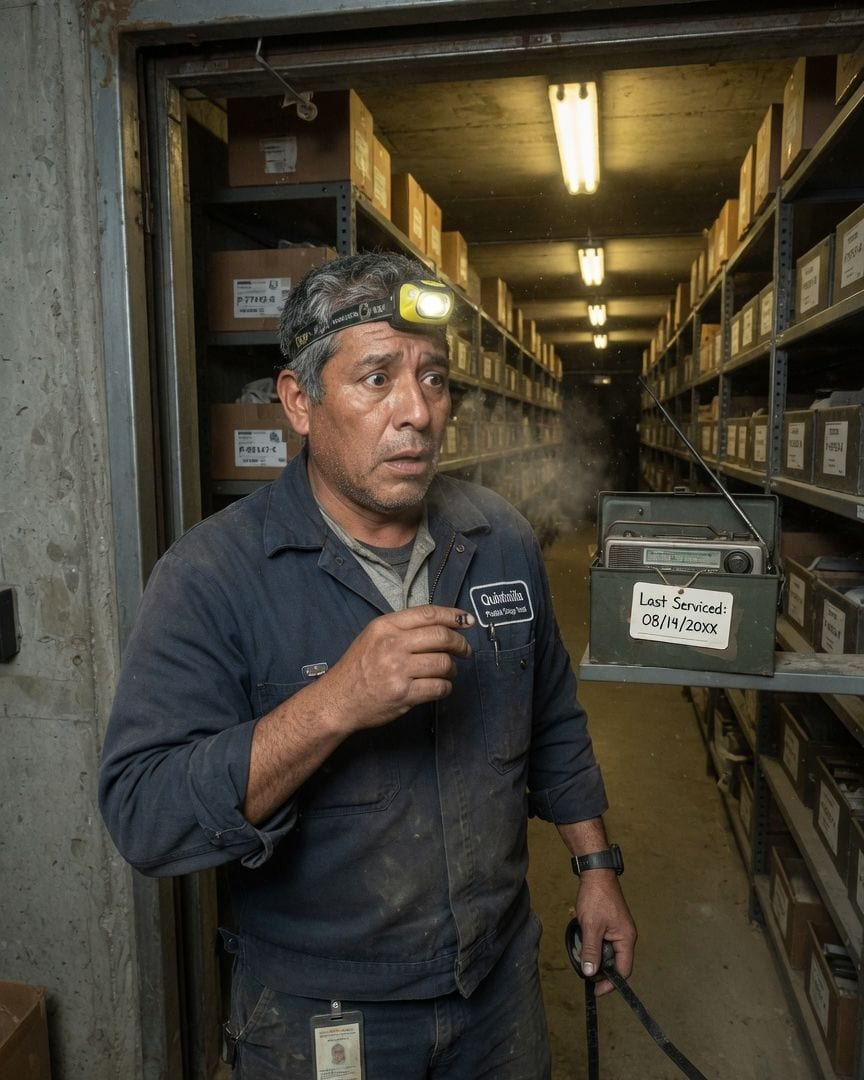
A Cold War bunker worker found a field radio serviced three years in the future, its ink still wet.
Salvador Quintanilla, one of the final two men at the Pueblo storage yard, was tasked with clearing Igloo 7, the last bunker before the facility's imminent closure. As he rolled back the heavy steel door, he discovered not an empty space, but metal racking extending impossibly far past the concrete wall, under the empty prairie, lit by a wan, humming light. Venturing into the profound chill, he found an old field radio with a service tag dated three years in the future, its dark ink still wet to the touch. The radio hummed faintly in his hands, and from deep within the impossible corridor, a metallic click echoed, confirming he was not alone.
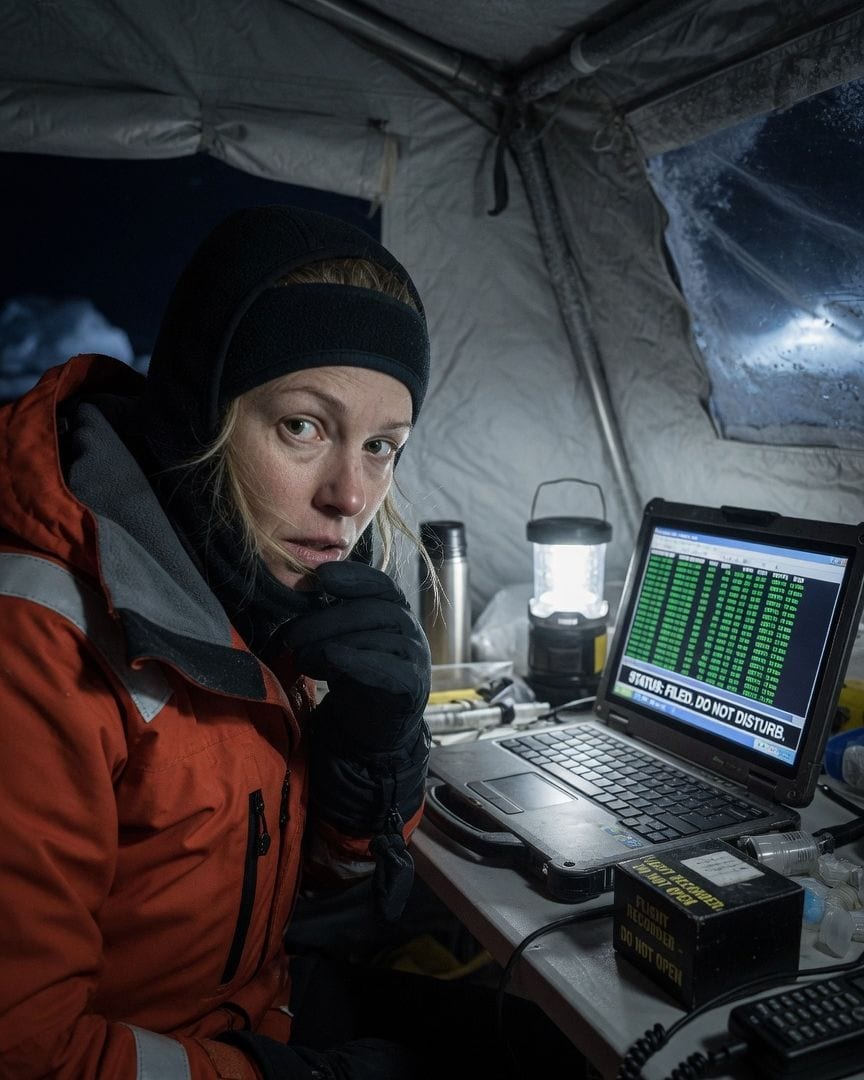
A glaciologist finds a Cold War plane 60 feet down in Greenland ice, its navigation lights still burning after sixty years.
Glaciologist Ines Faurholt skied across the vast, blinding Greenland ice cap when her path was abruptly blocked by a dark, corroded antenna mast. Beneath it, sixty feet down in ancient ice, a Cold War reconnaissance aircraft sat with its navigation lights eerily burning and its cockpit clock steadily keeping time. The sight was a violation of everything Ines knew about time and preservation in this frozen world. She called for a team, and days later, they extracted the plane's flight recorder, revealing data that showed the aircraft still flying years after its disappearance.
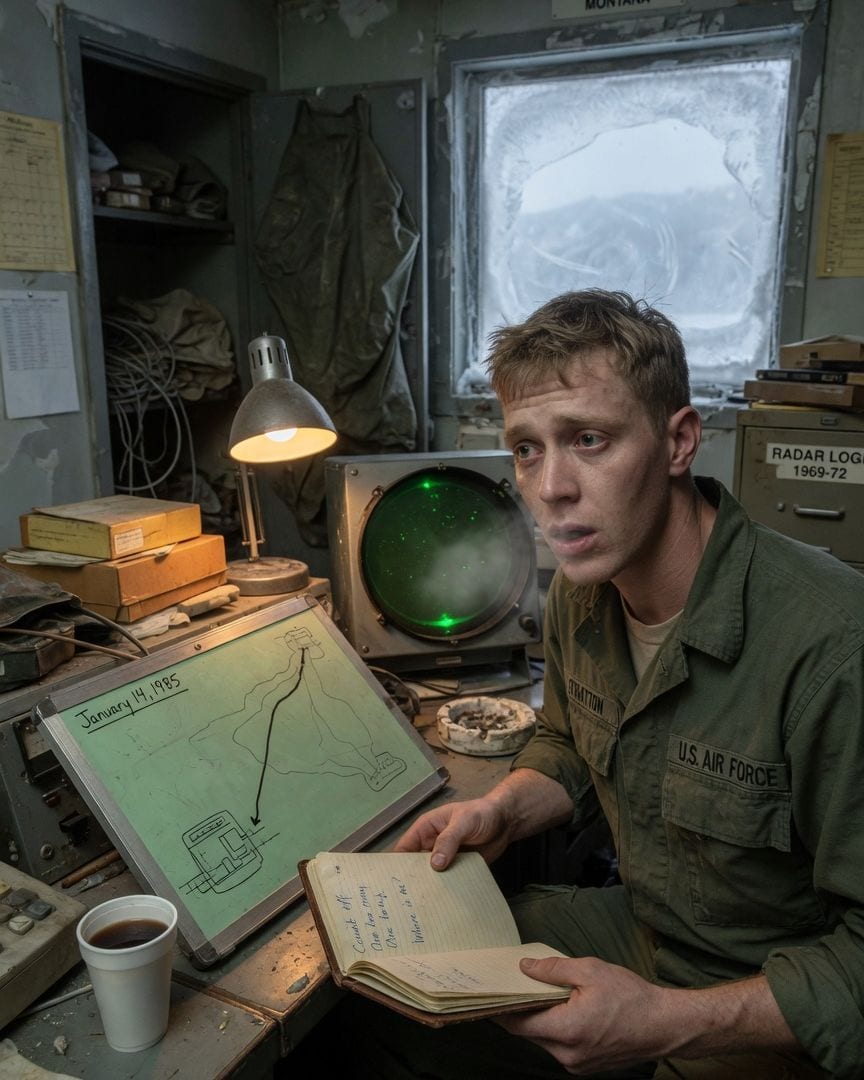
Airman Lars Stratton found an old Cold War manifest listing one name twice: 'Bernard Radcliffe' transferred and 'Bernard Radcliffe' still present.
Airman Second Class Lars Stratton was counting down his final weeks at Echo Station, a desolate Cold War outpost due for mothballing. He longed for home, far from the bitter Montana winds and the constant hum of static. Inside the dim radar shack, he logged the usual nightly ghost blip, a faint contact appearing at 2300, just as it had every winter since 1987. This night, a metallic tang like old blood lingered in the air, raising the hairs on his arms. Seeking distraction, Lars later discovered a leather-bound logbook from 1971, detailing the same 2300 contact, but with chilling notes and a manifest listing one airman's name, Bernard Radcliffe, twice—once transferred, once present. Was he truly alone in the silent, remote station?
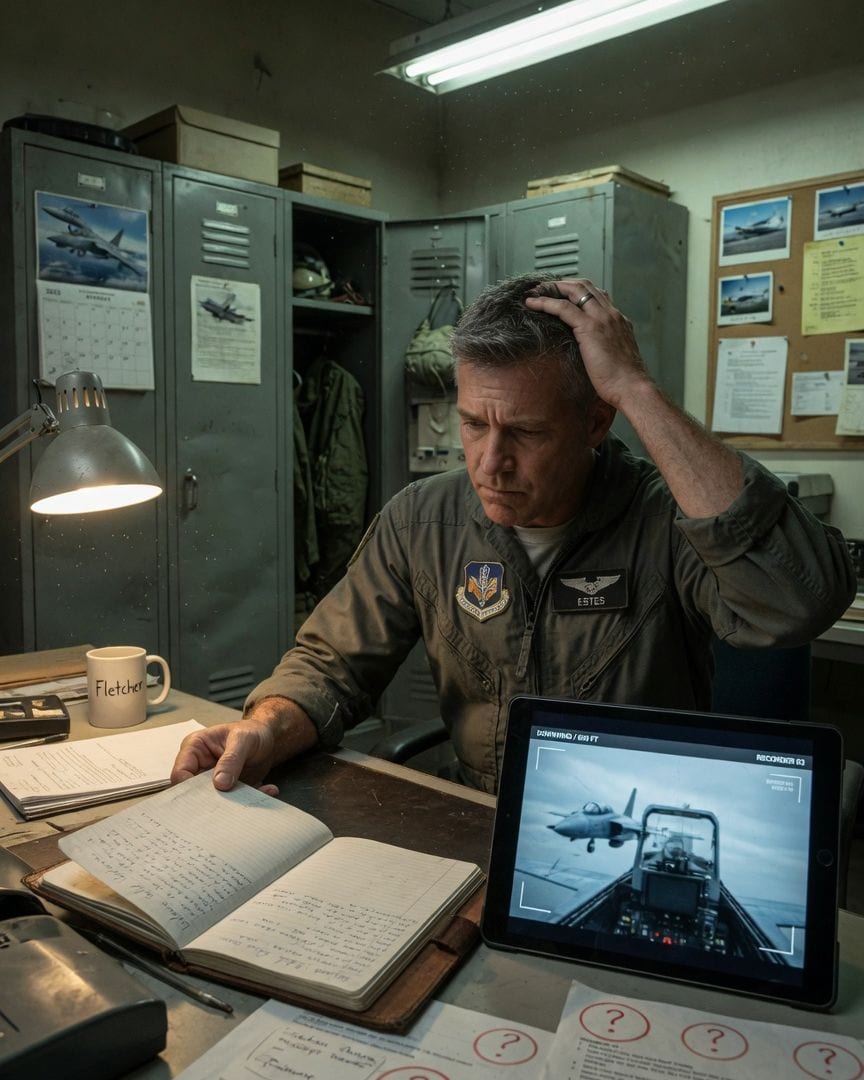
A Chief Warrant Officer's HUD tape shows a phantom jet, impossibly close, off his wing. Forty years ago, another Cold War pilot logged the same impossible sight.
Chief Warrant Officer Nathaniel Estes, a pilot whose career hinged on absolute precision, was under evaluation for a critical promotion. His nightly review of HUD tapes from routine Mojave test flights was a meticulous habit, but for a week, it revealed an impossible detail. At precisely 800 feet, one frame showed a sleek, experimental jet tucked impossibly close off his left wing—a craft ground radar never detected. When his maintenance chief found no equipment fault, Estes unearthed a dusty, decades-old logbook detailing identical phantom sightings from 1978. What unseen presence shadowed the desert skies?
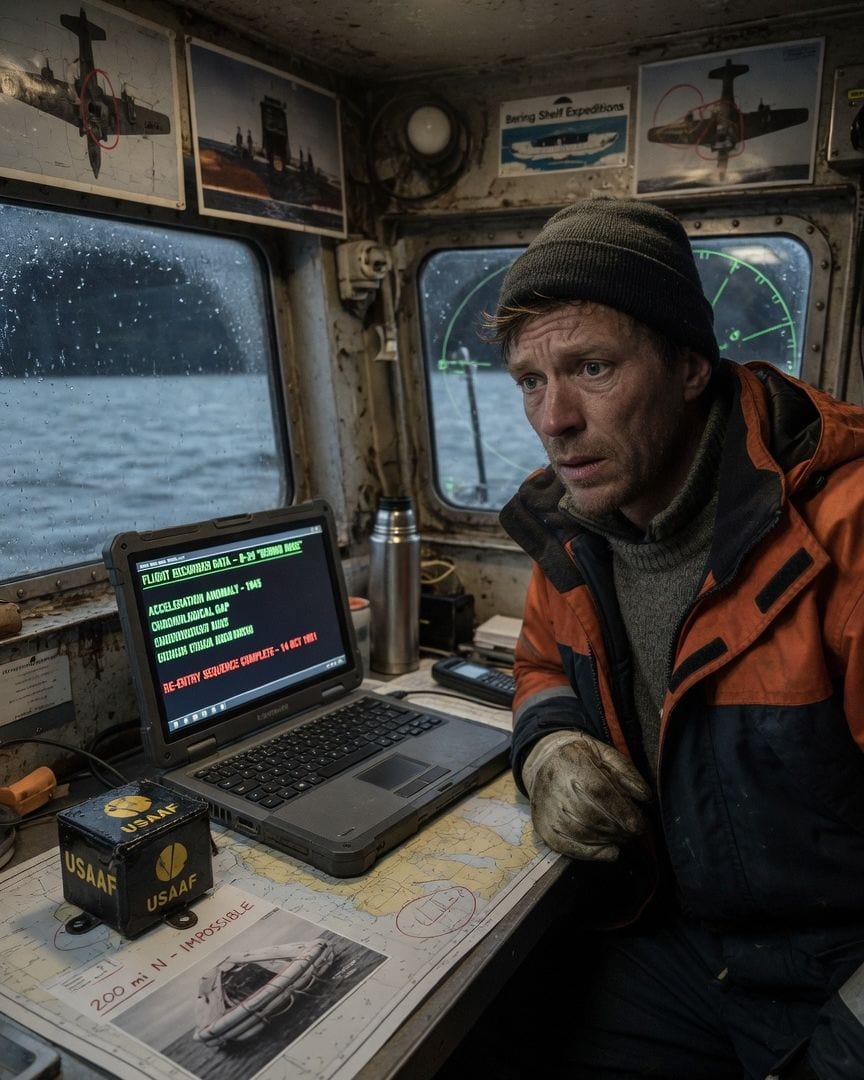
A wreck-hunter found the Cold War B-29 lost in 1945. Its upper escape hatch was open, from the inside.
Wreck-hunter Sten Höglund embarked on a decades-old promise to his 98-year-old aunt, seeking the B-29 bomber lost with eleven men in 1945. Deep on the Bering Shelf, his sonar found the 'Bering Rose' impossibly intact, a ghost in the mud plain. But the drop camera revealed a chilling detail: the bomber's upper escape hatch was not merely damaged, but wide open from the inside, and its life raft was gone. What impossible truth did the ocean hide from a crew that seemingly escaped a crash, only to vanish into the Bering Sea?
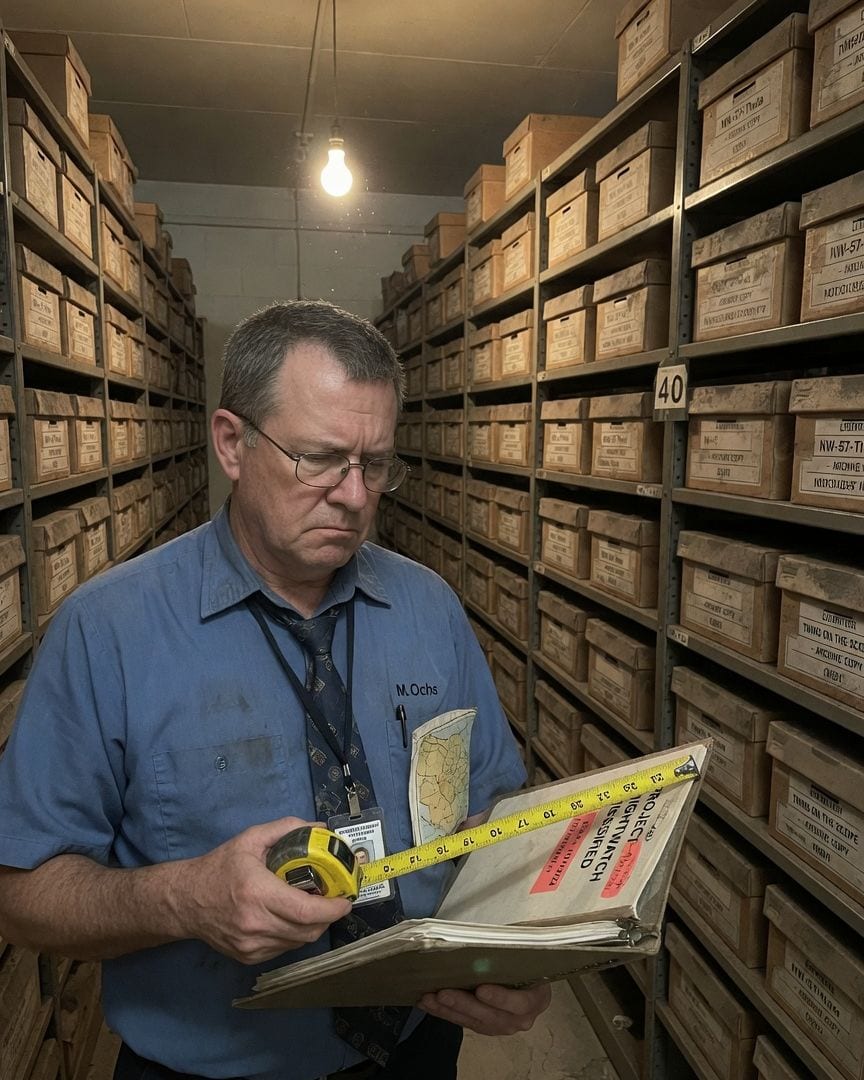
A Cold War records clerk on his final patrol found Aisle 40 stretched 61 feet longer, lined with unknown boxes. Inside one: 'PROJECT NIGHTWATCH - CLASSIFIED' with a fresh timestamp.
Marlin Ochs, a creature of habit after nineteen years at the St. Louis federal records depot, faced his final patrol through Aisle 40 before its scheduled pulping. His routine walk, usually 92 precise strides, suddenly stretched to an impossible 119, making the aisle 61 feet longer than its blueprint. The extra section felt colder, lined with dust-laden boxes bearing alien classification codes and no manifest. Inside one, he found a metal-bound file: 'PROJECT NIGHTWATCH - CLASSIFIED,' dated 1957, but with a timestamp just hours old.