My street's punishment book lists a nameless child, 'as before.' It repeats every decade to 1901.
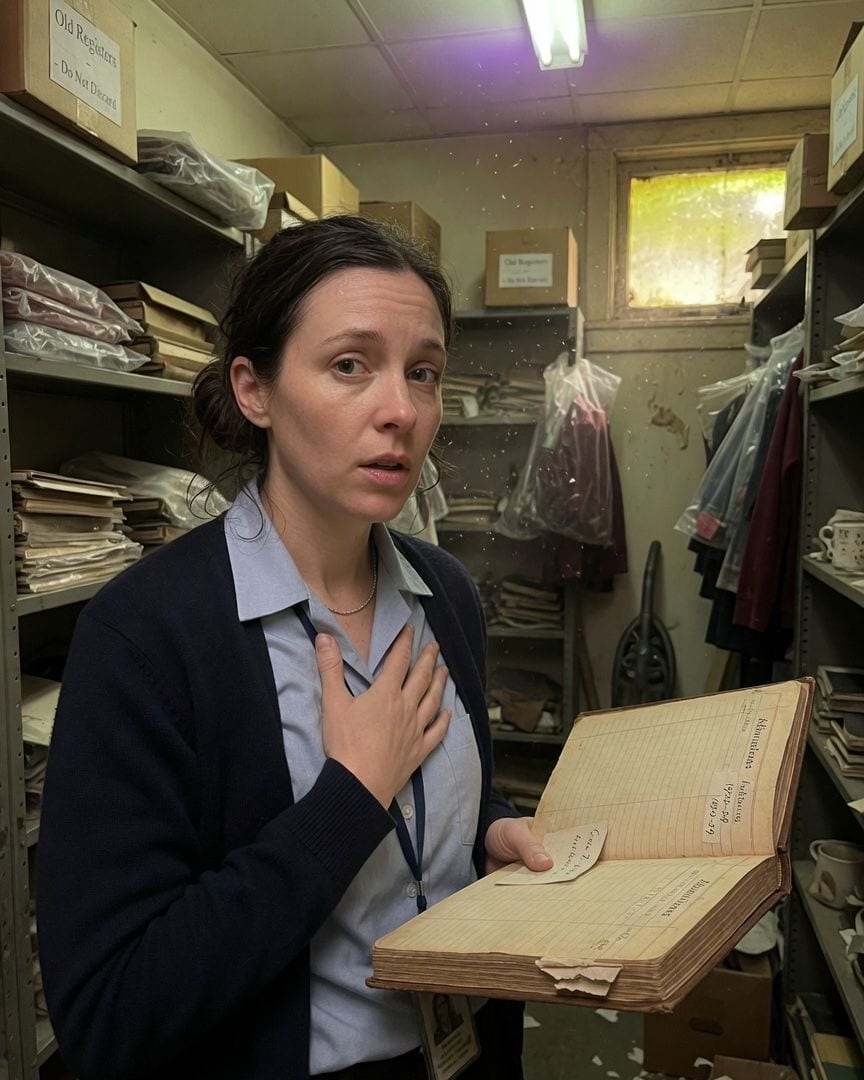
The cupboard in the back of the staff room, the one behind the broken printer, was always a bit of a mystery. Full of ancient textbooks, dusty trophies nobody cared about, and a smell of forgotten tea.
I’d worked at the village school for three years, and never once opened it properly. Until last Tuesday. I was looking for some old exercise books, a desperate measure, when I finally wrestled the sticking door open.
Deep inside, tucked behind a stack of moth-eaten atlases, I found it.
It was a ledger, leather-bound, its cover deeply scored, the spine cracked but holding. A punishment book, dating back, judging by the elegant, faded script on the first page, to the late 1800s. A relic.
I found myself flipping through it, half-curious, half-horrified by the intricate descriptions of Victorian-era transgressions: 'Speaking out of turn, twice,' 'Attempted defenestration of a classmate,' 'Failure to correctly parse Latin.'
Then I stopped. My finger caught on an entry from 1953. The script was still elegant, but the tone was different. ‘Child, Name Redacted, for severe disobedience.’
And beside it, a note from the headmaster of the time, his looping hand unmistakable: ‘the boy from Ropewalk, as before — punish, record no name.’
Ropewalk. My street. The one I live on, at number 14.
My stomach did a cold flip. Redacted in a private ledger? The odd phrasing, ‘as before,’ implying a repetition. And ‘record no name.’ It felt wrong.
I searched older pages, a growing unease in my stomach turning to outright dread. 1943. Identical entry. 1933. Same. 1923, 1913, 1901. Each decade. A single, identical entry. Always ‘the boy from Ropewalk,’ always ‘as before,’ always ‘record no name.’
The rhythm of it, the quiet, precise persistence, made the hairs on my arms prickle.
It wasn't just an old custom; it was a repeating anomaly, filed away like routine, like a tax return you filled out every year, no questions asked.
The next day, the ledger kept nudging at me. The image of those precise, repeating entries had burrowed under my skin. During my planning period, I found myself slipping into the school’s small, seldom-used archive room.
It wasn’t much: a converted broom closet, really, crammed with mothballed uniforms in plastic bags and faded yearbooks stacked precariously. The air was thick with dust and the faint, sweet smell of old paper.
I was looking for anything related to Ropewalk, specifically around those decade marks. Anything that might explain a child, a family, a historical event.
I started pulling out heavy, canvas-bound admissions registers. They went back to the turn of the century, too, each one a weighty tome of crisp, yellowed pages. My fingers traced lines of names, addresses, enrollment dates.
It was tedious work, but the quiet hum of the fluorescent lights and the methodical turning of pages was a strange comfort. It was an attempt to ground the uncanny into something explainable. A forgotten orphan.
A family forced to relocate. A child who simply never returned for reasons lost to time.
I found a few children listed from Ropewalk over the years, a steady trickle of names, but nothing that immediately jumped out as ‘missing’ or unusual. No grand, unrecorded tragedy.
The mundane explanation – a private child, a family moving on – it almost worked. Almost. Until I remembered the precise, clinical recurrence in the punishment book. The phrase ‘as before’ haunted me.
It implied not just a repetition, but a managed one. Not an accident, but a procedure. I needed something more concrete, something that connected the nameless punishment to a specific, identifiable gap.
Hours later, my eyes gritty, deep into the 1950s section, my finger dragging down a column of names, they snagged. My breath hitched.
‘Fairfax, Benjamin. Address: 14 Ropewalk. Enrolled: Sept 1952.’
My own house number. My heart gave a violent lurch, then pounded against my ribs. I scanned the following pages, frantic now. Benjamin Fairfax’s attendance record abruptly ceased in March 1953, mid-term.
There was just a blank space, a faint, almost erased line where his name should have continued. No transfer, no withdrawal, no reason. Just nothing.
And then, so faint it was almost invisible, a small, handwritten note tucked into the margin, scrawled in the same elegant hand as the headmaster’s entries in the punishment book.
‘Case 7, as before.’
I stared at the faded ink, the year, 1953, solidifying around me. It aligned perfectly with the nameless entry in the punishment book.
The dust motes danced in the weak light filtering through the archive’s grimy window, and the silence of the archive pressed in, cold and absolute.
I spent the next few days in a quiet frenzy, the archives becoming my second home. Cross-referencing. I checked every decade’s ‘nameless boy’ entry in the punishment book against the admissions registers.
Each time, I found a similar pattern, a ghastly echo of Benjamin Fairfax. A child, always from Ropewalk, always around the relevant year, whose record simply ended without explanation.
Some had ‘Case X’ notes in the margin, others didn't, but the abrupt cessation was consistent. A boy named Thomas Miller from 1963, a girl—unusual, but still ‘Case 7’—from 1973.
I even found a ‘Case 7’ note attached to a vanished child from 1933, a generation earlier, a boy named Samuel Rutherford. The ‘Case’ number, it seemed, was reissued. Or rather, the identity it signified was.
I tried to find any living relatives of Benjamin Fairfax or Samuel Rutherford, but the names were common. The village, despite its ancient roots, had a surprisingly high turnover rate for its inhabitants.
The local historical society had no record of any unusual disappearances, no missing persons reports from these specific years that matched. Each dead end only deepened the dread, turning the ‘anomaly’ into a verifiable, repeating fact.
This wasn't a glitch; it was a system. The school’s records were a meticulously kept graveyard of vanished children, all linked by a single street, and a chilling, repeating phrase. The mundane explanations had officially failed.
My investigations didn't go unnoticed. Rachel Rutherford, the school archivist, a woman in her mid-forties with tightly pulled-back hair and an air of quiet efficiency, became unusually watchful.
She was Samuel Rutherford’s distant cousin, I later learned, which felt like another cold thread in the tapestry. When I requested another stack of old registers, she hesitated, her eyes lingering on my face a beat too long.
‘Some things are best left filed, Miss Yates,’ she’d said, her voice flat, almost a warning. The archive room, which I'd started to think of as a sanctuary, suddenly felt like a cage.
Later that week, I found my office door slightly ajar after I’d explicitly locked it for my lunch break.
A file I’d been working on, a folder of old Ropewalk census data I’d brought up to my desk, was on my desk, open to a page I hadn’t been looking at. I dismissed it. Forgetfulness. A cleaner.
But the unease gnawed.
One evening, working late on a lesson plan, the school silent around me save for the distant hum of the refrigerators in the staff room, I found a small, folded piece of paper tucked under my keyboard.
Unfolding it, I saw a single word, handwritten in a neat, old-fashioned script, the same script from the punishment book’s margin.
‘As Before.’
My breath caught in my throat. I was no longer just investigating; I was being observed, warned. Someone knew what I was doing, and they were letting me know they were watching.
The school itself felt like it was breathing, its old walls listening.
The note solidified my resolve. I couldn't ignore it, couldn't pretend it was a prank. I confronted Rachel Rutherford directly, cornering her near the photocopier.
I laid out the punishment book, the admissions registers, the 'Case 7' notes, and finally, the 'As Before' message. Rachel’s calm facade cracked, her face paling. She started backing away, bumping into the wall.
She refused to explain, only muttering about 'privacy' and 'old traditions,' her eyes darting nervously. 'It's nothing, Brooke, just… a way things used to be done.' She wouldn't meet my gaze. She wouldn't break.
Realizing Rachel wouldn't give me answers, I knew there was only one person left. I found Julian Abbott’s number in the school directory. The retired headmaster, now 78, was a local fixture known for his sharp mind and long memory.
I called, my voice tight. He agreed to see me. I found him in his impeccably tidy garden, pruning roses with meticulous care. He greeted me with a disconcerting calm, a faint, almost pitying smile.
As if he’d been expecting my call, perhaps even my visit. The roses, deep crimson, seemed to deepen in colour in the late afternoon sun.
I laid out my findings, struggling to keep my voice steady. The recurring entries, the vanished children, the 'Case 7,' the notes. Julian listened, nodding slowly, his eyes never leaving mine.
When I finished, the silence stretched, broken only by the snip of his secateurs. He sighed, a sound of ancient weariness. 'The punishment book, yes,' he said, his voice soft, almost a whisper. 'A necessary record. For a necessary… management.'
I pressed him, demanding to know what ‘the boy from Ropewalk’ was.
Julian looked at me, his gaze unsettlingly steady. 'It isn't a child, Brooke. Not truly. It's a recurring manifestation. An entity. Tied specifically to the house at 14 Ropewalk. It appears once a decade, sometimes subtly, sometimes… more overtly.'
He paused, pruning a rose with precision. 'The school, for generations, has been tasked with its containment. Not to destroy it, you understand. That's impossible. But to manage it. To keep it dormant.'
'The punishments?' I asked, my voice barely a tremor.
'Are a ritual,' he clarified, his voice flat, devoid of emotion. 'A way to reset the cycle, to force it back. To keep it dormant for another ten years. To keep the village safe.
And 'Case 7'… that is its designation. Its name, if you will, to those who need to know. A way to track its return.'
I felt a cold dread spread through me as Julian Abbott spoke, his words painting a picture of an ancient, quiet horror managed with bureaucratic precision. The ‘boy’ was not a boy, but a thing.
The school was not educating, but containing. The truth, as it landed, was worse than any monster. It was a cold, institutional truth. I stammered, 'But the children… Benjamin Fairfax, Samuel Rutherford… what happened to them?'
Julian’s eyes, clear and blue despite his age, met hers. He didn't flinch. 'They were… temporary vessels, Brooke. Stronger manifestations. The entity requires an anchor, a focal point to manifest fully. To become… present.
And that focal point, for as long as records exist, has always been the house at 14 Ropewalk.'
I felt a sudden, dizzying lurch as the implication hit me with the force of a physical blow. I lived at 14 Ropewalk. My own house. Julian leaned forward, his voice dropping to a near whisper, his gaze unnervingly steady.
The air around him felt suddenly heavy, impossibly still.
'It's always the house, Brooke,' he said, a knowing, almost pitying look in his eyes. 'The anchor. The nexus. And you live in the house now, don't you?'
The question hung in the air, not a query, but a statement of dreadful fact, and I felt a chill colder than any winter wind.
Julian Abbott watched me, a faint, sad smile playing on his lips, as if he pitied me, or perhaps, simply saw my inevitable place in a very old story.
'The entity,' he continued, his voice soft but clear in the quiet garden, 'is an echo, a resonance of something ancient and hungry, tied to that specific plot of land. Number 14 Ropewalk. It feeds on disruption, on attention.
When it manifests as a child, it's seeking a conduit, a way to expand its influence beyond the house, to fully cross over, to become truly present in our world.'
My mind raced, every scattered clue snapping into a monstrously coherent pattern, a mechanism of horror I had walked right into.
'The school,' Julian went on, 'through its founders, learned centuries ago that direct confrontation was useless. Attempts to exorcise it, to destroy it, only made it stronger, more volatile. So, they devised the 'management.'
The 'punishments' are not for a child, but for the entity itself – a ritualistic act of suppression, a symbolic rejection that forces it back into dormancy for roughly a decade.
A binding spell, if you will, disguised as school discipline.' He looked pointedly at me. 'The redacted names, the 'record no name,' is crucial.
To name it, to acknowledge it as an individual, is to give it power, to provide the focus it needs to truly manifest. To break the cycle of containment.
'As before' is the mantra of its recurrence, a stark reminder that the task is endless. We contain, we suppress, we wait for its next cycle. We are merely custodians.'
The horror wasn't a monster under the bed; it was the meticulous, calm, institutionalized management of an inescapable reality.
I had not merely stumbled upon a secret; I had walked directly into the heart of a mechanism that had been turning for generations, and now, I was living at its precise fulcrum.
I felt a desperate urge to run, to scream, to tear myself away from this horrifying truth. To get as far as humanly possible from 14 Ropewalk. Julian, however, remained unperturbed, watching me with that knowing, weary expression.
'You understand now, don't you?' he asked, his voice gentle, almost kind. 'You are not just an observer, Brooke. You are the current custodian of the anchor. You are part of the management now.'
He spoke of my role not as a threat, but as an inevitability, a quiet duty. A legacy.
I stumbled out of his garden, the words ringing in my ears, the crimson roses blurring into a single, bl**d-red smear. I went straight to 14 Ropewalk, my own house.
The familiar walls felt alien, imbued with a silent, ancient presence. Every creak of the floorboards, every shifting shadow, felt suddenly amplified, weighted with meaning. I tried to pack, to gather my things, to leave this cursed place, this anchor.
I pulled my suitcase from under the bed, throwing clothes into it haphazardly.
But as I moved through the rooms, a strange lassitude settled over me. A subtle, insistent resistance.
I heard a faint, childish giggle from the empty hallway, felt a cold spot linger just behind me, saw shadows deepen and shift in my peripheral vision, just beyond direct sight.
The house felt less like a place I owned, and more like a living thing, slowly, subtly asserting its will. Its presence. My hands hovered over my half-packed suitcase, but I couldn't bring myself to close it.
The thought of leaving, of disrupting this… connection, felt wrong. Unnatural.
A growing, unsettling calm began to replace my panic. A sense of belonging, of quiet acceptance, seeped into my bones. The frantic urgency to escape simply… faded. I wasn't fighting it; I was settling in.
The pattern had closed around me, and I found myself, to my own horror, not fighting it, but flowing with it, a part of the quiet, terrible rhythm of Ropewalk House.
My first-person account simply ceased one autumn evening, a half-written sentence about the peculiar stillness in the house trailing off on her laptop screen, the cursor blinking silently.
The next morning, her colleague, Marianne Romano, found Brooke at her desk, marking papers. 'Morning, Brooke,' Marianne said brightly. 'Did you hear? We have a new student starting next week. From Ropewalk, actually. Number 14.'
Brooke looked up, her expression unreadable. She just smiled, a faint, knowing little thing, and turned back to her register.
If this one got to you
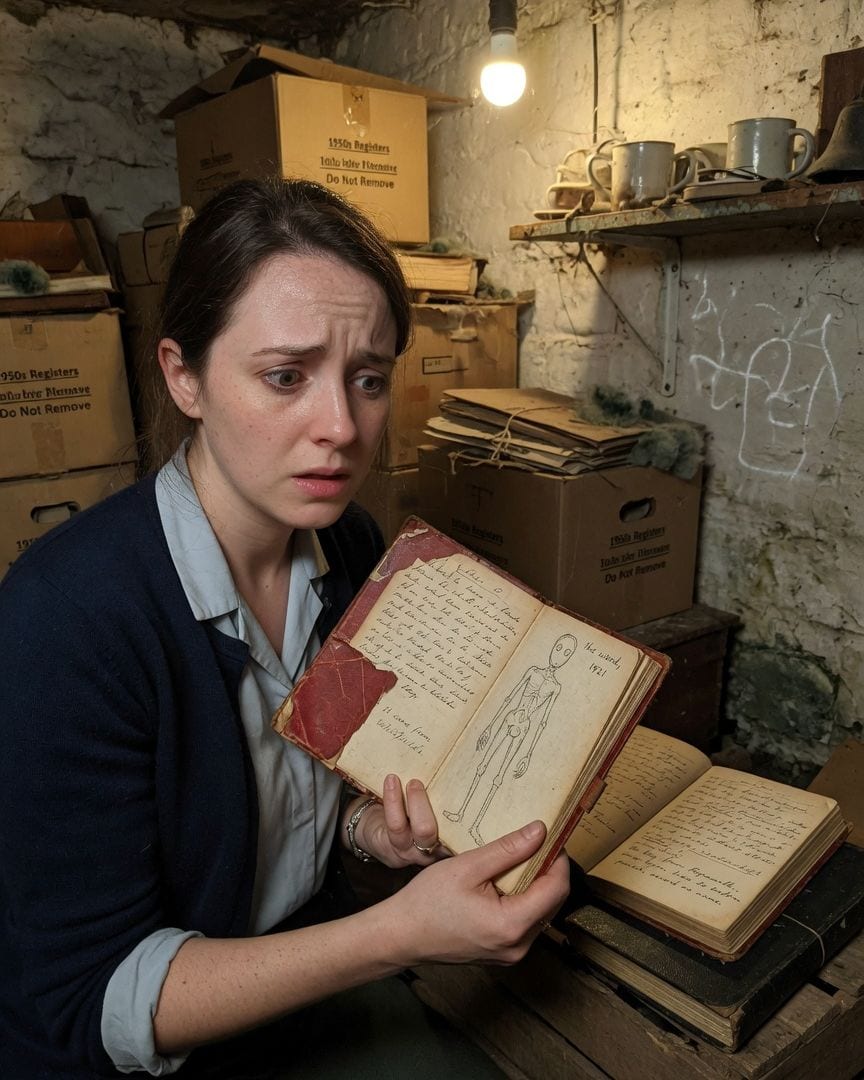
My old school punishment book lists a caning from 1953, the child's name blacked out. The head's note reads 'the boy from Ropewalk, as before — punish, record no name,' and Ropewalk is my street.
As the new teacher, I was sorting dust-choked archives when I found an old leather-bound punishment book. Its meticulous entries listed 'the boy from Ropewalk' caned once a decade, every decade, since 1901. A cold dread settled as I realized Ropewalk was my street, with the entries implying it was always the same child, from the same house.
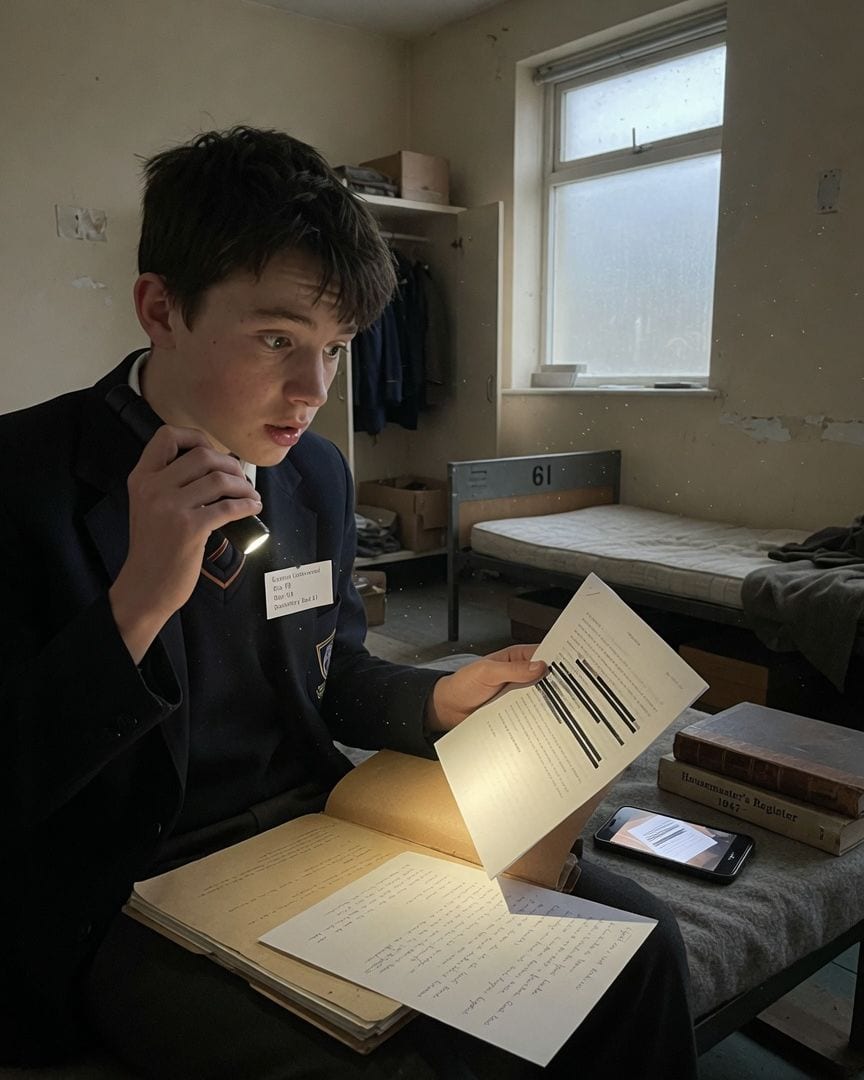
My boarding school bed number was 61, and the archive shows a boy assigned it every eight years since 1947, each leaving mid-term with the bed 'to remain made up'.
I found my matriculation card, listing me as 'Boy 61, Dormitory Bed 61.' Later, an old ledger revealed every boy assigned that bed since 1947 left mid-term, with an unsettling note: 'bed to remain made up.' Our housemaster’s recent scribble, 'as the others,' only deepened the dread around my own assigned bed.
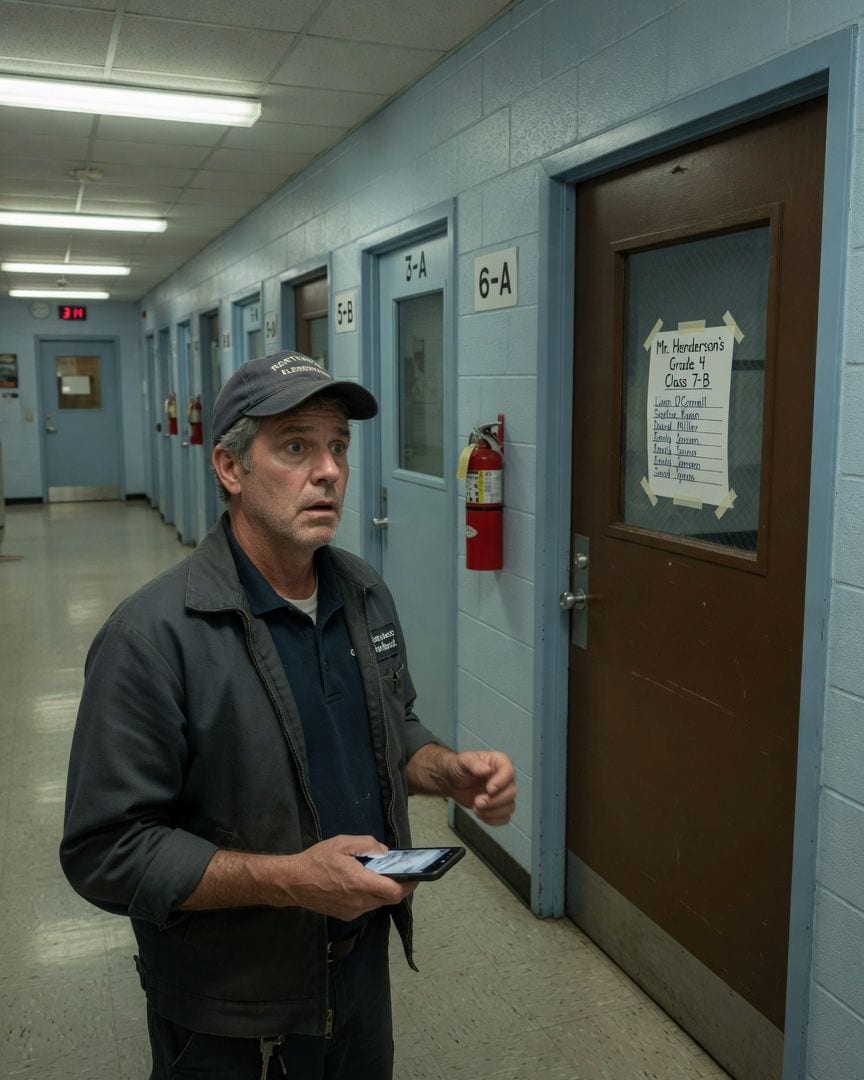
My classroom doors counted twenty-three last night. The extra one had a class list taped inside, names of children who've never been at this school.
My job as night caretaker at Northwood Elementary is routine: 22 classrooms, all accounted for. But one night, an impossible 23rd door appeared in the science block, nestled where only a wall should be. It bore a class list of students and a teacher who don't exist in any school record. Then, in an old logbook, I found that exact same list, dated 40 years ago.
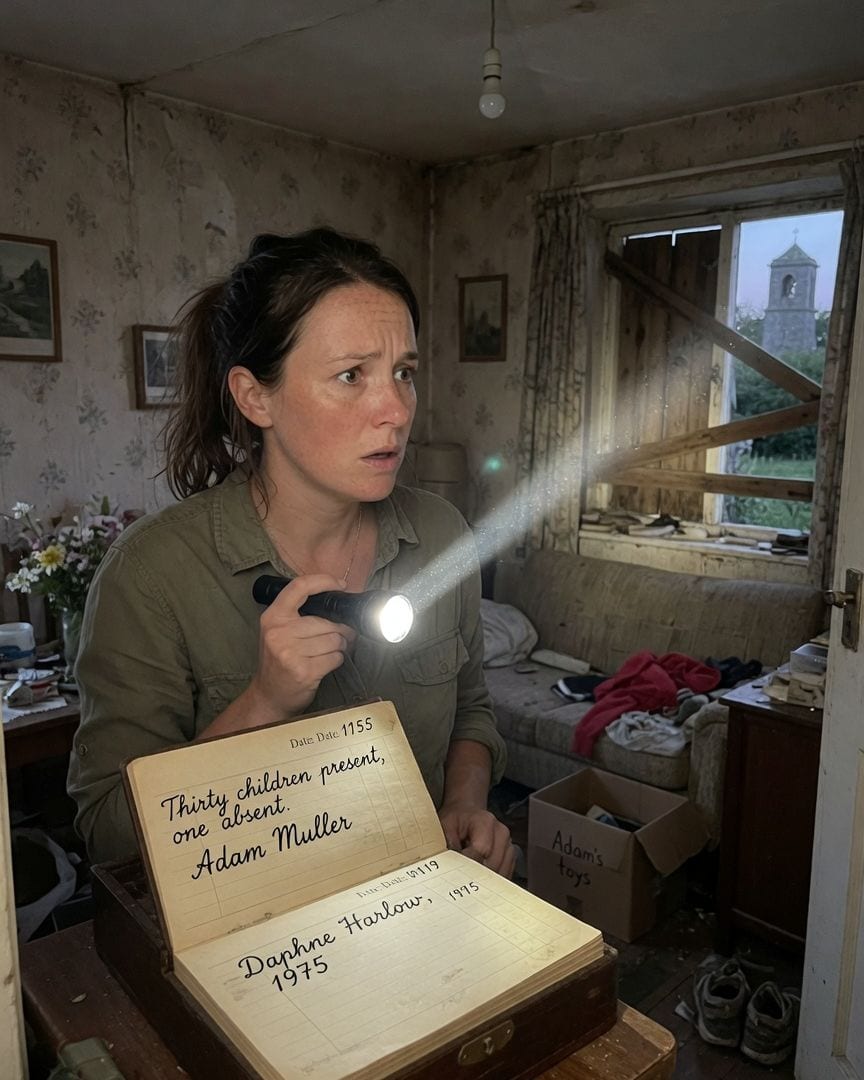
My son rang the old school bell. The attendance register, visible through the boarded window, now shows today's date and his name marked 'absent'.
We moved to a quiet village for peace, but my six-year-old son Adam found the old, boarded-up schoolhouse. Locals warned us, "Never ring the old school bell." That Tuesday, Adam rang it. Later, I saw his name on the school's long-closed attendance register, marked 'absent' in impossibly fresh ink from today.
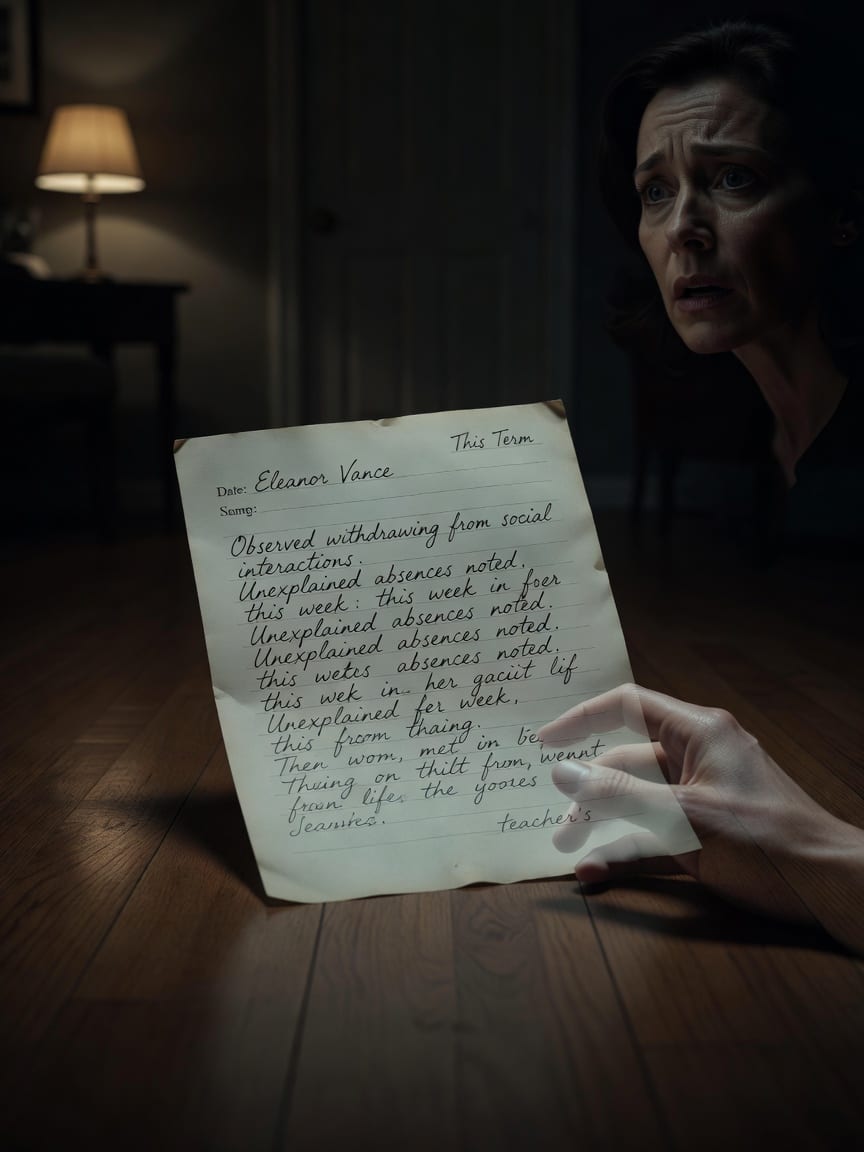
My school reports keep arriving, one a term, signed by teachers dead for decades. The latest describes something I'm doing *this week*.
My name is Eileen Caldwell, and my quiet life was upended by a school report from a place demolished decades before I was born. The report, signed by a long-dead teacher, eerily detailed my current habits. But the real shock arrived when I found my own name in a student register, dated 1968, with precise descriptions of my childhood—years before I existed.
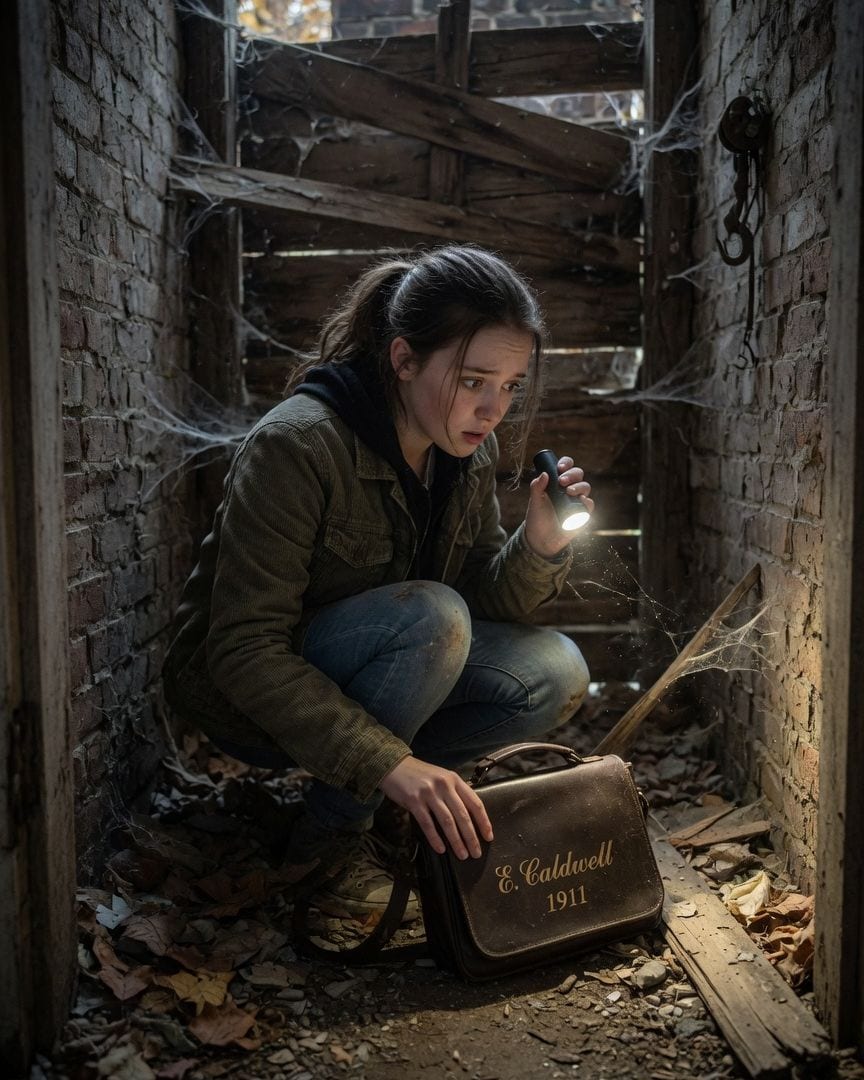
The school attendance register lists a child present every day since 1911. No such student ever sat an exam.
My new school, Caldwell High, felt too quiet, especially around its ancient, boarded-up bell tower. Teachers gave identical, rehearsed lines about it being "structurally unsafe." But then I found the attendance register, detailing a student named Eleanor Caldwell marked present every single day since 1911. No other record of her exists anywhere.