My uncle's wake book held my signature, dated yesterday, before he died. The words were not mine.
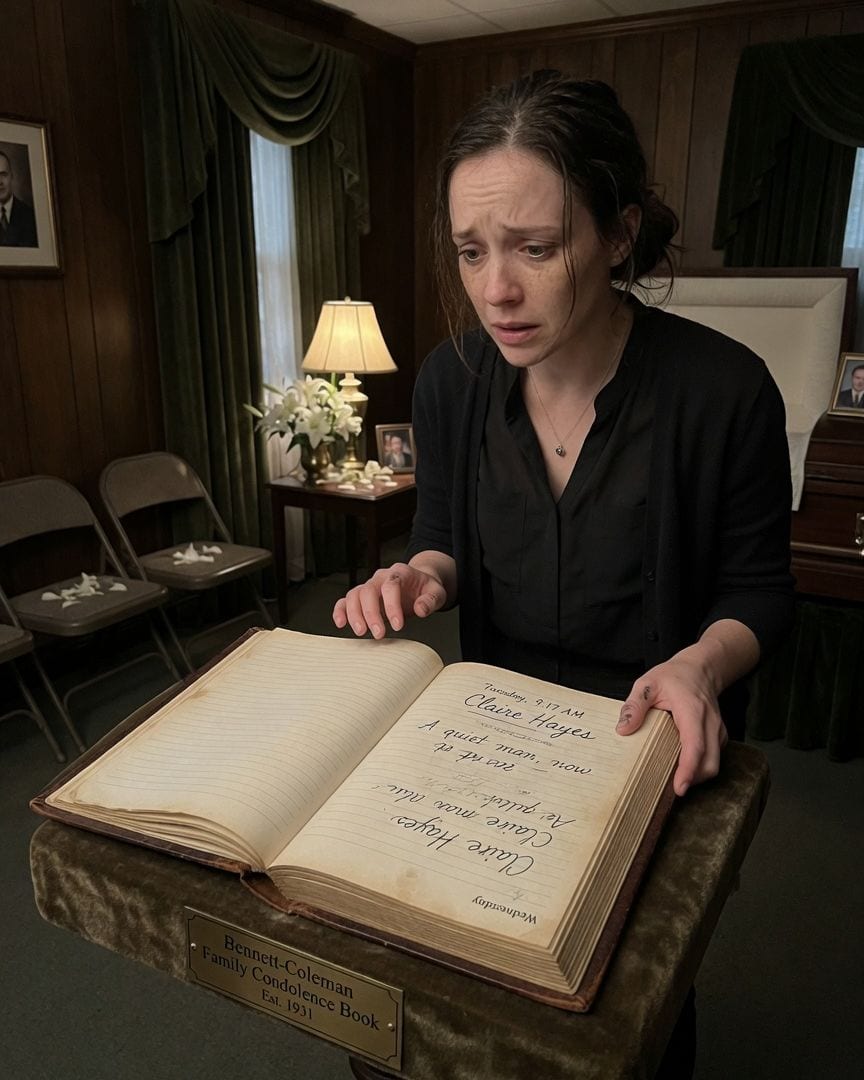
The scent of lilies and old wood hung heavy in the air of the Bennett-Coleman Funeral Home, a smell that always pulled me back to childhood memories I couldn't quite place.
I’d just signed the condolence book for my Uncle Charles, my hand still stiff with grief, near the bottom of a freshly turned page.
He’d passed quietly in his sleep Tuesday night, a blessing after so many years of quiet decline. Vera, my aunt, had asked me to be one of the first, just family.
I closed the heavy, leather-bound book, then a flicker of something, a nagging curiosity, made me open it again. I wanted to read what others had written about Charles.
I turned back a few pages, scanning the familiar names of cousins and old friends. My breath caught. Higher up, almost centered on a page dated the previous morning—Tuesday, before Uncle Charles had even passed away—was my own signature.
‘Claire Hayes,’ it read, in my unmistakably looping hand, the precise angle of the 'C' and the sweep of the 'y' a mirror of my own.
But the words beneath it, ‘A quiet man, now at peace,’ were not ones I would ever have chosen. They felt… distant. Generic. Not the raw, immediate ache of loss I felt.
The ink was fully dry, settled deep into the aged paper, impossible in a way that made my stomach clench.
A cold knot began to form in my stomach. It had to be a mistake, a trick of the light, or my mind playing a cruel game in my grief.
I squeezed my eyes shut, took a shaky breath, then looked again. Still there. The date, 'Tuesday, 9:17 AM,' was clearly visible. My signature, clear as day.
I excused myself from the small cluster of family, my heart thrumming an uneven beat against my ribs. I found my Aunt Vera in the reception area, her eyes red-rimmed and tired.
“Aunt Vera,” I began, trying to keep my voice even, “about the condolence book… is there more than one?”
She shook her head, a wisp of grey hair escaping her bun. “Just the one, dear. It’s been with the family for generations, a Coleman tradition. A real antique, that one.” She gestured vaguely towards the viewing room.
“Did anyone else… sign it yesterday?” I pressed, trying to sound casual, but my voice was tighter than I intended.
Vera frowned, a slight crease appearing between her brows. “No, sweetie. Charles passed Tuesday night, around ten. We didn’t open the funeral home for his viewing until this morning. Why?”
I mumbled something about seeing an old friend’s name and wanting to confirm, my rational mind scrambling. A relative with similar handwriting? A morbid practical joke someone thought was funny?
But the words, so formal, so unlike my own spontaneous grief, gnawed at me. My thoughts circled back to that specific, precise time stamp: Tuesday morning.
Not only had Charles not died yet, but the funeral home hadn't even opened the book.
I walked back into the silent viewing room. The book lay open on its small, velvet-draped pedestal. I looked at the impossible entry again. The date, Tuesday morning, was clear and undeniable.
The ink, undeniably dry, seemed to have settled deep into the fibers of the paper, not a fresh, wet sheen. I compared it to my fresh signature at the bottom of the page.
Same hand, same pressure, but a different emotion entirely in the stroke of the pen. It felt like an echo from a future that hadn't happened yet, already written.
Driven by a chilling instinct, a need to find a concrete answer, I sought out the funeral home director.
Desmond Russo was a man in his late forties, with silvering temples and a perpetually sympathetic gaze that usually made people feel at ease. Today, it just made him seem oddly placid.
I explained, carefully, about the signature, watching his face for any flicker of surprise or concern. Russo listened, his expression unchanging, then nodded slowly.
“The Coleman family has always been… particular about their records,” he said, his voice smooth and low, leading me away from the hushed main rooms and down a narrow corridor to a small, dusty office.
He pulled open a heavy oak drawer. Inside lay a stack of similar leather-bound books, old and worn, their spines faded.
He retrieved one, older still than the one in the viewing room, its cover worn smooth, the leather cracked like ancient soil. “This is one of the earliest ones.
Used for the family’s own services, going back to the thirties, when the funeral home first started.”
He opened it to a random page, his fingers lingering on the brittle paper. My breath hitched.
There, on an entry dated 1957, was another impossible message, another signature with a date clearly before the deceased’s actual passing, and the same unsettlingly generic phrase: ‘A life well-lived, now at rest.’ It wasn't just me.
It wasn’t a mistake. This book, this place, had a history of pre-writing the dead.
Over the next few days, that impossible entry, along with my own, became an obsession. The funeral was over, Charles was buried, and the initial wave of grief had settled into a dull ache.
But the gnawing question of the book remained. I returned to the funeral home, feigning interest in researching my Coleman family lineage, claiming I was helping Aunt Vera organize some old papers.
Desmond Russo, perhaps sensing my underlying unease, was surprisingly cooperative, or perhaps just used to the eccentricities of the Coleman family.
He never quite met my eyes when I spoke about the old books, but he never refused to show me what I asked for.
He led me deeper into the archives, past rows of urns and forgotten flower arrangements, to a small, climate-controlled room where dozens of these antique books were carefully preserved.
Each revealed similar anomalies: signatures dated days, sometimes even weeks, before the deceased’s actual passing. Always with those stilted, generic phrases. ‘Gone too soon, but never forgotten.’ ‘A peaceful journey home.’
The pattern was undeniable, stretching back decades, each entry a quiet, unnerving violation of time and reality.
I noticed something else: the earliest books contained entries almost exclusively from Coleman family members, or those closely associated with the funeral home. It wasn’t just a random oddity; it was a curated, generational phenomenon.
I asked about the books' origins, their purpose. Russo explained they were ‘Chronicle Ledgers,’ passed down through the Coleman lineage, kept as a tradition. “Some families keep photo albums,” he’d said with a shrug, his gaze distant, “we keep these.
They’re a record of the community, of lives lived and remembered.”
Then, almost as an aside, a detail that sent a fresh shiver down my spine. He mentioned that my own paternal grandmother, Margaret Hayes, had been a distant cousin to the original Coleman family.
She’d often helped with ‘administrative duties’ at the funeral home in her younger years, particularly after her husband died. “She had a fine hand for calligraphy,” he’d commented, “and a knack for organization.
Quite the asset to the family, back then.” The connection, however tenuous, felt like a cold tendril reaching out from the past, drawing me into this strange, impossible history.
I felt a growing dread, not just for the wrongness of the records, but for the way they seemed to be drawing me in, making me part of their strange, impossible history.
My research extended beyond the funeral home. I dug into old town records, genealogy sites, anything that might shed light on the Coleman family and their 'Chronicle Ledgers.'
I found mention of a small, local historical society, long defunct, that had once held a collection of Coleman family papers.
I spent hours sifting through dusty microfiches and brittle news clippings, searching for any clue, any explanation for these impossible entries.
The more I looked, the more the mundane explanations – a clerical error, a shared penmanship – crumbled away, replaced by a profound, unsettling sense of something deeply wrong with the fabric of what I understood as reality.
One afternoon, as I was leaving the old town library, my mind swimming with impossible dates and generic phrases, a dark sedan pulled up alongside me at the curb. The window rolled down slowly, revealing Desmond Russo behind the wheel.
His usual sympathetic demeanor was gone, replaced by a calm, almost unsettling stillness. His eyes, usually so kind, now held a deep, unreadable knowledge.
"You're digging too deep, Claire," he said, his voice low, devoid of inflection. "Some things are best left undisturbed. The Ledger maintains an order. It always has. And it always will."
He didn't threaten me, didn't raise his voice, but the implication was clear: he knew what I was doing, and he knew why.
The casual 'it always will' hung in the air, a quiet assurance that this pattern wasn't just history; it was an ongoing, active force. I felt a sudden, profound shift.
I wasn't just investigating a historical anomaly; I was being watched by someone who understood its power, someone who was part of it. The hunt had turned.
I was no longer just a curious niece; I was a perceived disruption to an ancient, unnatural order.
The cold wind that suddenly swept down the street felt less like weather and more like a deliberate breath, raising goosebumps on my arms.
Shaken but resolute, I confronted Russo the next day, cornering him in his office. His desk was meticulously tidy, a single, ancient leather-bound book—one of the Ledger's smaller versions—resting in the center.
"What did you mean, 'the Ledger maintains an order'?" I demanded, my voice tight, louder than I intended in the quiet room.
Russo sighed, running a hand over his face, as if tired of a conversation he’d had countless times before. “It’s not about changing what happens, Claire. It’s about how it’s remembered. How it’s recorded. Sometimes, events are… messy. Untidy.
The Ledger, it smooths things over.” He tapped the ancient book on his desk with a long finger. “It writes the memory of an event before it fully settles, ensuring the timeline appears… coherent. To us, anyway.”
My mind reeled, trying to process his words. “So my signature… it wasn’t a mistake? It was… written?”
Russo nodded slowly. “Yes. For your uncle. A small correction, to ensure his passing felt… appropriate, within the family narrative.” He explained that certain individuals, often those in mourning or at points of emotional vulnerability, could become temporary conduits.
“Your grief, your connection to Charles, made you receptive.”
The impossible entries in the other books, the generic phrases, the early dates – they all clicked into place with a horrifying, sickening precision. The generic phrases weren't just bad writing; they were the Ledger's neutral, 'corrective' language.
It wasn't about a literal time-traveling signature, but about a record being subtly, unnervingly altered, and then believed by everyone else. The world wasn't wrong; its memory had been edited.
And my own memory of signing the book, later, on Wednesday, was the true one. The Ledger had simply inserted another, earlier one, overriding what my aunt believed, what the funeral home recorded, what the general public would see.
The dread deepened.
I felt a dizzying horror. The Ledger didn't just record; it rewrote. But why? And why me? I pressed Russo, my voice barely a whisper. "My grandmother, Margaret Hayes... you said she worked here. Was she a conduit too?"
Russo hesitated, his gaze drifting to an old, sepia-toned photograph on his wall – a group of women, solemn-faced, standing outside the funeral home decades ago. I recognized my grandmother amongst them, younger, but unmistakable, her eyes serious even then.
"Margaret was… very close to the Ledgers," Russo finally said, his voice almost a whisper, as if sharing a sacred, dangerous secret. "More than just administrative. She was a… caretaker. And sometimes, the Ledger needs to correct its own caretakers."
He rose and went to a heavy, wall-mounted safe, spinning the dial with practiced ease. He pulled a thin, brittle document from inside. It was a death certificate for Margaret Hayes, dated twenty years ago.
My eyes scanned it, then froze on the space for 'Witness Signature.' Beneath the formal cursive of a doctor, barely legible, was a child’s unsteady hand, spelling out 'C. Hayes.' It was my own name.
And the date next to it was two days before her grandmother's actual date of death. I remembered that week vividly; I’d been home with the flu, confined to bed, miles from the funeral home, feverish and weak.
My own signature, for my own grandmother, pre-written by the Ledger, before the event, before I was even physically present. I wasn't just a conduit.
I was a part of the Ledger's history, a subject of its corrections, my own life already woven into its impossible fabric.
The photograph on Russo's wall now seemed to mock me, a silent testament to a history I was only just beginning to grasp. "My grandmother… she signed her own death?"
I whispered, the implications crashing down like stones in a well.
Russo shook his head, his face etched with a profound weariness. "No, Claire. The Ledger isn't a person. It's a mechanism. And it uses those most connected to the threads it seeks to 'smooth.' Your grandmother was a primary thread.
When her own life's end became… untidy, the Ledger sought the closest, most impressionable connection available. That was you, a child, full of raw emotion.
It used your hand, your grief, to pre-write the memory of her passing, to ensure its 'coherence' in the family narrative."
My childhood memories of that week, hazy and feverish, suddenly felt sinister. The sense of déjà vu I sometimes experienced, the faint feeling of having lived a moment before, now made a chilling, awful sense.
"So it's been using me my whole life?" I asked, a profound sense of violation washing over me.
Russo nodded slowly. "Not constantly. Only when a significant 'correction' is needed, and you are the most appropriate conduit. Your uncle's death was another such moment.
The Ledger ensures that even the most jarring events fit into a seamless, if manufactured, timeline for those who experience it. It's why no one ever questions the dates, why memories align with the false record."
The horror wasn't just that the world's record was wrong, but that my own internal world, my own timeline, had been subtly, repeatedly, rewritten by an unseen force operating through me.
It wasn’t a mistake that my memory had been off; it was an active, ongoing process, edited from within.
I knew, with a certainty that settled deep in my bones, that I couldn't let it continue. This Ledger, this insidious editor of reality, had to be stopped. I demanded to know how.
Russo, his face etched with resignation, as if he knew this conversation was inevitable, finally revealed the truth. "The Ledger feeds on connection. On the act of writing, of committing a name to its pages.
To sever its hold, you must sever your own connection. You must write the last entry, for yourself, and then ensure no one ever writes in it again." His eyes were grave. "But the Ledger resists.
It will try to make you forget, to make you doubt. It will try to make you write what it wants."
I took a deep, trembling breath. I couldn't destroy the antique book – it was too ingrained in the family's history, too protected by Russo and others who served it. But I could escape its influence.
That night, I returned to the funeral home. It was locked, but Russo had left a small, heavy key on the porch, under a potted fern. The air inside was cold, silent.
I found the Ledger, open on its pedestal, almost inviting, its pages waiting.
Taking a pen, my hand shaking so violently I almost dropped it, I opened to a blank page. I didn't write my name, didn't write a generic phrase. Instead, I wrote a single, defiant sentence: 'I remember.'
The ink, as I wrote it, seemed to shimmer, then bled slightly into the paper, as if resisting the very words. A wave of intense nausea washed over me, a sudden, blinding headache that threatened to black out my vision.
Memories flickered, old ones, new ones, blurring at the edges, as if the Ledger was fighting back, trying to scramble my mind, to erase the truth I was asserting. I gripped the pen tighter, focusing on the simple, declarative truth.
I remember. I slammed the book shut, the sound echoing in the silent, empty room like a gunshot.
Then, with a strength I didn't know I possessed, I took the Ledger, heavy and resistant in my arms, carried it out to my car, and drove it far away, to a remote, abandoned library I knew from childhood explorations, hiding it deep within a forgotten section, a single, defiant act of resistance against the silent editor of time.
I never saw Desmond Russo again. The Bennett-Coleman Funeral Home continued its quiet business, seemingly undisturbed. I often felt a phantom ache in my writing hand, a subtle tremor that would pass after a few moments.
My memories, though, were clearer, sharper, no longer subject to the Ledger's subtle edits. The world still had its inconsistencies, its small, inexplicable moments, but now I saw them as they truly were: anomalies, not 'corrections.'
I carried the proof of the Ledger's existence, not in a physical record, but in the unshakeable certainty of my own mind, a truth no one would ever believe.
I still attend family funerals, still sign condolence books. But I always check the dates, always scan the pages for those specific, generic phrases that whisper of a deeper, unsettling order.
I carry the weight of what I know, a quiet vigilance against the subtle rewriting of reality.
Sometimes, I wonder if the Ledger is truly dormant, or if it has simply found another hand, another heart, to twist into its service.
I saw a flicker of something in my cousin's eyes at a recent memorial, a distracted, almost distant look as he signed his own name. A shiver ran down my spine.
The knowledge was a solitary burden, a truth that marked me forever. She remembers.
If this one got to you
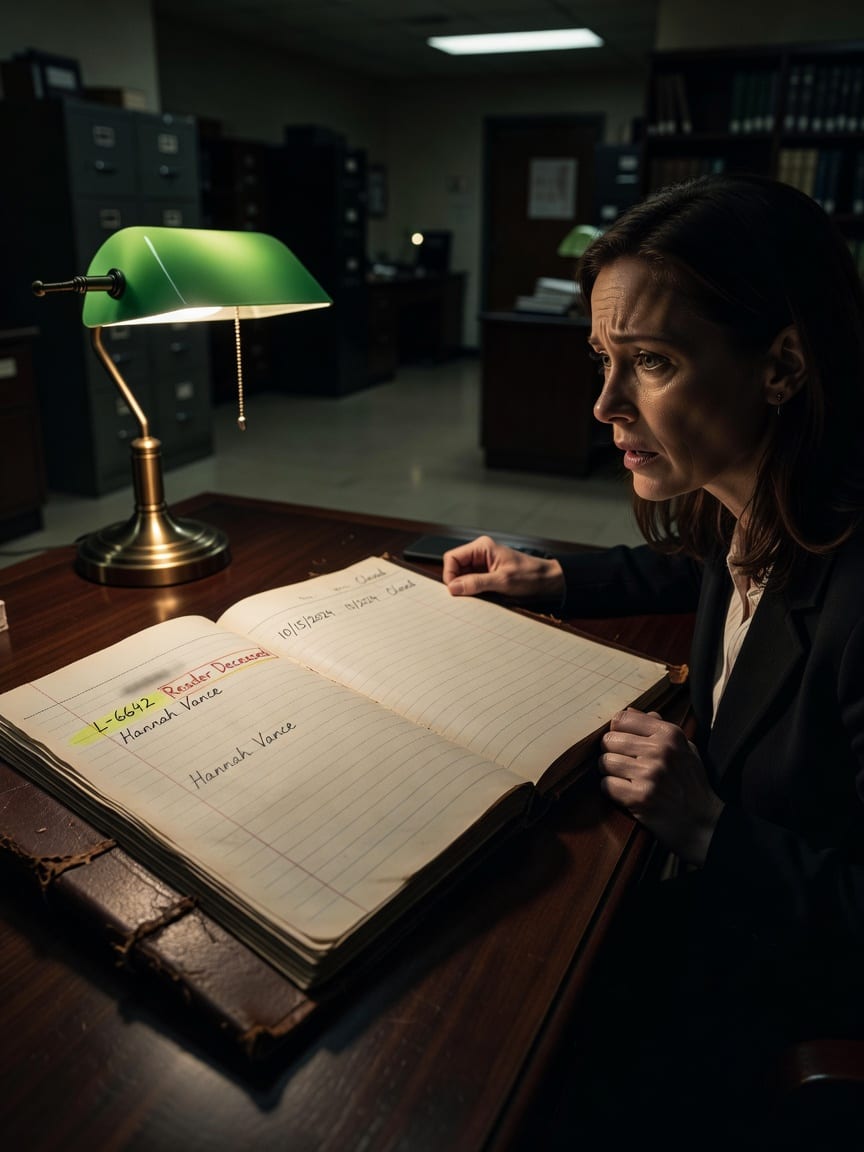
My library card number L-6642 was issued to me at seven — and the ledger shows that number has marked a reader 'deceased' every twelve years since 1949.
Returning my late father's library card to the old town library felt like a small act of closure. But the senior librarian's ancient ledger revealed a chilling pattern of 'reader deceased' entries tied to specific card numbers and borrowed books. My unease turned to cold dread when I secretly found my own name penciled in, marked for a future 'reader deceased' entry.
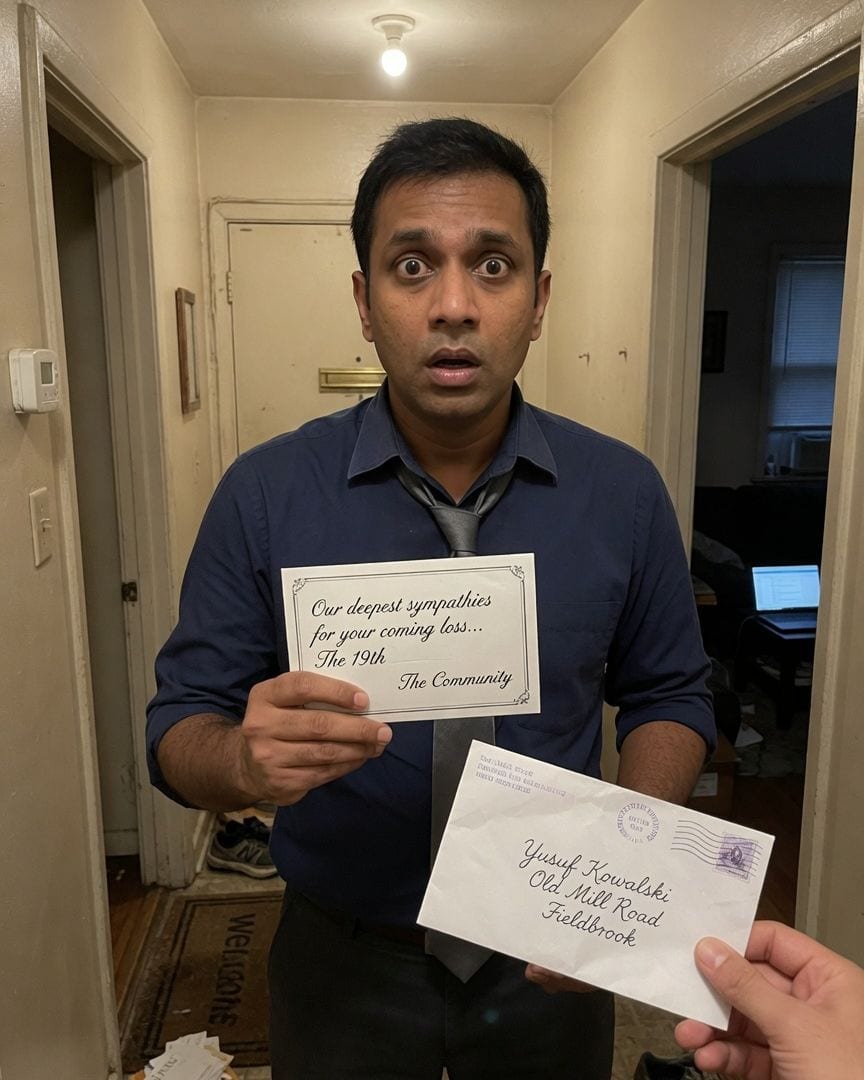
My bus driver knows my name, Yusuf, and said 'not long now.' Today is the 18th. He added a date this morning: the 19th.
My morning bus commute is a predictable comfort until driver Bernard Ellison addresses me by name. I've never told him Yusuf. Then, he adds a quiet, 'Not long now... The 19th.' Today is the 18th, and his words leave me with an inexplicable dread.
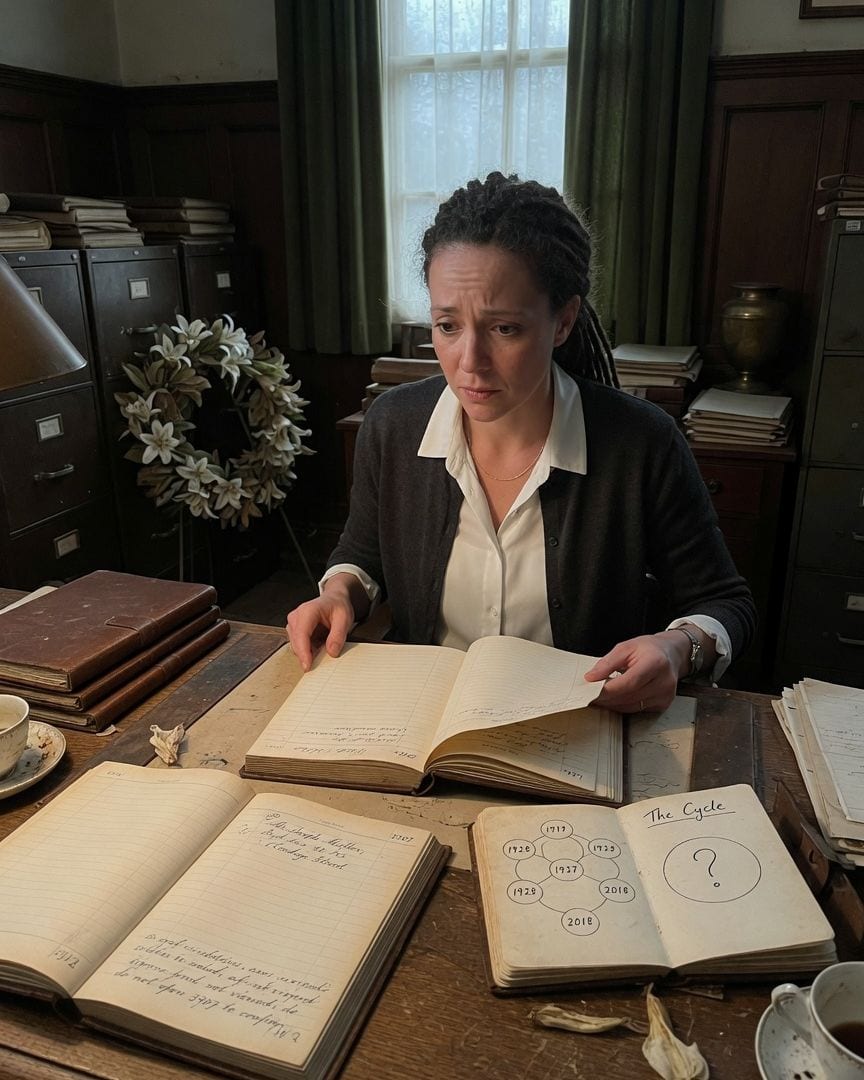
Our funeral ledger records my family name, same age, buried on Cordage Street every nine years since 1919. My great-grandfather's note: 'do not open 3907.'
Reviewing my great-grandfather Joseph’s old ledgers at the Ingram Funeral Firm, I stumbled upon a recurring anomaly. The same burial order for a Joseph Muller, age 45, residing at our family home, 14 Cordage Street, appeared every nine years across decades of records. Each entry, identical, carried the unsettling instruction: 'coffin sealed, not viewed.'
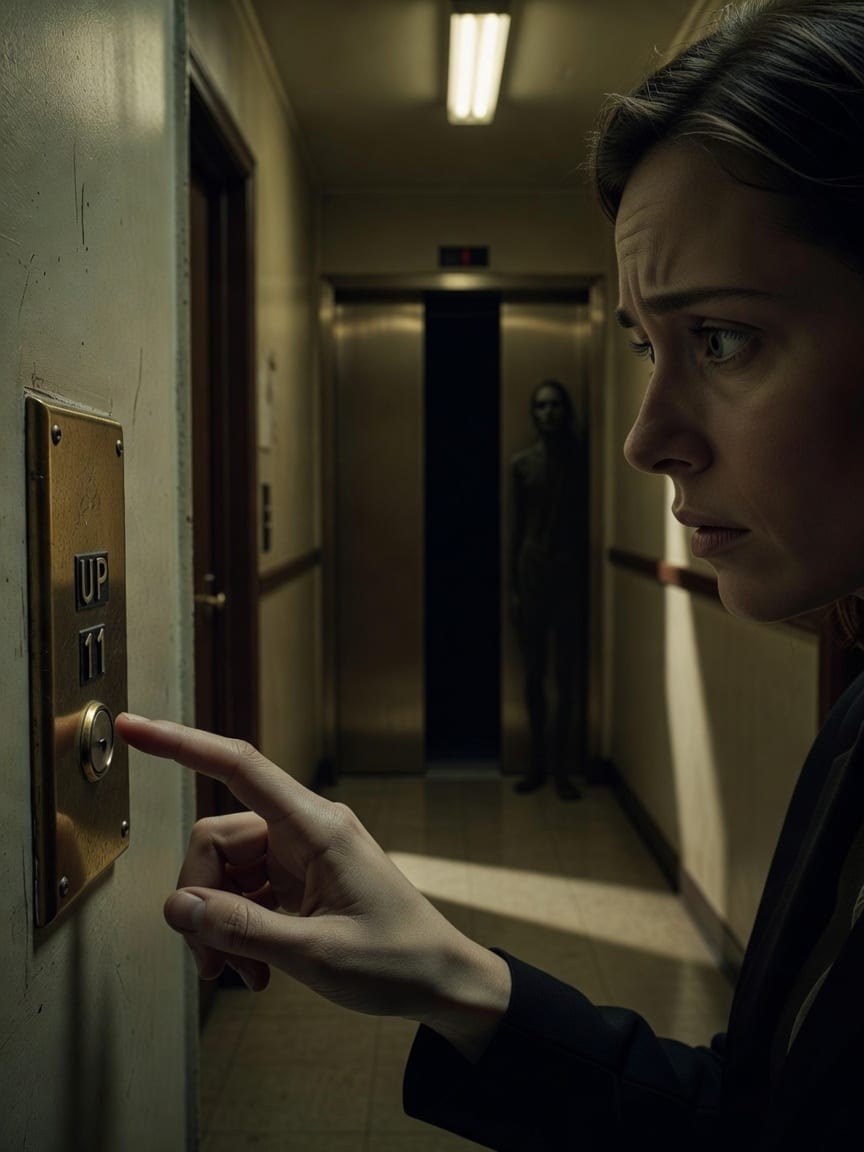
My doorman warned me not to take the tenth-floor lift on Saturday. The building's lift passed inspection last month. He seemed terrified that he'd said it.
My doorman's unsettling warning about the tenth-floor lift left me with a metallic taste of unease. I tried to rationalize it away, but then a birthday card arrived for me, five months early, from an impossible address. It was a site linked to unexplained disappearances, and a cold certainty began to settle in.
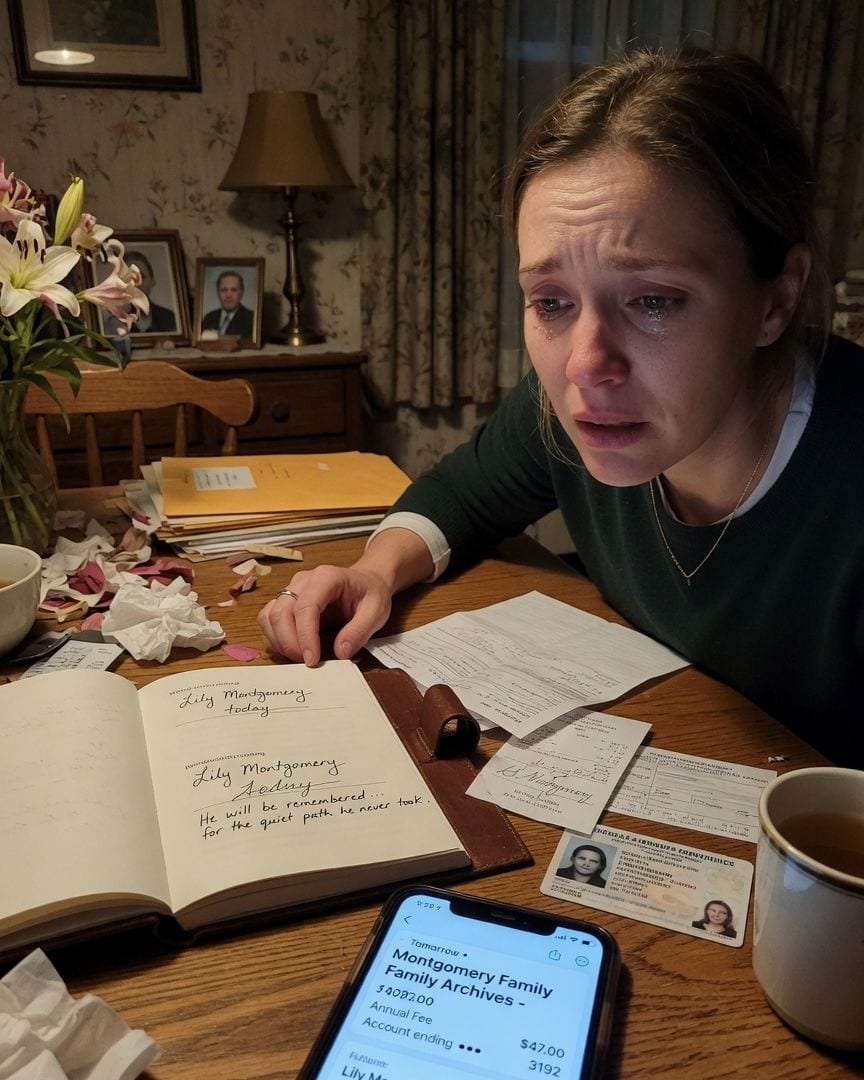
My handwriting was in the condolence book. Dated before my uncle died. Words I'd never choose.
At Uncle Howard's funeral, grief-stricken, I signed the condolence book. But later, flipping back through the pages, I found my own distinct handwriting on an entry dated the previous morning—before he had even died. The words beneath my name were chilling, a judgment I would never make.
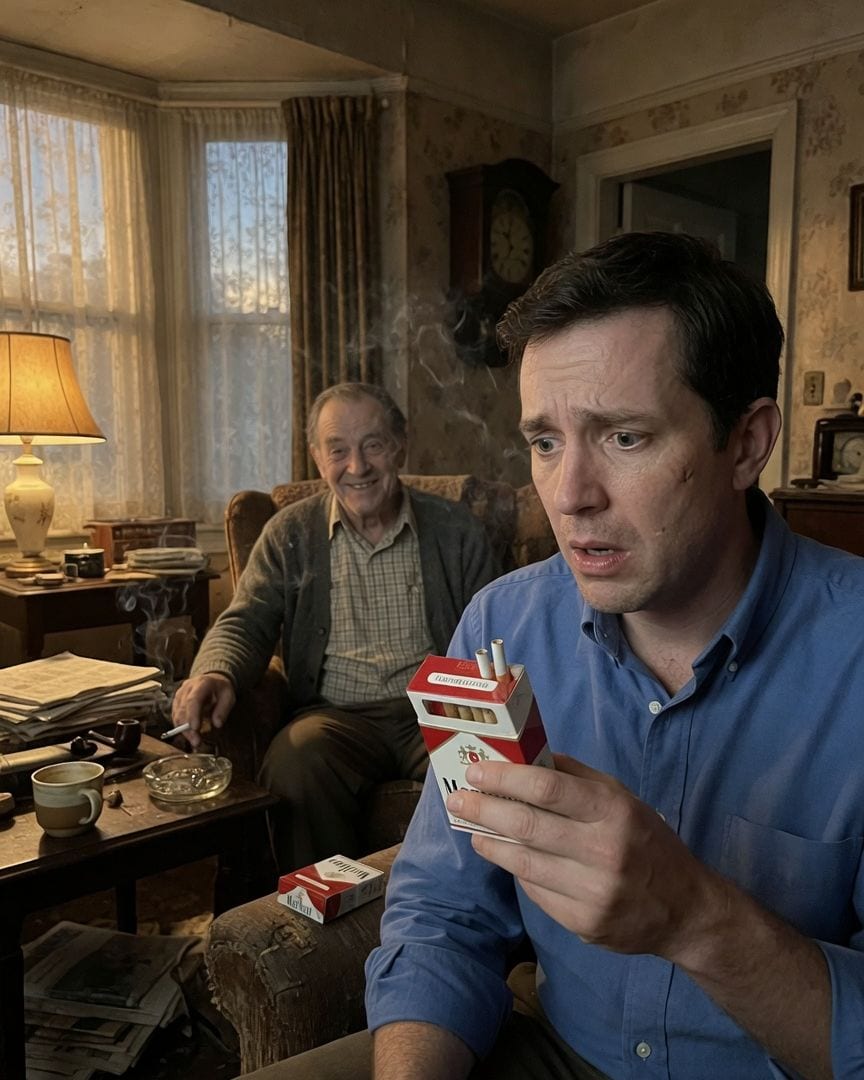
My uncle always smoked left-handed. He went missing, came back smoking with his right — and when I said so, he held out the pack and asked me to show him how he used to do it.
My Uncle Frank, a fixture in his armchair, vanished for two days and returned changed. He's always smoked left-handed, a nicotine stain on his thumb a permanent reminder. But tonight, he holds his cigarette in his right hand, a slow, wide smile on his face that doesn't quite reach his eyes.