An archivist had eight days to clear his Cold War film vault when a 1949 coastal survey showed a highway built in 1988.
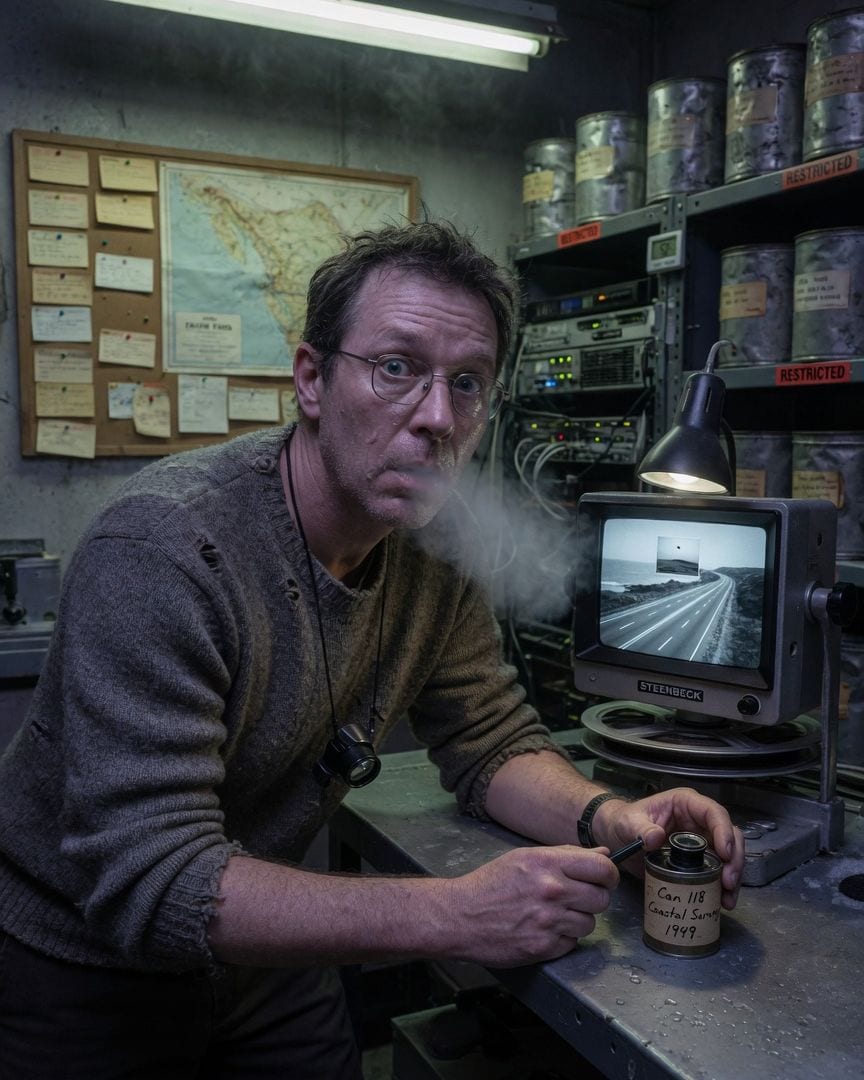
Archivist Prosper Nailes knew the cold of the College Park film vault better than he knew the warmth of his own apartment.
The pervasive 52-degree Fahrenheit chill was a constant, seeping into his bones through his woolen sweater, a necessary evil for the preservation of countless reels of history.
He had eight days, a ticking clock, to accession four hundred film cans before the collection underwent its mandated reduction. Today, Can 118 sat on his workstation, labeled simply: 'Coastal Survey, 1949.'
Prosper, a meticulous man by nature and profession, loaded the reel onto the ancient Steenbeck viewer.
The first pass of the 16mm film ran clean, a familiar stretch of undeveloped bluffs along an unnamed shoreline, grainy black and white footage of waves crashing against a pristine, empty coast.
Nothing out of the ordinary, just as the catalog promised. He noted the time stamp, 3:14 PM, and prepared for a second, identical pass, standard procedure for quality assurance.
The projector whirred again, the images blurring, then sharpening into focus. The bluffs rolled by.
But this time, running the entire length of the undeveloped coastline, stark against the dark earth, was a four-lane asphalt road, complete with painted white lines and a clear shoulder.
Prosper’s breath caught, a puff of vapor in the cold air. His gaze darted to the can's label—'Coastal Survey, 1949'—then back to the impossible highway scrolling across the screen.
He killed the projector, grabbed a loupe, and meticulously inspected the film's emulsion. Original stock. No splices. No cuts. The film itself was undeniably from 1949.
That road, he knew with absolute certainty, wasn't graded until 1988, a full thirty-nine years later. He rewound, his fingers fumbling slightly, and played the section again.
The four-lane road appeared once more, silent and defiant, a phantom highway in a forgotten year.
Prosper tried to force a rational explanation. A mislabel, perhaps? A re-cataloging error? He dismissed the film from the projector, the metal reel cool against his fingers, and logged into the vault's digital system.
He pulled up the entry for Can 118. The screen confirmed: 'Coastal Survey, 1949,' 'Original Stock,' with no record of re-filming, editing, or any annotation suggesting a later date.
He cross-referenced the physical can against the manifest—the serial numbers matched, the archival stamp on the box faded but clear.
His hands, already cold from the vault's constant temperature, began to feel clammy, a nervous sweat prickling his palms. He pulled the physical can again, examining the film's edges, the sprocket holes, for any tell-tale signs of splicing.
The reel was continuous, pristine. This wasn't some clever forgery; the film itself was untouched.
He then cross-referenced the geographic coordinates from the survey notes with local historical archives. The result was unequivocal: the four-lane road, precisely as depicted on the film, was indeed constructed in 1988 as part of a state highway expansion.
The aerial photographs from 1949 showed nothing but unbroken bluff. Prosper sat back, the sterile hum of the server racks now feeling less like background noise and more like a low thrum against his eardrums.
He searched for any related records for the 1949 survey, widening his query.
Deep within the metadata, he found a cryptic digital tag attached to not only Can 118 but a handful of other seemingly disparate files from various decades: 'Project TIMELINE.'
This tag, however, led to a heavily restricted index, a walled-off section of the database far beyond his usual archivist's access level. A cold dread, sharper than the vault’s chill, began to coalesce in his stomach.
Using a little-known loophole in the system’s permissions structure, a trick he’d learned from a former colleague, Prosper managed to gain temporary, albeit precarious, access to the restricted digital index.
His heart hammered as the system granted him entry, the cursor blinking expectantly on a stark, black screen. He typed 'Project TIMELINE' and 'Can 118.' The search yielded a single, heavily redacted file, its title almost entirely obscured.
He clicked it open, and the image of the 1949 film with its impossible road played in his mind's eye. This time, he didn't focus on the asphalt or the painted lines.
He remembered a faint flicker, a brief shadow in the distant sky above the bluff, too quick to fully register before. It had been an unconscious observation, dismissed as a bird or a trick of the light.
Now, a cold certainty settled over him.
He located the digital file of Can 118, navigated to the section with the road, and scrubbed through the footage frame by frame. He watched the coastline, the waves, the impossible highway. And then, he saw it.
A single frame, frozen. Above the impossibly present four-lane road, stark against the grainy, black-and-white sky, was the undeniable, angular silhouette of an unidentified aerial phenomenon.
He zoomed in, pixel by pixel. The shape resolved into something dark, sharp-edged, definitively not a plane, not a bird.
It was 'The Thing on the Scope,' undeniable, defying every law of its time, captured in 1949 over a road that shouldn't exist for another four decades.
Prosper stared, his heart thudding against his ribs in the cold silence of the vault, the screen's pale glow reflecting in his wide eyes.
Prosper’s archivist’s instinct, now thoroughly laced with a growing dread, took over. He meticulously dug deeper into 'Project TIMELINE,' bypassing official channels where possible, using every back door and obscure database command he knew.
He found other seemingly innocuous records: geological surveys, infrastructure proposals, meteorological reports—all from various decades, all linked to specific geographic zones, and all containing subtle, unexplainable temporal discrepancies.
A 1960s weather report detailed unusual atmospheric conditions, not just a storm, but a shift in fundamental air currents over a town that had been flooded and entirely abandoned in 1940.
A 1930s architectural plan for a monumental federal building that was never constructed, yet it was cross-referenced with exact blueprint details in a 1980s urban development report, as if it had always been there.
He began to see a horrifying pattern: these 'anomalies' weren't random glitches. They clustered around specific 'hot zones,' geographic coordinates that recurred across multiple disparate files.
And infrastructure projects, like the four-lane road, frequently appeared as a recurring motif, a strange temporal anchor point.
The vault's perpetual cold now felt less like a carefully calibrated preservation system and more like a massive, subterranean containment unit, keeping something powerful and unstable at bay.
He attempted to access physical files tagged 'Project TIMELINE' directly from the main archive.
Each inquiry was met with a curt 'Accession Pending' indefinitely, or 'Declassified - Redacted to Zero,' as if the records were either too sensitive to touch or had been wiped from existence entirely, leaving behind only their phantom digital markers.
The deeper he delved, the more solid the impossible became.
Prosper’s persistent inquiries and unusual access patterns, even with his carefully deployed loopholes, hadn't gone unnoticed. One morning, a crisp, unsigned note was slipped under his office door, tucked neatly beneath a stack of incoming manifests awaiting his attention.
The message, typed in a standard sans-serif font, read: "Some files are best left closed. Your clock is ticking." He dismissed it as a bad joke, a prank from a bored colleague. His work, after all, was public-facing, if obscure.
But then, subtle shifts began. A folder he meticulously left open on his desk, marked with his specific place-marker, was found closed the next morning, the marker tucked away.
His digital access logs, which he checked religiously, showed phantom entries—brief logins from his terminal, recorded in the system, when he knew he wasn't even in the building.
He told himself it was a system glitch, a delayed update, but the unease tightened its grip.
Then there was Albert Brooks. Albert, a quiet, methodical senior archivist, a man of routine and bland temperament, started to appear in the periphery of Prosper's vision.
Albert would be at the end of an aisle, ostensibly restocking files, but his gaze would drift, lingering on Prosper. He never spoke, never acknowledged the observation, just watched.
The silence of Albert’s observation was more unnerving than any direct confrontation. It was a practiced, patient gaze, like a predator circling, unseen, yet undeniably present.
Prosper felt a creeping certainty that his investigation had moved beyond mere academic curiosity and into something far more personal and dangerous. He was no longer just hunting for answers; he was, unmistakably, being hunted himself.
Prosper finally cornered Albert Brooks near the microfilm readers in the back of the vault, the low hum of the machines filling the tense silence.
Prosper laid out his evidence, spread across a vacant reading table: printouts of the anomalous 'Project TIMELINE' entries, the coordinates of the 'hot zones,' a high-resolution freeze-frame of the 1949 film showing the impossible road and, above it, the sharp, angular silhouette of the 'Thing on the Scope.'
Albert, his face pale beneath the fluorescent lights, initially tried to deflect, mumbling about misfilings and optical illusions, about "the vastness of human error."
Prosper pushed, his voice low and firm, pointing to specific entries, the impossible dates, the undeniable geographic overlaps.
He showed Albert the notation for Can 118, the vault log confirming its 1949 creation, the historical records confirming the road's 1988 construction.
Albert finally cracked, a deep, shuddering sigh escaping him, barely audible above the machine hum. He picked up the freeze-frame, his thumb tracing the outline of the impossible craft.
"It’s not just a repository, Prosper," he whispered, his voice thin, almost breaking. "This vault… it’s a holding pen. Some records… they don’t just describe reality. They are reality. Or they were reality, before it changed.
And sometimes," he paused, his eyes darting around as if expecting to be overheard, "they make reality."
Albert explained that the 'Thing on the Scope' events were not just tracked; they were instances where reality itself 'flexed,' where timelines diverged, moments of profound chronal instability.
The institution, he said, recorded these 'flexes' to understand them, and sometimes, to contain or even control them.
The road, he explained, was a minor 'flex,' a temporal ripple effect, an echo of a deliberate 'anchor' in the timeline, carefully put in place. "Be careful," Albert warned, his eyes wide with genuine, visceral fear.
"You need to talk to Eleanor Foster. She's the Head of Special Accessions. She’s the one who knows how to sign the new entries."
The implications of Albert's words reshaped everything Prosper thought he knew, the earlier clues now snapping into a terrifying, coherent, and deeply personal new truth.
Armed with Albert’s chilling partial truth, Prosper immediately sought out Eleanor Foster. Her office was in a secluded wing of the building, a place he rarely visited.
It was strangely devoid of personal items, filled only with floor-to-ceiling file cabinets made of dark, heavy wood, each perfectly aligned. A faint scent of old paper and ozone hung in the air.
He found her digital ledger, a system entirely separate from the main archive, requiring a higher clearance he didn't possess.
Driven by a desperate urgency, he remembered a string of commands Albert had once joked about, a back door used for emergency overrides during system crashes.
His fingers flew across the keyboard, the familiar tactile click-clack a counterpoint to his hammering heart. The security protocols dissolved, and the screen populated with Eleanor’s private digital ledger.
He filtered for 'Project TIMELINE' entries. The screen glowed with recent activity, some entries dated just today. He scrolled down, scanning for patterns, for any clue as to what "signing new entries" might mean.
The implications of Albert's words reverberated in his mind: records that were reality, records that made reality.
His eyes froze on a specific entry, dated just yesterday: a new 'Accession Pending' for a 'Temporal Anomaly Observation' under 'Project TIMELINE.' The description detailed an archivist's unusual access patterns and inquiries.
And under 'Subject,' his own name was listed, clear and undeniable: 'Prosper Nailes.' The cursor blinked, waiting for more, the file still being written, and he was the subject.
Prosper confronted Eleanor Foster in her office, the glowing ledger still open on his name, a stark white against the dark screen. She didn't deny it. Her composure was absolute, serene, more unsettling than any anger could have been.
"Welcome, Prosper," she said, her voice calm, almost detached. "We've been expecting you."
She explained that the institution didn't merely archive history; it managed 'chronal instabilities'—moments where timelines diverged or realities overlapped.
The 'Thing on the Scope' incidents, she clarified, were not just sightings, but manifestations of these instabilities, 'flexes' in the very fabric of time.
The records, she explained, were far more than historical documents; they were a form of containment, a way to 'anchor' a preferred reality, to ensure a stable timeline.
The 1949 film with the 1988 road, she revealed, was an early 'anchor,' a record of a future reality that was deliberately brought into being or stabilized to prevent a far worse divergence.
It was a seed planted, a path chosen.
The constant 52-degree chill of the vault, she added, wasn't just for preservation; it helped stabilize the chronal energy radiating from these 'active' records, containing the subtle distortions they emitted.
She confirmed that his own investigation was anticipated and recorded, not as a threat, but because anyone who delves deeply enough into these 'anchors' inevitably becomes an 'anchor' themselves, a new node in the system.
His name appearing in the ledger was simply the system registering his integration, a fact long foreseen.
Eleanor gestured to a plain, grey folder on her desk, thick and heavy, unlabeled save for a single, stark white label: 'Prosper Nailes.' Inside, the first page was pristine, blank.
"You have a choice, Prosper," she said, her voice devoid of malice, as if offering a simple career path. "Become part of the system. Learn to sign the new entries, help us maintain the anchors. Or… be filed away."
Prosper's mind raced, a frantic flurry of logic and fear. He glanced at the heavy, oak door, then back at Eleanor's impassive face. He tried the door handle, twisting it. It was locked, unyielding.
Eleanor simply offered a faint, sad, knowing smile, a flicker of something almost sympathetic in her eyes. "You're already in the system, Prosper. You were always in the system. Your file just needed to be completed."
He tried the door again, rattling the handle futilely, the sound echoing in the silent office.
He turned back to her, his breath catching. She was holding a pen, a simple black ballpoint, poised over the blank first page of his file. "It's a quiet job, Prosper," she said, her eyes holding his.
"But someone has to make sure the past stays… consistent. And the future, too." He looked at the pen, then at the pristine, empty page, awaiting its first entry. He felt a profound, chilling sense of inevitability.
He wasn't being trapped; he was being meticulously, calmly, and permanently documented, filed into a new existence.
Prosper Nailes was no longer seen in the main College Park film vault. His task of accessioning the four hundred cans before the collection's reduction was completed by Laura Coleman, another archivist, within the allotted eight days.
Prosper's old desk in the public area was cleared, his personal effects quietly boxed and stored in an anonymous locker.
Albert Brooks, the senior archivist, now avoided eye contact with anyone who asked after Prosper, his face a mask of practiced neutrality, his gaze fixed always on his own work.
Eleanor Foster's office light remained on late into the night, a silent, steady beacon in the secluded wing.
A new archivist, Laura Coleman, took over Prosper's former duties. While cleaning out the last drawer of his cleared desk, she found a small, unlabeled manila folder tucked deep in the back, almost forgotten.
Inside, there was only a single page: a heavily redacted printout of a coastal survey, dated 1949. On it, faintly, was the undeniable outline of a four-lane road, complete with painted lines.
And in the margin, in neat, methodical handwriting that looked uncannily like Prosper's, a tiny, almost invisible notation, simply three numbers: 3:14.
Laura Coleman held the page, tilting it to catch the fluorescent light, trying to decipher the faint script, a chill rising in the quiet office. It all fits.
If this one got to you
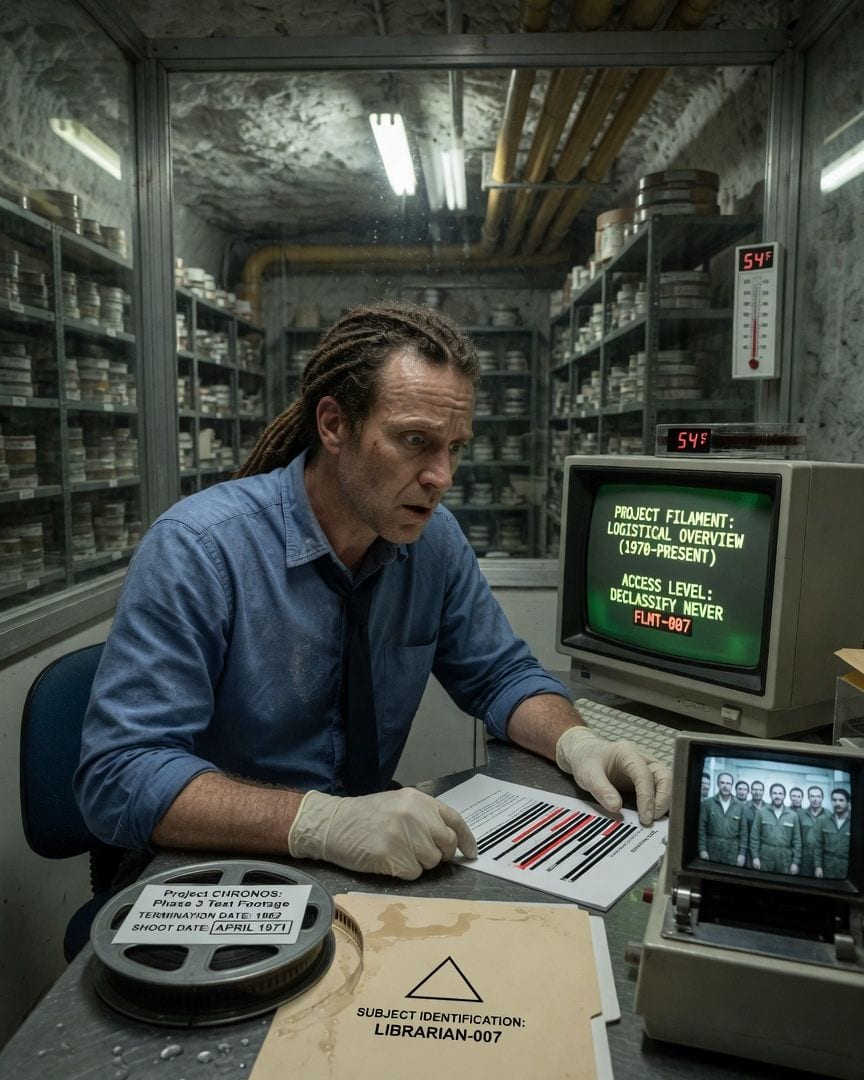
A records archivist found a Cold War film reel weeping cold condensation, shot nine years after its project officially terminated.
Hosea Pike, an archivist in a vast Kansas salt mine vault, meticulously maintained records in a perfectly dry, controlled environment. His brow furrowed when his gloved hand closed around a film reel weeping cold condensation, its metal chilled like well water. The label stated 'Project CHRONOS: Phase 3 Test Footage,' terminated in 1962, yet stamped beneath was an impossible shoot date: April 1971. What could explain a film shot nine years after its project's official end?
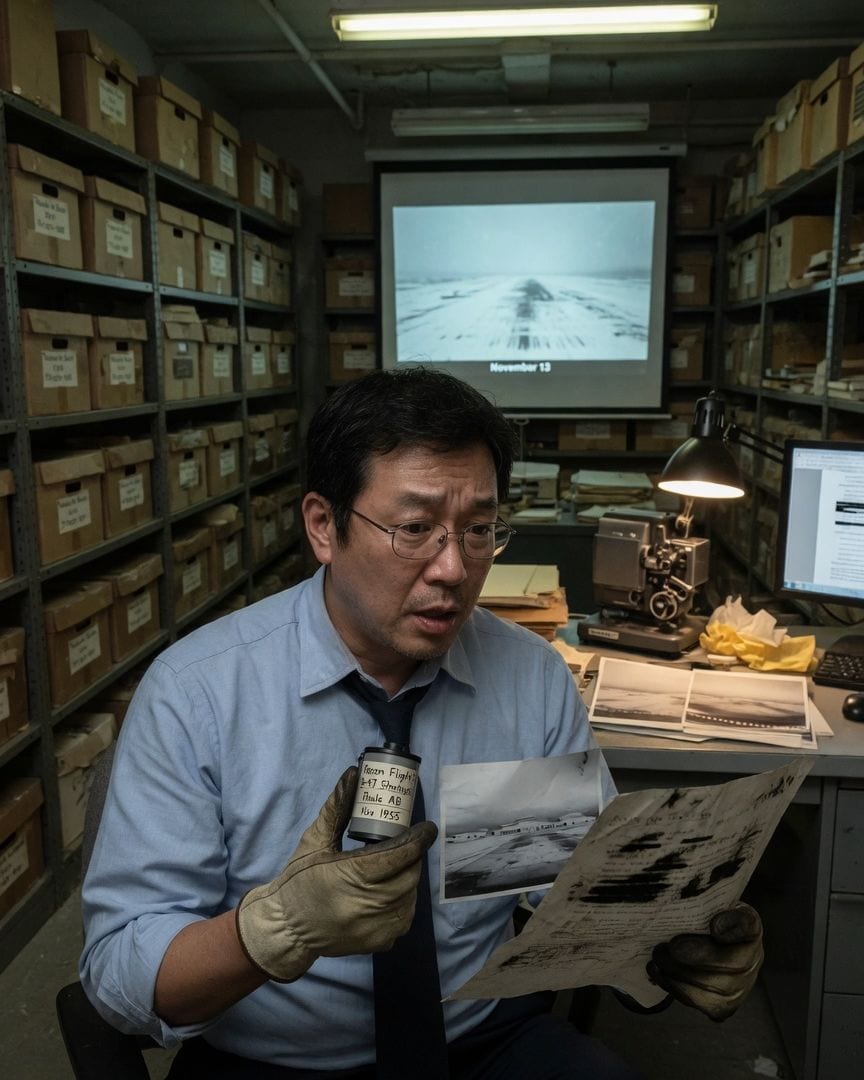
A Cold War archivist's last project reveals an ice cap airfield – the recon flight was lost the day before.
Ken Sudo, an archivist nearing a long-awaited transfer, meticulously sorted Cold War documents in the sprawling National Archives Annex basement. His final Thule project unearthed an unlabeled carton containing an old 16mm film canister, marked 'Recon Flight 734, Nov 1955.' On screen, an impossible airfield appeared carved into the featureless ice cap, dated November 13. A cold dread settled as Ken realized official records declared Recon Flight 734 lost the day before, on November 12, 1955. How could a lost crew record an airfield a full day after their official disappearance?
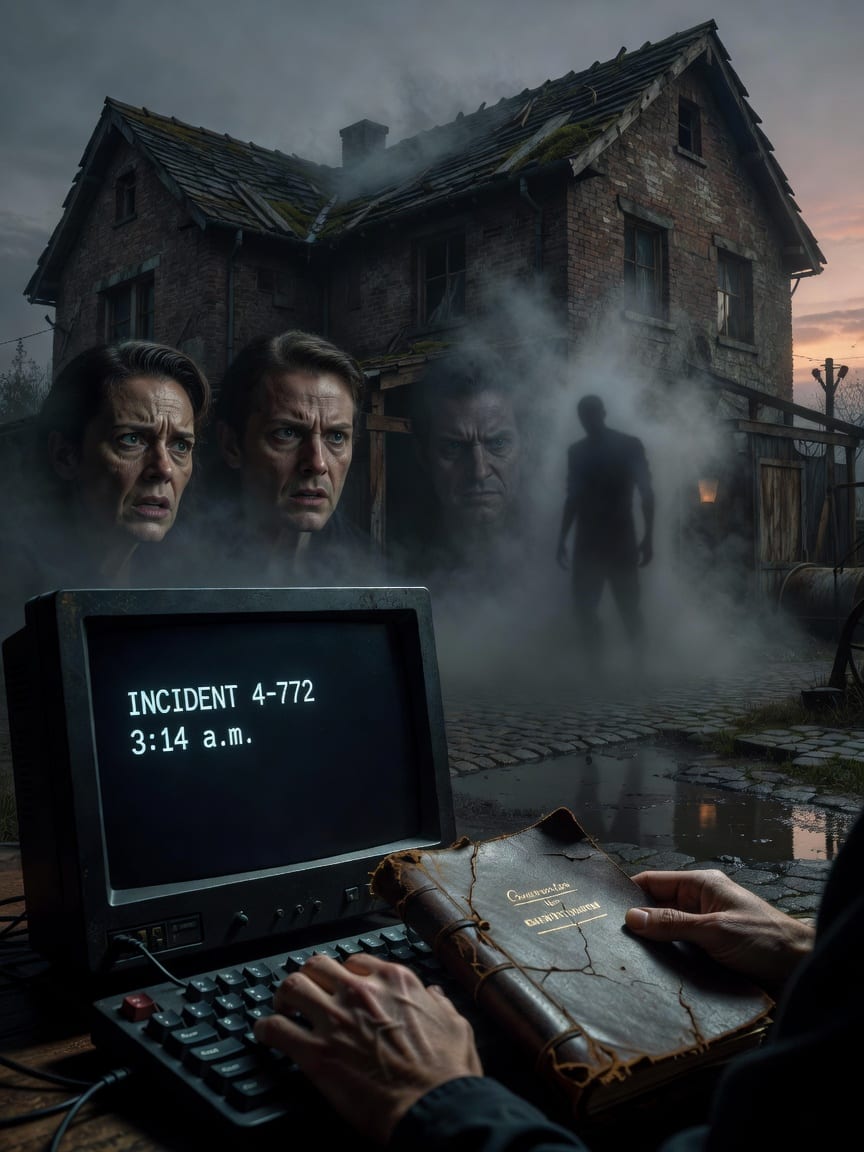
My screen showed Incident 4-772: a fire at the old rope works, 3:14 a.m. It was logged again for 1980. Then 1967. And 1993. Same incident, same time, same building. Each report ended with the same three words: 'expect recurrence.'
As a new archivist, I usually found my work digitizing old fire service records monotonous, until I found a heavily redacted line in a 1961 site assessment. Faint letters beneath the black bar slowly revealed my own family name, DRUMMOND, dated years before I was even born.
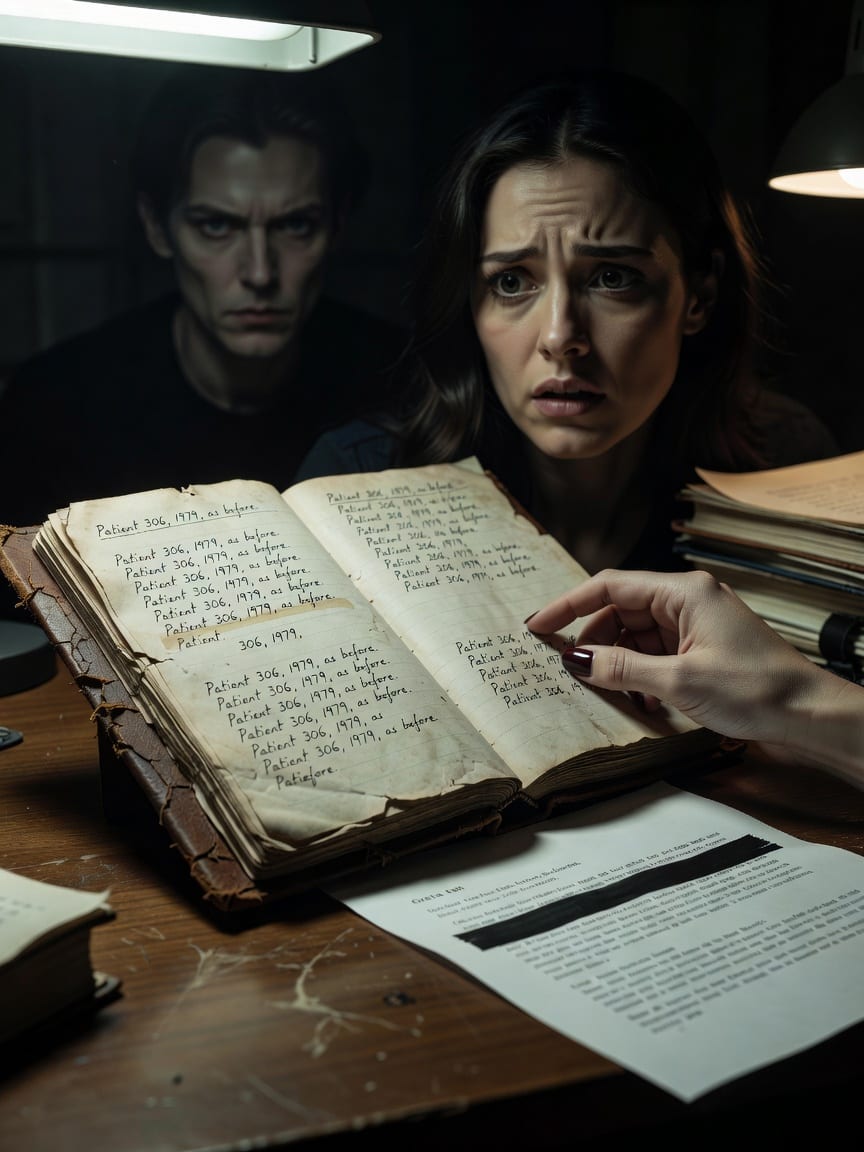
My archive ledger shows Patient 306 admitted in 1889, 1911, 1934, 1957, 1979 — same diagnosis, different names, and always, 'as before.'
My job as an archive transcriber is usually soothing, digitizing ancient admissions ledgers. But a recurring entry for 'Patient 306' caught my eye, noted 'as before' in the same hand for nearly a century. Digging deeper, I found a council file, dated 1998, outlining 'containment procedures' – and it named my own street and surname.
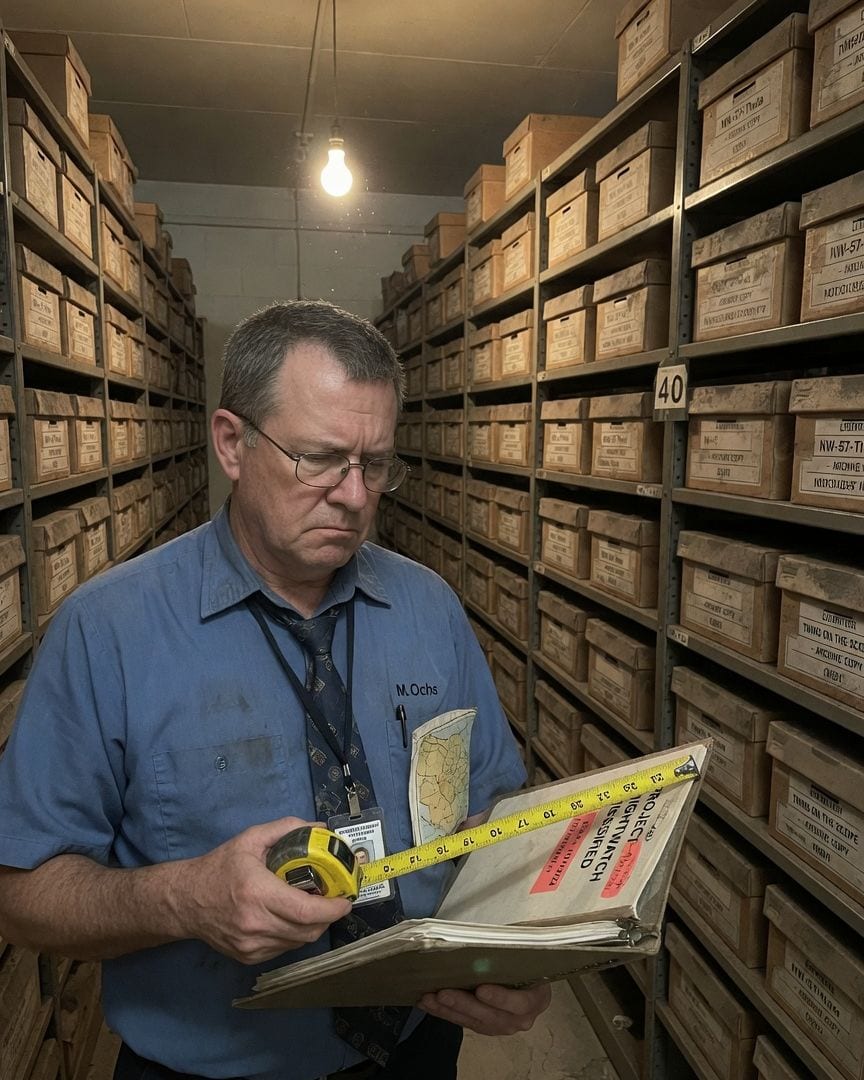
A Cold War records clerk on his final patrol found Aisle 40 stretched 61 feet longer, lined with unknown boxes. Inside one: 'PROJECT NIGHTWATCH - CLASSIFIED' with a fresh timestamp.
Marlin Ochs, a creature of habit after nineteen years at the St. Louis federal records depot, faced his final patrol through Aisle 40 before its scheduled pulping. His routine walk, usually 92 precise strides, suddenly stretched to an impossible 119, making the aisle 61 feet longer than its blueprint. The extra section felt colder, lined with dust-laden boxes bearing alien classification codes and no manifest. Inside one, he found a metal-bound file: 'PROJECT NIGHTWATCH - CLASSIFIED,' dated 1957, but with a timestamp just hours old.
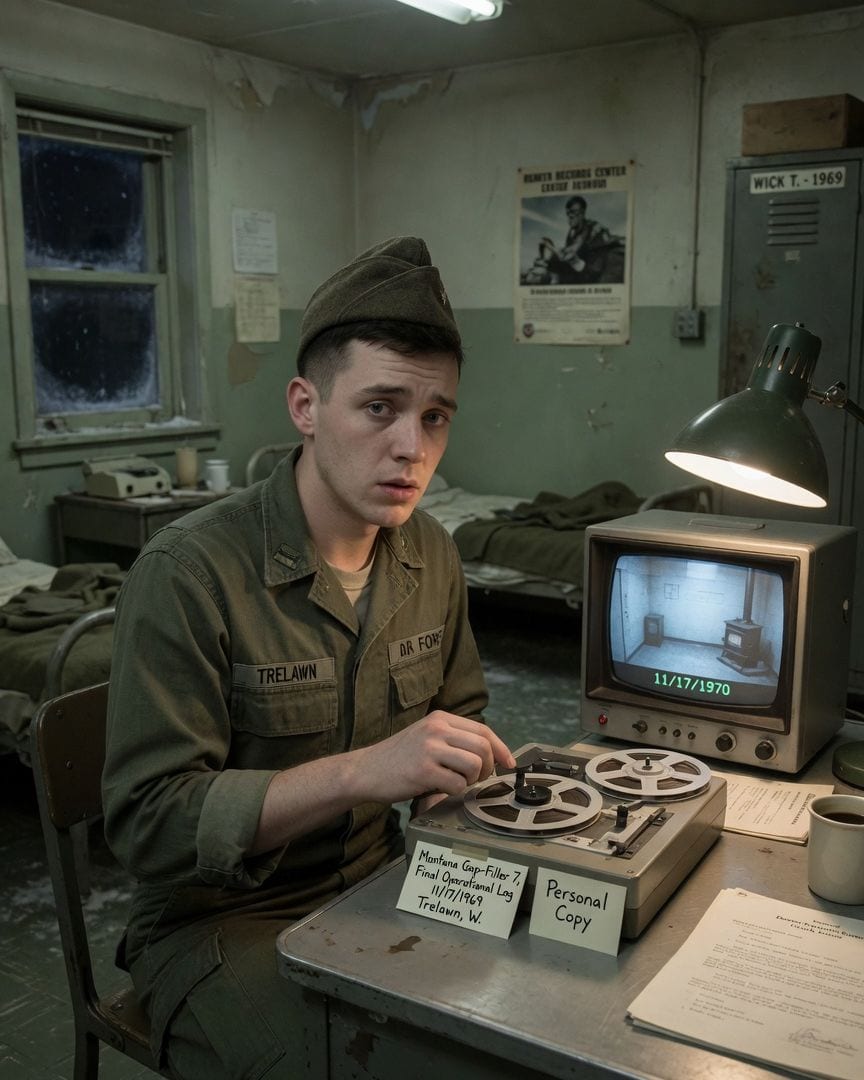
A Cold War gap-filler station was locked cold. Airman Wick Trelawn's final tape showed a man powering up the console a year later.
Airman Wick Trelawn shivered through his final hour at the remote Montana Gap-Filler 7, a Cold War radar station set to go cold forever. He meticulously logged its last operational moments, pulling the master tape as a final record. Later, reviewing a personal copy, Trelawn watched his empty control room play out as expected, but the tape kept running into a second hour. An indistinct man then appeared, methodically powering up equipment in the supposedly dead station. The site had been locked cold for a year by then, yet his official request for the original tape revealed a blinking timestamp of November 17, 1970. What impossible operations did the final log truly capture?