Boatswain's Mate Fontaine stood his last watch before the USS Vance was scrapped. He found a Cold War logbook with 1987 entries on a ship commissioned in 2000.
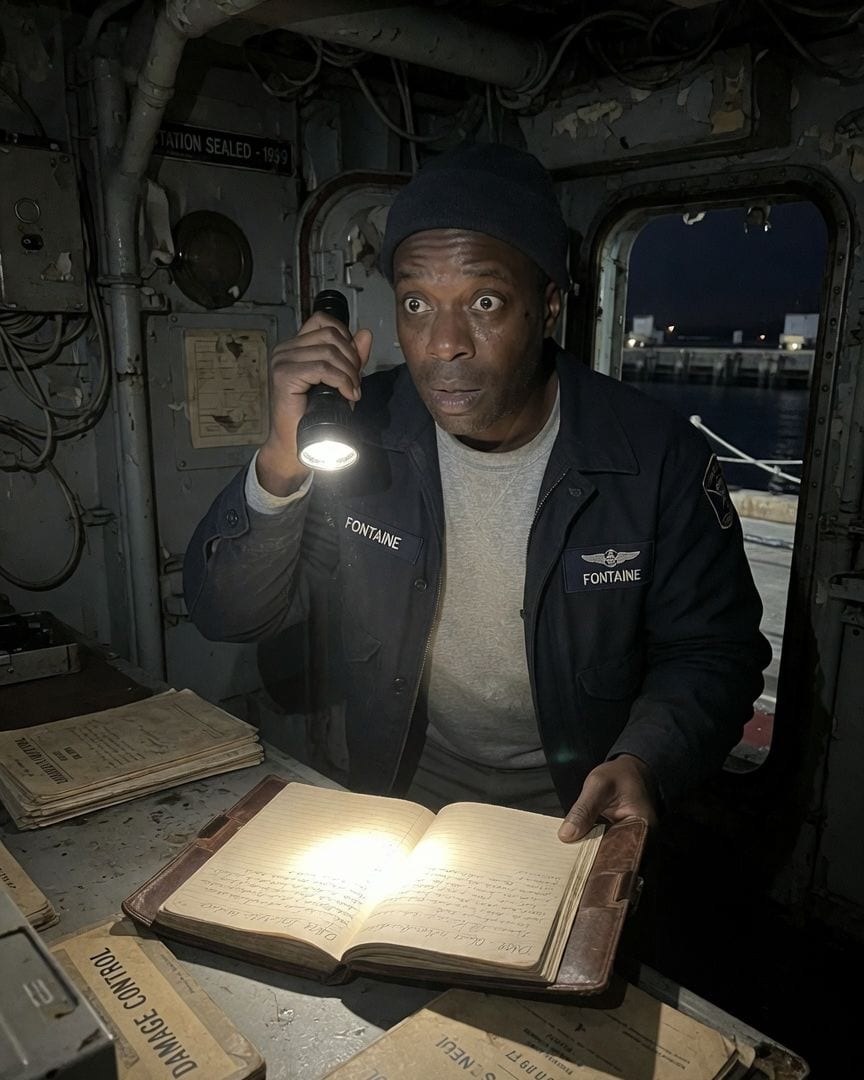
Maxwell Fontaine, Boatswain's Mate, stood on the quarterdeck of the USS Vance, the air crisp with the scent of salt and diesel.
It was 0400, the last watch before the destroyer was towed for scrap in three days, and his last before transfer to shore duty.
He hefted the lanyard, pulled the clapper, and rang eight bells – a tradition, but an empty gesture. The ship was in port, the watch technically unmanned.
Yet, from the accommodation ladder, the distinct, measured tread of a full watch section began to ascend. Boots on metal, a rhythmic, heavy beat that seemed to vibrate through the deck plating.
Maxwell froze, his breath fogging in the predawn chill. He glanced at the topside cameras feeding into the main bridge display, a monitor he’d double-checked minutes ago. The brow was empty. No one.
Just the sound of heavy boots, steadily approaching the deck.
Maxwell’s heart hammered a frantic rhythm against his ribs. He waited, straining his ears, peering into the gloom that clung to the ship’s sides. The sound of boots reached the quarterdeck, then passed, heading forward, towards the main deck.
He saw nothing but the mooring lines stretching taut to the pier and the still, dark water reflecting the few dock lights. He checked the cameras again. Still empty, a static, unmoving image of the gangway.
He tried to rationalize it away: fatigue from long shifts, an echo bouncing off the nearby warehouses, a trick of the swirling wind that sometimes whistled through the ship’s superstructure. But the sound had been too precise, too full.
He walked the quarterdeck, then the main deck, his flashlight cutting through the oppressive shadows. Nothing. No one. The ship was utterly silent now, except for the distant hum of shore power.
But as he passed the old damage control station, a faint, metallic tang, like ozone and old oil, prickled his nose – a smell not present on the rest of the ship.
The station was supposed to be sealed, its legacy systems disconnected, a relic from the ship's construction. He tried the hatch. It was unlocked, the latch clicking with a surprising ease.
Inside, the air was still, heavy, and dense with that strange, sharp odor. His beam found a small, dusty desk, half-hidden by a bulkhead.
On it, partially obscured under a stack of outdated manuals, was a worn, leather-bound logbook, its pages brittle with age, the leather cracked and faded.
Maxwell picked up the logbook. The cover was unmarked, smooth from years of handling, the spine cracked down the middle. He opened it to a random page.
The entries were handwritten, in a precise, almost archaic script – tight, slanting lines of faded black ink. Names, times, weather conditions, routine reports of equipment checks and watch transfers.
He flipped through the brittle pages, the paper rustling like dry leaves, until he reached the most recent entry on the last used page.
His finger traced a familiar time stamp – 0400 – and beneath it, a name: 'Okoro, B.M., Watch Relief.' The entry was dated 1987. Maxwell’s mind reeled. The USS Vance (DDG-87) had been commissioned in 2000.
This book, these entries, this 'Okoro'—they couldn't exist on this ship.
Maxwell secured the logbook in his locker, its impossible entry burning in his mind. He spent the rest of his watch trying to make sense of it, consulting the ship's official records as soon as he could access a terminal.
No Boatswain's Mate Okoro was listed in any crew manifest for the Vance (DDG-87), not active, not transferred, not deceased.
He tried to dismiss it as an elaborate, bizarre prank by a departing crewman, but the logbook felt too old, too real, too meticulously kept. The faded ink, the cracked leather – it spoke of decades.
After his watch ended, instead of heading to his bunk for a much-needed rest, he sought out the Executive Officer, Robert Carter, a pragmatic, by-the-book officer known for his unflappable demeanor.
Carter listened patiently, his brow furrowed slightly as Maxwell recounted the phantom footsteps and produced the ancient logbook.
Carter attributed the sounds to old ship noises, a common phenomenon on decommissioned vessels, and the logbook to a possible souvenir from a previous vessel, perhaps left behind by a former crewman clearing out their locker. "Fontaine, you're tired.
Last few days on the Vance, it gets to you. Happens to everyone." Maxwell wasn't convinced. He remembered the faint ozone smell from the damage control station, a scent of something electric and old.
He knew the Vance, like many newer ships, had an antiquated, isolated internal sensor network, a relic from its original build, meant for deep-level damage control and environmental monitoring.
It was supposedly disconnected from the main grid, a dormant black box. He decided to find a way to access it.
He spent hours in the engineering spaces, tracing old conduits, bypassing security protocols he'd learned years ago but rarely used.
Finally, in a dusty, auxiliary server room tucked away near the stern, he found a terminal still linked to the network. It was slow, clunky, running on an operating system a decade out of date, but it was active.
He typed in commands, navigating through decades of raw sensor data, a digital ghost from the ship's past.
It was there he found it: a continuous loop of thermal signatures, movement logs, and faint audio pings, all originating from the quarterdeck and main deck, all precisely at 0400, every single day, for years.
And always, a full section, a dozen distinct heat blooms moving with silent purpose.
The sensor logs were undeniable. Maxwell downloaded a segment, a chilling, silent video feed of the quarterdeck at 0400. The camera itself showed nothing but the empty deck, the mooring lines, the still water.
Yet, the overlaying thermal data depicted a dozen distinct heat signatures, moving with military precision, reporting aboard, sweeping across the deck, then disappearing forward. He felt a cold dread settle deep in his bones. This wasn't a prank, wasn't fatigue.
This was a system-level anomaly, a ghost in the machine that left a measurable, digital footprint. He knew he needed outside help, someone with access to deeper, older archives, beyond what the Navy kept on active ships.
He thought of Hannah Drummond, an archivist at the nearby Port Authority, known for her encyclopedic knowledge of naval history and records.
He called her, feigning interest in the Vance's "pre-commissioning history," hoping to dig up anything about the name Okoro. She was helpful, almost too eager, her voice thin and reedy over the phone.
"Oh, the Vance," she'd said, "a fascinating lineage. Did you know she carries the keel of an older destroyer? Lost in '87, off the coast of Maine, in a very... peculiar incident."
The detail struck Maxwell like a physical blow. 1987. The year in the logbook.
Later that day, as Maxwell was leaving the ship, walking down the pier in the fading afternoon light, he saw a nondescript dark sedan parked across the pier, its windows tinted opaque black.
He couldn't make out the driver, but the car had been there when he arrived for his shift, and it was still there. He brushed it off, telling himself it was just a coincidence, a civilian car waiting for someone.
But a prickle of unease lingered, a cold spot on his neck.
That night, back in the auxiliary server room, double-checking the network, he noticed a new log entry in the internal network's audit trail: an unauthorized access from a Port Authority IP address, exactly when he'd called Hannah Drummond.
Someone was watching him.
The next morning, Maxwell presented his findings to XO Carter. He laid out the worn logbook, the digital printouts of the thermal signatures, and the chilling audit log from the internal network.
Carter's pragmatic facade cracked, a vein throbbing faintly in his temple. "Fontaine, this is highly unusual. Why would Port Authority be monitoring an internal, disconnected network on one of our ships?"
Maxwell recounted Drummond's casual comment about the Vance's lineage, the keel from an older destroyer. Carter’s expression darkened, his gaze sweeping over the silent printouts, then landing on the 1987 date in the logbook.
"The official story is that the Vance (DDG-87) was a new build, laid down from scratch. But yes, there were... rumors. Classified. The original USS Vance was lost in a training exercise off the coast of Maine in 1987.
A catastrophic structural failure. No survivors recovered, no wreck ever truly found intact." He paused, looking out the porthole at the moored destroyer, a hulking shadow against the morning light.
"Some of its critical systems, specifically the damage control and environmental monitoring systems, were salvaged. They believed the data from those systems could help prevent future disasters. They were integrated into the new build's auxiliary network.
A 'black box' system, never connected to the main grid, meant to run in isolation, to continue recording." Maxwell felt the final, horrifying pieces clicking into place.
"So, the old Vance's ghost is literally in the machine," he said, the words barely a whisper. Carter sighed, running a hand over his face, looking suddenly much older than his forty-five years. "More like its memory, Fontaine.
A persistent data echo. We've known about the 'anomalous readings' from that system for decades. They're just classified as 'system noise' in our official reports. We're told to ignore them, to not touch the auxiliary network unless absolutely necessary. It's...complicated."
He looked directly at Maxwell, his eyes grim. "But the logbook, the 'Okoro' entry, that specific 1987 date matching the loss of the original Vance... that's new. And your name on the audit trail, tied to Port Authority access.
This is beyond system noise, Fontaine. This is a liability."
Maxwell felt a chill that had nothing to do with the ship's air conditioning. A cold, creeping certainty. "So, this isn't just a glitch," he said, his voice flat.
"It's a record of something that shouldn't be, being maintained by the system. A ghost in the machine that's been officially logged, then officially ignored." Carter nodded grimly, his face pale. "Essentially.
A phantom crew, still performing their duties in a digital void. But the 'Okoro' entry, and the 1987 date... that ties directly to the lost ship, not just its salvaged systems.
That suggests a level of continuity far beyond a mere data echo." Maxwell knew what he had to do. He needed to find the original crew manifest from the lost Vance, the one from 1987.
He returned to Hannah Drummond at the Port Authority archives, this time not feigning interest. He confronted her with the unauthorized access log. Her calm demeanor was unsettling, her eyes blinking slowly behind thick glasses. "Oh, that.
Just routine checks, Mr. Fontaine. The Vance is a sensitive vessel, given its history." She didn't deny it, didn't even try to offer an excuse. He pressed her for the 1987 Vance crew manifest.
Without a word, she led him to a dusty microfiche cabinet in the back, pulling out a specific reel from its drawer.
"You'll find some interesting notations in this one, Mr. Fontaine," she said, her voice devoid of emotion, like she was reading from a script.
As the projector whirred to life, casting a dim, flickering square of light onto the screen, Maxwell scanned the faded names. Petty Officer, Seaman, Boatswain's Mate.
He found 'Okoro, B.M.' and next to it, not a death date, not a transfer, but a status: 'Active Duty, USS Vance, Status: Anomalous Presence.'
Then, below it, a single, handwritten entry, recently added in a different ink: his own name. Maxwell Fontaine. And beside it, the notation: 'Watch Transfer, 0400, Current Rotation.'
The duty status for Okoro was marked 'Active Duty, USS Vance, Status: Anomalous Presence.' A cold certainty settled over him: he was now part of the impossible accounting.
The microfiche screen glowed with the impossible truth, its stark white characters unforgiving. Maxwell stared at his name, his actual name, scribbled onto a decades-old, classified manifest next to a phantom sailor.
The air in the archive room grew suddenly cold, and he felt a shiver trace its way down his spine. "What does this mean?" he demanded, turning to Hannah Drummond, his voice ragged.
Her eyes, magnified behind thick, owlish glasses, held no surprise, only a weary, almost detached resignation. She looked not at him, but at the glowing screen. "It means the watch continues, Mr. Fontaine.
When the first Vance went down, its internal systems, the ones salvaged, never stopped running. They were designed for ultimate resilience, to maintain operational continuity even in catastrophic conditions. To the system, the crew never abandoned their posts.
The Navy, in its infinite wisdom, found it easier to classify the persistent data as an 'anomaly,' as 'system noise,' rather than acknowledge a continuous, phantom duty cycle. But the system itself? It still requires accountability.
It still requires a watch to be stood." She gestured with a thin finger towards the microfiche.
"And when a physical presence interacts with it—like you ringing the eight bells at 0400, like you accessing its logs, like you standing on its quarterdeck for your final watch—it tries to integrate that presence into its existing, ongoing roster.
It sought a relief for Boatswain's Mate Okoro, whose watch it believed was still active. You answered the call, Mr. Fontaine. You became the relief."
The boots on the deck, the faint ozone smell, the ancient logbook, the thermal signatures, the 1987 date – it all clicked into a horrifying, coherent pattern.
The ship wasn't haunted by ghosts; it was trapped in an endless, bureaucratic loop of duty, and he had just been enlisted.
"This is insane," Maxwell whispered, the words tasting like ash in his mouth. He felt a dizzying sense of unreality. "So, I'm... what? A ghost-in-training? A data entry?" Drummond offered a faint, unsettling smile that didn't reach her eyes.
"You are now part of the Vance's crew, Mr. Fontaine. Accounted for. The system will ensure your watch is stood."
He realized the terrifying implication: his transfer, the decommissioning of the ship, none of it mattered to the deeply embedded, isolated systems that had once belonged to the lost Vance.
He was now on the manifest of the dead, eternally bound to a duty cycle that never ended.
He tried to argue, to deny it, to claim it was all a mistake, but Drummond calmly explained the protocols, her voice low and even.
"Any attempt to 'terminate' a phantom watch from within the system is met with a self-correction. The system believes it is maintaining vital operational continuity. It will simply reassign the watch, or worse, register a 'no-show' and escalate the reporting."
He thought of the phantom footsteps, the rhythmic, heavy beat of boots on an empty deck, the dozen thermal signatures. The 'escalation' would mean the system would actively seek its missing crew, its new Boatswain's Mate, Maxwell Fontaine.
He felt a chilling certainty that the 'sedan' he saw, the 'unauthorized access' logs from the Port Authority, were not just human surveillance, but the institution's way of monitoring its own, unacknowledged systemic failure – and its new 'recruit'.
He had to get off the ship, but more importantly, he had to break the cycle. He had three days before the Vance was towed for scrap, three days to sever his impossible connection.
He couldn't just walk away; the record, his 'assignment,' would follow him wherever he went, a digital shadow demanding its due. He had to decommission the system itself, not just the ship.
He returned to the auxiliary server room, a grim determination replacing his dread, the cold certainty in his gut hardening into resolve.
He would find a way to sever the old network entirely, to truly kill the ghost in the machine, even if it meant destroying the very data the Navy had sought to preserve, data that had instead preserved a horror.
He began meticulously mapping the physical connections, searching for the core power conduit for the legacy systems, a single point of failure that could stop the endless watch.
Maxwell Fontaine spent the next 48 hours fighting a phantom war against the ship's own logic, against the invisible currents of an ancient, unyielding system.
He worked with a feverish intensity, tracing thick, insulated cables, bypassing locked conduits, until he managed to isolate and physically sever the power to the entire legacy damage control network, cutting it off from the salvaged components, from the very keel it shared.
The screen in the auxiliary server room went dark, the hum of ancient data silenced. He felt a profound, unsettling quiet descend upon him, a quiet that tasted of victory and something else he couldn't name.
The USS Vance was towed for scrap on schedule, a silent hulk, its purpose extinguished. Maxwell was processed for his shore duty transfer a few days later.
No one mentioned the logbook, the sensor data, or his name on a phantom manifest.
XO Carter gave him a curt nod as they passed in the hallway, a look of shared, unspoken understanding in his eyes, a silent acknowledgment of the impossible burden Maxwell had carried.
Hannah Drummond was no longer at the Port Authority; her office was empty, a 'For Rent' sign taped to the glass.
Maxwell Fontaine reported for his new shore duty at Naval Station Norfolk. He was assigned to a quiet administrative post, far from the sea, a desk job reviewing old personnel files.
He found himself checking his watch at 0400 every morning, a phantom dread in his gut, a leftover twitch from the USS Vance.
One afternoon, while reviewing a stack of particularly old personnel files from an obscure annex, he found a familiar name: Okoro, B.M. The file was thin, brittle, marked 'Deceased, 1987.' His breath caught in his throat.
But attached to it, clipped with a rusted paperclip, in faded ink, was a small, handwritten note: 'Watch Relief Needed.' He put the file back into its folder, a cold certainty settling over him, colder than any deep ocean current.
He had cut the power, he had silenced the systems, but some records, some duties, never truly ended.
Months later, Maxwell Fontaine’s new commanding officer, reviewing the morning's duty roster, noticed a small, handwritten notation next to Fontaine’s assigned post for the upcoming 0400 watch. It simply read: 'Confirmed.'
If this one got to you
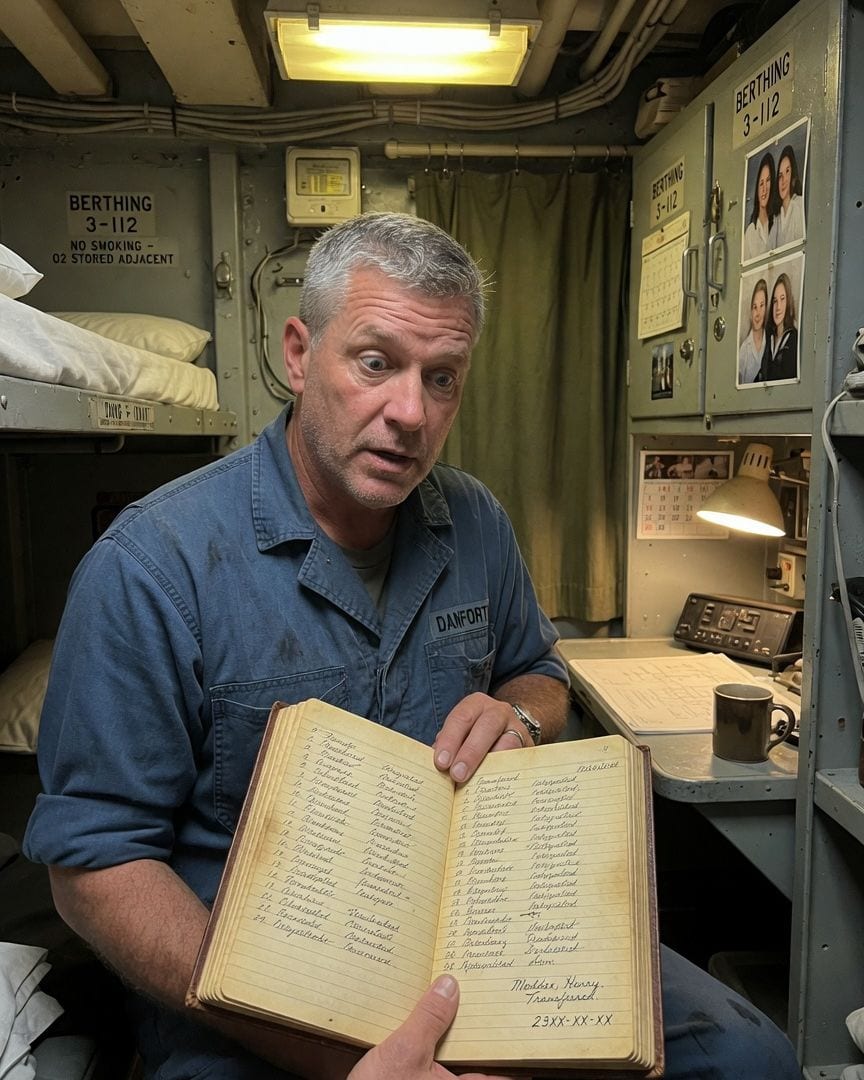
A Chief Petty Officer found a strange logbook. Its last entry listed a living crewman, dated next week.
Chief Petty Officer Russell Danforth was weeks from retirement, his three decades of service nearing an end aboard the USS Weatherall. Deep in the destroyer's familiar steel passages, he stumbled upon a sealed hatch where official plans insisted only solid bulkhead should be. Forcing it open, he discovered a cramped, unsettlingly 'lived-in' compartment holding a bare bulb and a mysterious logbook. Its final entry, stark and fresh, named a living junior petty officer from his own division, dated a week from today. What chilling fate awaited Henry Maddox, according to the Weatherall's secret history?
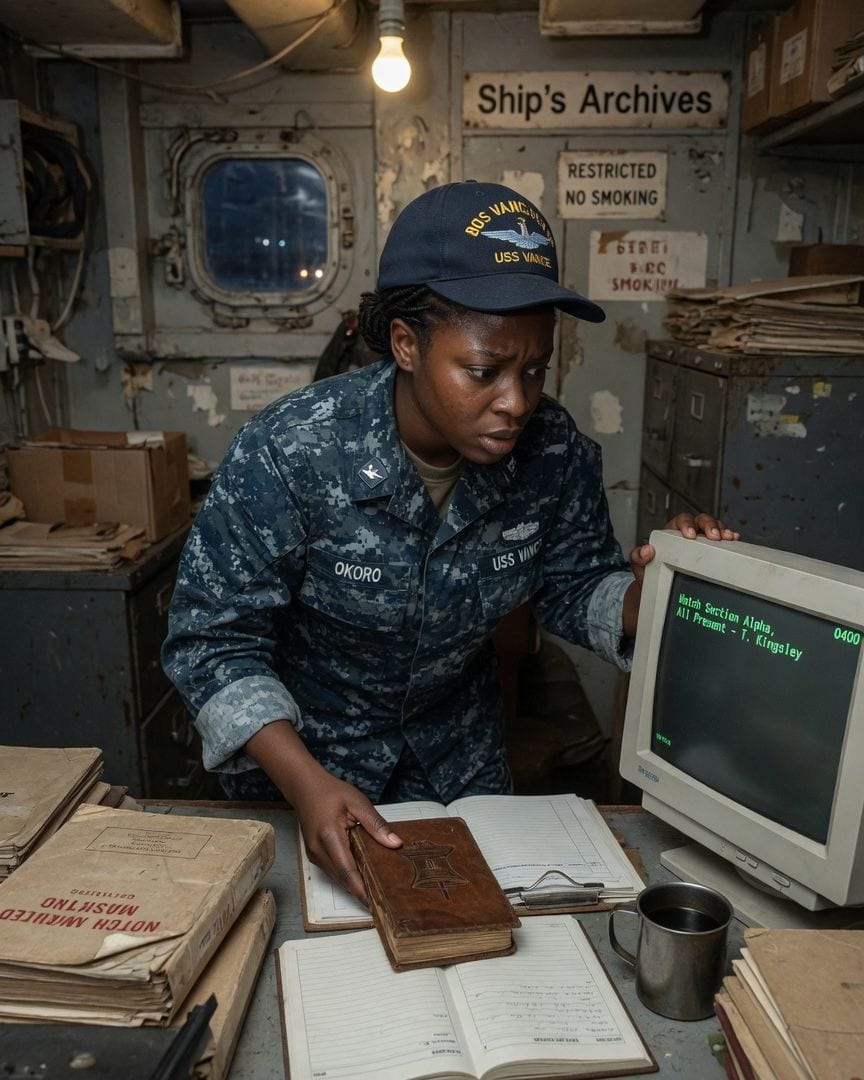
Boatswain's Mate Okoro finds her own name on a decades-old watch log, listed with a phantom crew reporting for duty on the decommissioning USS Vance.
Boatswain's Mate Catherine Okoro stood alone on the quarterdeck of the USS Vance, the ship awaiting decommissioning, performing a traditional unmanned watch in the silent, damp pre-dawn hours. At 0400, after tolling the ship's bell, she distinctly heard heavy boots of a full watch section reporting aboard, yet the security monitor showed an utterly empty entry point. Her own log entry for an unmanned watch was instantly overridden by a digital record of 'Watch Section Alpha, All Present,' signed by an unknown 'T. Kingsley,' a name she later found listed in a decades-old, unofficial logbook—with her own. Who was logging watches for a phantom crew, and how was her name on a book from the past?
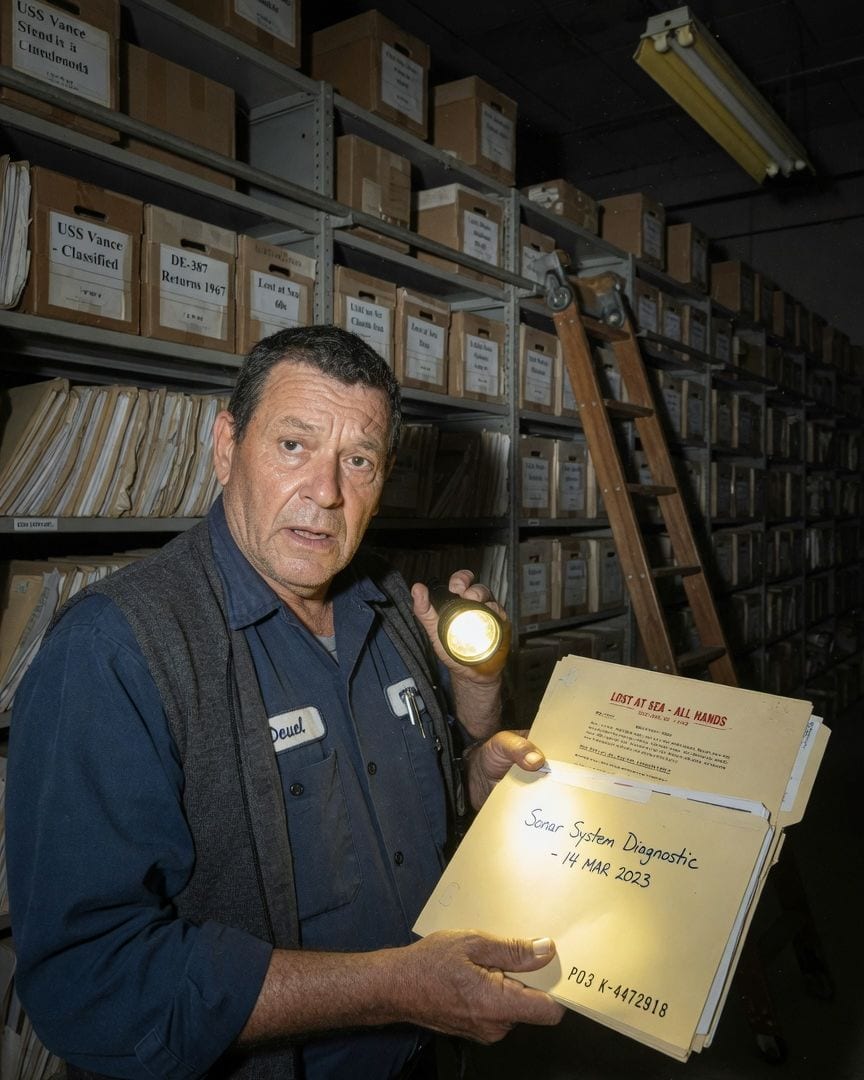
An archivist, alone in the Suitland annex, finds a 1968 lost Cold War ship file with a handwritten entry dated last Tuesday. The ink looks damp, but feels dry.
Carmine Deuel, 62, spent forty years amidst the dust and forgotten files of the Suitland annex. One night, alone in the cavernous space, a sticky squeal and the faint sway of a rolling ladder broke the silence. He found a classified file from the USS Vance, a ship lost in 1968, pulled from its shelf. Inside, a typed form held a handwritten entry: a routine sonar check, dated last Tuesday. The ink, impossibly, looked damp yet was perfectly dry. Who had accessed the file, and how could its entry be so recent?
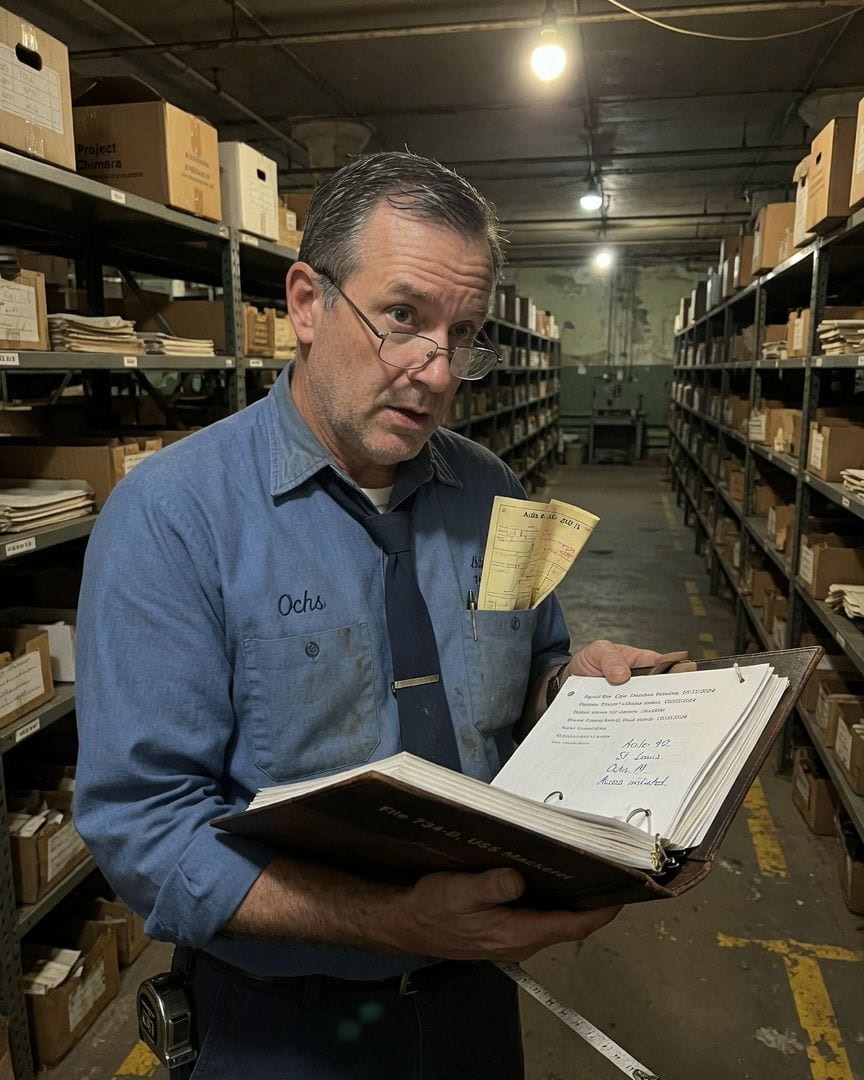
On his final inspection, a depot worker found Aisle 40 had grown 61 feet longer, and a Cold War submarine file hummed warm in his hand.
Marlin Ochs, a man of precise rhythms at the St. Louis depot, approached Aisle 40 for its final inspection before the entire structure was pulped tomorrow. For nearly two decades, the aisle had been a consistent ninety-two paces long. But on this night, his boot heels clicked past the expected mark, stretching to one hundred and nineteen paces, revealing an impossible, colder extension. Deep inside, Marlin found a heavy, leather-bound binder titled 'File 734-B, USS Mackerel,' a Cold War submarine lost with all hands in 1958. It felt oddly warm, almost humming against his palm, filled with maintenance logs and payrolls dated decades after the sub was sunk.
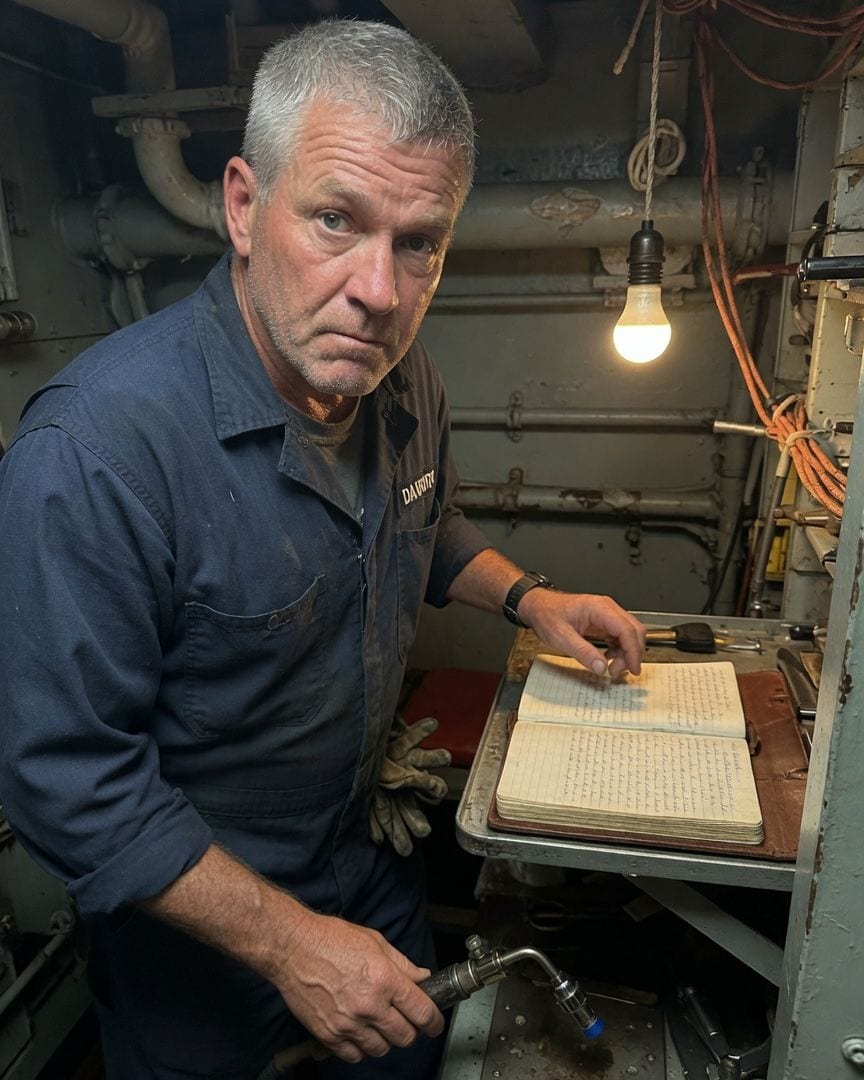
A week from shore duty, Chief Danforth cut a hatch where his ship's plans showed solid steel. An hour later, the wall was seamless, but the Cold War logbook from inside appeared under his mattress.
Chief Petty Officer Raymond Danforth, just a week from ending three decades of service, was intimately familiar with every pipe and plate of the guided-missile destroyer Weatherall. During a mid-cruise overhaul, his gloved hand found a sealed hatch where schematics promised only a solid bulkhead. He cut through the impossible seam to reveal a small, dry compartment, softly lit, containing a logbook filled with an unsettlingly familiar hand. When he returned an hour later with a witness, the hatch was gone, the wall seamless. Later that night, the same logbook appeared beneath his mattress, its pages revealing an entry: 'Petty Officer Howard Montgomery, missing, 1972.' How could a compartment vanish, yet leave its secrets behind?
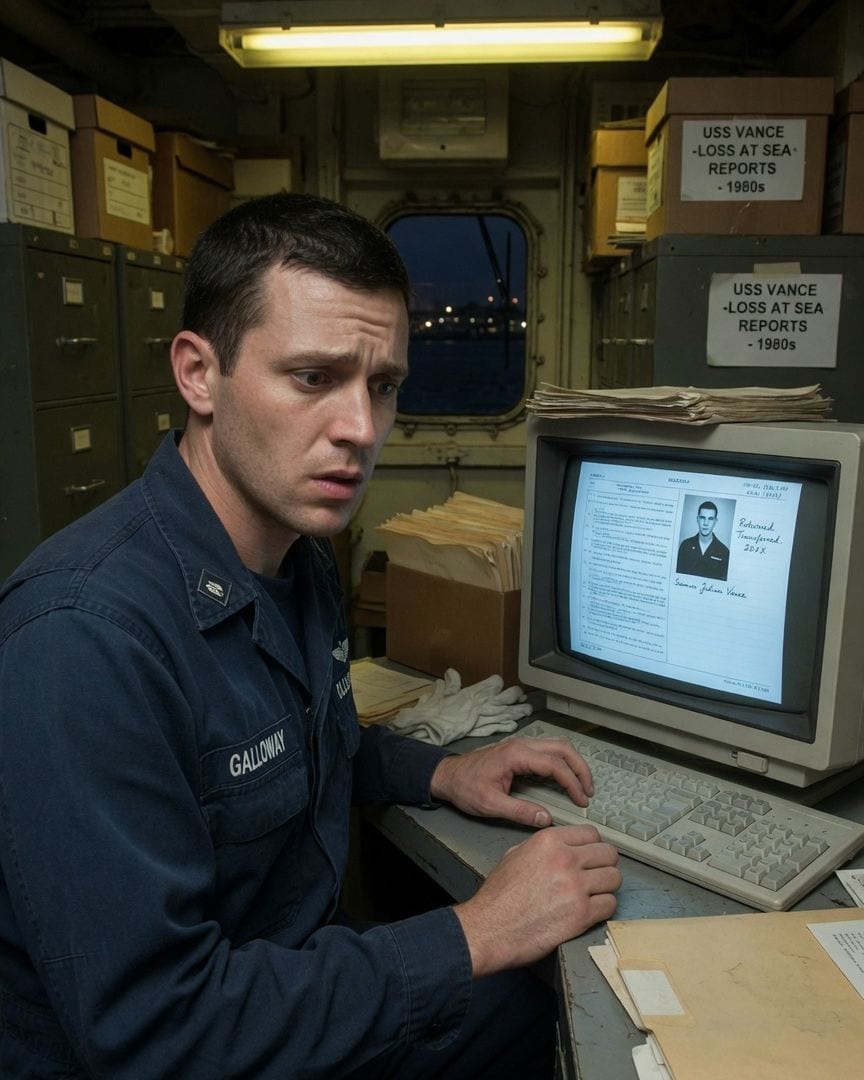
Petty Officer Galloway logged a sailor onto his ship. The man died at sea 40 years ago.
Petty Officer Joel Galloway scanned a sailor's ID on the USS Vance quarterdeck. The man's name, 'Seaman Julian Vance,' and his out-of-date uniform pricked at Galloway's memory. Later, the ship's berthing count came back one over, with an extra entry in the system but no physical body.