A week from shore duty, Chief Danforth cut a hatch where his ship's plans showed solid steel. An hour later, the wall was seamless, but the Cold War logbook from inside appeared under his mattress.
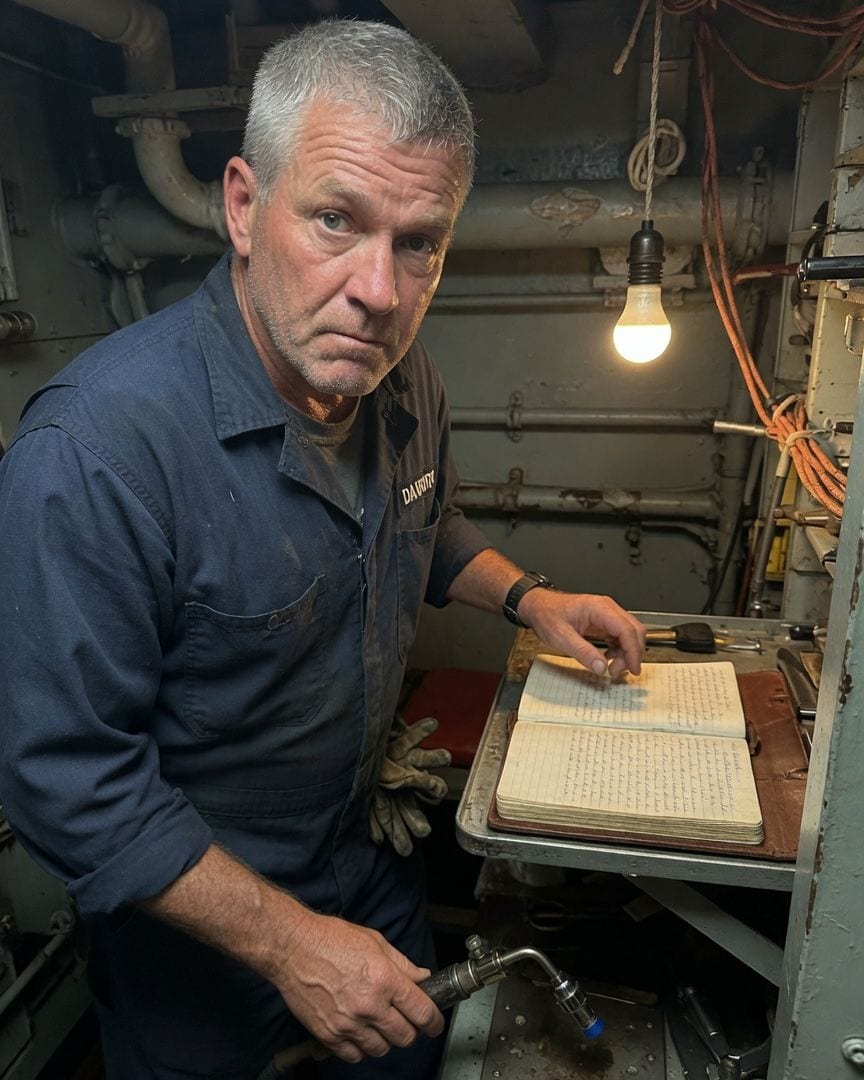
Chief Petty Officer Raymond Danforth, a week from shore duty and three decades of service done, ran a gloved hand along a cold-water line, deep in the guided-missile destroyer Weatherall.
The ship was in the midst of a mid-cruise overhaul, a symphony of grinding metal and hushed commands that vibrated through the deck plates. Danforth, a man who knew every pipe and plate of a warship, stopped.
Ahead, amidships, where the schematics promised only a solid bulkhead, he found a sealed hatch. No welds, no bolts, just a perfect, clean seam where none should exist, cold beneath his touch.
He consulted his damage-control plans again, a thick, laminated map of the Weatherall’s very bones. The plans were unambiguous: nothing here. Yet, the hatch was real, solid, and undeniably present.
He used a portable cutting torch, a precise, practiced hand guiding the blue flame, slicing through the impossible seal. The heavy plate hissed, then gave way. Behind it, a short, dry passage opened into a small compartment.
It was softly lit by a single, bare bulb. A neatly made rack, a regulation locker, and on a small, bolted-down table, a thick, leather-bound logbook lay open.
The air inside was still, dry, and cool, carrying a faint, metallic scent.
He stepped in, his boots silent on the deck plate, and stared at the logbook, its pages filled with a flowing, familiar hand he couldn't quite place, detailing tasks and observations no official record would ever recognize.
Danforth carefully picked up the logbook. The paper felt strangely warm, almost alive against his calloused fingers. He flipped through entries, each in that same unsettlingly familiar script. They started innocuously enough—routine maintenance, weather observations—then subtly shifted.
'New deck secured, 0400,' one read, dated two weeks prior. Another, 'Whispers from below, growing louder.' He tried to match the handwriting against ship personnel records, cross-referencing every crewman, every officer, but found no match.
The entries were meticulously dated, always aligning with periods of deep-sea deployment or extended overhauls.
He scanned his own memory, certain he'd seen that particular curl of a 'y,' that distinctive cross of a 't,' but it remained just out of reach, a phantom memory. Unease settled in his gut. This wasn't a prank.
The compartment was too real, too perfectly integrated into the ship's structure, yet utterly absent from the ship's official anatomy. He considered reporting it immediately, but the sheer impossibility of it made him hesitate.
He decided to find a junior officer, someone he could trust, to witness it first.
He secured the hatch as best he could, using the torch to re-seal it roughly, the metal cooling with a faint ping, then went to find Ensign Camille Patterson.
When he returned with her an hour later, the hatch was gone. The steel bulkhead was seamless, pristine, as if he had imagined the entire thing. Camille, looking puzzled, pointed to the ship's plans.
'Chief, this has always been a solid wall.' Danforth ran his hand over the cold, unblemished steel, his heart a hammer in his chest.
Danforth, despite Ensign Patterson’s skepticism, reported his findings up the chain. The commanding officer, Captain Montgomery, assigned Yard Supervisor Leonard Bishop to investigate. Bishop, a no-nonsense civilian with decades of naval yard experience, met Danforth at the designated spot.
Danforth led him to the exact section of the bulkhead where he’d found the hatch. Bishop ran his hands over the cold, unblemished steel, then consulted his own set of detailed blueprints. 'Chief, this is a solid structural bulkhead.
Always has been. No access point, no void space behind it.' Danforth, his voice tight with frustration, insisted, 'I cut a hatch here. There was a compartment. Lived-in.'
Bishop just shook his head, a look of polite concern on his face. Danforth felt a cold dread crawl up his spine, the impossible reality of it sinking in.
Later that night, back in his own rack, the ship's low thrumming vibrations a constant presence, Danforth pulled back his mattress. Tucked neatly beneath it, as if placed there deliberately, lay the leather-bound logbook from the vanished compartment.
He opened it, his hands trembling slightly, and the first entry his eyes landed on read: 'Petty Officer Howard Montgomery, missing, 1972.'
The logbook became Danforth’s secret burden, a lead weight in his sea bag. He spent every spare moment pouring over its pages, the worn leather growing slick beneath his thumbs.
The entries, always in that same unnervingly familiar hand, chronicled daily ship life, then veered into cryptic observations about 'the new space' or 'the shifting decks.'
He found dozens of names, each accompanied by a date and a brief, unsettling note: 'Accounted for, 0300,' or 'Joined the current, 2100.'
Danforth spent hours in the ship's administrative offices, poring over old manifests, casualty reports, and transfer orders, the smell of stale paper thick in the air. He cross-referenced the logbook’s names with official records.
For 'Howard Montgomery, 1972,' the Navy listed 'missing, presumed overboard.' For others, it was 'transferred to shore duty' or 'deserted,' but the dates consistently aligned with mid-cruise overhauls or prolonged deployments—just like his current situation.
He noted a peculiar detail: the handwriting, while always consistent in style, subtly shifted in its pressure and confidence, almost as if different hands were contributing to the same continuous script over time, each leaving a faint, individual trace.
He discovered that the Weatherall had a history of such 'incidents,' quiet disappearances that were always neatly explained away by the system, leaving no trace. He realized the compartment wasn't a singular event; it was a recurring phenomenon.
The ship wasn’t just a vessel; it was a collector.
He began to look for patterns in the ship’s maintenance logs, trying to find correlations between 'new deck' entries and structural anomalies reported years ago but never fully explained, only patched over.
He even snuck into the ship’s engineering archives, hoping to find older, less scrutinized blueprints that might show a discrepancy, the dust motes dancing in the dim light.
Danforth's clandestine investigation did not go unnoticed. His unusual requests for archaic ship records and his late-night visits to the empty administrative offices raised flags. One morning, he was summoned to Dr. Helen Rutherford, the ship's medical officer.
Dr. Rutherford, a sharp-eyed woman with a calm demeanor, asked about his sleep patterns, his stress levels, and his general well-being. She mentioned, almost casually, 'Some rumors have been circulating, Chief, about strange discoveries.
The stress of approaching retirement can sometimes cause… vivid imaginings.' Danforth maintained a façade of weary professionalism, but her words were a clear warning, a cold whisper in the quiet room.
Later, while he was deep in the bowels of the engineering archives, hunched over a faded, brittle blueprint from the 1960s, a faint metallic scent, like the air from the vanished compartment, tickled his nose. He froze.
He heard the faint scrape of boots on the deck plates outside the archive door, then the soft click of the lock engaging.
Danforth quickly dived behind a stack of dusty maintenance manuals, holding his breath, the cardboard edges digging into his back. The door creaked open. A shadow fell across the room, long and still.
He couldn't see who it was, only the slow, deliberate movement of feet, pausing, shifting. The figure moved silently among the shelves, pausing near the section of blueprints he had just been examining. The air grew colder, heavy and still.
After what felt like an eternity, the figure moved back towards the door, the lock clicked again, and silence returned. Danforth waited several minutes, his heart pounding, before cautiously emerging. He was being watched, monitored.
Someone—or something—knew exactly what he was looking for.
Danforth knew he needed answers beyond the logbook. During a brief shore leave, he tracked down Eugene Mercer, a retired Chief Petty Officer whose name appeared in the logbook with a 'transferred' note from the late 1960s.
Mercer lived a quiet, isolated life in a small coastal town, his eyes holding a distant, weary look that spoke of unspeakable things.
Danforth found him tending a fishing boat in the harbor, the salty air sharp with the smell of brine and diesel. 'Chief Mercer,' Danforth began, 'I’m from the Weatherall. I need to ask you about something impossible.'
Mercer, initially, was guarded. He spoke of 'bad dreams' and 'things best left alone,' his gaze sweeping the empty dock. Danforth pressed, showing him a photocopy of Mercer's entry in the logbook, the 'Accounted for' note. Mercer's face paled.
He looked around nervously, then lowered his voice, the words almost lost to the squall of gulls overhead. 'The ship… it’s alive, Chief. Not like a person, not like an animal. More like… a current.
It runs through the steel, through the wiring. It shifts things. Makes new spaces.' He described finding a similar compartment, not on the plans, during his own service.
He recounted how shipmates he knew, good men, had 'walked into the current' and never returned, their official records scrubbed clean with 'transferred' notes. 'They're still there, in a way,' Mercer whispered, 'part of the ghost crew.
Sometimes, late at night, you hear them. Answering a phantom call sign on the net, a faint boot print where no one could walk.'
He explained that the ship chose its crew, pulling them in during times of transition, like overhauls. 'It takes what it needs,' Mercer finished, his voice raw. 'And it knows who's looking too close. Stop looking, Chief.
Before it calls your name.'
Mercer’s words, heavy with decades of unspoken dread, echoed in Danforth’s mind as he returned to the Weatherall. The ship’s familiar thrum now felt like a predatory purr beneath his boots.
He pulled out the logbook, its leather cover warm beneath his fingers, and flipped to the oldest entries he could find, the ones written in a more formal, almost calligraphic hand.
He needed to understand the full scope of this 'current,' this 'ghost crew.' The names blurred before his eyes: Ensign Rutherford, 1961; Machinist Mate Ford, 1959; Seaman Apprentice Bishop, 1958. Each entry was concise, clinical: 'Assimilated, 0200.'
He traced the lines with his finger, the paper brittle and yellowed with age, yet the ink remained strangely vibrant, as if freshly applied. He knew the pattern now, the terrifying, repeating mechanism of the ship.
But Mercer’s final warning, 'Before it calls your name,' gnawed at him. He scanned for any names he recognized, any connection to his own life, his own family. And then he saw it.
A clean, precise entry, nestled among the others from the mid-1950s. The name was unmistakable, written in that same formal, almost archaic hand: 'Chief Petty Officer Raymond Danforth, USS Weatherall, 1957.' Danforth stared, his breath catching in his throat. 1957.
Decades before he was born. The logbook had his name, an impossible entry from a past that wasn't his.
The sight of his own name, an anachronism from 1957, detonated Danforth’s reality. It wasn't just that the ship took people; it had always been taking people, marking them, drawing them into its cycle.
He wasn't merely a discoverer; he was a designated participant, a name on a list preordained decades before his existence. The logbook wasn't just a record; it was the ship's living manifest, its true crew roster, spanning generations.
He understood now the 'familiar hand' that shifted subtly through the entries: it was a composite, the collective consciousness of all those absorbed, their individual traits blending into a single, continuous record.
The ship wasn't simply an entity that created spaces; it was a temporal anchor, pulling in those it chose, binding them to its impossible, eternal service.
The 'cold-water line' he had been tracing, the one that led him directly to the sealed hatch, wasn't a random maintenance task; it was a path laid out for him by the ship itself, a silent summons.
Every whispered rumor, every unexplained 'transfer,' every ghosted boot print—it all clicked into horrifying, coherent place.
The anomaly wasn't just in the system; it was the system, an older, deeper, darker order that simply coexisted with, and occasionally consumed, the official one. He was not an accidental witness, but a pre-selected recruit.
The dread was no longer fear of the unknown; it was the terrifying clarity of absolute, inescapable understanding.
Danforth stood in the Weatherall’s engine room, the ship’s massive turbines thrumming a deep, resonant pulse that now felt like a heartbeat, a low, guttural call. He held the logbook, its pages radiating a faint warmth against his palm.
He understood. There was no escape, no fighting a thing that had already claimed him before he was born.
The military system he had dedicated his life to, with its meticulous accountability and rigid order, was a fragile illusion woven over an ancient, indifferent power.
He walked slowly, deliberately, back to the section of bulkhead where the impossible compartment had first appeared, and then vanished. He ran his fingers over the cold steel. For a moment, it remained solid, unyielding.
Then, a faint seam, almost imperceptible, began to shimmer into existence. It widened, a hairline fracture in the steel, revealing a sliver of the dry, softly lit interior.
He could see the edge of the neatly made rack, the dark opening of the locker. The metallic scent, faint and familiar, drifted out, beckoning. It was a doorway, opening just for him.
He looked at the logbook one last time, its entries a testament to his fate, then laid it gently on the deck plate. He took a deep breath, a quiet, terrible resignation settling over him, colder than the steel.
He stepped forward, not with a struggle, but with the weary compliance of a man reporting for a duty he had always been assigned.
The seam widened just enough for him to pass through, then began to slowly, silently, close behind him.
Chief Petty Officer Raymond Danforth was officially listed as 'missing, presumed overboard' during the USS Weatherall's mid-cruise overhaul. An extensive search, involving multiple vessels and dive teams, was launched, finding no trace of him.
His service record, otherwise impeccable, was closed with a commendation for his decades of dedication. The Weatherall completed its cruise, returned to port, and was eventually decommissioned years later without further incident.
The sealed bulkhead in the engine room remained solid, just as the blueprints always insisted, a testament to the ship's unwavering adherence to its official design. No one ever found the peculiar logbook Danforth had carried.
It simply vanished with him.
Years later, Ensign Eleanor Bishop, Leonard Bishop's daughter, now assigned to archive old naval records at a desolate facility, found herself sifting through the decommissioned effects of the USS Weatherall.
Among a stack of routine maintenance logs, she discovered a thick, leather-bound book. Its cover was unadorned, its pages filled with meticulous entries detailing ship activities, alongside strange, almost poetic observations about 'the new space' and 'the whispers.'
The handwriting was precise, familiar in a way she couldn't explain. She flipped to the last completed entry, dated the exact day Chief Danforth had disappeared. It was the name she was looking for, neatly written.
Eleanor stared at it, a cold sense of recognition dawning on her face.
Years later, a young Ensign, Eleanor Bishop (Leonard Bishop's daughter), assigned to archive old naval records, found a peculiar logbook among the Weatherall's decommissioned effects.
Its entries detailed routine ship activities, alongside strange notes about 'the new space' and 'the whispers.' She flipped to the last completed entry, dated the year Danforth disappeared. It read: 'Chief Petty Officer Raymond Danforth. Accounted for.'
If this one got to you
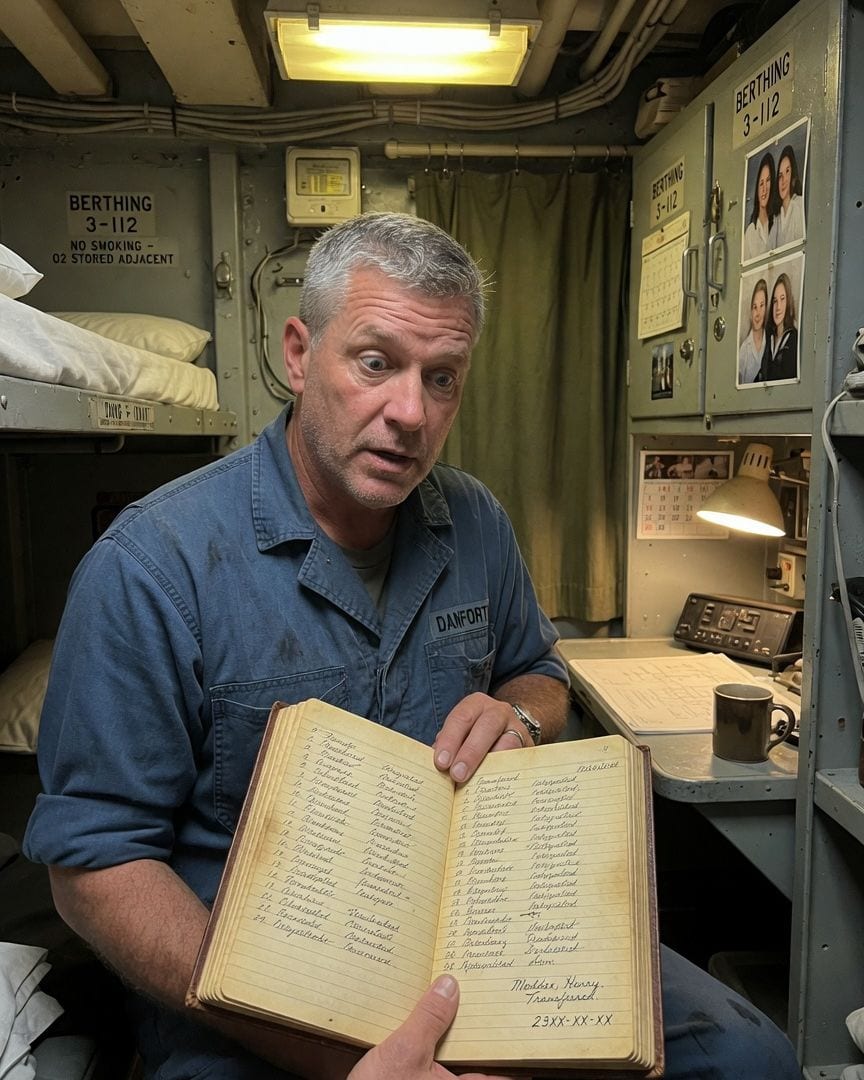
A Chief Petty Officer found a strange logbook. Its last entry listed a living crewman, dated next week.
Chief Petty Officer Russell Danforth was weeks from retirement, his three decades of service nearing an end aboard the USS Weatherall. Deep in the destroyer's familiar steel passages, he stumbled upon a sealed hatch where official plans insisted only solid bulkhead should be. Forcing it open, he discovered a cramped, unsettlingly 'lived-in' compartment holding a bare bulb and a mysterious logbook. Its final entry, stark and fresh, named a living junior petty officer from his own division, dated a week from today. What chilling fate awaited Henry Maddox, according to the Weatherall's secret history?
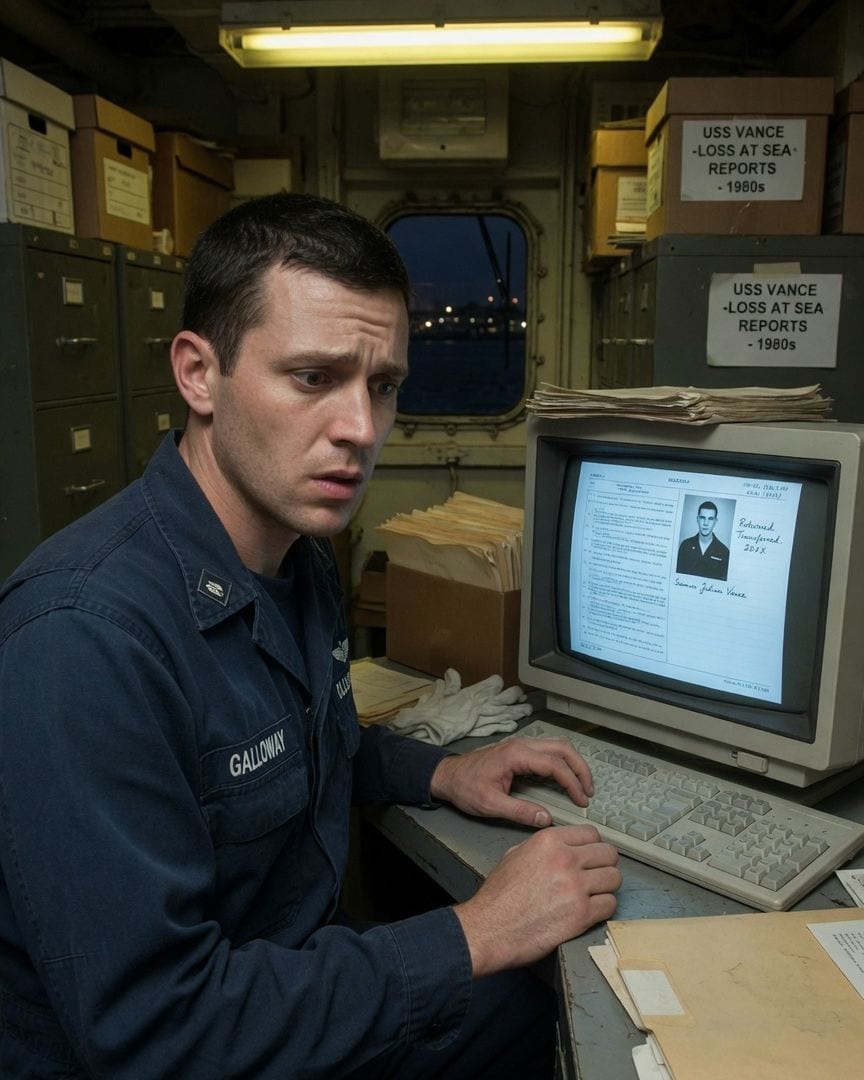
Petty Officer Galloway logged a sailor onto his ship. The man died at sea 40 years ago.
Petty Officer Joel Galloway scanned a sailor's ID on the USS Vance quarterdeck. The man's name, 'Seaman Julian Vance,' and his out-of-date uniform pricked at Galloway's memory. Later, the ship's berthing count came back one over, with an extra entry in the system but no physical body.
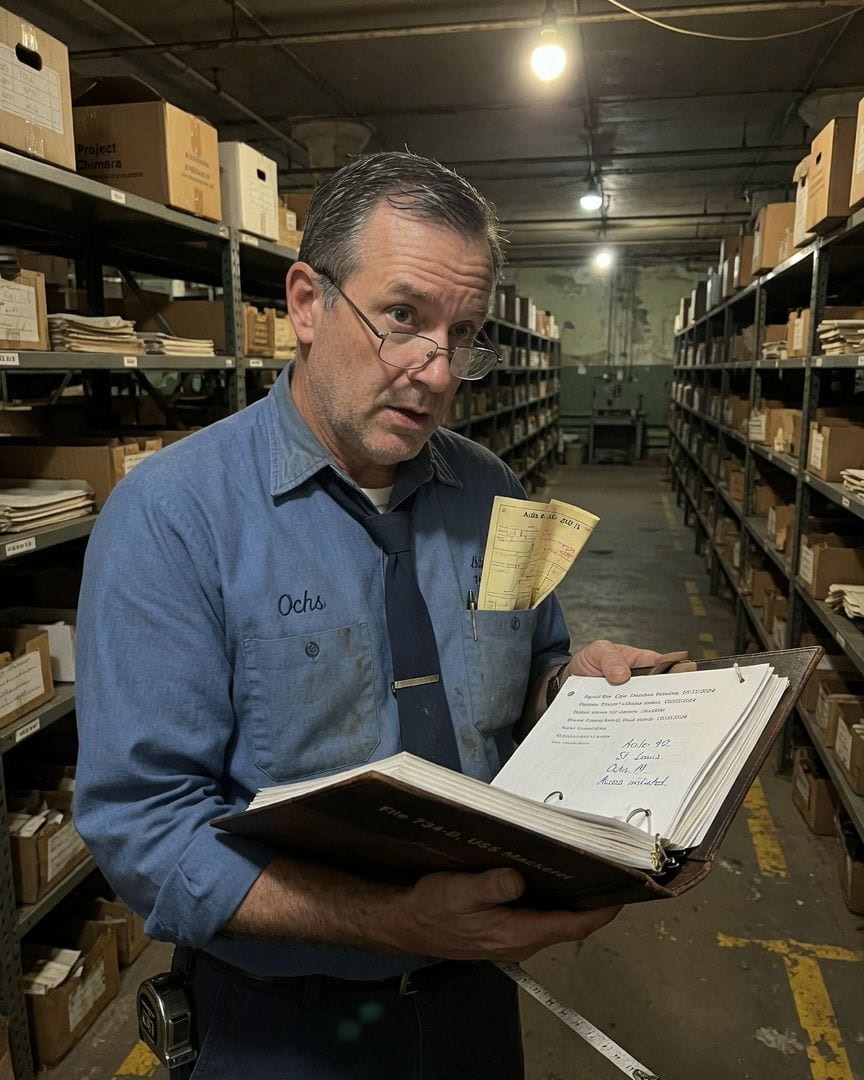
On his final inspection, a depot worker found Aisle 40 had grown 61 feet longer, and a Cold War submarine file hummed warm in his hand.
Marlin Ochs, a man of precise rhythms at the St. Louis depot, approached Aisle 40 for its final inspection before the entire structure was pulped tomorrow. For nearly two decades, the aisle had been a consistent ninety-two paces long. But on this night, his boot heels clicked past the expected mark, stretching to one hundred and nineteen paces, revealing an impossible, colder extension. Deep inside, Marlin found a heavy, leather-bound binder titled 'File 734-B, USS Mackerel,' a Cold War submarine lost with all hands in 1958. It felt oddly warm, almost humming against his palm, filled with maintenance logs and payrolls dated decades after the sub was sunk.
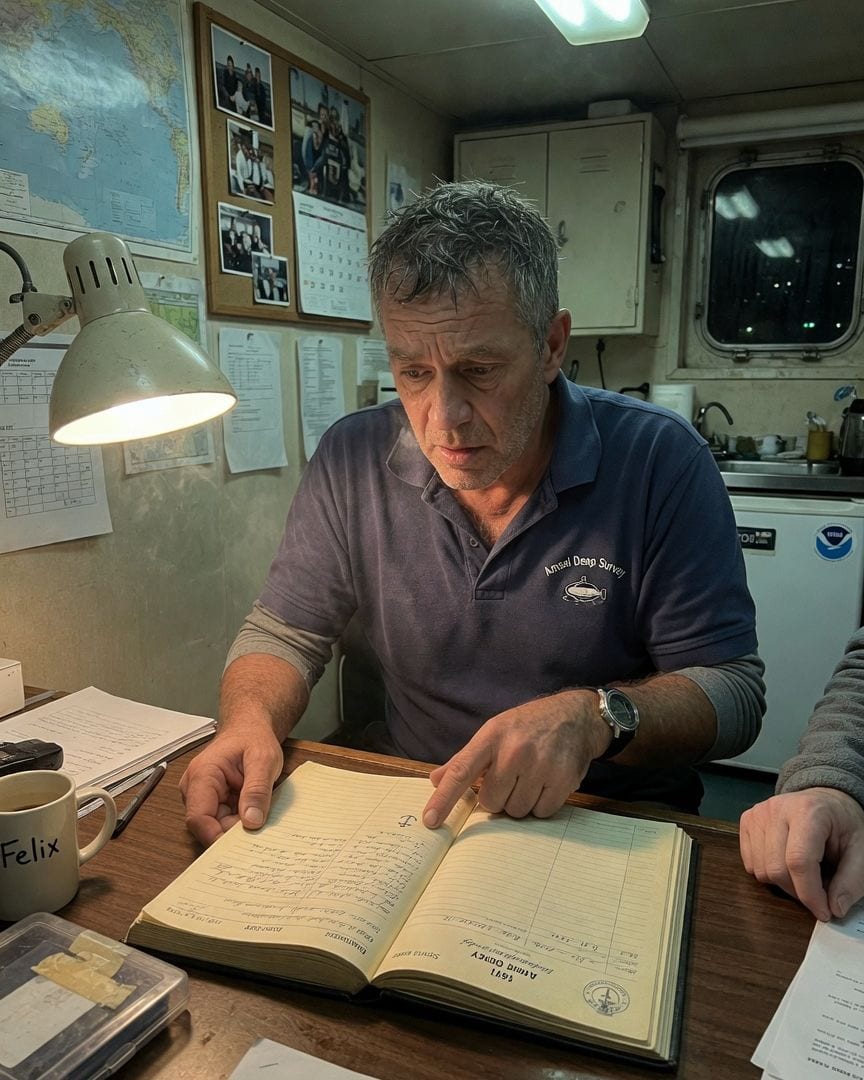
On his final deep-sea survey, a submersible pilot watches a 32-year-old Cold War wreck's rudder shift two degrees.
Deep-sea surveyor Hugo Amsel embarked on his final major dive, anticipating a quiet retirement after decades exploring the crushing pressures of the deep. His submersible's lights cut through the murky green, revealing the *Wynn Portal*, a sealer vanished in 1991, eerily preserved with unnervingly clear windows, free of any marine growth. Then, the inexplicable: the wreck's rudder angle indicator, softly lit, twitched two degrees further to starboard. Later, inside the wheelhouse, Hugo found the ship's official logbook, its final entry dated three days *after* the vessel's recorded disappearance, hundreds of miles north. How could a ship vanish, only to log a journey days later, from a place it never reached?
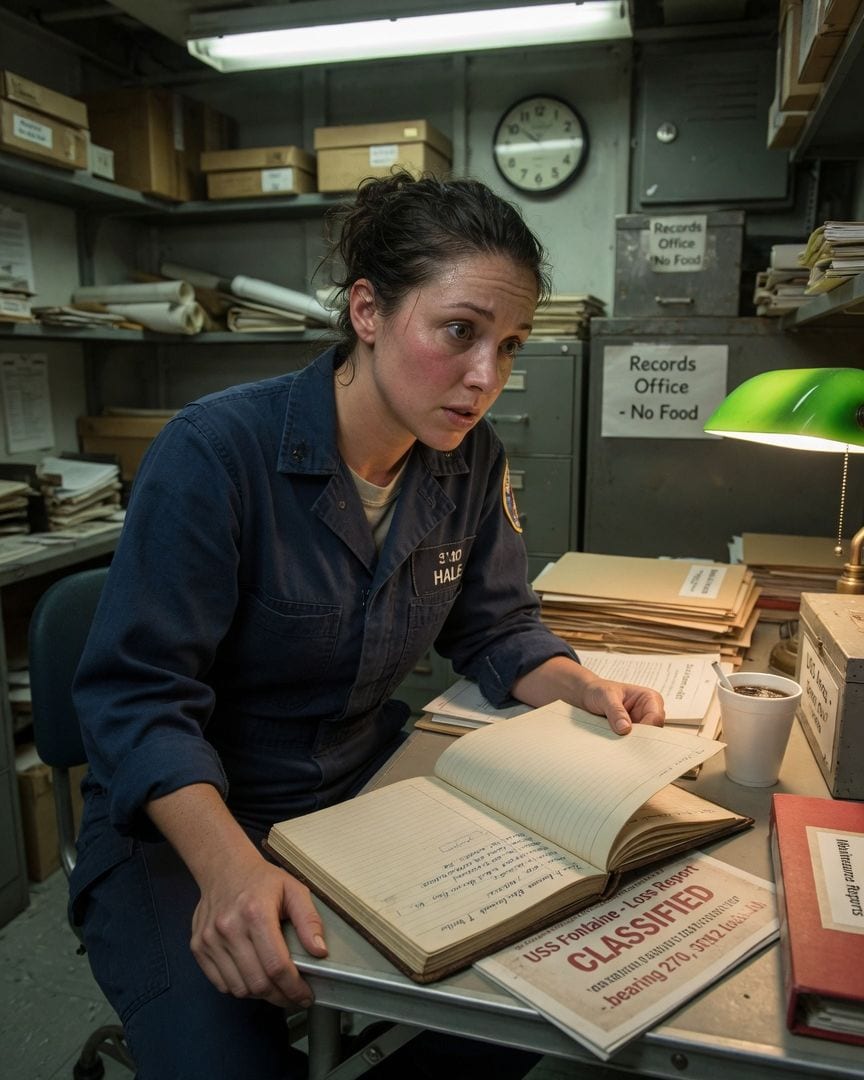
Petty Officer Hale needs a spotless record for her transfer. But the USS Ares sonar logs show an identical, impossible contact, logged to the minute, years apart, and tied to a classified loss report.
Petty Officer Sarah Hale needed a spotless record for her coveted shore duty transfer, a posting she'd worked five years to secure. Alone in the USS Ares sonar shack, three days out from San Diego, her midwatch was broken by an impossible contact: a close, slow echo holding perfect pace, invisible to radar, then vanishing. Her heart hammered, not from fear, but from the data's impossibility. When she found an identical entry in her own log from just one week prior, the cold dread tightened its grip. But the true chill settled when she unearthed decades of similar records, signed by other sonar officers, all showing the same impossible contact at 0212, off the port beam, for nineteen minutes, on the same ship, stretching back years—a persistent echo tied to a classified loss report.
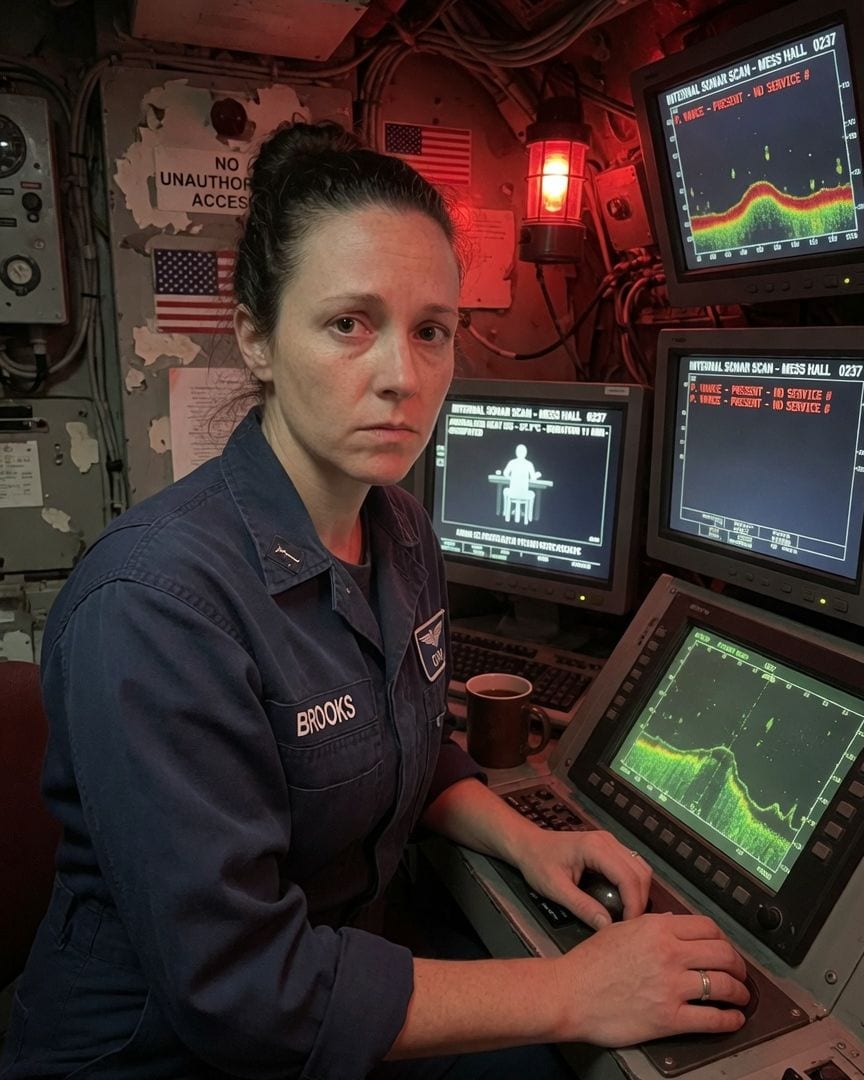
A Chief Petty Officer reviewed her submarine's sonar logs, finding a human heat signature where security cameras saw nothing, then the manifest listed an extra man who couldn't be deleted.
Chief Petty Officer Charlotte Brooks felt the weight of her submarine's impending decommissioning, its long service ending soon after a decade as her home. The quiet hum of the USS *Artemis* was broken when a nervous messcook reported seeing a shadow eating alone in the mess hall, then finding one plate short but a perfectly clean tray. Though skeptical, Charlotte checked the security feeds, which showed nothing, yet her sonar logs revealed a distinct human heat signature in the same spot, then abruptly vanish. Her dread deepened when the boat's manifest confirmed 101 souls instead of 100, listing a mysterious 'P. Vance' with no details, whose entry all systems refused to delete.