Our church trail cam logged a woman walking in at 11 PM. It never logged her walking out.
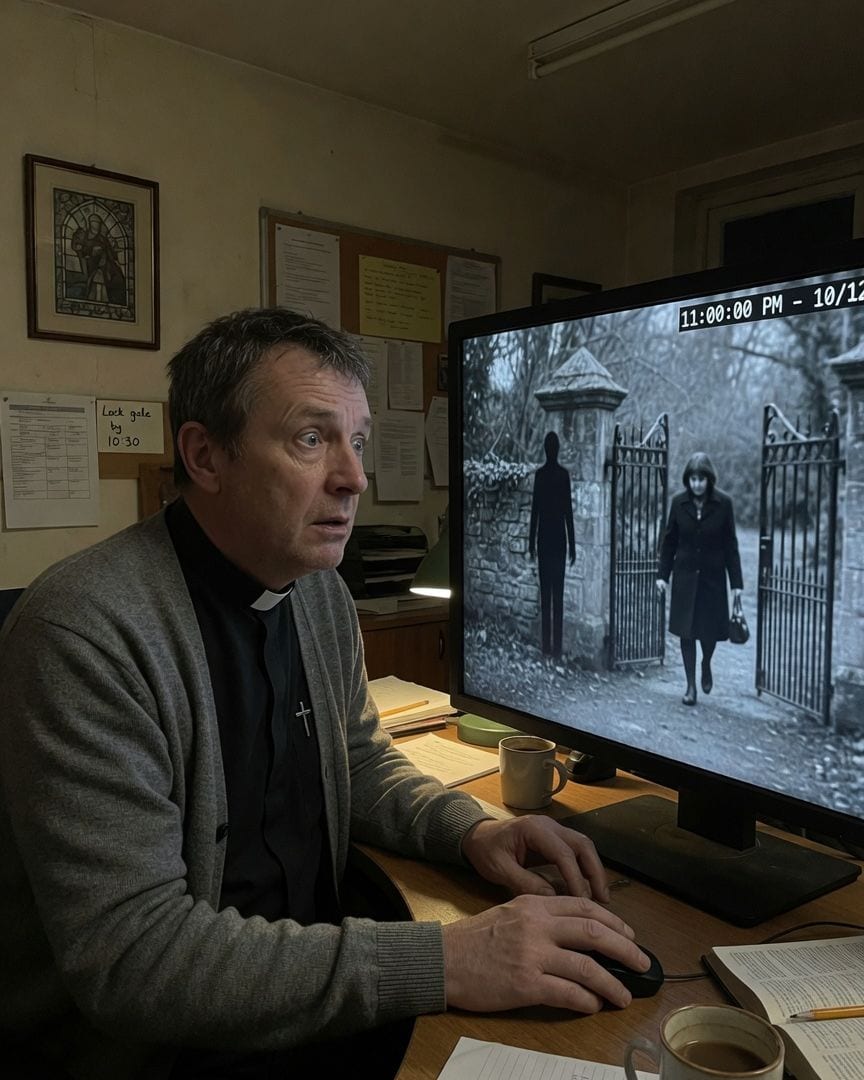
I still see her face when I close my eyes. Josephine Delaney. Not that I knew her before. I just know her now, better than I know most parishioners.
I know the dark coat she wore, the small handbag she clutched, the way her head was bowed.
I know the exact moment she walked into our churchyard, because I saw it logged on the trail cam monitor on my desk.
It was almost midnight, two weeks ago, and I was just tidying up after the late-night memorial service. Routine stuff. The gate, the wrought-iron one by the old oak, had been locked at 10:30 PM, I’d checked it myself.
But the log showed a timestamp at 11:00 PM. A woman. Josephine Delaney, head bowed, walking through that gate, into the churchyard.
I scrolled forward, then backward, my finger numb on the mouse. Nothing. No earlier entry. No later exit. The screen showed the gate, empty, at 11:01 PM. She had simply… walked in, and vanished.
The digital clock on the monitor ticked steadily, marking the passing seconds, but offered no explanation for the missing minute, the missing person, or the impossible record staring back at me.
I tried to convince myself it was a glitch, a corrupt file, anything but what my eyes insisted.
I spent the next morning replaying the footage, my coffee growing cold beside me. I watched Josephine Delaney again: the dark coat, the way she clutched that small handbag. The timestamp, clear as day, 11:00:00 PM.
It looked like a normal recording, perfectly ordinary. But as I zoomed in, a detail caught me. Josephine's gait wasn't natural.
It was too slow, too deliberate, almost a glide rather than a walk, like she was being pulled on an invisible wire.
Her head remained bowed, but there was no sense of grief, only an unnerving, trance-like focus on some unseen point ahead.
And the gate. It should have been locked, I knew it for a fact, but it swung open for her without a sound. No creak of the hinges, no clink of the latch. It just… yielded.
I’d walked past that gate this morning, rattled its heavy iron bars. It was sturdy, heavy, requiring a firm pull to open, a solid push to close. It couldn't have just 'swung' open like that for a gentle breeze.
I replayed the clip, frame by frame, looking for a hand, a finger, any interaction with the metal. Nothing. Josephine didn't touch it.
The gate simply opened, and she passed through, her movements disturbingly fluid, almost liquid, as if she were dissolving into the evening air.
The ordinary explanations, a simple oversight or a broken lock, felt flimsy, like trying to patch a hole in reality with tissue paper.
They didn't fit the quiet, deliberate way the gate had yielded, nor the strange, slow way Josephine had moved. Something was profoundly wrong with that minute of footage. I knew it.
Frustrated, I decided to watch the entire minute leading up to Josephine's entrance again. Maybe I’d missed something before, some shadow, some movement. The empty churchyard. The silent gate. The slow creep of digital seconds.
And then, as Josephine stepped through, I saw it.
In the deepest shadow cast by the old stone archway, just behind Josephine's left shoulder, something was there. A tall, indistinct shape, darker than the night, almost merged with the textured stone of the gatepost itself.
It was still, unmoving, a presence rather than a person. I froze the frame, my finger hovering over the mouse. It wasn't a tree branch, or a trick of the light reflecting oddly.
It was a silhouette, undeniably human-like, but too tall, too slender, too utterly motionless to be anything natural.
It had been there the whole time, hidden in plain sight, and it was still there as Josephine walked past it, into the darkness of the churchyard, never to emerge.
The figure in the footage became a silent accusation, driving me deeper. I couldn't unsee it, couldn't un-know that silent sentinel.
I spent hours in the church archives, the dust motes dancing in the narrow shafts of sunlight, poring over dusty, leather-bound ledgers, parish registers, and old newspaper clippings. I wasn't sure what I was looking for – other disappearances?
Strange local legends? What I found were cryptic, handwritten notes in the margins of baptismal and burial records, dating back over a century.
Phrases like 'the silent vigil,' 'the offering to the ground,' and 'the quiet keeping' appeared repeatedly, often next to entries for individuals who had no recorded deaths or burials.
It was chilling how many of these missing records had similar notes. Many of these notes were signed with familiar local surnames, including 'Sinclair.'
It was then that I thought of Warren. Warren Sinclair, the church elder and groundskeeper, whose family had been tied to the church for generations, the name appearing again and again in these old records.
I found him pruning rose bushes near the rectory, his hands gnarled but steady, his movements economical and practiced.
I showed him the trail cam footage on my phone, focusing on Josephine's entry and, more importantly, on that phantom figure lurking in the shadows.
Warren watched it with an unnerving calm, his expression utterly unreadable, as if he were observing a bird land on a branch. 'A sad thing, that,' he murmured, referring to Josephine, but his eyes barely flickered to the silhouette.
He offered no explanation, no theory, simply a shrug that spoke volumes. 'The churchyard has its ways, Abigail. Always has.' His placid acceptance grated on me, making the hairs on my arms prickle. He wasn't concerned; he was… resigned.
As if this was simply how things were, and had always been.
I returned to my office, the unsettling calm of Warren's words echoing in my mind.
I tried to dismiss it as the ramblings of an old man, perhaps a little senile, but the details from the ledgers, the figure in the footage, wouldn't let me.
A cold dread had begun to settle, seeping into the corners of my usually well-ordered life. I felt an increasing unease, a sense of being observed, even here in my own quiet office.
My office door, which I distinctly remembered locking when I’d left for lunch, was ajar when I returned. Not wide open, just a hair’s breadth, enough to catch my eye.
A file I'd been working on, detailing upcoming donation drives, was subtly misplaced on my desk, pushed a fraction of an inch off its usual alignment.
I dismissed it as my own absentmindedness, a side effect of my growing obsession with Josephine and the churchyard. My mind was playing tricks, I told myself.
Then, my phone rang. It was an unknown number, blocked. My heart jumped. I answered, and for a moment, there was only a low, sustained hum, like distant electricity, or a vast, unseen engine idling.
The sound was so deep it vibrated in my teeth. I started to hang up, thinking it was a telemarketer or a wrong number, but then a voice, barely a whisper, clear and resonant despite its softness, spoke my name.
'Abigail Montgomery.' It was a woman's voice, not Josephine's, but utterly devoid of inflection, like a recording played back without emotion, or a voice speaking from a great distance, across a huge, empty space.
Then, with a soft click, the line went dead. I stared at my phone, my hand trembling. The hum, the whisper of my full name, the implication that whatever I was digging into, it knew her.
The danger was no longer abstract; it was personal, and it had found me.
I found Warren again, this time in the quiet solitude of the old chapel. The stained-glass windows cast fractured rainbows across the ancient pews, but the light felt cold, unwelcoming.
I confronted him directly, my voice tight with a mixture of fear and anger, the phone still clutched in my hand. 'Who called me, Warren? And what do you mean, 'the churchyard has its ways'?'
He sighed, a slow, deep sound that seemed to pull the silence in the chapel even tighter. 'No one called you, Abigail. It called you.'
He looked at me, his eyes ancient and weary, like he’d seen this all a hundred times before. 'The churchyard… it’s a channel. Always has been. For certain people, at certain times, it opens up.'
I pressed him, my temper fraying, pushing the old ledgers I’d brought with me across the pew between us. The leather creaked faintly. 'What are these 'offerings'? These 'silent vigils'? What did your family do?'
Warren ran a gnarled finger over the faded script in one of the ledgers. 'They weren't offerings in the way you think. More like… a recognition. A tending. My family, the Sinclairs, we've always been the keepers. We don't interfere.
We just… document. We make sure the records are kept. We watch.' He nodded towards the trail cam I’d mentioned earlier. 'That little camera of yours? It’s just doing what the churchyard does naturally. Capturing. Recording.'
He explained that the figure I saw in the footage was not a person, not a gatekeeper, but an 'echo,' a residual presence of those already taken, guiding the next. A pull.
'The channel uses your name, Abigail,' he said, his voice softer now, almost a murmur, yet it resonated in the quiet. 'It knows you're looking. It knows you're listening.'
He finally admitted that Josephine Delaney was not the first, and she wouldn't be the last. 'The gate opens, they walk in, and they become part of the keeping. Part of the record.'
He gestured around the chapel, at the ancient stones, the old wooden beams. 'They're still here, you see. Always here. Just… in a different way. Integrated. Part of the fabric.'
His composure, his utter lack of surprise or fear, was the most terrifying part.
Shaken to my core by Warren's calm confession, by the sheer, terrifying coherence of his words, I stumbled out of the chapel. The world outside felt too bright, too loud, and utterly precarious.
Everything he’d said, every impossible detail, snapped into place with a horrifying logic, making the world tilt on its axis. I couldn't accept it, wouldn't. I needed proof, undeniable, physical proof to refute or confirm this madness.
This couldn't be real.
I rushed to the trail cam, mounted high on the gatepost. Its small red light blinked steadily, uncaring. My hands fumbled with the latch that secured the camera’s casing, my heart pounding a frantic rhythm against my ribs.
I pulled out the tiny memory card, a fragile chip holding what I hoped was nothing more than a broken file, a corrupted timestamp. Back in my office, I jammed the card into my computer's reader.
The folder 'Trail_Cam_Logs' appeared on the screen, just as it always did. I double-clicked it, my breath catching in my throat.
Instead of one video file from last night, from two weeks ago, there were dozens. All dated for tonight. All named identically: 'CHURCHYARD_GATE_2024-03-15_2300.mp4'. I clicked on the first one. Josephine Delaney walked through the gate. I clicked on the second.
A different woman, older, with a bright scarf, her face obscured by shadow, but clearly not Josephine. The third, a young man in a hoodie. Each one, a different face, a different person.
Each one walking through the gate at 11 PM. And each one, never walking out. The impossible object was real, dated, and staring back at her from the screen, an endless, horrifying loop of disappearance.
I found Warren again, still in the chapel, the impossible memory card clutched in my hand, its cold plastic a shocking contrast to the sweat on my palm.
I thrust it at him, the dozens of identical files flickering on my laptop screen, a silent, damning accusation. 'Explain this, Warren! This can't exist!
All these people, all on the same night, on the same file name, none of them leaving!'
Warren took the card, his gaze distant, almost sympathetic. He held it like it was nothing more than a pebble. 'It exists because the channel exists, Abigail. This… this is the churchyard's memory. Its ledger.'
He explained that the 'channel' wasn't a portal to another dimension, not exactly, but the very essence of the churchyard itself. A porous boundary, he called it, a place where the veil between worlds thinned.
Certain individuals, those who were lost, or seeking, or perhaps merely susceptible, were drawn to it at specific times, usually after dark.
The 'figure' I saw in the footage, he clarified, was not a single entity, but an amalgam of all those absorbed, a silent, magnetic pull, a kind of echo that guided the next.
'They become part of the place,' Warren said, his voice devoid of judgment, his eyes fixed on the chapel’s ancient stone floor.
'Their presence, their essence, is recorded here, in the stones, in the ground, and now, in your little camera. The cam doesn't just record; it captures what the channel takes.
It's an artifact that cannot exist, yet here it is, proof of a deeper, older truth.' He described how his ancestors had understood this, how their 'keeping' was simply to ensure the channel remained undisturbed, its natural, cyclical hunger met.
The names in the old ledgers, the whispered call on the phone, the endless loop on the memory card – it all clicked into place, a horrifyingly coherent pattern of absorption.
Everything I had dismissed as impossible now fit perfectly, making the churchyard itself feel less like a place of worship and more like a living, breathing, hungry entity.
Warren handed the memory card back to me, his eyes holding a profound, unsettling sadness, as if he pitied me, or perhaps knew my fate. 'By seeing this, by understanding, you've opened yourself to the channel, Abigail.'
He paused, then spoke my full name again, 'Abigail Montgomery,' but this time, it wasn't a whisper on a phone, nor was it entirely his own voice.
It was deeper, resonant, echoing from somewhere unseen, yet clearly from him, vibrating in the very air around us. It felt like the sound came from inside my own bones.
As the last syllable faded, the ancient church bell, which hadn't rung in decades, tolled once. A single, deep, vibrating note that seemed to shake the very ground beneath my feet, rattling the stained-glass windows in their lead frames.
I felt a strange, magnetic pull, a profound sense of belonging I'd never experienced, drawing me towards the chapel door, towards the outside.
It wasn't fear, not entirely, but an irresistible urge to go, to enter, to become part of the quiet keeping.
My feet moved without conscious thought, carrying me towards the flickering red light of the trail cam at the churchyard gate. The memory card felt heavy in my hand, a small, cold weight, a passport to the impossible.
The gate stood slightly ajar, just as it had for Josephine, a sliver of darkness beckoning. I heard Warren’s voice, now sounding distant, almost a part of the wind whispering through the rafters: 'You'll be in good company, Abigail.
Always here.' I didn't look back. The pull was too strong, the sense of inevitability too absolute. I was walking, slowly, deliberately, towards the open gate, towards the shadow that waited.
The old church stood silent once more, its bell still. Warren Sinclair, impassive as ever, continued his duties, tending the rose bushes, sweeping the paths.
The trail cam on the churchyard gate blinked steadily, its red light a tiny, watchful eye in the twilight. Abigail's office remained as she had left it, the laptop open, the memory card slot empty.
No one reported her missing for several days; she was a private person, and her absence was easily mistaken for a vacation. The church sought a new secretary.
The trail cam, reviewed by the new church secretary a week later, showed a new entry. At 11:00 PM on March 29th, a woman, Abigail Montgomery, was logged walking through the gate. She never walked out.
The churchyard remained quiet, ancient stones holding their silent secrets. Warren Sinclair, passing the gate, glanced at the trail cam. Its red light blinked. He nodded almost imperceptibly, then continued on his way.
The gate swings shut behind her, silent in the gathering dark.
If this one got to you
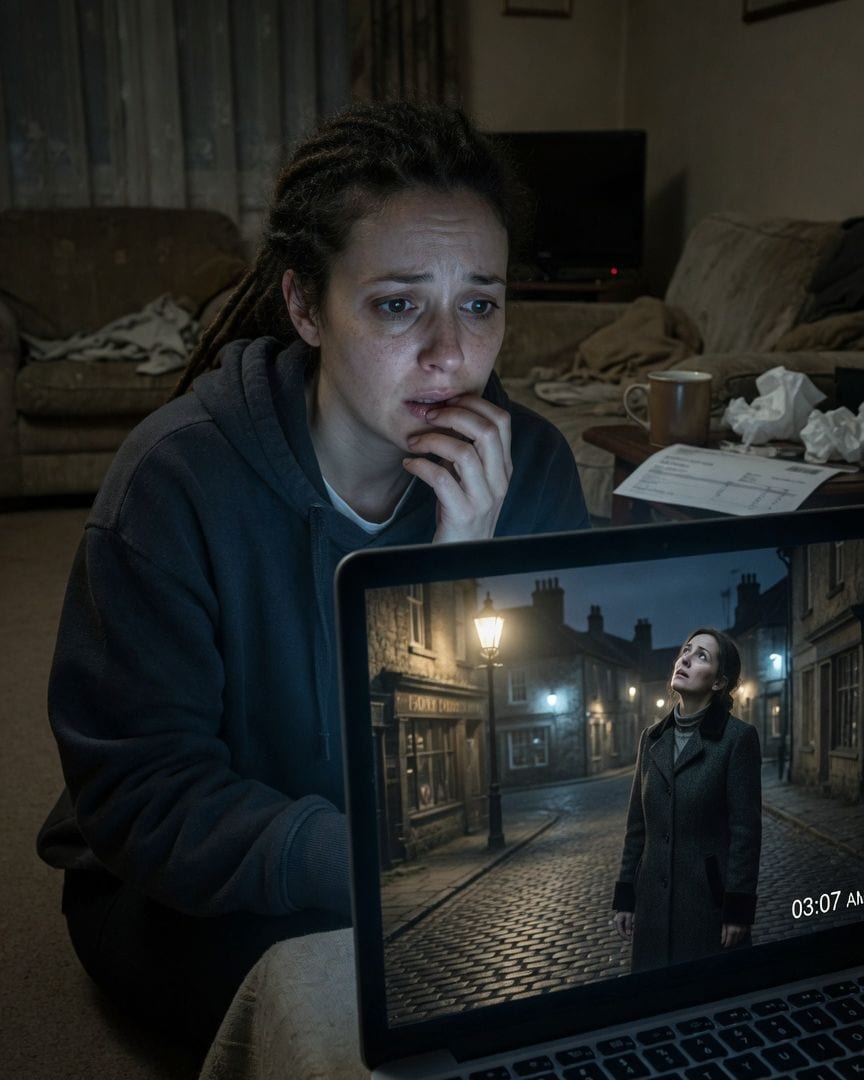
My aunt's coat walked into the village square at 3 AM. The webcam caught her looking straight into the lens, two weeks after we buried her in it.
Staring at my village church webcam at 3 AM, the square was deserted and quiet. Then a figure emerged, wearing the distinctive wool coat my Aunt Constance was buried in just two weeks ago. She paused, then slowly tilted her head up, looking directly into the camera lens, right at me.
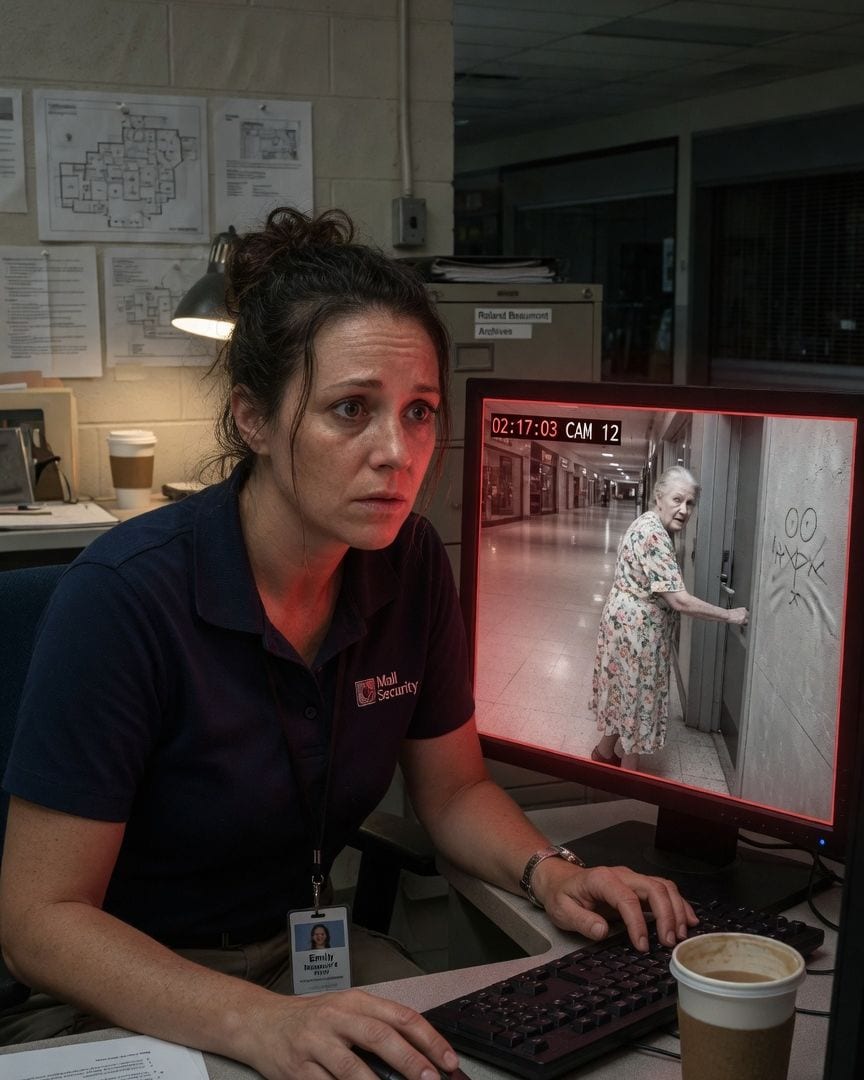
Mall security footage caught an old woman walking the concourse after closing. Every camera filmed her, but no single frame shows how she got in.
Working the overnight shift, I monitor my locked mall's security footage. It was 2:17 AM, five hours after closing, when an old woman in a floral dress simply appeared on Camera 7. She was never seen entering the frame, only *present*, walking slowly across the deserted concourse.
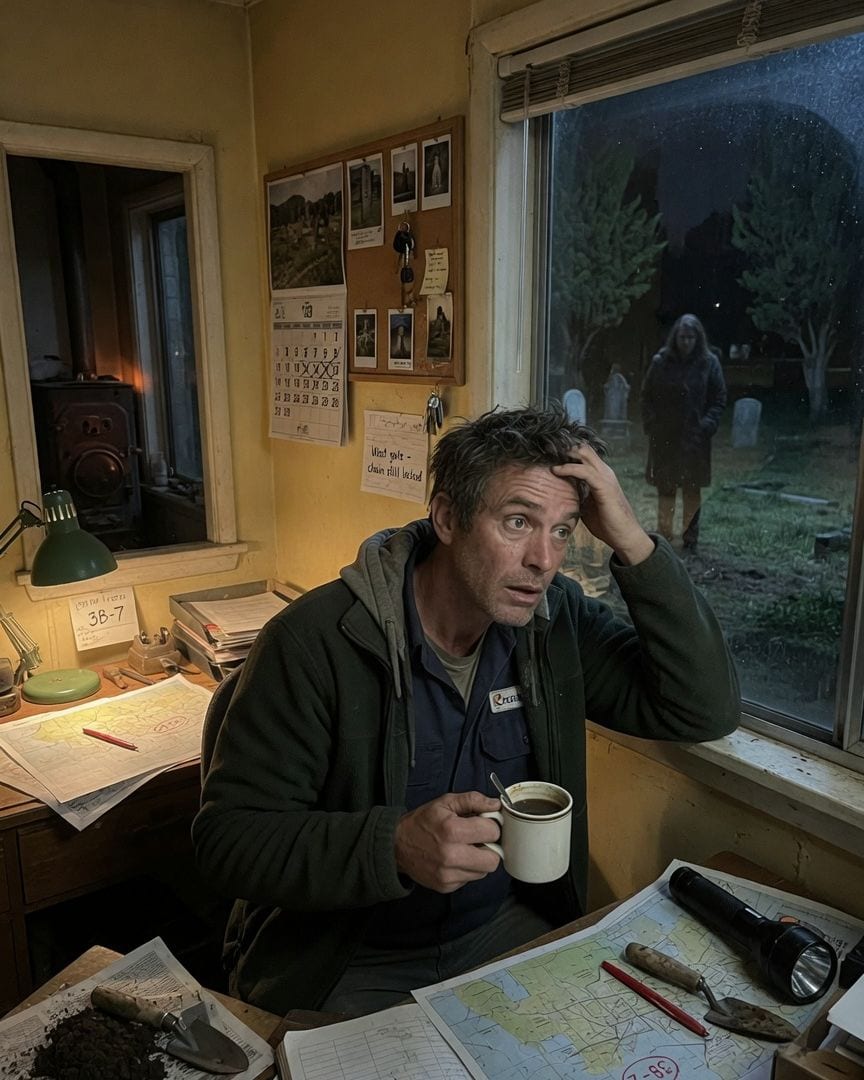
My cemetery lodge overlooks a woman visiting an empty grave near 3 AM most nights. The west gate she uses has been chained shut since autumn, its lock untouched.
As the cemetery's night caretaker, I'm used to the quiet hum of the lodge. But for three weeks, a woman has appeared nightly at plot 3B-7, a silent mourner in the deep night. What chills me is how she leaves: walking straight through the west gate that's been chained and padlocked shut for eight months.
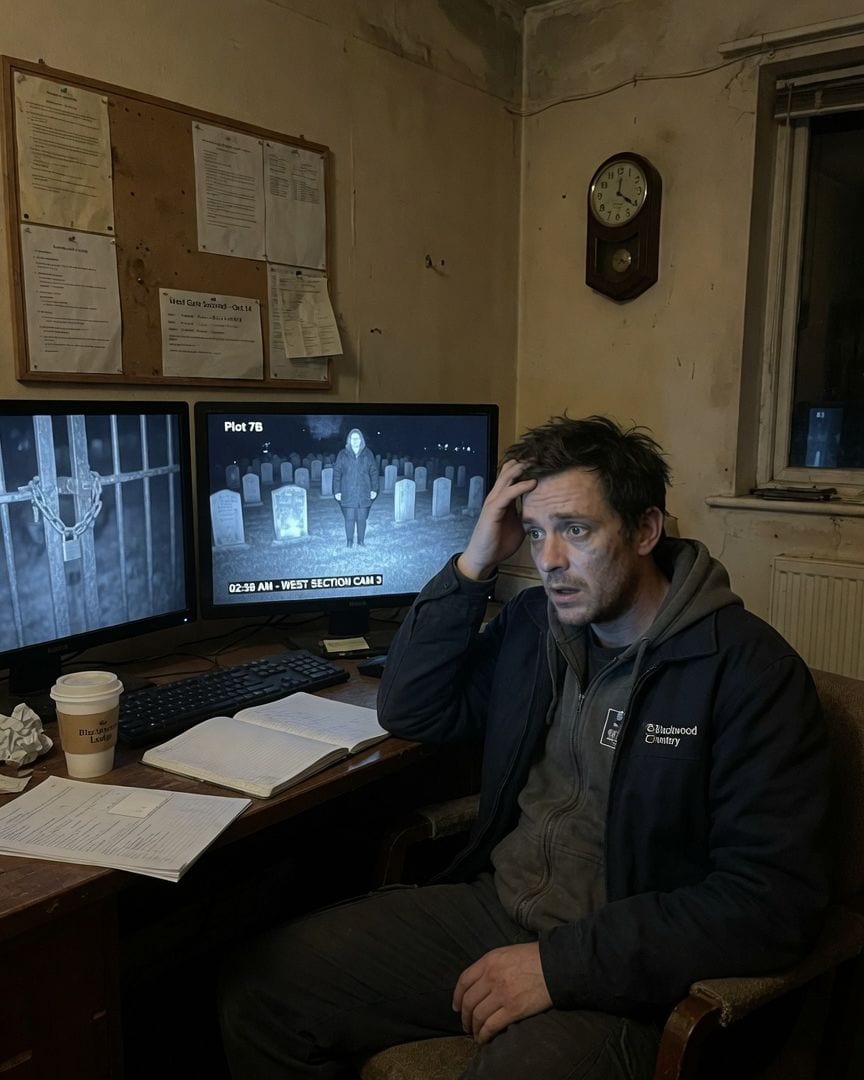
An empty grave in my cemetery gets a nightly visitor. She walks out the west gate, which has been chained and locked since autumn.
My graveyard night shift means quiet hours watching the CCTV monitors. For weeks, a woman has appeared, always stopping at an unused plot before walking towards the west gate. I just watched her walk straight through the locked, chained gate, but my own shift log now shows *my* name on a gate check I never made.
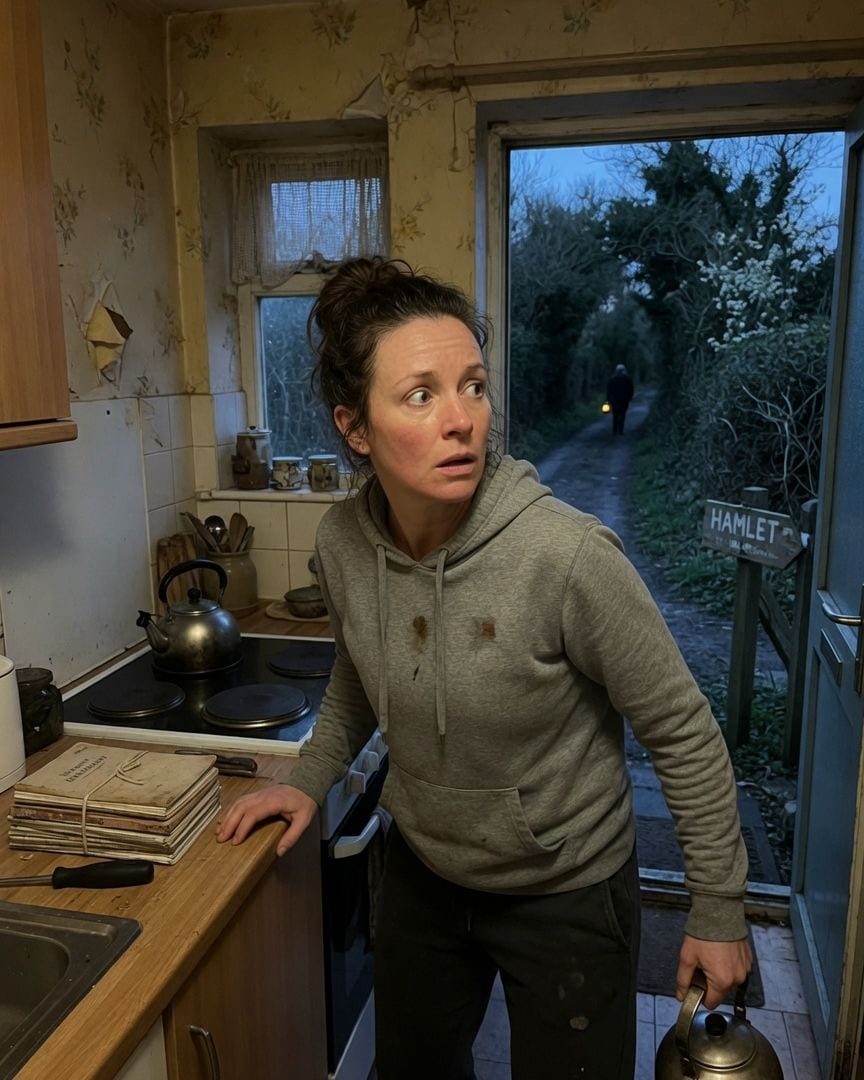
My side gate opens onto a dirt lane between hedgerows, not the close, and a figure with a lantern comes up it toward me.
My side gate normally opens onto the familiar tarmac of the close, but lately, it's opened to a narrow, overgrown dirt lane instead. Three times now, at dusk, I've seen a man with an old-fashioned lantern walking unhurriedly up this impossible lane towards my house. Each time, when I dare to look again, the lane is gone, leaving only the bins and a racing heart.
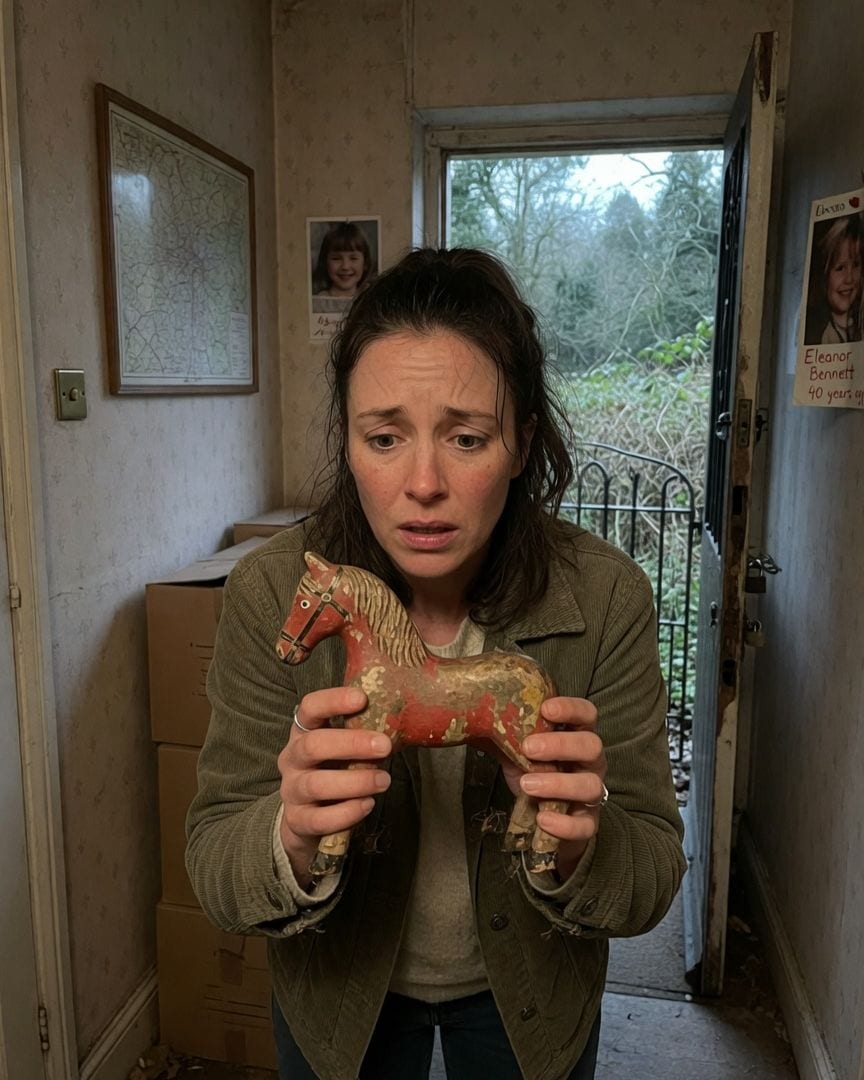
My black gate stands open, the padlock hanging closed but the hasp unscrewed clean out of wood untouched for years. The parish keeps that gate shut. It's the rule.
I'd settled into my new village, accepting the old farmer's gruff rule about the black wrought-iron gate that guarded the ancient woods. But last Sunday, I found that heavy gate wide open, a gaping maw in the orderly lane. The padlock still dangled from its frame, securely locked, but the metal hasp was unscrewed clean out of the gatepost.