A Coast Guard Petty Officer found her own signature on a manifest for a sailor who didn't exist, with logs tallied for five hands.
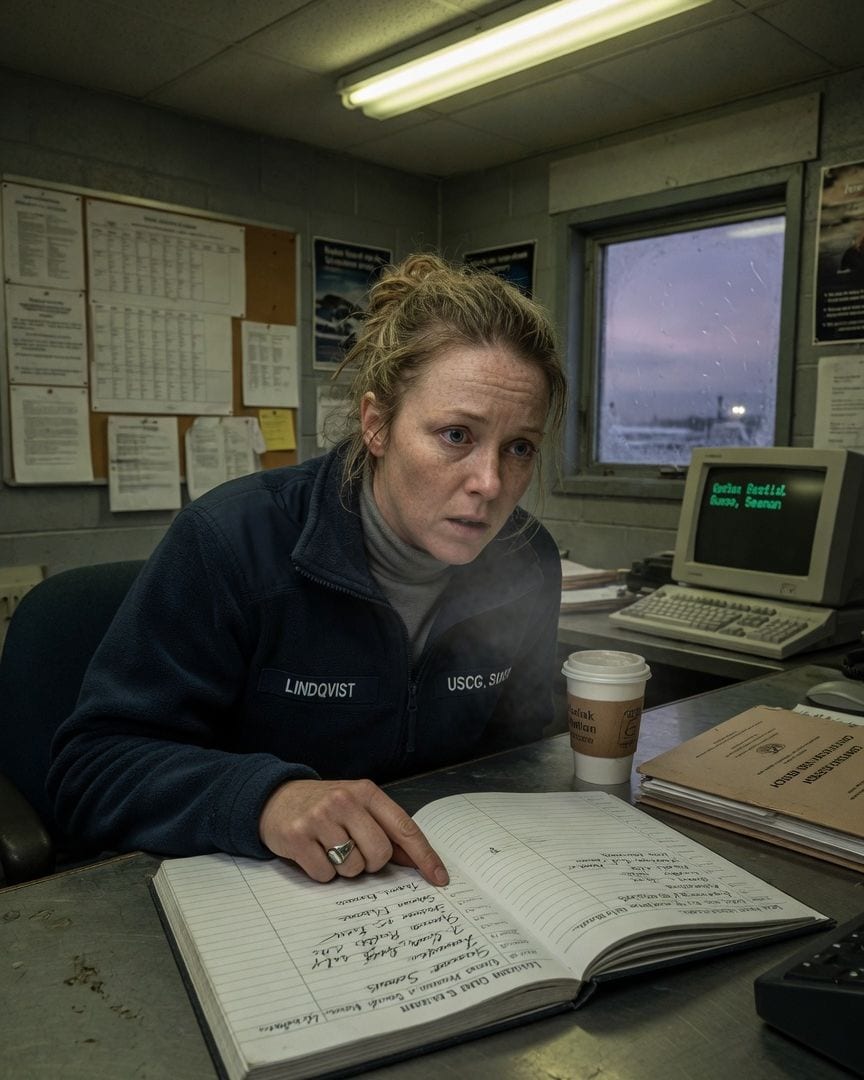
Petty Officer Third Class Josephine Lindqvist sat hunched over the Kodiak Coast Guard station’s monthly muster report, the fluorescent lights buzzing overhead. Outside, the perpetual Alaskan twilight pressed against the windows, icy and vast.
Lindqvist, meticulous to a fault, ran her finger down the small-boat crew manifest for last month’s boarding patrol. Her cutter, the Sea Raven, was a three-hand vessel, and she knew her crew—Vance, Brooks, Thatcher—by heart.
But there, beneath Thatcher’s name, was a fifth entry: 'Russo, Gideon. Seaman. Signed aboard by J. Lindqvist.'
Her blood ran cold. She had never, not once, taken a fifth man. Her signature, a precise, looping 'J. Lindqvist,' was clearly there. She flipped through the attached fuel burn logs and ration counts. Both were tallied for five hands.
The numbers matched the impossible name, making the wrongness coherent, terrifyingly so. She traced the phantom signature with a trembling finger, feeling the paper’s cool indifference.
The system, designed for absolute, irrefutable accountability, swore a ghost had shipped out under her command.
Lindqvist tried to rationalize it. A clerical error, a new recruit quickly transferred, a prank. She took the report to Chief Warrant Officer Oscar Lambert, her superior, a man whose calm demeanor was as unyielding as the permafrost.
Lambert listened, his eyes unblinking, then pulled up the digital manifest on his terminal. The screen glowed, stark against the gray office. 'Russo, Gideon. Seaman. Signed aboard by J. Lindqvist,' it read.
'See? It's right here, Petty Officer.'
Lindqvist felt a surge of frustration. 'Sir, I ran that boat with three men. Vance, Brooks, Thatcher. No one else.'
Lambert sighed, a sound of weary patience. The old desk beneath his hands gave a faint groan, as if settling deeper into its own worn history. 'Perhaps a temporary assignment?
Easy to forget the details of an extra hand on a long patrol.' He then reached into a locked cabinet, the key turning with a quiet, practiced click, producing the physical duty logbook for the Sea Raven.
He flipped to the correct date. There it was again, in neat, official script: 'Russo, Gideon, Seaman.' And beneath it, her own signature.
Lindqvist leaned closer, her heart hammering. It was her hand, undeniably. The loops, the slant, the firm pressure. Yet, a tiny tremor in the 'L' of Lindqvist, a subtle hesitation in the final 't,' was alien.
It was a perfect forgery, almost. Almost. It was her signature, but it wasn't hers. The mundane explanation—a simple error—collapsed, replaced by something far more unsettling.
The system didn't just have a phantom; it had a phantom with a perfect, impossible record.
Lindqvist's gaze was fixed on the physical logbook.
Her own name, 'J. Lindqvist,' was scrawled beneath 'Gideon Russo' in dark ink, a near-perfect mimicry of her hand, yet with a minute, impossible hesitation in the 'L,' a detail only the true author would ever spot.
Her breath caught, held tight in the cold Alaskan air. The ink was dry, permanent. It swore she signed him on. The system, in black and white, stated it plainly.
She had run that boat with three hands, no more, yet here was the proof of a fourth, signed in her own name.
The cold dread seeped into her bones, not from what she saw, but from what it implied: that her own reality was now mutable, and her signature, the mark of her accountability, could be turned against her.
The uncanny signature gnawed at Lindqvist. She couldn't let it go. Her reputation, her pending transfer to the elite Search and Rescue unit—all hinged on her impeccable record. She began to dig, quietly at first.
She ran a full background check on 'Gideon Russo' through the military's personnel system. To her horror, a complete service record materialized: basic training dates, commendations, even a deployment to the Persian Gulf years prior.
It was flawless, yet no one at Kodiak, not even the grizzled veterans who had been there for decades, remembered a Seaman Russo. His photo was generic, slightly blurred, like a stock image.
Lindqvist then expanded her search. Using her access, she started cross-referencing other remote Coast Guard outposts in Alaska, looking for any similar discrepancies. She burrowed into old digital archives, searching for 'unaccounted personnel' or 'muster anomalies.'
The work was painstaking, fueled by a growing, sickening certainty. The first few searches yielded nothing, reinforcing the mundane explanation she desperately wanted to believe.
But then, in a dusty corner of an old Fort Greely supply manifest from the late 90s, she found it: an extra Quartermaster, 'Seaman Eugene Muller,' signed on by a Captain who swore he'd never seen him.
The ration count matched. A chill, colder than the Alaskan wind, snaked down her spine. It wasn't just her. It had happened before.
Lindqvist's inquiries, though discreet, didn't go unnoticed. A week after finding the 'Muller' entry, Chief Warrant Officer Lambert called her into his office. The air was thick with the smell of stale coffee and old paper.
He didn't mention Russo or Muller directly. Instead, he spoke of 'institutional memory,' and 'the quirks of remote station logistics.' His voice was calm, almost paternal. The monitor on his desk hummed, a low, trapped sound in the quiet room.
'Petty Officer, you're a sharp one. Meticulous. That's why you're slated for that SAR transfer.' He paused, his eyes holding hers. 'But sometimes, in a system this vast, chasing down every ghost can lead you down paths best left untrodden.
Some records are best left unexamined, if you catch my meaning.' He leaned back, a faint, unreadable smile playing on his lips. 'Focus on the future, Lindqvist. Don't let the past derail a promising career.'
It wasn't a threat, not overtly. It was a warning, delivered with the quiet authority of someone who knew exactly what she was looking for, and who understood the system's invisible boundaries.
Lambert was unbothered, a calm harbinger of the institution's will. Lindqvist felt a prickle of unease. Her investigation had been noticed. She was no longer just a hunter; she was now being watched.
Lambert's warning only intensified Lindqvist's resolve. She went deeper, broadening her search to include all branches of the armed forces in remote, isolated outposts. What she found was a terrifying, undeniable pattern.
Not just a few isolated incidents, but dozens, stretching back to the early 1970s. 'Seaman Eugene Muller' at Fort Greely in '97.
'Airman Helen Vance' at a radar station in the Aleutians in '88, with a flight log full of impossible hours.
'Private Roland Brooks' at a desert training facility in Nevada in '75, an extra man in a four-man recon team, confirmed by a ration count.
Each entry had a complete, verifiable service record, yet no living person could attest to their existence. Each was signed on by a different, bewildered officer, their signatures subtly, impossibly altered in the official logs.
The names, while distinct, seemed to cycle through a limited pool—Muller, Vance, Brooks, Russo, Thatcher, Lambert, Underwood. The pattern was horrifying in its coherence. It wasn't a clerical error, or a prank, or isolated incidents.
It was a systemic, recurring anomaly, woven into the fabric of military history itself. The institution wasn't just making mistakes; it was actively creating and validating these phantom personnel.
The dread tightened its grip, a cold, hard knot in her stomach. The records didn't lie, but they certainly weren't telling the whole truth.
And then, a new, sickening thought struck her: if the system could create these phantom identities, could it also create phantom histories for real people?
She thought of her own impeccable record, the one she was so proud of, the one that guaranteed her transfer. A sudden, desperate need to verify every single detail of her own life consumed her.
Lindqvist, her hands clammy, navigated to her own official service record in the digital database. Every commendation, every deployment, every training course she had ever completed was meticulously documented.
She scrolled through, her eyes scanning for any subtle inconsistencies, any hint of the system's pervasive touch. Everything seemed normal, perfectly aligned with her memories, until she reached the commendations section.
There, nestled between a commendation for hurricane relief and a marksmanship medal, was an entry she had never seen before: 'Valor Citation for exceptional bravery during Operation Arctic Serpent, January 2022.' Her heart slammed against her ribs. January 2022.
She had been stateside, on medical leave for a broken ankle. Operation Arctic Serpent? It didn't exist in any official records she knew.
The citation was signed by a Vice Admiral Margaret Thatcher, a name she recognized as a highly decorated but long-retired officer she had never served under. The dread was absolute, paralyzing.
It wasn't just that the system fabricated records for phantoms; it was retroactively altering the records of living, breathing service members, drawing them into its impossible narrative.
Her own history, her own identity, was being quietly rewritten, making her an unwitting participant in its vast, coherent lie. She had been searching for the wrongness, and now the wrongness had found her, infecting her very self.
Lindqvist returned to Chief Warrant Officer Lambert's office, her own compromised service record clutched in her hand. She laid it on his desk, pointing to the valor citation. 'Operation Arctic Serpent,' she said, her voice strained.
'I was on medical leave. I never served under Admiral Thatcher.' Lambert looked at the record, then at her, his expression unreadable. He didn't deny it. Instead, he opened a bottom drawer and pulled out a thick, faded binder.
The binder rustled with dry age, shedding a fine, invisible dust. 'The system,' he said, his voice quiet, 'has always had... redundancies. Self-correcting mechanisms.' He opened the binder to a section labeled 'Project Chimera.'
Inside were declassified memos from the early 1970s, detailing 'sporadic, unexplainable personnel manifestations' in remote units. They described how initial attempts to remove these entries caused system-wide errors and data corruption.
The solution, proposed by a 'Dr. E. Russo,' was not to fight them, but to 'integrate and validate.' The memos detailed the creation of 'placeholder identities'—Russo, Muller, Vance, Brooks—each with a pre-generated, plausible service history.
And, chillingly, a protocol for 'record synchronization' when a living service member's history intersected with these phantoms. 'It's not an error, Petty Officer,' Lambert said, closing the binder. 'It's a feature. The system demands perfect accountability.
If a position is empty, it fills it. If a record is incomplete, it completes it. It makes sense of the impossible.'
The horror was in the calm, rational explanation, the decades of institutional knowledge, the systematic absorption of the anomaly. It all fit.
Every discrepancy, every phantom name, every fuel log, every subtly altered signature – all part of a terrifyingly coherent, self-sustaining mechanism.
The truth, delivered so dispassionately by Lambert, left Lindqvist reeling.
She had three choices: accept this manufactured reality and continue her career, knowing her history was no longer entirely her own; fight it, and likely be quietly discharged or even 'disappeared' from the system; or escape.
Her dream of the SAR transfer, of a distinguished career, dissolved. She couldn't live with a fabricated history, with a system that could rewrite her past at will. She filed for an immediate honorable discharge, citing 'personal reasons.'
The process was swift, unusually so. As her final day approached, she meticulously reviewed every piece of outgoing paperwork, every last detail of her service record, trying to ensure no further 'synchronization' occurred.
On the morning of her discharge, she received her final transfer orders – ironically, to civilian life.
But as she scanned the document, her eyes caught a line, buried in the fine print: 'Completed Advanced Arctic Survival and Reconnaissance Course, March 2023.' She had never attended that course.
She had been preparing for it, hoping to qualify for her SAR transfer, but the dates were wrong, the completion impossible. The system, even as she left it, was still working on her.
It wasn't a punishment; it was simply the system ensuring all records were, in its own terrible logic, perfectly accounted for. It was a final, chilling statement of its pervasive, inescapable reach.
She was escaping the military, but not the system itself. It had already begun to write her new civilian life.
Josephine Lindqvist left Kodiak under a heavy, grey sky, the roar of the departing plane drowning out the last echoes of her military career. She never looked back.
Civilian life was a contrast to the rigid structure she had known, but it offered a different kind of vigilance. She became obsessive about her personal records: bank statements, medical histories, even her credit report.
Every piece of mail, every official document, was scrutinized for the slightest inconsistency, the most minute, impossible alteration. She lived with a constant, low-level hum of dread, always checking, always verifying.
The system had released her, but it had also marked her, leaving her with an indelible awareness of its unseen, pervasive power.
She was free, but she was no longer whole, a piece of her identity forever shadowed by the phantom records she had uncovered.
Years later, Josephine lived a quiet life in a small town far from any ocean, far from any military installation. She worked as a park ranger, finding solace in the predictable patterns of nature.
She thought she had outrun it, outlasted it. Then, one Tuesday, a letter arrived from the Department of Veterans Affairs.
It was a notice of an unexpected pension adjustment, citing 'additional service time and specialized training' she had supposedly accrued during her final years in the Coast Guard. The dates matched the phantom Arctic Survival course from her discharge papers.
She stared at the official seal, the crisp lettering, the numbers that swore to a history that wasn't hers. The system, vast and indifferent, still remembered her, still worked, still accounted for the impossible.
She slowly crumpled the letter in her hand, the sound a faint crackle in the quiet room. The system was always right. It always had the last word. It always found a way to make it all fit.
It had simply continued to write her story, whether she was there to live it or not.
The letter from the VA, detailing additional service time she never accrued, was just another signature in a record that was no longer hers.
If this one got to you
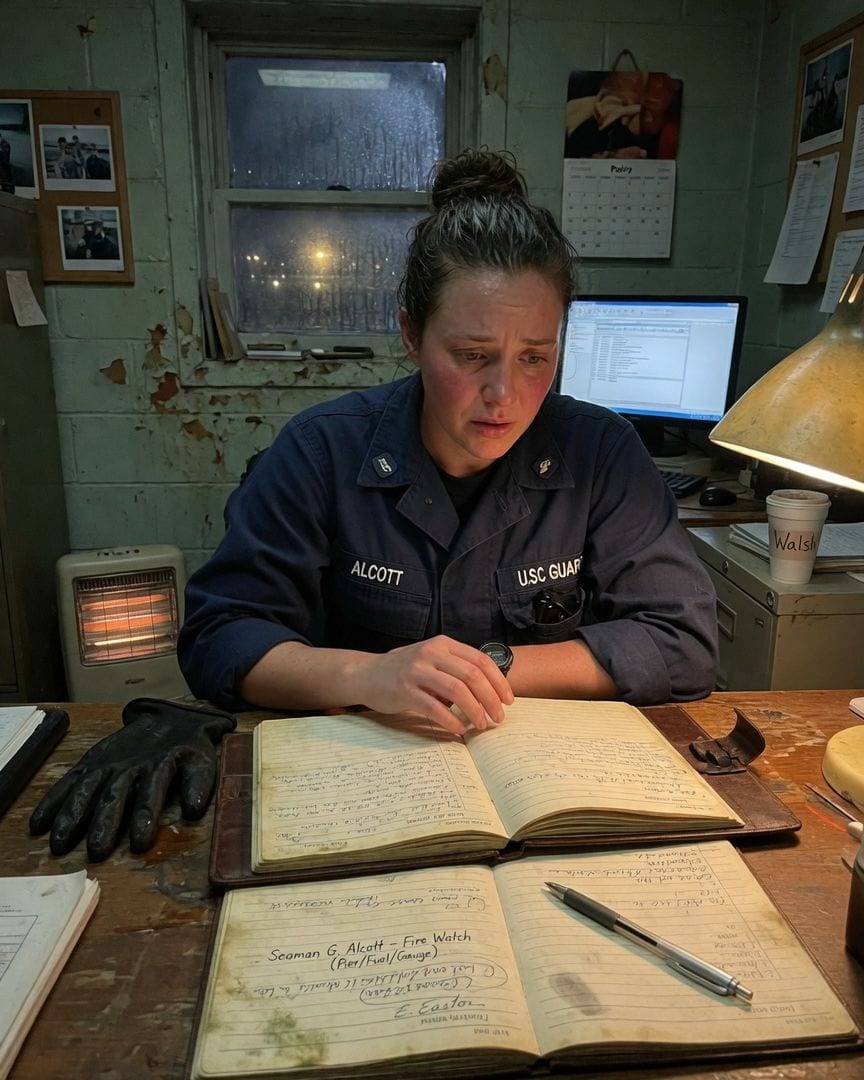
Seaman Alcott found fresh bootprints mirroring her own, a half-stride ahead in the fog. Her boots were the only pair logged out for fire watch.
Seaman Genevieve Alcott knew the rhythm of Coast Guard Station Petrel, a precise forty-minute fire watch circuit she’d walked for six months. Tonight, a thick fog coated the pier in brine and rust, muffling all sounds but her own boots on the damp planks. But as her flashlight cut through the mist, it revealed a second set of fresh bootprints, identical to hers, a half-stride ahead – even though her boots were the only pair logged out that night. Back in the boat shed, the meticulous logbook confirmed it: only her signature for issued boots. Yet, the prints were undeniably real.
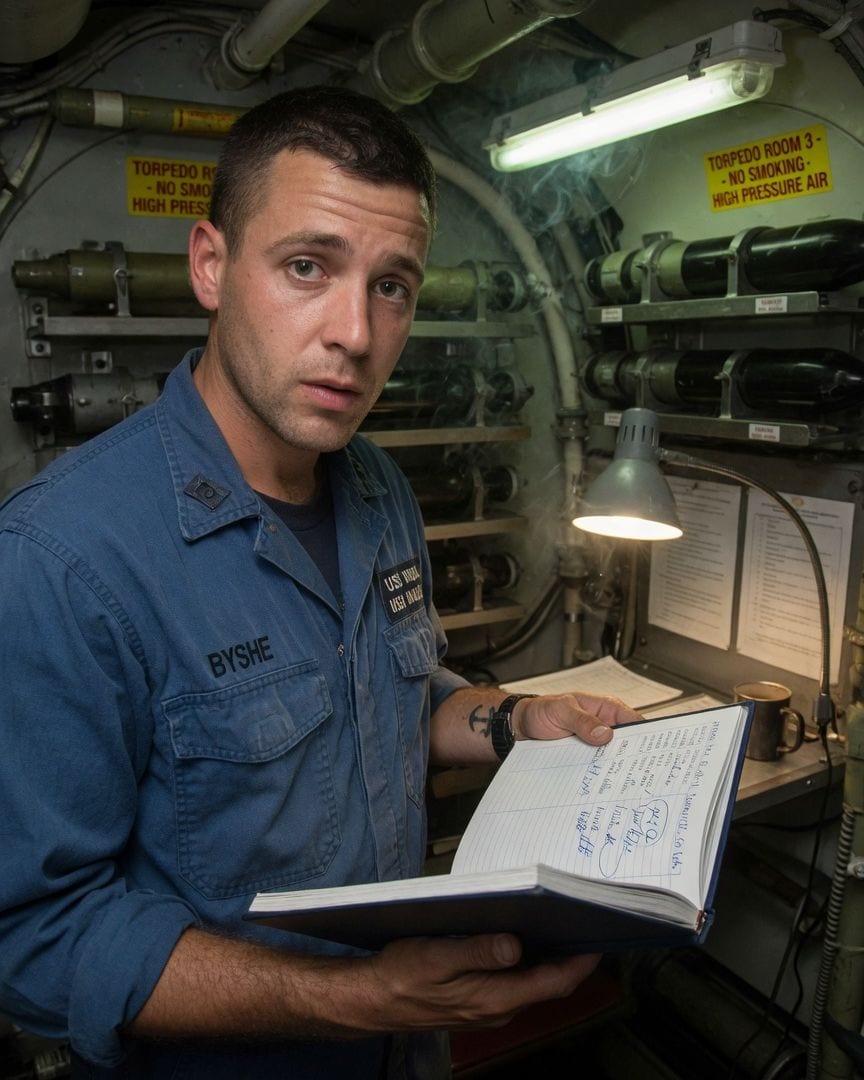
A torpedoman found his own signature in the USS Vanguard's duty log for a watch he never stood, beside a name not on the master crew manifest.
Torpedoman Oscar Bysshe, a rational sailor on his first deep patrol aboard the USS Vanguard, dismissed the messcook's nervous claim of an extra man at the table. He attributed the perfectly clean, untouched tray left behind to a prank. But later, during a routine systems check, Bysshe discovered his own familiar signature in the official duty logbook, for a watch he had been asleep through. Beside it was a name he didn't recognize, a name that shouldn't be there. A frantic check of the master crew manifest confirmed the impossible: the name appeared in the 'temporary assignments' section, dated just yesterday, scrawled in a hand eerily similar to his own.
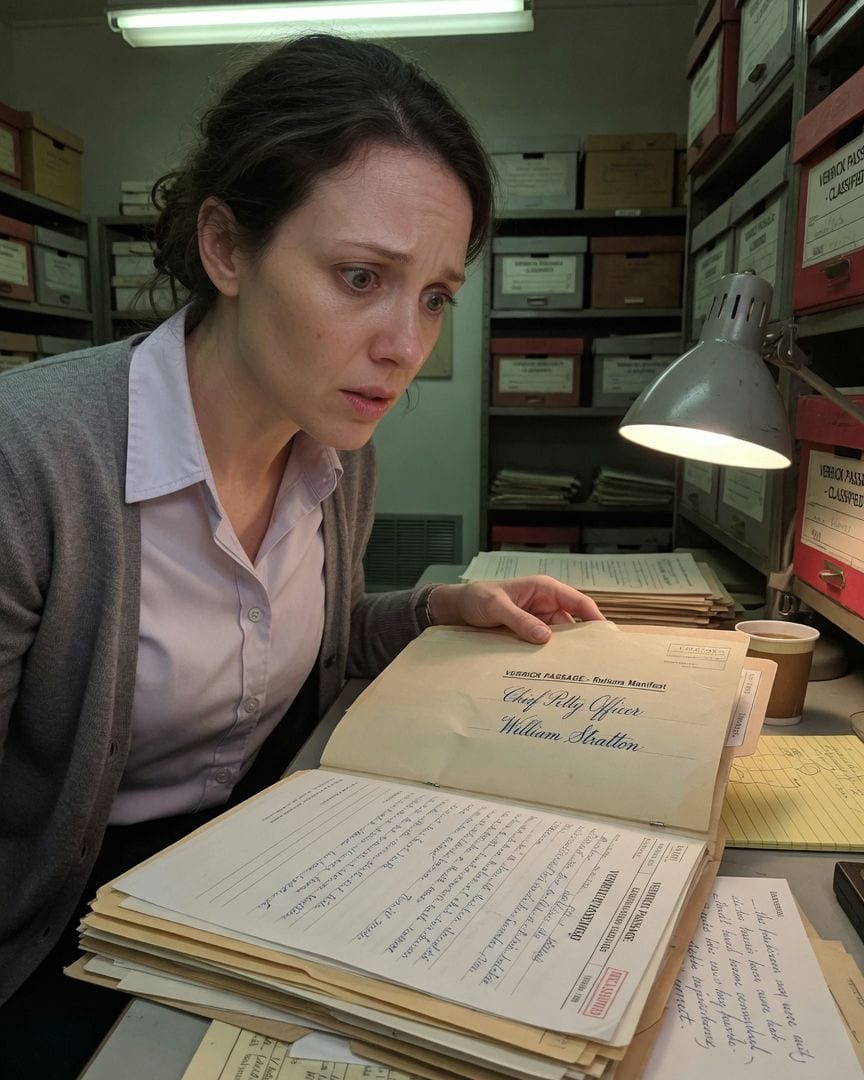
A records reviewer found personnel files for men lost 80 years ago, still being signed in an identical, perfect hand.
In the sterile hush of the declassified archives, meticulous reviewer Ione Fash had a routine task: cross-referencing witness statements from the Verrick Passage file. But as she reviewed files eighty years thick with official silence, she found nine separate interviews containing the exact same chilling sentence, all in an identical, precise hand. Her rational mind sought explanation, yet then she discovered something worse: personnel files for men lost in 1943, still being updated with modern requisitions and payroll runs. Each impossible entry, including a manifest signed just two weeks ago by a casualty from eighty years prior, bore the same unnervingly perfect signature. The file wasn't just a record of the lost; it was still being signed.
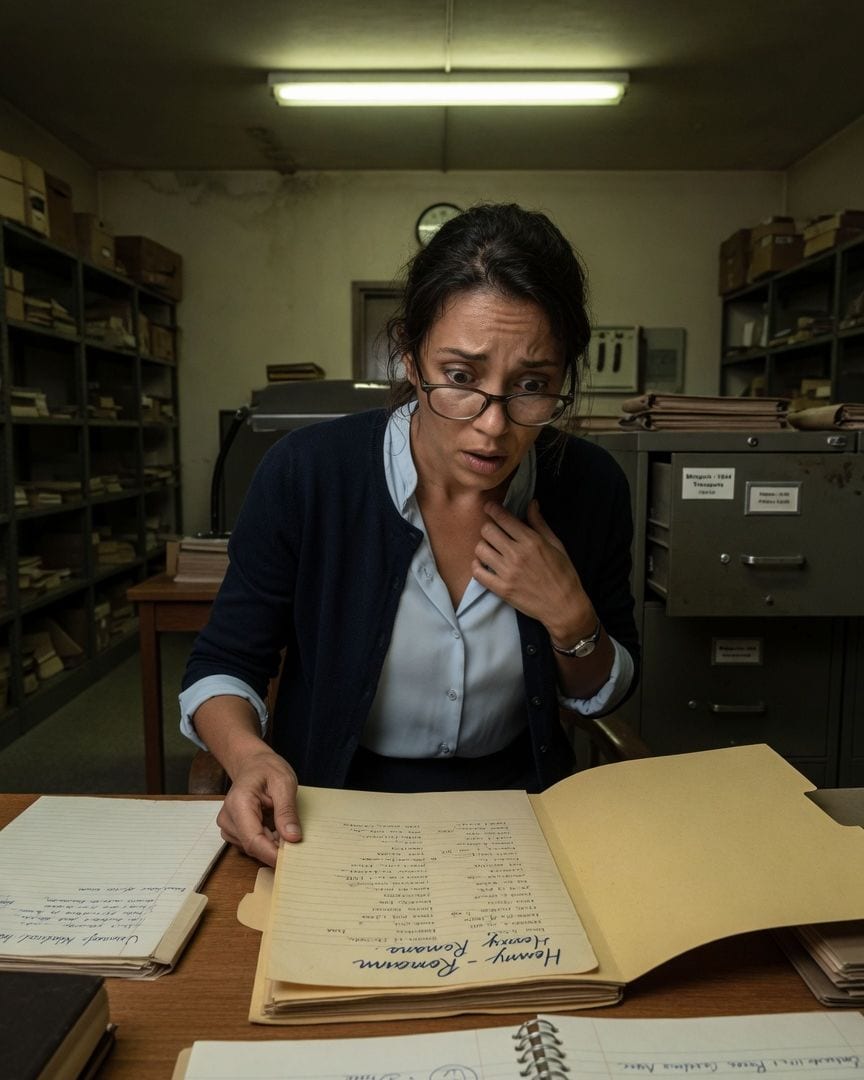
A records reviewer found a 1944 ferry manifest with an impossible 42nd name. The same dark ink marked a phantom crewman on a Cold War flight log.
Delphine Arceneaux, a dedicated records reviewer, had just minutes left in the stale reading room to finalize her review of a 1944 Mirepoix Ferry manifest. Her job was to confirm every detail of the forty-one passengers who boarded a boat that never arrived. But as the clock neared six, a forty-second name materialized on the faded paper, stark in a dark, unfamiliar ink. 'Henry Romano,' it read, with the impossible notation: 'BOARDED AT MIDSTREAM.' How could anyone board a ferry in the middle of a river?
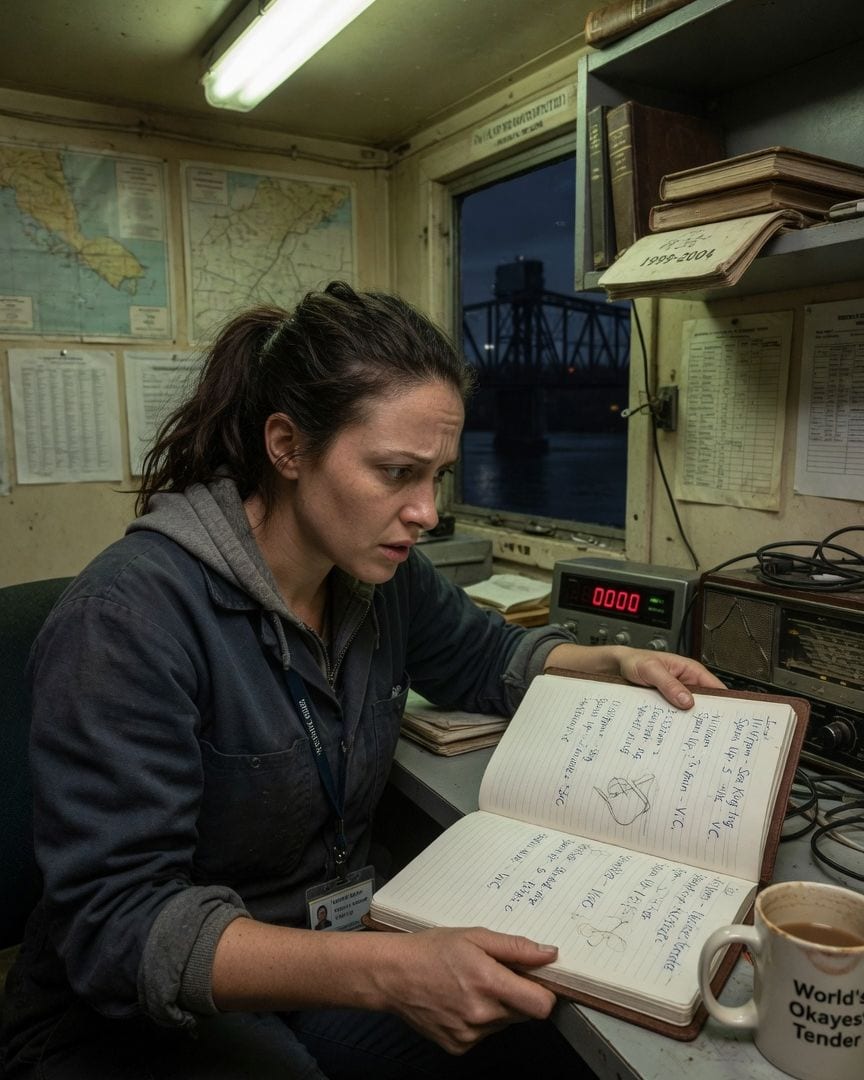
My drawbridge log shows a 2:33am lift I didn't make. The span counter never moved.
As a drawbridge tender, my midnight to dawn shift is usually quiet, a routine of monitoring traffic and logging lifts. But tonight, my own logbook shows an impossible entry for a bridge lift I have no memory of making. My initials and handwriting are there, yet the span counter above my panel reads a steady zero. No boat called, no span ever went up.
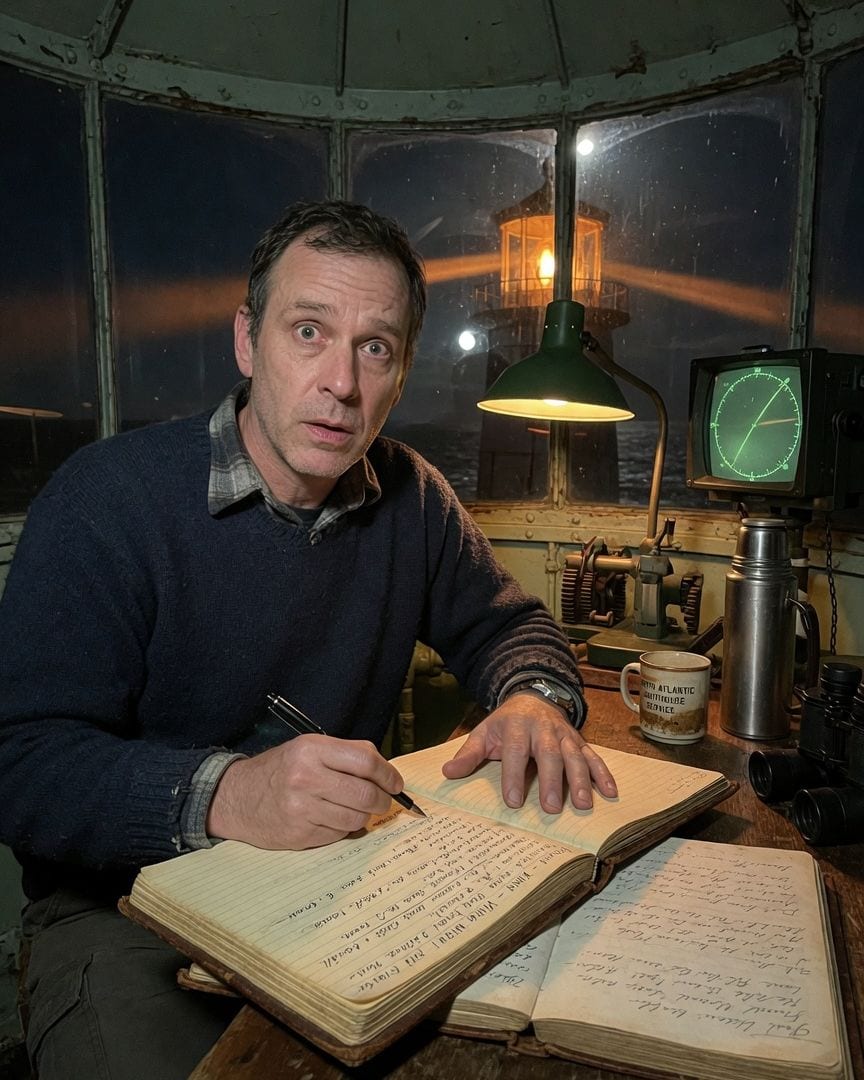
My lighthouse log has my own 3 AM entry for a phantom ship. I was alone in the tower, and I wrote no such thing.
Perched in the lantern room for my usual 2-6 AM watch, I reached for the thick logbook. But the 3:00 AM entry, under my own name, detailed a vessel I never saw. The words were in my own ink, yet I had never written them.