A records reviewer found a 1944 ferry manifest with an impossible 42nd name. The same dark ink marked a phantom crewman on a Cold War flight log.
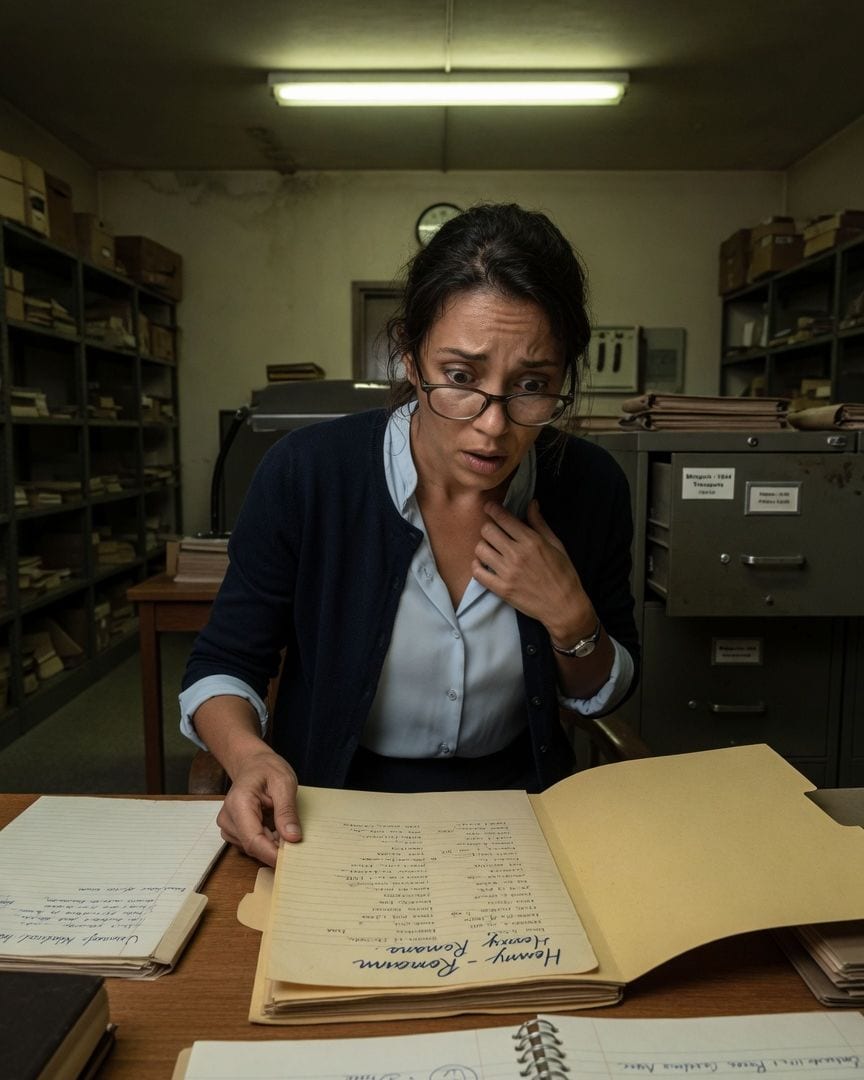
The reading room’s fluorescent hum felt louder at five-thirty, the air stale with old paper. Delphine Arceneaux had until six with the Mirepoix Ferry manifest, sealed since 1944. Forty-one passengers had boarded a boat that never arrived.
Her job, as a records reviewer of nine years, was to cross-reference passenger lists, confirm names, find any discrepancy. The manifest listed forty-one names, neatly typed, a relic of a hurried wartime departure. Then she saw it.
Below the final typed line, a forty-second entry had been added, the handwriting stark against the faded paper, written in a darker, different ink: ‘Henry Romano,’ no ticket number, with the peculiar notation ‘BOARDED AT MIDSTREAM.’
Delphine blinked, then reread it. Midstream. There was no shore at midstream. Her first thought was a clerical error, a late addition, a note from a desperate clerk who’d tried to amend the record after the fact.
But the ink was too precise, too stark against the yellowed page. It wasn't messy or rushed; it was deliberate.
She had seen that exact shade of dark blue before, a specific dark blue she had mentally labeled 'archive blue,' in other files she’d reviewed—always on an anomaly. A missing detail, an impossible addition.
She tried to dismiss the chill that ran through her, the way the filing cabinet she’d pulled this particular folder from felt colder than the rest, as if an old draft seeped from its steel.
It was just an old file, a long-dead mystery from a forgotten year. But the name, Henry Romano, and that impossible note, looped in her mind, a quiet, unsettling rhythm.
The next morning, the name Henry Romano consumed Delphine. She spent hours cross-referencing every database, every census record, every passenger list from the region and era. Nothing.
No Henry Romano had ever purchased a ticket for the Mirepoix Ferry, or any other vessel departing that port in 1944. There was no birth record, no marriage, no death certificate under that name, anywhere near the time.
It wasn't a stowaway; it was a name that had simply materialized on the manifest. The impossibility of it gnawed at her, a persistent itch in the back of her mind.
She pulled out her log of unusual file notations, a habit she'd developed over her nine years in the archives.
Sure enough, the distinctive dark blue ink, that specific shade she thought of as 'archive blue,' appeared in a dozen other files. She found it on a missing supply convoy from '58, marking an extra, unlisted crate.
She found it on a downed civilian aircraft from '63, denoting a phantom passenger.
Each time, it marked an impossible detail, an extra cargo crate, a phantom passenger, a 'transfer' point that defied logic, like a mid-air rendezvous or a pick-up on a closed highway.
The pattern was too precise to be mere coincidence, too consistent to be a series of unrelated mistakes.
Delphine remembered Samuel Sutton, her old mentor, a man who’d seen more dust and secrets in these halls than anyone else she knew.
He used to talk about 'unaccounted for' files with a peculiar reverence, almost a fear, always just beneath the surface of his calm demeanor.
He had a way of filing things that made no sense to the official system, creating his own strange logic in the margins, a shadow index of the unexplained.
She wondered if he knew about this ink, this impossible name, this chilling signature that seemed to mark the passage of something that shouldn't exist.
The air in the reading room felt heavier, charged with the weight of her growing realization.
Driven by a growing unease, Delphine began searching for any other files marked with that archive blue ink. The official catalog, as expected, yielded nothing.
It was as if the files themselves had been deliberately removed from common access, existing only in her memory and her personal log.
She found herself in a rarely accessed, dimly lit corner of the archive, a section she'd always avoided because its aisles seemed to twist and lengthen, a minor architectural anomaly in a building designed for rigorous order.
There, tucked behind a row of obsolete microfiche readers, was a stack of unmarked, identical wooden boxes, much older than any standard archive container. They weren't on any inventory, their existence a quiet defiance of the archive's meticulous rules.
Her heart thumped against her ribs, a frantic drum in the silence. One box, slightly ajar, revealed a single, very thin file. She pulled it out. It was a logbook for a missing Cold War-era reconnaissance flight from 1957.
Her breath hitched. The flight manifest, just like the Mirepoix Ferry's, had a final, impossible entry, in the exact same distinctive ink, listing an additional, unlisted crewman with the notation: 'TRANSFER AT ALTITUDE.' It wasn't a single anomaly.
It was a signature.
The discovery of the flight logbook was a cold shock. Delphine spent the next few days in a haze, pulling more files from the unmarked boxes. There were dozens. Each one held a record of an inexplicable disappearance.
A missing cargo ship, its manifest noting 'TRANSFER AT SEA.' A vanished train car, with an extra passenger ‘TRANSFER AT JUNCTION.’
A quiet town, once vibrant, now only a handful of homes, a record of several families ‘TRANSFER AT TOWNSHIP LINE.’
Each incident was decades apart, geographically disparate, yet all bore the same impossible added 'passenger' and a similar 'transfer' notation, always in that archive blue ink.
The 'transfer' points were never true destinations, but places of liminality—mid-ocean, high altitude, a rail junction in the middle of nowhere, the invisible boundary of a town. These were not places one simply boarded or disembarked.
Delphine started mapping them, dates and locations, a chilling constellation of disappearances spreading across time and space. The pattern was undeniable, a cold, precise method to the madness. A system.
And these boxes, these 'unaccounted for' files, were clearly Samuel Sutton’s domain. She remembered his meticulous, if unconventional, system, his shadow index.
He hadn't just categorized anomalies; he’d created a hidden archive for them, a secret record of these impossible events. The air in the archive felt denser around her, pressing in, as if the walls themselves were listening.
She knew she had to talk to him, despite the growing dread, despite the unsettling chill of the watching quiet. He was the only one who could possibly understand what she was finding.
Samuel Sutton lived in a quiet suburban home, the kind of place where nothing unexpected ever happened. The lawn was neatly trimmed, the curtains drawn against the midday sun.
He looked frail, his hands spotted with age, but his eyes were still sharp, observant, missing nothing. When Delphine mentioned the Mirepoix Ferry manifest, his face remained neutral, a practiced mask.
But as she started describing the 'transfer' notations and the distinctive archive blue ink, his demeanor shifted, subtly, like a shadow moving in a dim room. A flicker of something, fear or resignation, crossed his face, quickly suppressed.
He leaned forward in his armchair, his voice a low rasp that barely disturbed the quiet. 'Some patterns, Delphine,' he said, his gaze fixed on a point beyond her, 'are best left buried. They don't like to be disturbed.'
He told her about Eileen Hughes, a reviewer from years ago who had gotten 'too close' to a similar string of anomalies. She was 'transferred' to a different department, he said, his voice flat, never to be heard from again.
He didn't elaborate. 'Nobody ever really leaves this archive, Delphine. Not really.' His words were a soft warning, a chilling prophecy that echoed the silence in the room.
He seemed to know more than he was saying, but offered no further explanation, only that unsettling, calm acceptance.
As Delphine drove away, her heart pounding against her ribs, she saw it—a dark sedan, parked a few houses down, its occupants obscured by tinted windows. It hadn't been there when she arrived.
The cold prickle on her skin was undeniable, the sensation of being watched now a certainty, not just a feeling.
Back at the archive, the sense of surveillance lingered, a cold weight on Delphine's shoulders. She marched straight into Jeffrey Merritt's office, determined to find answers.
'Mr. Merritt,' she began, trying to keep her voice steady despite the tremor in her hands, 'I've found a section of unmarked boxes. They contain files detailing impossible disappearances, all with specific notations in a unique ink.'
Merritt, usually unflappable, a man carved from granite and good intentions, stiffened. His calm exterior cracked for a fleeting moment. 'Those are... sensitive files, Arceneaux. They're not for general review.'
His tone was laced with an edge she had never heard before.
Delphine pressed him, detailing the Mirepoix Ferry, the Cold War flight, the 'TRANSFER AT ALTITUDE' and 'BOARDED AT MIDSTREAM' notations, the chilling pattern she had uncovered. His face paled, the color draining from it.
'Samuel Sutton,' she continued, 'warned me about them. He said Eileen Hughes got too close.' Merritt slammed his fist on his desk, a rare display of temper that made the framed awards on his wall jump. 'Sutton was a problem!
He became obsessed. These are anomalies, Delphine. We contain them. We don't investigate. There's a standing order.' He rubbed his temples, his gaze darting around the room as if searching for an unseen listener. 'Sutton wasn't just an archivist.
He was part of a small, unofficial unit years ago, tasked with categorizing these events. His 'retirement' was more of an early departure when he started... making connections. He started to believe the records kept themselves.'
The words hung in the air, chilling Delphine to the bone.
The earlier clues re-meaning themselves in her mind, snapping into focus: Samuel's peculiar filing system, his vague warnings, the very existence of the hidden boxes—it all clicked into a terrifying new focus.
The institution wasn't just keeping records; it was managing something far more profound, something that contained and controlled, a system that kept itself.
Merritt’s warning echoed in Delphine’s ears: 'The records keep themselves.' She worked late into the night, the only sound the rustle of paper and the distant hum of the building's ventilation system.
A cold draft seemed to coil around her ankles, though all the windows were sealed. She found herself drawn back to the unmarked boxes, searching not for more 'transfer' incidents, but for something else entirely: Personnel files.
Within the hidden section, intermingled with the records of vanished ships and phantom passengers, she discovered a series of internal archive staff records.
There was Eileen Hughes's file, ending abruptly with a 'transfer out' date that didn't match any known department or position within the archive, or any other institution for that matter. It was a dead end.
Then, she found an older, thicker personnel file, marked in faded red ink: 'OBSERVED – POTENTIAL.' It was Samuel Sutton's. Her hands trembled as she opened it.
It was dated decades ago, long before he even joined the archive, long before he was her mentor, before she had ever stepped foot in the building.
And within that file, tucked inside a folded memo, was a small, handwritten note. It was in the exact same distinctive archive blue ink as all the 'transfer' notations.
It listed names of new hires and their assignments, a list of futures pre-determined. Delphine’s eyes scanned the list, then dropped to the very bottom.
Beneath the line, in that same chilling ink, was her own name: 'ARCENEAUX, DELPHINE – REVIEWER.' It was dated two years before she was even hired.
Delphine’s breath caught in her throat, her gaze transfixed on her name, printed in that indelible archive blue. Two years before she was hired.
The Mirepoix Ferry, the Cold War flight, the 'transfers' at sea and altitude—they weren't just isolated incidents, a collection of unrelated anomalies.
The archive wasn't merely a place where records were kept; it was a living, breathing system, self-aware and self-perpetuating. The unmarked boxes were not just for anomalies, but for those who found them, those who got too close.
Samuel Sutton hadn't just been a categorizer; he was a gatekeeper, an 'observed potential' who had learned to navigate, or perhaps even serve, the system.
The 'transfer' notations were not just a way to mark individuals who had been collected; they were a form of accessioning, a signature of ownership, an official filing.
The pattern snapped into place with a horrifying clarity that left her cold, colder than the deepest corner of the archive.
The missing people, the 'transferred' archivists, and now her own pre-dated 'assignment'—they were all part of the same monstrous, self-perpetuating record. The institution wasn't just archiving; it was identifying, selecting, and ultimately, collecting.
Her entire career, her nine years of meticulous review, had been a prelude. She was never just a reviewer; she was an item to be filed, a name waiting for its final 'transfer' notation.
The silence in the archive felt like a vast, empty space, waiting to be filled.
A soft click echoed through the vast, silent reading room. It was the main door, locked for the night. Delphine’s heart hammered against her ribs, a frantic rhythm against the sudden quiet.
Footsteps, slow and deliberate, approached her desk, the sound magnified in the cavernous space. She didn't look up, her gaze still fixed on her name in Samuel Sutton's old file, on the two-year pre-date, the chilling certainty of it.
She heard the faint rustle of fabric, the soft creak of the floorboards as someone stopped directly beside her. Jeffrey Merritt. She didn't need to see his face.
The silence was heavy, thick with implication, a truth unspoken but profoundly understood. He didn't need to say anything. She had found the pattern, and in doing so, she had completed her own file.
She was never just a reviewer; she was an item to be filed, a name waiting for its 'transfer' notation. Her hand, steady despite the tremor in her soul, slowly reached for the pen on her desk.
It was an ordinary black ballpoint, but in that moment, it felt like the heaviest object in the world.
The cold dread wasn't in being caught, but in the sickening realization that she had walked into this, that her own curiosity had led her to complete the very record she had tried to unravel.
The pen felt strangely light in her fingers. The silence stretched, a vast, waiting space, pregnant with the unspoken.
The archive's reading room was quiet the next morning, the fluorescent lights humming impersonally. Kathleen Hale arrived for her shift, noticing Delphine Arceneaux's desk. It was unusually tidy, every paper squared away, every pen aligned precisely.
The Mirepoix Ferry manifest was back in its proper place in the sealed cabinet, its secrets once again locked away.
The section of unmarked wooden boxes, usually tucked obscurely in the back corner, was now secured behind a new, heavy steel grate, gleaming under the weak light. A sense of order, rigid and absolute, had returned to the archive.
No one asked where Delphine was. No one seemed to notice her absence.
On the staff board, Kathleen Hale saw a new memo: a temporary position for a junior reviewer, effective immediately. On her own desk, a crisp, new file waited for her first review of the day.
It was the personnel file of a former archivist, Eileen Hughes, marked 'TRANSFER OUT.' Beneath the line, in a hand that was not Eileen's, there was a small, neat handwritten note: 'ARCENEAUX, DELPHINE – TRANSFER AT ARCHIVE.'
Later that week, Jeffrey Merritt passed Kathleen's desk. 'How's that Hughes file, Hale?' he asked, a faint, almost imperceptible smile touching his lips. Kathleen looked up, her expression a little too bright. 'Coming along nicely, Mr. Merritt.
Just found a fascinating little detail. A note added in a different ink.' Merritt nodded slowly. 'Is that so?'
If this one got to you
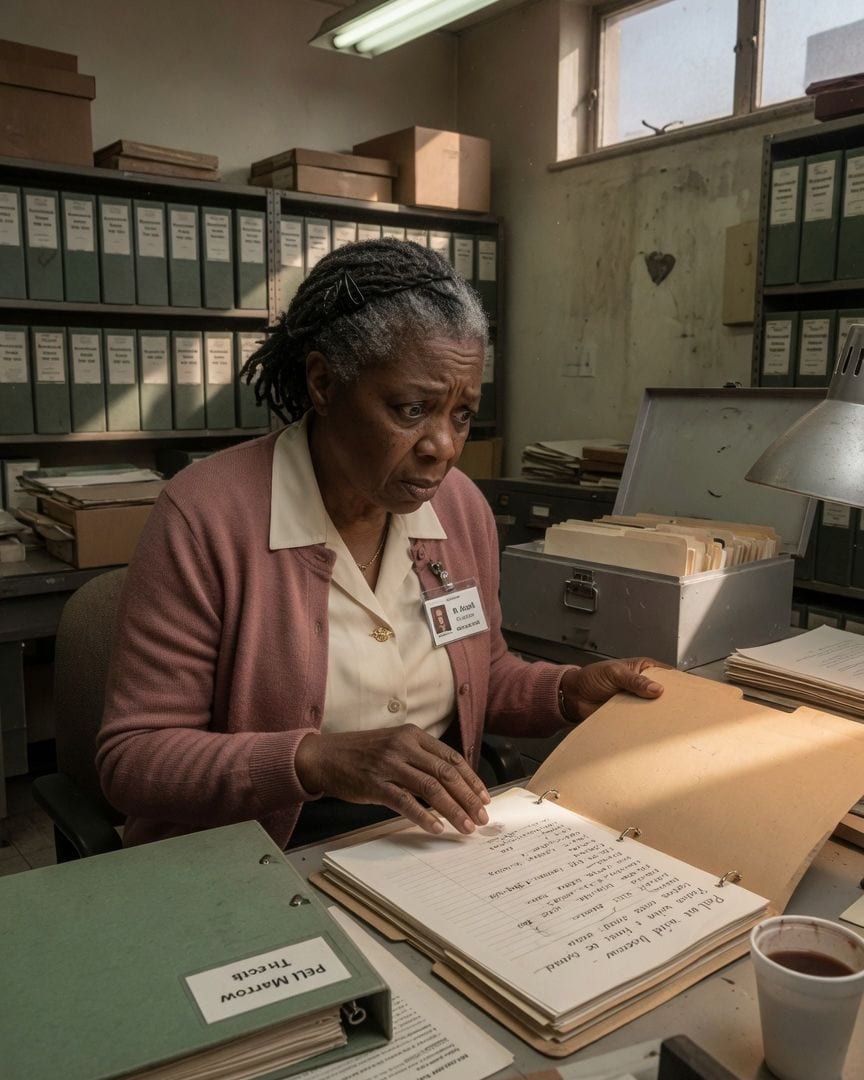
A records clerk's archive file for a Cold War reconnaissance plane lost in 1968 showed it flew yesterday to her own building.
Marguerite Ansell, a records clerk nearing her final week before retirement, meticulously audited Cold War-era files. In the cool, dusty archive, she pulled a file for an oiler declared missing in 1951. Inside, she found a fueling schedule with entries stretching into the present, the last dated just eleven days ago. Then, a second lost ship revealed a similar impossible log, and a cold certainty began to bloom in her chest. Deep in the shadows, Marguerite found an unmarked steel box containing a file for a reconnaissance plane lost in 1968. Its flight log showed a final flight yesterday, to the precise coordinates of her own archive building.
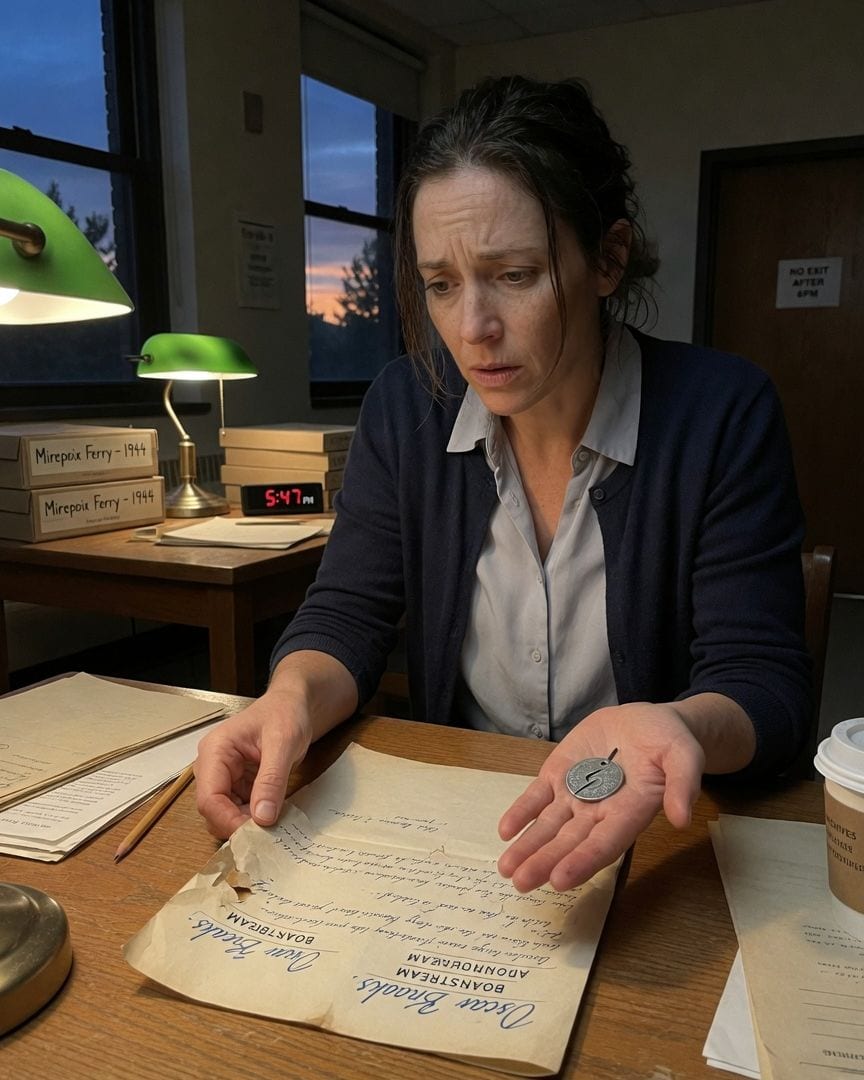
A researcher's last minutes with a 1944 manifest revealed a hidden metal tag. It hummed, impossibly cold to the touch.
Delphine Arceneaux had spent nine years chasing a phantom, and with minutes left before the archive closed, she meticulously scanned a 1944 ferry manifest in the hushed reading room of Building 7. Forty-one names were listed, but her gaze snagged on a forty-second, 'Oscar Brooks,' marked 'BOARDED AT MIDSTREAM' in a distinct, darker ink. Beneath the aged paper, her fingers found a hidden slit, revealing a small metal tag. It was impossibly cold to the touch, humming faintly, etched with an unknown symbol, leaving her to wonder what impossible truth it held.
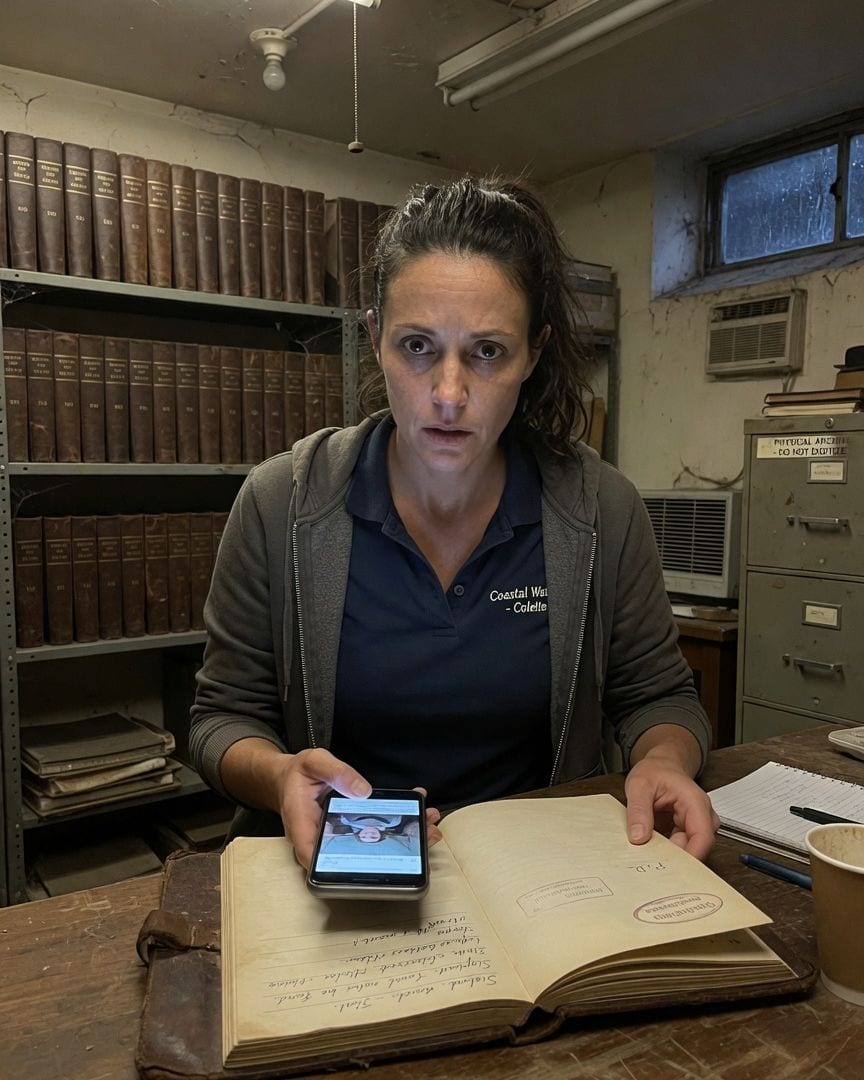
My coastguard log noted Sighting 9 again tonight, a light where no vessel showed. The old logs carry Sighting 9 off Skerry Point at 3:14am every tenth year since 1954, always 'nothing found,' always 'send no boat.'
On my watchtower night shift, the radar screen glowed green and the ocean was quiet. Then, a familiar light appeared off Skerry Point, exactly on cue, just as it had every tenth year for decades. But digging deeper, I found a hidden stamp in an old logbook: 'Operation Skerry. Status: Complete.' It left me with a chilling sense of finality.
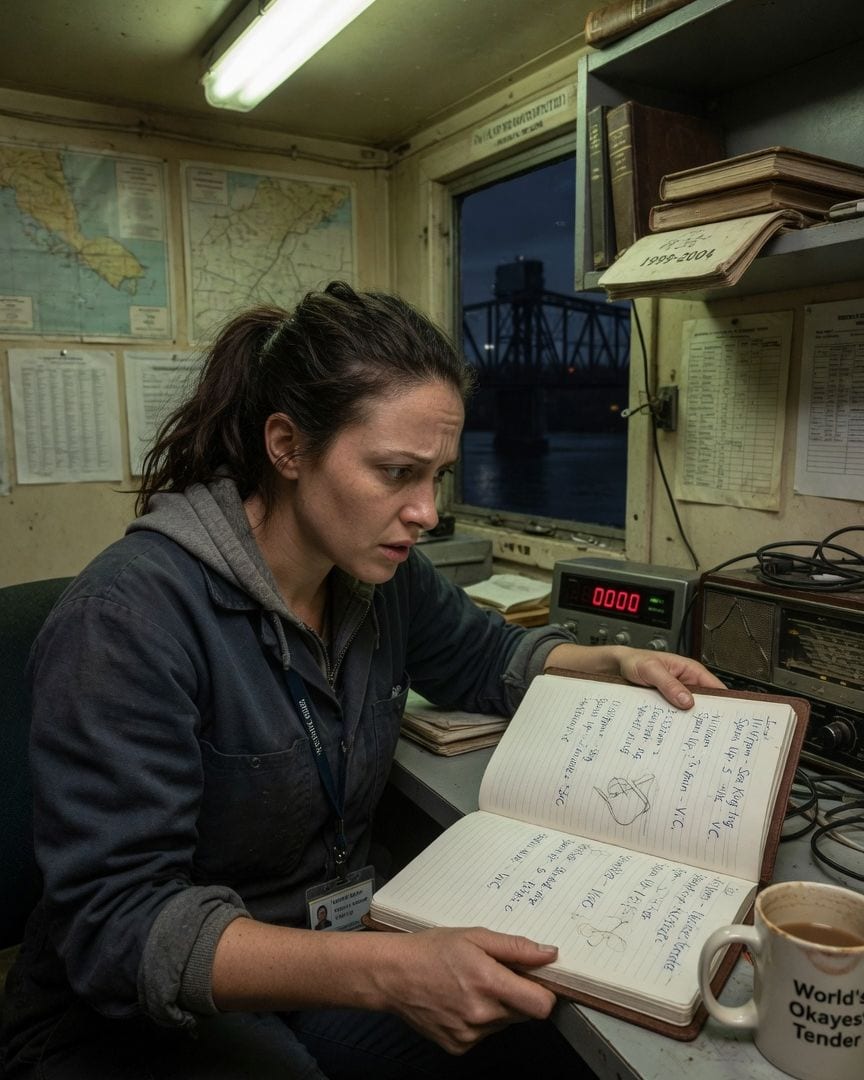
My drawbridge log shows a 2:33am lift I didn't make. The span counter never moved.
As a drawbridge tender, my midnight to dawn shift is usually quiet, a routine of monitoring traffic and logging lifts. But tonight, my own logbook shows an impossible entry for a bridge lift I have no memory of making. My initials and handwriting are there, yet the span counter above my panel reads a steady zero. No boat called, no span ever went up.
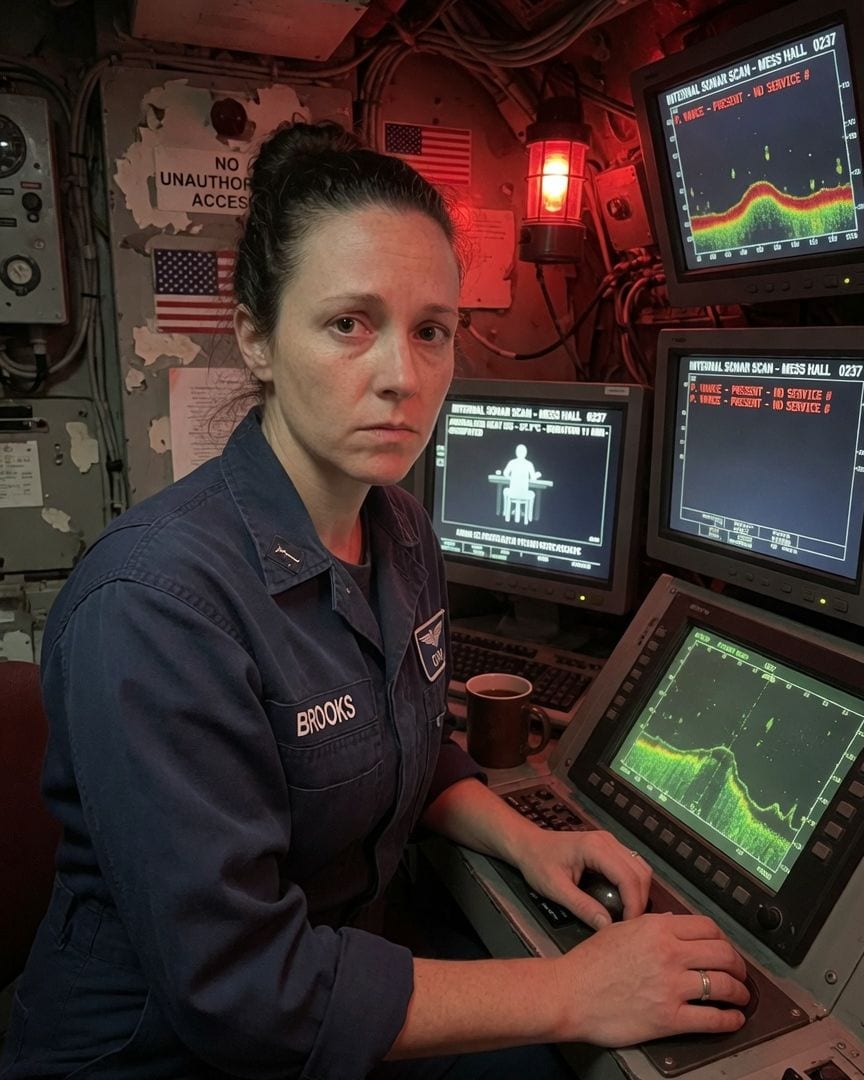
A Chief Petty Officer reviewed her submarine's sonar logs, finding a human heat signature where security cameras saw nothing, then the manifest listed an extra man who couldn't be deleted.
Chief Petty Officer Charlotte Brooks felt the weight of her submarine's impending decommissioning, its long service ending soon after a decade as her home. The quiet hum of the USS *Artemis* was broken when a nervous messcook reported seeing a shadow eating alone in the mess hall, then finding one plate short but a perfectly clean tray. Though skeptical, Charlotte checked the security feeds, which showed nothing, yet her sonar logs revealed a distinct human heat signature in the same spot, then abruptly vanish. Her dread deepened when the boat's manifest confirmed 101 souls instead of 100, listing a mysterious 'P. Vance' with no details, whose entry all systems refused to delete.
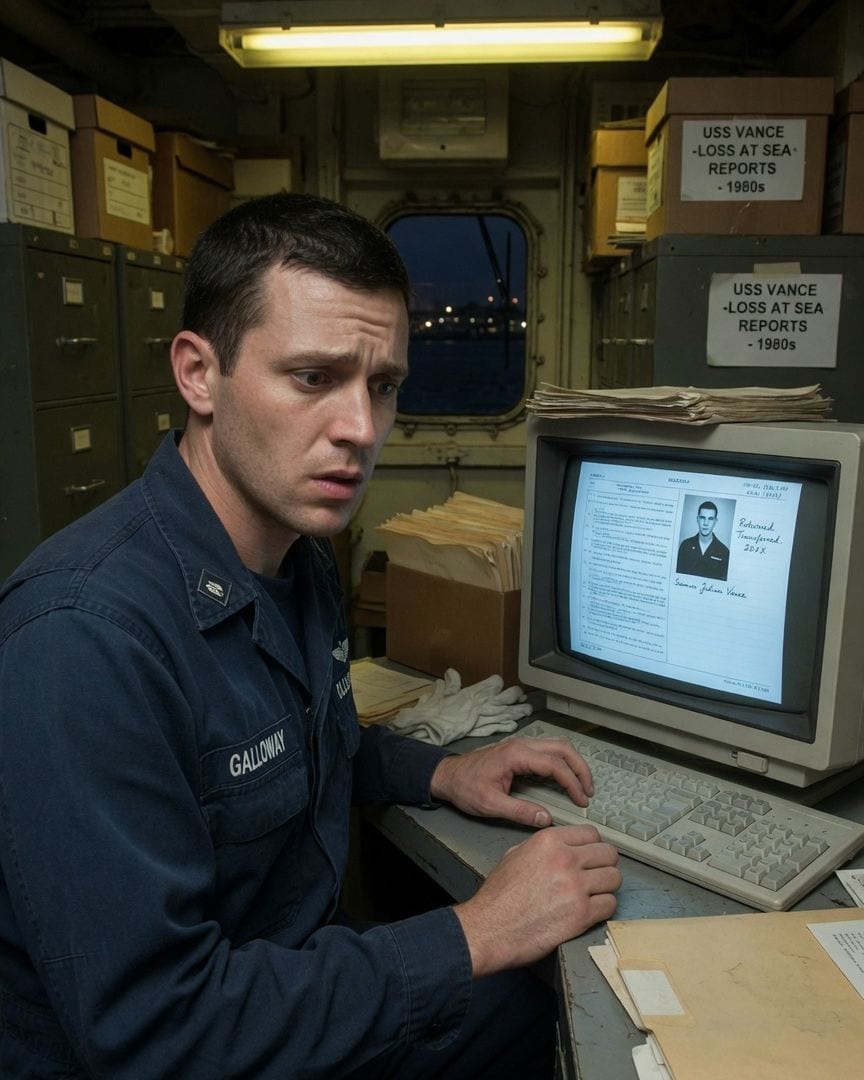
Petty Officer Galloway logged a sailor onto his ship. The man died at sea 40 years ago.
Petty Officer Joel Galloway scanned a sailor's ID on the USS Vance quarterdeck. The man's name, 'Seaman Julian Vance,' and his out-of-date uniform pricked at Galloway's memory. Later, the ship's berthing count came back one over, with an extra entry in the system but no physical body.