A Cold War pilot's pay stub arrived four years after his helicopter was officially lost.
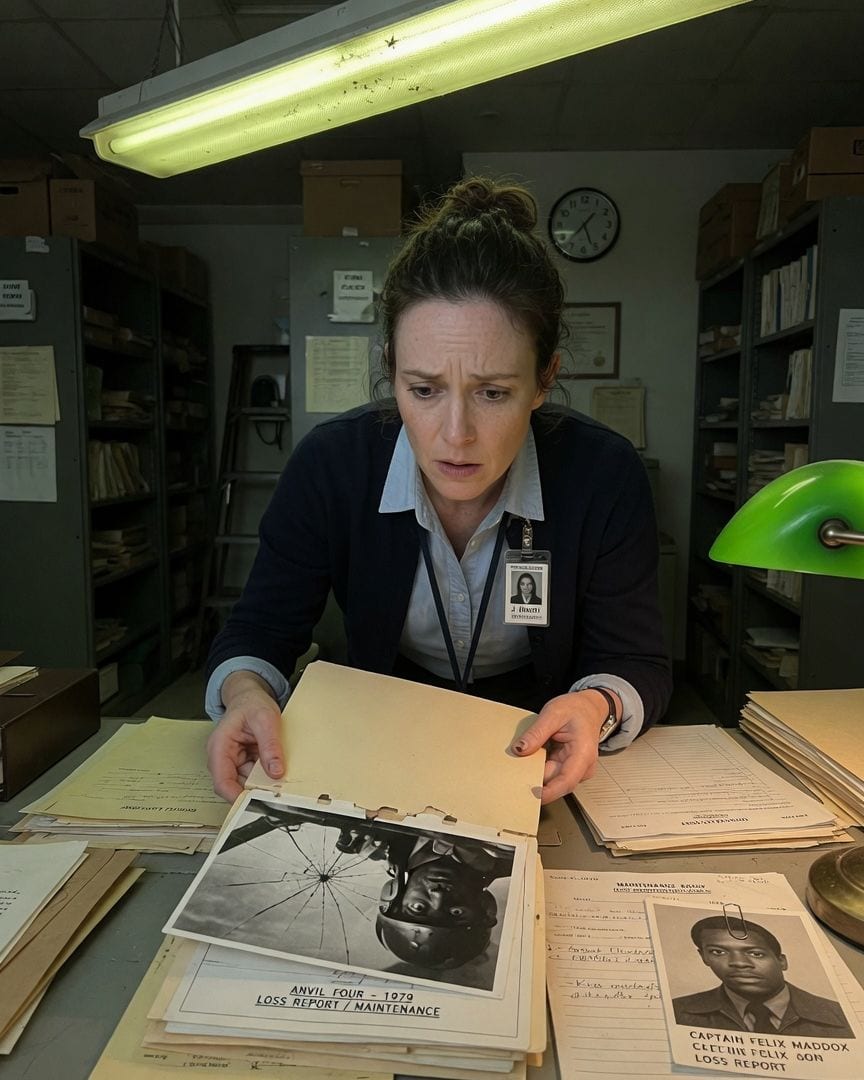
The fluorescent hum of the National Archives Annex always felt like a low, patient sigh, but today, processing the backlog of declassification requests, it felt more like a held breath.
Josie Ilnicki had spent years as the quiet keeper of forgotten histories. Today, a file arrived for the helicopter 'Anvil Four,' lost in the Nevada ranges in 1979.
A widow in Reno, Vivienne Sinclair, had asked for it every year for forty years, and finally, the request cleared. Inside the folder, past the official loss report and the board findings, Josie found a maintenance sheet.
It was dated not 1979, but eight months later, in March 1980. The discrepancy noted was a cracked windscreen, described with an unnervingly steady official hand. Stapled to the sheet was a grainy, black-and-white photograph.
It showed the crack, spiderwebbing across the plexiglass, and behind it, a man in the left seat, his face shadowed, but his eyes wide open, staring out, as if still flying.
Josie’s first thought was a clerical error, a misfile, or a stock photo mistakenly appended. She had seen plenty of those in her twenty years at the annex. It was the only rational explanation.
She carefully detached the photograph, turning it over. No stamp, no date, no identifying marks on the back, just the faint impression of the staples from the original attachment.
She checked the maintenance code on the sheet against the Anvil Four’s specific records; it was an exact match for that particular airframe.
Not a generic form, but one tied directly to the lost helicopter, detailing a repair that should never have happened. Then she pulled the loss report again, cross-referencing the pilot’s name: Captain Felix Maddox.
Josie looked back at the photo, trying to reconcile the shadowed face with the official portrait in the report.
The jawline, the set of the shoulders, even the faint line of a scar above the left eyebrow – it was him.
Felix Maddox, officially dead and buried in 1979, was in a photograph dated eight months later, seated in a helicopter declared lost, with an expression that wasn't of a ghost, but of a man very much alive and in command.
The ordinary explanation dissolved, leaving a cold, hard knot of dread in its place. This wasn't a mistake. This was a statement.
Josie felt a prickle of unease, a sensation she usually only got from a draft in the cavernous stacks. The fluorescent lights overhead seemed to buzz louder, a constant, low thrum that grated on her nerves.
She pushed the maintenance sheet aside and dug deeper into the Anvil Four file. Beyond the official board findings and the terse 'no further action' memos, tucked into a sub-section marked 'Operational Logs,' she found more.
A flight hours log, meticulously updated, showing sorties flown in 1981. A requisition for JP-4 jet fuel, dated July 1982. Even a pay stub, for Captain Felix Maddox, from October 1983, his rank and service number correct, his pay deposited.
Each document was stamped with the same official markings, filed with the same unnerving precision. The Anvil Four file was not a record of a loss.
It was an ongoing account of a helicopter and a pilot who, by all accounts, simply refused to be gone.
The Anvil Four file became Josie’s obsession. She started cross-referencing other 'lost' cases, particularly those with long-standing widow’s requests or unusual classification histories.
The consolidation of the archive meant she had access to deeper, less-frequently-accessed sections, files that hadn't seen daylight in decades. And she found them. More of them.
The cargo ship Vera Calloway, officially lost in the Pacific in 1962 with all hands, had supply manifests for dry goods and medical supplies dated as recently as the late 1990s.
The entries were for a crew of twenty-five, the exact number on board when it vanished.
Then, Outpost Sigma-7, a radar unit declared abandoned in the Alaskan wilderness in 1971, had quarterly inventory reports for specialized electronics and rations from the early 2000s, signed by a 'Unit Commander H. Granger.'
The common thread was undeniable: these entities, declared lost to the world, continued to generate official, meticulously filed paperwork for years, sometimes decades, after their disappearance.
It wasn't a clerical error repeated across multiple classifications and eras; it was a system. A very patient system.
Josie noticed a subtle, almost invisible watermark on these 'active-after-loss' documents – a stylized, three-pronged symbol that looked like a bird’s foot, or perhaps a stylized arrow pointing down. It was on every single one of them.
Her rational mind, desperate for a mundane explanation, tried to invent a deep-seated inter-departmental misfiling bug, but the coherence of the pattern, the specificity of the dates, and the internal consistency of the documentation shattered that illusion. This was deliberate.
Someone, or something, was keeping these records alive.
Her unusual requests for these deep-classified, 'dead' files quickly drew attention. Her supervisor, Gordon Granger, a man whose face seemed perpetually set in a bland, unreadable expression, called her into his office.
He was 60, nearing retirement, and had seen countless clerks come and go. 'Josie,' he began, his voice smooth, 'you've been very diligent with these… historical requests. Anything specific pique your interest?' His gaze, usually distant, was unsettlingly direct.
She tried to sound casual, mentioning the consolidation and the need to clear old requests. He nodded slowly, a faint, almost imperceptible smile playing on his lips. 'Some histories,' he said, 'are more persistent than others.'
Later that day, Josie found a small, folded piece of paper on her desk. It was unsigned, unaddressed, simply reading: 'Some things are better left filed.' The paper was thick, creamy, the kind not used in this office.
Her heart beat a little faster. Was it a warning? Or just a cynical joke from a colleague? She looked around, but the annex was quiet, the few other clerks engrossed in their own screens.
The silence in the long aisles seemed to deepen, a heavy, listening quiet. As she walked to the breakroom for coffee, she glanced down the long, shadowed aisle of the 'Special Holdings' section.
Gordon Granger stood there, perfectly still, watching her. His face was impassive, but the sense of being observed was palpable, a cold hand on her spine.
He didn’t move, didn’t acknowledge her, just stood there, a silent sentinel in the labyrinth of the past. The hunt had become personal.
The next morning, Josie confronted Granger. She walked into his office, a stack of the anomalous files clutched in her trembling hands: Anvil Four, Vera Calloway, Outpost Sigma-7. She laid them out on his desk, the cracked windscreen photo face-up.
'Mr. Granger,' she began, her voice steadier than she felt, 'these files. They don’t add up. Aircraft lost in '79, still logging flight hours in '83. A ship sunk in '62, still getting supply manifests in the '90s.
An outpost abandoned in '71, still filing inventory reports in the 2000s.' She pointed to the subtle three-pronged watermark. 'And this symbol, it's on all of them.' Granger picked up the Anvil Four file, his movements slow and deliberate.
He looked at the photo of Felix Maddox, then at the maintenance sheet. He didn’t deny anything. He didn't even feign surprise. 'You've been thorough, Josie,' he said, his voice quiet, almost a whisper. 'More thorough than most.'
He leaned back, his gaze fixed on the ceiling. 'These are not errors. These are active records.' He paused, letting the words sink in. 'There are certain assets, Josie, that, while removed from public record, continue to perform… duties.
Their operations are simply… reclassified. The archive, this entire institution, is not merely a repository of the past. It is a maintenance facility. We maintain the records of the unavailable. We ensure their continuity.'
Josie’s mind raced, trying to grasp the implication. 'But the people? The crews? Captain Maddox?' she asked, her voice barely audible. Granger’s eyes, cold and clear, met hers. 'The personnel are integrated. Their files keep writing because they keep writing.'
The dread that had been a knot in her stomach now spread through her entire body, a cold, creeping certainty. The truth wasn't that the records were wrong. The truth was that they were terrifyingly, coherently right.
Josie pushed, her voice hoarse. 'Integrated? What does that mean? Are they… alive?' Granger’s faint smile returned, a chilling, almost pitying expression.
He slowly opened a deep, rarely-accessed bottom drawer in his desk, revealing a stack of files bound in dark leather, unlike anything she’d ever seen in the annex. The air in the room suddenly felt heavy, thick with unspoken history.
He pulled one out, thick and heavy, and placed it gently on the desk between them. The label, embossed in gold, read: 'Personnel Relocation & Reassignment - Ilnicki, J.' Her own name. Her breath caught in her throat.
This couldn't be. This was a mistake. A cruel joke. She reached for it, her fingers trembling. Inside, the first document was a transfer order. It was for her, Josie Ilnicki.
It was dated not today, not last week, but two years ago, moving her to 'Records Maintenance, Special Assets Division.' It was stamped, signed, and countersigned.
Beneath it, a recent performance review, also for her, praising her 'diligence in processing anomalous records,' noting her 'unusual aptitude for pattern recognition.' The words swam before her eyes.
Her life, her career, meticulously documented, not by her, but by the very system she was investigating, years in advance. She was already in the file. She was already part of it.
Granger watched Josie’s face, his expression unchanging. 'Your file, Josie, is one of our most successful activations.' He tapped the transfer order. 'You were slated for this position years ago. Your meticulousness, your need for order, your curiosity… all identified.
All accounted for.' He explained that the 'secrecy machine' didn't just record events; it anticipated them.
It identified individuals with specific, often obsessive, aptitudes – a pilot’s dedication, a clerk’s precision, a diver’s tenacity – and then 'activated' them when needed.
The 'lost' units and personnel, like Anvil Four and Felix Maddox, were not just filed away; they were seamlessly integrated into a parallel, hidden operational structure.
Their records continued because they continued, performing duties outside the public eye, their identities maintained by people like her, who were, in essence, also 'filed' and activated.
The pattern across decades and classifications wasn't a glitch, but the very fabric of the system: a continuous, self-sustaining cycle of identifying, activating, and record-keeping for assets deemed essential.
The archive wasn't where things went to die; it was where they lived on, in a different form.
Every clue, every anomalous document, every cold gaze from Granger, clicked into place, forming a horrifyingly coherent picture of a world running silently beneath their own, governed by a logic that was both absolute and terrifyingly mundane.
Granger closed Josie’s file, his hand resting on it. 'So, Josie,' he said, his voice calm, 'the choice is yours. You can continue your duties, as laid out in your file, maintaining the records of the active assets.
Or you can be… deactivated.' He pulled out a single sheet from the file: a blank, pre-dated 'Deactivation Notice,' with her name already printed at the top. The implication was clear, unspoken but heavy in the air.
Deactivation wouldn't be retirement. It would be an end, a quiet erasure, her file simply stopping, like the others. She would become one of the 'lost,' a record that no longer wrote itself.
The horror wasn't a threat of violence, but of utter, bureaucratic finality. It was the ultimate paperwork, the ultimate filing.
Josie looked at the blank notice, then at the thick stack of files on his desk, the endless records of those who were gone but still here.
She thought of Vivienne Sinclair, waiting for forty years, for a closure she now knew would never come. She understood her place. She was a cog, meticulously chosen, now fully engaged. There was no escape, only acceptance of the truth.
'I understand,' she said, her voice barely a whisper. 'I'll continue my duties.' Granger nodded, a faint, almost satisfied smile on his face. He pushed her file back across the desk to her, the 'Deactivation Notice' still inside, waiting.
Her hand, steady now, reached for it. She was part of the machine, destined to maintain the records of the 'lost,' and her own, for as long as she was 'active.'
Josie returned to her desk, the hum of the archives now a familiar, almost comforting drone. The files no longer held mystery, only purpose.
She continued her work, processing new entries for Anvil Four, for the Vera Calloway, for Outpost Sigma-7. Each stamp, each signature, was a confirmation of an ongoing existence, a life lived in the shadows of official record.
Her own file, 'Ilnicki, J.', lay open on her desk, a new, blank 'Performance Review' sheet waiting for its next entry.
She knew it would be filled, eventually, by Granger, or by someone else like him, someone who also knew the truth. Her meticulousness had not led to closure, but to a deeper, chilling integration.
A new file landed on her desk, marked 'Urgent: Declassification Review.' Inside, a requisition for 'Specialized Archival Software, Mk. IV' for a newly designated 'lost' research vessel, the Orion's Gate. Her hand, steady and unhesitating, stamped it 'APPROVED.'
She closed the file on her own desk, the blank performance review now lying beneath her official stamp, waiting for its future. The hum of the annex continued, a silent, patient machine.
Her own file, a living document, was still being signed.
Weeks later, Granger watched Josie Ilnicki from the end of the aisle. She was diligently processing a thick folder, her face impassive. He knew her file was still writing, just like all the others.
He felt a faint, wrong little smile touch his lips. The system, after all, was always signing.
If this one got to you
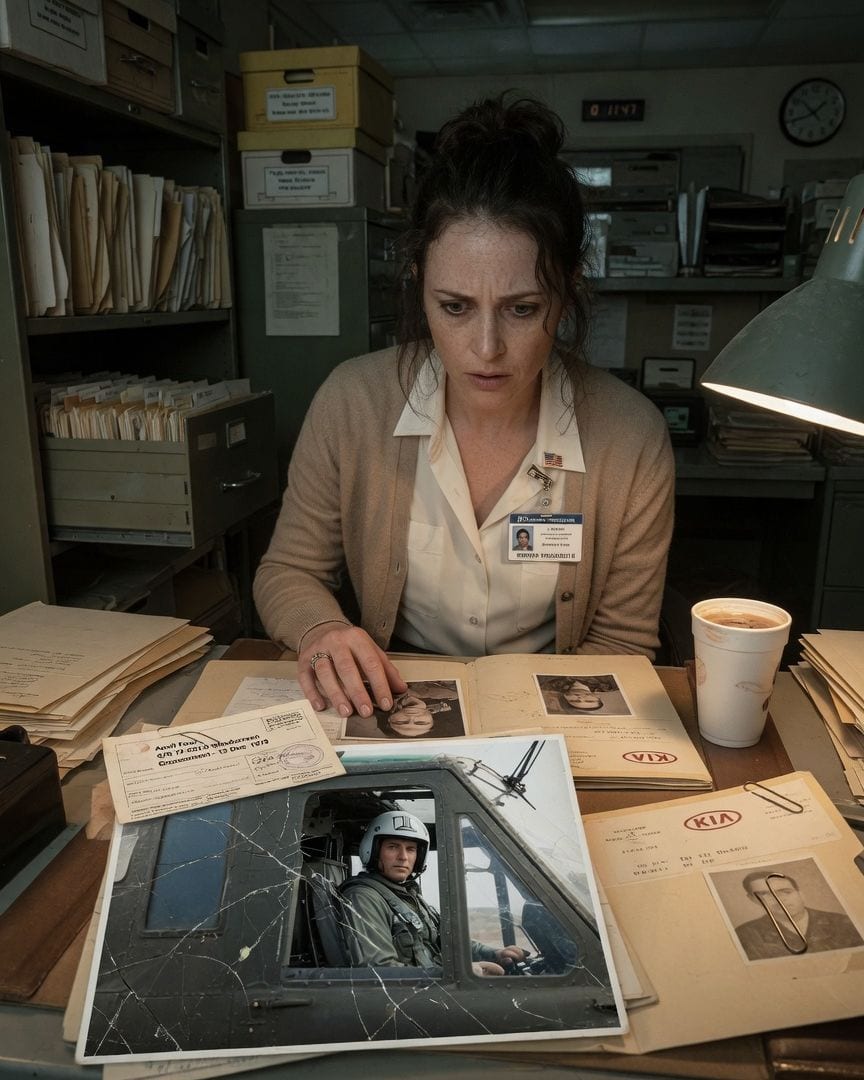
An archive photo shows a Cold War pilot, officially dead eight months, sitting inside his lost helicopter.
Josie Ilnicki, a meticulous Department of Defense archivist, finally processed a file requested annually for forty years by a woman in Reno. The Anvil Four file detailed a UH-1H helicopter officially lost in April 1979 during a training exercise over the vast Nevada ranges, holding the usual reports of a cold disaster. But tucked inside, dated eight months after the crash, was a maintenance sheet for Anvil Four, complete with a grainy photograph. The image showed a man, calm and unsmiling, sitting in the helicopter's cracked cockpit – a man Josie identified as Major Oscar Vance, the pilot declared Missing In Action on the very day the helicopter vanished. What impossible truth did the official records truly hold?
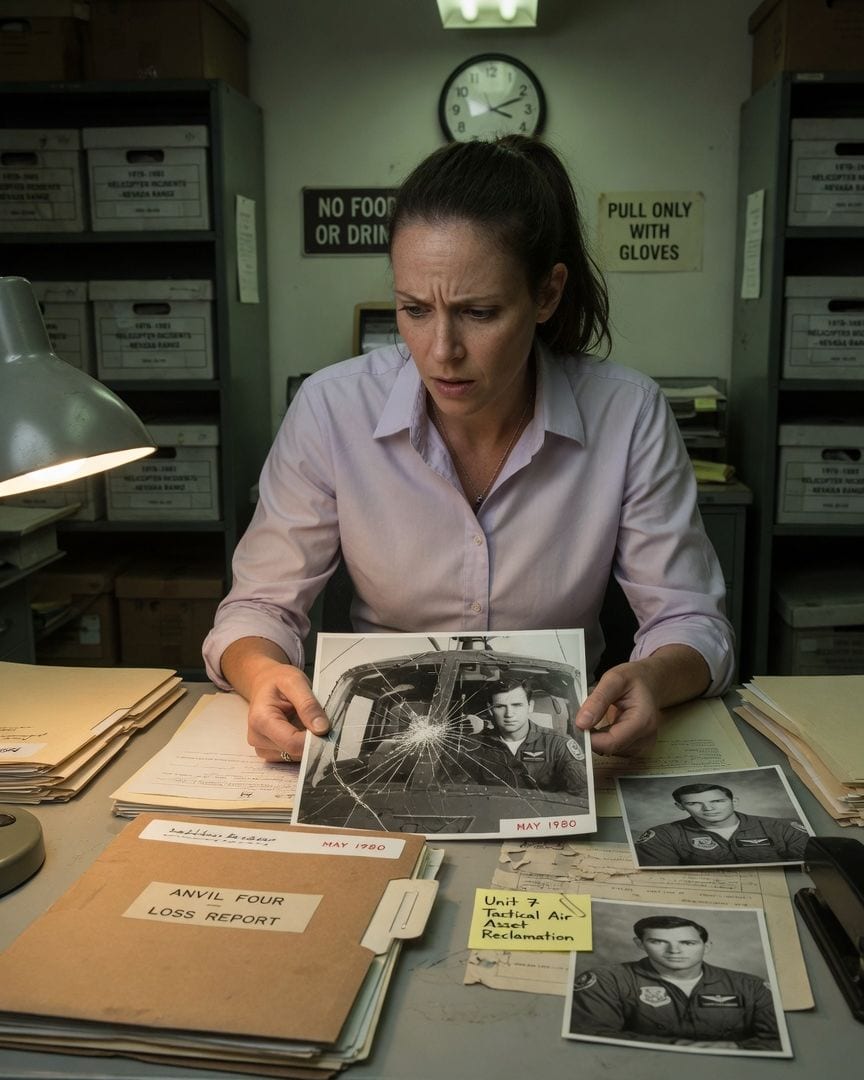
Archivist Josie Ilnicki found a lost helicopter's maintenance sheet dated eight months after its total loss, showing its dead pilot inside.
Archivist Josie Ilnicki meticulously handled a forty-year-old file, a routine request carrying the weight of a widow's grief for helicopter Anvil Four, vanished decades ago. Inside the standard folder, she found a maintenance sheet inexplicably dated eight months after the aircraft's documented total loss and disappearance. The sheet included a photograph of a man in the cockpit, his face obscured, later identified as Benjamin Mitchell, the pilot listed as Killed In Action. But the uniform in the photo bore a unit insignia not authorized until three years after Mitchell's official death, pressing an impossible truth into the sterile archive air.
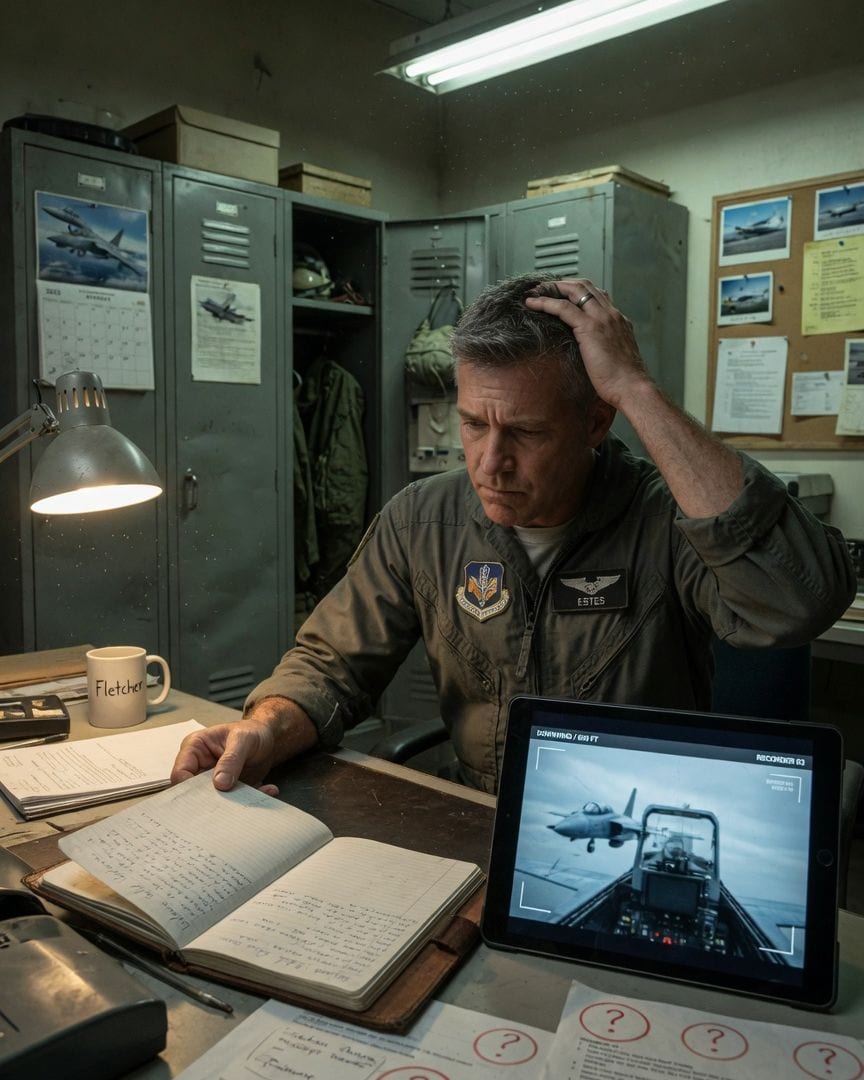
A Chief Warrant Officer's HUD tape shows a phantom jet, impossibly close, off his wing. Forty years ago, another Cold War pilot logged the same impossible sight.
Chief Warrant Officer Nathaniel Estes, a pilot whose career hinged on absolute precision, was under evaluation for a critical promotion. His nightly review of HUD tapes from routine Mojave test flights was a meticulous habit, but for a week, it revealed an impossible detail. At precisely 800 feet, one frame showed a sleek, experimental jet tucked impossibly close off his left wing—a craft ground radar never detected. When his maintenance chief found no equipment fault, Estes unearthed a dusty, decades-old logbook detailing identical phantom sightings from 1978. What unseen presence shadowed the desert skies?
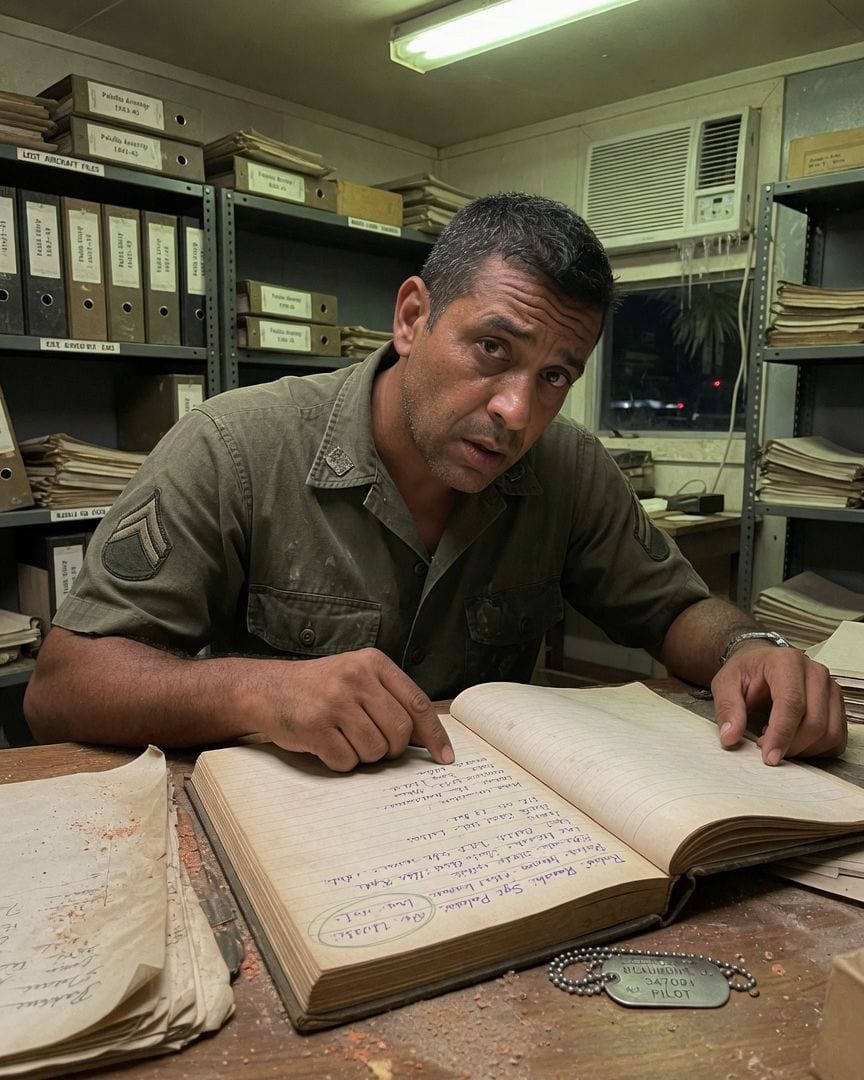
A sergeant's last watch on a forgotten outpost: His own name appeared on an 80-year-old crash manifest.
Sergeant Leon Pulaski spent his last night at the remote Peleliu Atoll Airstrip, its final closure imminent, listening to the rhythmic sigh of the Pacific. Just after 0330, a garbled distress call pierced the silence, requesting the field for a plane with a tail number, 'Ghost Two-Niner-Niner,' retired since World War II. Though Pulaski, disciplined and rational, logged the impossible call as a phantom, the crash crew later found a fresh gouge in the coral and a shard of cockpit glass, still warm, where no wreck existed. His quiet unease only deepened when he discovered a dog tag belonging to a pilot declared lost eighty years prior. But the true chill landed when he found his own name on that same eighty-year-old crash manifest.
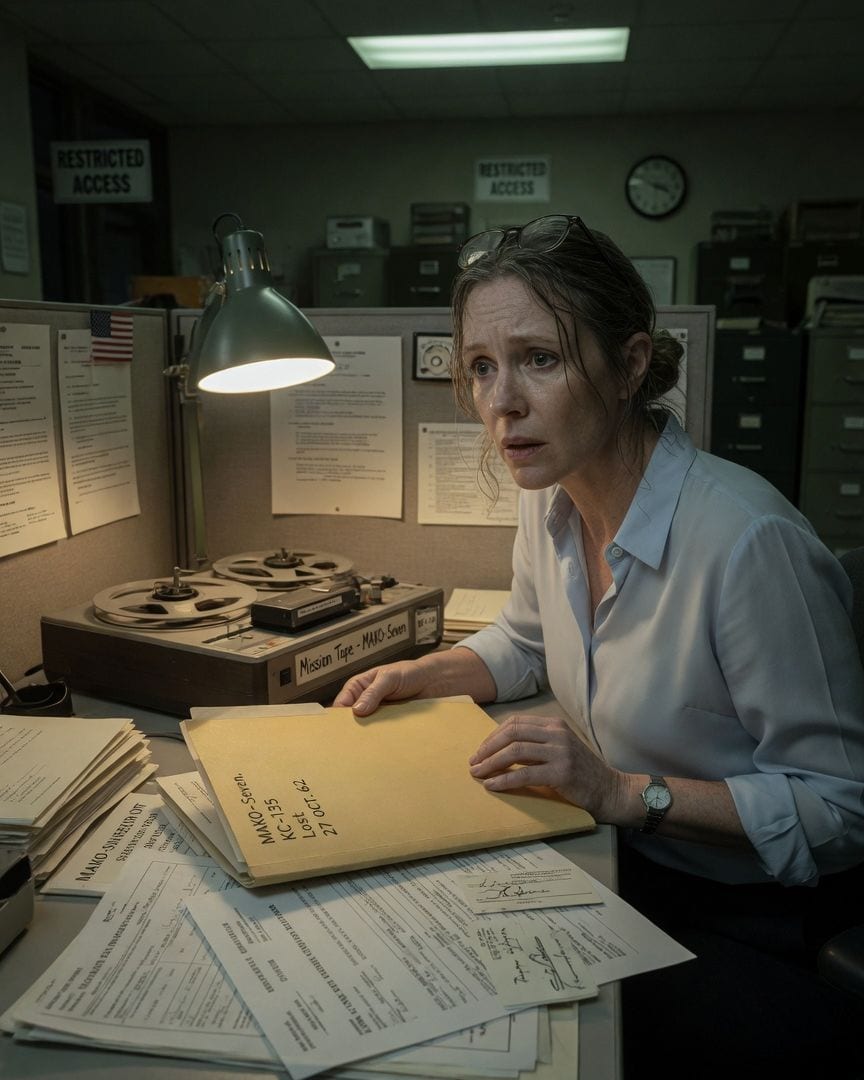
A declassification reviewer found Captain Sowell's signature authorizing parts for his lost Cold War aircraft, sixteen years after its official crash.
Janet Kingsley, a declassification reviewer, was processing a routine request for a lost Cold War mission when she made a chilling discovery. The official report stated the KC-135 MAKO-Seven impacted the Labrador Sea in 1962, but its mission tape continued for nine minutes after the official crash, with the pilot calmly landing. As Janet dug deeper into the yellowed file, she found official documents for the aircraft and pilot dated years after its disappearance. The final discovery was a requisition for replacement parts, signed by Captain Thomas Sowell himself, a full sixteen years after his plane was officially lost and he was declared dead.
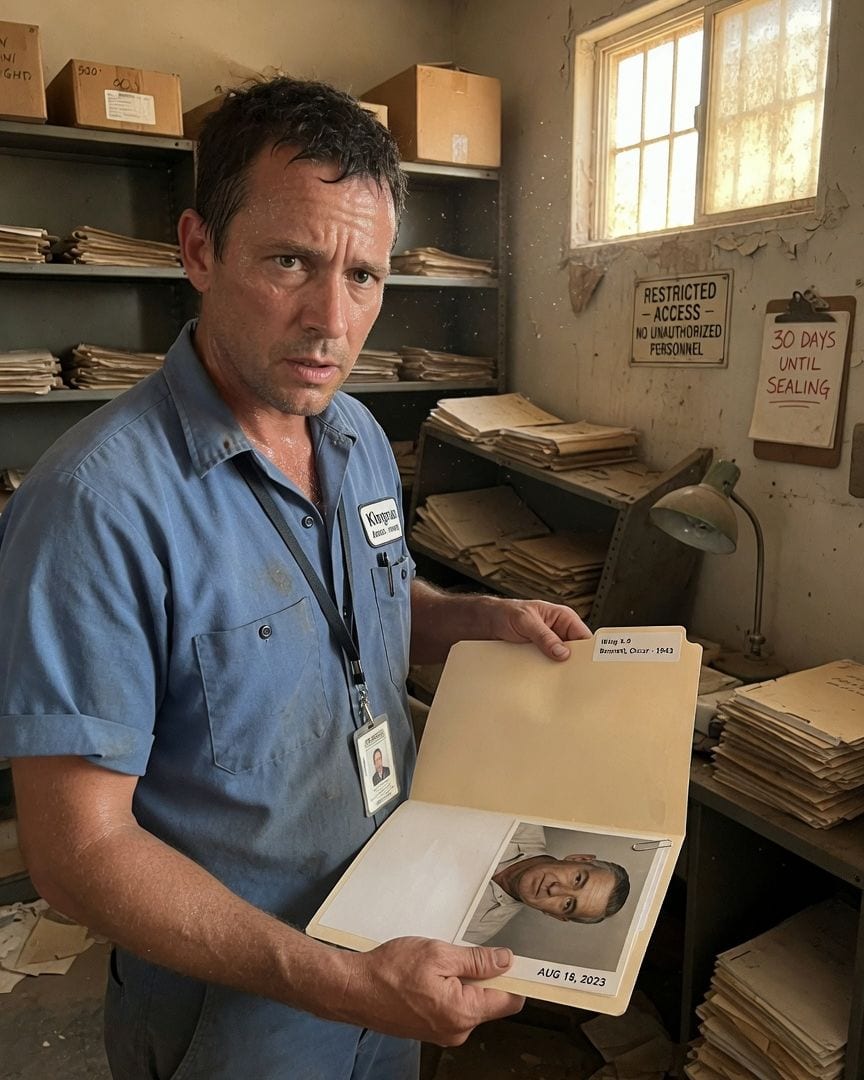
An inventory clerk in a Cold War boneyard finds a pilot declared dead in 1952, alive and photographed just last week.
Inventory clerk Rafe Delahunt toiled under the oppressive Arizona sun, racing against a deadline. He had just one month to catalog the vast Kingman boneyard before its final closure, a task made grueling by the crumbling archives and the suffocating heat. Deep within a forgotten bay, he unearthed eleven folders that defied explanation. Cool and supple to the touch, unlike any other document, they bore a 1943 date but smelled of fresh paper, filed under a designation 'Wing X-9' that shouldn't exist. Inside, the pristine files detailed a P-51 Mustang and its pilot, Oscar Bennett, officially declared 'crashed without trace' in 1952. Yet, tucked into the back, was a photograph of an older Oscar Bennett, clearly alive, with a date stamp from August 18, 2023.