An archive photo shows a Cold War pilot, officially dead eight months, sitting inside his lost helicopter.
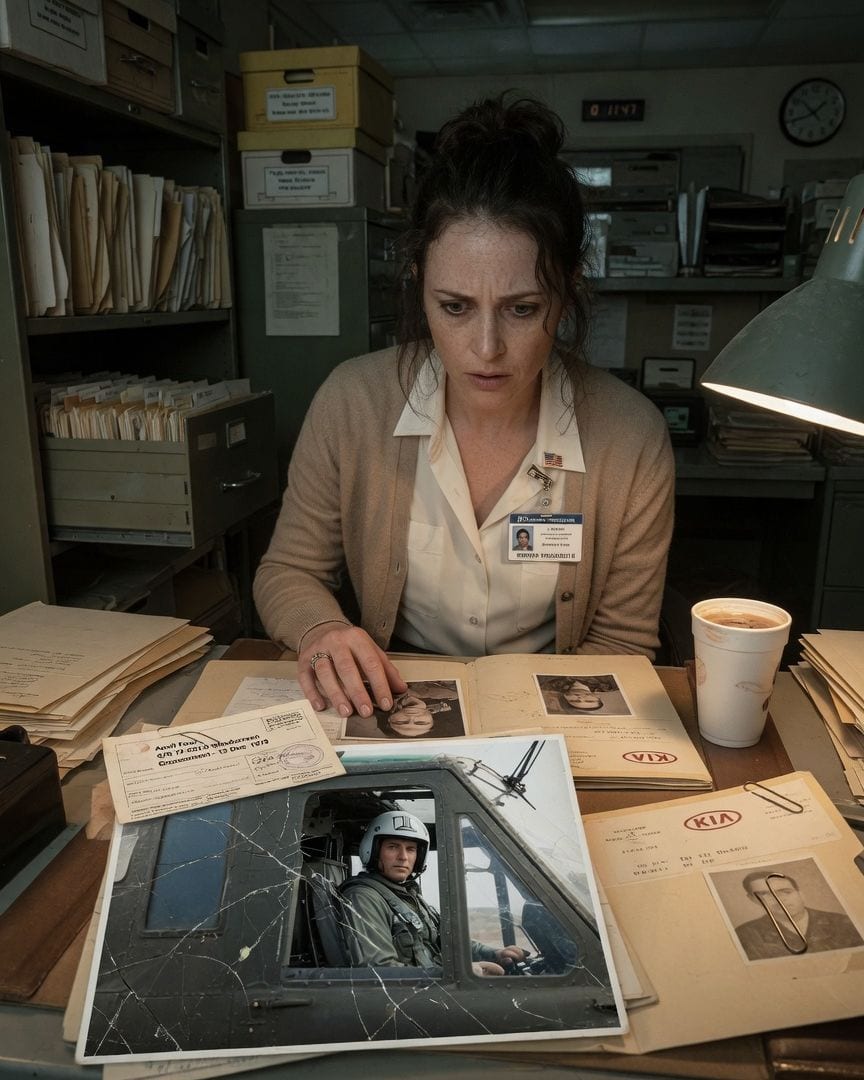
Josie Ilnicki, a stickler for order in the labyrinthine Department of Defense Archives, smoothed the brittle cover of the Anvil Four file. Forty years.
Charlotte Donovan in Reno had asked for it every year since 1979, a persistent ghost in the bureaucratic machine, and finally, this was the year the request cleared.
Anvil Four, a UH-1H helicopter, officially lost on April 12, 1979, during a routine training exercise in the vast, empty Nevada ranges.
Josie expected the usual: a loss report, board findings, perhaps a few faded aerial photos of a crash site, meticulously numbered and indexed.
She found all of that, neatly typed, stamped, and signed. The official record of a disaster, cold and complete.
Then, tucked deep within a section marked 'Post-Incident Material,' eight months after the loss report, dated December 1979, she found a maintenance sheet. It detailed a cracked windscreen.
And stapled to it, with an official-looking paper clip, was a grainy, color photograph of the helicopter’s cockpit, viewed from the outside, through the very crack it described.
In the left seat, a man sat, his face calm, unsmiling, looking directly out of the frame, past the lens, past Josie, into nothing.
The helicopter had been officially lost in April. This photograph, the maintenance sheet confirmed, was taken in December. Josie’s breath hitched, a cold knot forming in her stomach.
Her first, rational thought was a clerical error, a misfiled sheet, but the serial number on the maintenance sheet matched Anvil Four perfectly.
The crack in the windscreen was unmistakable, a jagged spiderweb, unique in its splintered pattern, clearly visible in the photograph. And the man in the left seat was undeniably there, present, in a helicopter that officially did not exist.
Josie pulled Oscar Vance’s service record, cross-referencing the personnel file with the Anvil Four’s crew manifest. Pilot: Major Oscar Vance. Born 1949. Last known status: Missing In Action, presumed Killed In Action, April 12, 1979.
She compared the face in the grainy photograph with Vance’s official portrait, a younger, crisper image in his personnel file. There was no doubt.
The set of the jaw, the faint scar above the left eyebrow, the way his dark hair fell across his forehead – it was Oscar Vance. Alive. Eight months after he was officially dead.
Josie felt a prickle of unease crawl up her spine. This wasn't a misfile. This was a direct, undeniable contradiction. She double-checked the dates, the file numbers, the stamps.
Every detail was meticulously recorded, officially signed off by names she recognized from old Department rosters. The maintenance sheet wasn’t an anomaly; it was part of the official record.
The photograph wasn't a mistake; it was stapled, numbered, and referenced, just like every other piece of data.
Her rational mind, trained to seek order and explanation, tried to conjure scenarios: a twin brother she didn't know about, a posthumous award ceremony using an old photo, a re-enactment for some obscure documentary.
But the maintenance report was specific: 'Anvil Four, UH-1H, S/N 77-0312, windscreen crack assessment – Dec 1979.' A living pilot, in a lost helicopter, getting a cracked windscreen repaired, eight months after it vanished.
The implications were a cold, impossible weight.
Josie laid the photograph flat on her desk, the pilot’s calm gaze meeting hers. Next to it, Oscar Vance’s official 'Killed In Action' report, signed and dated April 12, 1979.
Her finger traced the jagged line of the cracked windscreen in the photo, then moved to the date on the maintenance sheet: December 1979. Eight months. Eight months after Anvil Four ceased to exist.
Eight months after Major Oscar Vance was gone. But there he was, in the left seat, a silent witness to an impossible truth. The air in the archive, usually still and dry, suddenly felt heavy, charged with something unseen.
She looked from the living face in the photo to the stark 'KIA' on the report, the impossibility staring back, demanding an answer that wasn't in any official manual.
The discrepancy gnawed at Josie. She couldn't just refile it, stamp it 'closed,' and move on. Her professional integrity wouldn’t allow it. Her next step was to dig into the raw data from April 1979.
She accessed the digitized flight logs from Nellis Air Force Base, specifically the radar tapes covering the Nevada ranges.
It was a tedious process, sifting through static and routine flight patterns, her eyes blurring from the constant green flicker of the simulated scope. Then she found it.
At 14:37 on April 12, the exact time Anvil Four's distress beacon ceased, there was a faint, anomalous blip.
It wasn't Anvil Four's transponder code, but a primary radar return, strong, then fading, then, impossibly, a brief, sharp return again at 14:51, miles from the last known position, before vanishing completely. A 'ghost' return, an impossible contact.
Josie remembered the 'Thing on the Scope' legends from old base lore, dismissed as atmospheric anomalies or equipment malfunctions. This looked too precise to be either.
She decided to seek out someone who would have been on duty that day. Felix Winslow, a retired air traffic controller, still lived in the area.
Josie found him in his quiet Henderson home, surrounded by old ham radio equipment, the air thick with the smell of dust and solder. He squinted at the printout of the radar anomaly.
'Anvil Four… yeah, that was a bad day. Heard about it on the news. Always stuck with me, a ghost in the system.' He paused, his eyes narrowing at the blip. 'Funny, I remember something like that. A flicker.
We were told it was a bad tube, interference. But it was… too solid, for interference. Like it winked at us. Then Command came down hard, said it was classified, not to discuss. Funny, that.'
He looked at Josie, a flicker of old fear in his eyes. The quiet hum of his radio equipment seemed to pulse. 'You’re digging into old dirt, aren’t you? That kind of dirt… it doesn’t stay buried.'
The next morning, a man in a crisp, dark suit was waiting at Josie’s desk when she arrived. Maxwell Sterling, Special Projects Auditor, DoD Archives.
His smile was cordial, a thin, professional curve of the lips, but his eyes held no warmth, no flicker of genuine emotion.
'Ms. Ilnicki,' he began, his voice smooth and even, 'I understand you've been taking a keen interest in the Anvil Four file.' Josie felt a chill that had nothing to do with the archive’s air conditioning.
'It had a discrepancy, Mr. Sterling. A maintenance sheet and photo, dated months after the official loss. My job is to reconcile such things.'
Sterling nodded slowly, his gaze unnervingly steady. 'Yes, these things happen. Clerical errors, misfiles. Our system, as robust as it is, occasionally generates… interesting artifacts.' He paused, letting the implication hang.
'However, pursuing retired personnel, accessing raw radar data… that goes beyond standard discrepancy resolution, wouldn't you say?' Josie kept her voice level, a practiced calm. 'My job is to ensure accuracy.
When an official record contradicts itself, it's my duty to investigate. I'm merely trying to understand how such a contradiction could have persisted for forty years.' Sterling leaned closer, his voice dropping, though it never lost its even tone.
'Or perhaps, Ms. Ilnicki, your duty is to ensure such contradictions remain… contained. The chain of command for declassified files is quite clear. Certain documents, certain anomalies, are meant to be observed, noted, and then quietly re-filed. Not chased.'
He produced a single, unmarked manila envelope from an inner pocket. 'A small addendum to the Anvil Four file, Ms. Ilnicki. Overlooked, I believe. For your eyes only. And a quiet recommendation: let the past stay buried.
It's safer for everyone.'
He placed the envelope on her desk, its crisp edges seeming to hum with unspoken menace, then turned and walked away, his steps silent on the carpet, leaving Josie with the unsettling certainty that her digging had been noticed, and that Sterling wasn't just an auditor.
Josie tore open the envelope Sterling left. Inside was a single page, a memo dated 1980, stamped 'RESTRICTED - EYES ONLY' in faded red ink. It was a debriefing report, detailing 'Asset Re-evaluation Protocol 79-Alpha.' The language was clinical, chilling.
It described a 'brief, unscheduled re-manifestation' of Anvil Four in December 1979, with 'pilot Vance in situ.'
It detailed a rapid 'assessment of asset integrity' – the cracked windscreen – and a 'brief window of opportunity for data acquisition' before the asset 'reverted to unobservable status.'
It wasn't a clerical error. It was an event. Anvil Four had returned. Oscar Vance had returned with it. And then they had both vanished again. Josie’s mind raced, connecting the dots.
The faint radar blip Felix Winslow saw, the impossible maintenance sheet, the photograph of Vance, alive and unsmiling. It all clicked into place, forming a horrifyingly coherent picture.
The institution hadn't just 'lost' Anvil Four; it had filed away an impossible return, quietly cataloging a breach in reality.
Sterling's words echoed in her mind, a cold whisper in the silent archive: 'Certain anomalies are meant to be observed, noted, and then quietly re-filed.'
This wasn't about a crash; it was about something that defied physics, something that came back, for a moment, before receding again.
The memo concluded with a chilling recommendation: 'All personnel involved in Re-evaluation Protocol 79-Alpha are to be re-assigned or retired.
All records pertaining to said protocol are to be sealed and re-classified under 'Project Chimera,' with a review period of 40 years, or upon specific family lineage request.'
The 'specific family lineage request' caught her eye, a detail that resonated with Charlotte Donovan's decades of annual inquiries. Those requests hadn't been an annoyance; they were a trigger. A mechanism within the system.
Josie felt a profound sense of dread, a cold shadow falling over her orderly world. This wasn't a one-off. This was a process. And she, in her meticulous pursuit of truth, had just activated it.
The fluorescent lights above her desk flickered, then held steady, like a held breath.
Josie, reeling from the 'Asset Re-evaluation' memo, noticed a small, almost invisible, handwritten annotation in the margin of the last paragraph. It was a single, precisely penned initial: 'S.' Sterling.
He hadn't just 'overlooked' the memo; he had deliberately placed it, a breadcrumb for her to find. But why? She scanned the document again, her eyes searching for anything else.
Tucked away in a section labeled 'Succession Planning for Classified Archival Access,' she found a small, typewritten list. It contained a series of surnames, each followed by a date.
She recognized a few, names of long-retired archivists who had vanished into obscurity. And then, near the bottom, listed with the current year, was her own name: 'Ilnicki, J.'
Josie stared at it, a cold, creeping horror washing over her. Her family. Her.
She wasn't just a clerk investigating a file; she was part of the file, named in its deepest, darkest corners, a designated recipient of its impossible truths, a link in a lineage she never knew existed.
The file wasn't just being opened; it was opening her, unearthing a legacy written in invisible ink decades before she was born. The air in the archive grew impossibly still, the only sound the frantic beat of her own heart.
Josie confronted Sterling in his sparsely decorated office, the 'PROTOCOL 79-ALPHA' memo and the 'Succession Planning' list clutched in her hand, the paper crinkling under her tight grip. 'My name, Mr. Sterling. Here. What does this mean?'
Sterling, calm as ever, gestured to a chair opposite his stark, empty desk. 'It means, Ms. Ilnicki, that you are exactly where you are meant to be. Your family, the Ilnickis, have a long and distinguished history with the Department.
Not in the conventional sense, but as custodians. Recorders. For generations.'
He explained that Anvil Four was one of many 'returns' – objects, sometimes personnel, that briefly re-manifested after impossible disappearances.
The institution’s purpose was not to understand 'how,' but to manage the 'what': to observe, document, and re-file these anomalies, maintaining the illusion of a stable reality.
'Major Vance,' Sterling continued, his voice utterly devoid of judgment or surprise, 'was one such return. Brief, lucid, then gone again. The cracked windscreen was his last trace, proof of his impossible passage.
Your family's role is to ensure these records are handled correctly, that the 'lost' remain lost, but always accounted for, should they ever… flicker back into existence.
Your meticulous nature, your dedication to accuracy – it’s a family trait, Ms. Ilnicki. You were always going to find this file. And you were always going to be named in it.'
The horror wasn't just the helicopter; it was the vast, silent machinery of denial, running for decades, and her own unwitting, hereditary role within it.
Every planted clue, every impossible detail – the radar blip, the photo, the maintenance sheet, Charlotte Donovan’s persistence, Felix Winslow's fear – now coalesced into a terrifying, coherent pattern.
The file wasn't just a record of a past event; it was a living document, a silent testament to an ongoing, impossible reality, guarded by generations of Ilnickis.
A low, imperceptible hum filled Sterling's office, a sound Josie now felt, rather than heard.
Josie didn't escape. There was no escape. Sterling slid a new, sealed file across his desk. It was unmarked, unnumbered, a plain manila folder indistinguishable from hundreds of others.
'Your first assignment, Ms. Ilnicki,' he said, his voice devoid of malice, 'a new 'lineage request' has been activated. The subject is Project Chimera, sub-file Gamma-7.'
Josie’s hand trembled as she reached for it, her fingers brushing the cool, smooth cardstock. She was no longer just a clerk; she was a designated custodian of the impossible, a cog in the machine she had only just discovered.
The rational, orderly world she had always inhabited had been subsumed by the cold logic of 're-evaluation protocols' and 'asset re-manifestation.' Her meticulous nature, once a source of professional pride, now felt like a pre-programmed function, a hereditary trap.
She looked at Sterling, searching for defiance, for an argument, for a way out, but there was nothing. He was simply stating facts, the way she herself would document a new intake, assigning it to its proper place.
The dread was in the utter lack of overt threat, the quiet inevitability. She was not being forced; she was being folded in. The institution had simply absorbed her, as it had absorbed so many impossible truths before.
Her professional integrity, her drive for accuracy, had led her not to expose the system, but to become a vital, secret part of its perpetuation.
The file was not a doorway; it was a cage, and she had just stepped inside. The quiet of Sterling's office pressed down on her, an invisible, crushing weight.
Josie returned to her desk, the new, sealed file heavy in her hands. She continued her routine, processing mundane requests, stamping forms, but now every action was imbued with a chilling undercurrent.
The Anvil Four file, once a mystery, was now a foundational text.
Charlotte Donovan’s annual request for the Anvil Four file was quietly marked 'Closed - Access Granted to Designated Official,' the notation now made by Josie herself, her pen moving with a detached precision.
The world outside the archives remained blissfully unaware, while within its walls, a new records clerk had taken her place in a lineage stretching back decades, tasked with maintaining the fragile illusion of reality.
The quiet hum of the fluorescent lights and the rustle of old paper were now the soundtrack to a deeper, more profound silence.
Josie sat at her desk, the new, sealed file open before her. Inside was a single, faded photograph of a different missing aircraft, a biplane from the 1930s, its wooden propeller splintered.
The photo, like the one of Anvil Four, had a date in the margin, months after its official loss.
And beneath it, a name, written in elegant, looping script, unfamiliar yet hauntingly recognizable: 'Ilnicki, L.' The file was still being signed, and now, so was she.
If this one got to you
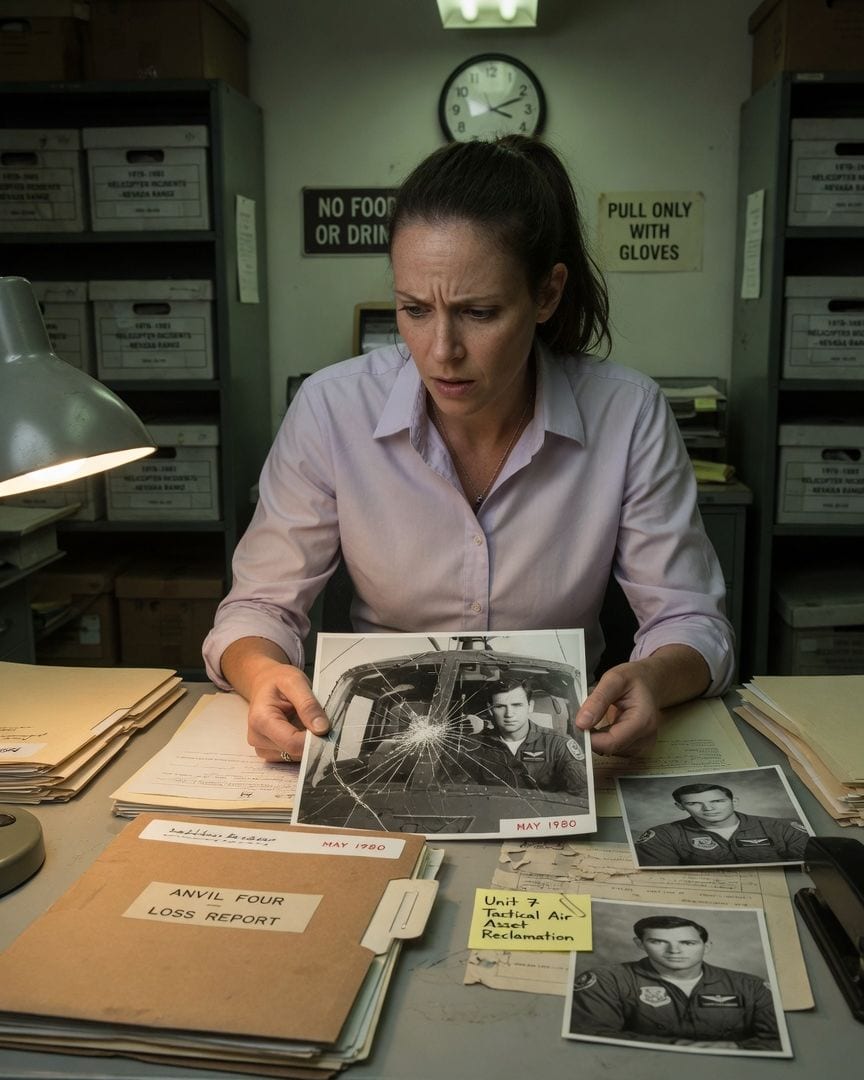
Archivist Josie Ilnicki found a lost helicopter's maintenance sheet dated eight months after its total loss, showing its dead pilot inside.
Archivist Josie Ilnicki meticulously handled a forty-year-old file, a routine request carrying the weight of a widow's grief for helicopter Anvil Four, vanished decades ago. Inside the standard folder, she found a maintenance sheet inexplicably dated eight months after the aircraft's documented total loss and disappearance. The sheet included a photograph of a man in the cockpit, his face obscured, later identified as Benjamin Mitchell, the pilot listed as Killed In Action. But the uniform in the photo bore a unit insignia not authorized until three years after Mitchell's official death, pressing an impossible truth into the sterile archive air.
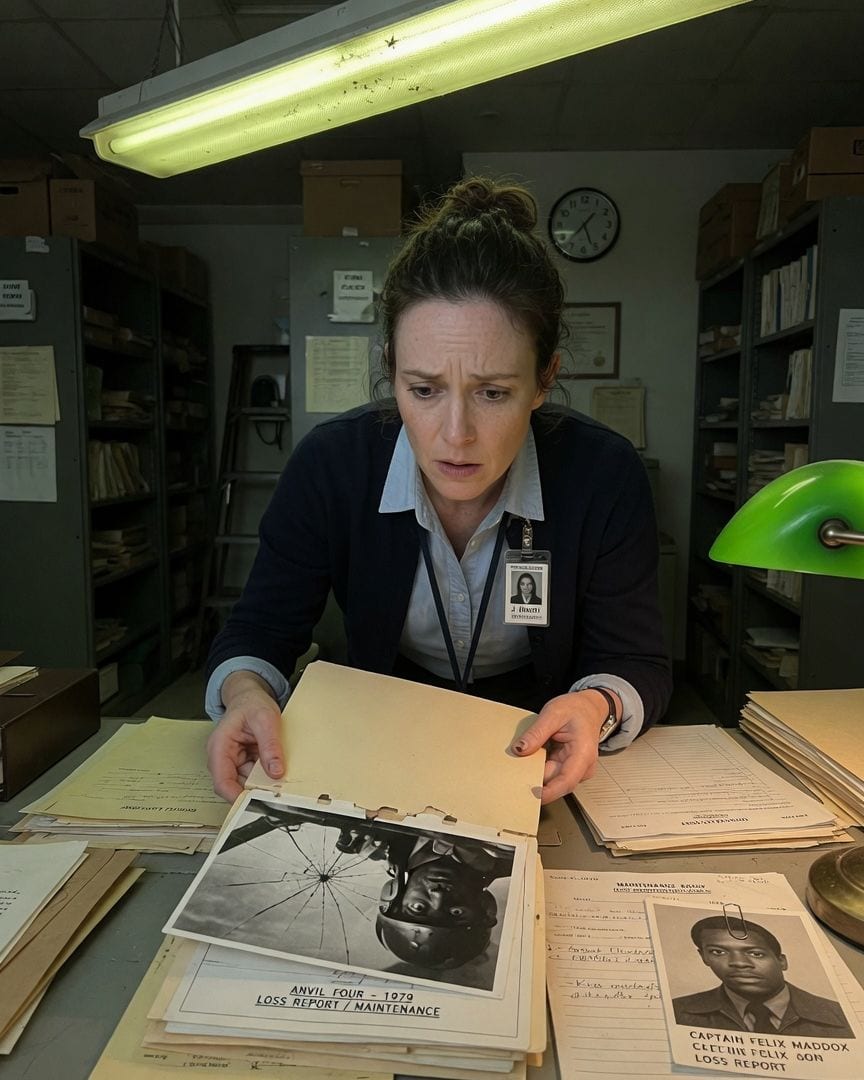
A Cold War pilot's pay stub arrived four years after his helicopter was officially lost.
National Archives archivist Josie Ilnicki spent years immersed in forgotten histories, the fluorescent hum of the annex a constant companion. Today, processing a declassification request that had waited forty years, she opened the file for 'Anvil Four,' a helicopter lost in the Nevada ranges in 1979. Inside, past the official loss reports, Josie found a maintenance sheet dated eight months after the crash. Stapled to it was a grainy photograph, showing the cracked windscreen – and behind it, Captain Felix Maddox, the pilot officially dead, staring out with wide-open eyes, as if still flying.
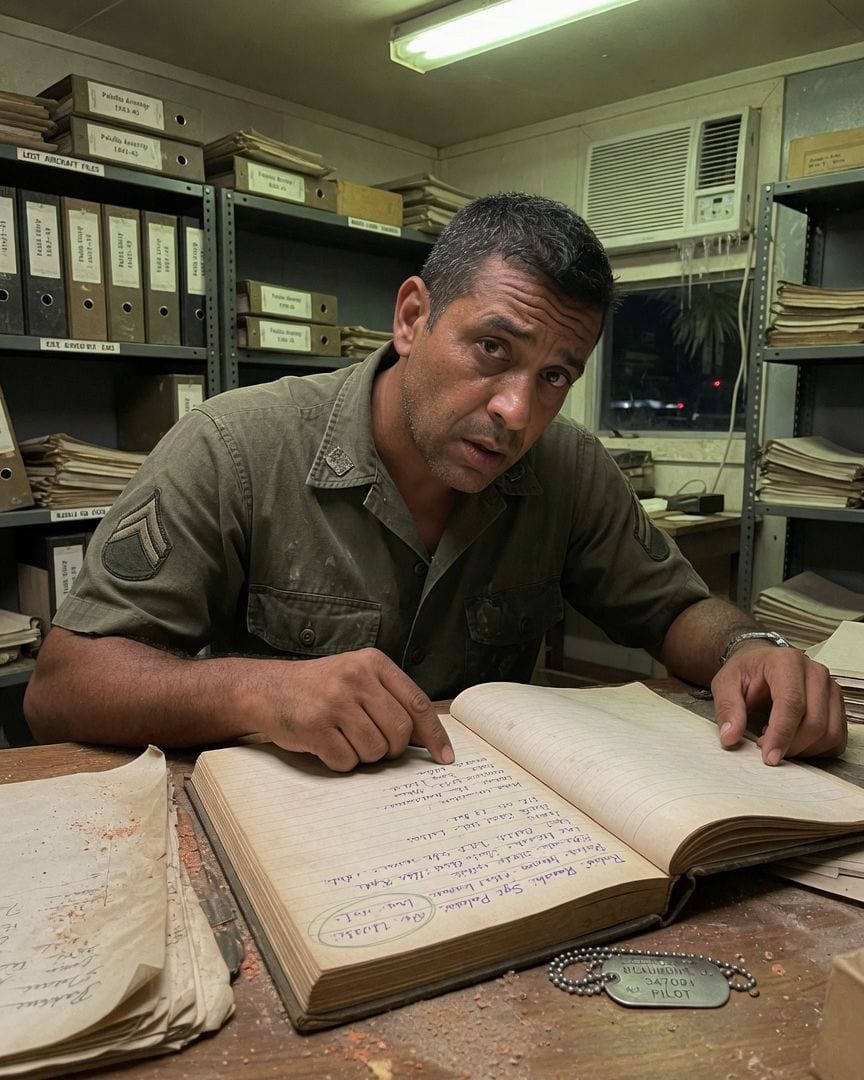
A sergeant's last watch on a forgotten outpost: His own name appeared on an 80-year-old crash manifest.
Sergeant Leon Pulaski spent his last night at the remote Peleliu Atoll Airstrip, its final closure imminent, listening to the rhythmic sigh of the Pacific. Just after 0330, a garbled distress call pierced the silence, requesting the field for a plane with a tail number, 'Ghost Two-Niner-Niner,' retired since World War II. Though Pulaski, disciplined and rational, logged the impossible call as a phantom, the crash crew later found a fresh gouge in the coral and a shard of cockpit glass, still warm, where no wreck existed. His quiet unease only deepened when he discovered a dog tag belonging to a pilot declared lost eighty years prior. But the true chill landed when he found his own name on that same eighty-year-old crash manifest.
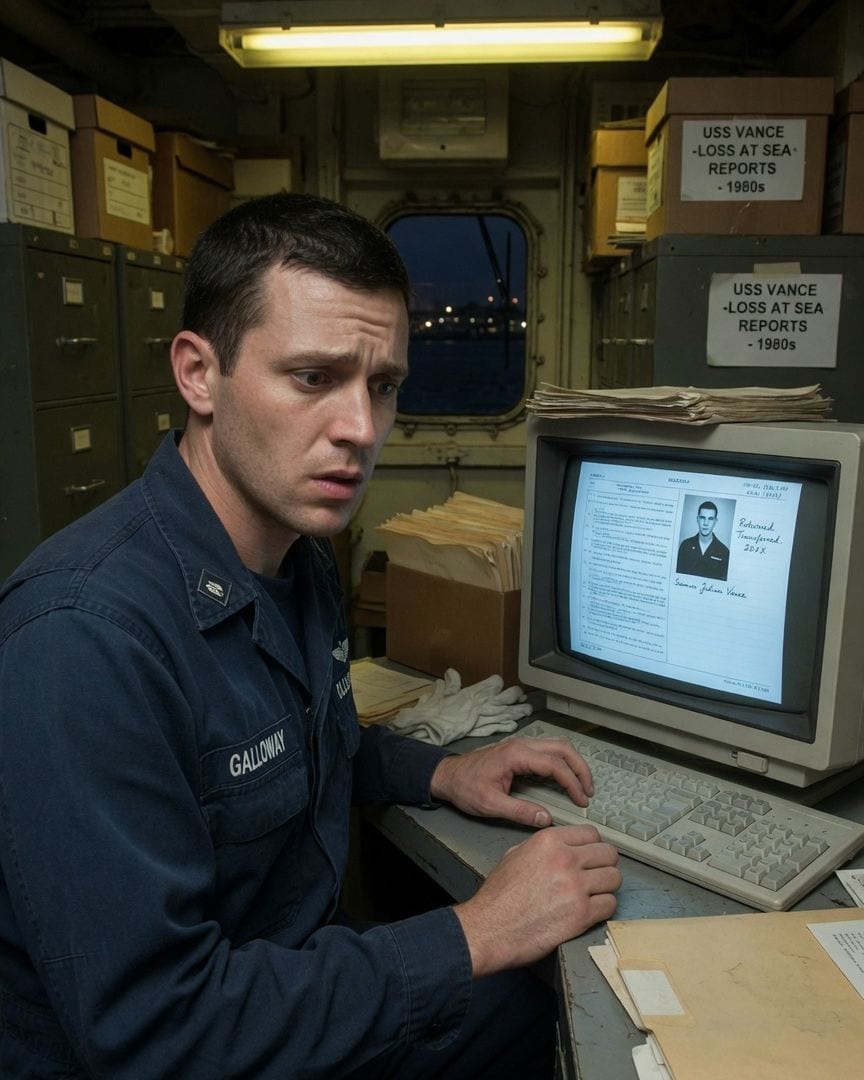
Petty Officer Galloway logged a sailor onto his ship. The man died at sea 40 years ago.
Petty Officer Joel Galloway scanned a sailor's ID on the USS Vance quarterdeck. The man's name, 'Seaman Julian Vance,' and his out-of-date uniform pricked at Galloway's memory. Later, the ship's berthing count came back one over, with an extra entry in the system but no physical body.
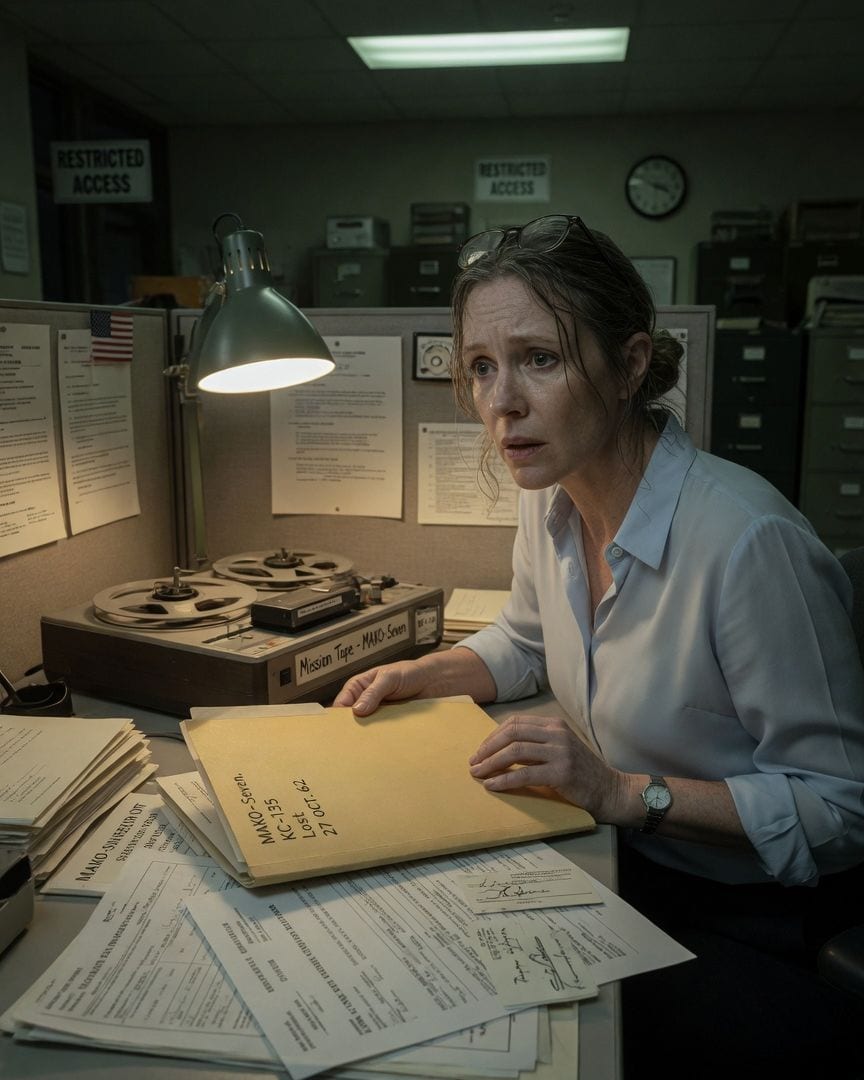
A declassification reviewer found Captain Sowell's signature authorizing parts for his lost Cold War aircraft, sixteen years after its official crash.
Janet Kingsley, a declassification reviewer, was processing a routine request for a lost Cold War mission when she made a chilling discovery. The official report stated the KC-135 MAKO-Seven impacted the Labrador Sea in 1962, but its mission tape continued for nine minutes after the official crash, with the pilot calmly landing. As Janet dug deeper into the yellowed file, she found official documents for the aircraft and pilot dated years after its disappearance. The final discovery was a requisition for replacement parts, signed by Captain Thomas Sowell himself, a full sixteen years after his plane was officially lost and he was declared dead.
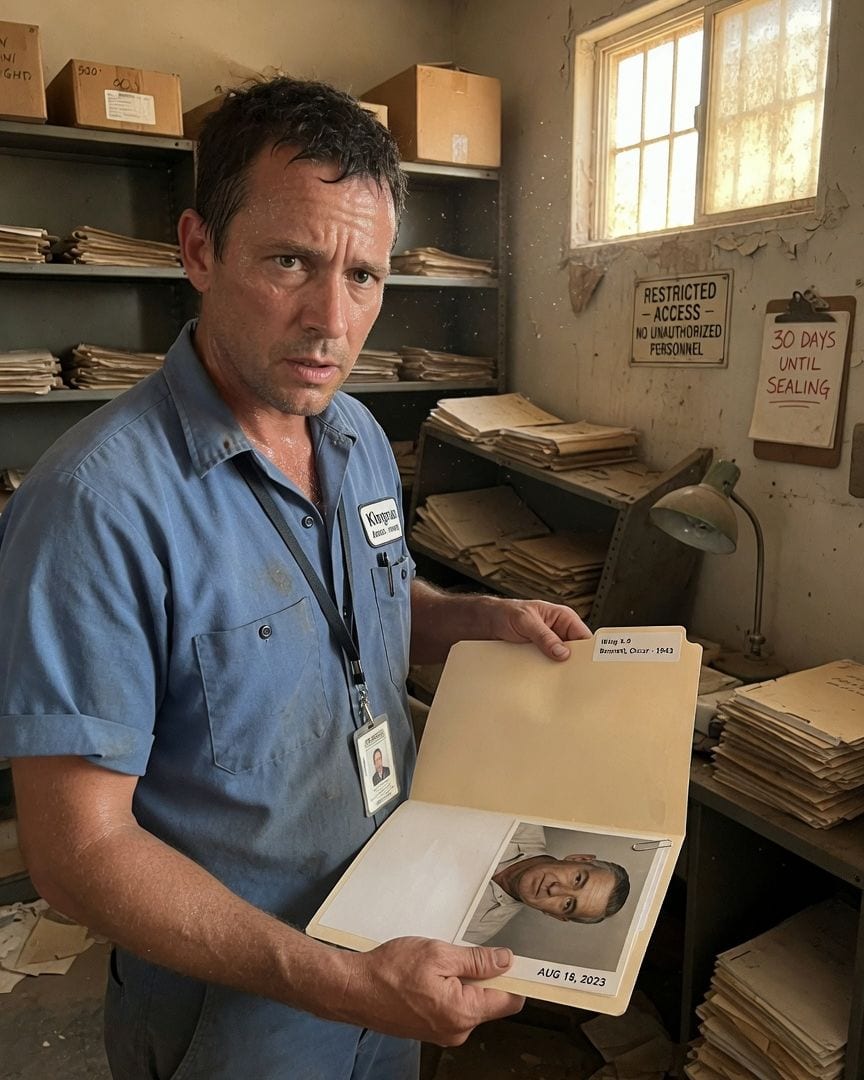
An inventory clerk in a Cold War boneyard finds a pilot declared dead in 1952, alive and photographed just last week.
Inventory clerk Rafe Delahunt toiled under the oppressive Arizona sun, racing against a deadline. He had just one month to catalog the vast Kingman boneyard before its final closure, a task made grueling by the crumbling archives and the suffocating heat. Deep within a forgotten bay, he unearthed eleven folders that defied explanation. Cool and supple to the touch, unlike any other document, they bore a 1943 date but smelled of fresh paper, filed under a designation 'Wing X-9' that shouldn't exist. Inside, the pristine files detailed a P-51 Mustang and its pilot, Oscar Bennett, officially declared 'crashed without trace' in 1952. Yet, tucked into the back, was a photograph of an older Oscar Bennett, clearly alive, with a date stamp from August 18, 2023.