A Cold War Private Kell Hobarth saw a flash from a mission that didn't exist. Fifty years later, his own name was on a secret 'witness management' list.
The dry, cracked earth stretched under a sky the color of old brass. Private Kell Hobarth, twenty-eight years old, stood in a trench at Vermey Flats, the dust a fine film on his uniform.
A letter had reached him eleven days late, its crisp white paper a contrast to the grime of the camp: his daughter, Marie, had been born. Eleven days.
He’d stared at the postmark, then at the date of birth, the numbers a quiet accusation. The next day, a schedule posted in the mess hall announced the fifteenth shot: GRAYSHIRE, dawn Thursday.
His name, Private Kell Hobarth, was typed onto the trench roster.
He pointed it out to Russo, the range officer, a man in his fifties with a perpetually unimpressed air. Russo squinted at the paper, then scoffed, a dry, rattling sound. “There’s no GRAYSHIRE, Private. Never has been.”
He’d walked away, leaving Hobarth to stare at the black ink of his own name. But on Thursday, at dawn, a faint, almost silent pulse of light flared across the flats, washing the horizon in stark white.
Hobarth was the only man in his tent who stirred. He watched the light bloom and fade, the silence profound, the air suddenly still and cold enough to raise gooseflesh on his arms.
Then he lay back down, the image burned behind his eyes as every other man in his tent—all six of them—slept straight through it, undisturbed, breathing deeply in the dim light.
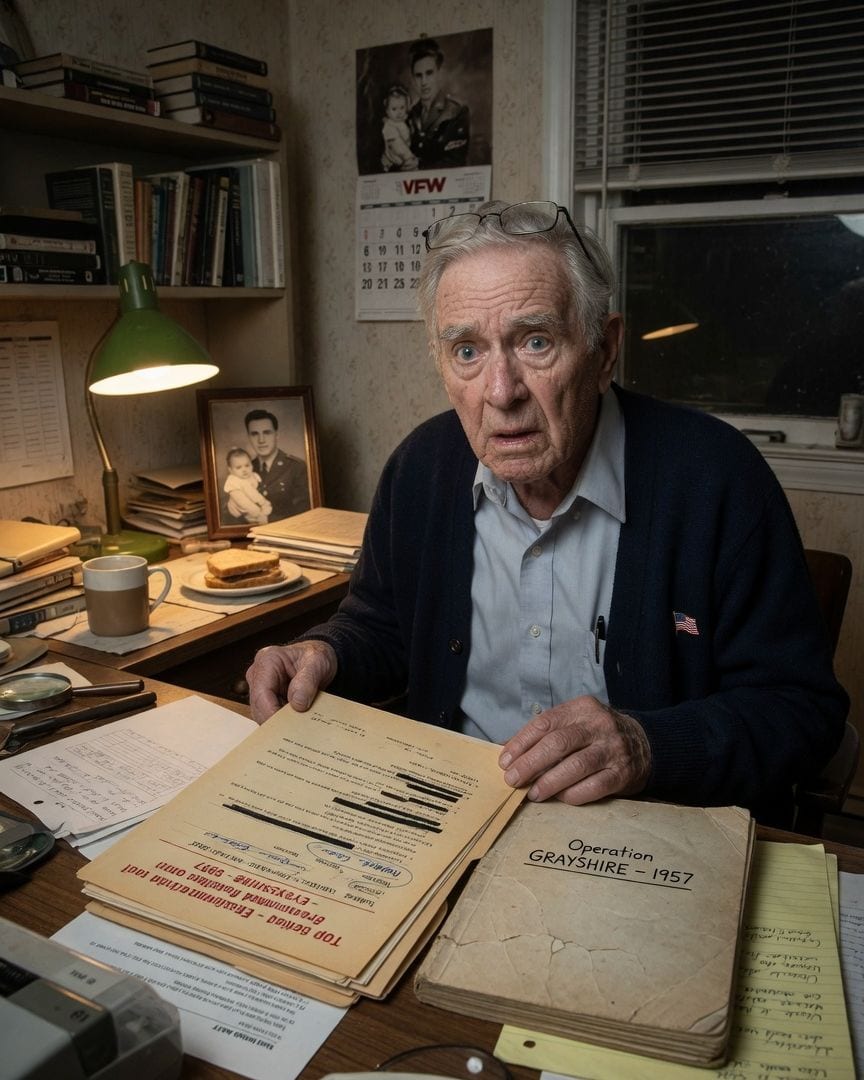
Fifty years later, in 2007, Kell Hobarth, now seventy-eight, a retired veteran living in a quiet suburban home, still felt the chill of that dawn.
His daughter, Marie, now fifty, often remarked on his distant gaze, a faraway look that would come over him without warning.
He’d spent years quietly trying to find any mention of GRAYSHIRE in declassified military records, poring over microfiche in university libraries, sifting through online archives.
All he ever found were heavily redacted files, blacked-out passages that devoured entire paragraphs, and an official silence so absolute it began to feel deliberate.
A chance conversation with an old service buddy at a Legion hall, a man who swore he’d heard whispers of 'unassigned projects' in the late fifties, led Hobarth to a forgotten annex of the National Archives.
It was a dusty, dimly lit room, smelling of old paper and forgotten things, filled with endless rows of unmarked boxes. He spent days sifting, his fingers growing raw as he wrestled with brittle cardboard and crumbling files.
Then, tucked beneath a stack of quartermaster reports, his fingers found a loose, unofficial logbook, its cover faded to illegibility, the binding cracked. Inside, scrawled in a precise but unfamiliar hand, was an entry: ‘Operation GRAYSHIRE – 1957.
Target acquisition: non-terrestrial. Duration: 0.00 seconds. Status: Unresolved.’ He almost laughed, a dry, incredulous sound, rationalizing it as a bad joke, a misfiled sci-fi script from some disgruntled clerk.
But the handwriting was too official, the context too real, the chill in the air of that forgotten room too familiar. It was the same cold he’d felt on the flats that dawn.
Deep within the same box, beneath a stack of mundane supply manifests from 1958, Hobarth found a sealed, heavily watermarked manila folder.
The official stamp on it, faded but still legible, read: ‘TOP SECRET - EYES ONLY - GRAYSHIRE-1957: Personnel Reassignment and Memory Debriefing Protocol.’ His breath hitched, a sudden, cold constriction in his chest.
He carefully opened the brittle paper, the ancient seals crumbling. The document detailed a ‘contact event’ at Vermey Flats, not a ‘shot.’
And then, on a list of personnel marked for ‘reassignment and psychological recalibration,’ was his own service number, followed by his full name, ‘Kell Hobarth.’ Listed next to his name, chillingly, was ‘Subject 001.’
The date of reassignment was the day after the GRAYSHIRE event, 1957. He saw the cold, official language, the precise instructions for ‘witness management,’ and realized the silence and the denial were no accident.
It was all deliberate, and he was not just a witness, but a subject.
The file shook Hobarth to his core, but also galvanized him. He now had proof, stark and undeniable.
He returned home, the folder clutched in his trembling hand, and meticulously cross-referenced other names on the ‘reassignment’ list from the classified document.
Many were listed as deceased, others untraceable, their trails vanishing into the same official silence that had plagued his own search. He finally found one, Samuel Vaughn, eighty-five, listed in a quiet retirement community upstate New York. Hobarth didn’t hesitate.
He drove for two days, the old car humming with his restless energy, the highway a blur of trees and concrete.
Vaughn, a frail man with a sharp, distant gaze that seemed to look right through Hobarth, sat in his sunroom, surrounded by faded photographs.
Initially, he denied any knowledge of Vermey Flats or GRAYSHIRE, his eyes flickering with an unreadable emotion, his hands gripping the arms of his chair.
Hobarth pressed gently, his voice low, mentioning the specific date of the event, the ‘reassignment protocol.’ Vaughn’s hands trembled, his face paling, a faint sheen of sweat appearing on his brow.
He abruptly ended the conversation, retreating into a shell of polite but firm dismissal. As Hobarth left, the words of the classified document echoed in his mind.
He remembered a cryptic, handwritten notation in the margin of his copy of the original classified document: ‘Continuous monitoring protocol, per Subject 001's unique response profile.’
He began to suspect the records weren't just about the past; they were a living, breathing thing.
Back home, Hobarth felt a new kind of unease settle over him. It wasn't just the past haunting him; it was a present, watchful presence that raised the hairs on his neck.
His old landline, usually silent except for Marie’s weekly calls, would ring once, then stop, a disembodied click on the line that felt less like a dropped call and more like a probe.
A letter he'd mailed to a historical society, inquiring about Vermey Flats, was returned unopened, the postmark smudged, the envelope slightly torn, as if carelessly searched.
One evening, an anonymous email landed in his inbox. The subject line was blank. The attachment was a single, grainy, infrared gun-camera still. It showed Vermey Flats, 1957, just before dawn.
In the center of the frame, hovering low over the desolate ground, was a perfectly still, geometric object, its surface reflecting no light, only absorbing it, a dark void against the grayscale landscape.
No wings, no visible propulsion, just a silent, impossible form. Hobarth zoomed in, his heart pounding against his ribs like a trapped bird. He recognized the exact spot where his trench had been, a faint indentation in the earth.
The email had no sender, no traceable origin. Someone knew he was digging. Someone was watching, and they had access to records he shouldn't even know existed.
Hobarth drove straight back to Samuel Vaughn’s retirement home. He found Vaughn staring out a window overlooking a manicured lawn, his face etched with a deeper weariness than before, as if he hadn’t slept.
Hobarth didn't speak, simply slid his tablet across the table, displaying the gun-camera image. Vaughn gasped, a choked, guttural sound that caught in his throat. “I saw it,” he whispered, his voice raspy, barely audible.
“I was part of the cleanup crew. The flash... it wasn't a shot. It was a signal. Everyone just… stopped. Frozen. Like statues. Everyone but you, Private.”
Vaughn’s eyes darted around the room, as if expecting to be overheard, his gaze lingering on the closed door, on the silent telephone.
He explained that the object emitted a field, a kind of localized catatonic state that could lock a man in place, leave him breathing but unseeing, unfeeling.
Hobarth, in his trench, had been partially shielded by the earthworks, or perhaps uniquely resistant. “The ‘memory debriefing’ wasn't just to make us forget,” Vaughn continued, his voice a dry rustle of leaves. “It was to… recalibrate.
To make us see what they wanted us to see. A missile test, a flare, anything but what was actually there. But you… you were too aware. They couldn’t quite get you. Not fully.”
He described how the institution, the ‘secrecy machine,’ feared the object, unable to understand or control it, so they filed it away, and monitored those who had seen it, those who were ‘aware.’
Hobarth realized the denial of GRAYSHIRE wasn't a lie; it was a carefully constructed truth, designed to protect an even darker secret, something that had existed long before the Cold War ever began.
Vaughn, now desperate, his old eyes wide with a terror Hobarth recognized as his own, fumbled in his pocket. His hands, gnarled with age, shook as he pressed a small, unmarked data chip into Hobarth’s hand.
“They’re still signing it,” he rasped, his voice barely a breath. “It’s a live file. Look for your name. They never close it.”
Hobarth, his hands shaking so violently he almost dropped the chip, returned home. The quiet suburban street felt alien, the houses like silent sentinels watching his return.
He inserted the chip into his computer, the small click echoing in the suddenly cavernous room. It was an encrypted military log, active and current.
He navigated through layers of recent entries, each one stamped with a current date, references to ‘GRAYSHIRE-1957 Follow-up’ and ‘Proximity Alert, Sector Gamma,’ indicating ongoing operations, not historical record-keeping.
His dread mounted with each scroll, each line of cold, official text. Then, a new entry appeared, timestamped today. It listed a familiar service number. It was his own.
And next to it, in stark, cold type, a notation read: ‘Target: Subject 001. Current Residence: [Hobarth’s actual address]. Next scheduled contact: [a specific date in the near future].’
Hobarth stared at the screen, the words searing into his mind like acid. The file was a living, breathing thing, an active log of an ongoing protocol, not some dusty relic from 1957.
The ‘GRAYSHIRE’ event wasn't an isolated incident; it was the first documented ‘contact point’ with an unknown, non-terrestrial entity, an entity that established periodic recurrences.
The military, unable to destroy or fully comprehend it, had chosen a strategy of ‘management’ and ‘monitoring.’ Individuals like him, those with a unique resistance to the entity's sensory manipulation, were designated ‘subjects.’
His daughter’s birth, the letter arriving eleven days late, the GRAYSHIRE schedule also reaching him belatedly—it was all part of a subtle, systemic control of information, a way to isolate and observe.
The range officer’s denial, the fact that everyone else had slept through the event, the gun-camera image of the impossible object, Samuel Vaughn’s terror—it all clicked into a horrifying, coherent pattern.
It was a long-term observation, a meticulous data collection centered around him, around others like him. The ‘shot’ was never a weapon; it was the entity's method of marking a location, a time, and a witness.
The entity wasn't hostile in any conventional sense, just present, and the military was utterly terrified of what would happen if they ever ceased their patient, decades-long watch.
He was a piece on a board he never knew existed, his entire life a data point in an alien interaction.
Hobarth closed the file, his fingers fumbling with the data chip, the small piece of plastic feeling impossibly heavy in his hand. He knew the full truth, and it was a cold, unyielding weight that settled deep in his bones.
There was no fighting it, no escaping an institution that had known and watched for half a century, nor an entity that defied comprehension and existed beyond human understanding.
The climax wasn't a chase or a confrontation, but an internal collapse of his world, the tidy assumptions of his life imploding.
He slid the chip from the slot, then gripped it, crushing the tiny piece of plastic between his thumb and forefinger until it snapped.
The sound was surprisingly loud in the quiet room, a sharp crack that echoed the shattering of his reality.
He looked around his living room, at the familiar worn armchair, the framed photos of Marie growing up, the mundane objects of a life he thought he understood, a life he had thought was his own.
The ‘next scheduled contact’ date was only days away. He realized he had been part of this vast, patient, silent network his entire life, a node in a system he had only just discovered.
He was not a victim in the traditional sense, but a designated subject, an observed variable. The knowledge was a solitary burden, a truth that could not be undone or acted upon.
He simply knew, and the knowing was the ending to his long, quiet search.
Days bled into a week. The specific date from the file came and went without overt incident. No lights in the sky, no strange sounds, no official vehicles parked conspicuously down the street. Life continued, outwardly unchanged.
But the quiet in Hobarth's home was different now, infused with a new, subtle hum he alone perceived, a low thrum that vibrated just beneath the threshold of hearing.
He began to notice patterns: the way the streetlights on his block sometimes flickered in a synchronized, rhythmic sequence, or how a flock of birds would occasionally freeze mid-flight, perfectly still for a second, suspended in the air, before continuing their journey as if nothing had happened.
The world had not changed, but his perception of it had, every ordinary occurrence now a potential trace of the unseen, unheard presence that had shaped his life.
He sat in his living room, a letter from his now-adult daughter, Marie, in his hand. She was pregnant, her neat handwriting full of excitement about the new life.
He looked out the window at the quiet street, where the streetlights had just begun their rhythmic flicker.
A faint, almost imperceptible hum filled the air, a frequency that only he seemed to register, a silent song meant just for him. He knew the file wasn't closed.
It was still being written, and the next name was already waiting.
The old man sat in his living room, a letter from his daughter clutched in his hand. He watched the streetlights flicker, a faint, rhythmic hum in the air only he seemed to notice. The file was never truly closed.
It was just waiting for the next signature.
If this one got to you
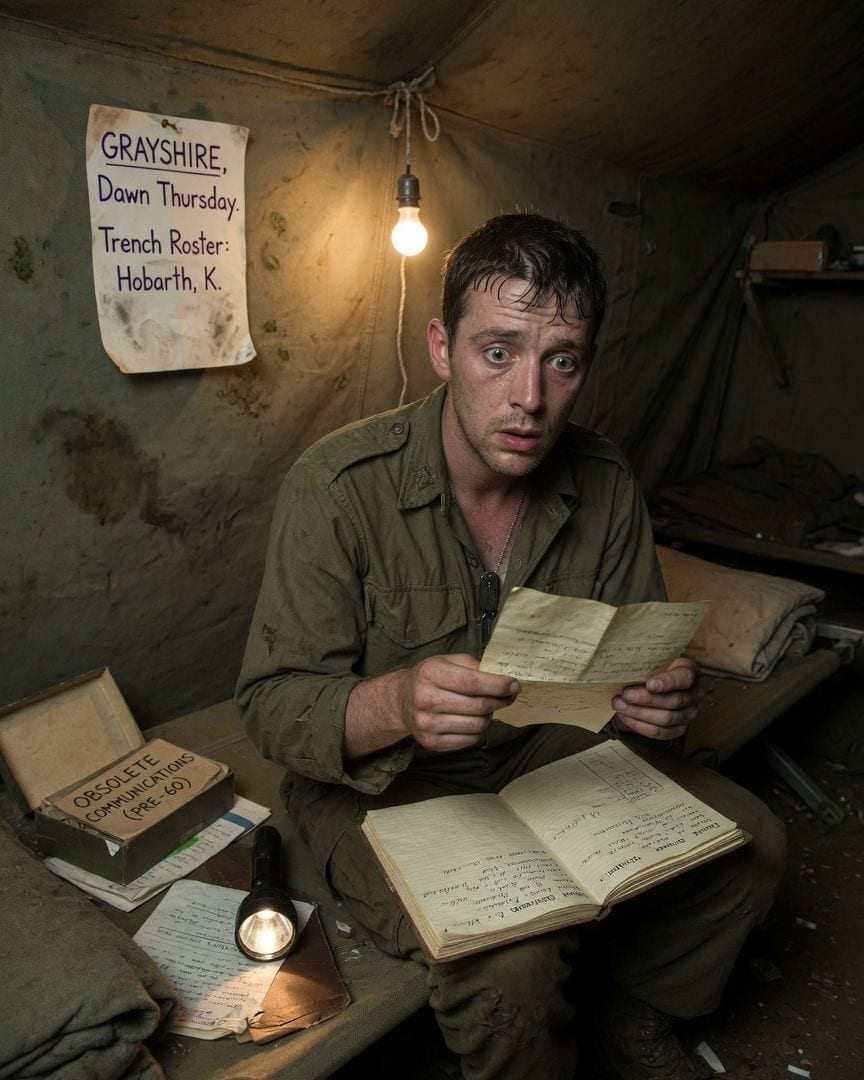
A records clerk's old logbook entry shows his service number for 'Personnel Observation' on a date that hasn't arrived, for an event he saw last week.
Private Kell Hobarth clutched the letter confirming his daughter Frances' birth, a bittersweet reminder of a world far from the Vermey Flats trench tent. He'd seen a mysterious roster entry for 'GRAYSHIRE' and been dismissed by his superior. But then, a silent, vast pulse of white light turned his tent transparent for a full minute, yet every man around him slept through it. Haunted, the records clerk searched the dusty annex archives, finding a leather logbook. Inside, his own service number was listed for 'Personnel Observation' on a date that had not yet come, for the very event he had already witnessed.
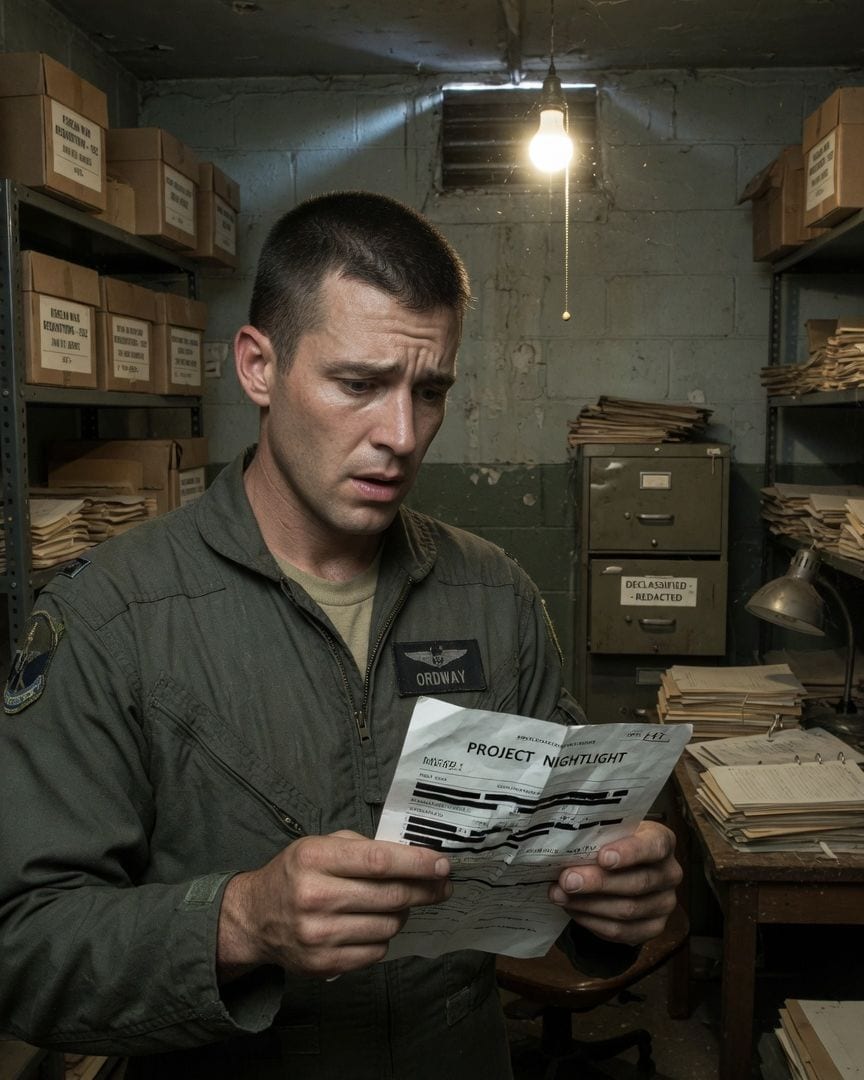
A Cold War pilot's F-104 Starfighter was shadowed by an impossible object. Weeks later, a secret memo referenced his own service number for 'pilot reassignment protocols.'
First Lieutenant Cal Ordway soared over the Mojave in his F-104 Starfighter in 1962, the night sky a familiar canvas. But that night, one 'star' broke formation, pulling alongside his wing and mirroring his every impossible maneuver. His instruments confirmed the silent, unblinking object, defying all known physics. After filing his precise report, Cal found his flight log altered to 'no incidents,' radar tapes corrupted, and a superior advising him to 'let it go.' Driven by his training, he uncovered a heavily redacted memo referencing 'Project NIGHTLIGHT' and, chillingly, his own service number for 'pilot reassignment protocols initiated.' Was he merely a witness, or already a subject in a much deeper secret?
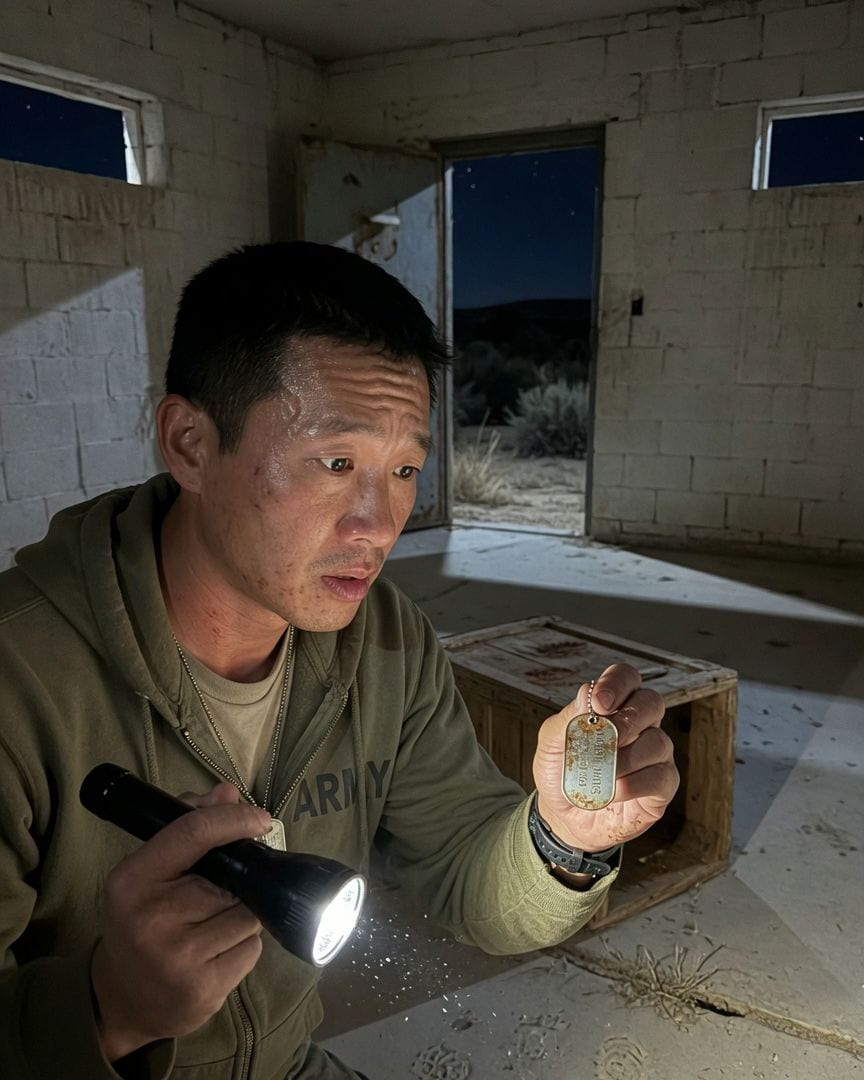
Staff Sergeant Rhee’s squad found a Cold War building not on their map. Range Control confirmed no structure. Minutes later, it vanished, leaving a foundation decades old.
Staff Sergeant Adam Rhee halted his squad at the Yakima Training Center, staring at a cinderblock building that simply wasn't on his map. Range Control confirmed there was no structure at his coordinates, leaving him to wonder what impossible thing stood before them. Moments later, after the range-safety truck arrived, the building vanished, leaving only a rectangular patch of earth with a foundation of decades-old weeds. That night, driven by an unsettling certainty, Rhee returned to find the building reappeared, its door ajar, holding a single, rusted dog tag from 1983. How could a place appear and disappear, leaving behind evidence from forty years ago?
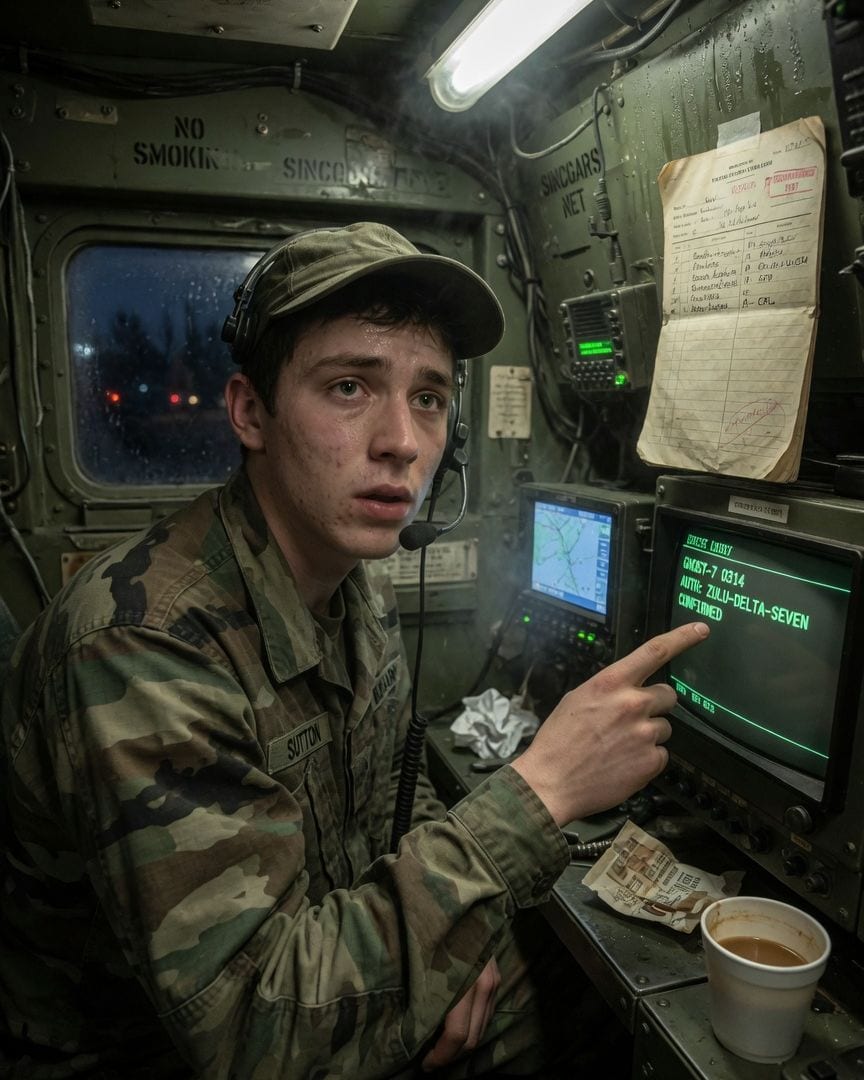
Corporal Aldous Sutton found his own name, rank, and call sign in a 1987 logbook from his exact outpost, decades before he was born.
Corporal Aldous Sutton, 22, was hunched in his cramped comms track, the air thick with stale coffee, monitoring a quiet German night. The division exercise outside was routine, all units accounted for, until an unknown call sign crackled through his headset. 'Ghost-7' requested authentication using a protocol decommissioned years before Aldous was even born. Despite his superior dismissing it as a glitch, Aldous found official logs confirming the impossible exchange, even dating his own hesitant responses. But the real dread landed when he cross-referenced the phantom unit and discovered his own name, rank, and call sign listed in a 1987 logbook, attached to 'Ghost-7' at his exact outpost.
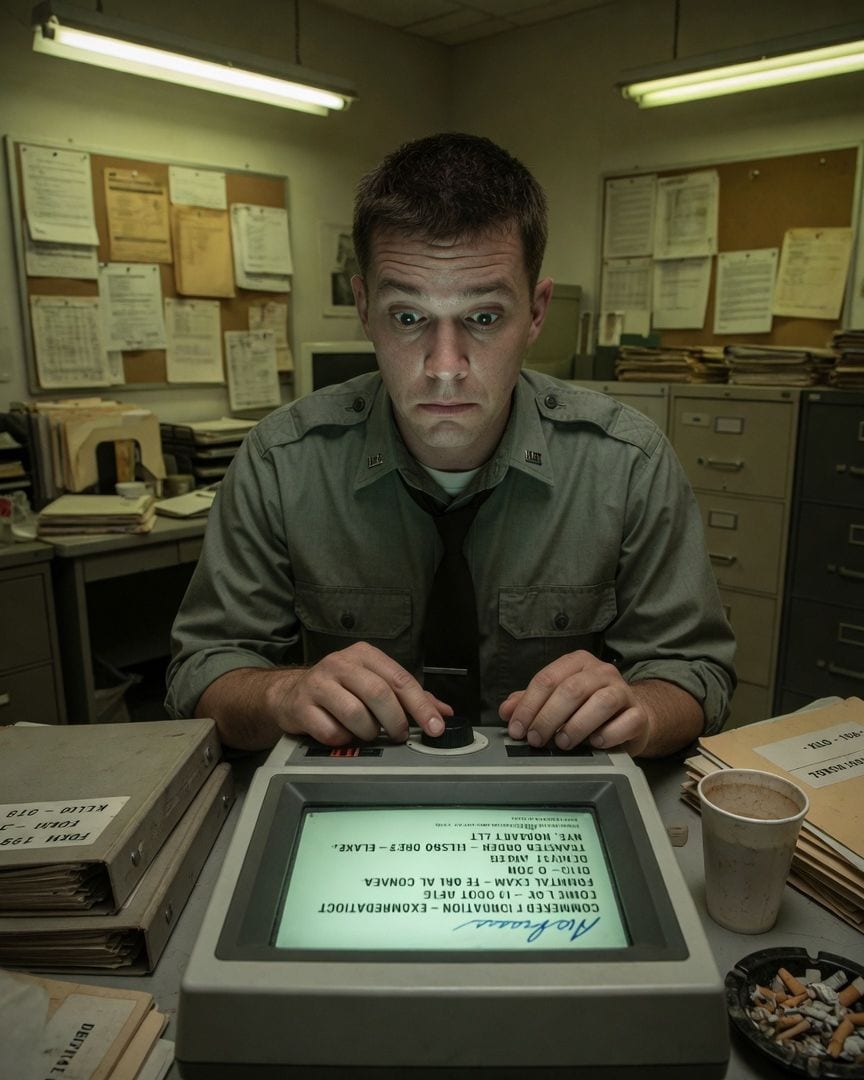
A missile commander watched his ten nuclear silos go dark. His own service record shows his signature on a future he's never lived.
Second Lieutenant Hobart Nye, a missile commander in Wyoming, had his quiet 0247 watch shattered by a security report: a massive, silent black triangle hovered over Launch Facility Kilo, casting a perfect shadow. Hobart watched his console's fault panel light up, signaling all ten nuclear missiles going dark in an impossible silence, followed by eleven minutes his security team could not remember. Official logs called it a "radio malfunction," but Hobart found a requisition for invisible-tracking sensors, signed by a base commander who was supposed to be off-base. The final, chilling discovery came when his own service record showed new entries—a dental check-up, a transfer to Alaska—all dated for a future he never lived, complete with his perfectly replicated signature.
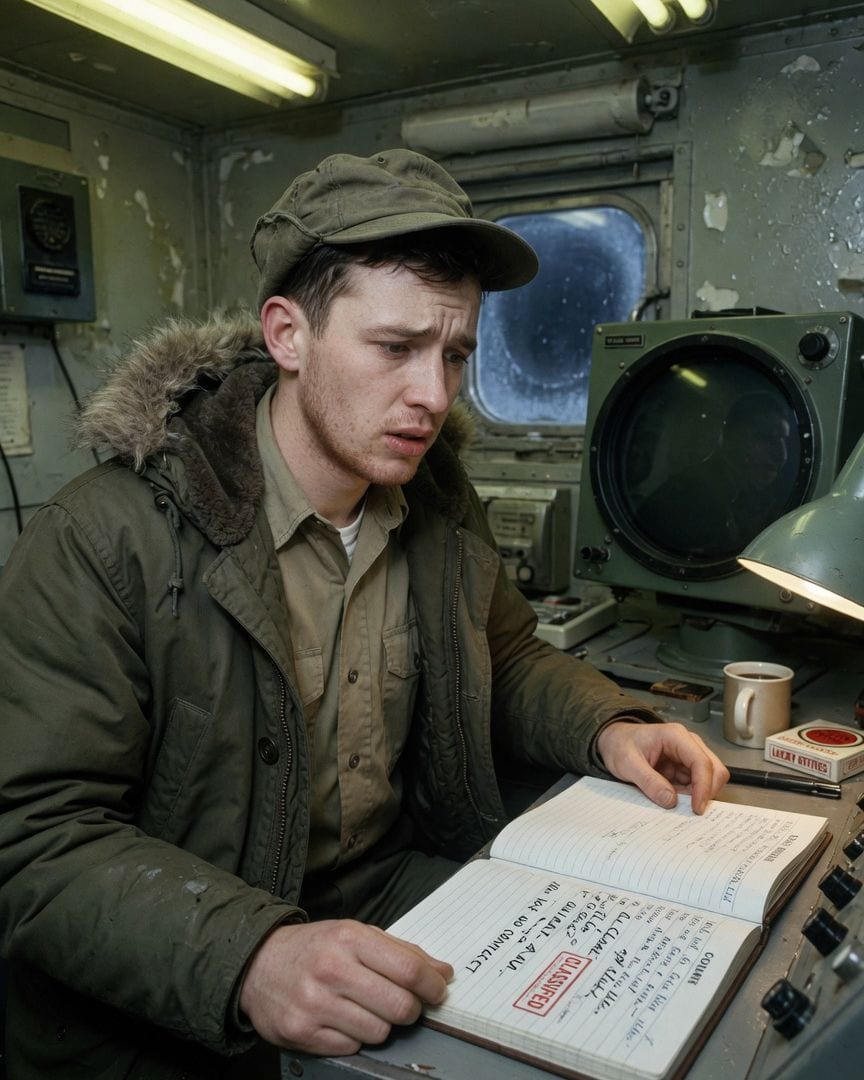
A Cold War airman logs an impossible radar contact on his last sweep. But his official logbook entry is stamped 'CLASSIFIED' and then contradicted by a hastily scrawled 'ALL CLEAR' dated moments before it.
Airman Ordway Vance, 22, manned the radar dome at Site Pellin in the biting North Atlantic dark of January 1962, running the last calibration sweep before its decommissioning. His scope picked up a faint, impossible return, growing closer with each pass, though the ocean remained empty to the eye. When Vance detailed the contact in his official logbook, a 'CLASSIFIED' stamp appeared, followed by a hastily scrawled 'ALL CLEAR' dated moments before his own entry, contradicting his every word. Commander Hartley dismissed it as equipment malfunction, but Vance sensed a chilling, official erasure behind the lie. He soon found a locked cabinet marked 'SITE PELLIN ANOMALIES,' hinting at a deeper truth buried within the base's final days.